Fall clean up: squash beds done

Yay! The squash beds in the old garden area are now all done.

Also, where the pumpkin mounds were, we now have three new beds.

Here is how it looked when I started.

The bamboo stakes are marking where I planted the seed potatoes I found while digging up the potato beds. It should be interesting to see what happens there in the spring!

Being such a narrow row, it shouldn’t have taken long to prep this area. It was, however, incredibly full of rocks. Not even big ones, really. Just so many! If we decide to continue planting here, this area would be the one most in need of a raised bed. If we do build a raised bed in this area, it’s going to be long, narrow (no more than 2 ft wide), and will have a built in trellis for a back “wall”.

Here is how the pumpkin mounds looked before I started.

The black that you see is the ashes cleaned out of the fire pit.

The crab grass growing through it is noticeably brighter!

Once done, here is how the back row looked.

It’s hard to see through the mulch, but I turned the soil and mulch, so the more decomposed mulch was more on top, and the less decomposed mulch was partially buried. I don’t know what we’ll plant here next year, but whatever it is, it’ll need to be pretty hardy, until we can build the soil up more!

Here is how the pumpkin mounds look now.

I was pretty sure about turning one of the mounds into a larger bed, but with so much crab grass, I didn’t think I would do the others. However, after a year covered in mulch, and a lot fewer rocks then in other areas, the soil was much softer than expected, and I ended up turning them all into larger beds. The one on the left had the least amount of grass and weeds to clean up, but it also had the most rocks that needed to be cleaned out! When I started on the middle mound, the soil was so much better than it had been, I went ahead and dug another bed, pulling up as many weed roots as I could. That went fairly easily with the crab grass. They took the easy route, and their rhizomes spread like a net under the mulch, rather than into the ground. Those come up quite easily.

Then I hit a patch of Creeping Charlie, making its way through the mulch. I lost about an inch or two of topsoil, pulling up those root mats. !!

The third bed was even easier to dig up, so that went very quickly.

So this area now has 6 beds in total, ready for next year. :-)

The next area to prep will be the carrot and beet beds. I’ve been leaving them in the ground as long as possible. Which might be working for the carrots, but the beets are mostly a lost cause. Too many visits from deer! That area will be cleaned out and prepped for the winter garlic that should be coming in within the next couple of weeks.

I will leave that for tomorrow, however. Today, we need to strain the crab apple cider vinegar. We meant to do it yesterday, but so many things went sideways, it got postponed.

I am happy to say that the septic truck did show up yesterday, shortly before 6pm. The poor guy looked so tired! All I could say after greeting him was “long day?” I think he had been bracing himself to be given a hard time for being so late, because all the tension seemed to just droop out of his body as he simply said, “yeah.” He ended up spending half an hour on the tank. I honestly don’t know how my parents emptied the tank only once a year with 7 of us. We didn’t empty it this past spring, since we’d had him come out in the winter, when things started backing up into the basement. So it was more than 6 months since it was cleaned out, and it showed!

When we booked him to come in, I asked how much it would cost so I could take out cash; it’s not like these guys can take debit. ;-) I didn’t have exact change, but when it came time to pay, I didn’t ask for any, even when I confirmed the amount and he gave me a lower number! Maybe he was giving me a deal for being so late but I figure, if anyone deserves a tip, it’s the septic guy! If I’d had more to give him, I would have!

I really, really appreciate people like him. What would we do without people willing to do such dirty jobs?

Meanwhile, I have not heard back from the plumber. We’re getting near the point of having to call someone else. Our plumber knows this place and has been doing work here for many, many years, plus he’s really gone above and beyond for us, so I would rather not go with someone else. But we need to get that well pump changed. We should have done it months ago, but all our “spare” funds went to paying for the new differential on my mother’s car. If it does turn out to be something wrong in the well itself, we want to find that out now, not when there’s snow on the ground! We shall see how that pans out.

The Re-Farmer

Fall clean up: starting the squash beds, plus… this could be bad!

On my list of things to do today was to prep the squash beds for winter.

Of course, things happened, so I started much later than intended – past 2pm – and didn’t get as much done as I’d planned on.

Here is how it looked when I started.

The first thing I had done we pick up the bricks we’d used to weigh down the plastic we used to cover the beds in the spring, and again under some of the plants to protect the stems or support heavier squash.

You can really see which bed had the most successful plants!

Also, notice the raspberry canes to the left on the foreground? Or, should I say, the bare raspberry canes?

The deer have been nibbling the leaves off those, as well as the sunflowers!

I had brought out both the potato fork and the spade to see which would be better to work on the beds.

It turned out to be the fork. After a year under the mulch, the ground was a lot softer than before, but even with the fork, I had difficulties getting past the rocks. We have only one good spade. I don’t want to break the blade on a rock!

Here is how they looked when I finished for the day.

The bed on the left was still a real chore to dig up. With each section I lifted with the fork, I had to break up the soil by hand. That gave me the opportunity to pull out weed roots and the more in-the-way rocks. The bed on the right was much easier to work, and I had a lot fewer rocks that needed to be pulled out. The squash plants were also buried so they can compost directly into the soil.

I was really happy with how much easier the soil was to work with. To compare, I had pushed the spade into the ground next to the mulched area. After working for a while, I took off my jacket and hung it on the spade. A few minutes later, and a gust of wind turned my jacket into a sail and down it went. So I pushed it into the ground again, this time, standing on the foot supports and bouncing my ample weight on it a few times, then hung my jacket back on the handle. The next stiff breeze, and it fell over again! And I didn’t even hit and rocks when I was pushing in the spade! What a difference, working under the mulched squash beds. Not only was the ground much easier to work, I was finding SO many worms! What a great sign. :-)

The next area I will dig up will be the long row at the back, and then the pumpkin hills in the middle. The one hill nearest the back row, I might enlarge to create another longer bed, but the other two are so surrounded with crab grass, I’m just going to dig up a roughly 4′ x 4′ area and pull out as many rhizomes from there as I can.

The main reason I had to stop, though, we because I started to feel rather unwell. It took a while for me to realize something.

I hadn’t eaten yet, other than a couple of freshly baked cookies, before I headed outside.

Usually, I do my morning rounds outside, then have breakfast while going over the trail cam files. Today, I was out earlier to make sure the gates were open for the septic truck. (Which still hasn’t shown up.) Then I heard someone in the kitchen and with our kitchen being so small, I decided to wait until they were done.

Then my husband came over and informed me we were almost out of butter. He is having a good pain day today for a change, and was up to making cookies, not realizing we didn’t have enough butter to make them. Normally, we would have done our monthly shop by now, and there would have been a whole bunch in the freezer, but we had to take care of other things. We’ll be going in a couple of days.

So I made a quick run into town to pick up a few things along with the butter. I’m glad I did, because once I had a data signal, I started getting texts from our plumber. I’d sent him pictures of our well pump when I was in town yesterday, as he requested, and he was responding to them

*sigh*

The first thing he noted was that the new pump is 1/2 hp, while the old pump is 3/4 hp. My brother bought this pump and he knows the system very well, so I knew it would work. It’s just not as powerful. After seeing the pictures of the old pump, from various angles, he thought the problem might be in the well itself. This is something my brother and I had talked about, as he thinks the foot valve might be leaking. The problem is, this is a very old system. He has actually worked in there before – about 20 years ago! – and that was probably the last time anyone has gone into the well.

So aside from it getting harder to find parts for it, it’s going to be fragile. If he starts opening things up to see what’s what, we might end up with no water at all. I could go to a company that specializes in wells, but they don’t like these old systems, either, and he said we would most likely be told we need a new well drilled. We could instead replace the submersible pump in the well, along with the pump in the basement, and that would take care of all sorts of potential problems down there. I asked him for an idea of what those pumps cost, but before he could get back to me, I had to leave town and head home, where I would no longer be able to get text messages. I sent him a message to phone me later and headed home.

Once at home, I emailed my brother to pass on the info, since he knows the system way better than I do. We both agreed that we should just get the pump in the basement switched to the new one, then see how it goes. If we still have problems, then it would be time to have someone go into the well and see what’s what. I hope it doesn’t come to that. Over the years, the well cover has been damaged. It’s a concrete circle with bent rebar handles embedded in the concrete. At some point, one of those handles got broken right off, and the other is bent down against the concrete. I’m not sure how we would get it open.

So I ended up calling the plumber back and leaving a message about starting with switching out the old pump in the basement and seeing how that goes. I also called the septic company to see if they are still coming out today, but we’ve had no call back from them, either. Which is really, really unusual for them.

I don’t like have the gate not only unlocked, but open, for so long. At least I can keep an eye on it through the live feed of the garage security camera.

It’s still afternoon as I write this, but it feels like it should be several hours later, right now!

I have such an urge to just go to bed right now.

The Re-Farmer

Fall planting grape hyacinth, day one

So a few things we’d talked about before have changed a bit, as we decided where to start planing the grape hyacinth (muscari).

This is the area we settled on, before clean up.

Two summers ago, this area was quite overgrown. Some of the lilacs and carigana I cut back have started to encroach again. I deliberately did not mow around here, because I wanted to see what would come up.

Not much, it turns out. Lots of crab grass, and a few of a type of wildflower we have all over the place.

In this area, there are rows of trees planted varying widths apart, with a path to the old garden that splits it into east and west sides (this is the west side we are working on). After clarifying where we wanted to keep walking paths, one of my daughters and I started raking, and I also cut away some of the encroaching lilacs, caragana and the maple suckers that were coming up.

The row of elm and maple on the left has a narrower space between them and another row of trees to the north. Then there is a wide space that will be kept open as a walking path, followed by several more rows of trees planted way too close together.

We will be planting a bag of bulbs on either side of the row of trees on the right of the photo, and not too close to the lilacs and caragana. We want to encourage them to spread outwards from that row of trees.

There was quite a lot of debris, so we ended up using the firepit to burn it. When my other daughter was able to come join us, they continued the hard physical labour, while I tended the fire. :-)

This sort of stuff makes for a very smoky fire!

After the dry debris on the surface was raked away, they went over it with a thatching rake to get even more up, and try and loosen the soil. The piles from what were not appropriate for burning, so they’re going to be used as a sort of mulch, elsewhere.

The girls even kept going and raked up the next area we’ll be planting in.

Just not today!

They also remembered that auger I bought, intending to use in the old garden area. On realizing how much rockier it was than expected, we never did.

So I got it out, attached it to our drill and tested it.

Yeeaahhh…

No.

That didn’t work. Too many roots! The auger would jam and stop turning, almost immediately! Those circles you see where as deep as I could go before it got hung up and starting making some very unfortunate noises.

Which may well have been a good thing, I guess.

After scattering a bag of bulbs fairly randomly in the prepared area, the girls got to work, digging 4 inch holes manually (the recommended depth for muscari) and planting them, while I continued to tend the fire.

We are now down a trowel.

There it is – with the rock that broke it!

We have another one, but no one can remember where it ended up, so they found another tool and continued.

Hitting a rock like that with the auger probably would not have broken the auger.

It would most likely have broken my drill, though!

Here is one section they worked in. It’s hard to tell where they planted the bulbs from the ground scuffed as they worked! It was a very difficult job, with many roots and rocks in the way. The soil is very hard. I know, however, that grape hyacinth can handle that, since I’ve seen them growing in much worse conditions!

The entire area has been watered and, tomorrow, we will work on the next section.

The crocuses will also be planted in this side of the maple grove (the east side still has piles of dead branches waiting to be chipped), but the iris and tulips will go someplace much more prominent and visible. They don’t have the spreading habit the grape hyacinth and crocuses do, so we’ll be more particular about bulb placement, too.

I’m so happy! When I was a kid, going through catalogs, grape hyacinth were among the things I always wanted to grow. When living in Victoria, BC, where they grew like weeds on the sides of roads (which is how I know they can handle the hard soil of this area just fine!) that only solidified my desire to have them. Now we finally do! And with a couple hundred bulbs planted, I think we can be assured of a decent number of them sprouting next spring.

As long as the skunks and squirrels don’t dig up and eat the bulbs!

The Re-Farmer

Fall Clean up: finally clearing the second tire planter

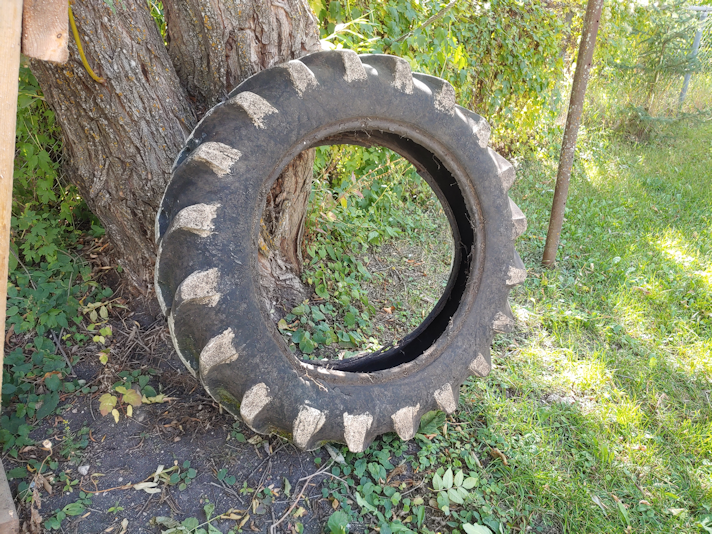
When we moved here, there were two tractor tire planters in the yard. One of them had been next to a willow for so long, it was actually damaged by the willow as it grew.

You can read about what a job it was to clear that out here, and here.

Thankfully, this one was not as big, and easier to get to!

The other one was likely about 130-140 pounds, so I’d guess this one was probably around 100 pounds.

Not counting any soil inside it.

The first thing to do was pull up the spent, self-seeded flowers, which I’d already done before taking the picture. Then I needed to loosen the soil and clear out the remaining plants, weeds and grass.

There had been a concrete block in the middle of this, to support the bird bath that used to be here. I dug it out to use in the fire pit, leaving a hole behind.

You’ll notice, there is no hole.

Junk Pile’s kittens LOVED playing in the dirt, and filled it in with their rolling around in it.

They were also very fascinated by me working on this, and were even willing to stay fairly close to watch!

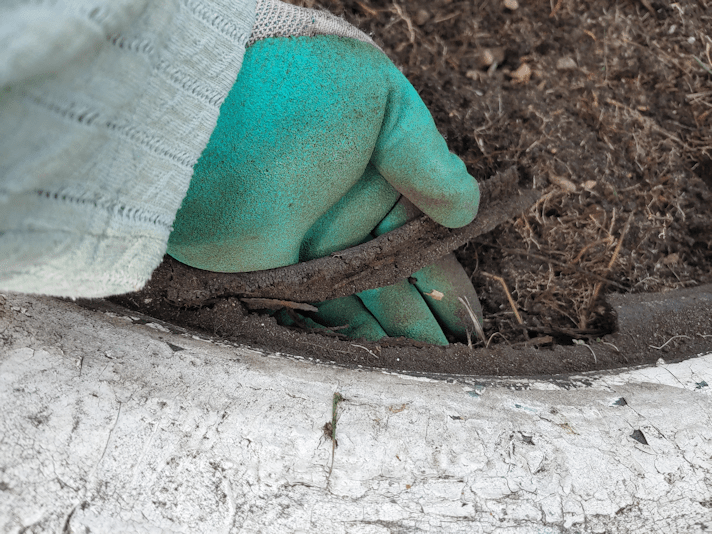
Though I could pull out a fair amount of roots, stems and bigger rocks with my hands, it still wasn’t good enough for the soil to go into the retaining wall blocks.

So I rigged a sieve.

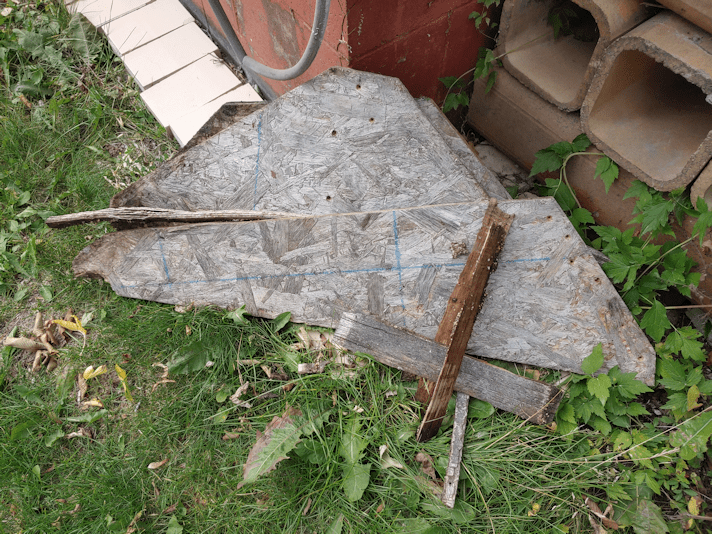
This is the mesh from what had been a screen window that would be put over the window to the old basement in the summer. The wooden frame had rotted and broken, so we built fitted replacement. The old wood frame is trash, but the steel mesh worked well for sifting the soil. A slightly finer mesh probably would have been better, but it did the job well enough!

Well enough that I think I will build a new frame for it, for future sifting jobs like this!

After filling the wheelbarrow with enough soil to top up half the retaining wall blocks, I was at a point where I needed to start lifting the tire itself.

While working my way around the tire, I could hear roots tearing as I lifted it!

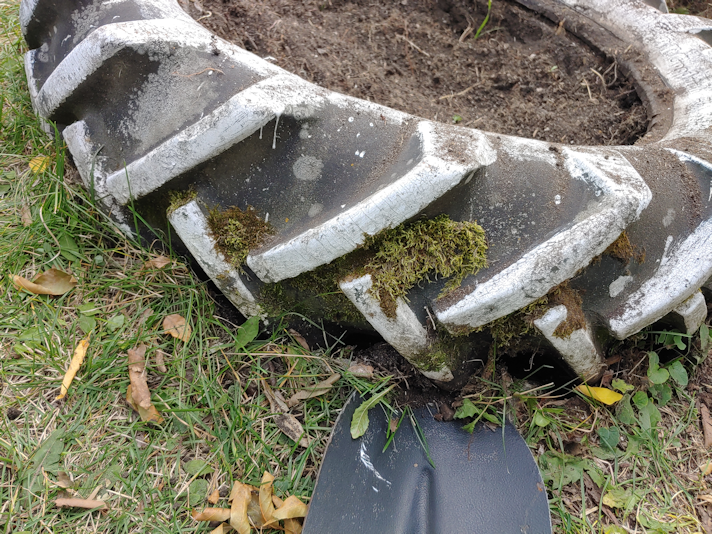
And yes, this has been here long enough for moss to start growing on it!

Since this tire planter wasn’t placed next to any trees to damage it, it could potentially still be used for something – in a better location! However, as I cleared the soil and roots away, I could see there is still a fair bit of damage from weathering. I was even pulling broken pieces of cable out.

Eventually, after clearing enough soil to finish topping up the retaining wall blocks, I had removed enough soil to actually lift it up.

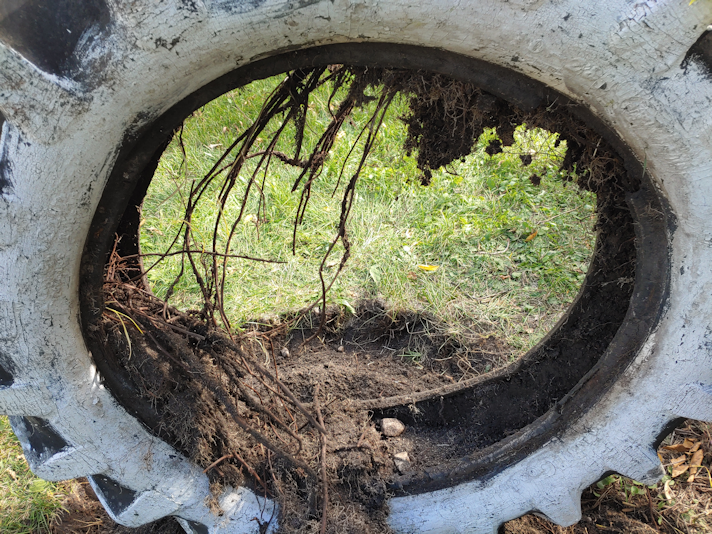
As you can see, there’s still a lot of soil in there!

Soil that is jam packed with roots.

I tried loosening the soil with a garden tool, but the root mats were so dense, it was hard to break it loose. It ended up falling over in the process.

Which did a much better job of knocking the root filled soil loose!

In the end, the easiest way to clear it was to roll it a bit, pull it back, bounce it, roll it again, pull it back, bounce it…

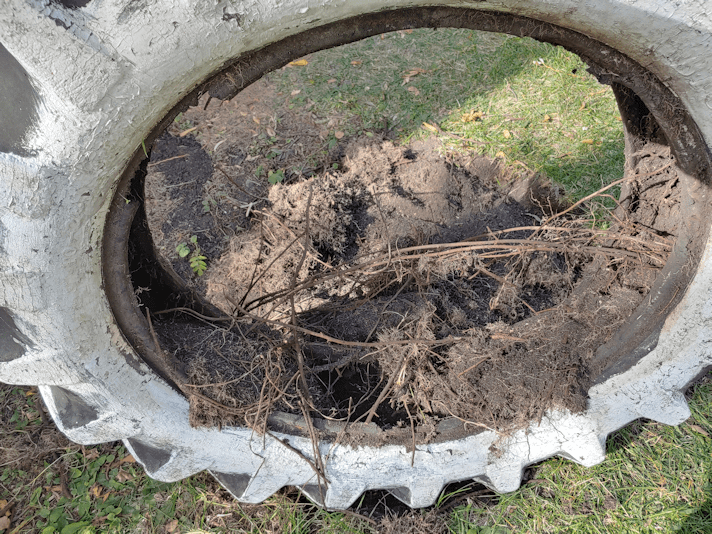
I finally got it all out! You can see the pile of roots in the back, where I’d pulled out the biggest, vine-looking ones. I don’t know what they were from; they look like they’ve been dead for a long time. Certainly nothing growing in the planter since we’ve been here came from those long roots!

The tire was just been set aside for now. We might still try to find a way to use it, but not as a planter!

For anyone reading this, thinking of re-purposing tires as planters…

Don’t.

Just… don’t! :-D The tires do degrade quite a bit, they are difficult to work around, and they are a huge job to clean up!

Speaking of cleaning up…

Yay!! No more tire planter!

That thing was such a pain to mow around!

All rakes up and ready to have some grass seed added, next spring.

Another job off the list!

The Re-Farmer

Fall clean up: cucamelon surprise

The frosts we have had didn’t quite kill off the cucamelons, but they are certainly beyond being able to continue producing.

There were still a few left on the vines that were big enough to withstand the frost, though!

They were still tasty, too. :-)

After taking down the yarn net I made for a trellis, I started pulling each of the plants up.

Which is when I found a surprise.

They have tubers!

When I looked up how to grow cucamelons, I found one site that said, if you lives in a colder climate, you could dig up the roots and pot them. Kept in a cool, dark place over the winter, they could be started indoors for better transplants in the spring.

I don’t remember the site mentioning the roots were tubers!

When I kept finding more, I decided I would try it.

These are the biggest ones that I found. After trimming away the vines, I filled a couple of deep buckets with peat (we still have most of a bale) and planted the a bunch. I fit about 9 tubers between the two buckets. That left a few littler ones that I decided not to bother planting.

The buckets are now being repeatedly watered, to get as much of the peat to absorb moisture as possible. Then, they will go into the old basement (where the cats can’t get at it!) for the winter.

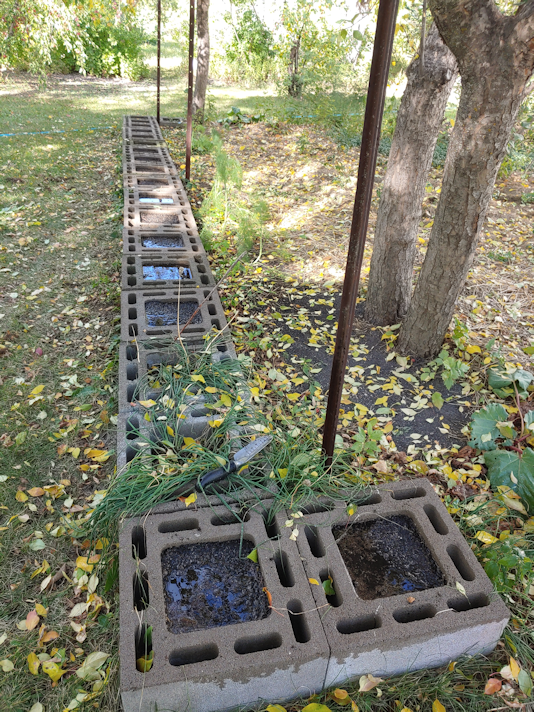
The next thing to do was to prepare the retaining wall blocks. When I placed them last year, which you can read about here and here, I filled the bottoms with mulch, then topped with peat. As expected, everything settled a couple of inches, so they all needed to be topped up.

For that, I wanted to use the soil from the remaining tire planter, so the retaining wall waited for a bit, while I dealt with that.

Which will get it’s own post.

It turned out to be a pretty big job!

Once I had the soil, I loosened and broke up the peat layer, topped off all the blocks with soil, then watered them thoroughly, to help it settle in.

After giving each block a thorough soaking, my daughter and I made a dump run, giving the soil plenty of time to absorb the water and settle. Once back, I topped up the soil again, then gave them another soak.

The cucamelons are now all cleaned up, and the retaining wall is ready for whatever we decided to plant here next.

Oh, I almost forgot!

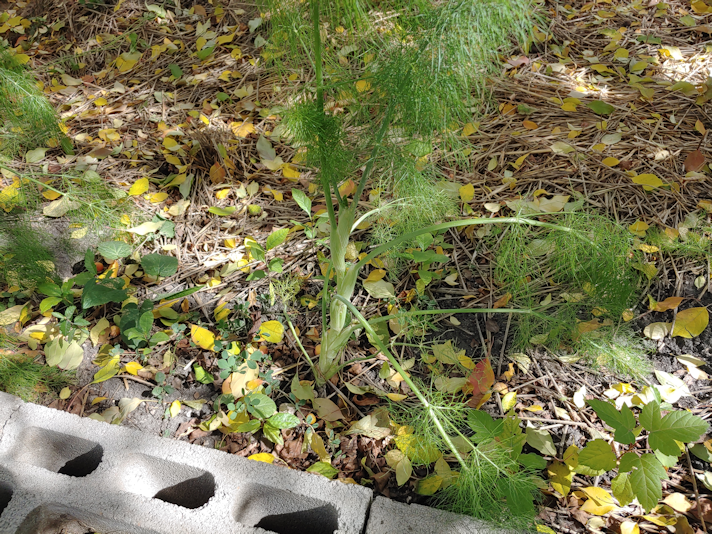
One of the other things we transplanted in the area where the surviving fennel seedlings.

This is the biggest and strongest of the 4 that survived.

I admit, all I did with them over the summer was water them. I suppse they’re still edible. If nothing else, I think the fronds can be used as an herb, and there are plenty of those! :-D

The only thing left in the blocks are the two with chives in them. I will be leaving them for now, but before winter, those will get topped up with soil, too.

Another job off the list! :-)

The Re-Farmer

Fall Clean Up: the platform bird feeder

We had a light frost last night, and have frost warnings for tonight, but today was a gorgeous day to get work done outside! We reached a high of 15C/59F, which is an ideal temperature, I find.

The first thing on the list was to work on the platform bird feeder. It has been just sitting off to the side for a couple of weeks now, so it’s about time!

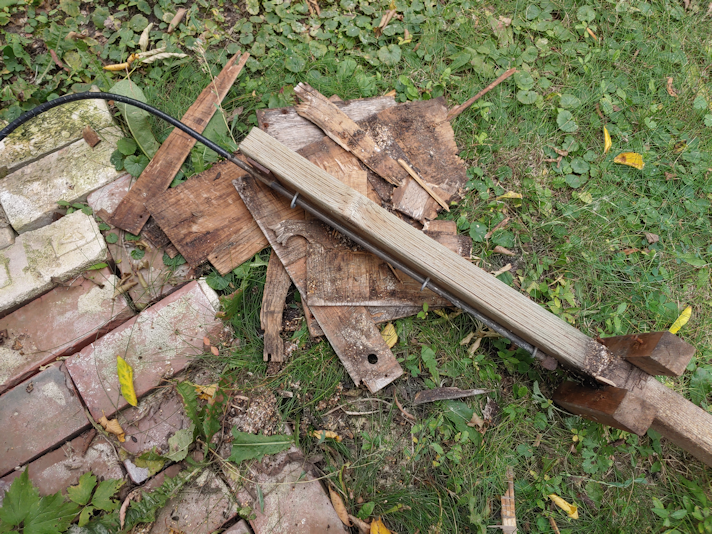
The first thing to do was remove the “legs”. They’re not particularly stable, and showing rot where they touch the ground, so it was time for them to go.

There were a remarkable number of screws holding them in place!

There were 20 screws between 3 legs!!

You can see how they were starting to degrade.

Also, pieces of the platform feeder were just peeling right off!

That took a bit more effort to take off. I started to remove screws from the supports under it, but realized it is really solid, so I tightened them again and left it.

Then I had to find the screws holding the platform to the supports.

I found one I was able to remove. Another would not budge.

It was actually easier to just tear apart the platform with my hands.

I had to use pliers to loosen the remaining screws before I could take them out.

After that, I brushed and scraped away the old bird seed that had gotten jammed around the support post, the scrubbed again with water. Is was then set aside to dry in the sun.

Later, I will cut off the rotten end of the support post, and then I think we will paint it. This can definitely be salvaged. We just need to figure out how to securely set it in place. With a bird feeder hanging off the hook – or even just the cage of a suet feeder – the wind kept blowing it over. I also want to find a way to put on another platform. Maybe something not wood, to avoid the problem of rot that developed on the old one!

We’ll figure it out as we go. For now, we’ll see about getting it painted, first. :-)

The Re-Farmer
Temporary fire pit, finally moved!

Last night, I finally had a chance to clean up and move out the temporary fire pit I’d set up to burn things that wouldn’t fit in the burn barrel.

It was too dark for photos at the time, so I went back this morning.

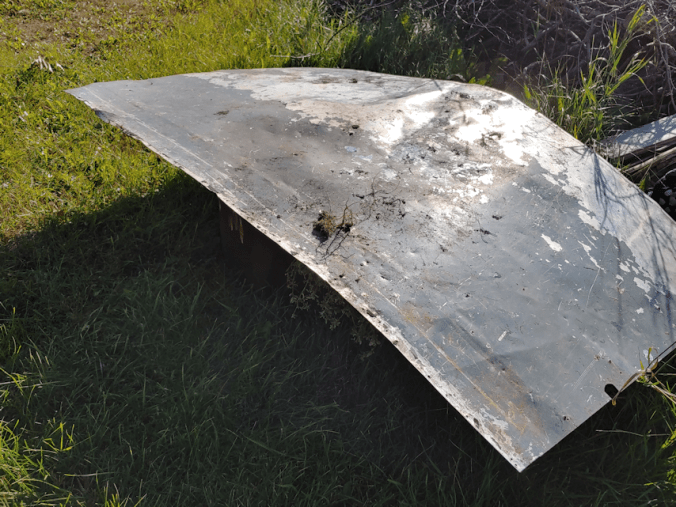
This is where it had been sitting, and you can really see how the heat affected the ground, through the metal sheet it was on.

I’ve set it aside near the burn barrel for now. It worked out so well, I want to have it handy for future use.

That weed that managed to grow through a hole in the metal sheet was certainly tenacious!

I had originally intended to dump the ashes behind the old outhouse. That is where we’ve started to dump things that are compostable, but not appropriate to use in the garden later. Then I remembered something.

Not far from the burn barrel, there were two tractors. My dad had given one of them to my nephew. He and my brother, amazingly enough, got it running and were able to move it, though my nephew had to come back another time with a buddy to help him get it home. The tractor had been sitting there so long, its wheels had sunk into the ground, leaving behind holes. They had filled the holes with scrap wood and rocks that they found around the area, but it wasn’t quite enough. While we don’t usually go into this overgrown area, it was still a safety hazard. Especially when the renter’s cows got through the fence. Human or cow, it would be easy to break a leg in them.

I could use the ashes to fill the holes the rest of the way!

So I did.

Here, you can see 3 of the tire holes. The fourth is hidden by the little maples. The holes from the back tires each needed a full wheelbarrow of ashes to fill. A third wheelbarrow was enough to fill the smaller holes from the front wheels. That was even with the pieces of wood and rocks filling them! After those three loads, the fire pit was empty enough that, with maybe another shovelful or two scraped up, I could remove the ring and use the sheet of metal to pick up and pour the remains into the wheelbarrow. That last little bit went onto the larger holes.

So I was able to accomplish two things at once; remove the temporary firepit, and fill in some holes!

As for the little maples growing where the tractor was, I am debating if I want to let them grow, or if I should take them out. In time, we plan to fill in and level out this area, and maybe put in some polytunnels, raised beds, etc. This would be years in the future, and I don’t even know if we’d go into this space. If we leave them, and then find we want to build around there, they would be much harder to get rid of than now.

I still need to cut away the trees growing through the remaining tractor. I can decide then.

The Re-Farmer
Clean up: progress on the old wood cookstove

Looking at the weather forecasts, it’s looking more and more like our planned outdoor gathering with family to celebrate multiple birthdays and anniversaries is going to be an indoor celebration!

So today, I focused on tidying up the Old Kitchen a bit more, so my mother, at least, can sit in it comfortably. Between the Old Kitchen and the sun room, we should be able to fit all of us, if a bit tightly. Of course, if my mother is up to doing the stairs between the old and new parts of the house, we can always move to the dining room.

While wiping things down, I started doing a more thorough cleaning of the old wood burning cookstove. It’ll probably just have a tablecloth thrown over it and be used to hold the food, but I wanted to get some more progress in cleaning it out. Including several decades old ashes in the fire box!

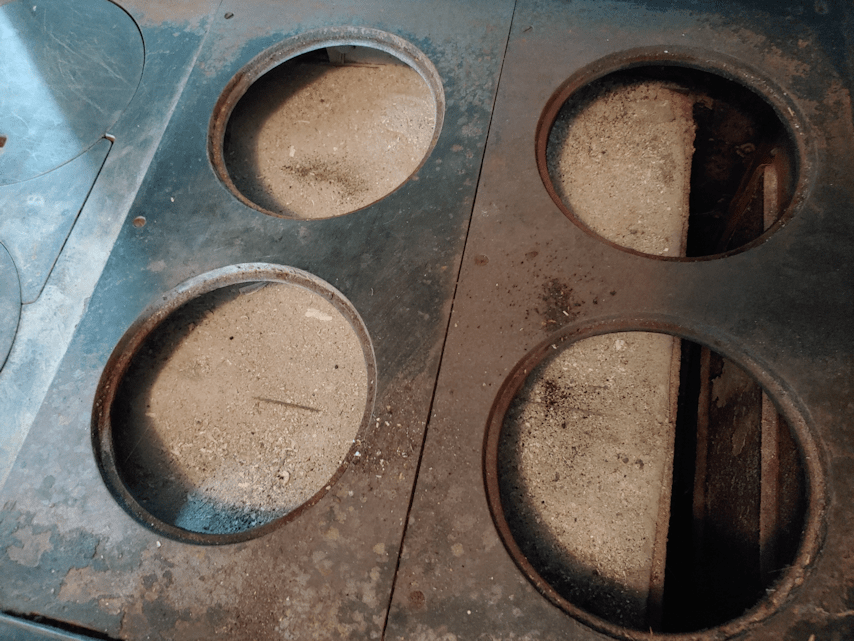
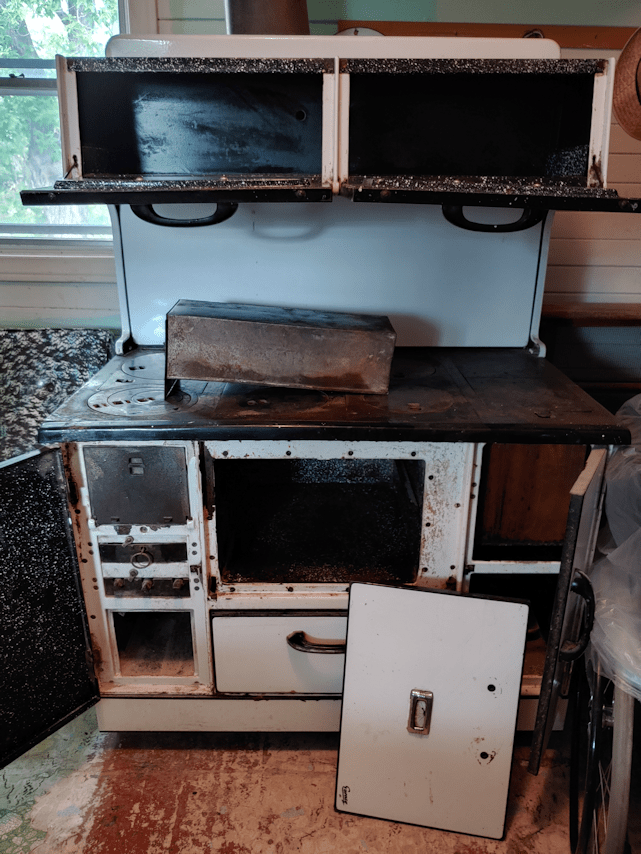
Here is how it looked after I removed the top pieces, and brushed the ashes through.

I should be able to remove the metal plates at each end, which would allow me to remove the grate at the bottom, but I couldn’t see how to do that. For now, I just tried to sweep away as much as I could.

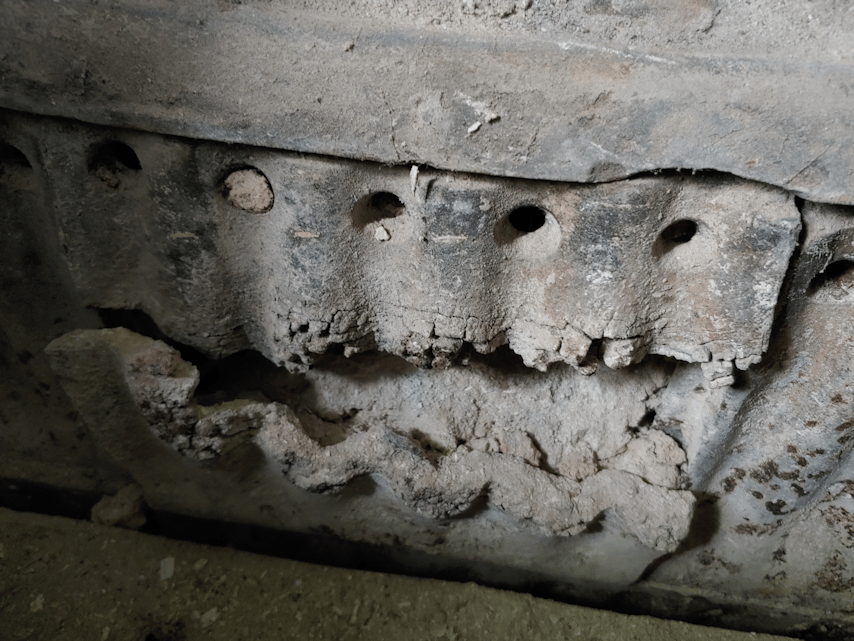
Doing so revealed something strange about the inside wall.

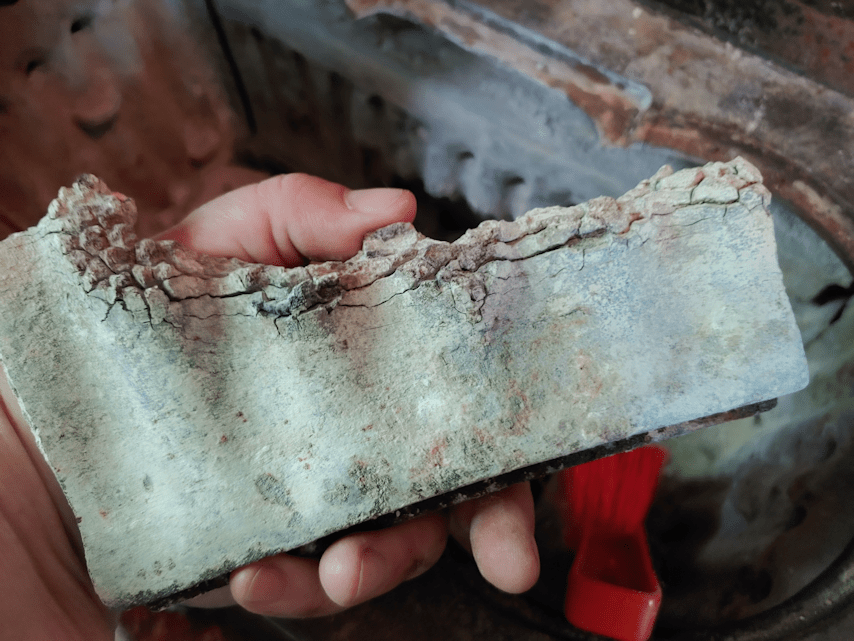
The middle plate looks absolutely destroyed!

I left that for later. First, I wanted to get rid of the ashes. Under the grate are three rollers that can be turned from the outside; a crank handle to do that seems to be missing, but I was able to turn them with my fingers. This allows the ashes to fall into the box below.

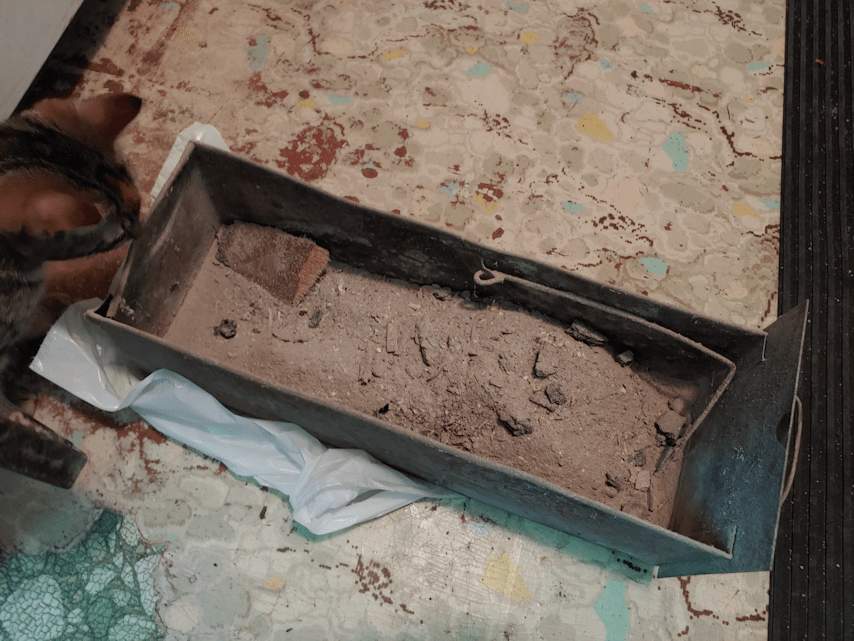
I had mostly emptied this box before, so this is all ashes from the fire box.

I’m not sure where that unburned piece of… paneling? … came from. I might have simply missed it, before.

The piece to hold one end of the handle is broken.

After taking the ashes out to the compost, I hosed it down. Then used a chisel to scrape off things stuck to the sides and bottom that were definitely not wood ashes. :-( After hosing it down again, I set it aside to dry, then went back to working on the fire box.

I ended up taking out the bottom of that destroyed panel completely.

This is thick, cast iron. Just how hot did things get, for this top happen?

Once it was out, I tried to sweep away more ashes.

I ended up knocking out chunks of packed ashes, like this one. More was jammed behind the top piece of the metal panel, and I took that out to get at the rest.

Ashes are not supposed to be able to get in there!

I then started sweeping out the space the ash box fits into. In the ashes I swept out, I found some odd things, like old nails and…

What is this???

That, my friends, is the screw end of a light bulb.

Later, I found the filament in the ashes, too. No glass, thank God!

Why on earth would someone toss a light bulb into the fire? The nails, at least, I can see happening. Scrap wood would have been burned, and if they had nails in them, no one would have taken the time to pull them out, first.

But a light bulb???

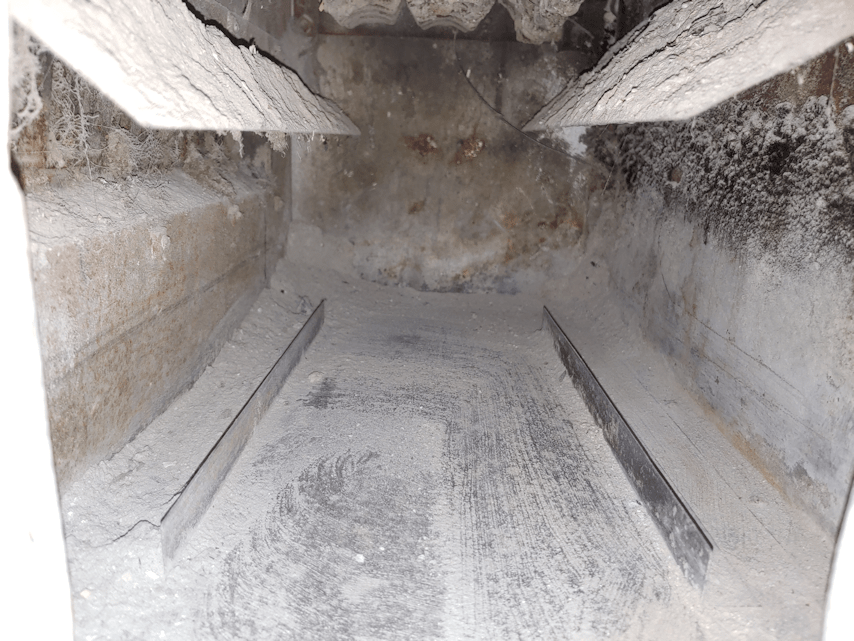
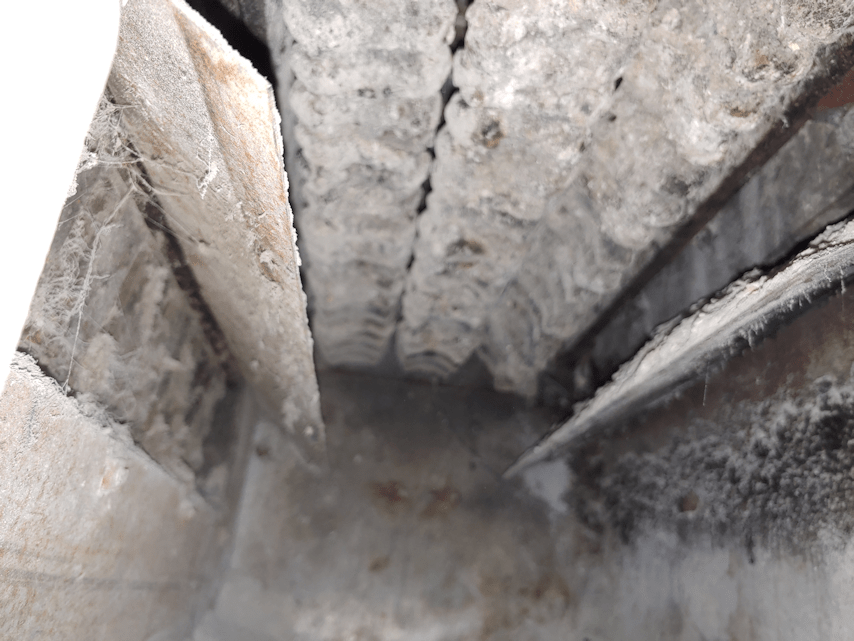
Then I used the miracle of technology that is my phone camera, to see what I couldn’t see otherwise!

This is where the as box slides in. The flaps above divert the falling ashes towards the box.

The camera focused on the flaps, but you can see the rollers above, that keep the hot coals from falling into the ash box.

I did as much as I could for now on the fire box side. Next was the cook top above the oven.

As you can see, the oven box is covered with ashes. Now that I’ve seen the broken panel piece in the fire box, I know why.

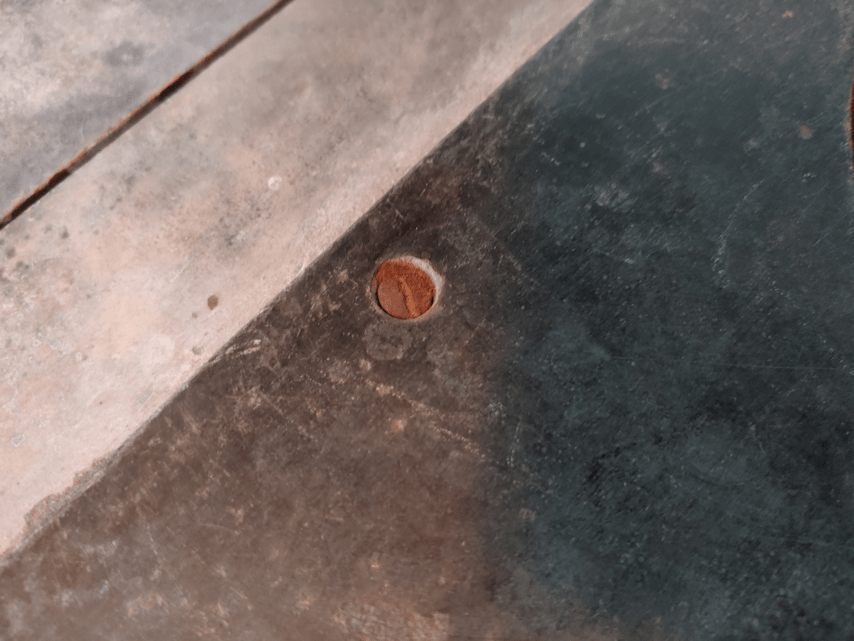
I didn’t even try to get those out. The metal pieces can be removed for easier access, but…

… they are held in place by screws, and there is no way I’m going to try and take those screws out now!

Though I’ve taken the ring plates out before, somehow I never looked at the bottoms of them.

!!!

It seems the fire was allowed to be built up too big and too hot to cause all that damage in the fire box, which then lead to ashes and sooty smoke getting into the space around the oven box. I was quite young when this was still being used, and don’t remember much about it, but I may well have been among those causing the damage. :-/

I really wonder, at times, how we didn’t burn the house down back then!!

I just brushed off as much as I could from the underside of the ring plates. The panels over the water reservoir didn’t need as much.

I didn’t even try to clean the inside of the water reservoir this time.

I did go into the drawer under the oven. The handle and a piece of hinge from the broken oven door is in there, along with …

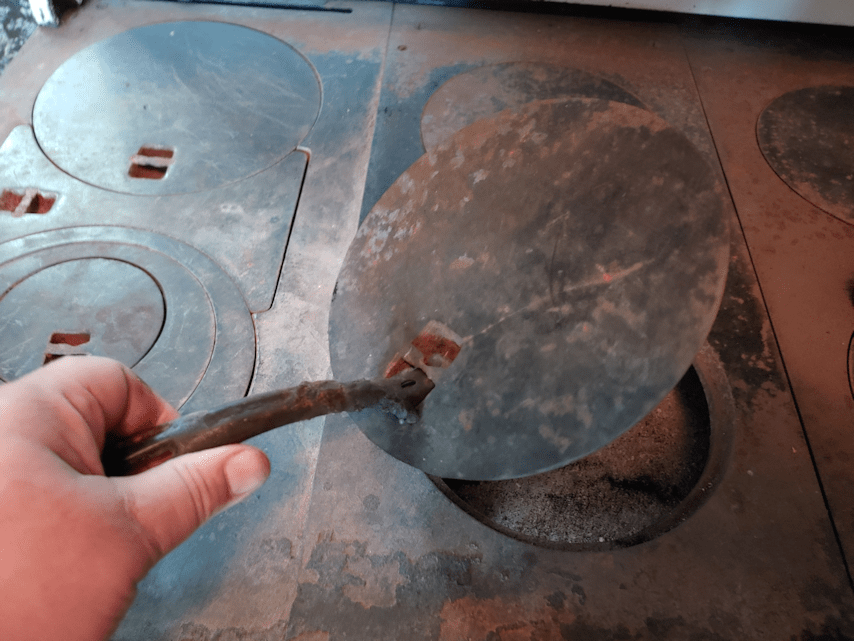
… the lifter for the ring plates.

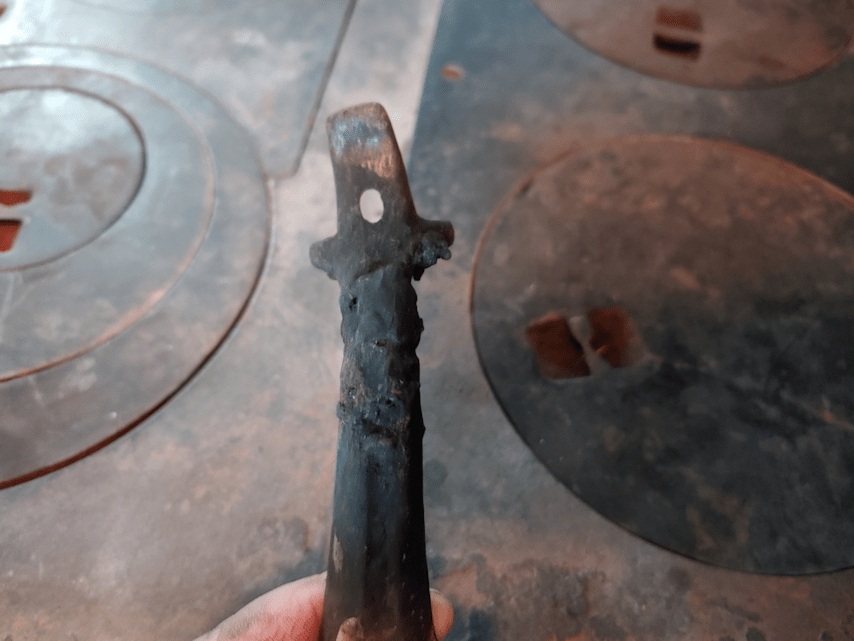
I just used my hands to lift them, but when the stove is in use, this tool is vital.

I… can’t imagine what was done to it to cause this damage. !!!

The final thing to do was give it all a wipe down, then leaving it to dry completely before closing it up and putting everything together again. The cook surface and parts like the front of the fire box, and the panels below it, are the only things that are not enameled. Eventually, I want to use stove blacking on those parts. The rest still needs a very thorough scrubbing and rust removal, but I really don’t know far I’ll bother to go with that. We can’t use it – partly because of the damage, partly because we’d lose our insurance if we did – so mostly, I just want to keep it from degrading further. It would be great if we could get it all fixed up but… I’m not sure that it’s worth it. Especially since, there is another one in the storage shed that I know my late brother used, back when that building was his workshop. As far as I know, it’s in good shape. It’s not as old as this one, but is almost exactly the same design.

Who knows. When we finally build our outdoor cooking area, maybe we can include the wood cookstove as part of it. I think I’d really like that.

The Re-Famer

Clean up: working towards the junk pile, and… really??

It was a little bit cooler today, so I decided to do a bit of clean up around the spruce grove perimeter. Eventually, we want to clean out the junk pile, but it’s got kittens in it, so I am just working my way towards it.

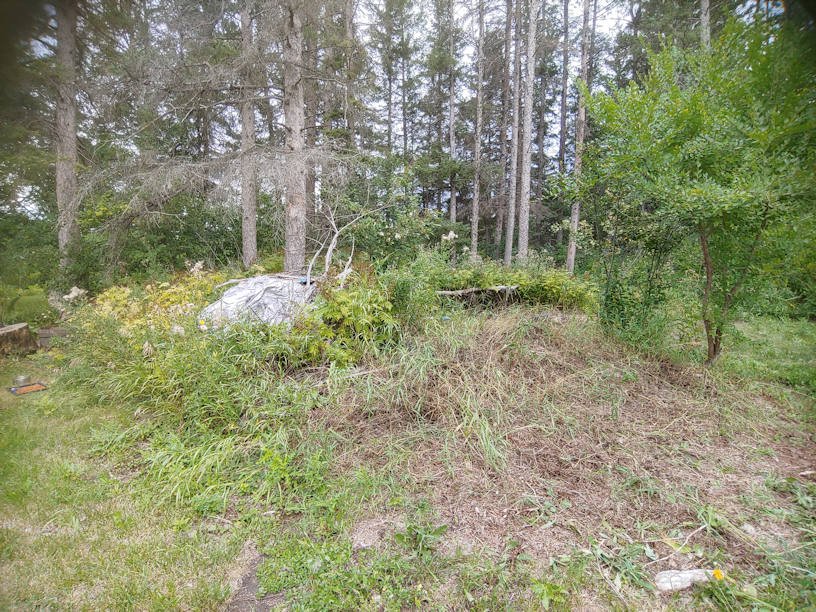
Here is where I started working.

All those thistles and crab grass are growing out of a pile of … dirt? I’d already cleared a path to the chokecherry tree behind it, and now I wanted to clear the pile itself.

Which meant pulling the thistles and crab grass up by hand.

Yes, the row marker I used in the spring was still there!

It is now leaning against the garage, where there is at least a bit of shelter from the elements.

As for the pile itself, I’m not sure what it is. Stuff was pulling out of it easily, so I thought it might be an ash pile from cleaning out the old wood furnace over the years?

It’s really quite sandy in texture, though.

I’m sure this pile was made for a purpose, but if it’s not an ash pile, I just can’t figure out what that might have been!

After clearing most of the pile from both sides, I continued working my way towards the junk pile. I had seen branches piled there early on, and had added a few myself whenever I needed to clear something but didn’t have a chance to take the wood to one of the piles outside the yard at the time. Like part of the cherry tree by the house that broke off when I tried to move it around the post with an old bird house on it. In the above photo, I’d already cleared that out – and dragged out a length of those tiny decorative wire fences for around flower beds, in the process. It was pretty bent up, so that ended up on the junk pile that will eventually be hauled away.

My first load of very old branches that I dragged out after pulling away more thistles and years of crab grass.

I never did get another full load…

The closer I got to the junk pile, the more old branches I uncovered – as well as something yellow. It looks like a large piece of very thick plastic… tarp?

It was at about this point that I got stung, and found a small, yellow and black wasp stuck in my shirt.

After brushing it away, I kept a close eye out while pulling out a few more branches.

Aaaaannnddd… yes. There were more wasps.

To the left of centre in the above photo is the remains of a log. The wasps seemed to be coming out from under it.

So I took a hose to it, then eventually used a long metal pipe we use for poking around when doing a burn, to lift it over.

Yup. It looked like the opening to a ground nest was right under it.

I hosed that for a while, too. I don’t know if it was enough to drown out the nest, but there were quite a few wasps flying around. They don’t show up in the photo, but they’re there!

At which point, I was done.

I have never seen so many wasp nests in my life, before this summer. They’re all over the place! There is the tree in front of the kitchen window, and one beside the beet and carrot beds, that are nests. Then there are 3 active paper nests in various places, plus the one above the garage door that I got rid of, and the one under the eaves of the house at the old kitchen that I got rid of. There appears to be a nest inside the branch pile near the garage, and now this ground nest by the junk pile.

And those are just the ones I know of.

There isn’t much we can do to stop them from building under the eaves, but this is just more reason to get rid of the junk piles, debris and branch piles!

And those Chinese elms.

Meanwhile…

This is the pile of thistles and quack grass, with a couple of spirea I pulled up near the end, that I cleared up and added to the new compost pile. With so many thistle seeds, I plan to give them a few days to dry, then burn them. That will help with breaking down the old tree stump in the middle, and making sure more saplings don’t start pushing their way through again.

So, I think this is going to be it for clean up in this area for a while. I’m not sure what to do about the wasps, other than hosing the area down repeatedly. With the kittens living in the junk pile, I don’t want to be using wasp poison.

I think it’s time to pick up another wasp trap. The one I got before is currently being used to catch fruit flies in the house, which suddenly became a problem.

Well, a bit of progress is better than no progress at all!

The Re-Farmer

New compost location

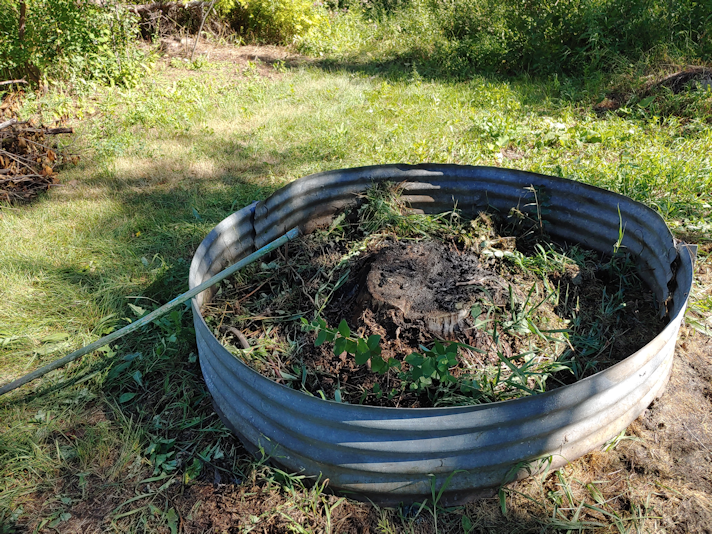
Yesterday, I moved the metal ring the compost pile was in to its new location. I ended up using the same wires to hold the seam together; they’ll just be much easier to undo in the future! That allowed me to simply roll the whole thing over.
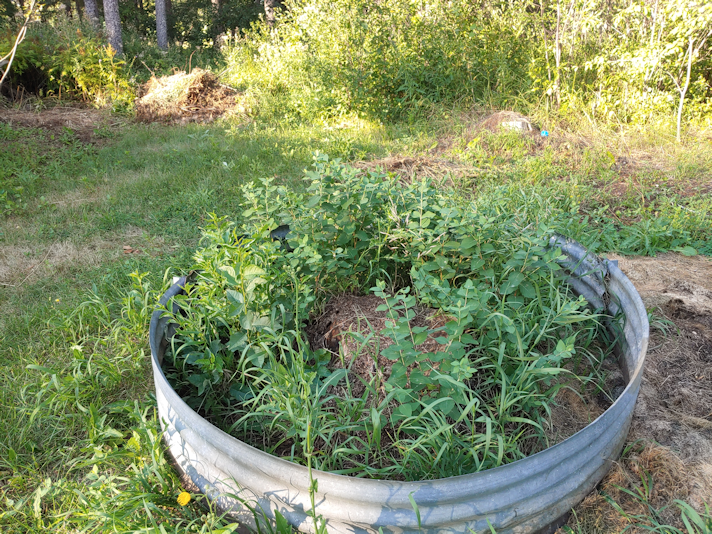
This is where we decided to put it. I’ve trimmed around this old tree stump many times, but those little trees (several kinds of them) keep coming back.

In the background, you can see part of what was cleared to get at the chokecherry trees, including another tree stump, and the pile of spirea and thistles from clearing towards the junk pile.

Now that we’ve discovered her babies, I fear Butterscotch has already moved them somewhere else. I hope not!

After taking a pruner to the saplings and adding a pile of dried weeds and grasses I’d pulled up when clearing here earlier, it looks full already!

The tree stump does take up a lot of space.

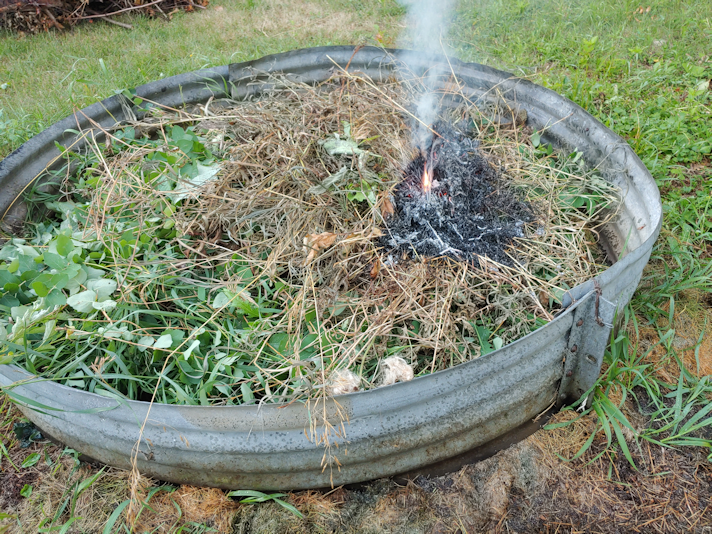
Time to start burning!

I needed to burn out all around the stump, to hopefully kill off the root systems those saplings keep growing from.

By the time I was done, several hours had past, and it was completely dark when the girls came to help me make sure all the coals were out and put everything away.

I had the hose going so much, spraying around the fire and keeping the sparks from getting far, it was actually muddy by the ring.

On the plus side, I got rid of the pile of spirea and thistles in the process.

Of course, I needed dry wood to keep the fire going, since much of what I was burning away was pretty green. So I raided the pile of branches by the garage that’s waiting to be chipped.

I couldn’t see anything, but I am convinced there is a wasp nest somewhere in that pile. I can hear them, and the sound is NOT coming from the nearby Chinese elm.

!!

This is how it looked this morning.

Hmm. I am thinking I might need to do this again, before we start using it for compost. The stump didn’t burn much, but that’s okay. It’s the area around it that has stuff I want to kill off, so they don’t start growing into the compost when we start it.

I’m thinking this will be a good location. We’re happy enough with the nearby garden beds (even with the deer decimating our beets) that we will continue growing there, so having a compost pile nearby will be handy. It’s closer to the house – but not too close! This is near where we plan to build the cordwood shed to use as an outdoor bathroom with a composting toilet. It might be in the way during construction, but the way things have been going, I’ll be happy if we can just dig out the sod where we want to lay down gravel and level things, first.

Though we plan to have a composting toilet, the contents will NOT be used for compost in any of our garden beds. I’ve seen many sites talk about how great human waste is for compost, and it absolutely horrifies me. It’s not the waste itself I have concerns with, but what might be in it. Not many people are in my husband’s situation, having to take more than a dozen different prescriptions, but even if it’s just OTC pain killers, hormonal birth control, or other prescriptions, it will be an issue. So we will have a separate dumping site, well away from anywhere food will be grown.

So that is how things are progressing with the new compost location.

One of these days I intend to get some dual roller composting bins. They are supposed to compost a lot faster but, for me, it’s more about accessibility and mobility. We may not need it now but, at some point, it will be more of an issue.

That’s one thing I learned about living in the housing co-op we were in before moving back here. It was one of the few places that had a lot of wheelchair accessible housing, and many of my friends and neighbours had a variety of mobility issues. Now, I see everything with different eyes. It did make the transition to my husband becoming disabled much easier, to be honest. It can happen to any of us and, as we age, it’s almost inevitable. One woman I know uses the term TAB to describe people without disabilities: Temporarily Able Bodied.

Accessibility is now an almost constant thought in the back of my mind as we work on things and plan ahead.

Even with composting.

The Re-Farmer