More fall clean up, prowlers, and there’s a stranger in town!

While it was a warm day today, it wasn’t quite warm enough to work on garden beds, so once the outhouse floor was done, I focused on doing a number of small jobs around the yard.

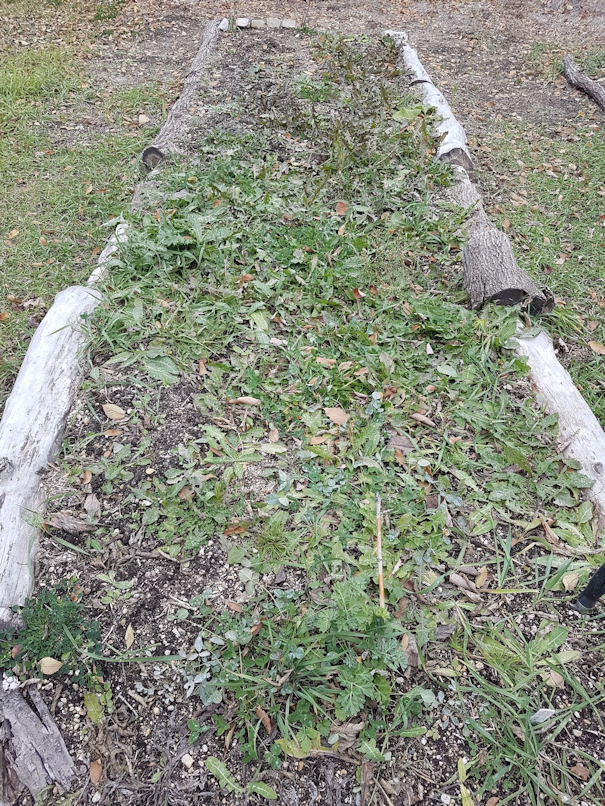
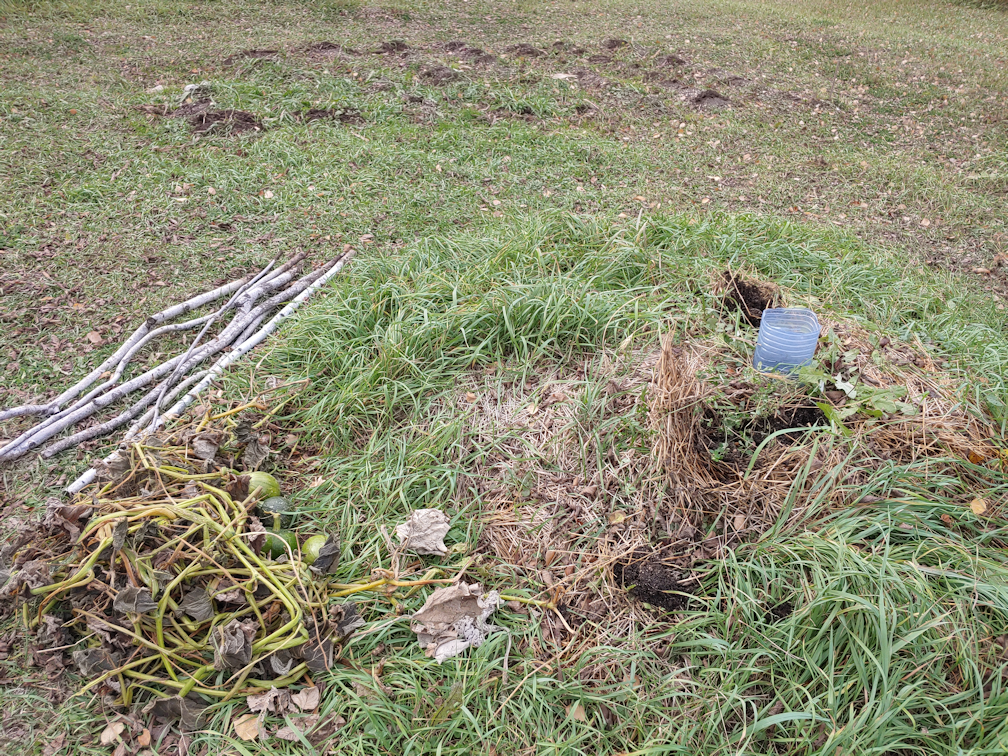
One of them was to replace the grass mulch on the garlic beds with a thick layer of straw. The grass mulch went into the newly framed bed, which has a trench in the soil for now. We’ll toss our kitchen scraps for the compost into the trench as well, before it all gets buried in fresh garden soil.

While I was getting ready to roll up the garden hoses at the back of the house, the cats were prowling all around me! It seems like, everywhere I turned, there was a cat, circling around me.

Except for Tuxedo Mask. The cheeky bugger planted his butt in a plant pot! The flowers in there are one of things my mother planted that turned out to be invasive. After telling me there was nothing in the old kitchen garden she wanted me to save, and I cleaned out and covered it all with layers of cardboard and mulch, she changed her mind and wanted me to keep them. They pushed their way through the layers of mulch, anyhow, so I transplanted some into this pot while preparing beds to plant in this spring. They’ve still managed to take over a section of the old kitchen garden, but it’s an area that is overshadowed by lilacs, honeysuckle and roses, so it’s not likely we’ll ever plant anything else in there. We’ll just have to keep them out of where we have built new beds, which looks like it’s going to be a challenge!

These flowers, which look a lot like periwinkle, are very hardy. They won’t have any problem recovering from a cat sitting on them, so I didn’t bother chasing Tuxedo Mask off!

I probably should have waited for a warmer day to put away the hoses, but it’s done now, except for one hose in the front of the house that I left for a bit longer. From the long range forecast, this weekend will be the last warm days, then the day time highs will slowly drop. Even so, we’re not expected to have highs at or just below freezing until past the middle of November.

I’m good with that!

After doing some other clean up around the yard, I got the burn barrel going for a while, then headed inside before the light failed. At the last minute, I decided to top up the cat kibble, which had been gotten into by that big skunk again. Of course, as soon as I came out of the sun room with the container of kibble, I had cats prowling all around me, crying like they were starving to death.

Including… hold on…

That wasn’t Tuxedo Mask over on the sidewalk. He’s busy trying to trip me on the way to the kibble house.

We had a stranger in our midst!!

After refilling the kibble trays, I was able to try and get photos.
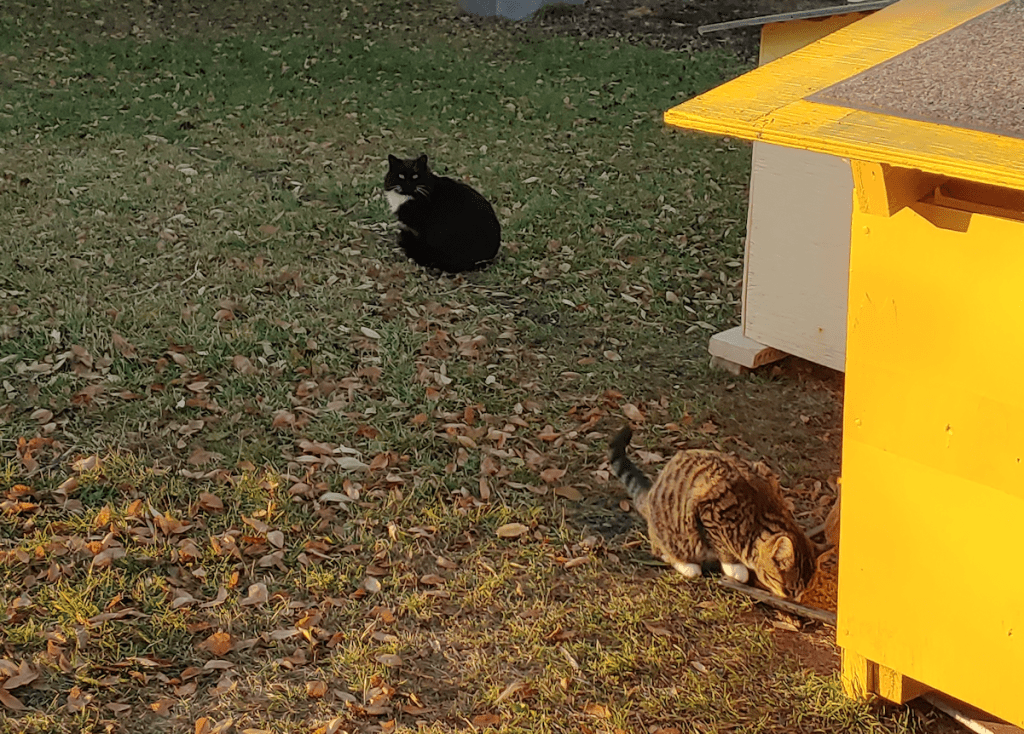
What a handsome stranger!

The other cats didn’t seem the least bit bothered by his presence, either. I saw the kittens act more skittish around Creamsicle Baby than this guy!

He moved away from the food while I was trying to get a photo, prowling around the cat’s house and kibble shelter, and making his way back to the sidewalk, but he never ran away.

Even when my older daughter came out to see him, he stuck around. I went inside to let my younger daughter know. She was in between batches of bread baking, so she was able to come out, too. He did eventually start eating while my daughter was just a few feet away.

I wonder where he came from? This is the first time we’ve had a long haired cat come by, and the first time we’ve seen another tuxedo.

As long as the cats get along, he is more than welcome!

The Re-Farmer

Our “second bathroom”; painting the floor

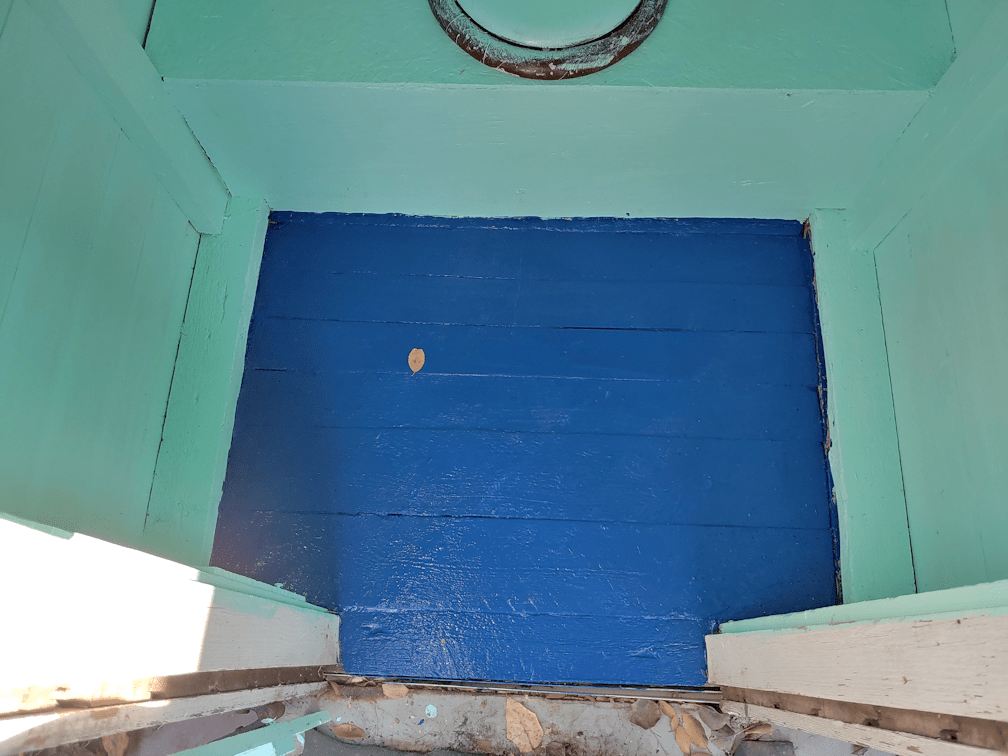
As our day warmed up in the afternoon, I took advantage of it to get some stuff done outside. Now that the sign’s lettering is done, I used the paint, which I chose for its durability, to get the floor of the outhouse painted, first thing.

The first thing to do was remove the remarkably heavy piece of … whatever the stuff is called … out, then sweep and scrub the floor as best I could. Unfortunately, there are cramped spaces on either side of the door frame that I just can’t get into. At least not without making efforts I’m just not willing to make for an outhouse! LOL

I just painted over the crud. I figure, if it’s stuck to the point I can’t get it out with a brush, it can stay there.

Of course, in the time it took for me to turn around and set the paint can and brush down, a leaf blew onto the wet paint!!

I was able to reach it without getting into the wet paint myself, though. :-D Then I quickly closed the door before more leaves blew in!

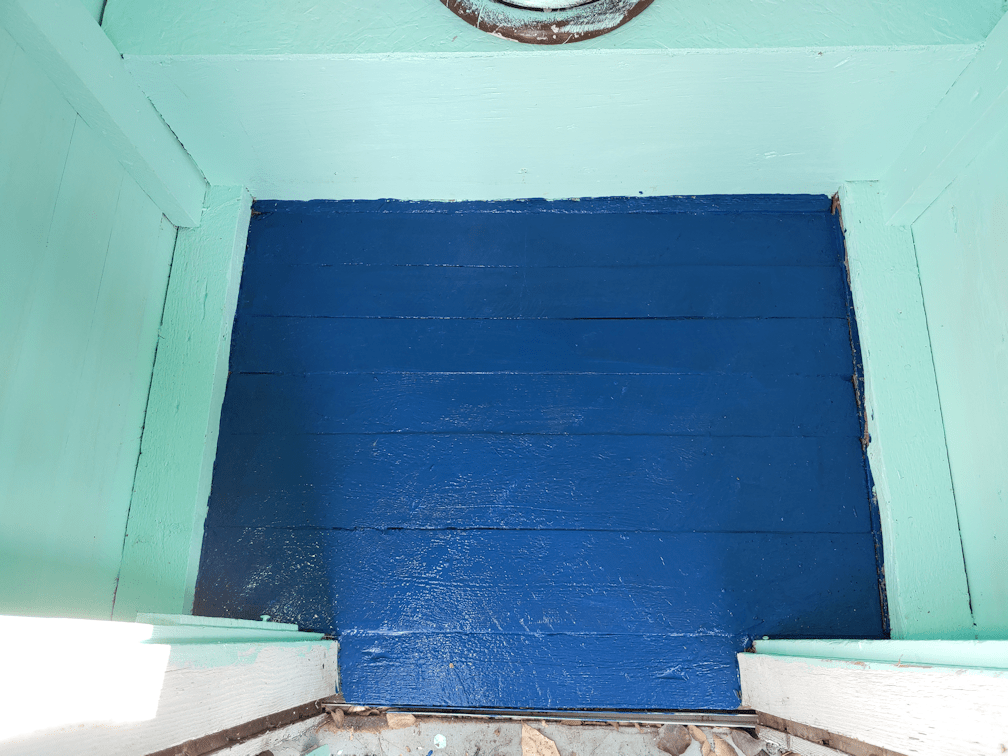
I don’t think I’ll bother with a second coat. If you look really hard, you can see some of the mint paint through the blue a bit, but most of this will be covered with the mat. I just wanted to protect the wood, really, and I think this will be just fine. If it isn’t, we can always add another coat next year, when we get more of the mint paint. The girls want to give it a final coat in semi-gloss.

It doesn’t look like we’ll be able to redo the roof before winter, so I’ll probably cover it with plastic before the weather turns, though at the state it’s in, it probably won’t make much difference if we don’t.

Which means that, once the paint is dry and the mat is returned, our emergency bathroom is now done for the year! :-)

The Re-Farmer

Boxes, tubers, broken tools and… cows!

We’re having another lovely, mild day with sunny skies. A perfect day to get more done outside!

My main goal for the day was to finally build the third low raised bed box and set it up.

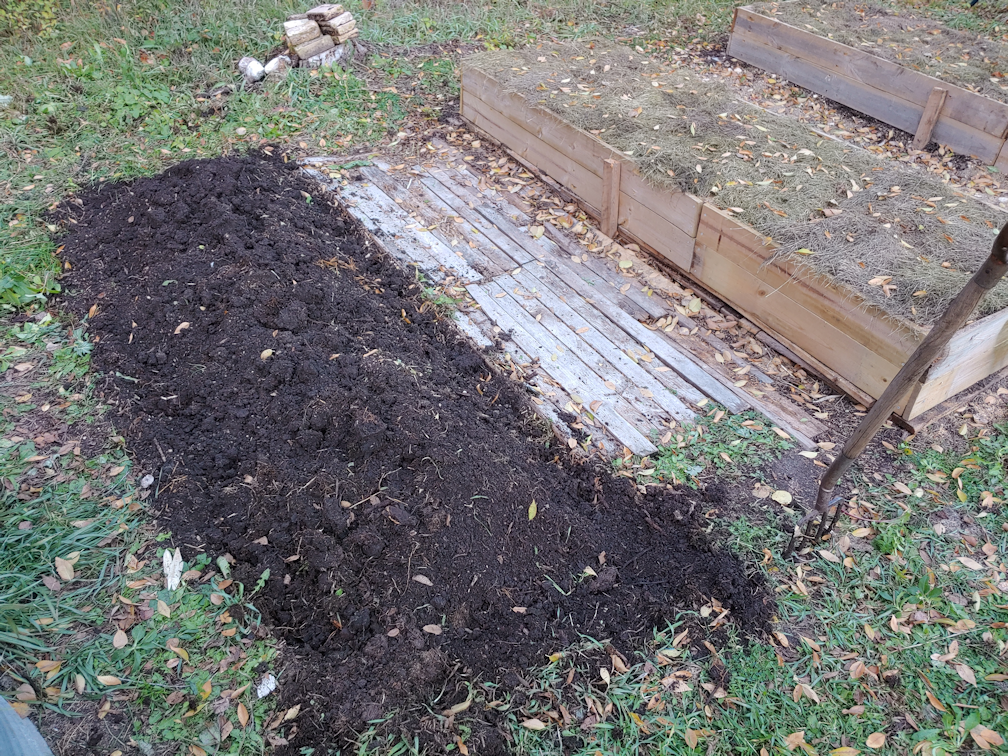
The ground is starting to freeze, though, so I couldn’t make quite as deep a “foundation” as with the other beds. It should be all right, though.

This is as much as going to be done with it, for now. Things are supposed to get warmer of the weekend, so I might get a chance to bury stuff from the compost pile down the middle, then top it up for the winter.

While I was building the bed, my younger daughter started working on beds in the old kitchen garden.

Beds that were more shaded than other areas.

Beds that were more frozen than not!

Alas, it was too much for our garden fork; one of the few useable tools we found that hadn’t been “disappeared” while the place was empty. It had a tendency to bend in that spot, and when my daughter tried to straighten it, it broke! The poor thing felt so bad.

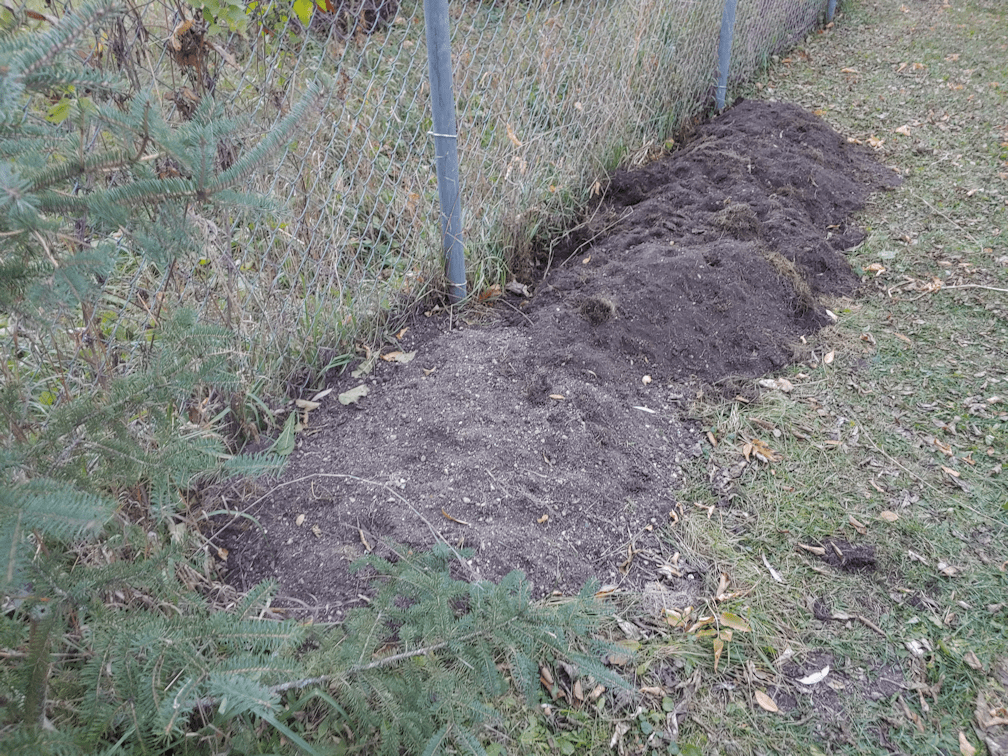
The old kitchen garden got left for warmer days, and my daughter moved on to clean up the remaining bed at the chain link fence. The chicken wire protecting the cucamelons and gourds had to be removed, the plants pulled, and the soil moved to prepare for the block planters.

The cucamelons did not to well in our drought. The plants grew, there were many, many flowers, with teeny little fruit, but very few of them ever matured. Very likely, they just didn’t get polinated.

As my daughter dug the area up, however, she discovered they did much better below the soil!

Cucamelons produce tubers. I’d read that, in colder climates like ours, they can be dug up, put in a pot of soil and overwintered indoors, then transplanted in the spring. I tried that last year, but the tubers just disappeared in the soil. They, however, were nowhere near as big and thick as these ones!

My daughter set aside the biggest ones, and we will try overwintering them. Maybe at this size, they will have a better chance of surviving to be transplanted.

When my daughter was done cleaning out the bed, she headed inside and I continued working on it.

We had four of these chimney blocks waiting. My daughter had already moved the soil, and I just needed to level it for the blocks.

I found more cucamelon tubers in the process!

I ended up moving the blocks a little bit further away from the fence, so that when we bring up the remaining blocks and lay them down, the fence post won’t be in the way. I put leaf litter in the bottoms of the blocks before filling with the soil, since there is so much of it handy.

It was around this time that I could hear the sound of a utility vehicle nearby, so I headed over. The wife of the couple renting the property had come over to check the electric fence. I have spoken and messaged with her quite a few times, but this is the first time I met her in person! She brought their little daughter along, too, and she was a great help with holding the wire for Mom. It did take quite a while to find one of the ends; it must have gotten caught on a cow’s leg when it got spooked. Not only was it well away from the fence, but a couple of the support poles were pulled right out of the ground!

There was just enough slack that she could twist the wires back together, then we went around to another section where she said she had found a cow had gotten through, in a very unusual spot. She agreed with me, that something must have spooked the cows into going through areas they normally don’t.

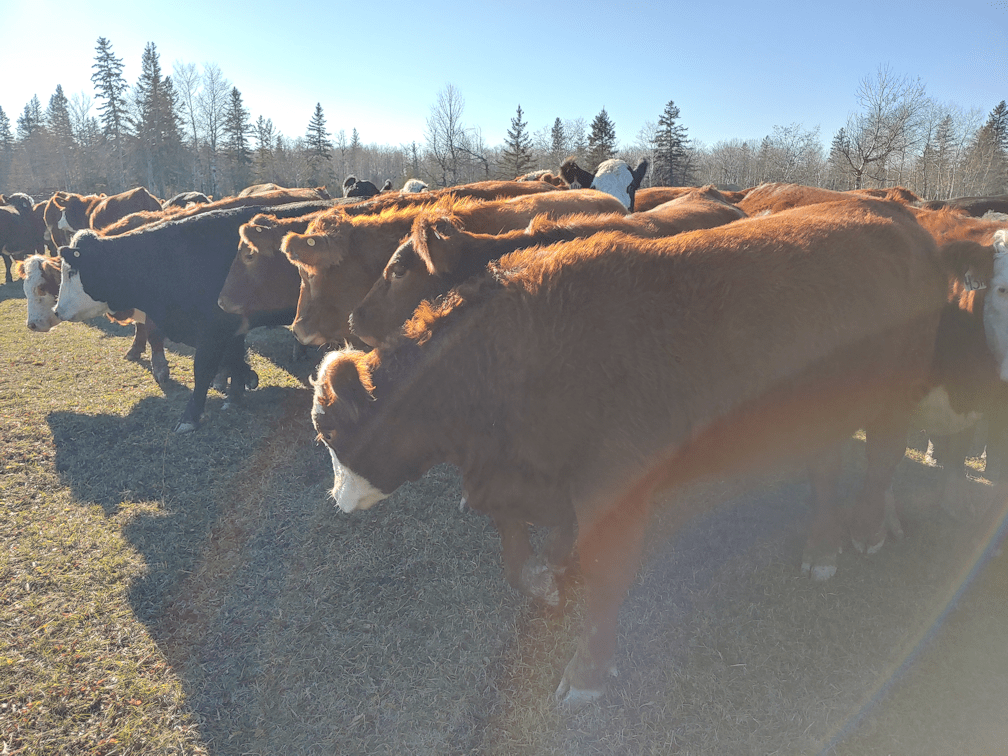
While we were walking around, the cows were intensely curious about us humans – and looking for another grain treat!

Just look at those adorable faces!!

Unfortunately, they were a bit TOO interested in Tiny Human, who was starting to get scared. With just cause. Cows may look docile, but they can be aggressive and dangerous to an adult, never mind a wee one. Tiny Human was much more comfortable being carried by Mom!

I took the opportunity to tell her about where we are looking to put a fence through the old hay yard, so we can plant trees for a wind break against the south winds. She let me know that they will likely take out the old fences completely, and put in new, because of the cows getting through so often. We also talked about redoing the fencing around the septic field, so we can still access it from our side, rather than filling in those gaps the cows got through this time. She said she would pass on the things I brought up, and hopefully her husband will soon be able to find the time to come over and we can do a more thorough walk about and discuss it in more detail. They are such good renters. With all our long term plans, I don’t want to be doing anything to make it more difficult for them. That’s part of why I wanted to make sure they knew about where I want to add the fence and plant a windbreak, since it takes away some of the land the cows graze in.

So, all in all, it turned out to be a very productive day, on several levels. :-)

The only down side, is we how have to replace a garden fork. :-D

The Re-Farmer

Back Tracking a Bit, and Looking Ahead

A while ago, my daughters cleaned up the beds in the main garden area while I worked elsewhere. I’d asked for photos, but thought they’d forgotten to take any. One of them, however, did remember to get before and after pictures, and recently passed them on to me.

So here is some of the cleanup done by my daughters, almost a week ago.

This first bed had two types of onions in it; the yellow onions we stared from seed that actually survived the cats, and red onion sets. Before those were planted, a row of… Hmm. I’ll have to check back. I believe it was the purple kale that we got as free seeds from Baker Creek that got planted down the middle. If anything germinated, something got to them before we ever saw them.

As the onions got harvested later, the bed was left empty when they were done. It had been weeded as much as I could, between the onions, while the onions were growing. This turned out to be one of the easiest beds to clean up and took them very little time.

This is one of the three beds that started out with spinach. After the spinach was harvested, they sat empty until the heat waves finally passed. On the left of this bed, I planted radishes and … gosh, I can’t remember, but it was another cool weather crop. Neither survived the grasshoppers. Eventually, we planted some lettuce seeds that had spilled out of their envelopes and got mixed up. They turned out to be mostly one type; Merlot, I believe they were called, with a couple of buttercrunch that we got as free seeds from Baker Creek. We were able to add a mesh layer over the chicken wire cover on this bed, so they survived. Unfortunately, after a while, the lettuce leaves got very bitter and nasty tasting. I don’t know why. It’s not like they were bolting, and we weren’t getting anymore heat waves, but it got so bad, we just couldn’t eat them anymore. It’s a shame, because they handled the frosts we got extremely well. They didn’t go to waste, though, and are now adding nutrients to the high raised bed. :-)

This was another bed that started out with spinach. Believe it or not, this bed got weeded quite thoroughly before I planted different radishes and one of the chard varieties. You can see the one chard that survived, surrounded by wire, in the background. Closer to the front you can see some bricks and stones that are surrounding the last couple of radishes that survived. This bed turned out to be very difficult to clean up and was thoroughly filled with rhizomes. It took so long to clean up, this was where they had to stop for the day.

Before they left, though, my daughter had gotten a before picture of this last bed. It was the third bed with spinach in it, then it got planted with the Bright Lights chard and French Breakfast radishes. The chard did well until it got hit repeatedly with frost. It handled a couple of frosts very well before finally freezing beyond recovery. There were only a couple of the radishes that never quite recovered from the grasshoppers. Like the lettuce, they got pulled and composted into the high raised bed. My older daughters were able to come back to finish cleaning this bed a couple of days ago, and it was much faster and easier than the last one they did!

Over time, each of these beds will be replaced as high raised beds. They are about 14-15 feet long, but will be reduced to 9 ft, so it will be easier to build frames for protective covers that can be easily moved by one person. We will keep using the dead trees we clean up from the spruce grove to build the beds for as long as we have enough of them. That should be enough to do the remaining five beds. That will leave us room to do a second row of high raised beds, if we choose, but by then, I think we will no longer have enough wood from dead spruce trees to use. We shall see. It’s a big job that is going to take a while to do. In the spring, we will plant into these beds as they are, but now that we have a chain saw, I expect to be able to cut down the dead trees and cut the lengths we need in advance, so that in the fall, we will just need to assemble them.

To get the height of our first high raised bed, we used eight 9ft logs and eight 4 ft logs. With five more beds to build, that means 45 nine ft logs and 20 four ft logs. It took us most of four trees (including one that was smaller than the three we cut from the spruce grove) to make this one bed. The remaining trees that need to be cut are all quite large, but if we assume four trees per bed, that means we’ll need 20 more trees to do the remaining beds.

We have more than that many dead trees to cut. It will only be a question of how solid they are, or if they have rot or ant damage to the trunks. A few of them are so big that I would want to split the logs cut from the bases of the trunks, lengthwise, and use them at the very bottom of the beds, so they’re not too thick. If the wood on all the remaining trees is sound enough, given their size, I am thinking we will probably need closer to 15 trees to finish the beds rather than 20. Considering we have probably another 24 dead trees to cut, that just means more beds we can build!

Just thinking of having a whole row of high raised beds here makes me very happy. I can hardly wait!

The Re-Farmer

2022 garden preparation: fixing up the tomato bed

Today, I took advantage of the lovely, warmer than forecast weather we are having, to clean up and redo the tomato bed.

Here is how it looked when I started. This is a new bed, built this spring, and I was very happy to see how deep and strong the roots on the tomato plants where, when I pulled them. I also saw the biggest, fattest worms I’ve seen this year!!

There were two goals to redoing this bed. One was to make sure the soil didn’t go through the chain link fence. When the bed was build, we laid cardboard down on the grass first, with the flaps up against the fence. That cardboard is pretty broken down now. We had to top up the soil part way through the year, and boards I’d scavenged from the barn were used to keep it from going through the fence. The other goal was to use the bricks to create a little retaining wall around the bed. When watering the tomatoes, no matter how gentle we tried to be, soil eroded into the path, exposing roots. Especially at the end by the vehicle gate, which got even more soil added to try and combat the erosion.

The first thing to do was move the soil away from the fence and pull up the boards. Then I went back along the fence with a hoe to make it as even as I could.

The boards were then put back, this time to fit in between the fence posts. Each section got one full length board, plus another cut to about 3/4 length. I snagged an extra board from the where the cucamelons were planted, on the other side of the people gate, to have enough.

The chain link fence is kind of wobbly, so I used the left over sections of board and placed them at the “seams” between each pair of boards, to support them from the weight of the soil.

Then, in a couple of sections, I also hammered pegs into the ground on the outside of the fence, for extra support.

That done, it was time to start working on the bricks.

First, I had a decision to make.

Should I make the bed two, or three, bricks wide?

I decided on two and a half!

This way, not only would the bed be a comfortable width, but there would be no corner to catch a foot on. Because I just know that I’d be doing that, constantly! :-D

Once that was decided, the soil was moved out of the way and the space where the bricks would go, leveled as well as I could with a hoe. Then the bricks were spread out along the length of the bed.

Would I have enough? It did look like it, but I wasn’t completely sure.

The next job was to use a garden claw to loosen the soil where the bricks would go, so I could push them down a bit. Not too far, though, because I didn’t want to lose any height.

By the time I reached the end, there was a gap of about two inches, so I just moved the bricks at the end to fill it!

Then is was time to level off the soil. This was also the time to pick out any remaining weeds and roots.

Then I went over it with a hose to wash the soil against the bricks and boards a bit more, and clean off any soil that got on top.

The final touch was to mulch the whole thing with leaf litter.

This bed is now ready for next year!

The tomatoes did so well here, we might use it for tomatoes again next year!

The boards and bricks around this bed are temporary. The wood will rot away, and there bricks are just sitting on the ground. At some point, we plan to get to the salvage place and see what sort of bricks and blocks we can find. Maybe even some paving stones. Once we have the materials, the path will be laid with bricks or paving stones, and the bed itself well get framed in a more permanent way. Until we are able to do that, though, this will be enough to keep the soil in this bed from washing away when we water it.

I was pretty much done when the girls finished their stuff inside, and came out to work on the last bed in the main garden area that needed to be cleaned up.

Since we have the straw bale now – and the chipper/shredder – I am thinking of running some straw through the shredder and using that to mulch the top of these beds over the winter.

Aside from that, these beds in the main garden area are now all done and ready for next year.

I’m pretty happy with how these are turning out!

The Re-Farmer

High raised bed – it’s done!

Oh, my goodness, what a difference having that new chainsaw made!

But before I could break it in, I needed to drag down the stuck tree, so I could use the wood in the high raised bed. Thanks to my husband very securely attaching the hooks I got to the rope I got – rope rated to 450 pounds – it was a simple matter to use the van to pull it out.

My goodness, where those top branches ever entangled! When I started pulling it, it didn’t fall, but stayed stuck until I got far enough that the tree was no longer dragging on the ground, but lifting up. At which point, it rolled up and got dragged over the compost ring, then finally it broke free from the branches and dropped.

Right on the cherry trees we are intending to cut away, so there’s no loss there!

After replacing a large divot of sod that got dragged out, I then used the baby chain saw to start cutting away the branches, and cutting away the top of the tree.

Then it got rolled onto the compost ring, so the rest of the branches could be trimmed off.

Finally, it was time to break out the new chainsaw!

Of course, I took the time to read the manual, first, then added chainsaw oil to the reservoir.

Then I measured out and cut a pair of nine foot lengths from the tree trunk.

The bucksaw does a great job, but the chainsaw did in mere seconds what would have taken me probably 5, maybe even 10, minutes, per cut, by hand!

Then, while I dragged the logs over to the high raised bed, I helped a daughter move the rest of the tree trunk aside, so they could set up the wood chipper. They cleaned up all the dead branches from the tree, as well as the little cherry trees we’d cut away to access the last tree we’d cut down.

They spent more time prepping the branches to fit the chipper and shredder, than actually doing the chipping and shredding! Unfortunately, the little spruce branches were so twisted, they ended up clogging the shredder chute to the point that my daughter had to take it off to unclog it. Once that was cleared up, they did a few celebratory shreds before heading inside to start on supper.

Meanwhile…

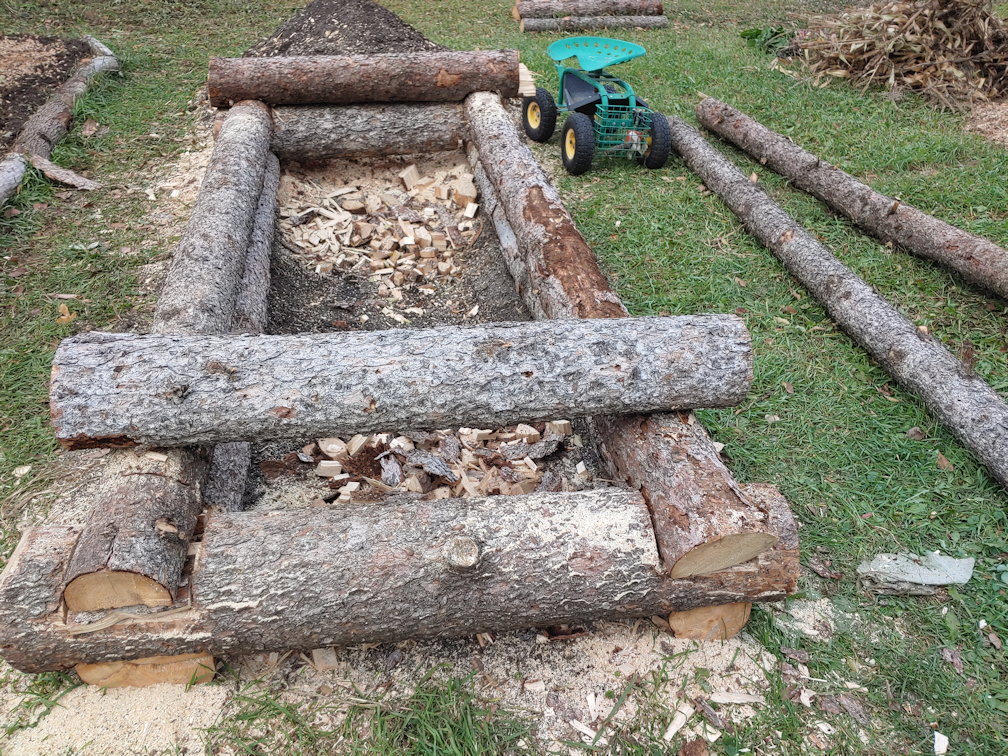
I started working on the high raised bed by first taking it apart! I cut away the notches in the base logs so that the cross pieces would sit lower, and no longer have that gap that was there before. I also was able to clean up the cuts and make adjustments, as needed.

The new nine foot lengths were thicker than I thought, so after I put the bottom cross pieces back, I used the new logs for the next level.

I ended up not needing to cut notches in them at all. Instead, I was able to just adjust and cut the notches in the next level of cross pieces to fit.

It was SO much faster and easier to cut the notches with the chain saw! Pretty much every notch we’d cut before needed modification.

I used smaller, thinner, logs at the top, which turned out to be a pain. These are from higher in the tree, which meant they were not as straight, and had more little branch stubs all over. I ended up having to trim logs along their lengths to get rid of lumpy bits, so things would sit against each other better.

Then I went and cut two more four foot lengths to do the last cross pieces.

There we have it! The high raised bed is built!

Standing next to a corner, it’s just barely reaches my hip. For mobility and accessibility purposes, we could probably have gone higher than this, but I think this will be fine.

Now, we just need to fill it! We’ve got old logs for the bottom, with corn stalks, leaves, grass clippings and garden waste to layer in. I’ll add thin layers of soil in between each layer of organic matter before topping it off with soil for about the depth of the top logs.

That will be a job for tomorrow!

I may have had to juggle the budget a bit to get that chainsaw, but it was worth every penny. There is no way I could have finished this today, without it. In fact, I have my doubts I would have been able to finish it before winter, at the rate things were going!

About the only other thing we might end up doing with this is maybe get some short pieces of rebar, drill holes through the top couple of logs and set the rebar in them to really make sure the logs stay in place.

It’s really a horrible, messy, slapdash job, but it will still probably last us many years.

Now we just need to cut down more dead trees, so we’ll have the material to build more!

The Re-Farmer

Our “second bathroom” – little details

While things were still pretty wet from rain this morning, I used some of the stuff I picked up yesterday and worked on the outhouse.

The chain latch was something we already had in the basement, and the handle was something I picked up yesterday. I got a second one that I put on the outside of the back door into the garage, so I don’t have to pry that open with my fingers anymore. :-D This door is kept closed from the outside by a piece of wood that spins on a nail in the door frame. Turn the wood over the door and it holds it closed, rotate it 90 degrees and it basically just pops open. When we get around to replacing the hinges and rehanging the door so that it is straight, it should close better again, but for now, it needs a way for the door to stay closed while someone is inside!

I didn’t find the switch plate LED light I was after, so for now, I just screwed in a cup hook and hung the LED light I’d already brought over for use in here. You can see the sunlight on the wall from the door – and the reflected light from the mirror, too! The switch plate light I’m after can be mounted either with screws that fit into slots on the back, or with self adhesive velcro strips. When it’s mounted, we’ll use it to cover the hole I made with the cup hook, and the hole left behind by a nail from before. I was going to put the cup hook in the pre-existing hole, but it seems that there is a piece of metal broken off inside the hole!

There was enough light in here with the door closed that the auto-flash did not turn on when I took the photo. :-)

The main thing I wanted to do was add the second shelf, not that I have brackets for it.

Of course, if there is a shelf, there must be something on it!

I rifled through the garage again and found these miniature picnic tables. I believe they are condiment holders. They have larger holes cut into the table tops that look big enough to hold those round mustard and ketchup squeeze bottles, and a pair of smaller holes look like they could hold salt and pepper shakers. There were a few of the same flowers I used to decorate inside the mirror cabinet, left in the garage, so I grabbed them, too.

It occurred to me while I was working that the paint I picked up to do the lettering on the sign would be perfect for the floor in here. I’m in no hurry to do the lettering, so the floor boards will probably not get painted until spring.

I had been concerned that things would start raining again, but the sun came out while I was working on this, which meant I could get the stuck tree dragged down, and finish the high raised bed!

That will be for my next post. :-)

The Re-Farmer

First time canning, and garden clean up progress

Just a bit of catching up on how things went yesterday.

The short version: Long.

It went long. Very long!

For me, it was working on pickling beets using the water bath canner. Until now, we have only done refrigerator canning, and my only experience with water bath canning was helping my mother, as a child. This is the first time I’ve done it myself, from start to finish.

It took WAY longer than I expected!

I have a Ball cookbook of canning recipes. The pickled beets recipe was for a half dozen 500ml jars. They had the basic pickle recipe, but also variations. After looking over our quantities of beets, I figured I could do two batches, with one batch being a “sweet pickle” using cloves and cinnamon sticks instead of the pickling spice mix of the basic recipe.

One batch called for 10 cups of beets. I decided to use up as much of the little beets as I could. Since they would be blanched and trimmed, and their small size would pack tighter than cubed larger beets, I made sure to grab more than 10 cups. I figured, if there was extra, we could just include them with supper or something.

While the first batch was blanching, which filled the blanching pot I found stored in a barely accessible space in the kitchen, I prepped a second batch to blanch. At the same time, I cooked the liquid with the pickling spice bag, and had everything ready to do the sweet spice version.

I was all ready to can the first batch, when I realized I had a problem.

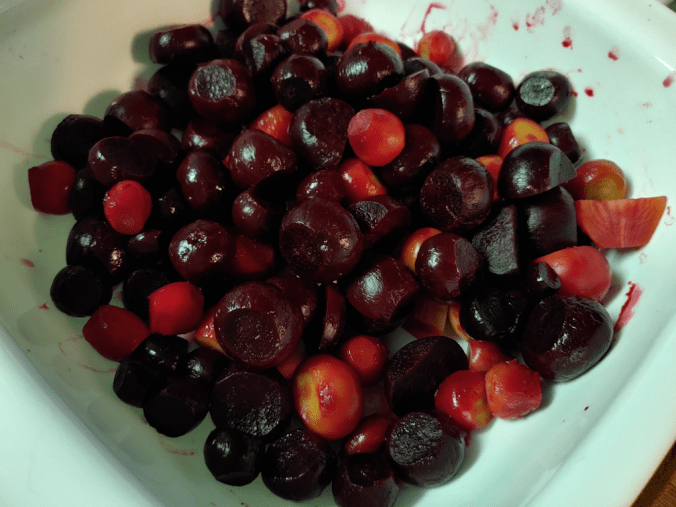
These are the first batch of fully prepared beets.

I doubt I could have filled three jars with that, never mind six!

So I added the second batch.

I still wasn’t sure there would be enough to fill the six jars I had prepped in the canner!

The next step was to put them into the pickling liquid and bring it to a boil, then start filling the jars. After my first jar, I realized I would likely have another problem. Not enough liquid! So I started the spiced version going and continued. I ended up being able to do only four jars with the basic pickling liquid, and the last two got the sweet spice version.

I started working on this before my daughters headed out to work in the garden. They came back four hours later, and I was JUST reaching the point where I actually start putting beets into jar. Most of that time was spent scrubbing beets, blanching beets, removing the outer skins, trimming the tops and tails, and waiting for water to boil.

I know “a watched pot never boils”, but my goodness, it takes a long time for large amounts of water to come to a boil!

But, if finally got done! Our first time canning AND our first time canning our own produce!

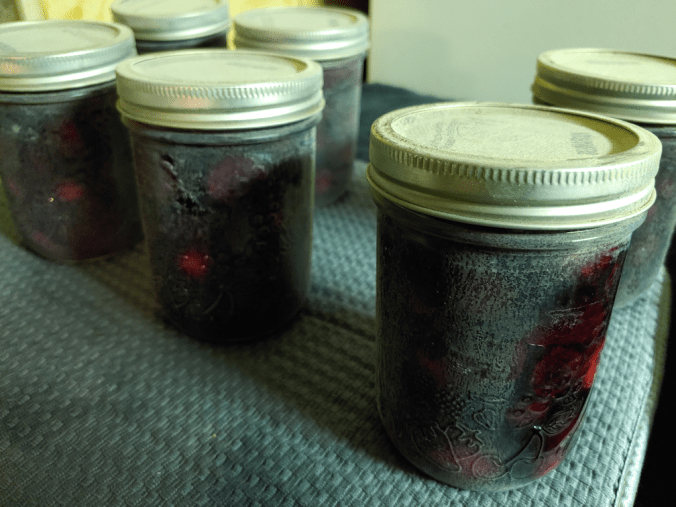
Pulling my first jar out of the water, though, was a bit of a surprise.

I mean, I know our water is hard, but wow! For the jars to come out with a layer of scale like this is crazy! You can see on the jar on the far right, where I wiped some of it with a paper towel. They’re going to need to be washed!

I finally had a chance to remove the rings and check the seals, just a little while ago, and they all came out fine! I made sure to keep track of which ones had the different pickling liquid, for when the scale gets washed off and they can be labelled.

Except the jars we open to taste test! :-D

By the time I was done, it was full dark, so it wasn’t until this morning that I could get a photo of the girls’ hard work outside.

They got three of the four remaining beds in the main garden area done – and most of that time was spent on just one of them! The first two weren’t too bad, but the third one was filled with crab grass, and it took them ages to get as many of the rhizomes out as they could!

I am amused by all the cat footprints in the loose soil! :-D

I’m glad they were able to get these done. Today turned out to be a write-off for outside work, but I will cover that in my next post. :-)

The Re-Farmer

Our 2021 garden cleanup: progress and plans for the day

I worked on some of the garden beds yesterday, until it got too dark to keep it up. Here is what I managed to get done.

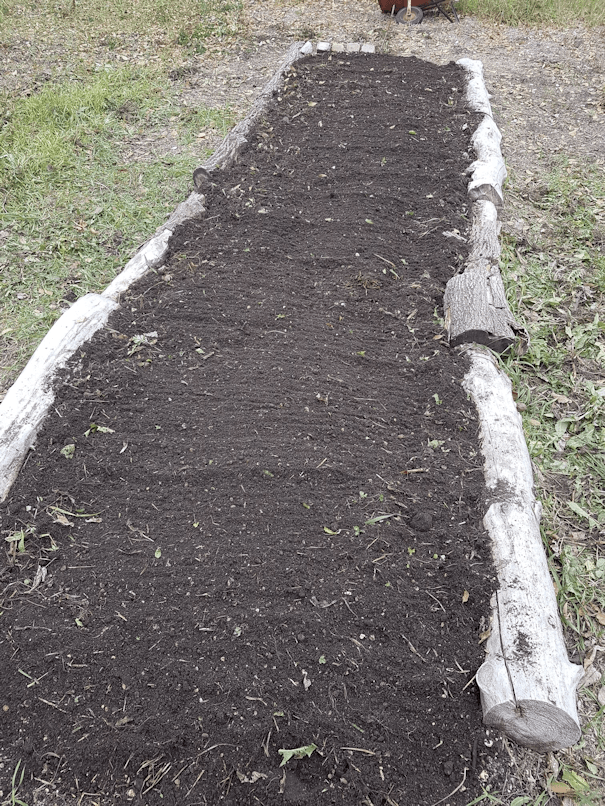
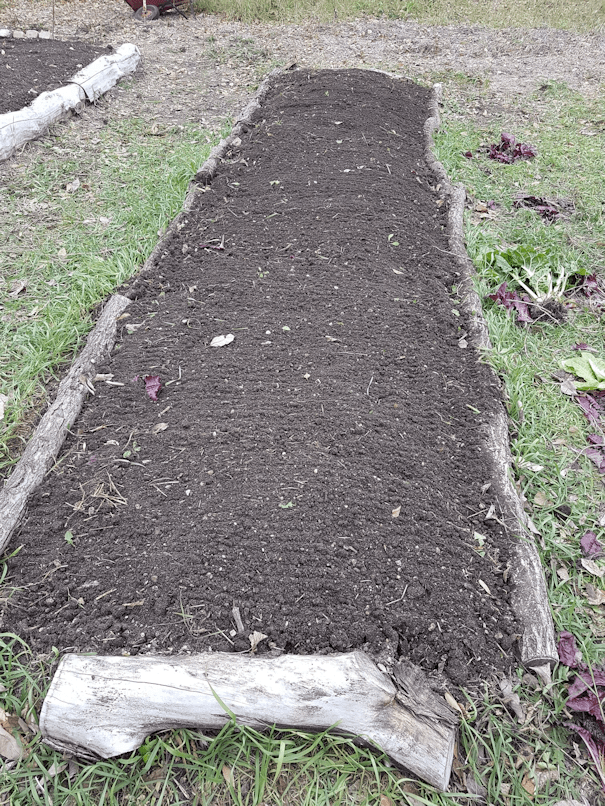
The first bed I worked on was the beet bed by the garlic, as this one will be getting a box frame soon. I started by removing the bricks and rocks around the edges, some of which you can see in the background.

I had to come back this morning to get a picture of this area. The beet bed had a row of red bricks along one side, which I moved over by the tomato bed. Then I went around the house and yard to pick up all the red bricks I could find and brought them over. When this bed gets cleaned up, we’ll re-do the boards along the fence, so that they fit better between the fence posts and line the entire length of the fence, to keep soil from washing through the chain link. The rest of the bed will be framed with these bricks, to keep the soil from washing into the path.

Amazingly, even though the vines are quite dead, there are still tomatoes ripening. I did not expect that, with the temperatures we’ve been having!

The beet bed then got weeded, and lengthened to match the garlic beds. I also moved the soil more towards the middle. I will not be digging out the soil to do the layering like I did with the others on this one. We only have wood enough to make a box frame one board high, so even though the boards I found are wider than the ones used in the other beds, it still won’t make a bed as deep as the others. This bed also got layers of material buried in it as it was made this spring, and quite a lot of the new garden soil was added, so it won’t need as much material to fill it. Once the box is built, it’ll pretty much just be laid over the existing bed. About the most I’ll do is make a “foundation” of old boards, like I did with the other two beds. Once that’s in place, I will make a trench in the middle of the soil and bury more organic material from the compost pile, but that’s about it.

The next area I worked on was a quick job. I just had to spread out and level the soil from the potato bags (and even found a few missed potatoes!). Nothing fancy is happening here. There are some lilies that need to be broken up, and they will be transplanted here.

The last spot I worked on before it started getting too dark was where the poppies had been. One of the things my daughters and I observed over the summer is that we needed to make areas to walk through, without stepping on plants. So at one end, by the rhubarb, I used the flat stones I found under the old wine barrel planter along the spruce grove as stepping stones. The rhubarb covered the poppies that had been planted near it, so I’m considering transplanting those somewhere else completely, but that won’t be done until the spring. We have only three interlocking bricks, so I used them as stepping stones at the end nearer the laundry platform.

The poppies that were here would have self seeded, which my loosening of the soil would have disturbed, but that’s okay. I did harvest a few little pods. I will broadcast more seeds some time over the next few days, then do it again in the spring. Once they have established themselves, this should end up being a permanent bed for Giant Rattle Breadseed Poppy. I do plan to get another variety of edible poppies I found from a Canadian source, but those will be planted in a completely different area.

So that’s as far as I got, yesterday evening. Today, I won’t be working on the garden clean up at all. My daughters will be working on that, later today. It’s supposed to warm up a bit more, but I’m really hoping the winds will die down. They made things quite bitter while I did my rounds this morning!

I’ve asked them to take before and after pictures for me. :-D

As for me, I have decided that I will can some of our beets. After going over my recipes, we do have enough to pickle. My daughter has been doing refrigerator pickles with the summer squash, which is great, but they take up a lot of room in the fridge, so I want to do water bath canning, so they will be shelf stable. I should at least get a half dozen 500ml jars.

I’d better get started!

The Re-Farmer

Our 2021 garden: cleanup up and high raised bed progress

While I was working on the garlic, my daughter did a whole bunch of clean up!

She pulled the Dorinny corn stalks that were next to the squash tunnel, then pulled all the squash, gourds and melon. Aside from the sunflowers, which we will be leaving for the deer to nibble on in the winter, we just need to weed and prep the beds that will be used next year, and put away things like the bin we keep tools and supplies in, empty the rain barrel and put it away for the winter, and take down the last of the critter barriers.

Then she pulled all the purple corn stalks, removed the three layers of barriers we had around the Crespo squash, and pulled those, too. I’m not sure what I’ll be doing with the corn block. There’s some very good soil there. It would be good to plant some sort of legume there, next year, to replace the nitrogen the corn used up. As for the squash hill, that’s something else I’m not sure what do do with. When we plant squash again next year, I want it to all be on the other side of the main beds, where they get more hours of sunlight.

What a sad sight. The Crespo squash had recovered so well from the critter damage! I definitely will be trying these again – with critter barriers, right from the start!

Once I finished with the last garlic bed, I pulled the frozen chard and the remaining radishes we’d hope to grow for pods.

All those radishes we planted, and these are the only ones that survived the grasshoppers!

It’s a shame we don’t have chickens. They would have loved all the greens we pulled today! Not that they will go to waste. They will get buried in the beds as we prepare them for next year. There are still four more beds in the main garden area, including the one with lettuce still in it, to clean up. The lettuce is handling the overnight cold very well, but they have become very bitter tasting, so they will be pulled. Of course, there is still the high raised bed to work on.

I had company while I worked on the garlic. The cats do like the high raised bed. I’m sure the wood is much warmer on their toes than the ground. :-)

My daughter was able to help with the high raised bed this time. She finished making the notches on the next end piece, in the background, while I cut another 9′ side piece from the last tree we cut down. She does not like using the baby chainsaw, and much prefers a hammer and chisel, so I started on the notches on the end piece in the foreground, until the second battery on the baby chainsaw ran out. By then, it was starting to get dark, so my daughter finished up the end piece she was working on and we called it a day. You can’t see the cuts I made on the end piece in the foreground, as I rolled the log onto them. They make it less likely to roll around, should the cats decide to climb all over it again.

The side pieces that are waiting are from higher up in the tree trunk, and quite a bit thinner than the other logs. Almost too thin. Since we will probably make this bed four logs high, I am thinking I should wait until I have thicker logs to use, and save the narrower ones for the top row. The tree that’s still stuck on the branches would give me logs that are just the right size – if we could get it the rest of the way down! :-D It’s either that, or find another dead tree to cut down. The problem with that is, most of the trees that need to be cut down are all really huge. They might be too big!

As glad as I am to have so many dead trees available that are still solid enough for this project, I’m a bit sorry to be using them. These are the trees we intended to use for the walls of the cordwood shed we plan to build as an outdoor bathroom. It’s possible, however, that we will be able to get a load of cast-off electricity poles. These are the remains of poles that broke in storms or had to be replaced for some reason, and we’re on the mailing list with the electric company. They don’t come available often, and not always in our area, but these are cedar poles and would be much better to use for cordwood walls than spruce. So maybe it’s for the better, that the dead spruces are being used to build high raised bed gardens!

The Re-Farmer