Clean up: our “second bathroom”, part one

Today turned out to be a very pleasant day, weather wise, so I used it to do a job that I’ve been avoiding for a long time.

I started cleaning up our “second bathroom.”
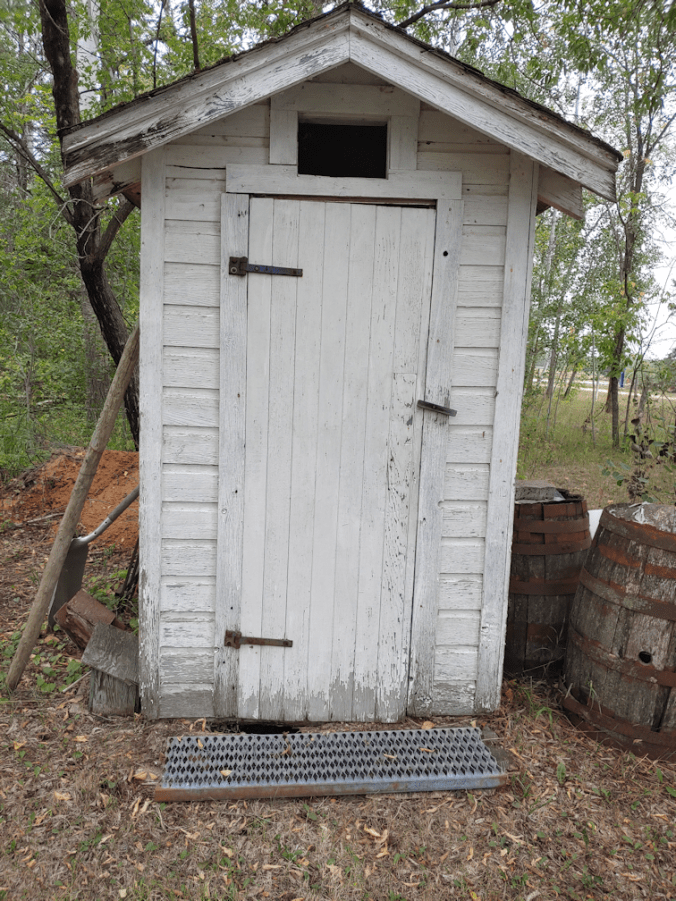
Yup.

The outhouse.

Now, we do have plans to build an outdoor bathroom that can be used should we ever lose power or water. We are wanting to build a cordwood practice building, with the intention that it will have a composting toilet in it, and no pit under it. That way, in the future, it could be converted to something else without too much difficulty. We were supposed to at least start preparing the base last year, but that didn’t work out, and now I’m glad it didn’t. We have a whole lot of dead trees to cut down not far from the location we chose for it. A location that is the most open space that we would want to fell the trees towards.

Meanwhile, we have this old thing.

This post will be about working on the outside. Part two will be about working on the inside.

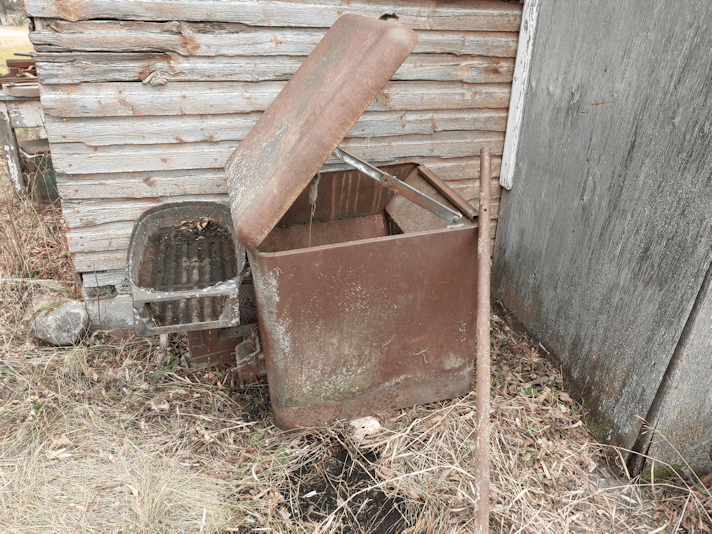
This right here is the main issue with the outhouse. I placed the metal (I can never remember what those area called!) in front of the door because it would sometimes open in severe winds, but also because of that hole.

Our first two springs after we moved here, we discovered that when the snow melted, it would pool in front of the outhouse. I was able to see through that hole that the pit would fill with water. Another reason why we want to have an outdoor bathroom elsewhere, and no pit!

One of the delays in getting this done was trying to figure out what to replace this with! I didn’t want it to be an issue again in the future, so not wood, for starters. But what could I use that would be big enough to cover the front, solid enough to walk on, yet thin enough not to block the door from opening?

Barn salvage to the rescue.
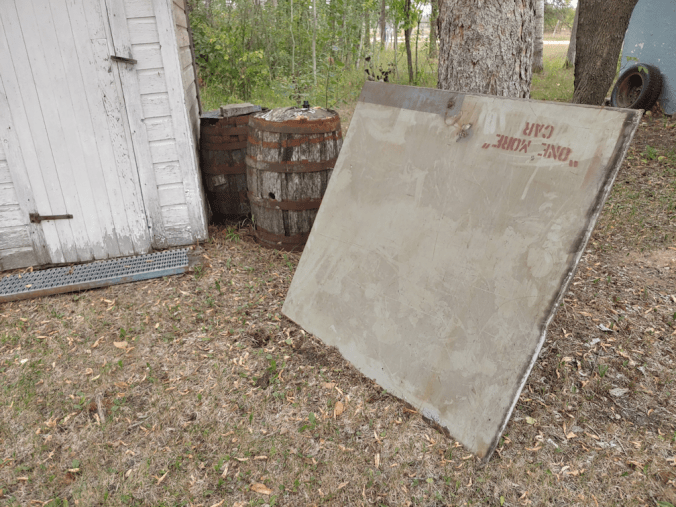
There were several large sheets of steel in the barn and, tucked in between, was this smaller piece.

Yeah. That’s the smaller piece.

Now, when I was looking at the sheets, all I saw was rust. They’re heavy, so I hadn’t moved them enough to see their other sides. It wasn’t until I was bringing this over, turning it end over end, that I realized the other side had no rust on it.

Also, it had writing on it.

What a curious thing!

Once the steel sheet was brought over, I removed the top piece that was in front of the door.
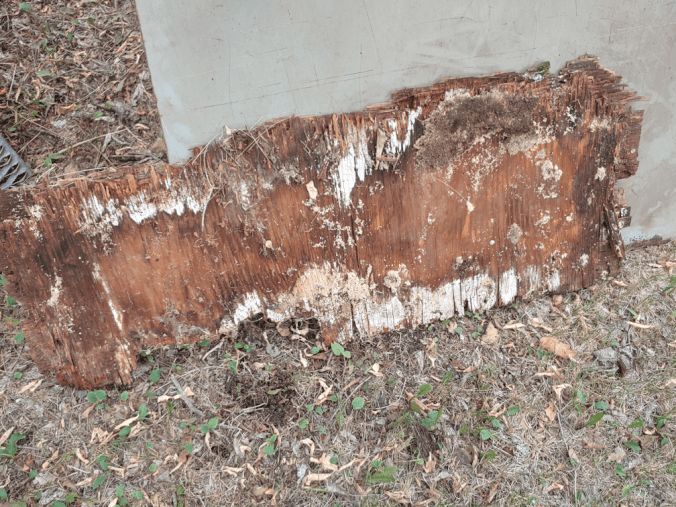
So… that’s disgusting. !!!

The outhouse is sitting on top of two large beams, which extend in front. The piece I’d removed was nailed to those beams, but everything was so rotted, there was nothing holding anything anymore.

Also, that sawdust is from ants.

Time to clean up and assess what’s underneath.
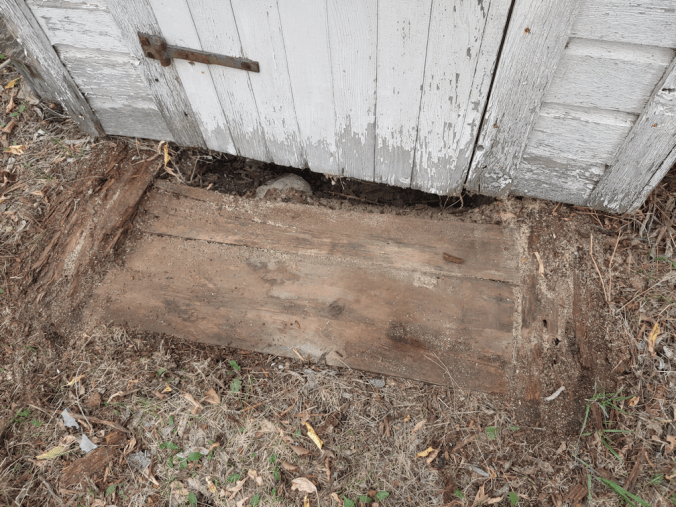
The boards I uncovered felt surprisingly solid. They were also quite thick.

And very rotten. They only felt solid because they were supported by the soil beneath.

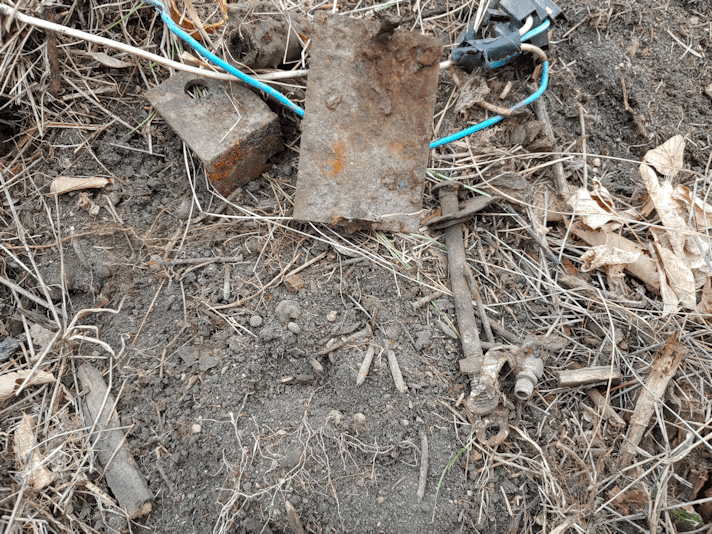
Also, that’s a very large opening under the door! It seems the edge of the pit had started to collapse. No surprise, since the pit was filling with water in the spring.

The first order of business, then, was to block that opening.

The garage is nearby, and there were some pieces of metal roofing leaning against the side. There was also a strip of what I think was the top cap for the metal roof. I’m not 100% sure, only because I’ve never seen one up close. I just see them at the top of the outbuildings we have with metal roofs.

Thankfully, we have some really heavy duty metal cutting sheers. I used them to cut the piece to fit under the door, between the two beams. The metal was already bent slightly in the middle, which made it easy to bend it to a 90 degree angle. It turned out to be the perfect width, as the top of the metal is flush with the floor of the outhouse. It will not get in the way of the door, nor be a tripping hazard.

It is also supported by that rock, so it’s not going anywhere.

There is, however, still a gap under it. Which is where the rest of the metal piece got used.

After bending it to a 90 degree angle, it also fit perfectly flush with the floor, and covered the largest part of the gap. The little bit of space under the door hinge is mostly filled with that big rock.

Now it’s time to fill the space.

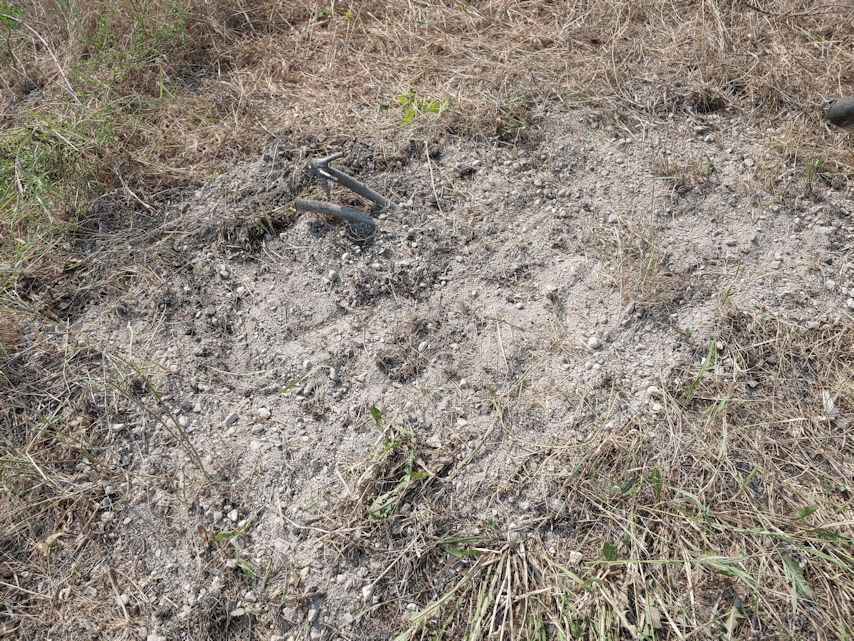
This is where I got to take advantage of the hard work the groundhogs have been doing, building their den under the junk pile, leaving some beautiful rocks and gravel for me to use!

First, I collected the biggest rocks that were visible. I also grabbed one of the flat rocks I’d found under the old half wine barrel planter I’d cleaned up from near the junk pile. That was used to cover the small gap near the big rock under the metal pieces. Then the rocks were added to keep everything in place.

Then I brought over a load of sand and gravel – and a few more larger rocks – from the groundhog den.
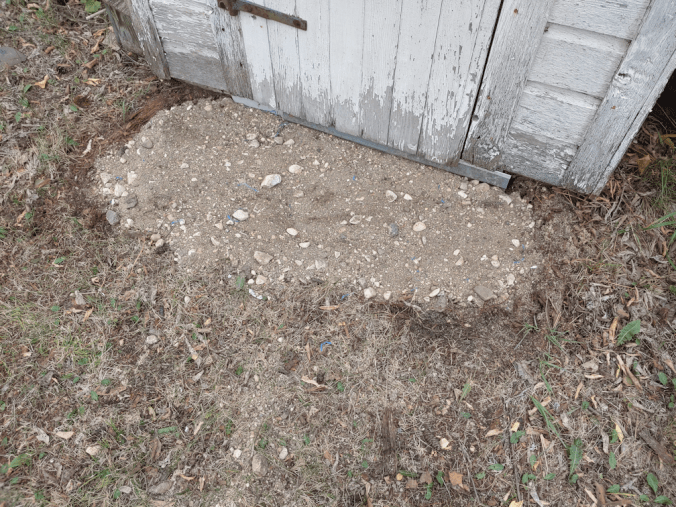
Most of it went to filling in the space left behind from removing the rotted wood and tamping it down.

The rest was spread out to go under the metal sheet. At this point, the sheet was laid down and removed a few times, until I got it fully supported by gravel and rocks, and level. I did end up having to get a bit more sand and gravel before I was done.
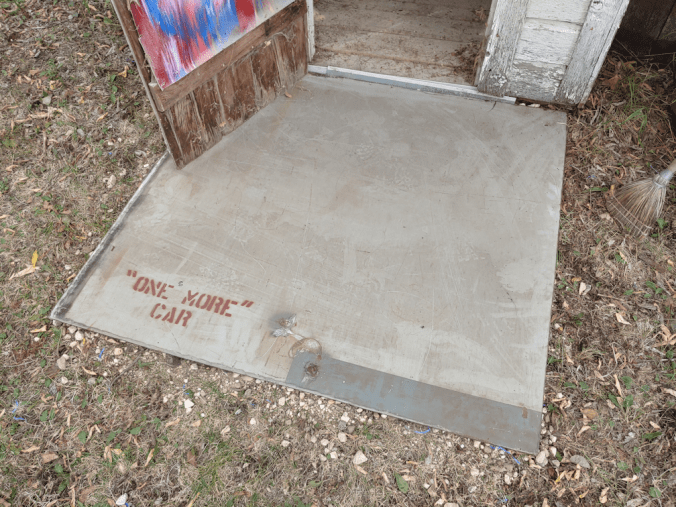
And there we have it! We can now to into the outhouse, and not worry about anything collapsing under our feet and getting hurt.

I just had to make sure the text on the metal sheet was facing so that it could be easily seen and read. I am curious as to why it says “one more” car, and why the words “one more” are in quotes, but the word “car” is not. :-D

Now that it’s safe on the outside, time to see if it’s safe on the inside!

Find out, in my next post…

The Re-Farmer

Our 2021 garden: fixing the beet bed, and last things

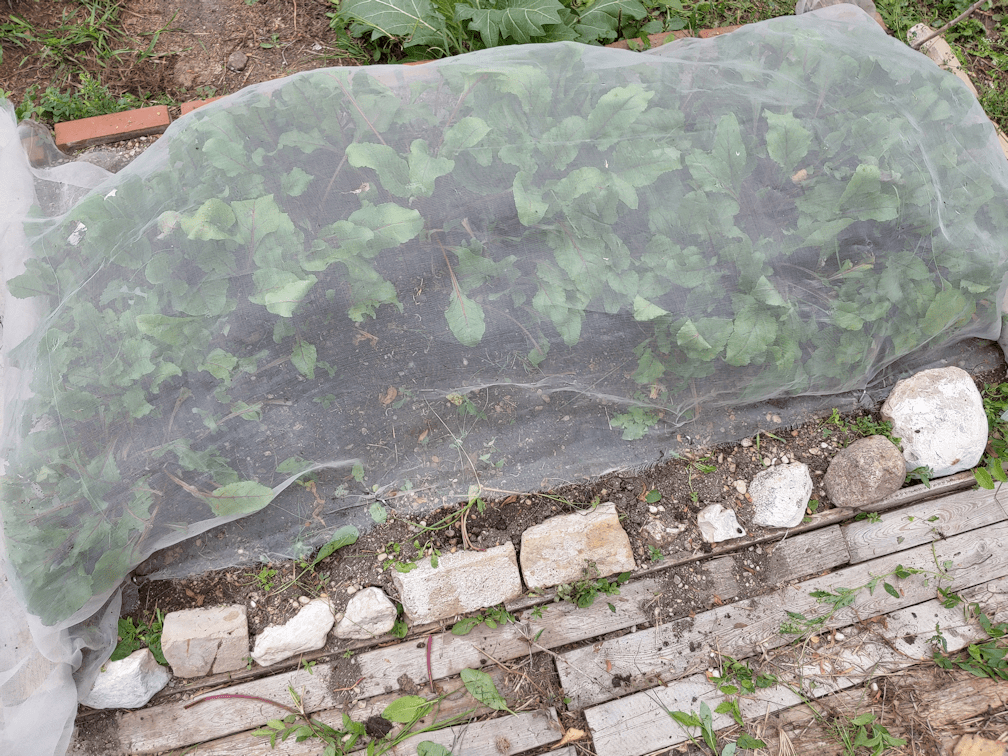
One of the things we’ve done to protect some of our garden beds from the groundhogs and deer was to use mosquito netting as row covers. The edges were weighed down with whatever was handy; rocks, bricks, pieces of wood… that sort of thing.

The beet bed near where the garlic had been planted has been recovering very well. So well that the greens were tall enough to pull the netting out from under the weights that were holding it in place, in spots.

More specifically, out from under this board and the rock that was weighing it down. A grog took advantage of the gap and had a bit of a snack.

There wasn’t a lot of damage. The netting still did its job.

I took advantage of the situation to do some weeding and pick the onions that had been planted around the beets as a deterrent.

The down side of adding the netting was that the onions were rather squished, as they were planted so close to the edges of the bed. A few ended up on the compost pile, but there were still a few good enough to harvest! These last onions joined the others that are curing under the canopy tent right now.

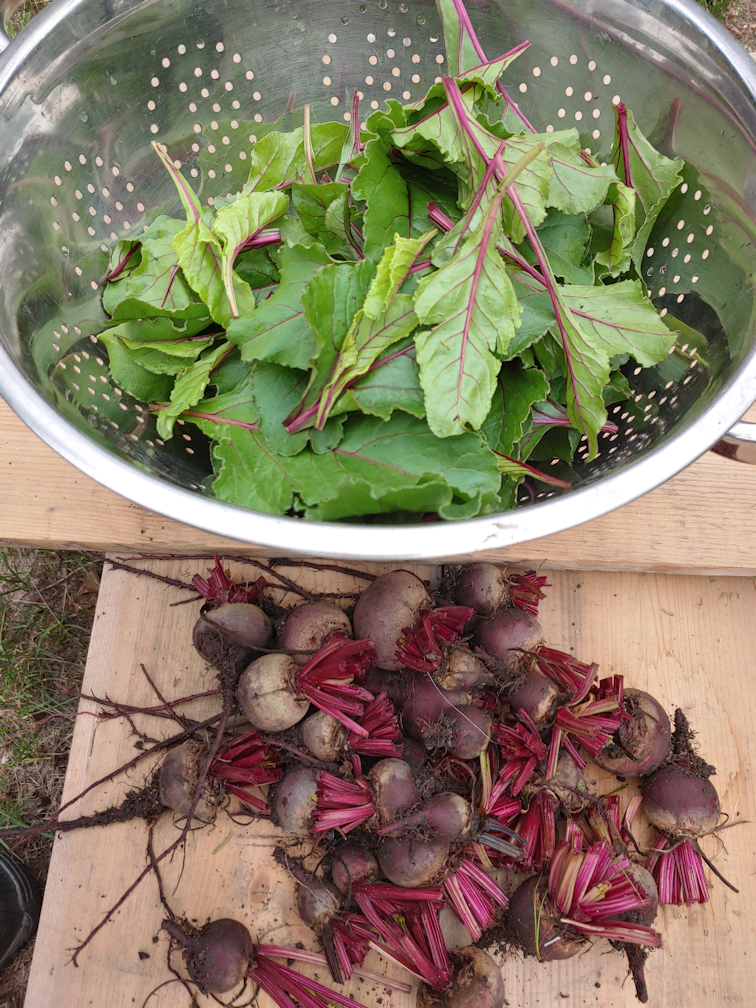
I picked the beets that had the most of their greens eaten, plus a few more while I was weeding, which left me with some greens to harvest as well.

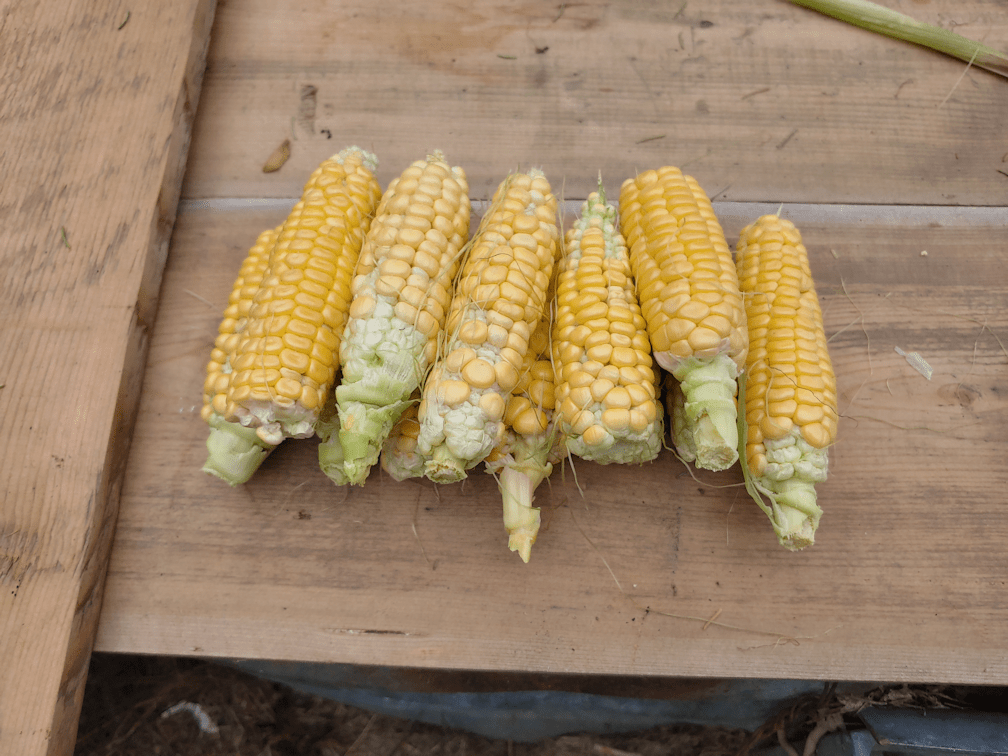
They got to join the corn I’d picked earlier.

This is pretty much the last of the Dorinny corn. There are still a few little cobs out there. I figure I’ll just leave those, and when we clean up the beds in the fall, we might have some seeds to save for next year, perhaps.

I just wanted to share how the first Mongolian Giant sunflower to start blooming is progressing, too. :-D

Back to the beets!

They are looking a lot better for a bit of clean up! There are some pretty big ones forming in there, too. It should be interesting to see what we get when it’s time to harvest the entire bed.

Then the netting was returned. I made good use of the bag of tent pegs I found in the garage, and pegged the sides down snug along the length, but close in to the beets, so that there would still be slack over the bed, with room for the beets to continue to fill out. I rolled boards into the excess netting at the ends and tucked them close under the leaves as well, so there would be no gabs in the corners for critters to get through.

The beets in the big L shaped bed in the old kitchen garden are starting to lift their floating row cover as well. I spotted a small gap where the rocks weighing the edge down had rolled off, and there are a few nibbled on greens at the very edge. There are heavier weights on either side of the gap, so a critter the size of a ground hog isn’t getting any farther. Tomorrow, I plan to uncover the bed, give it a thorough weeding, pick some more beets, then peg the netting down like this one, so it is more secure.

The beets planted against the retaining wall in the old kitchen garden don’t have this problem. They have not really recovered from when they got eaten. I think it has more to do with low light levels. That area is more shaded by the ornamental apple trees than the rest of the old kitchen garden. I’ll be uncovering them to at least weed them, and get a better look at how they are doing in the process.

As for what was picked today, the corn was added to the summer squash and teeny tomatoes the girls had picked earlier, and roasted in foil with some olive oil, granulated garlic, salt and pepper. The beets got roasted in another foil, with some chive blossom oil, salt and pepper. That way, I could roast both at the same time, in the same pan, without the beets turning the other vegetables all purple! :-D It turned out very well!

The Re-Farmer
Things fixed and things found

The first chance I got, I headed outside to take care of the bird feeders, starting with fixing the base of the big feeder.

I was able to find some longer wood screws that weren’t so long, they’d go through the wood I added to the base. Hopefully, the 6 screws will now be enough to hold! Then I got the loppers out and pruned the Korean Lilac. The raccoons have been using it to get to the feeder, and they’d already broken a couple of branches. Though they look close, the ones in the background are well away from the feeder. I also pruned some low hanging branches from the Chinese Elm in front of the kitchen window, as much as I could. Once I’d removed the weight of the first branches, the main branch lifted out of reach! Hopefully, the raccoons won’t try to use them, because their weight would bow the branches down to the feeder. I don’t think they actually used the elm at all, but I wanted to at least take away the option!

It wasn’t until I unloaded the van that I noticed the new hanging feeder didn’t have a cable to hang it from! The instructions didn’t even show one, though there were holes in the top for it. I ended up using the one from the broken feeder, so that worked out.

This feeder hold a bit less than the old one, but I think it will be easier to refill. Instead of trying to pour the seeds into a small hole at the top, the container comes out and can be used to scoop the seed. It even has a convenient handle. We shall see if it really is helpful. Unfortunately, so much seed has been lost to the breaking of feeders, we’re running out of seed, and the amount in the bin was too shallow to scoop the new feeder full.

As you can see, the birds were quick to use the new feeder!

I had the soaker hose going in the garden while I did this, and spent the rest of the evening moving the sprinkler around every half hour or so, for the evening watering. While checking on the sunflowers and sweet corn, I found proof of what nibbled on the sunflowers!

This hoof print was in the row of corn nearest the nibbled on sunflowers.

The deer managed to step right on a new pea sprout!!

I could see several other hoof prints through that corn bed, which really made me wonder how the garden cam’s motion sensor missed it! Well, if we get any other visitors in there tonight, I hope the new location will be better to catch the critters!

There are very few, so far, but it was nice to see some bigger green beans have developed.

I also checked on the sad purple peas. They aren’t as small or as chewed on as the green peas, but they certainly aren’t doing well. The plants aren’t being eaten, but the few pods are! Amazingly, we are still seeing pea flowers. With so little growth, the peas aren’t climbing their trellises as they normally would, but some of the purple peas are long enough that I would wrap them around the vertical twine. Much to my surprise, I found a couple of pods.

Dried pops.

The first one I found had three peas in the pod, and then I found one with a single pea in it.

These can actually be saved to plant next year!

I still have the envelope the King Tut peas came in, so that’s where they are now, and the envelope has been added to the packets of leftover seeds for next year.

We have officially saved our very first seeds for our own garden! :-D

In between moving the sprinkler until it was back to watering manually, the evening was so lovely and cool, I hang around outside.

With kittens.

I’ve got a camp chair set up near the steps, and was able to play with the babies a bit. They still won’t come up to me, but I can at least wiggle a stick on the ground and get them close!

From left to right is Chadicus, Bradicus, Caramel, and Broccoli, next to her mother.

While watering the south garden beds, I got to see Nosencrantz and Toesencrantz. They are much shier than Butterscotch’s babies. Not as shy as Junk Pile’s babies, though! They are coming to the kibble house for food, but if we step outside, they immediately run off in a panic, even as their mother stays in the kibble house and watches us. I don’t have much hope for socializing that particular litter!

Tomorrow I’ll be doing the morning rounds quickly again, though I’ll have a chance to make up for it before it gets too hot. I’m going to be heading out to a town north of us to do a pick up. We found a fairly local beef farm that does direct sales, and I’ll be meeting them to pick up our package tomorrow. Which is handy, since it meant we didn’t have to pick up much meat during our city shop. I got the invoice and an itemized list of what will be in the mixed pack we ordered – the contents of the pack depends on what’s available at the time – and I’m really looking forward to it. There are cuts of meat in there that we could never afford to buy before! I honestly can’t remember the last time I had a steak, never mind a high quality cut. The price per pound, compared even to city prices, is so much better! I don’t begrudge retail stores their prices; there’s a lot those prices have to pay for. Things that don’t have to be included when buying direct from the farmer. I’m so happy I found this place! I’d found another company that is further away, but does regular deliveries to meet-up locations in the city. If we’d placed an order with them now, we wouldn’t have been able to get it until November, at the earliest.

I’m really looking forward to bringing home the beef! :-D

The Re-Farmer

Not as bad as I thought it would be

While doing my morning rounds, I checked the hole by the concrete stairs under the dining room door, and was happy to see the pieces of wood we used to block it looked undisturbed.

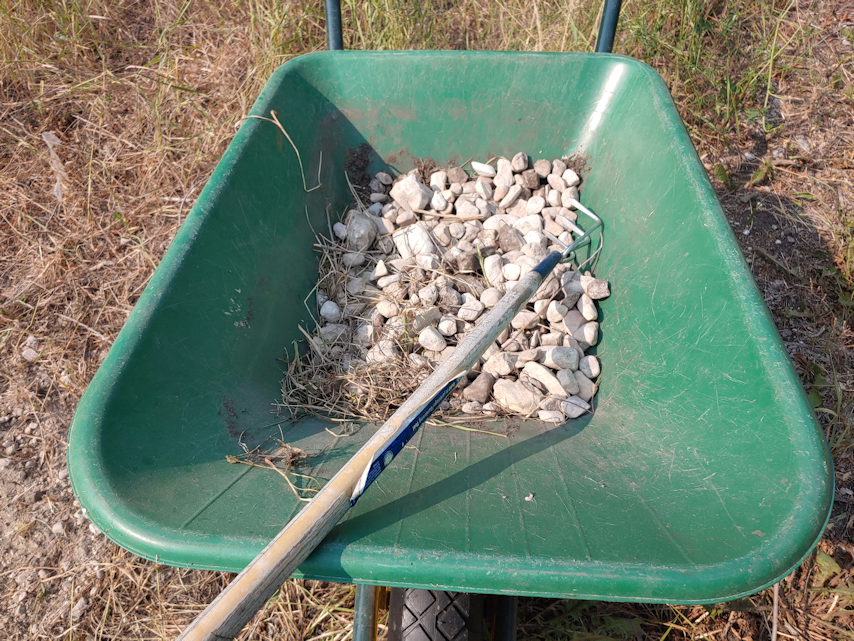
When I was done my rounds, I started working on getting that filled in, which meant I needed rocks. Since we got almost no rain at all yesterday, the garden needed watering, so I set up the sprinkler, then grabbed a wheelbarrow to start picking rocks.

Since the big woodchuck had conveniently dug up a lot of rocks for us, I started there. Last night, my daughters saw the woodchuck leaving the den, so they flooded it, then shoved some pruned branches into the opening before moving some of the soil over it.

This morning, while using a long handled garden claw to help pick rocks, I finished filling in the hold and spreading the sand and gravel out more evenly. We’ll have to come back to get rid of the sticks.

Most of these rocks were gathered from what the woodchuck dug up!

Then I just wandered along with the wheelbarrow, picking rocks as I went. Since was was using the garden claw to help moving them, I was also able to break up some of the old plow furrows as well. I picked only the larger rocks, up to a point. The biggest ones were set aside to be available for things like weighing down row covers or whatever.

By the time I got this many, the heat was getting a bit much, so I just hoped they would be enough and moved on. I could easily have filled the wheelbarrow entirely, if I stayed out longer.

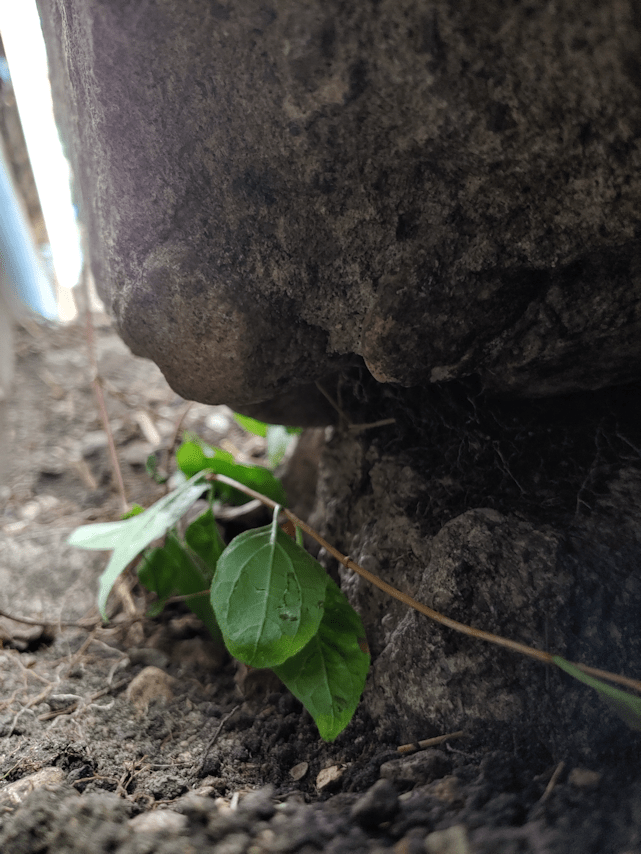
Once at the stairs, the first thing I needed to figure out was what to do with the mock orange. I didn’t want to dig it up, even though we plan to transplant it. We still need to decide where to put it. So I took a piece of plastic that had been used as a row cover and wrapped it around the back of the mock orange, then used twine to tie it up. This turned out to be enough to be able to access the hole.

While I was working on the mock orange and moving the wood to access the opening, to my amazement, I heard something scrambling out the other side of the stairs and run off. I could not beleve it! The woodchuck had somehow squeezed through the other side of the stairs!

Then came the assessment phase.

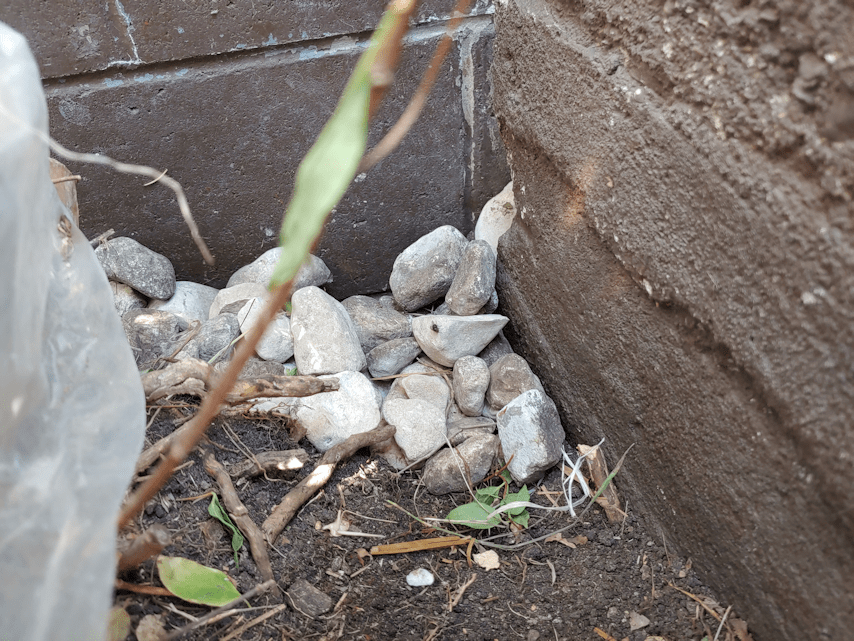
The curious thing about this hole is the lack of dug up soil piled around. So I played the contortionist as best I could, to get pictures through the opening.

This is where I found my good news. The hole didn’t go any deeper! The opening was dug just enough for the woodchuck to access under the stairs. That explains the lack of dug up soil.

What a relief!

Time to start filling with rocks!

In the one picture, I could finally see the opening to under the stairs. I can certainly understand why critters have been going under there! What a great, safe hideaway.

Which is great if we’re talking kittens. Not so great when we’re talking woodchucks!

Okay, so the hole is filled with rocks, but there is still the space between the stairs and the wall. As long as it was there, things would still try to get under there.

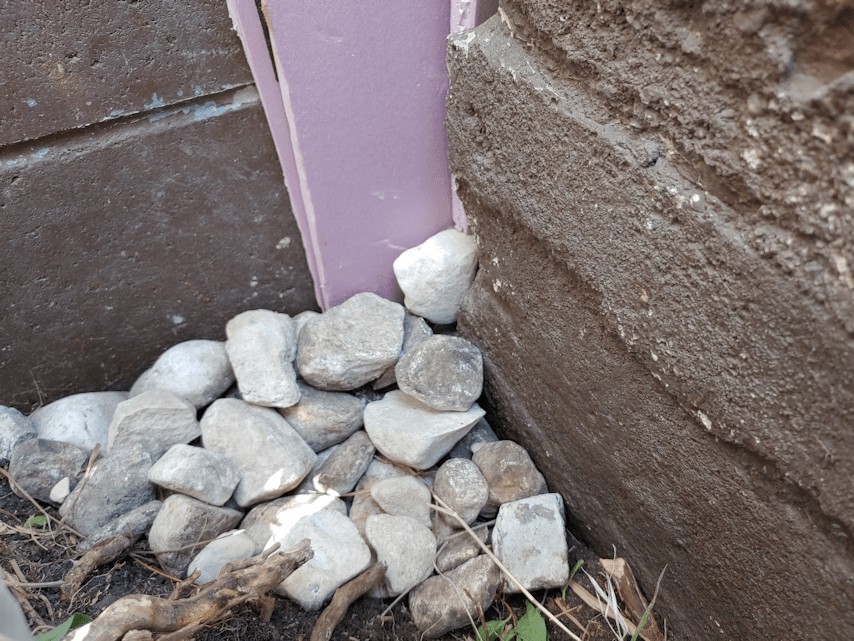
Time to raid our pieces of rigid insulation!

A couple of larger pieces were used to cover the back of the stairs, which would cover the opening under them completely. Another, shorter sheet was jammed between those pieces and the brick wall.

More smaller pieces were used to fill in the gap at the end, and rocks were piled up to secure them even more.

What looks like a gap at this end is blocked by a lumpy area of concrete.

Done!

Before I headed inside, I went to move the sprikler, startling the woodchuck that was watching from under the spirea near the stone cross!

When I headed out a while ago to move the sprinkler again, I could see that something had tried to get under again. I had to replace a small piece of insulation and push the rocks back. On the other side, something had tried to burrow in the gap that isn’t a gap, but only enough to displace some of the small rocks.

It seems to be working!

After replacing the rocks, I used those little pieces of plastic garden fencing to block it off even more.

I am much relieved that the damage was so very minor. I do wish I hadn’t had to block off the back of those stairs entirely, though. It was a really good, safe place for mamas to have their kittens.

Ah, well. Better that than having a woodchuck living under there!

The Re-Farmer

Painting the kibble house: first coat

Oh, I am so glad I got that gazebo tent!

Today, I finally started painting the kibble house. The temperatures were pretty warm. It is “only” 22C/70F as I write this, but after today, we’re supposed to get hit with another heat wave over the next week, peaking at 34C/93F, so I’m glad to get it started today. And glad we aren’t expected to see the 40-45C/104-113F temperatures that some provinces are getting hit with right now!

Under the tent, it was much more pleasant. If fact, I could forget the heat, until I stepped out into the sun for a few moments!

The first coat, I’m happy to say, is done.

Mostly.

We won’t be able to do the rest until the paint has cured enough to flip it, and the floor pieces, upside down.

The roof may or may not get a second coat. We will likely shingle it, but until we do, the paint will be enough to protect it from the elements for now.

Even with just one coat, it’s looking so much better already. My daughter chose a lovely colour. :-) This is REALLY going to brighten up the yard!

If we end up not putting on shingles, I’m thinking we should paint garish designs all over the roof. :-D

I tried to get the more reachable parts underneath, but not under the overlap of the roof itself. And not just because I didn’t want to disturb this beauty!

What a gorgeous moth!

As far as I know, it’s still there, too. :-)

I’m not sure if we’ll bother painting the underside of the roof. Maybe just around the overlap, if at all. I do want to get the inside walls, though. That will make it easier to clean up after dirty kitties! The gaps under the roof are there partly so the cats and get in and out through them, if needed. They did use those gaps over the winter, which meant muddy paw prints, all the way up the walls. :-D

I’m rather happy with out it’s turning out.

The Re-Farmer

Starting on the hinge fix

Well, for better or for worse, I’ve started working on the door hinges.

This is intended to be a temporary fix, until we can replace the door and frame completely, but I have no idea when we’ll be able to do that, so this patch job may need to last a while.

The first thing to do was to open the door as wide as possible (with a built in closet in the way, that isn’t as far as I’d like!) and place supports under it to hold the weight.

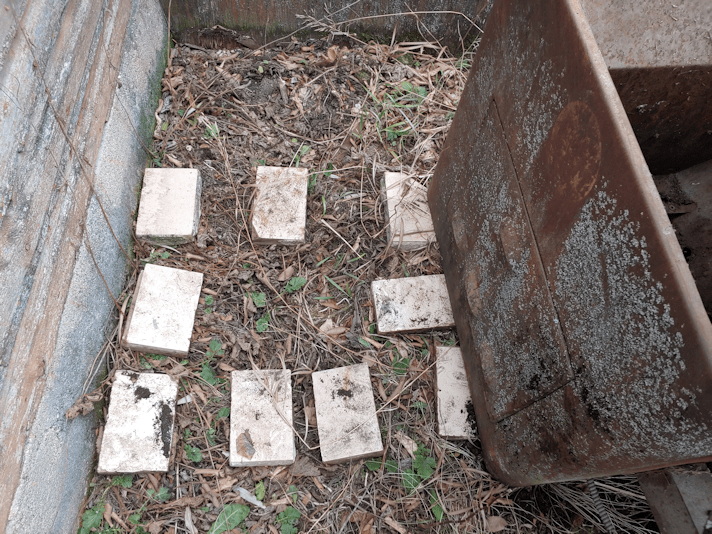
One of the things we’ve been finding lots of, while cleaning this place up, is laminate floor tiles. It’s amazing, how handy these have become. A couple of pieces of wood under the door made up most of the height, then it took 3 of these tiles to get it fully supported where it needed to be. We’ve also used them to put under bench legs and wooden shelves in the basement, to get them off the damp concrete, and so on. I’ve found a couple of cases of these tiles, just in the basement – there are more in the barn. Definitely things to keep, even though they’ll never be used as flooring! :-D

Once propped up, I could remove the screws which, I’m happy to say, were not damaged as I had thought they were. I do not have to replace the screws. I was able to remove 2 of them with just my fingers, and the only reason I had to use a screwdriver for the 3rd one was because it was the offset middle one, where the hinge wasn’t pulling away from the door as much.

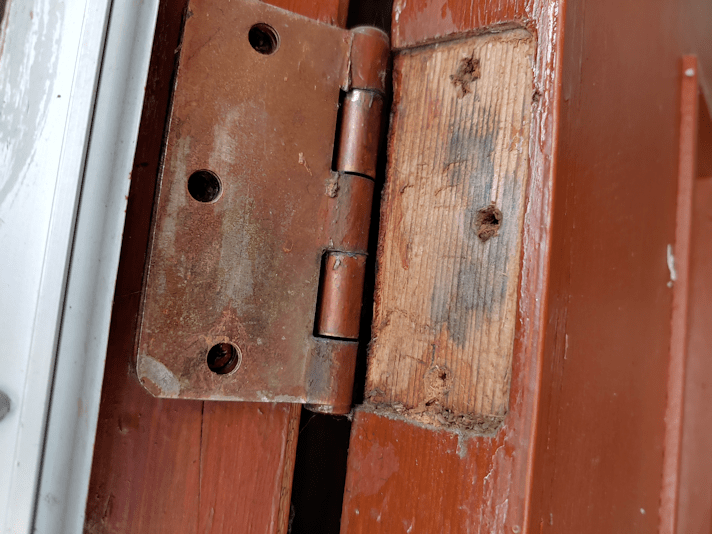
The hinge still needed to be pried loose before I could take a good look at the damage. It fits perfectly in that recess.

Because of how close this is to the frame and storm door , I actually got a better look by taking a picture, then with my own eyes!

The damage isn’t actually as bad as I feared it would be.

The next step was to bring out the Dremel to clean out and enlarge the screw holes.

The Dremel just barely fit in the space available, but it worked. I used a couple of grinding and engraving tips; first a small cone shaped one to clear out the holes, then a metal tip to clean out further into the openings than the cone could go.

The wood is so dry, there was smoke coming out of the holes from the friction!

For the wood plugs, I ended up choosing some pieces of lilac branches I’ve still got hanging around. They were already the size and shape I needed; I only had to strip bark off the pieces, then make one end slightly narrower. Also, I will need to pre-drill holes before putting the screws back in, to prevent cracking, and the core of the lilac is already little more than sawdust that can easily be removed. They’re basically already pre-drilled. :-D

I was going to use wood glue to put the pegs in, only to discover it had dried out, so I went with all-purpose glue that I happened to have.

After making sure the pegs fit into the holes, I applied a bit of glue to their ends, then gently tapped them into place with a little bitty hammer I happened to have. With a normal sized hammer, I wouldn’t have had the space to swing, without hitting the window of the storm door.

The pegs will now sit for a few hours before I check the glue and decide to cut the pegs flush tonight, or wait until tomorrow morning. If I can cut the pegs, we’ll be able to close the door most of the way as the glue finishes setting overnight. If not, we’ll be stuck with this all night…

These are the pieces of insulation we’d cut last year, to fit over the inner door, held in place with Velcro strips, to keep frost from forming on the bottom of the door, and ice on the windows. It worked well, but there were some issues with the strips, and we haven’t found a workable alternative, yet. Thankfully, this winter has had only a few days cold enough for the ice and frost to form.

The arm bar is coming handy for holding the pieces in place!

If this works out, we’ll do it again for the middle hinge. That should tide us over until we can replace it all with an insulated steel door and a steel frame.

Hopefully.

The Re-Farmer

Clean up and… there are no quick and easy jobs here!

Photo heavy post ahead! :-D

Today is supposed to be our last warmish day in quite some time, and we are very fortunate to have it. Just yesterday, a major system passed through. To the north of us, they had near blizzard conditions. To the south, it was rain instead of snow. Yet, there on the weather radar, was a clear spot in the system, passing over our area!

I am quite grateful for out continued mild weather! It gave me one last day to patch the other window in the pump shack.

Here is how it looked before I started.

In the forefront is an old forge my dad made. My brother told me he’d cobbled it together using an old blower that the tray of coals is attached to.

I’d already cut away the bigger saplings that had self sown in the area. Before I could start, I had to cut away some more, move the steel bars and that flat piece of metal with a slight curved shape to it (it turned out to be partly buried), out of the way.

I also pulled this out of the grass.

I don’t know what it is, but it’s in the pump shack now. My brother had said something about it in passing, but I just can’t remember. I understood that he felt it was worth salvaging and protecting, so that’s what I’m going.

After clearing things away, I was able to pick up all the broken pieces of glass.

As I looked more closely at the window itself, I realized it was just held in place with three bent nails. All I had to do was rotate them, and I could take out the whole thing!

So I did.

It’d hard to see, but each piece of glass has tiny little metal things holding the panes in place. They have pointed ends driven into the wood frame. The glass was then caulked to the frame, but most of that has long since fallen off, revealing those metal bits in the process.

I decided to use some rigid foam insulation to fill in the hole, as well as support the wooden pieces that were holding the remaining glass in place. I trimmed the inside edges of the insulation so it would fit more flush into the recesses of the wood.

Everything was very loose. Even the corner joins. Though the thickness of the piece of insulation would help keep things from moving around, there was still a pretty high chance other pieces of glass could fall out.

So, I got out the silicone caulking I had left and caulked it all, then put the window back in place.

It looks horrible, but it’ll do the job for now.

Here is how it looks from the inside.

Any work done on this building is just keeping it going as long as possible. It really needs to be replaced completely. Even the concrete floor is cracked and heaving. But it still keeps things inside dry, and it isn’t collapsing, like other buildings, so it’s worth it to keep patching things.

That done, I turned my attention to the old forge. Now that things were cleared away under the window, I wanted to move it next to the wall, for a bit more protection from the elements.

It had sunk into the ground and, as I was looking around to see what I had to work with, I found the plug for it! :-D

I tried lifting and shifting, and while I could move it a fair bit on one end, the end with the coal tray was much heavier. The tray itself has only two screws holding it to the metal, so I couldn’t even use that as a grip to lift.

I ended up grabbing one of the steel bars I’d set aside, using it as a lever. The ground was pretty soft, so I also tried using bricks, as well as another, shorter, bar I found in the grass, as support.

I was having a hard time getting things under it, though. There was something blocking me.

Did this thing have legs?

No!

Are those… wheels???

By now, I realized I would need to tip it over onto its side, because I just could not lever the heavy side out of the dirt and over the overgrown grass.

The coal tray had stuff on it, though, so I took that off.

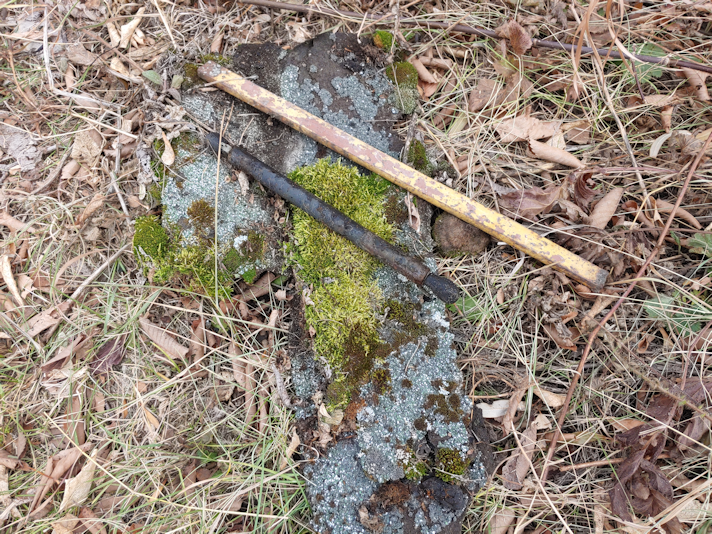
It was asphalt shingles, covering the coal. The yellow metal piece was on top, but the round metal piece was something I found under the shingles, lying on top of the coal bits.

I then tried to use the bar to lever it around some more. There was really just one place solid enough to put the bar. The piece you can see under the coal tray is hollow, which I discovered when it started crumbling when I pushed the bar against it.

I did, eventually, manage to get it on its side.

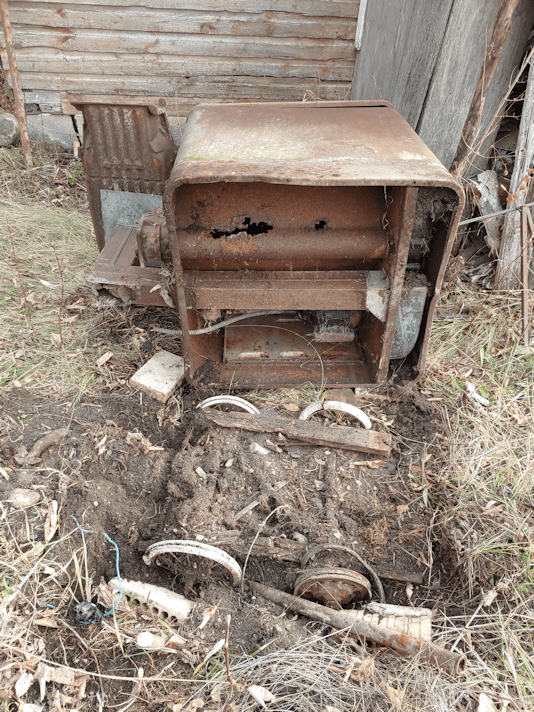
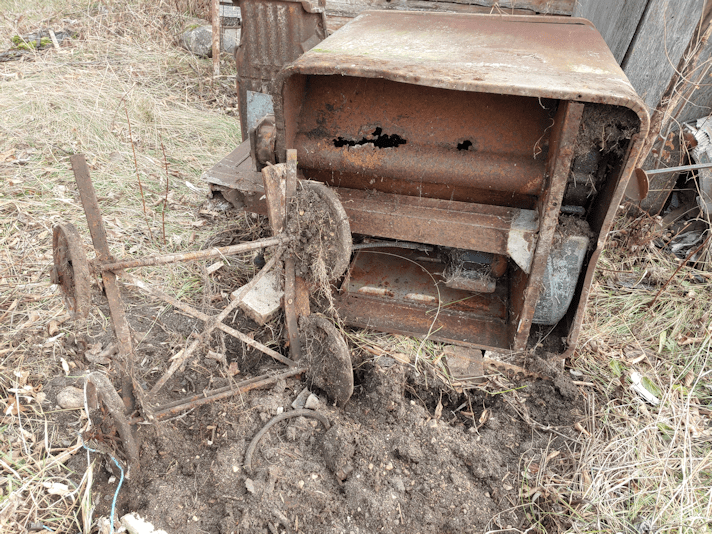
Yup. Those were wheels! But they weren’t attached to the forge!

There was still some rotted wood attached. It was like a little wheeled scooter that the whole thing was resting on.

It wasn’t until I uploaded the pictures that I realized where the motor was. It is on the light end!

I kept trying to shift the forge, but the weight on one side made it very awkward to do anything.

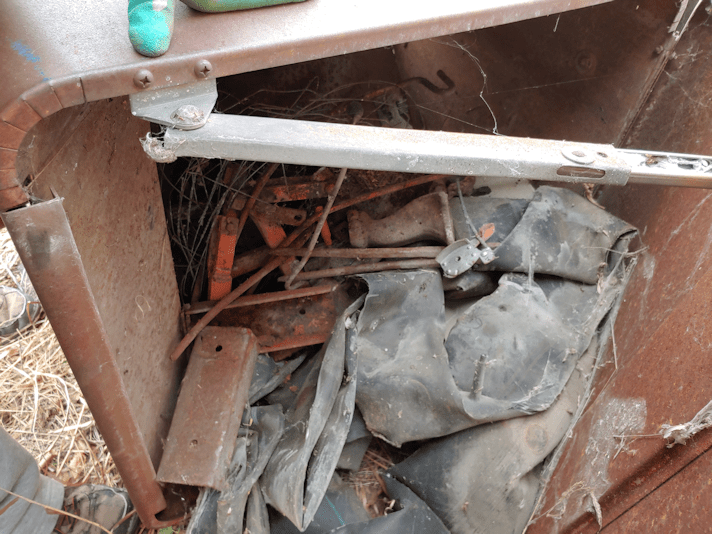
I’d opened it before and saw someone had stuffed some inner tubes inside. Maybe I could take the blower pieces out or something, and lighten it?

There… is no blower in there.

What on earth was I seeing in there? Hidden away, under the inner tubes?!!

Dear Lord in Heaven.

It’s a grinding wheel.

Why on earth did someone put a grinding wheel in there?

Not that I mind too much. This might be the one I remember as I child. The log building it was in had been burned to the ground to get rid of it, and as far as I knew, none of the stuff inside had been removed, first. So I’m actually very happy to see this.

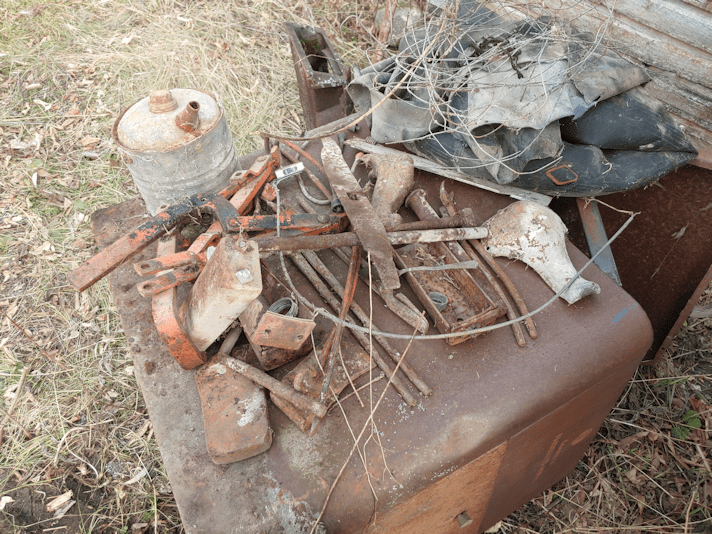
After moving it away, I started pulling other things out.

There was just so much stuff!!

I found 4 inner tubes, a gas can, a lawnmower blade, the throttle cable from a lawn mower, and even a spoon.

There are also blacksmith tongs, though one has the handle broken off. A couple of objects with lots of pivoting pieces on it. A couple of old metal legs, like off an old-style bathtub. Two ax heads, and more odds and ends

Two things in there really excited me. I don’t know what they are called, but from videos I’ve watched of people using carving benches, I recognize them. One end goes into a hole drilled into the carving bench, and the other holds the item being carved in place. It was something I realized I could really use, if I plan to extend my carving repertoire. I just had no idea where to find them – a hard thing to do when you don’t know the name of what you’re looking for – and some of the carvers whose videos I watched, commented on how expensive they are They’d made their own, instead.

Now I have two!

So I’m pretty excited about that!

Once empty, I was able to right the forge again.

After seeing the remains of the wheels it was on, I decided to take some of the glazed bricks I’ve been finding and put them under the forge.

Even empty, it was still hard to move! The light end, I could grasp and lift, but the heavy end was harder to get a grip on. I ended up using the bar to lever and shift that end, to get it onto the bricks.

I did finally get it in place!

You can see the bar I used to lever it.

The coal tray looked like it was cracked, but I think it was there for a purpose. The “crack” extends to some holes in the middle of the coal tray. Under the holes is the squared pipe. The air from the blower was directed under the coals through there.

I considered throwing away the wheels, but the frame they’re attached to looks like it might actually be salvageable, so I am keeping it for now. I just knocked the dirt and roots out of the spokes, first.

After that, it was time to clean up where the forge had been sitting.

I’d found a few metal bits and wires. Then some nails.

Then more nails. And screws.

And more nails!

I think a container full of nails, screws and other odd bits had spilled there. The last thing I wanted was for someone to step on them and get sepsis or something.

So I dug out what I think is the original lid for our septic tank, to use as a tray, and magnets.

Along with the nails, I found bits of spark plugs, a gas cap, the tooth of a hay mower, and miscellaneous other bits!

Once that was done, and my younger daughter helped me tuck the keepers I’d found into the pump shack, I enlisted her help to move the other thing I don’t know the name off. One of the pictures below is from when I first dug it out from beside the fuel tank, yesterday. This is another of those things my brother said was worth salvaging and protecting, so I wanted to move it into the pump shack.

In the older photo, you can see what looks like a completely sheered piece of steel, in the middle.

There was dirt and roots jamming one of the pieces sticking out the narrow side – in the first picture, it is completely hidden by grass. It now rotates freely again.

Between the two of us, we could not lift it! Not without risking injury, anyhow (and I think my daughter might have hurt her back trying, but isn’t telling me, so I won’t worry. :-( ). I’m astounded by how heavy this thing is.

One thing we noticed after trying is that some ?oil? leaked out.

I ended up rolling and flipping it, end over end, until it was under the coal tray of the forge.

We could hear fluid sloshing inside!

So that’s tucked away as much as it can be, for now.

My goodness, what a lot more work there turned out to be! But it’s done now, and we don’t have to worry about this stuff as winter comes in.

The Re-Farmer

Winterizing: window fix

I got a couple of bigger jobs done in preparation for winter. The smaller one was taking care of a window on one of the sheds. This is the one my brother and I had patched the roof of earlier in the year, and is one of the few sturdier sheds left.

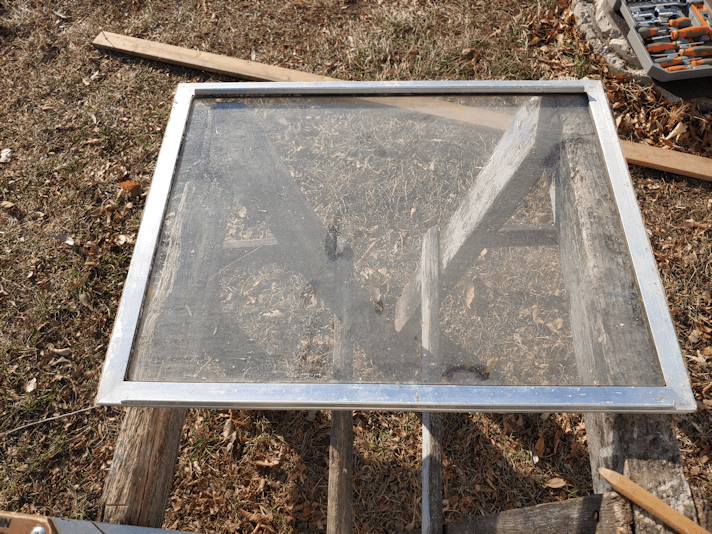
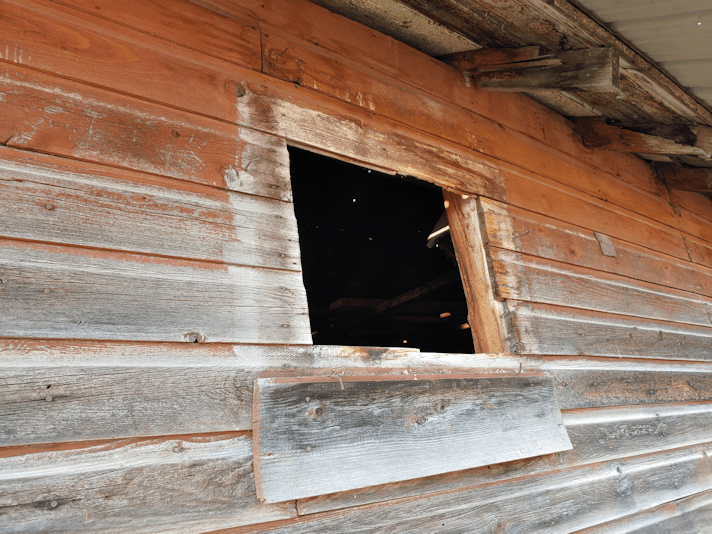
My original intention had been to simply board it up, but the window is pretty much the only source of light in the shed, and I had a vague memory of seeing a window in the barn that was about the same side. So I took some measurements, then went looking around.

I found the window, and it turned out to be almost exactly the same dimensions!

And when I say “almost the exact dimension”, I mean the hole in the wall. The frame makes it just barely bit enough that it doesn’t just fall through!

It also looks like it came off of a storm door.

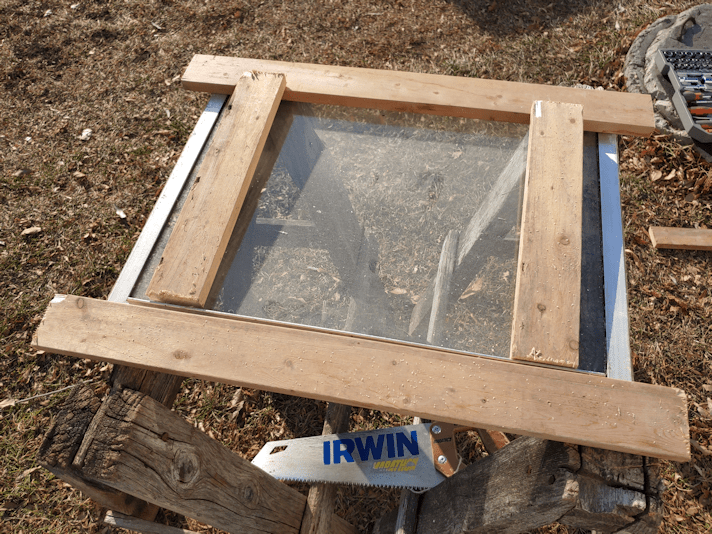
I grabbed a piece of salvaged wood and cut a new “frame” for the window.

If you look at the first photo, you can see the parts of the window that would have been used to slide it up. One of them is flush with the outer edge, the other is flush with the glass. The one flush with the outer edge will be resting on a piece of wood at the top.

This is the window opening. It is, literally, a hole cut in the wall, between two joists.

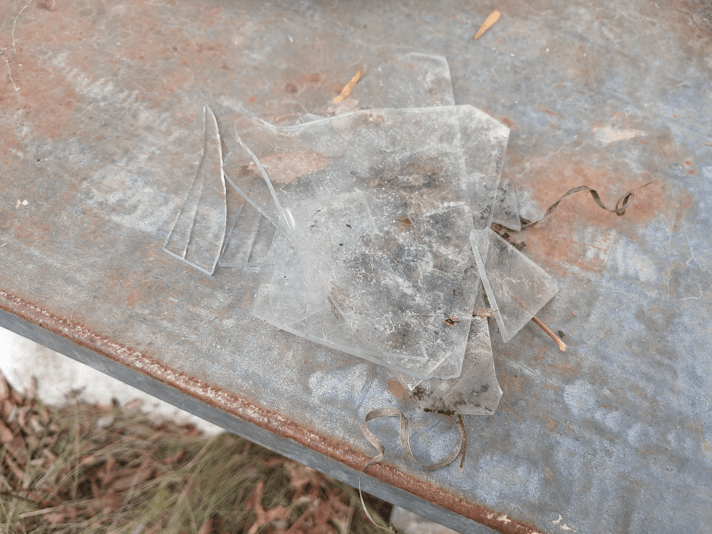
I also picked up as many pieces of the old window as I could, and some of the bigger pieces of glass. I couldn’t get all of it, though. They are too buried in the grass. This concerns me, as the renter’s cows could hurt themselves. I’ll have to do something about that.

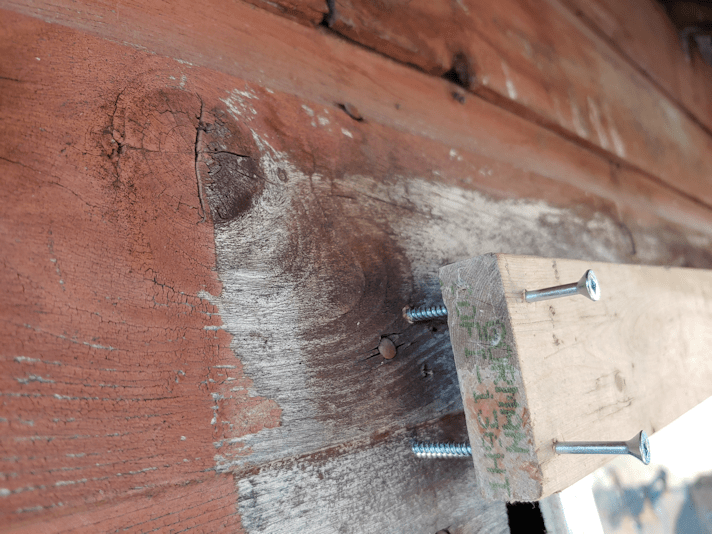
Since I didn’t feel like fighting with an extension cord to the barn, I pre-drilled holes in the wood and put the screws partway through, before I brought everything over. I even cleaned the dirt off the glass, too! :-D

I forgot about the cladding creating gaps, though. I ended up having to replace the screws in the top and bottom pieces with longer ones. I didn’t bother changing the screws in the side pieces, since they don’t need to support anything; just cover any potential gaps from the uneven cut of the opening.

I ended up moving the side pieces in a bit, butting them up against the metal strip on top of the bottom piece. It made them a bit more secure.

There’s one screw at the top right hand corner I couldn’t screw in all the way. I think I hit something in the joist; probably a nail.

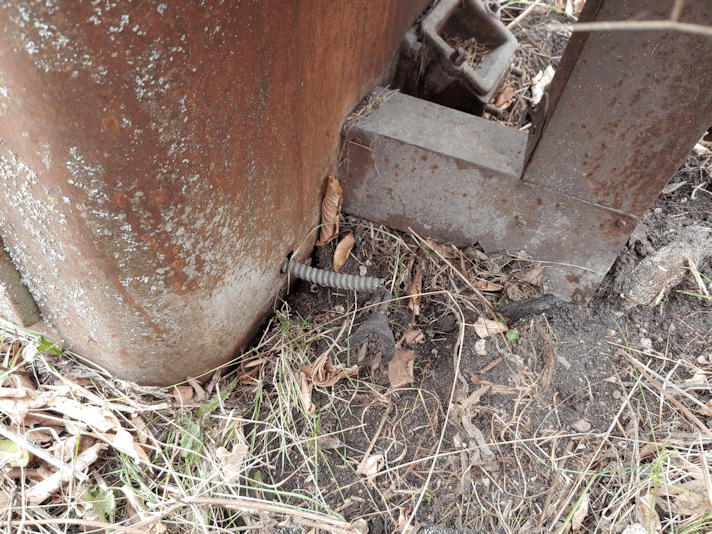
Speaking of nails, if you look around the window, you can see several bent nails. There’s two at the top, one on each side, and two at the bottom. I’m pretty sure they’re all that held the old window in place! Well, that and the board hammered onto the wall underneath. No wonder it fell off!

I’m rather happy with how this turned out – and very happy not to have to board it up.

Now I just have to board up some windows in the pump shack. I don’t think I’m going to luck out and find old windows to fit, like I did with this one! That, however, will wait for another day. For today, I had a much bigger job to move on to, and that one will get it’s own post! :-)

The Re-Farmer

Fixed!

We have a working washing machine again! :-D

This is the new panel he put in. All of this is behind the touch screen in front. At the far end is the power button, then where the knob pops on, the start/pause button, and then the controls for temperature, spin and soil. There is no load size control; the machine senses that itself and adjusts the amount of water accordingly, but at the far right of the panel, you can do things like add a soak time, and extra rinse, or even tell it to add extra water. All of these can change the time, which is where the digital display comes in.

Of course, he tested everything before he started, and it was exactly the same as before. After switching out the panel, but before putting it all together, we tested it.

Power? Yes.

Knob for wash cycles? Yes.

Start/pause? Yes.

Temperature? No. Spin? No. Soil? No!

But, of the buttons on the far right did work.

Just one!

So he opened it up again, tested them without the front panel, and everything was working.

He put it back, and it was working.

Best guess, there just wasn’t enough contact between the touch screen and the switches, the first time he put it on.

Of course, we kept testing it over and over, as he put everything back in place!

It’s all working fine now.

Hopefully, it will stay working!

I have a sudden urge to do laundry…

I’m sure if I ignore it, it’ll go away, though. ;-)

The Re-Farmer

Progress: the sun room door is don… AAAAAAaaahhh!!!

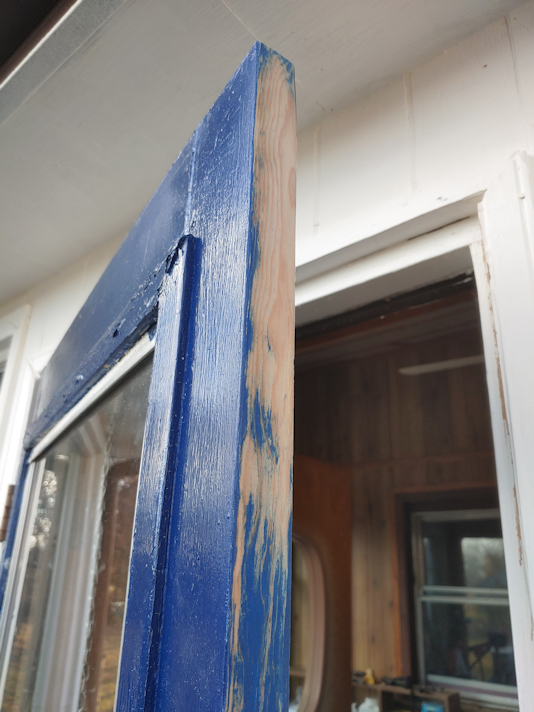
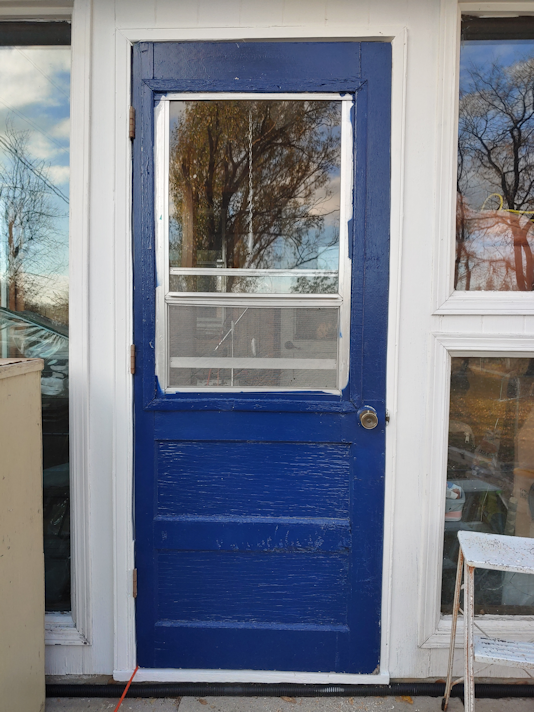
This afternoon, with the help of a daughter, we hung the replacement door back up onto the newly painted frame.

We lined the hinges up with where they were before, except further in as far as we could go. Just to be on the safe side, my daughter held the door in place while I marked the holes for the screws, then I drilled pilot holes for just the top hinge. We screwed in the top hinge, then double checked the locations for the other pilot holes and re-marked accordingly.

As you can see in one of the photos, the entire frame looks like it’s pulling away from the wall! It was like this when we moved here, and the gap doesn’t seem to be getting any bigger, so I don’t think it’ll be a problem. At least not any more than anything else is! :-D

Also, we only had the old screws available, since none of the new screws we have were the right size, and there were only 6 of the same type. So each hinge is missing 1 screw! I still drilled the pilot holes, though, for when I pick some up.

Of course, as soon as we got the top and bottom hinges secure, we tested the door, just in case.

Aaannndd…

Really???

The door was hitting the frame again! It had to be forced closed!

We decided to finish hanging the door, though. Once it was in, I tested it again, which is when I noticed this…

The door latch was now higher than it was before.

Keep in mind that we did NOT raise the door when we put it back. The hinges were lined up with where it was hung previously. The only change was mounting them further in the frame than it was before. Apparently, that was enough for the door latch to be about half an inch higher than it was before!

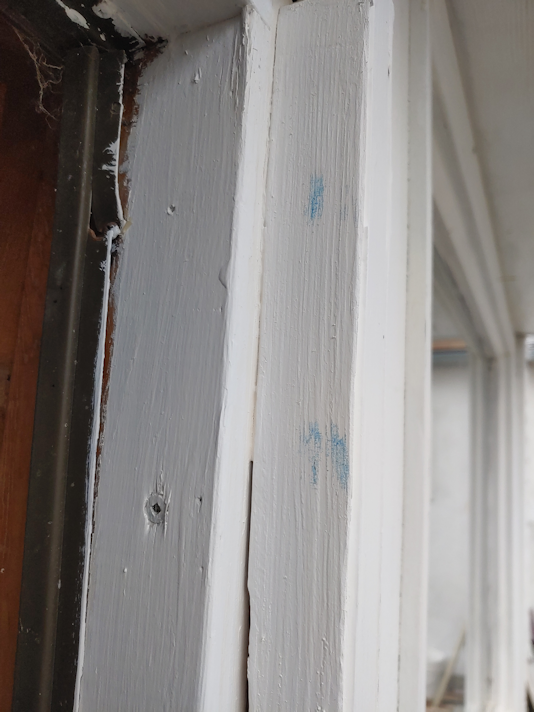
Using where the blue paint marked the frame as a guide, I went back to trying to reduce the wood in those spots. I used the shaver, a chisel, a rasp, and even some of my coarsest sandpaper. For some of the tools, it was hard to get right into the corner. Time and again, I tested the door, and it still was hitting.

Finally, I started shaving wood off the door itself. That wood is so much softer than the frame, I could do in moments what took several minutes, and a variety of tools, to take off the same amount of material.

I took these photos when I figured I was done, but then went ahead and took off more material. Just in case!

I also gouged out more of the hole for the latch. After testing the door again and again, I finally put the latch plate back on.

That mark on the inside of the frame by the latch plate?

It turned out part of the door handle assembly – I just looked it up and now know it’s called a “rose” – hits it. So I used sandpaper to gouge out a recess there. That wood is also very soft compared to the frame pieces I’ve been fighting with!

The door now closes, easily and properly!

In fact, it’s probably the smoothest working door in the entire house right now!

I had one last thing to attach.

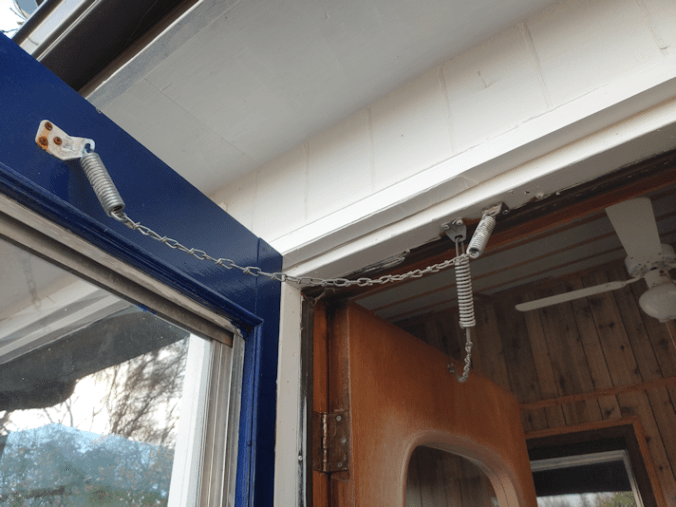
The stop chain!

I started screwing it in where there were pre-existing holes, but realized the bent part of the plate was extending beyond the wood, and the door would be hitting it. While moving it over, I noticed the plate for the chain on the inner door had only one screw holding it in place, so I fixed that, too.

Now, there is no chance the door will bang open too far. It doesn’t even hit the shelf behind it anymore, which means no risk it’ll hit the window. I can now move that shelf to the other side of the door, in front of the cracked window.

Tomorrow morning, I’ll be touching up the paint that I scraped off, including the door; thankfully we still have some of that blue left.

Once I was done hanging the door, I just couldn’t help it.

I stood there, opening it and closing it again, and giggling to myself. :-D

I am easily entertained!

This door was so much more of a problem to replace than we could have imagined!

The Re-Farmer