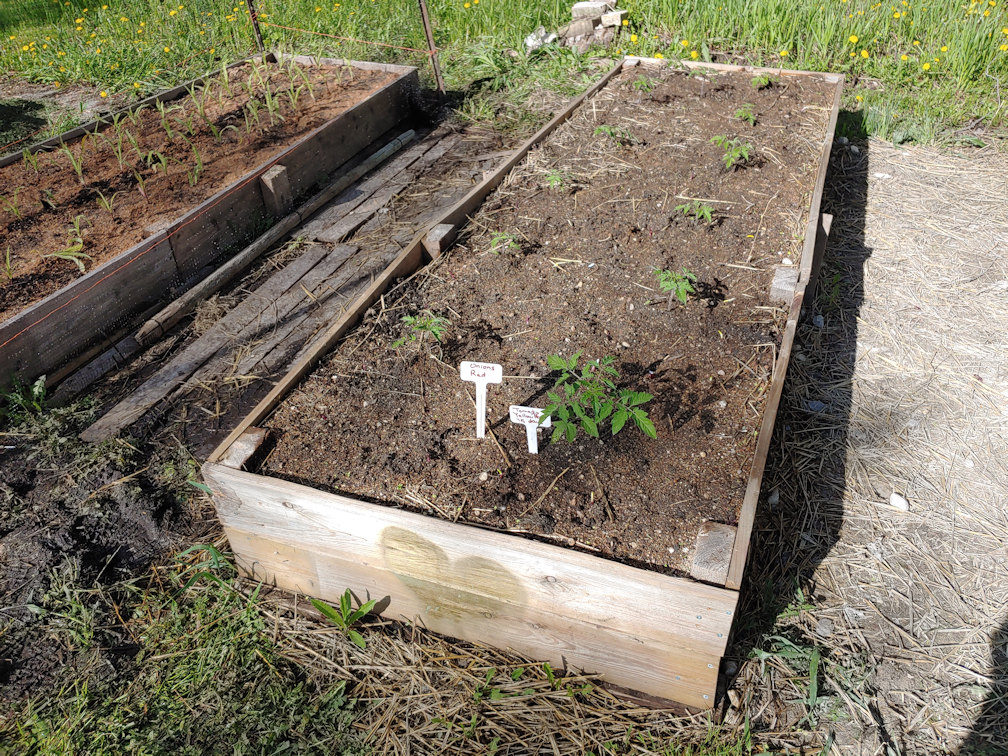
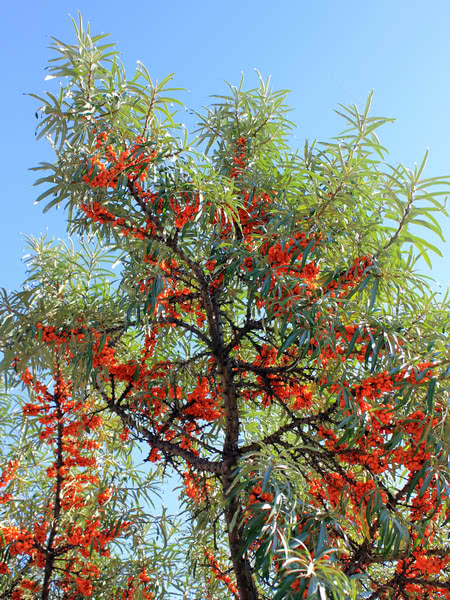
We’ve been having rain off and one, and are still getting storm warnings for today as well. Nothing too excessive; our expected highs and lows are well within average, and the garden beds seem to be really liking it.
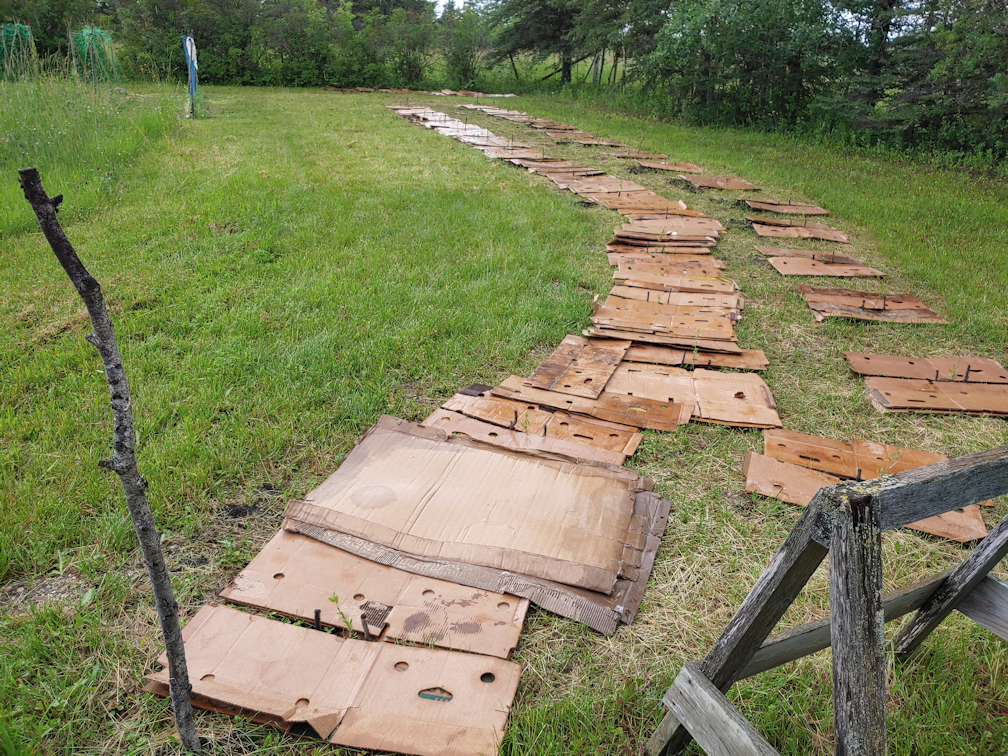
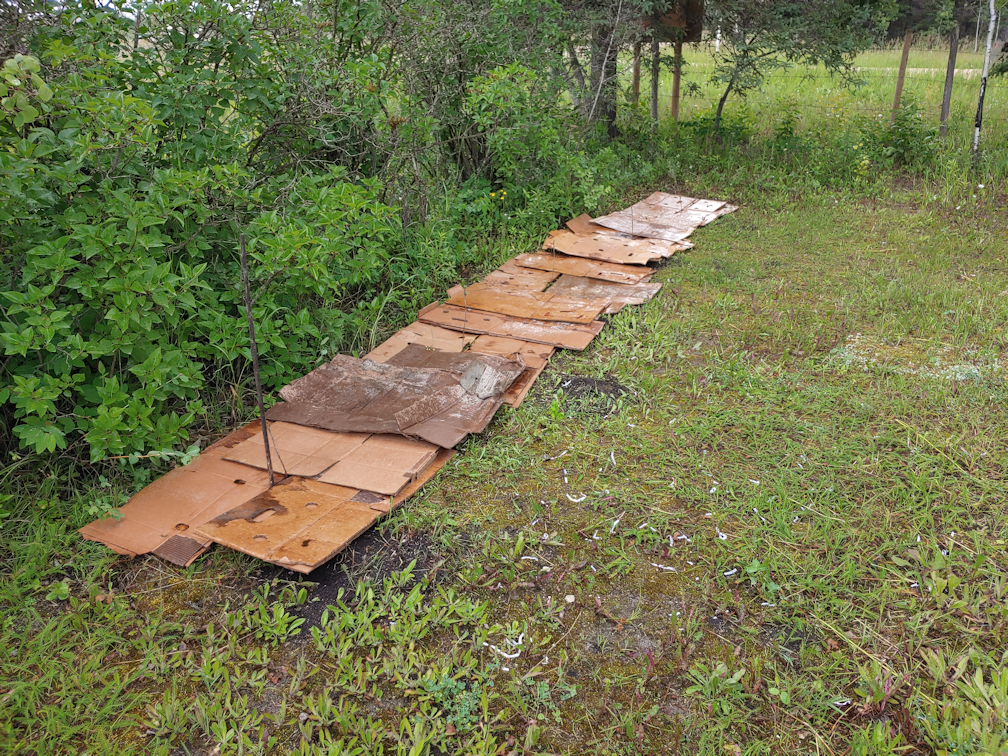
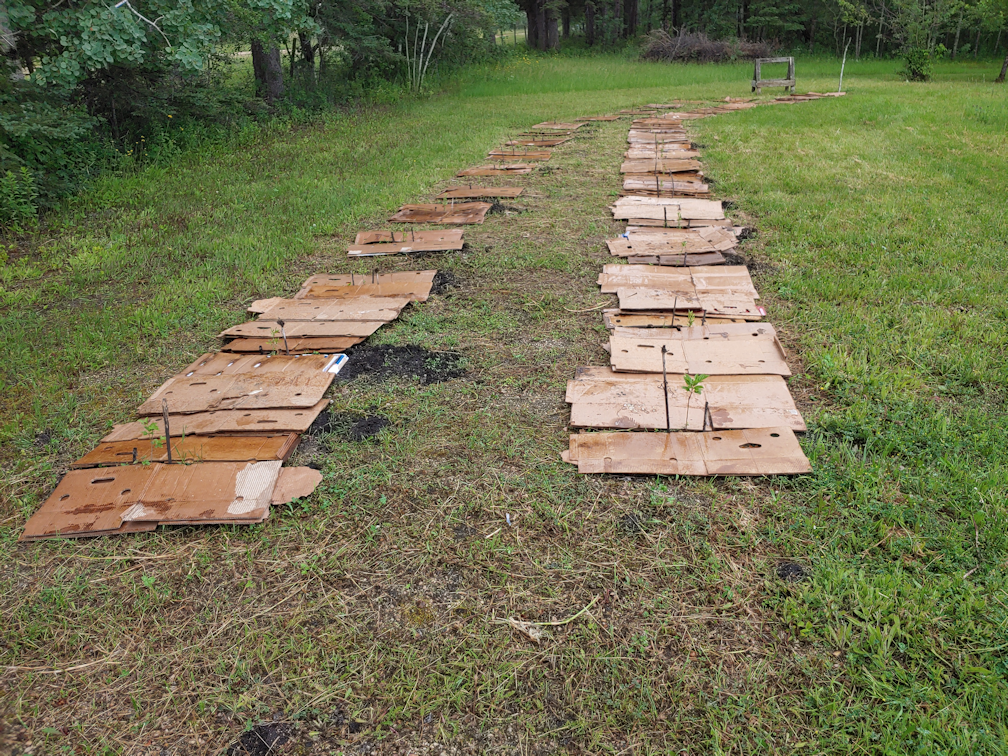
After doing my morning rounds, I was able to get the cardboard laid out along the saplings. The pile had been well rained on, which made it easier to lay them out, and less likely to get blown around if we get high winds.
This is the end I started at. The main thing was to get cardboard laid down close to all the saplings – but not too close!. The sticks I added to make them more visible (especially when using the weed trimmer) helped with that. Once all the trees had cardboard around them, I started filling in the spaces in between with what was left of the pile. It started raining again as I was working on it, which I didn’t mind at all. I’d have had to take a hose to it, otherwise.
The Sea buckthorn has all the cardboard they need, and are ready for when we have wood chips to lay on top of the cardboard.
I had enough cardboard to fill in the gaps all along one row, then start on the other, before I ran out. The priority is to cover the two rows, but if I can get enough cardboard, I want to fill in the space between them, too. That might take another 2 loads of cardboard to fill it all in.
We’re going to need a lot of wood chips to cover all this!
Once these bushes are fully grown in, this entire area should be a solid barrier of interlocking branches. There might be enough room to walk between the rows when they are fully grown, but not much. As they are bushes, once a good thick layer of mulch is laid down, they shouldn’t need anything more; they’ll basically be their own mulch, eventually. When we start planting fruit trees in the area, we’ll be working towards planting different edible cover crops into the mulch around them, but there won’t be space for anything like that with these, once they’re filled in.
The space between the saplings and the trees at the fence line is being left open as a lane to drive through. Once the berry bushes are getting to the point where they are starting to form a privacy screen, we’ll start cleaning and clearing up the rest of the fence line. Most of those fence posts in this section need to be replaced, and I want to open up access to it for that, for general maintenance – and to eventually replace the fence with something other than barbed wire! I’d like to also put a gate next to where the sign is, or some sort of fence crossing that will allow us to step over it, rather than trying to get through it. I really hate getting my clothes caught on the barbed wire when trying to go through it! :-D We’ll figure something out.
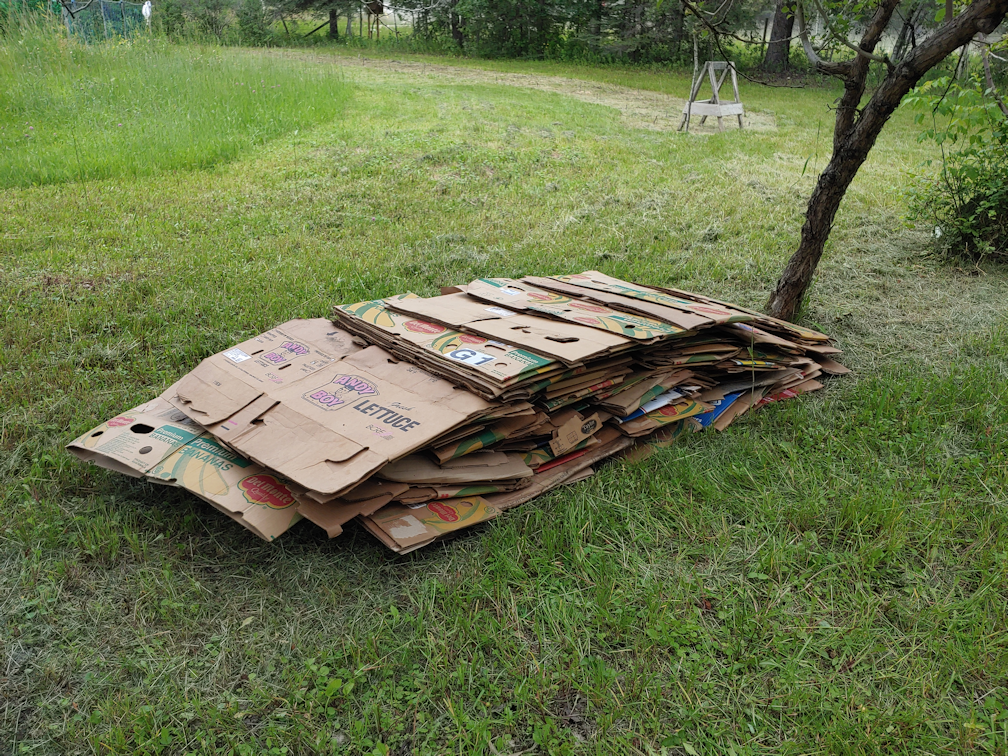
I just got back from the wonderful person who is letting me take cardboard from her food waste deliveries.
This filled most of the back of the van, with room for me to still see through part of my back window.
The stack looks so small, on the ground! :-D
The next step will be to douse ourselves with bug spray, then go through each of the boxes to remove any tape, plastic labels, etc. Once that is done, we can start laying them around the saplings as a weed suppressant. Priority is around the saplings, but the space between them will also be covered. The cardboard needs to be thoroughly soaked – rain would be very handy right now! :-D Once we have it, it will be covered with wood chips.
I will easily need at least one more load of cardboard to cover the area, so no hurry on the wood chips right now.
We also got a bonus with this load!
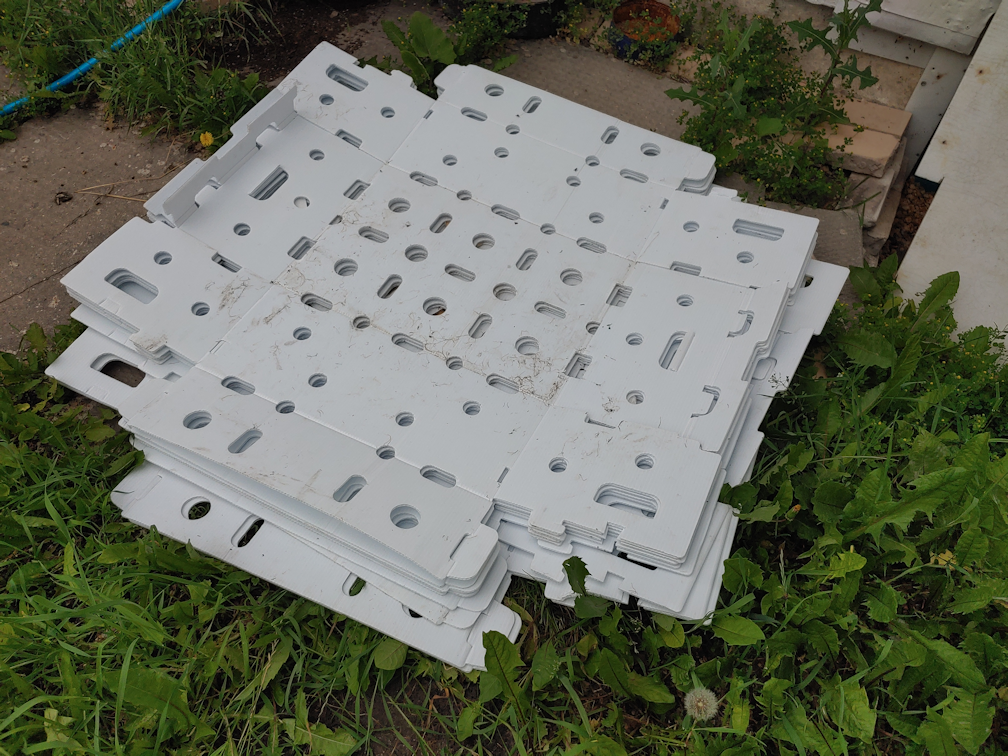
These boxes are corrugated plastic. From the looks of it, they mostly held corn. After they get cleaned off, these will work very well for when we need to store potatoes and other things in the root cellar over winter. :-) Plus, as you can see, they easily fold flat for storage. I think I got 10 or so of these. I think they will be very handy for a lot of things!
An extra bonus is, I got to see their baby chickens and turkey, pigs, donkeys and alpaca. They’re already doing a lot of things we are working towards and, once we get our chicken coop built, we’ll be able to buy chicks from them!
I am so happy to have found this family. :-)
In other things, my husband got notification that my new keyboard was ready for pick up, on Monday. I went to the post office to pick it up and there was no card in the mail box. Today is Thursday, and I stopped by on my way home, but still no parcel.
Once I got home, my husband looked up the order.
It was sent by Purolator.
So while I was unloading the van, my husband called the nearest drop off location, since we are not in their delivery zone. Normally, we would have received an automated call from Purolator, if it was being sent there. When I got back inside, he was on hold – with Purolator. It wasn’t at the drop off location, either.
It turned out to be in the city.
How we were supposed to know that, I have no idea. This information was not included in the delivery notice. It just said that it was delivered.
It’s now being rerouted to the drop off location, and we’ll get a call when that happens.
Places that don’t deliver to PO boxes are a real pain in the butt.
I headed outside earlier than usual, to try and get some work done before things got too hot. My goal of the day was to take the weed trimmer to where the berry bushes are. Tomorrow, I’m getting another load of cardboard and plan to lay it down around them as a weed barrier.
This is how it looked when I started.
I shoved the stick into the ground as a post to mark the end one of the rows of bushes.
Can you see the silver buffalo berry?
The row on the left, you can see the sawdust mulch around several of them, but the row on the right just disappears in the trimmed weeds and grass.
I ended up using sticks that were used to hold trellis lines last year, to mark where the saplings are. A few of them got two. They were so buried and trimmed material, I didn’t want to risk accidentally hitting them with the weed trimmer! I’ll be looking to make sure they all have at least two sticks marking each of them, when the cardboard get laid down.
From this end, the two saplings marked in the foreground are the two highbush cranberry.
It took adding one more length of extension cord, but I was able to trim around the sea buckthorn, too.
Since I had the trimmer in the area anyhow, I used it around all the trellises, the hulless pumpkin patch, and the bean tunnel.
The goal was to beat the heat, but I failed. By the time I was working on the bean tunnel, the thermometer attached to it was reading 30C/86F in the sun. Our high of the day is supposed to be 25C/77F, and we are now under a severe thunderstorm watch. When I headed out this morning, we were being warned of possible thunderstorms on the weekend, and just possible showers later today!
I kept at it, though, and was able to use the trimmer around the crabapple trees. The one I’m standing next to, to take this picture, died over the winter and will need to be cut away. There are a couple other sickly ones down the row that need to be removed, and the others need some pruning, but that will have to wait.
I’m hoping to be able to head out again with the lawn mower, set as high as it can go, to finish around the garden area. Even the lowest spot near the branch pile in the background is finally dry enough to mow.
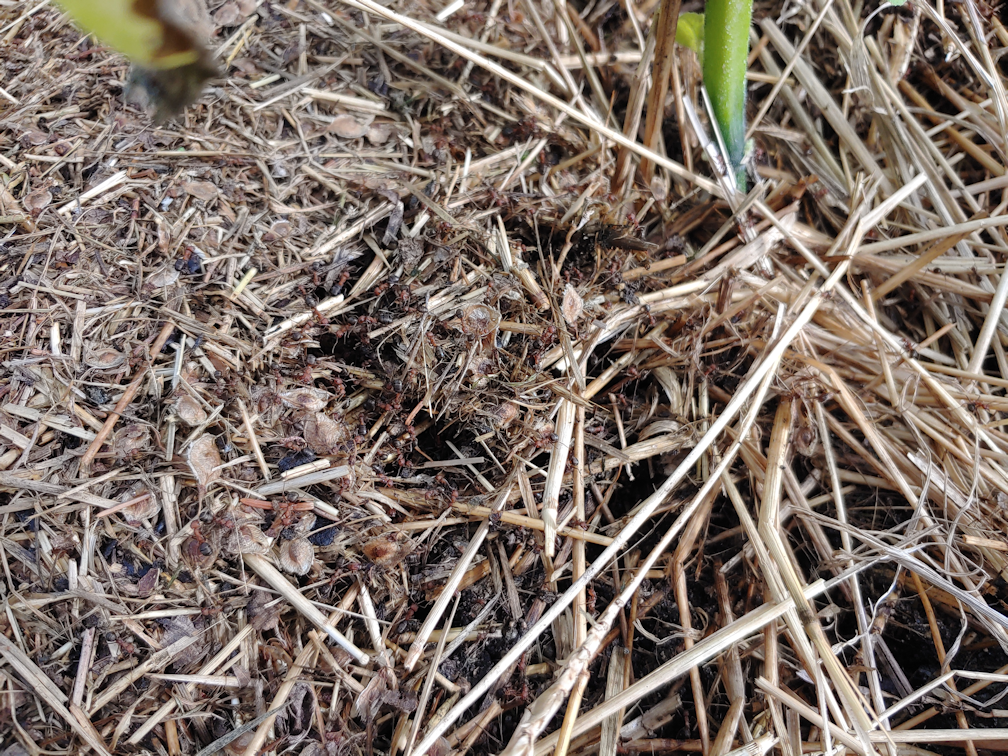
The metal ring in the foreground was something I brought to do burns over old crabapple tree stumps that were infected with a fungal disease. It’s over a taller one that hadn’t been burned completely away. Currently, the ring is full of an ant hill!
We have SO many ants this year!
In other things, whatever happened to our phone last night was no longer an issue this morning. We can use our land line again. I did get an email response from the phone company to try disconnecting all but one phone and seeing if it was still an issue, which I’d done (there’s only 2 lines to disconnect; the extra handset for the cordless phone doesn’t connect to the land line on its charger base). I wrote back to explain that it was working again this morning.
It sounds like there is a short somewhere. Possibly due to rodent damage somewhere. I’m guessing the cause of the problem is outside the house itself. If it’s a short, we could lose our connection again, at any time. In my email response, I did include that possibility. It would require a tech to come and test the lines, though. They’d be able to do that at the pedestals at the fence lines, one of which is hidden by trees in the first two photos at the top of this post, at first. From there, they would know if they have to come to the house and test again or not.
For now, I’m just happy the phone started working again on its own!
My morning rounds are taking longer, as I am able to do more in the various garden beds as I go along.
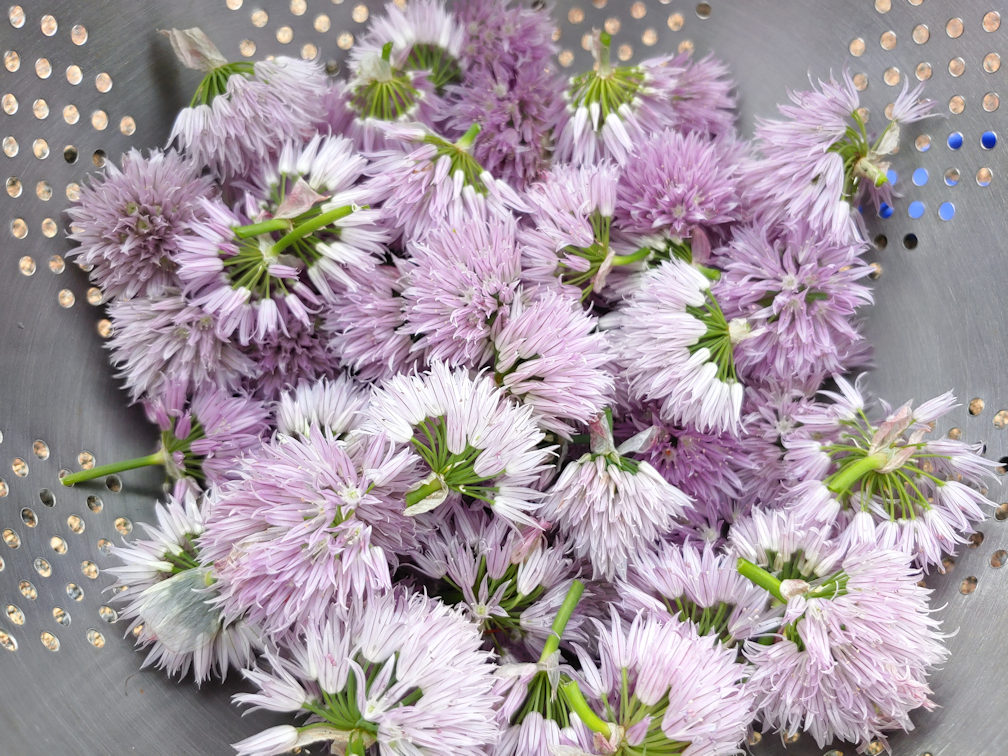
I harvested the largest of the chive blossoms, before they go to seed. While I continued with my morning rounds, one of my daughters washed and de-bugged them, then laid them out on a cooling rack in a baking tray to dry. They are in the oven, with no heat at all, to protect them from the cats. Once the wash water is dried off, we’ll stick as much of them in a jar as we can, with olive oil. Any extras will go in the freezer. Or maybe I should split them into two jars and use them all. There are more chive blossoms to harvest later on, so we’ll have plenty to infuse in vinegar, too.
Speaking of drying things, during the night that cats did manage to get at the stacked screens of drying mint leaves. We’ve lost about 2 screen’s worth of mint leaves to the floor. :-(
When I moved on from the old kitchen garden to check on the squash patch, I noticed one of the giant pumpkins was no longer upright. I thought it might be because it had grown large enough to start leaning over, but I was wrong.
The stem is broken, right at ground level. Possibly from the high winds we’ve been having. Or…
Possibly weakened by the ant hill that has formed on that side of the pumpkin mound!
I built soil up around to support the stem again, in the off chance that it will survive, but with a break that large, I don’t expect it to. We are likely down to just one giant pumpkin plant.
Everything else in the squash patch seems to be surviving so far, and I’m seeing new growth in most. The squash that were started at 4 weeks are so very small, though. I kinda feel like maybe we should have started them at 6 weeks.
I had a very pleasant surprise in the tomato patch nearby, though!
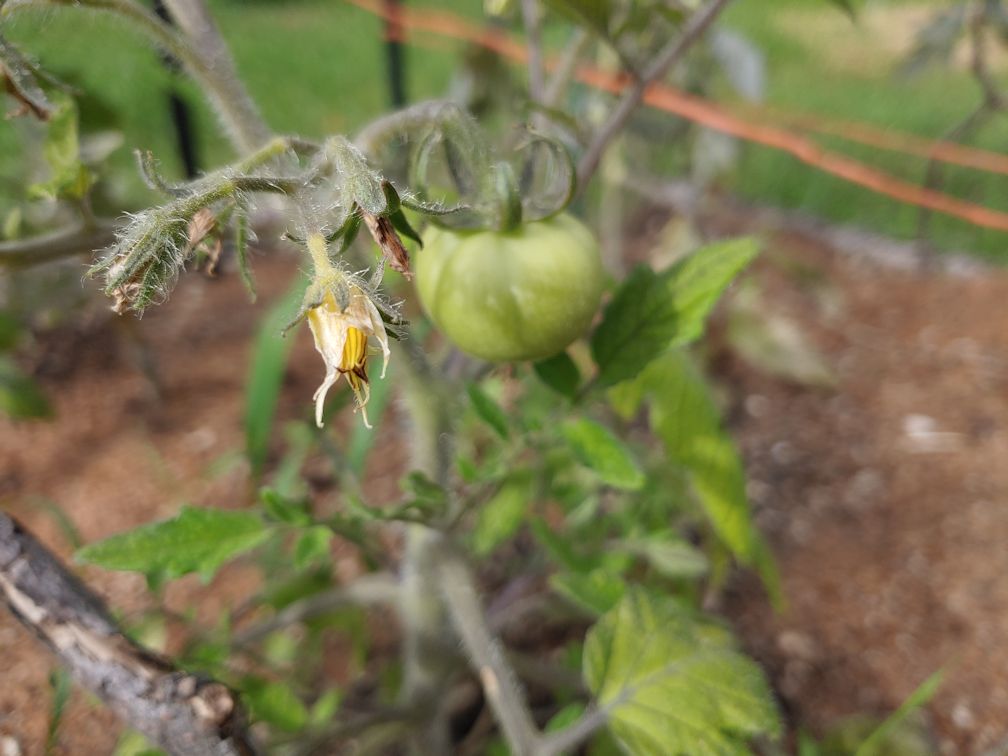
Of course, the camera on my phone didn’t focus where I wanted it to. :-D
We have our first tomatoes forming!
These are on the Sophie’s Choice tomato plants. We got these seeds as a freebie with my order from Heritage Harvest, which was a very pleasant surprise. They have a much shorter growing season, and were started indoors at around 10 weeks or something (it’s a good thing I am using the blog as a gardening journal to record the details, because I’m already forgetting!). So I am not surprised that these are the first to start forming fruit.
We did get some rain last night, but it was light enough that much of the water in the garden was able to get absorbed by the soil, and the paths are just really wet, instead of big puddles of water. That meant I could finally do some much needed weeding in the summer squash bed, then pruning of tomatoes.
I took some of the strongest, healthiest looking branches that I pruned off the Sophie’s Choice tomatoes and transplanted them in the open spaces between the summer squash. I don’t know if I’m breaching any companion planting rules here (do tomatoes and squash go well together?), but whatever. If they take, great. If not, that’s okay, too. I specifically wanted to propagate more Sophie’s Choice tomatoes, as they are listed as extremely rare, so if I can save seed and help keep the variety going, that would be a good thing. Because they start producing so much faster than the other varieties we have, I’m not as concerned about cross pollination.
While I was weeding and tending different parts of the garden, I had Rolando Moon hanging out and keeping me company. Not wanting attention. Just being nearby.
I had to chase her out of one of the sweet potato bags, as she decided to start rolling in it! Then she jumped up into the high raised bed and lay down on some onions. THEN, she moved into the squash and corn patch, and sat on some corn seedlings!
That cat seems determined to be destructive!
Meanwhile…
The tomatoes are not the only things blooming. Two of the Styrian hulless pumpkins have suddenly burst into bloom, and they are all covered with buds again. Their first buds had been pruned away when they were transplanted. They look to still be all male flowers. I’m debating whether these flowers should be pruned away, too, so more energy can go to the plants establishing themselves more. It hasn’t been that long since they were transplanted, after all.
Anyone out there know if it would be helpful to prune the flowers off now or not?
The beans and peas at the trellises and bean tunnel are looking quite good. The cucumbers seem more touch and go. The first peas that were planted are getting quite large, and the snap peas are already large enough that some have latched onto the vertical trellis strings already. The snap peas are growing noticeably faster than the pod peas.
There is a single, out of place pea plant that showed up, right near the upright post at the start of the row. It seems to be a pea from last year that finally germinated! It germinated quite a bit earlier than the others, and I’m trying to train it up the support post, since it’s too far from the vertical lines to climb. Last year, we planted the King Tut purple peas here, so that’s what this one would be. It’s even almost as large as the purple peas we started indoors from saved seed, and transplanted against the chain link fence to climb. They are all tall enough that they’ve attached themselves to the fence and are making their way upwards, even though they are still looking kinda spindly.
The Wonderberries have been ripening, though the plants haven’t really gotten any bigger, and have what looks like weather damage. I’ve been able to taste them. They are lightly sweet, but don’t have any predominant flavour. This may be something we just leave for the birds. I’ll have to get the girls to try them, too, and see if they like them. I don’t mind them self seeding in this location, as I’d rather have the berry bushes that produce food, either for us or for the birds, than the invasive flowers.
In other things, my plans for the day have had to change. My sister never made it out to my mother’s yesterday, because my mother told her it was “too soon” to start packing and bagging things in preparation for her apartment being sprayed for bed bugs. She has a shift today, so that’s out. My brother, meanwhile, is out of town for a funeral that had been delayed until now by the lockdowns. So it looks like I’ll likely have to go to my mother’s to help out. I’ll phone her, first, once I’m sure she is back from church. My sister will be able to come out tomorrow morning, and I hope to come out in the early afternoon for the last of the packing and bagging, and moving of larger items. Then she’s back the next morning to bring our mother to her place for the night. I’ll head over in the early evening to check on the place and make sure it’s locked up while my mother is gone.
On Tuesday, I should be heading into the city for the first half of our monthly shopping, too. I will time it so I can check her place on my way home.
Which means I’ll be getting very little accomplished at home over the next few days!
While my husband and I were gone for our medical appointments, my daughter finished watering the rest of the garden beds and transplants, including the trees.
She sent use this sad photo.
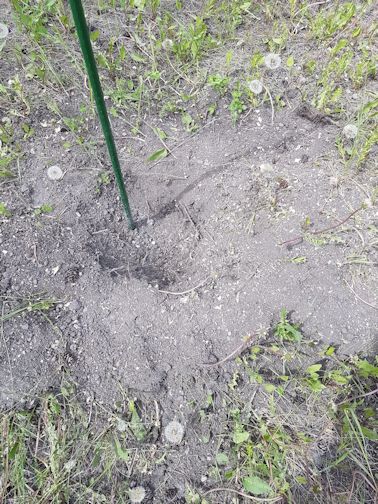
One of the Korean Pine was gone! Not only was it dug up, but even the wood shaving mulch was gone! There was nothing left but a hole in the ground.
So disappointing.
When my husband and I got home, my daughter and I headed to town to see what we could find to protect the rest. My original plan had been to pick up some metal mesh garbage cans at a dollar store somewhere – it was a recommended suggestion I found when looking up how to care for the Korean Pine. Somehow, I just never found any.
The local Dollar Store was no different. They’re about half the size if the city stores, so that’s not a surprise.
I did find something else to try.
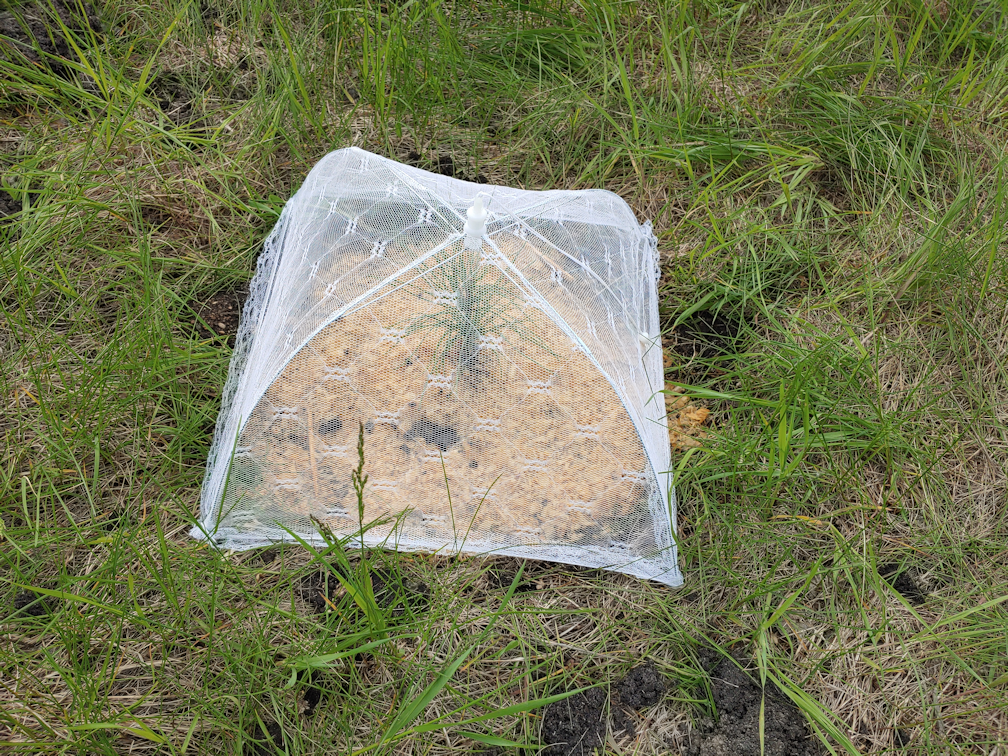
These are food covers to keep the bugs away while eating outdoors. I picked up 5 of the smaller size for each of the remaining Korean Pine. I used the last of our ground staples on a couple of the, and tent pegs in the rest, to secure them to the ground. Obviously, they won’t stop a determined critter, but they should be enough to keep away any that are not determined!
When I went to where the lost one was, I looked around the area, just in case it was just a critter digging, and that the seedling itself wasn’t eaten or dragged away. There was no sign of it, unfortunately.
With so much open water around this spring, and especially in this part of the outer yard, the mosquitoes are insane. All I could hear was the whining of clouds of mosquitoes. Since I wasn’t going to be long, I didn’t use any bug spray, so I was lunch! As you can imagine, I tried to finish up as quickly as I could. It wasn’t until after I’d covered the remaining Korean Pine and brought the support poles back to the house that I realized I’d forgotten the one by the lost pine. So I battled my way through the clouds of mosquitoes and went back to get it.
Since I was there anyhow, I looked around again. Because once you’re bitten a hundred times, what’s a few more?
I found it!
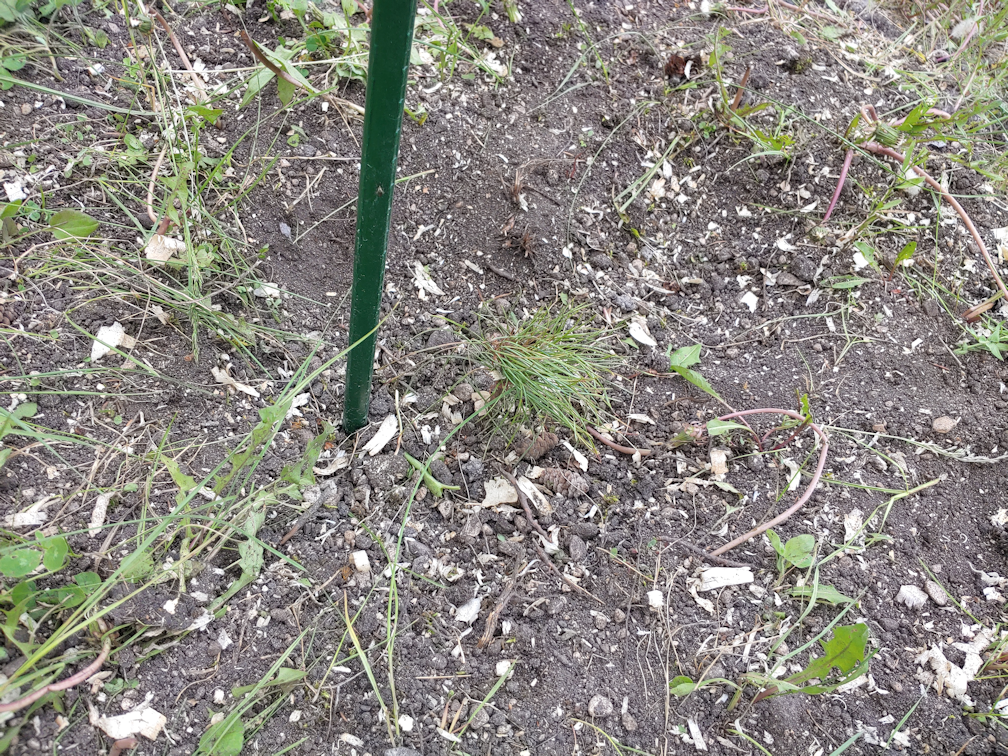
The poor little seedling was hidden in the grass, just a couple of feet away. I’d walked right past it, at least twice, while looking before!
I quickly replanted it and returned as much of the soil as I could – whatever dug the hole had certainly spread it far and wide! Then I went and grabbed one of the remaining tomato cages and filled a watering can. The tomato cage is now over the seedling, with the support post running through it for extra support, and it has been thoroughly watered.
I intended to get a picture, but I was being eaten alive by mosquitoes, so I ran away as soon as I could!
Hopefully, it will survive it’s brush with whatever dug it up. My thought is it was likely a skunk, digging for grubs, and it dug there because the soil was looser.
So we are back to 6 Korean Pine… and will hopefully stay that way!
My younger daughter planted the last of this year’s tree orders today.
These got planted in the outer yard. Because of how big they get at maturity, we had some issues deciding where to plant them, since we also need to keep a lane open from the driveway to the back gate, plus have open lanes from the garden area, and the fire pit area, gates. Eventually, the old, collapsing fence line on that side of the inner yard is going to be removed completely, and there will be no barbed wire gates at all, but the renter’s cows still sometimes get into the outer yard, so the fence stays for now.
Hard to believe these teeny things will eventually grow at much as 18m/60ft tall, with a spread of 9m/30 feet. It’s that spread that is the kicker. In the end, she planted them in two rows of 3, on either side of the lane from the driveway we want to keep open. We had talked about planting 1 in a corner between the back gate and the garden gate, then the remaining 5 in a row on the west side of the lane we want to keep open, but with spacing them to their mature sizes, that would have put at least one, maybe 2, in an area that is still basically a pond right now. So she winged it.
For now, they are marked with tall stakes, since they are so small they disappear in the tall grass. They are slow growing for their first 5 years, and these are 2 yr old seedlings, if I remember correctly. They are sold out as I write this, so that information isn’t on the website anymore.
If we can manage extension cords from the pump shack, we should be able to get out there with the weed trimmer and clear further around the saplings. We can’t get at some areas here with a lawn mower at all.
I also want to put something around them to protect them. I don’t know if deer will eat them – they don’t seem to bother pine trees – but if the renter’s cows are on this quarter and get through the fence, they might stomp on them or something.
It will be quite a few years before they reach the age to start producing pine nuts, but when it comes to trees, we’re planting for future generations! The main thing is, they are finally in the ground.
While I spent most of my time with the kulli corn, my daughters took care of other things.
My younger daughter got the sea buckthorn planted. These saplings are quite a bit larger than the silver buffalo berry! This will eventually close the gap of the hedge along the north fence line, where the deer jump through. Hopefully, we have both male and female plants, and will have berries. We do plant to get more, over time, but it will probably be another year or two before we know for sure.
The only trees left to plant now are the Korean Pine.
My other daughter started on the tomatoes.
Along the chain link fence, she planted the dozen Chocolate Cherry tomatoes. That’s a variety I got specifically as a gift for her. :-)
Last year, tomatoes did REALLY well in this location. This year, we’ll see how they do in other locations!
The next tomatoes she and her sister transplanted here were the Cup of Moldova and Sophie’s Choice tomatoes.
The row on the left, and in the centre, are all Cup of Moldova, while the Sophie’s Choice are the row on the right.
There are still two Cup of Moldova waiting to be transplanted, but they ran out of space.
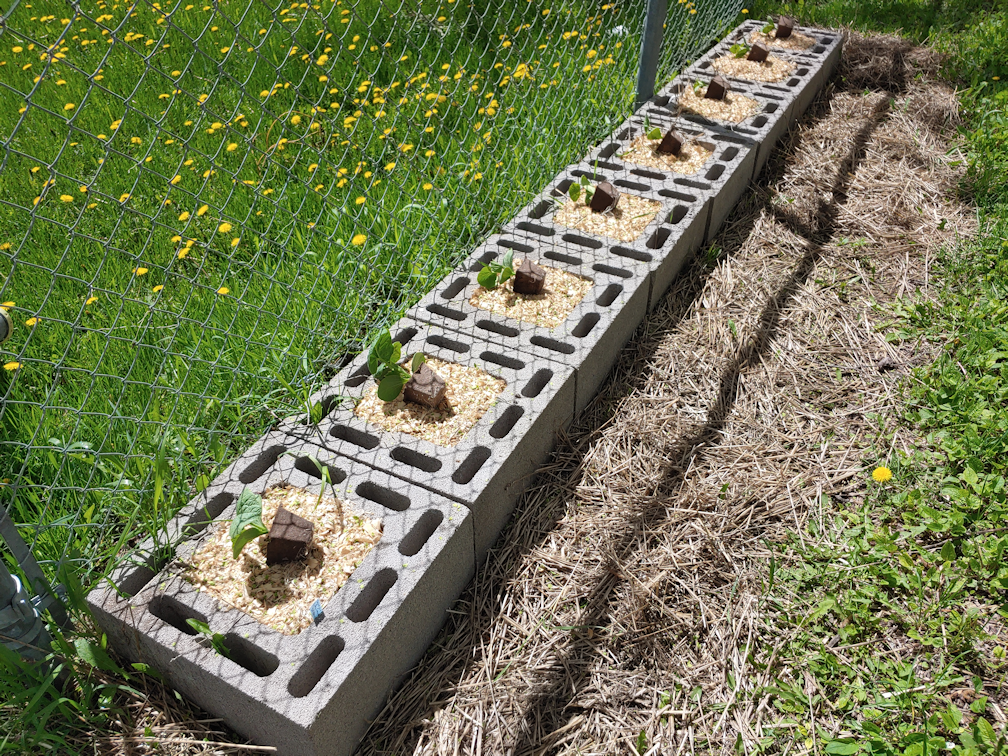
While they worked on that, I transplanted into the blocks we finished adding along the chain link fence this spring.
The Red Kuri/Little Gem squash went into these. I hope they do well here. Last year, we had only 2 plants, but they produced quite a lot of squash. Unfortunately, with the drought, the squash developed so late, we only really got 3 that were mature enough to be edible. The girls and I found them delicious (my husband is finding that he’s not a fan of winter squash), and we look forward to having enough to store for the winter.
While one daughter worked on the bed of tomatoes in the main garden area, adding more support posts and winding bale twine back and forth to help support the tomatoes as they grow, my other daughter and I made use of the newly available bed next to the kulli corn.
There was a total of 13 Yellow Pear tomatoes to transplant. Once they were in, we got the box of red onion sets and planted them all along the outside of the bed in a single row, then fit the rest into the middle, in 2 rows.
The last thing we needed to do before heading inside was putting netting on the kulli corn and the Red Kuri squash. Those were the only two things that were most at risk of betting eaten overnight!
The net is hard to see. I used pipes hammered into the ground to hold the net away from the squash. The blue bits of pool noodle shoved into the tops of the pipes are there to protect the net, as there are some sharper edges on some of the pipes. Last year, we had chicken wire at an angle over cucamelons and gourds, and the vines kept wanting to attach to the chick wire, instead of the chain link. There’s no way the net could hold the weight of squash climbing it, so I wanted to keep it away from the plants as they start growing large enough to reach the fence and start climbing. On the inside, the edge of the net is held in place with ground staples. The excess net went over the fence, and my daughter rolled it up and zip tied it down. We still want to be able to access and tend the plants as needed, which will mostly be done from the inside.
The last thing the girls did was lace up the ends, so keep the critters out. A determined critter could still tear through the net, but hopefully, they won’t want to be bothered.
In the background, you can see some wire “fencing” has been added to the outside of where the Chocolate Cherry tomatoes were planted. It will get netting as well, but the only thing in there that is in danger of critters are the carrots, and they aren’t even germinating yet, so there it no hurry, there.
We have a lot more to transplant, but work needs to be done to prepare for them, first. The supports for A frame trellises need to be added, and beds need to be weeded. The rows we used for the bush beans last year, as well as the straw mulched mounds we grew summer squash in, are completely hidden by the crab grass that has taken them over. The squash tunnel, which will be a pole bean tunnel this year, needs minimal work at least, and the summer squash can be planted in the deep mulch near the potatoes. After we’ve transplanted the squash, gourds, melons and cucumbers, and planted the pole beans, we’ll have a better idea of where we can plant the yellow corn, and the popcorn. We have more bush beans and peas we can interplant with the two types of corn, too.
We also have another variety of baking poppies and dill to plant, but I think we’ll have to skip those for this year. I know where we will plant the Wonderberry, but have still not figured out where to plant the ground cherries. All of these will be treated as perennials, as they will reseed themselves year after year, so they need permanent locations.
We’ll figure it out.
As for tomorrow, I’m finally going to make our second stocking up trip to the city. It’s unlikely I’ll be able to do any work in the garden, but we shall see. It’s hard for me to stay out of the garden, now that the weather has finally turned nice, and we can catch up! :-D
It feels so good to finally get things into the ground!
Since planting trees and bushes are more long term than our usual gardening, I decided to start a food forest category.
Including for things that were already here before we moved in, like these Saskatoons. It’s so nice to see them blooming again – though you can very clearly see how high the deer ate the twigs and branches! Hopefully, we’ll have berries this year. Thankfully, these are very flexible, so we should be able to bend them down to harvest them.
We are, however getting a frost advisory tonight. !!! Well, our June 2 last frost date is just an average, after all. It’s supposed to dip to just barely freezing, so most things should be all right.
Including…
The 20 out of 30 silver buffalo berry my daughter was able to transplant today!
She does not take progress pictures, though, so I just got a picture at the end of the day.
Even with the holes already dug, it was a huge job. The soil that was removed was so full of roots, rocks, weeds and gravel, she was using garden soil from the remains of the pile we got last year – which is clear across the garden area. After sitting there for a year, it’s full of roots, too, which she picked out as best she could.
She started at the north end of the double rows, next to the highbush cranberry, as the ground is slightly higher there, and the holes were mud rather than filled with pools of water. It didn’t take long before she was having to deal with standing water, though.
Towards the end, I was able to help her out, adding the mulch and watering it just enough to keep it from blowing away. By the end of it, my poor daughter was so knackered, she could barely lift the shovel on its own, never mind with soil in it!
So the remaining 10 silver buffalo berry (I just realized, I’ve been calling them bison berry, because we don’t have buffalo; we have bison. The label says buffalo) will be planted tomorrow. Holes still need to be dug for the sea buckthorn, but there’s just 5 of those. Then there’s the Korean pine, which is going to be planted in the outer yard.
While she did that, I worked on the main garden area and got some decent progress done, too – but that will be my next post.
After much discussion with my daughters, we have made our “seed budget” purchase for this month, and it is trees.
We’ve been going through a number of websites for nurseries that supply cold hardy trees. Among the ones we want to get is a nut orchard collection, and the nursery that sells the one we’re looking at has scaled down the package deal, making it much more affordable. The collection, if planted spaced out as recommended, would cover 1 acre. However, some of the trees in the collection have the potential to reach 100 ft tall. That’s almost 40 feet taller than the tallest trees in our spruce grove! Which means we have to plant them in the outer yard, or even beyond, where the renter’s cows pasture, and we are just not going to be ready for that this year.
Beyond that, some of the sources we have been looking at just don’t have new stock listed yet. Among the things we are eyeballing are fruit trees, such as apple trees to replace the diseased crab apple trees we will have to cut down, pears, plums, Saskatoons, highbush cranberry, as well as different types of raspberries, etc. There’s only so much we can do in a year, though, and only so much space we are ready to plant into.
For this year, then, we settled on buying from Tree Time. They do a lot of shelterbelt trees, but also have fruit, nuts, berries, etc. They also come highly recommended. They are a reforestation nursery, which you can read about in their “how to order” page. Right from the start, they say:
We are a reforestation nursery that makes it easy for Canadians to purchase large quantities of tree, shrub, and berry seedlings at low prices.
Shop with us if you want convenience, selection, low prices, outstanding service, a guaranteed ship date, and high quality stock. Our customers tend to enjoy doing things themselves and watching their trees grow.
We grow our trees for maximum survival, not height or aesthetics. We mostly grow 1-2 year old trees because they have the best survival rates and are easier to ship in the mail.
We decided to focus on two areas. First, creating our privacy barrier/living fence, and second, our first nut trees. Because of how they bundle their trees, the numbers we are getting are quite different than they would have been, elsewhere.
This is what we are getting (all images belong to Tree Time nursery).
When talking about what to get as barrier trees, we were thinking of setting these aside for another year, but the way various things have changed since then, we’re going for it.
This is a zone 2b tree, so well suited to our zone 3. They are good in poor soil, are nitrogen fixers, and their berries are edible and healthy. They can grow up to 15 ft in height, with a 12 foot spread, and should be planted at 3-4 ft spacing, so they will do very well as a living fence/privacy screen, as well as a deer barrier, once they grow big enough. Plus, they will provide food for birds.
These will come as year old, bare root trees. We will be getting their smallest bundle, which is five trees. Sea buckthorn requires 1 male tree to 4 females to produce berries, but at only 1 year old, there is no way to know what sex the trees are. It may be a few years before we can tell! The males do not produce berries, but hopefully, there will be at least one male in the bundle.
Where we plant these will be partially dependent on how far we go with this next batch.
This is one that disappeared from other sites we were looking at, so we were very happy to find them at Tree Time.
These are a super hardy, Zone 2a tree. Like the Sea Buckthorn, they can also handle poor soil and are excellent for attracting birds. They can grow to 18 ft in height, with a 10 ft spread, and should be planted 3-4 ft apart, so they should also make a good barrier and privacy screen. These will come as 1 yr old bare root stock.
We also got them in the smallest bundle of 30.
Which is triple what we expected to buy, when we first found these.
The area we planted the corn and sunflower blocks is where we intend to plant these. Right at the corner, along the north fence, the lilac hedge my mother slowly extended over many years, peters out. There is a gap there that the deer jump through. I am thinking that section would be a good place to plant the 5 Sea Buckthorn. Then, the Silver Buffalo Berry can be planted all along the east line, leaving a “lane” behind them to access the trees along the fence line itself, and also leaving a gap where the telephone line is buried.
With 30 of them, planted 3-4 feet apart, however, we will have WAY more than will fit in a row in that area. Since we will be slowly planting more food trees further west, we will be planting just the one row of them. Which means we’ll need to find another location to plant the remaining trees! I am thinking of the area we had originally considered planting the Sea Buckthorn later on, which is in along the north fence line in the outer yard. Or even filling in gaps west of the lilac hedge. This would go a long way to help reduce the road dust that drifts into our yard in those areas, every time a vehicle drives past on the gravel road.
Before the trees arrive, we will have to measure and mark out where we want to plant in that north east corner. Once we know how many we can fit into there, we’ll know how many we have to plant somewhere else. That is a lot of trees for how we want to use the spaces.
Now that I think of it, we could also gift some to my older brother, for the forest he’s been working on for the past couple of decades. :-)
Then there are our first nut trees. Pine nuts, to be more specific!
In other sources, we have seen these as being a Zone 2 tree, and some listing them as reaching up to 100 feet in height. !!! Considering where we intended to plant them, that was just not good.
These, however, are listed as Zone 3a, and reach “only” 60 ft in height – about as high as the spruces in the spruce grove. Which is about where we intend to plant these.
These also have a spread of up to 30 feet, but the website doesn’t list how far apart to plant them. We’ll get that information later.
We ordered two bundles of three, 2 yr old seedlings as plugs, not bare root. They have special requirements. For the first five years, they grow very slowly and need to be kept shaded, because their bark can be easily burned by the sun. This is why we want to plant them along the north side of the spruce grove, between the grove and the row of crab apple trees, where it is shaded for most of the day. At 5 years, they suddenly shoot up in height, and no longer need to be protected with shade. Since we’ll be getting 2 yr old seedlings, that should happen in three years.
I have some concerns.
The nursery we first found these at sells them with their roots in a plastic wrapped ball of soil – the only tree they don’t sell as bare roots – because they require a particular fungi at their roots for optimum growth. We may be able to buy the fungi to inoculate the soil, though. At least that’s what I learned from this other nursery. According to the Tree Time website, however, there is no mention of the fungi needs, plus it says they should be planted in full sun, not shade.
We’ll have to do more research on them, because this might be due to differences in varieties. We might end up having to plant these somewhere else. They would make a good shelter belt tree, and at 60 feet high, that would mean either along the north property line, or further out in the south, where we get hit with winds because there is a gap in the sheltering trees. Since we intend to plant permanent garden beds in the outer yard, anything we plant there has to be carefully placed so as not to create the very shade we are trying to get away from!
It’ll take about 7 years before these start producing pine nut containing cones. I don’t think I’ve ever bought pine nuts before, as much as I’d like to be able to use them for making pesto, etc. I enjoy them, but they are just too expensive. These trees have the potential to be a cash crop.
When placing our order, I chose a shipping date of May 30. Since our last frost date is June 2, I thought that would make the most sense. It also means that, in the week or so before they are shipped, we can get out and measure where they will be planted, and even pre-dig the holes (the ground should be thawed out enough), as well as making sure we have everything we need for planting, then protecting, the 41 seedlings we will be getting!
There we have it. After 4 years of living here, we are finally at the stage where we are starting to plant trees and shrubs in bulk. The first stage of a multi-year plan in planting food trees and reach our self-sufficiency goals. Given how long it takes for trees to start producing fruits or nuts, it would have been better if we’d started this years ago, but when we first moved here, we didn’t even know what we wanted, or how to get them. There is a big difference between planning for things that will live for decades, and can potentially become very large, and planning vegetable beds!
Placing this order really feels like a milestone for us!