Today has been another day of rain and high winds.
After today, we’re going to be back to high temperatures and sun. My Weather Network is forecasting 37C/99F on Wednesday! I think that must be some kind of typo, because I’m not seeing that anywhere else. The highest I’m finding is on my phone’s app, which is forecasting 27C/81F on the same day. Even so, it’s going to get hot again, and I am really, really glad we’re getting this rain right now!
In between rainfalls, we managed a trip into town, and I even got a bit of weeding done in the garden. We’re going to need to do a LOT of weeding once this rain passes. The weeds are loving the rain as much as the things we actually planted.
Speaking of which, while weeding among the corn earlier, I did find some radish sprouts. They are recent sprouts, not the ones that came up before the corn did, then disappeared. So we will have at least a couple of radishes. Unless these sprouts disappear, too!
Gosh, I’m just watching the trees outside my window as I write this. If a section of that big maple came down right now, it wouldn’t surprise me at all!
With this weather, our internet is seriously cutting out. It’s taken me more than an hour just to be able to start this post, and I still can’t get images to load. So this will be a quick one!
I wanted to share some of the new things we’re trying this year. The chives are blooming, and we decided to try making chive blossom vinegar.
I got a small bottle of white wine vinegar, and we’re simply putting clean, dry chive blossoms into it (after removing a bit of vinegar to make space. Some of the blossoms are left whole, while others had the bit at the bottom taken off, so all the individual flowerettes are loose. We’ve been adding to the bottle as more blossoms open up, then we’ll let it sit for a couple of weeks, in a cool, dark place, giving it a few turns every now and then. After that, the vinegar will be strained and re-bottled. I’m looking forward to seeing how this turns out!
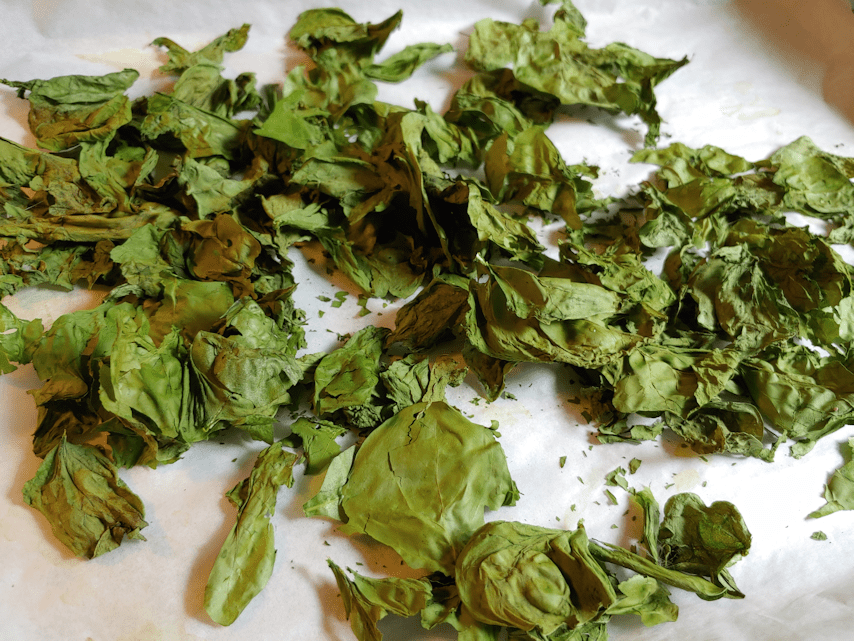
I’ve also started to dehydrate spinach leaves.
I use our oven to dehydrate things, using the “warm” setting, reduced to it’s lowest temperature of 145F (default is 170F). For something as light and thin as spinach leaves, I shut it off and let the oven light on to stay warm. We can only fit two trays in the oven at a time, but after I went to turn the leaves and found they’d shrunk enough, I combined them into one pan and left it for the night. In the morning, I just crushed them lightly, and put them in an air tight canister. There’s maybe 1/3rd of a cup of dried, crushed leaves from the 2 trays. We’ll keep doing small batches like this and, eventually, we’ll reduce them to a powder instead of flakes. It kind of reminds me of dehydrating celery. You start off with what looks like so much, but by the time it’s completely dehydrated, it looks like there’s nothing there! :-D
Now it’s time to see if I have enough connection to publish this!
While heading out to feed the outside cats, I heard a noise from an unusual direction.
I had startled Nicky the Nose on the sun room roof!
I always get a giggle out of how he pancakes himself like that when he’s startled. As if he can somehow make himself small. :-D
Our cats never go on the sun room roof, that we’ve seen. They’ll go onto the new part roof, where they can look at the girls through the second floor windows, but it’s quite a leap to go onto the rest of the roof from there. It was a surprise to see Nicky there!
My daughters had a Mother’s Day treat planned out for me. In our tiny little hamlet, we have a small hotel with a bar and itty bitty restaurant. Well, with all the restrictions in place, they’ve had to change things up. About a month ago, the separate bar and restaurant was reworked as a single country style pub, and quickly got a good reputation for their excellent food. It’s a small menu for a small town, but we’re just excited to have options at all.
Of course, the government promptly pulled the rug out from under restaurants again, so they’re limited to take out, only. I guess the government isn’t done killing small businesses, yet. So we wanted to give them some support!
I saw them post a photo on their Facebook page for a platter that is not on their menu, so I had to ask about it. They were able to put together an appetizer platter for us, including deep fried mushrooms, which are also not on the menu yet. It was awesome! Even with 4 of us, by the time we were done, I could only manage one slice of the pizza I got for myself. My daughters ordered their cheeseburger platters, and were thoroughly impressed just by the size. There was enough there for two meals! And yes, they tasted really good, too! It’ll be much nicer to be able to order food from just a few miles away, instead of having to go to another town. Unless we want Chinese food. ;-) I’m glad we were able to order there today. Driving by over the past month, I was always seeing vehicles and people out front and, on nice days, people sitting and eating at the tables outside. Today, with the increased restrictions kicking in at midnight, there was nothing. Just two employees, and me, and I only heard the cook, but never saw him. So we’ll be trying to order food from there as often as our budget allows. Hopefully, lots of other people will be doing the same. Considering how few people live here, that still won’t be much, but it might be enough to keep them going.
In other things…
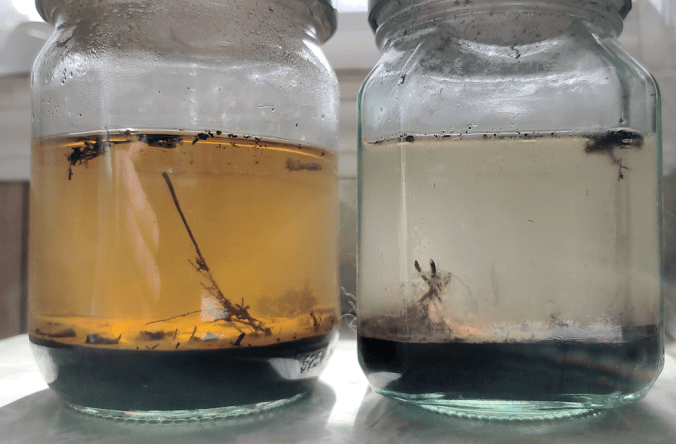
I had hung on to the soil samples from the tests done in them, and today I finally got some photos before getting rid of them. Here are the jars from the first two tests we did.
The first sample was from the soft soil uncovered when the old wood pile was cleaned up. The water is still very distinctly orange! The second sample is from the new garden soil we purchased.
These are from the third and fourth tests we did. The one that’s more orange and still cloudy is from where we’d planted potatoes using the Ruth Stout method, while the other is from the unamended soil that has never had anything planted there before. I find it interesting to see how clear – or not! – the water became, after letting the samples sit undisturbed for so long.
Later this afternoon, my daughters and I went out to do some watering, and to plant onion sets in the last of the beds in the old garden area. The 2 bags of shallots had only a dozen sets each, so they were planted in one row along one side, while the yellow onions were planted in a three row grid on the other. Later next week, kohlrabi will be planted in between the two. Besides that, there’s still half a bed left that will be planted with carrots. Aside from successive sowing the spinach, that will be it for those beds.
There were still maybe a dozen onion sets left over, so I’m thinking of interplanting them with the beets that will be planted near the garlic beds. Hopefully, they will help deter deer from going after the beet greens. If all goes well, that will be completed tomorrow.
Before heading back indoors and out of the high winds we were having, the girls and I checked on the flowers we’d planted in the fall.
We’re finding more and more of the teeny, tiny crocuses blooming! I know these are not large flowers, but I didn’t expect them to be this minuscule! I suspect, after they’ve had a year to establish themselves, they will come up a bit larger, next year.
I then spent some time tending the seed starts in the sun room. The gourd pots got moved to the sun room awhile ago, but there is still nothing of the Ozark Nest Egg, Thai Edible Bottle gourd, and birdhouse gourds. I am hoping it’s just because they take so long to germinate normally. I probably should have started them earlier. It’s the squash and melons that I’m eyeballing more. They haven’t been in the sun room long, but I was hoping the increased warmth would help. I’m happy to say that I did see a couple of seedlings trying to push their way through, but most show no sign of any germination. I keep second guessing myself about what we used to plant them in and all the things we did differently this year, thinking that maybe I’ve gone and killed them off somehow. :-/ It’s still just under a month before we can transplant anything outside, so there’s lots of time yet for them to germinate.
At least, that’s what I keep telling myself!
Oy. Today has been a really bad day for internet connectivity – as happens every time we have high winds. This post took forever to get done! Time to stop trying to do internet things for a while.
Hmm… I still have lots of my Mother’s Day pizza left. Maybe a late snack is in order? :-D
I hope that your day was full of joy and blessings.
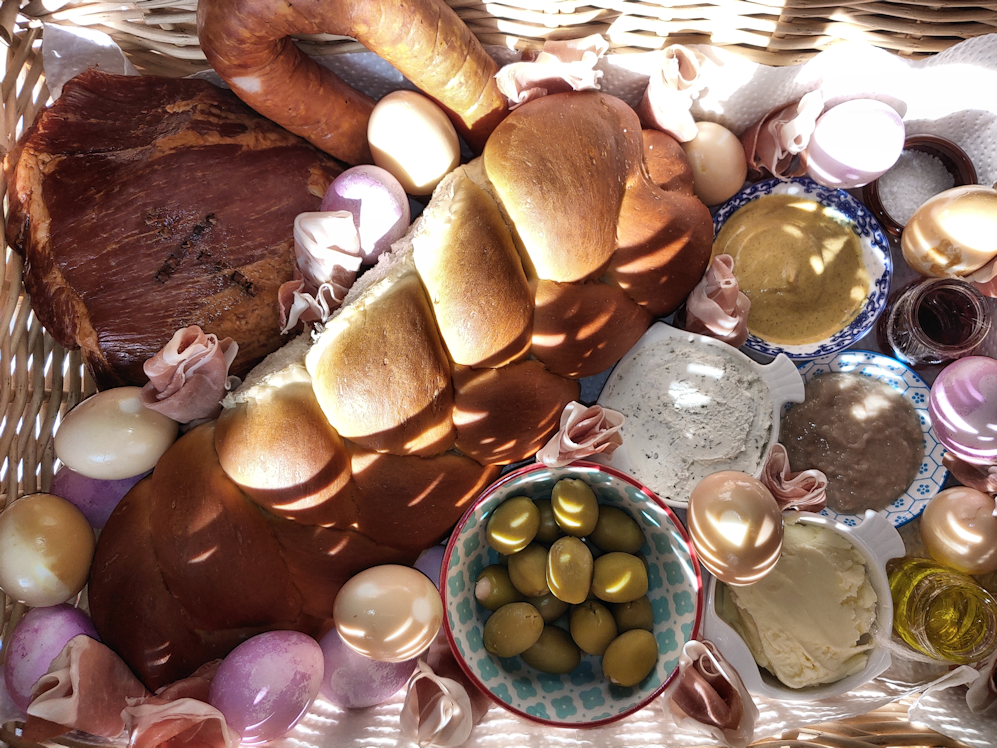
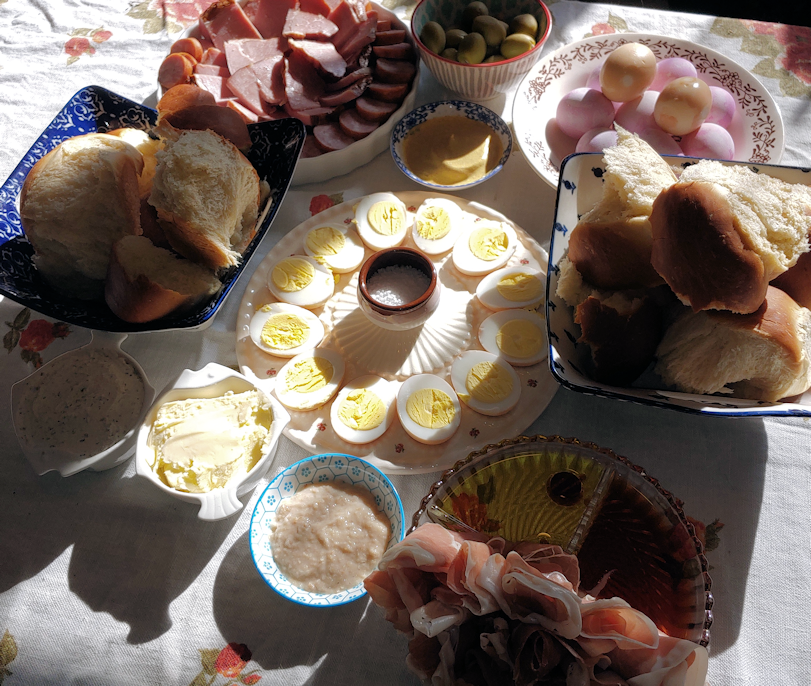
Our favourite tradition is our Easter basket.
The traditional items include bread (I made a challah this year), eggs (half were pickled, half were coloured with beet juice), ham, sausage, cheese (goat cheese with herbs this year), horseradish (we purchased a spread this year, as our ground it still too frozen to dig up fresh roots), butter and salt. In place of the traditional bacon, we twisted prosciutto rosettes. Among the non-traditional items, we have mustard, olive oil, wine vinegar and olives (almond stuffed, this year). Other items that some people like to include are wine, grapes or an apple, a bottle of wine, or a single white candle. Every item has symbolic meaning. It’s not in the photo, but the basket was covered with a hand embroidered linen cloth; a small table cloth, stitched and gifted to me by my godmother, many years ago. I have a small collection of hand embroidered linens that I like to use to cover our baskets. Lots of people cover their baskets with crocheted lace doilies.
Typically, the basket would be taken to church for blessing on Holy Saturday (as my mother was able to do), but we blessed it ourselves again, this year. I’ve seen people with very elaborate baskets, with added decorations on the basket itself, along with sprigs of flowers, greenery or pussy willow branches. I’ve also seen baskets as simple and elegant as a loaf of rye bread in a small basket covered with a cloth napkin.
A while back, we tried a recipe for overnight bread, which you can read about here, and find a link to the original recipe we used.
I then tried an “over day” version, using the dough baby from my Babcia’s bread experiment. It was fantastically successful!
We’ve made it again, as a pretty basic no-knead bread and, once again, it turned out awesome!
If you are new to this blog and don’t know the background to this, you can read the story behind my experiment to try and recreate the bread my grandmother made in pre-WWII Poland, as my mother remembers it. Or you can check out all the posts about it at this link. All links will open in new tabs, so you don’t lose your place here!
Here is how we made No-knead bread, using the old dough method.
The first step is to dig the dough baby out of the flour it sleeps in.
My Babcia did bread baking once a week, and when the old dough sits that long, it tends to be dry enough to break apart into pieces before reconstituting it. This time, the dough baby had not been sleeping in its bed of flour for that long, and it was still quite… doughy! :-D
So I just pulled it apart a bit and placed it in the bottom of a very large bowl.
I don’t know how much that is. Maybe about 2 cups, including the flour stuck to it? The dough baby rises and collapses while stored in the flour, and I made no effort to measure the quantity.
I also pre-measured 2 Tbsp each of course salt and sugar, and 1 Tbsp of yeast.
The yeast would be optional. The dough would need more time to rise without it, which would give more of a sourdough flavour.
Four cups of very warm water was added to the dough baby. Since it wasn’t dry enough to break into pieces, I spent some time stirring it and breaking it up in the water.
Then, the sugar and yeast was added and mixed in, the bowl loosely covered, and it was left for about 10 minutes.
I like to use traditional active dry yeast, rather than quick or instant dry yeast, but that’s just me. The traditional yeast needs more time to proof in the liquid compared to the quick yeast, and the instant yeast wouldn’t need to be added at all at this point, but would be mixed in with the flour.
If I were not using yeast, I would leave the water, dough baby and sugar mixture in a warm place for much longer, checking regularly to see how active it was.
Here is how it looked after 10 minutes. I stirred it again to break up the dough baby a bit more.
Then it was time to add some flour.
I started by adding 3 cups of flour. It’s easier to mix in that amount compared to starting with just one cup.
I decided to use Durum wheat flour at this point, just because I have it. Use whatever flour, or mix of flours, you like best!
After the first 3 cups was thoroughly beaten in, I added another cup of flour and the salt.
More flour was beaten in, about a cup at a time at first, then a half up at a time.
How much flour to use is something I’ve never been precise about. I know there are bread bakers that weigh and measure precise amounts, but in my experience, that just doesn’t work. The amount of flour needed can depend on things like how fresh the flour itself is, to how much humidity there is in the air.
With 4 cups of water, I would have expected to work in at least 8 cups of flour for this recipe (with my usual kneaded bread, I typically used 5 or 6 cups of flour to 2 1/2 cups liquid).
We are very, very dry right now.
Today, I worked in 7 1/2 cups of flour, and probably could have done with a bit less.
By this point, I was working the flour in with my hand rather than trying to stir it with a spoon. If you have an electric mixer with a dough hook, go ahead and use it!
Before setting it aside to rise, right in the same bowl, I sprinkled some flour over the top and sides, in case it rose high enough to touch the bottom of the bowl’s lid.
Lightly cover the bowl, then set it in a warm place for about an hour. With our chilly our kitchen is in the winter, I heated our oven to its lowest setting (145F on “warm”), then shut it off before I started mixing the flour into the dough. The covered bowl is left in the warm oven, with the light on, to rise. Anywhere that is warm and draft free will do.
Here it is, after an hour. It just barely touched the bottom of the lid! :-D
The dough it then pushed down and worked a bit to incorporate the flour that had been dredged on top.
Next is a very, very important step.
A piece of the dough needs to be removed and set aside for the next batch of bread!
I dumped some flour on a container and plopped about a cup of dough onto it.
Once the new dough baby was set aside, the rest of the dough was dumped onto a 9×13 inch baking sheet that was lined with parchment paper. The last time I made this, I used a parchment paper lined lasagna pan, but I could also have split it into two parchment paper lined loaf pans.
If I didn’t have parchment paper, I would have well oiled the pan, first.
Speaking of oil…
After spreading the dough out to fill the bottom of the pan, I stabbed at the dough with my fingers to create “dimples”, then topped it with oil, course salt and dried parsley flakes.
I happened to still have some fake truffle oil that I used, but an olive or avocado oil would work just was well.
The pan was then set aside for the dough to rise again. Since this batch is so flat and thin, I started preheating the oven for 450F right away. Had I used loaf pans or the lasagna pan again, I would have let it rise longer before preheating the oven. If I had used no yeast at all, it would be left in a warm place until doubled in size.
While the shaped loaf was waiting to go in the oven, there is this to deal with…
The bottom of the bowl still has quite a bit of dough stuck to it!
We can’t let that go to waste!
Into the bowl went the new dough baby, and the flour it had been resting on.
While working the flour dregs into the dough baby, scrape as much of the dough stuck to the sides and incorporate it into the dough baby.
You probably won’t get all of it off the sides, which is okay.
The dough baby is now ready for a nap. I have a canister of flour that I bury it in, but it can also be buried right in a bag of flour, as long as you’re not planning to use the flour for anything else in between bread baking!
After the dough baby has been buried, it will rise quite a bit before collapsing in on itself, breaking through the surface of the flour. Remember to check on the dough baby later on, to make sure it is still covered in flour.
Once the oven is ready, place the pan of bread into oven and bake. If you wish, place a container with about a cup of water on the rack under the bread pan, to add some steam to the oven as it bakes.
For a very flat loaf like what I made today, it took about 25 minutes. A deeper loaf, or a pair of loaf pans will likely need 30-40 minutes. Bake it until it looks like this.
With the oil added to the surface, it will have a deep, golden colour when it’s ready.
When baked, remove from the oven and left to cool for a few minutes. Once it is safe to do so, remove the bread from the pan and onto a cooling rack (parchment paper makes that job a LOT easier!).
I really like the big, flat slab of bread, but it is a bit hard to cut a slice off! :-D
Here is how it looks on the inside.
The crumb is light and fluffy, yet still wonderfully chewy. The star of the show, however, is that golden, flavorful top crust! It’s just a lovely and delicious combination of textures and flavours.
The only problem with this bread is how difficult it is, not to just scarf it all down right away! :-D
Here is the recipe.
Old Dough No Knead Bread
Ingredients:
old dough set aside from previous bread baking
4 cups warm water
2 Tbsp sugar
1 Tbsp traditional active dry yeast (optional, or use 2 Tbsp if you don’t have old dough)
2 Tbsp course salt
about 7 or 8 cups of flour
small amount of good quality oil (olive oil, avocado oil, etc.)
small amount of dried parsley and course salt
Break up the old dough into a large bowl. Pour water over the old dough and stir. Add the sugar and yeast and leave to proof for about 10 minutes. If you do not have old dough, use the larger amount of yeast and proof it in the sugar water. If using only the old dough and no added yeast, leave the bowl in a warm place until the mixture is bubbly.
After the yeast and old dough has proofed, add 3 cups of flour and mix thoroughly until it forms a very smooth batter. (An electric mixer can be used at this stage.)
Add the salt and 1 cup of flour, mixing thoroughly.
Add more flour a little at a time, mixing thoroughly after each addition, until it reaches a thick but sticky consistency. Use your hands to mix in the last of the flour. (If you have an electric mixer with dough hook attachments, switch to the dough hooks at this point.)
Leaving the dough in the bowl, dust the top of the dough with flour and cover loosely. Place in a warm spot to rise until doubled in size.
Prepare baking pans by lining with parchment paper or oiling thoroughly.
When the dough has risen, punch it down again, folding it into itself to incorporate the flour dusted on top.
Dust some flour on a small plate or bowl. Remove about a cup of dough for the next batch of bread, setting it aside on the floured container until later.
Pour the remaining dough into the prepared baking pan(s). Using your hands, press the dough to fill the pan to the edges and corners, then stab into the surface with your fingers to create dimples in the dough.
Carefully sprinkle oil across the surface of the dough, then use your hand to spread it evenly across the surface.
Sprinkle the oiled surface with course salt and dried parsley.
Set aside in a warm place to rise.
While the bread is rising, return the dough set aside earlier to the mixing bowl, along with any flour in the plate or bowl. Use the flour and the dough ball to scrape off any remaining dough stuck to the surface of the bowl, working the dough ball until smooth. Shape the dough into a ball, then bury it in a container of flour, for use in the next batch of bread.
When the pan of rising bread is almost doubled in size, preheat the oven to 450F.
Place the bread in the centre rack of the preheated oven; if desired, place about a cup of water in an oven proof container on the lower rack to create steam.
Bake until the bread is a deep, golden colour – about 25 minutes when using a 9″x13″ baking sheet, about 30-35 minutes if using loaf pans, or a cake or lasagna pan. The finished loaf should sound hollow when the bottom is tapped.
Set aside to cool in the pan for a few minutes, then transfer the bread to a rack to finish cooling.
Today, we got to use our pasta machine for the first time, while making pasta for the first time. :-)
Granted, I have made pasta-like noodles before, before, but nothing quite like this.
Of course, I did some research first. I wanted something really basic for a recipe. This turned out to be just flour and eggs. Most places I found went with a ratio of 2 eggs per 1 cup of flour. I did find one that used a ratio of 2 eggs per 3/4 cup of flour. As for quantities, it was recommended 1 egg per person.
Based on that, we could have gone with 4 eggs and 2 cups of flour, but I went ahead and did 6 eggs with 3 cups of flour.
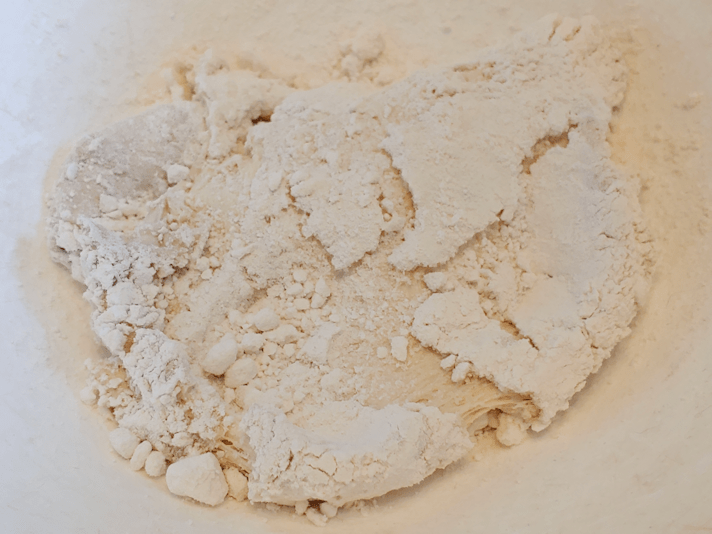
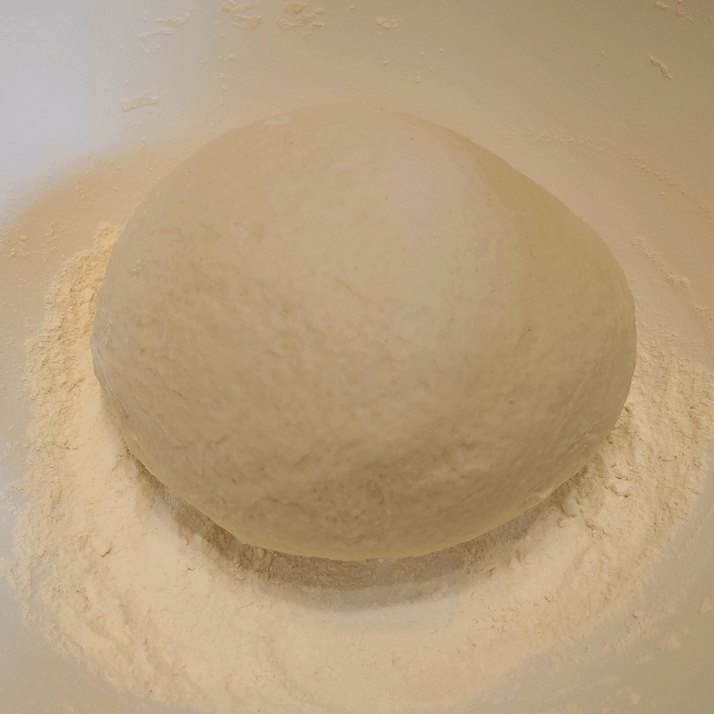
I worked the dough in a bowl until the dough was well formed, then turned it onto our kneading mat.
This turned out to be waaaayyy too dry! I would expect relative humidity would affect the dough, like it does with bread, and we are very dry right now. I simply could not knead in the rest of the flour.
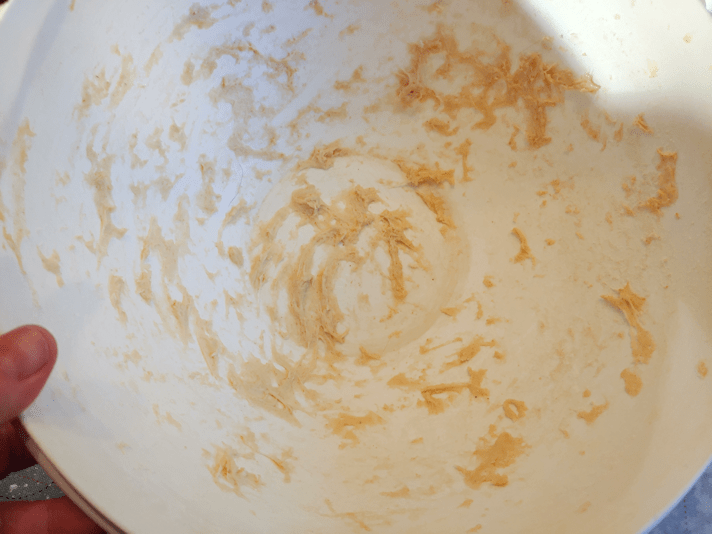
The flour had bits of dough in it, though, and I wasn’t about to let that go to waste.
If you are a pasta aficionado, you may want to look away right now… ;-)
I remembered that one resource I found that used the 2 eggs: 3/4 cup flour ratio. It had a recipe calling for 7 eggs to 3 cups of flour.
I decided to add an egg.
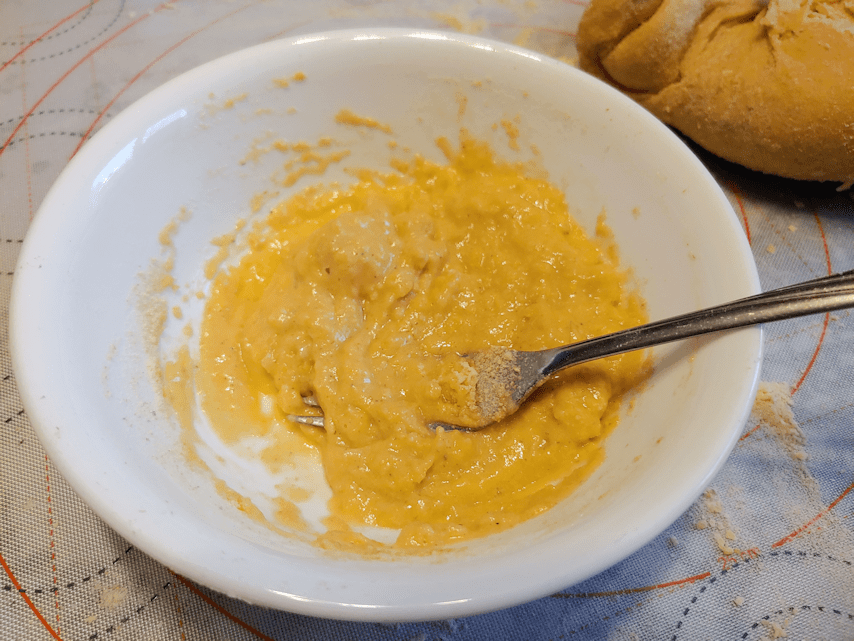
Of course, I couldn’t just knead in an egg, so I beat it in a bowl first, then beat in the flour that I couldn’t work into the dough. I even broke off some pieces of the dough and mixed that in, to get it thicker.
I then opened up the dough so I could add the additional egg mixture into the middle, then fold the dough over it.
Kneading that in was pretty messy, anyhow!
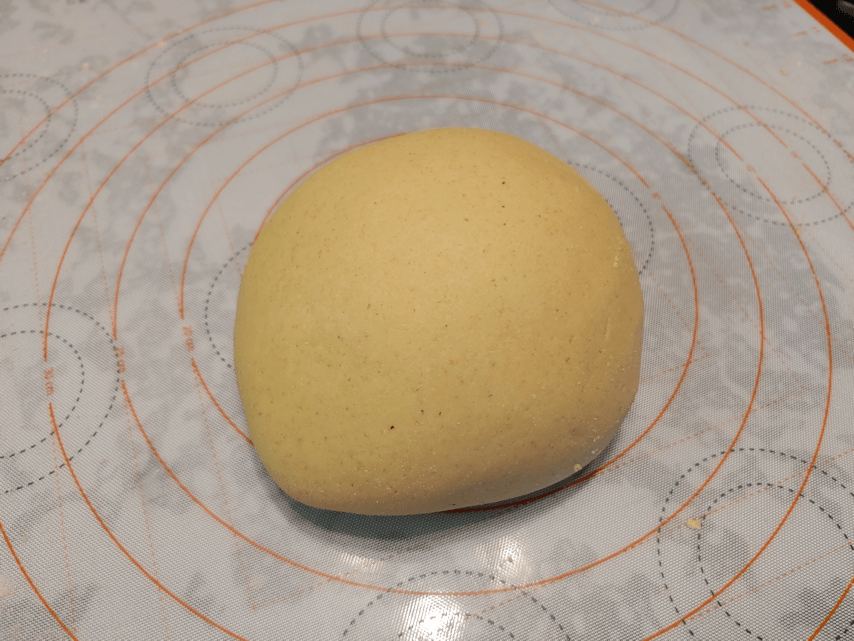
Once it was thoroughly worked in, I only needed to add perhaps a tablespoon of flour onto the mat to clean up the stickiness, then I kneaded it for 10 minutes.
I’m sure I broke all sorts of rules or committed some terrible faux pas in doing this, but hey – it worked! The dough was wonderfully smooth and elastic, and just barely sticky.
At this point, I covered it with some plastic wrap and let it sit for 20 minutes.
While I was looking things up, there were a few points I kept seeing repeated. One was that the pasta cooked extremely quickly, so before I even started it, I made a use-watcha-got meat sauce. The other thing I kept seeing was to use extra salt in the water the pasta would be boiled in. Since they cook so quickly, they don’t have the chance to absorb salt from the water, if the usual amount was used.
So while the pasta was resting, I made a few final touches on the meat sauce, then prepped a pot of salted water. No one mentioned how much more salt to add, so I winged it. :-D
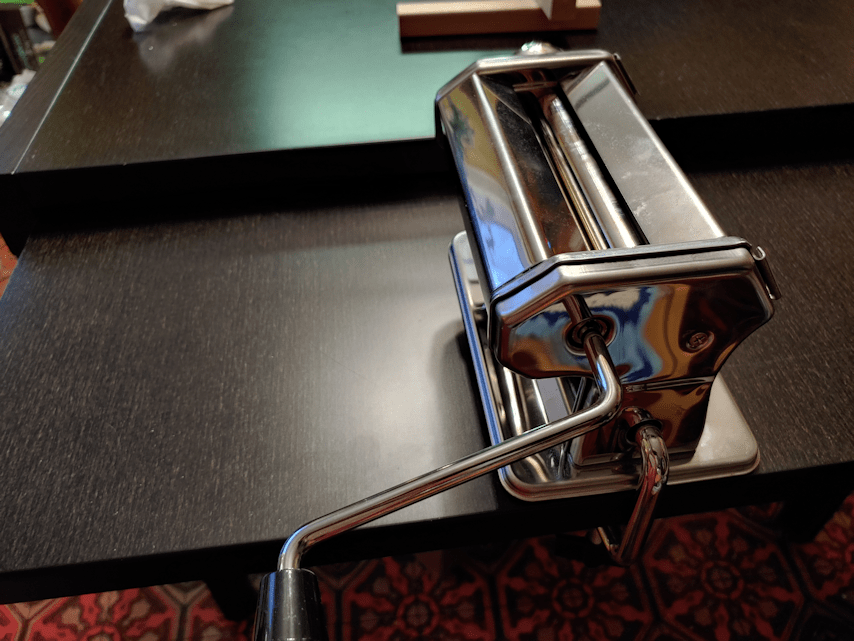
The next thing to do was set up the pasta machine.
What’s hilarious is that the first image has the pasta photoshopped onto the machine completely wrong. It shows cut pasta coming out of the flat rollers. :-D
The machine comes with a clamp to attach it to a table, but our table has a different design. It can expand to twice its size. The two halves of the table top slide one over the other when it’s closed, with a support piece running under them at each end. The whole thing is about 6 inches wide – way too much for the clamp to fit around.
It worked out though.
I was able to partially slide out the extension, and still have a stable surface to clamp on to.
When it was time to start rolling the dough, I started with only half of it. The first time I rolled it through the machine, though…
It just tore apart!
I spent some time going through the instruction manual to figure out why. I ended up using a rolling pin to thin it out more, first, and dusted more flour on each side. That seemed to do the trick.
Another thing I kept reading was to make sure to roll the dough thin enough to see through. I kept reading that the pasta will thicken as it cooks, so it’s better to roll it thinner.
In reading the instructions, it said to set the machine at 1, for the widest setting, rolling the dough through, folding it in half, rolling it again, about 5 or 6 times, then working it thinner and thinner until about 3.
There was one problem with that.
The numbers on the machine are backwards from the numbers in the instructions! The widest setting is 7, not 1. :-D Which doesn’t really matter, as long as it works, but I did find that funny.
It took a while to get the hang of it. One problem I encountered was that the crank handle kept falling off! The pasta also tended to go off to one side. After a while, a daughter was able to come give me a hand, too, which made things much easier to handle.
The pasta sheets kept getting longer and longer, and I ended up having to cut them in half. Then do it again! In this photo, we have the 4 sheets draped on the pasta drier, ready for us to put the cutter attachment on and start cutting them.
I have to add that I’m really glad I waited until we found Durum flour for this. We could really feel the difference in how well the pasta held out to all the stretching and handling.
The first ones we cut were still hilariously long, so we cut the remaining sheets in half again.
Their widths might have been consistent, but their lengths certainly weren’t! :-D
After finishing the first batch, they got to dry while the second half of the dough was prepped. This half went much faster, now that we knew what we were doing! Also, we split the second batch of dough in half, right from the start.
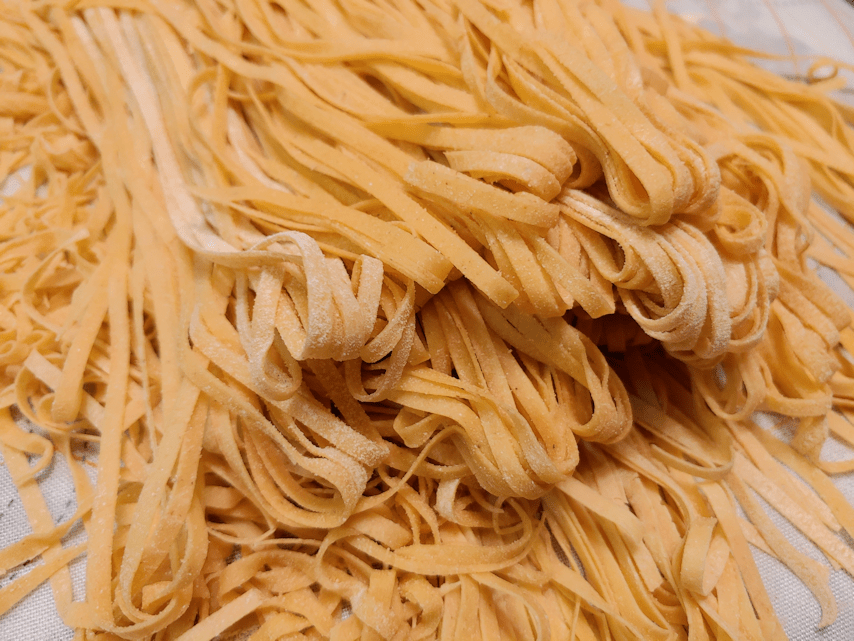
Once they were done, it was time to get the water boiling. After a while, I took the longest pasta pieces and broke them in half, to make them a more reasonable length!
Just before the water was boiling, I took them all off the drying rack, to make them easier to handle and carry and break any really long pieces that got missed..
Don’t they look pretty?
And yes. I did cook the whole lot!
Here, I have pretty much just added them to the water. It hasn’t even come back to a boil, yet, and already the pasta is half cooked!
I boiled them for 2 minutes, but that was probably at least half a minute too long! :-D
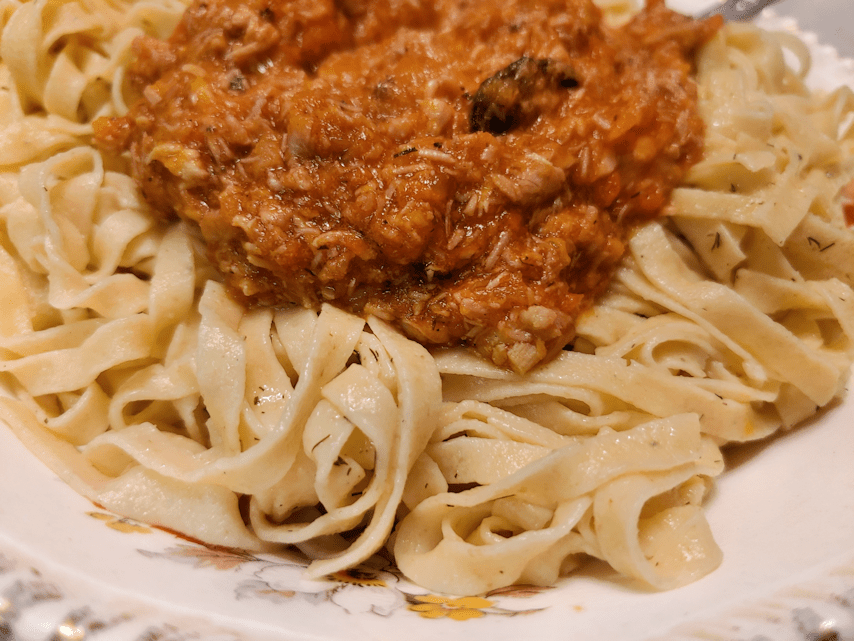
After draining them, I tossed them in some herbed butter my husband made earlier in the day.
There was have it! Fresh made pasta, with meat sauce.
So, how did it taste?
Many of the sites I found with recipes raved about how good they were, and how you’ll never want to eat store bought pasta again, and so on.
It was good, but I don’t know that I would say it was that good! At least, not when considering the amount of physical labor involved. The family did all really enjoy it, though.
I actually found the pasta a bit thin. I like a toothsome pasta. In rolling it out, I went to the recommended “3” on the knob, based on what I’d read (the instructions with the machine suggested going to 3, but with the numbers reversed on the knob, that actually meant 4). It was certainly thin enough to see through, but I think that, next time, I’ll just bring it down to 4 on the machine.
It does use a lot of eggs, though. We’ll have to buy more, before we can do this again! Or we could make it with just water. The instruction manual has a recipe, too.
We definitely can do some experimenting! :-D
All in all, I’d say this was a success, and I am quite glad we got the machine to make the job easier! Even with the handle falling off so often! :-D
When setting the old dough to reconstitute and ferment overnight, I had some concerns about temperature. The crock was sitting on our dining table, and that room gets pretty chilly. I did warm up the rice bag we have been using to warm our fermenting hard apple cider (which is probably ready to be bottled, but we haven’t gotten around to it yet) and set it under the crock, to help keep it at least a little bit warm.
While investigating some cat noises in the wee hours of the morning, I checked it and found it was looking pretty much the same as when I’d left it. So I warmed the oven up a bit, then put the crock in, shut the oven off and left the light on.
This is how it looked about 3 hours later.
Warming it up, did the trick! I’ll have to keep that in mind, as we continue experimenting.
I warmed the oven up a bit again, then put the crock back for another 3 hours or so, before I was able to start making the dough.
That’s looking nice and puffy!
I find it interesting that the pieces are still distinctly separate. When I stirred it, before adding it to some flour and salt in a bowl, I found the pieces separated and stretched, before starting to mix together. The water under the old dough pieces was pretty much clear until I mixed it, too.
I added this to a bowl with 3 cups of flour and 2 tsp of Kosher salt and mixed it together. I kneaded another 4 – 4 1/2 cups of flour in before turning it onto my table and kneading it for another 5 – 10 minutes.
Normally, I would oil the bowl the dough will be rising in, but my grandmother would not have done that, so I used flour, instead.
With this batch, I’ve got the same amount of water as the first batch the old dough came from, but I’m using less flour. That first batch was too dense. With only a little more than 4 cups of flour in here, after I remove some dough for the next batch, I think I’ll just make one large round loaf this time, instead of two.
Next time, I think I’ll up the water and flour quantities a little bit, and make a bigger batch. I don’t think I’ll adjust the amount of salt, though. Not unless I end up doubling the recipe or something.
The dough is now covered and set aside for its first rising. I’ll give it at least an hour, probably two, before punching it down and leaving it for a second rising.
I will post again, later today, with the final results! :-)
I may have mentioned in past posts, about my mother’s memories of bread baking in pre-WWII Poland. I was fascinated by what she could tell me. With no commercial yeast available, I had thought my Babcia (grandmother) had used a sort of sourdough. I know my father remembers this; a portion of the bread dough would be set aside to continue to ferment, and be used in the next batch of bread.
My grandmother did something different. She allowed her old dough to dry.
We lost our own sourdough starter, the Sourceror this past summer. It almost made it to 2 years, but we had a real problem with fruit flies this year. Somehow, they managed to get into the container and contaminated it.
Having a big bubbling bowl on the counter has been a bit of a problem for other reasons, so the more I heard about how my Babcia saved her dough, the more I wanted to try it.
My mother’s memories go back to the late 1930’s, early 1940’s. Then WWII happened and they eventually ended up in Canada, where commercial yeast was available. After questioning her about it, this is what I’ve been able to piece together.
Babcia would bake bread once a week. She would set aside some of the dough, adding in the scrapings from the wooden dough bowl, form it into a ball, then burying the ball in the flour. The night before she would be baking bread again, she would take out the dried ball of dough, break it up into pieces, and soak it in water overnight. In would get all bubbly, and that would be her yeast for her bread baking, with the cycle continuing each time.
My basic bread recipe includes things like oil, sugar, eggs, milk… all things that I just couldn’t see handling sitting in a bag of flour for a week without going off. On questioning my mother, I learned Babcia used none of these things. It simply wasn’t available. Her bread was flour, water, a bit of salt, and the reconstituted old dough. That’s it.
The flour would have been flour they milled themselves (at least they did until the Nazi’s caught them using an illicit hand mill and destroyed it), using grain they grew themselves. My mother says corn flour was also sometimes used, which they also would have grown themselves. The ingredients may have been few, but my mother remembers it as being the best bread; especially when corn flour was added. She remembers it was light and fluffy, too.
My mother was too young at the time to remember a lot of details, though, so I did some research. I know that bread can be as basic as flour and water, but if salt is used, would that be a problem? I know that sugar feeds yeast, while salt retards it. How would having salt in the dough affect the old dough yeast cake? Also, how much dough was set aside? My mother remembers a “ball”, but as young as she was, her sense of how large that was would be distorted.
In my research, I found quite a bit about “old dough” bread baking. This gave me a lot of the information I was looking for. For some types of old dough baking, dough is set aside before the salt was added, while others were taken out after. Both work. As for how much was taken out, I eventually found a general “about the size of an egg” description.
What I didn’t find was anyone who used old dough that was stored in flour. Nor did I find any that stored the dough for weekly baking. Most described setting the old dough aside in the fridge for 2 or 3 days, at most. In some forums I found, people described using it in their daily baking. Not a single person described using their old dough the way my mother remembers her mother did it. They all used wet dough. None used reconstituted dry dough.
I have decided, instead of getting a sourdough going again (for now), I will try and recreate my Babcia’s bread.
Of course, some things I will simply not be able to recreate; at least not now. We’ll be using plain old AP flour. I won’t be adding corn flour right away. I don’t have a big wooden dough bowl like my Babcia would have had (with a wooden dough bowl, yeast would have gotten into the wood itself, adding its own layer of flavours). I also don’t have a wood burning masonry stove (something similar to this, with a sleeping area on top) like my grandmother would have been baking in.
I found some proportions for ingredients for 2 loaves that I will start with, and I will probably experiment with making some a couple of times a week before I start adjusting quantities for larger batches.
One of the main differences in this experimental process is that I don’t have a yeast “mother.” My mother has no memory of where her mother got hers from. It was always just there. She may well have gotten her first old dough from the family members she was living with (my great grandparents having already gone to Canada to start a homestead, only to not be able to send for their children as they had planned, because of WWI). However, as they saw the warning signs leading to WWII, they abandoned their farm in Eastern Poland, taking nothing but the clothes on their backs and a goat they could milk for food, to settle in Western Poland. At that point, my grandmother likely got another old dough ball from one of their new neighbours.
It’s amazing how much history is intertwined in something so ordinary as how my grandmother leavened her bread!
So this is what I will be doing in my experiment that will possibly span years.
Today, I have started a first batch of plain bread; it’s rising as I write this, and I will post about it separately when it’s done.
I will be using a commercial “sourdough” yeast I happened to find, in this first batch.
After the dough is risen and before I shape it into loaves, I will break off some of the dough and store it in a container of flour, then bake the rest of the dough as usual.
In a few days, I’ll reconstitute what should be a mostly dried ball of dough overnight, make another 2 loaf batch, then continue repeating the process.
What should happen: the flavour of the bread should change and develop over time, just as with a sourdough.
What might happen: I’ll have sucky bread that doesn’t rise properly? The dough ball will start molding? The yeast will die off and I’ll have to start over? I have no idea.
For the first few months, at least, I will stick to the same basic mix of flour, water, salt and the old dough for yeast. Eventually, I will try adding corn flour. If I do decide to modify the recipe in other ways, it will be by doing things like kneading in herbs or shredded cheese or whatever, after the dough ball has been removed. I won’t be adding things to the base recipe, like sugar, milk, oil or eggs.
After I’ve done a few batches, and assuming this works, I plan to give some to my mother to taste. Hopefully, she will remember enough to be able to tell me if I’ve succeeded or not! :-D
Today, I bring to you a variation of the traditional Polish dish called haluski. You can go here for a traditional recipe with some common variations. The link will open in a new tab, so you won’t lose your place. :-)
Oddly, though my parents were both born in Poland, and I grew up with a lot of traditional Polish foods, haluski was not one of them. Mind you, when I was a kid, I hated cabbage and probably wouldn’t have eaten it if my mother did make some! Even so, my parents also took us to Polish celebrations and events in the city, and I have no memory of this dish. I did not discover it existed until within the past year or so, while looking up things to do with cabbage!
Of the recipes I found, the most basic is onion, cabbage, noodles, and a lot of butter. Some include bacon, kielbasa or a variety of cured meats, like pancetta. I tried making it with bacon, and we liked it enough that it has since become a fairly regular dish in our household. My husband is not too keen on cabbage, though. ;-)
This time, I decided to experiment with the recipe, and I am very happy with the result. The plain egg noodles were replaced with mushroom egg noodles and, because I still had some left, I included dried mushrooms as well.
The dried mushrooms are a mix of white button mushrooms, crimini and shiitake mushrooms.
The next time we dry mushrooms, we need to do a whole lot more! :-D
The noodles I used are a brand that is easily found in our area, usually in its own little display. They are made with 2% porcini mushroom granules.
While preparing the noodles according to package instructions, I chopped the cabbage and onions, cut the bacon into small pieces, and set the dried mushrooms to reconstitute in boiling water. If I were using fresh mushrooms, I would have just sliced them.
Not pictured is the butter and seasonings. The seasonings can be just salt and pepper. As I still have some left, I used mushroom salt, as well as freshly ground pepper, garlic granules and paprika. Fresh garlic can be used instead of the granules, adding them in just before the cabbage.
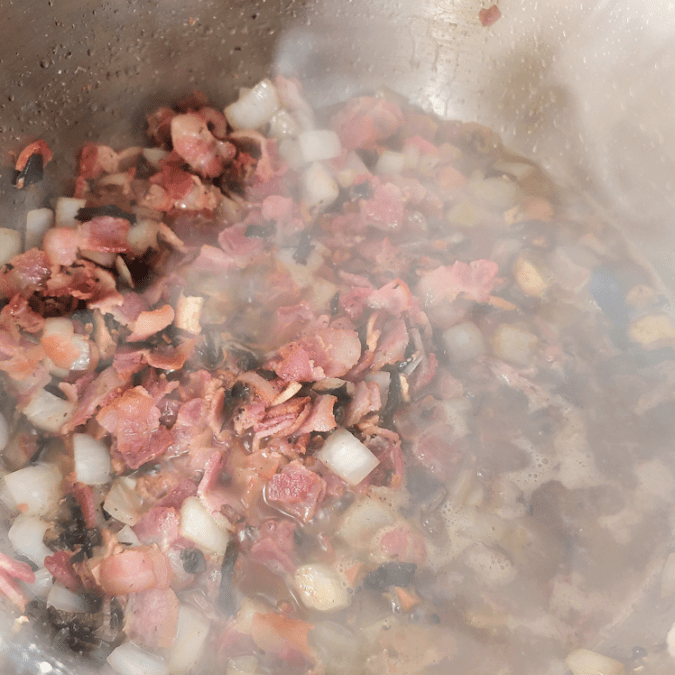
The bacon pieces were added to a large pot and fried until they started getting crispy. The bacon fat is used in place of butter at this point.
Then the onions were added and, after they had softened a bit, the reconstituted mushrooms were added. The liquid was included, too, which helped deglaze the pot. The seasonings were also added at this point.
Where I using fresh mushrooms, I would have added them to the bacon before the onions.
Next, the cabbage was added, along with a dollop of butter, and cooked until soft.
By the time the cabbage was ready, the noodles were cooked and drained.
The cooked noodles were then mixed in, along with another dollop of butter.
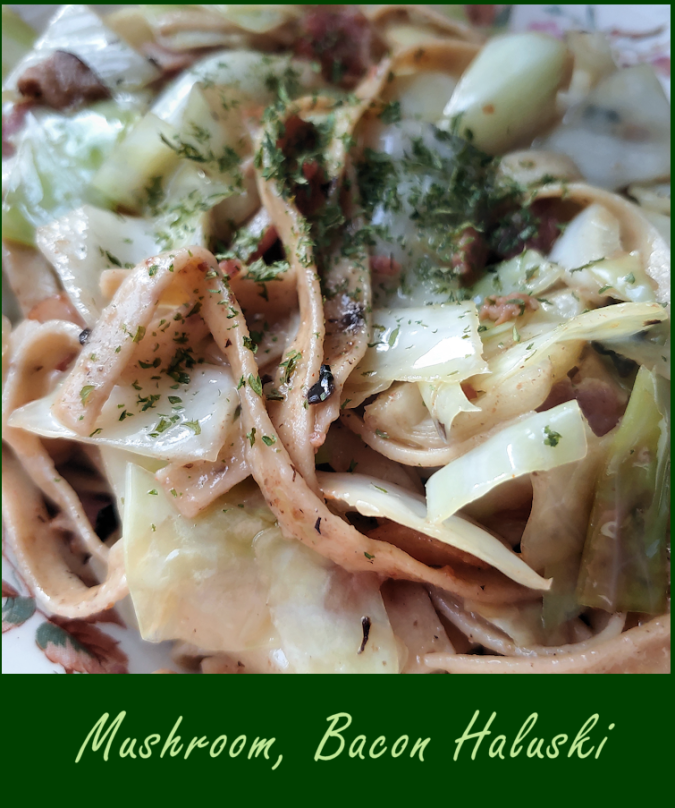
Here is the end result, sprinkled with dehydrated parsley from our garden.
The mushrooms and mushroom noodles were a very tasty modification to this traditional dish. The flavour they add is not overpowering, but there is a whole new layer of umami in the dish that works very well! I think it would have done nicely with a dollop of sour cream on top, too.
Here is the recipe! If you give it a try, I hope you come back to let me know how you like it. :-)
The Re-Farmer
Mushroom, Bacon Haluski serves 4, generously
Ingredients:
1 medium cabbage 1 medium yellow cooking onion 1 package bacon slices, 500g 1 package mushroom egg noodles, 350g 1/3 cup dried mushrooms of choice seasonings to taste (mushroom salt, pepper, paprika and garlic granules were used for this recipe) butter, as needed
Directions:
remove outer leaves from cabbage, core and chop into pieces about the same size as the noodles
chop onion and slice bacon into roughly half-inch pieces
line a small bowl with a coffee filter. Add the dried mushrooms, breaking up any larger pieces, and cover with boiling water
cook noodles according to package directions
while the noodles are being prepared, place the bacon pieces into a large pot. Cook on medium high heat until desired crispness, stirring frequently
add chopped onion and cook until the onion begins to turn translucent, stirring frequently
add the reconstituted mushrooms (the coffee filter makes it easier to pick them up out of the liquid). Cook briefly, then add the liquid the mushrooms were soaking in. Stir to deglaze the bottom of the pot.
add seasonings. Continue cooking, stirring often, until onions are soft and the liquid is cooked down until almost gone
add the chopped cabbage, along with about 1/4 cup butter (adjust quantities of butter as needed). Combine well and continue cooking, stirring often, until cabbage is at desired tenderness
add cooked and drained noodles to the cabbage mixture, adding more butter as desired
combine well. Cook until the noodles are heated through.
At our last Costco trip, we picked up large packages of three different types of mushrooms. After using as much fresh mushrooms as we wanted, I planned to dehydrate the rest. I really like the mushroom salt we’d made, but wanted to have mushroom powder, without the salt, to use. The powder is an excellent flavour enhancer.
We had used a dry “gourmet mushroom blend” we’d picked up at Costco to make the salt, but it looks like they don’t carry it anymore. So I decided to just dry our own mushrooms.
I had used a coffee grinder to made the mushroom powder for the salt. The mushroom blend had some very large pieces – large enough that I cut them with scissors before I could put them in the coffee grinder. Even so, some of the thicker, more leathery pieces would jam the blade.
With that in mind, I very deliberately sliced the mushroom pieces quite thin, before laying them out on baking sheets to dry. I had enough button mushrooms to fill one sheet, while the other was filled with shitake and crimini mushrooms. The “warm” setting on our new oven is 175F, but I put it at the lowest temperature it would go: 145F. Then I left the trays in the oven overnight.
This morning…
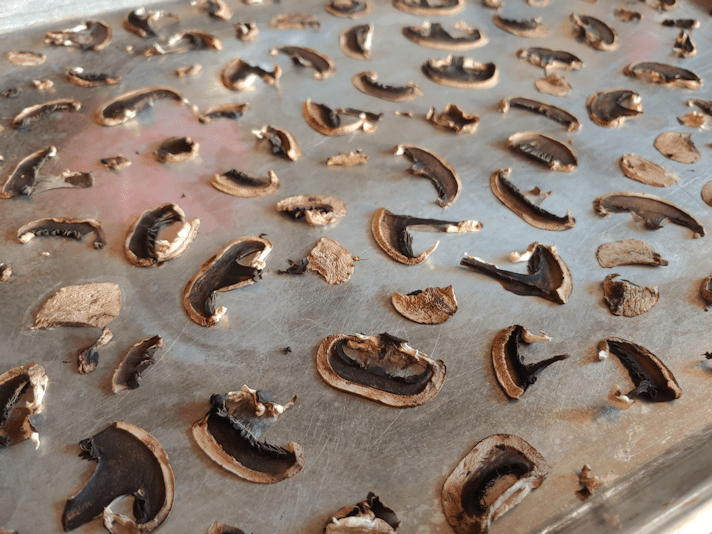
Well… they did dry very thoroughly!
This is the sheet of white button mushrooms. They had been quite crowded together, and I could barely fit all the pieces in. They are now about 1/3 – 1/2 the size before drying.
They are also thoroughly stuck to the pan.
The shitake mushrooms didn’t shrink anywhere near as much, and were easy to loosen.
These are the crimini mushrooms, which are also very stuck to the pan! I have been using a spatula to try and scrape them off. We’ll keep working at it, little by little, as we are able, throughout the day.
Well, I wanted powdered mushroom, and I’m getting powdered mushroom!
Normally when I dehydrate in the oven on pans, I like to use a cake rack to allow air circulation under whatever I’m drying. Some things are just too small for that, which is why I didn’t use any this time. I was thinking that it might have been better if I’d had a drying screen, but looking at how the pieces have adhered to the pans, I’m thinking they would have done the same to a screen. At least with a pan, I can scrape them off and still use them. If they had stuck to a screen, there probably would have been no way to get them unstuck without damaging the screen.
So in the future, I’ll know to cut crimini and white button mushrooms thicker! I know we should be able to leave them whole, or just cut them in half, but I don’t want big pieces. I’ll have to find that balance.
We’ll just have to get more mushrooms and try again.
Not that we need an excuse to get more mushrooms! :-)
While making scalloped potatoes yesterday, I wanted to find a way to use the carrots from our garden I had picked that morning.
If they had been larger, I would have just sliced them thin and layered them with the potatoes, but these were on the small side.
So I got creative.
Here is how I ended up making the the scalloped potatoes.
For the cheese sauce, I used 1 medium onion, sliced thin, butter, flour, seasonings, whipping cream and cheese.
We already had old cheddar and grated Parmesan in the fridge. I also picked up a cheese that has recently showed up in local stores that is just awesome. BellaVitano Reserve. We’ve tried the three different varieties we have available, and I picked up Tennessee Whiskey this time. They have an Espresso one that it really good, too. I shredded this, plus the cheddar, and mixed it all together with some grated Parmesan. I used most of it in the sauce, saving some for later.
For the seasonings, I used mushroom salt, freshly ground pepper, garlic powder and paprika. For the liquid, I like to use whipping cream, but it can be made with milk or a lighter cream, though why anyone would want to, I don’t know. ;-)
To make the sauce, the onion first gets slowly cooked in about a tablespoon of butter until soft. Then, a couple more tablespoons of butter is added. When that’s melted and bubbling, the flour (about 2 tablespoons) is added and cooked, stirring constantly with a whisk, for maybe a minute. Then 2 cups of room temperature cream is added, little by little, with pauses to whisk it smooth. For the first while, the flour thickens the cream very quickly. After all the cream is added, the sauce is simmered, while constantly stirred with a whisk, until it is slightly thickened. Then the seasonings are mixed in. Finally, the heat is turned off, then the shredded cheese mixture is stirred in until melted. After tasting to see if the seasonings need adjusting, it is set aside.
For the rest of it, I had potatoes peeled and sliced thin and the carrots were peeled and shredded. I didn’t count how many potatoes I used. They were on the small side, so it was probably around a dozen. The shredded carrots made about 3 cups, loosely packed.
In a buttered baking dish, I put a layer of potato slices, topped it with 1/3rd of the shredded carrots, then added 1/4th of the onion and cheese sauce. This was repeated two more times, then the top layer was just potatoes and the last of the sauce.
It then went into a 350F oven for about 40 minutes.
Shortly before the time was up, I took a ring of Polish sausage and cut it into slices. The slices were then laid on the top of the potatoes.
I hadn’t originally planned to use the sausage, but I happened to have it, so why not? :-)
I did have some concerns at this point. We’re still getting used to the new stove, and haven’t used the oven much at all in this heat. When stabbing the potatoes with a fork before adding the sausage, they were still surprisingly hard. I had forgotten to cover it with foil at first, so that might be why.
I covered with foil at this point, but it really should have been added right from the start.
With the sausage on the top, I put them in for another 10 minutes. Most recipes for scalloped potatoes that I’ve seen say to bake for 40-50 minutes, and I was shooting for 50 minutes in total. After that, I added the rest of the cheese mixture on top.
Back in the oven it went, though without the foil. I didn’t want the cheese to stick to it. I then baked it until fork tender.
It ended up taking a lot longer to cook than I expected.
Also, handy hint. Put the pan on top of a baking sheet, in case the sauce bubbles over.
We’ll be testing out the oven’s self cleaning function, next…
:-D
When it was fork tender, I took it out and topped it with chopped parsley I’d picked from our garden that morning.
This was quite an experiment from how I usually make scalloped potatoes. They are usually just the potatoes and onion-cheese sauce, these days. I was very curious as to how the carrots worked.
They pretty much disappeared!
I used some of each type of carrot we have; white satin, rainbow (orange, pale yellow, and white), and deep purple. The purple carrots left colour on the potatoes, but with them being shredded, and such a long cooking time, they all pretty much disintegrated and disappeared into the sauce. I could taste a hint of their sweetness, but that was it.
I would definitely be up to including them again.
The addition of sausage… well, you can’t go wrong with adding kielbasa!
The cheese mixture worked really well, too. That Tennessee Whiskey cheese added to the flavour, but did not overpower.






























 The Re-Farmer