I recently harvested the two biggest heads of sunflower seeds that were done blooming. They are now hanging in the basement to dry, where the birds can’t get at them.
As for the rest of them, we’ve got seed heads at all stages! Not all will have time to mature before the growing season ends, but we should still have a decent number of them to harvest and dry for the winter.
Click on the images to see larger sizes, though they are all 25% of the original size.
That one mutant sunflower, with all the extra seed heads developing, is one to keep an eye on! We might actually get a couple of seed heads mature enough to harvest before the end of the growing season.
While going through some of the photos I took with one of my daughters, she was suggesting I make some available for sale, in various forms. We’re still trying to come up with ways to be able to raise funds for things like a new roof, when I cannot get a job (for the new folks following this blog; as we are living on my husband’s health insurance disability payments, anything I earn would be deducted from his payments. If I were to earn more than his payments, he would lose his plan, which means no more coverage for his prescriptions). I was considering offering things up as fundraisers: all proceeds go towards replacing the roof, or getting yard cats fixed, or building a wheelchair ramp, etc.
So I’m putting the idea out there. If I were to, say, make photos available on, say, Redbubble, as prints, mugs, t-shirts, etc., would this interest you? I’ve had it suggested to put a donation button up, but I don’t like to ask for something for nothing. Other people use sites like Patreon, where there are rewards for different tiers. Of course, there are always affiliate links, like with Amazon, where the site would earn a commission. All proceeds would go to specific things, such as a new roof (long term goal) or getting yard cats spayed and neutered (short term goal) or building a wheelchair ramp (mid term goal), etc. It would have to be fundraising for a specific project, not an income for us. We would have to be very careful about that.
Today, we took advantage of the warmer weather and dug up our two potato beds.
The first one got done fairly early in the morning, before we headed to the city. Having already dug up a few of them earlier, I had some idea of what to expect, but I have zero experience with growing potatoes the “Ruth Stout” way.
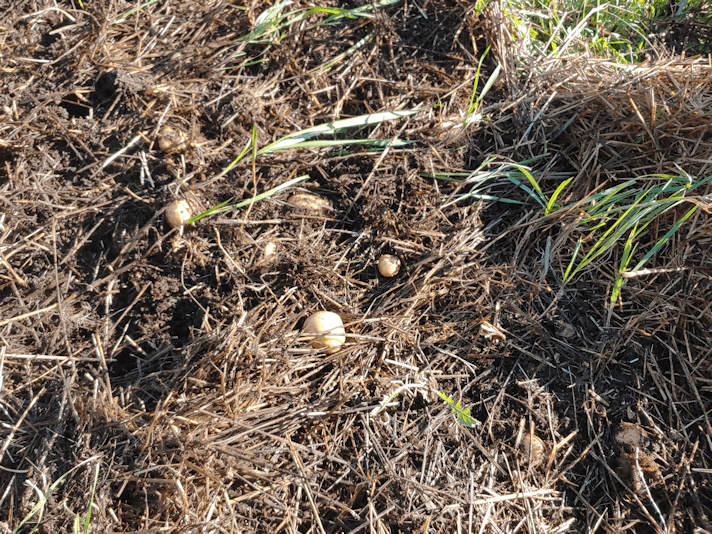
I first pulled up the potato plants, then carefully used my potato fork to lift off, then “rake” the mulch away. Here, you can see some of the potatoes I uncovered in the process.
I also uncovered several chilled little frogs! I carefully moved them to the mulch by the squash, where they could warm up in the sun.
I also uncovered slugs.
I did not rescue them. ;-)
Almost all the potatoes I found were just sitting on top of the soil! Some took a little more raking away of the mulch to find, but not much more.
What had been rock hard ground when we started, the mulched soil was so much easier to work – even with all the rocks.
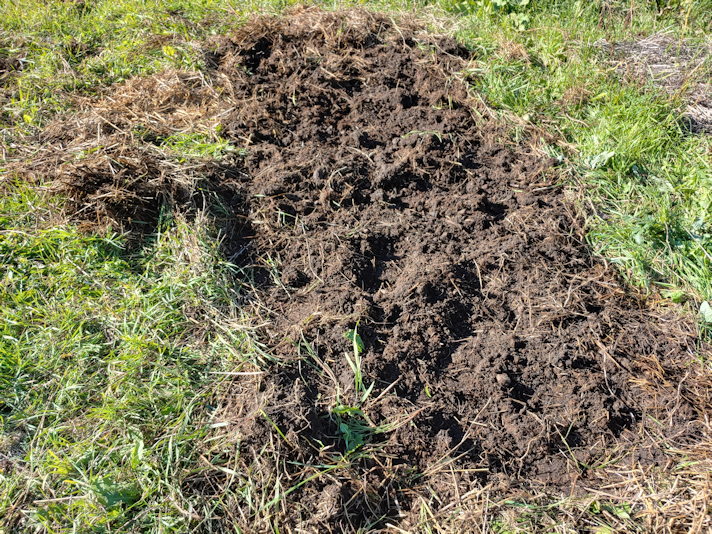
I took advantage of the situation and dug up the entire plot, so I could pull out as many weed roots as I could. The crab grass came out pretty easily. Then I hit a solid mass of roots near the surface, with a tap root of some kind that continued deep into the ground. I could not get it out with the fork! If I’d had the spade handy, I might have been able to cut through it, but since it seemed to be dead, I left it. It will be buried.
I did find a couple more potatoes in the process!
The end result looked like a 4×8 foot grave! :-D
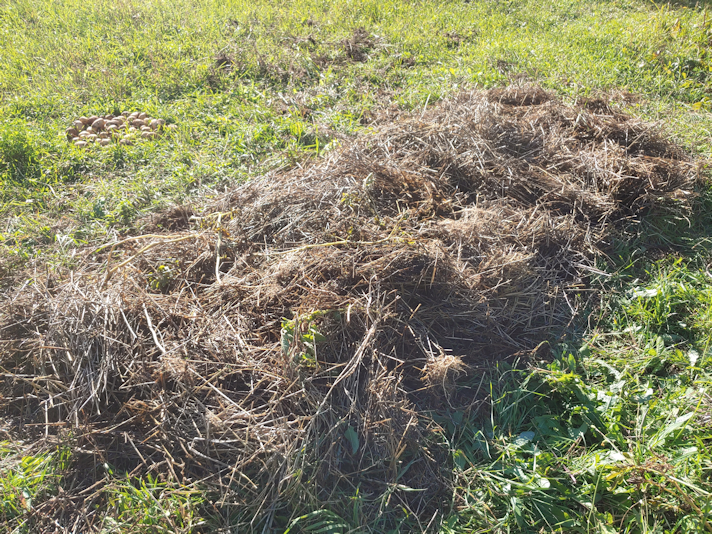
When I finished pulling up as many roots as I was able, the mulch all went back – along with the potato plants that had been pulled up.
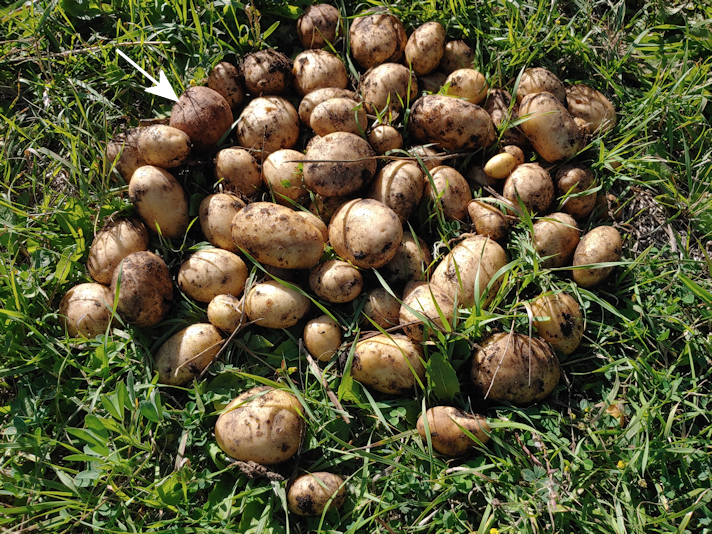
These are all the potatoes I got out of the one bed.
Also, note the one slightly darker potato with the arrow pointing to it. I’ll explain that, below!
When we got back from the city, I continued working on the second bed.
Once again, I was finding most of the potatoes on the surface of the soil as I pulled away the mulch.
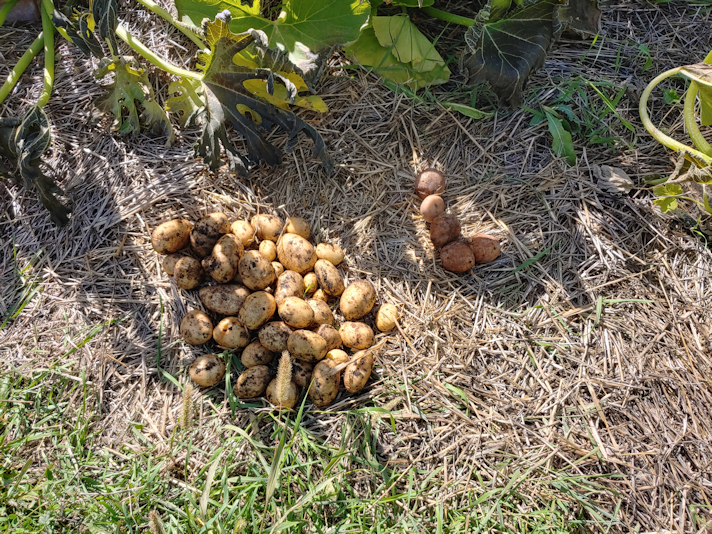
These are all the potatoes I found, before I did any digging at all. Unfortunately, quite a lot of them had holes eaten into them. :-( After digging, I found maybe 5 more.
Speaking of 5, do you see those 5 darker potatoes on the side?
Those are the original seed potatoes! The other bed had only one. While they had stems and roots that I broke off of them, they are just as hard as the day I planted them. I found the remains of some other seed potatoes, all mushy and used up like one would expect at the end of the growing season.
I got two 3 pound boxes of seed potatoes, which gave me 3 row of 6 potatoes in one bed, and 3 rows of 5 potatoes in the other, plus an extra. That’s 34 potatoes – and 6 in total never grew more potatoes!
As with the previous bed, I dug it all up, finding a few more potatoes, a whole lot more slugs, and pulling out weed roots.
Would slugs be the cause of those holes in the potatoes?
This bed had quite a few more rocks near the surface that I got rid of, too. My fork was hitting many more as I dug down, but I didn’t try to get them out, since we will continue to build these beds up. The mulch and old potato plants went back over the soil.
I then took all the harvested potatoes and laid them out on the dry straw mulch between squash beds, so they can cure (is that the right word for it?) in the sun. Except for the tiniest ones, which will be cooked and eaten right away. :-)
I then had the 6 original seed potatoes. What to do with those??
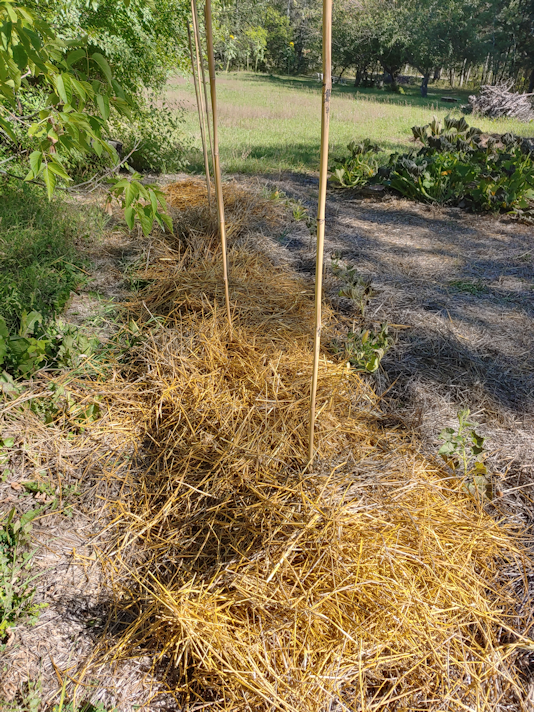
Yeah. I planted them, almost the same way they were planted in the original beds. The only difference is that I did loosen the soil a bit, first. Not to bury the potatoes – there are so many rocks along this end, I could barely do more than scrape away the mulch on top! No, it was so I could push in the bamboo poles to mark where they are. Even then, I don’t think the poles will be able to stay up for long. I could barely get them into the soil at all. No matter how I shifted and searched, I kept hitting rocks just inches below the surface.
What will most likely happen is that the potatoes will freeze over the winter, and nothing will come of them. Another possibility is that they will be protected by the mulch and, as soon as it gets warm enough next spring, they will start growing and we’ll have early potatoes started.
We’ll find out next year!
As for now, the potato beds are put to bed for the winter. I don’t know what we will plant in those spots next year. We do intend to do potatoes again, but in a different location. We don’t want to entice the Colorado potato beetle by planting in the same location again. We didn’t see a single one this year, but one of my neighbours a mile up the road mentioned that his potatoes had been decimated by them! My parents always planted lots and lots of potatoes, and I well remember going through the rows, picking off the beetles or their larvae, and hunting for the eggs to crush. Even with several of us doing that every day, some years my mother had to resort to using a poison powder of some kind, to get them under control.
I’d really rather not have to deal with them at all, if I can avoid it!
As for the squash, for now I have stopped harvesting any more of the sunburst squash, though there are a couple of zucchini that are almost large enough to pick. I prefer them when they are quite small, but with the sunburst squash, I want to give them as much of the remaining warm weather as I can for them to grow. As I write this, past 6pm, we are still at 21C/70F. We are supposed to stay fairly warm over the period covered by the long range forecast, with no more frosts expected overnight. That should give our produce a bit more time before we have to harvest what we can, then prep for the winter – and next year’s gardening! :-)
Our first year gardening since moving here has been quite interesting, and quite the learning experience. We will, for sure, continue using the Ruth Stout method until we are able to start making the accessible raised beds that are the ultimate goal. The extensive use of mulch is making a very noticeable, positive difference in the soil, even after just one year. My mother may be disappointing in our gardening, compared to what she had here, years ago, but I’m happy with our progress so far! :-)
After seeing how great the sunflowers did, after last night’s first frost, it was time to see how the squash beds looked after a day of relative warmth.
You can see how all the leaves that got hit with frost have shriveled and darkened.
There is some hope, though…
For many (not all) of the larger plants, the leaves underneath are looking just fine, as are the little squashes. Even the pumpkins look like they’ll make it.
On the one hand, I’m encouraged. On the other, it shows that if we’d been able to cover them, they probably would have fared much, much better.
Ah, well.
In other things…
Our trip to the cardiac clinic in the city turned out to be a waste of time, but that did result in us coming home earlier.
Yesterday, my younger daughter and I had gone into town. Since she needed to go to the grocery store and I didn’t, I popped across the road to the garage to see about my mom’s car.
It’s done!
In fact, he had stayed late on Friday to do it. However, the car had been sitting there for so long, the battery was dead! He had it on a charger and said it would be ready for pick up this morning. Since we were heading to the city this morning, I told him I could come in tomorrow morning.
With today’s changes in timing, we were able to zip into town before he closed for the day. We were going to pick up something else half an hour before he closed, so we went to the garage first. I paid the bill and got the keys, and we would come back later. It’s a good thing we did it that way, because by the time we were done, the garage was closed!
So we are now, once again, a 1 1/2 vehicle family (since I own half of my mother’s car! :-D ).
This is a relief, as we now have a back up vehicle if something ever happens to the van.
The guy at the garage did warn me, though, that the car might make some noises for the first while. Not only did the battery die from sitting so long, but the discs on the brakes are all rusted up again! He advised we drive it as much as we can, which I was already planning to do.
I don’t think I’m ready to drive it to the city quite yet, though. I want to take if for a few spins locally, first. Even if it’s just to the post office and back.
I’m happy to say that last night’s frost seems to have had no effect on the sunflowers at all.
The only leaves with frost damage that I saw were leaves that had first been broken by the high winds we had a few days ago.
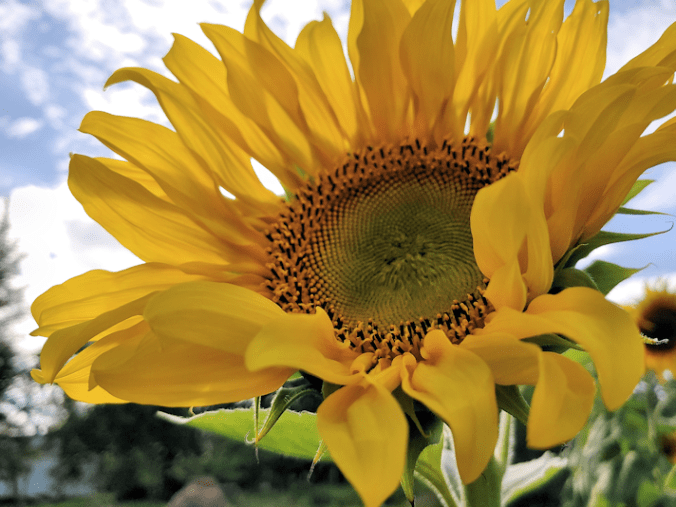
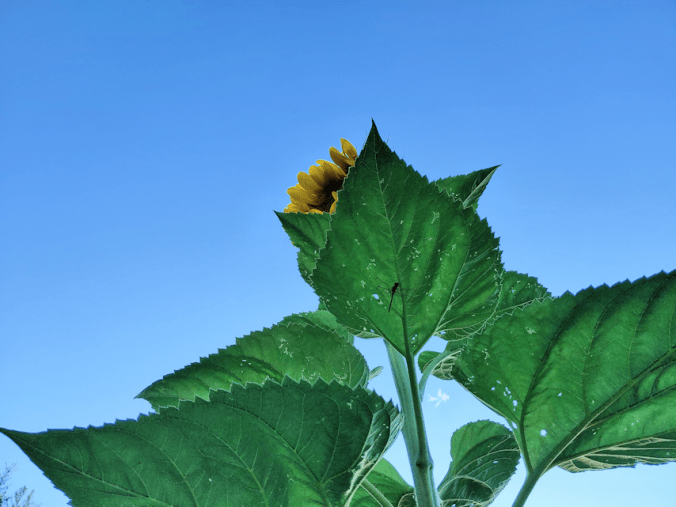
Right now, we’ve got seed heads at pretty much all stages of opening and ripening!
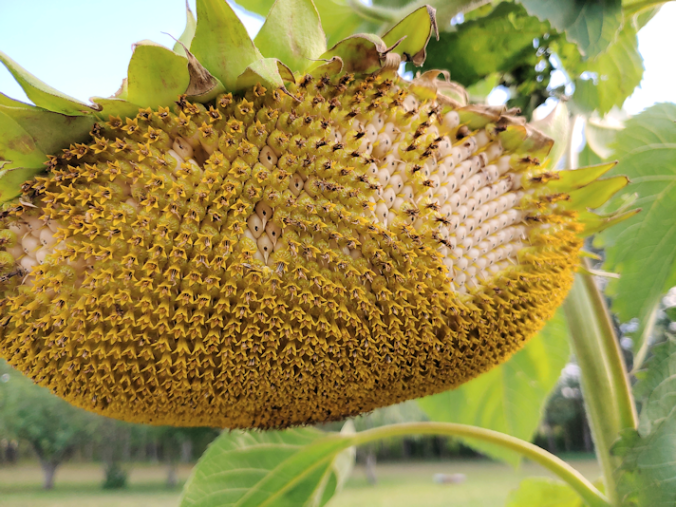
The birds seem to have finally discovered this one. Based on what I researched, I should be able to cut this seed head off and set it up to dry, but in the video I saw that demonstrated this, the guy was able to easily brush off the flower heads from the seeds. That isn’t happening on this seed head at all! The ones that haven’t already fallen off on their own are still attached quite well.
The girls and I will be heading into the city tomorrow, but I might harvest this seed head after we come back. If not then, then the day after. I’m planning to dig up the potato beds as well. We’ll see how the timing of things goes.
Hopefully, tomorrow’s trip to the city will be more productive than today’s – but that will get it’s own post later!
My husband has an appointment at the heart clinic in the city today, so I was out a bit earlier to do my rounds this morning.
As I write this, it’s still only 1C (33F), with a “real feel” that has warmed up to -2C (28F) since I last checked. Our high today is supposed to reach 15C (59F), which is warmer than the last few days. We’re then supposed to go above 20C (68F) for a couple of days, before dropping back to the mid-teens, which is more typical for this time of year.
We don’t have what we need to be able to cover plants as large as our squash right now, so this morning was more about surveying the damage.
I will check them again, after we get back from the city. Some look like they’re completely killed off, but others might still make it through the rest of the season.
I’m pretty sure the pumpkins are a total loss, though.
This is the largest of them, and you can see where the frost was on the pumpkin itself.
This pumpkin hill is the one that’s the furthest South – which means that it gets more shade from the trees than the others. It isn’t much, but as you can see by the plant, it doesn’t take much, either. This plant still had visible frost on it.
The other two hills were pretty much clear of frost. The developing pumpkins don’t show signs of direct frost on them – but from the state of the plants, I think they’re likely complete losses, too. We shall see.
Remember this little birdhouse gourd, bravely blooming just yesterday?
This is how it looked this morning.
*sigh*
Well, this year was our year to figure things out, and we’ve learned a lot.
We will have to work on finding different ways to cover and protect our plants from late and early frosts. Especially since we do want to keep growing squash, which are more easily damaged by the cold. The beets, carrots and parsley are just fine. Even the cucamelons showed less frost damage than the squash, which surprised me.
Altogether, though, we did far better with our gardening this year than I expected. It really has been a successful year, for the circumstances!
You’d think, having grown up here and helped my mother with the gardening for my entire childhood, I would already know what is needed, but everything is really quite different than the garden of my childhood. Especially with my parents planting or allowing so many trees to encroach into the garden.
While we will continue to have garden plots in this area, my mind is already starting to look at the outer yard, towards the barn, for possible raised beds, polytunnels or greenhouses for vegetable gardening.
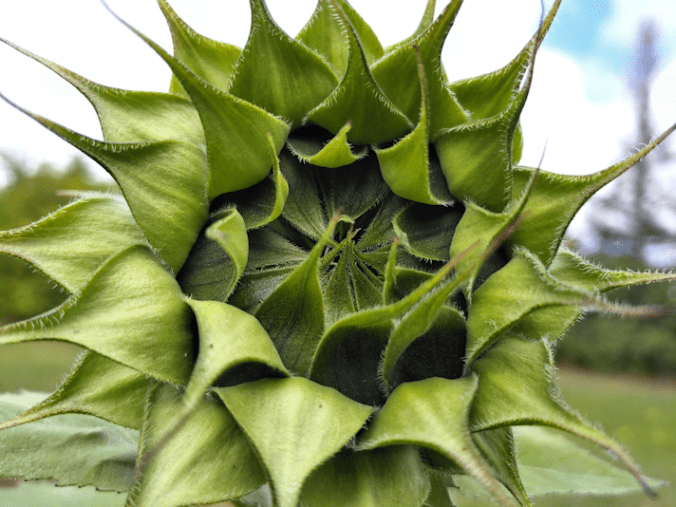
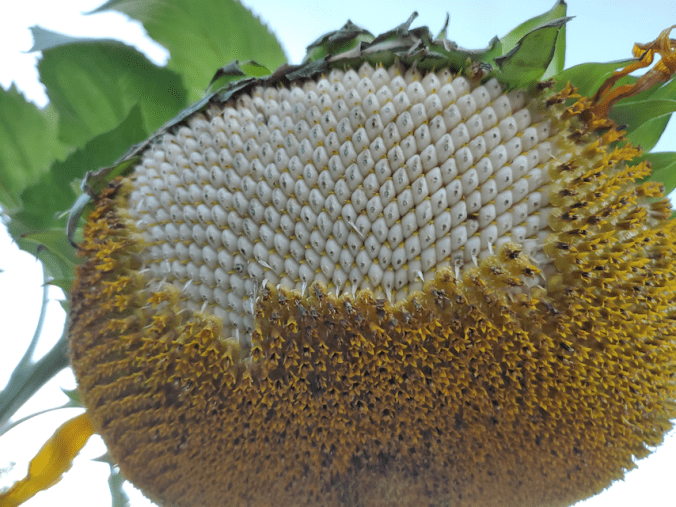
The first seed head to blossom is already losing its little flowers!
I think I should be able to harvest it and set it to dry at this point; at least that’s what I’ve learned from my research. But would the seeds normally be this white?
I think I’ll leave it a bit longer. So far, no birds seem to be going for it.
Pollinators aren’t’ the only ones interested in the budding sunflowers.
The leaves make great shelter for resting dragonflies!
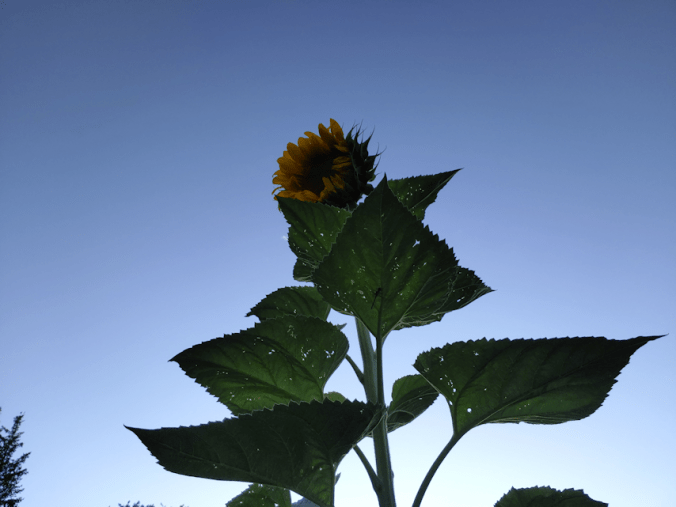
Those leaves have a lot of holes in them. I can’t see what’s causing them, though. They still seem to be doing all right, so I’m not concerned at this point.
We now have two seed heads on the originally planted giant varieties, opening up.
The first one to start opening is getting big enough, the stalk is starting to droop quite a bit – which means short little me can see it better! :-D
Nice to see the pollinators busy at work on the second one to start opening!
Speaking of pollinators, they are just loving our squash bed right now. So many new flowers. Including in the pumpkins.
Look out big this pumpkin is getting!
This pumpkin mound has two plants growing in it, lots of flowers but, so far, there is just this one pumpkin that seems to be growing. There is another on the second plant, but it doesn’t seem to be getting bigger.
This one is on the plant in the mound I’d planted 5 seeds in, and it took so long to come up, I thought none would germinate. Now, not only is the plant just big as the ones that sprouted earlier, but it has a pumpkin that’s almost as big as the other one!
I still don’t thing there is enough of a growing season left for the pumpkins to fully develop and ripen, but I’m still enjoying how they are doing now.
Among the things we chose to plant for our first garden since moving out here were Yukon Gem potatoes. My view when it comes to planting potatoes is, since they are so inexpensive and easy to find in the grocery stores, we’ll choose a variety that are not available unless we plant them ourselves. Yukon Gem are a yellow flesh variety that is supposed to be more resistant to disease, and are good for both fresh eating and storage.
We only got 6 pounds for our first try, so we’re not expecting to have any to store. At least not for long! :-D
The biggest thing we did differently, though, was to use the Ruth Stout method. When my mother had her garden in this location, she had my dad or my brothers to plow it for her, every year. She had a working tiller (we’ve got 4 or 5 lying about, and none work), and 5 kids to help pick rocks.
While the area did get plowed before we moved here, no one’s been picking rocks for ages, and the plow job was a bad one. So what we’ve got to work with is rock hard soil, full of rocks, and very little equipment. The traditional method of growing and hilling potatoes was simply not manageable.
Among my recommended posts is a Canadian gardener who tried the Ruth Stout method in his own garden. He sowed his potatoes on top of hard, grassy ground, covered them with a thick layer of hay for mulch, and at the end of the season, he had lots of potatoes, and the ground beneath was greatly improved.
We didn’t have hay, so I used straw from the bale we got last fall. What we don’t use to cover our septic tank gets used for mulch, and we still have plenty left this year. Mulch was already a big part of our plans to improve and amend the soil.
Well, the potato plants seem to struggle through the mulch, and never got really bushy. They did bloom, however, and at one point I dug around under the mulch to see if I could get some baby potatoes to try.
Even though this was after a rainfall, and the straw was damp, the ground beneath was bone dry. The only potato I could find was the mushy seed potato.
So… I was beginning to think this was a write off. I don’t know if it was because I used straw instead of hay, but it seems like the straw absorbed all the moisture, and it never made it to the soil.
While going through the garden over the past few days, I’ve been watching the potatoes. Some of them have already died back completely.
This morning, I decided to dig up the 3 potato plants that had died back on one end of a potato bed.
After moving the straw, there wasn’t much to see.
That is the seed potato, and no sign of any others. Only after digging, did I find one tiny potato under this plant.
It wasn’t a complete loss, though.
A few others were visible once the straw was moved, and they were looking pretty good.
Time to carefully dig around with the potato fork and see what I could find.
The first thing I noticed was how different the soil was. Even with plenty of rocks to dig around, the soil itself was much, much softer. I even found worms, as well as a single slug. :-D
So even if we don’t get a lot of potatoes out of here, we will have at least improved the soil!
How many potatoes did I find?
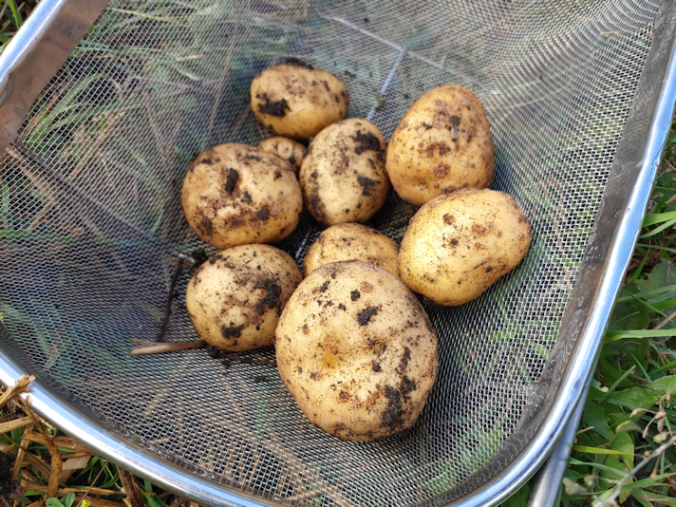
Here they are! Our first potatoes!
I’d say these were from 3 plants but, really, they’re from 2 plants. You can just see the itty, bitty potato that I found by the seed potato of the third one.
Of all the larger potatoes, one had a hole in it from a bug. The rest were solid.
I’m rather pleased! After what I found earlier, I was really wasn’t expecting to find much of anything.
Now to think about how to cook them for supper this evening. :-) I’ll likely make them very plain, so we can get a sense of how this variety tastes, compared to what we usually have.
One of the things we planted this spring was a couple of rows of kohl rabi (or is it kohlrabi? I have seen it both ways…).
They have not done well.
Of all that we planted, there were about 4 surviving plants that sprouted.
Of those, a couple got et by deer.
The last two, however, were getting quite big and leafy and looking to have some potential, though there was as yet no sign of a bulb forming.
Then, something got at them.
At first, it looked like the caterpillars from cabbage moths. I found a whole bunch on the underside of the leaves, wreaking havoc, and got rid of them.
Soon after, however, the leaves were looking even worse.
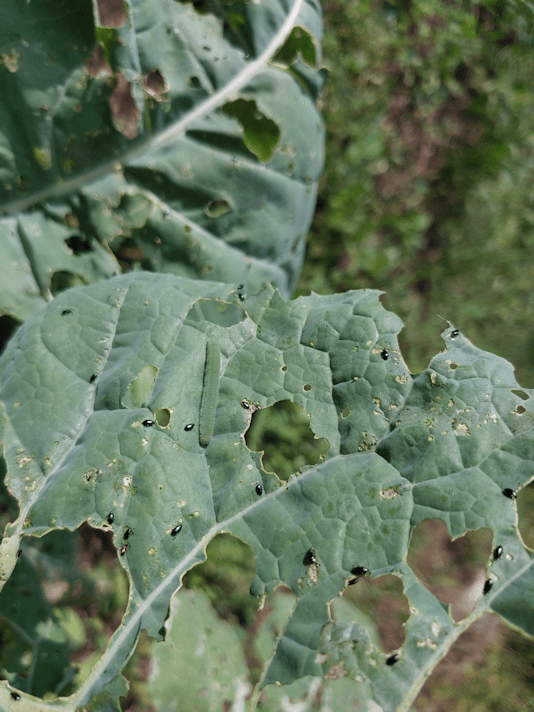
I took this picture yesterday. These are the culprits.
The leaves are absolutely infested with these teeny, tiny black beetles.
I hosed them off after taking the picture, but when I checked them today, they were back, and there’s hardly anything left of the leaves, but the veins and stems.
So… kohl rabi is a bust for our garden!
Darn. I was looking forward to having our own. It’s one of those “treat” vegetables that we buy only once in a while.
At least whatever those beetles are, they are completely uninterested in anything else we’re growing.

















 The Re-Farmer