I ended up using a dollar store shower curtain I’d got to potentially use around the eggplant and pepper bed last year, but ended up using the dining table protectors instead. That should help out with warming up the soil and, hopefully, kill off any Creeping Charlie and crab grass in there. I will probably use one of these two solarized beds to plant our potatoes.
I also removed most of the mulch from the wattle weave bed and had a pleasant surprise.
In the first image, you can see the wild strawberries (or whatever they are), which I was expecting. What I was NOT expecting, but hopeful for, you can see in the next image. That is thyme! It survived the winter!
In the next photo, you can see an overview of the long part of the bed. There’s a sort of lighter colour mass about half way down; those are the self seeded Chamomile. Hopefully, it dropped seeds and will come back again this year.
The very last photo is the thermometer in the covered bed. It looks cloudy because I took the photo through the plastic cover. It looks like it was about 18C/64F in there.
Looking around, I couldn’t see much of the green seedlings I uncovered while removing most of the mulch. I likely damaged them too much. There were a lot of seeds scattered in there, though, so I expect more to be coming up soon.
The temperature inside the portable greenhouse was a fair bit higher!
40C/104F! That would definitely start warming up the water in the heat sink I set up, though when I popped the cover off to check, it still seemed cold. That would be in comparison to the very warm temperatures I was standing in!
The next image, meanwhile, is a screen cap taken right after I got a photo of the thermometer, showing what the outside temperature was at. 5C/42F A 35 degree difference (Celsius)!
It should be interesting to see what the thermometer says in the morning, after the 0C/32F we’re supposed to drop to, tonight.
Oh, I also remembered to remove most of the mulch from the strawberry bed in the main garden area – and return the chicken wire over the top. It was quite frozen under there, and there’s no sign of the Albion Everbearing strawberries we have planted there.
The next time I should have time to do anything of note in the garden will be on Wednesday, and right now, the forecast for Wednesday is for a high of 14C/57F with a mix of sun and clouds. It should be a very good day to be working outside!
Meanwhile, I moved things around with the seed trays in the basement. I had the containers with pre-germinating seeds on top of the light fixture over the heat mat, but that light turns itself off, so what little heat it produces doesn’t last long. I thought I figured out how to reprogram the timer, but it seems to have not made any difference. It’s been a while, and there has been no sign of germination. They’re just too cold. So I ended up moving the trays with the chitting potatoes to the top shelf with the winter squash, under the shop light, then set up the second heat mat under aquarium light. So now the tray with the eggplants, peppers, tomatoes and luffa seeds is on one mat, and the three containers of melon seeds are on the other.
When I checked on them before shutting things down for the night, I was already seeing hints of radicals! They will be ready to be potted up by tomorrow or the day after!
Amazing how just a little bit of warmth makes such a huge difference!
Yesterday, I had my eye appointment, which included pupil dilation, so I had my daughter there to drive me home. I’ll have another field of vision test in 6 months, though probably not the dilation. This will be my third field of vision test, which will give a solid baseline to compare with in the future. For now, the miniscule hemorrhages she can see in my eyes have not really changed, and we’re still in the monitoring stage. As for my regular eye test, my left eye has changed, but not enough to be worth getting new glasses.
All that went well, and I took a break from stuff to give my eyes time to recover. So I can’t blame that for my rough night. I was just getting pains in different places at different times, making it impossible to get comfortable, nor stay asleep for very long. So my daughters did the morning cat feeding and kitten cuddling for me while I tried to sleep in.
Tried to.
This time, it was cats that kept me awake! Butterscotch, after months of hiding under a chair, now likes to sleep with me. Or on me. She still won’t leave my room, but this is progress! She gets along with most of the cats, but some of them have decided to be aggressive towards her, so every time she sees them, even if they’re just walking by, she starts snarling and growling. Then there’s Ghosty, who likes to lick my nose, and Shadow, who tries to eat my buttons. Or Cheddar and Clarence, who get aggressively cuddly!
It’s better than being kept awake by pain, at least!
In the end, my having a late start turned out to be a good thing. I was inside for the call from Home Care about my mother and her wanting to move to a nursing home. We’ve dealt with this guy before, and he has assessed my mother in the past, which didn’t help her any. They can’t provide the help she needs. He was somewhat confused about getting the fax from her doctor to do a panel on my mother. It turns out, this is basically the opposite of how it usually works. Typically, someone has a fall or some other incident that puts them into the hospital. That’s when Home Care does their panel, the doctors do the other tests, and the person usually doesn’t go home from the hospital, but straight to long term care.
Which is not what we were told. When my brother called the nursing home my mother wants to move to (which is where her sister and my father, as well as many of their friends, spent their final months and years), he was told we needed to get a doctor’s recommendation. Which we now have. We didn’t know Home Care would be involved until that appointment. Home Care and a brain MRI are the last things that need to be done.
As he was explaining it to me, he felt that, since my mother hasn’t actually put herself in the hospital or had any falls, he doesn’t expect his assessment to amount to much. We already know this is basically putting her on a waiting list, but when I mentioned this, his response was that “waiting list” is basically too generous a term. More like an “indefinite list”.
She’s coming up on 93. I really don’t think that’s going to be an issue.
At one point, I called out the absurdity of the situation. Basically, because my mother is being so careful about things like NOT falling down and hurting herself, she’s being penalized for it? He sort of walked that back but, really, that’s what it comes down to.
Anyhow. The appointment was made for Monday, which is nice and fast. I will be there for this one. The assessment should take 1 1/2-2 hours.
Once I got off the phone with him, I called my mother to give her the appointment time and explain some of the things he told me. I suggested she write down the things that concern her the most, just so nothing is forgotten. It’s not just about her physical difficulties, but we also talked about how she’s noticed problems with her memory, too, and that needs to be taken into account.
Then I sent an email to the family to keep them in the loop. It would be ideal if my brother could be there, too, since he’s got a longer history of helping my mother out, plus he has Power of Attorney, but there’s no way he can get off work for it.
Well, part of the deal for us living here is that I am now able to take on this stuff for my mother. My schedule is the most flexible, and we live the closest to her.
I was eventually able to get outside and get some things done. We had scattered showers, but that’s it. The yard still has water pooling all over, so mowing the lawn is still out of the question. We were also getting high winds, which were blowing the plastic on the box frame over the eggplant and hot peppers loose. I kept putting the weights back on the bottoms, but in the end, just before I came back in for the day, I ended up tying twine all the way around, on two levels, to keep the plastic in place. If the sheets had been long enough to overlap, it would not have been an issue, but it is what it is. I also finally anchored the T posts holding the netting for the snap peas to climb. Some of them are getting long enough to actually start climbing, and the weight of them would eventually pull the posts inwards. Now, they are secure.
But that was at the end of things.
I decided the place to start today was in the wattle weave bed.
I’ve already transplanted the Forme de Couer tomatoes in the rectangular bed. There were only six Black Cherry tomatoes, so I decided those could go in the old kitchen garden, too. They got their protective plastic rings, as well, each with a pair of bamboo stakes to hold the rings in place and, eventually act as supports for the tomatoes.
I had two pots of luffa, but they each had three plants in them. I considered just planting them in groups of three, but decided to split them, so we now have six luffa plants. I put them in the same area as last year, right around the turn of the L shape. They also got the protective plastic rings, but just one bamboo stake. These were positioned closer to the wall, so that the luffa can be trained up them, until they can reach the lilac above.
Then, because there was still space, I transplanted the last of the Red Wethersfield onions, and the German Winter Thyme. There is self seeded chamomile coming up in between some of the strawberries, with room for the thyme beside it. More chamomile is coming up in the path, too!
There is still a small space that can have something planted into it, closer to where the garlic is in this bed, but I have not decided what to put in there. Most of the transplants we have are things that will get rather large, so they would not be appropriate for that spot. I should look through my seeds for direct sowing for something to go there.
Once everything was transplanted, I used some of the grass clipping mulch that had been removed from the other beds in the spring, and mulched around everything. Especially right up against the wattle weave walls, since a lot of stuff growing outside the bed makes its way through there.
At this point, the only tomatoes left to transplant are the San Marzano – and I have no idea where those are going to go!
What really needed to get in the ground, probably more than anything else, was the Trader mulberry. They’ve been in their pots for too long, and were not looking very healthy.
These went on the north side of the main garden area. These can get quite large, so I didn’t want them casting shade over places we want to grow vegetables. Plus, they will act as a wind break from the North winds.
For now, however, they need to be protected.
The first one went in front of a gap in the lilac hedge that the deed have been getting through. I used the loppers to clear away some lilac and little poplars. There was also a dead poplar on the fence side of the hedge. It’s been dead for a long time, so I was able to basically tear it loose from the ground. I laid it across the gap, near the fence (it’s an old barbed wire fence that’s slowly collapsing), which should also deter the deer from using this spot.
Of course, as soon as I started digging a hold for the mulberry, I started hitting rocks and gravel. I added nothing to the soil, though. The planting instructions for these specifically stated to NOT add anything to the soil when transplanting.
Normally, I would have set them slightly above grade, but this area is higher than other parts of the yard, and tend to get very dry. For this reason, I actually want water to pool a bit around the trees before it drains away. Once the sapling was in place, I emptied a 5L watering can around it, to settled in the soil and the roots. Next, thick cardboard was placed around the sapling as a first layer of mulch. At this size, they need to be protected from critters. I had some wire mesh that was used for something else last year. It was taller enough that I could cut it in half. I put bamboos stakes through the wire, then into the ground through holes in the carboard, so they would hold both in place.
Then I walked about 10 paces to the West for the second sapling. There was no gap in the lilacs there, so I cut away some of it to make a little protective hollow. This time, when digging the hole, I was hitting both rocks and roots! The loppers had to be used a few times to cut through the roots.
Once the second sapling was done, they both got their final mulch. They each got an entire wheelbarrow load. Most of it went outside the wire mesh, but I carefully added some to the inside, too, making sure there was nothing too close to the saplings themselves.
By the time this was done, the winds were picking up again. I could actually hear it roaring at times, but where I was working was well sheltered! Tucking them close to the lilacs should protect them from the worst of the elements, until they get larger. They will still get the full sun that they need, too. These will eventually grow 15-20 ft/4.5-6m tall. The berries are edible, of course, but apparently the leaves can be used for a tea that helps control blood sugars. It should take 2-3 years before they start producing fruit. We got these last spring, but they were out of the 2 year old saplings, so instead of the one we ordered, we got two, teeny tiny 1 year old saplings that I didn’t dare plant outdoors yet! I don’t know if that will make a difference in how long before they produce fruit, but I’ll just assume it’ll take 3 years.
Assuming they survive in the first place!
We shall see.
We’re supposed to be a bit more rain this evening, but none at all tomorrow. The high should also be cooler, too. That means I should be able to get back to working on shifting those last three beds to their permanent locations. What really needs to be transplanted next are the winter squash and gourds. Especially the Crespo squash. They are getting really tall, I’ve already pinched off flower buds, and more are appearing! So I might first make small raised bed, just for them, behind the compost pile. We made a small bed there last year, but the few things planted there didn’t survive. Right now, it’s very wet, so it would need to be made into a low raised bed, anyhow. I do have a 4’x4′ frame, much like the one that’s around the strawberries planted this spring, that can be repurposed for this, then we can add a few loads of garden soil from what’s left of the pile. We haven’t even uncovered that, yet. That this location is very wet right now would actually be a benefit, since the Crespo squash are supposed to get very large, and they need a lot of water to reach their full potential.
This will be the… third? year we’ve tried to grow them. I just looked at some of my old posts. The first year we grew them was in 2021. So this will be our 4th year trying! They did amazing, the first year, until they got eaten by deer and groundhogs. They recovered so well, with many fruit developing, only to run out of season. We did a large squash patch in 2022, but that was the year we flooded, so just about everything was a loss. Last year, they got their own patch out by the old squash tunnel that still needs to be dismantled. They did quite poorly. This was close to where the mulberry have been planted, and it seems that the spot actually got too much sun and heat. We did get a squash to harvest, but much smaller than it should have been. It started developing so late, it never reached full maturity. So, this year, I am taking that into account in choosing where to plant them. The spot I have in mind still gets full sun, but is shaded in the morning, and doesn’t get baked like the north east of the main garden area does.
The other winter squash will need plenty of room to grow, too, so they’ll probably take up a couple of the beds that I’m working on now, at least. I’m planning to put melons in the trellis bed that was built last year, along the side the trellis will be attached, but those are small enough that they can stay in their pots a bit longer. We might have to get creative in finding space for all of them, though. A good problem to have, I suppose!
I plant to put the peppers in the high raised bed, but they, too, are small enough that they can handle staying in their pots a bit longer, while I work on the remaining beds.
I have three pots that we planted herbs in last year. I think I’ll direct sow summer squash in those. That way, we’ll at least have some, even if we end up not having room in any of the main garden beds!
So many things to plant, and so few beds ready to plant in!
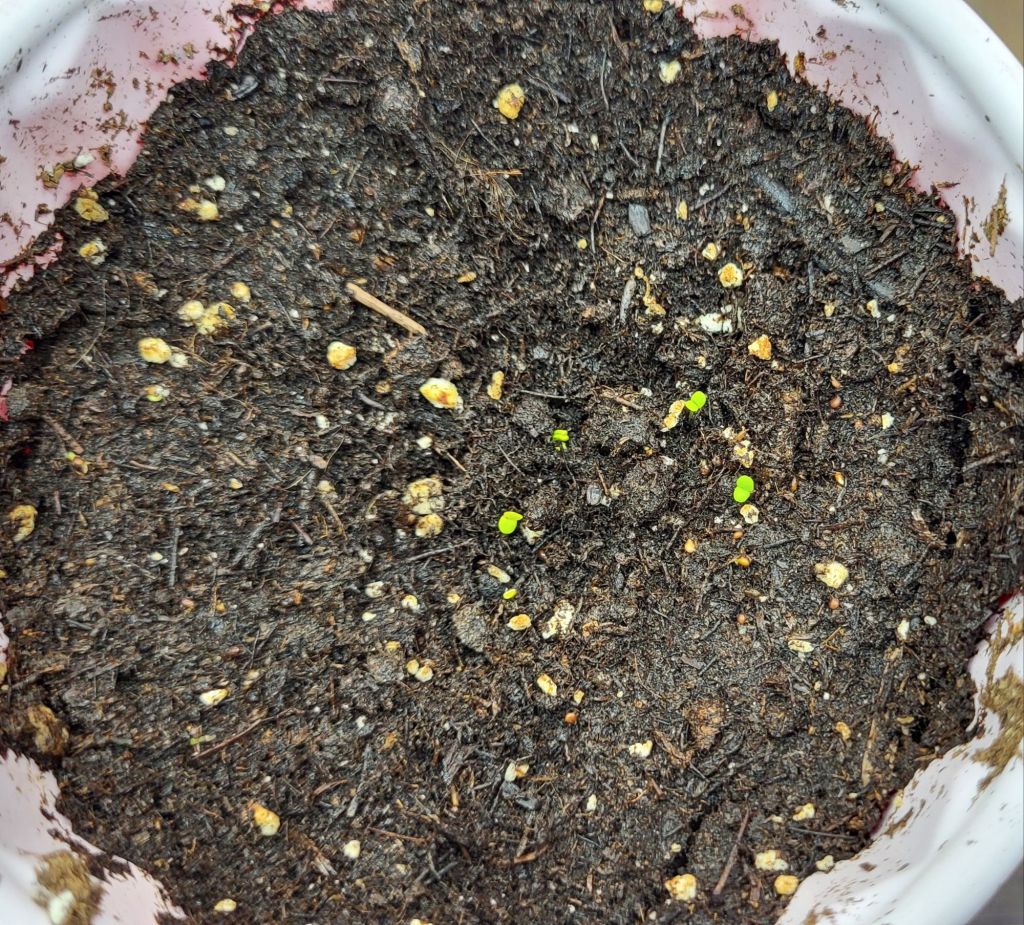
The German Winter Thyme has sprouted. Gosh, they are so tiny! I actually had to wait a day before I could get a picture where they could be seen for what they are.
I expect the oregano to sprout next – unless we have problems like last year. It will be a while longer before I expect to see the peppers sprouting.
We made the living room a cat free zone to protect our house plants. It has a huge east facing window and gets lots of light for a brief period in the morning. After that, it’s a pretty dark room. It’s not too bad for the plants near the window, but our huge jade tree… well… one of them… is against a wall in the middle of the room. We have another that’s gotten just as big, but with needing the window for seedlings, it’s off to one end of the shelf it’s on, and no longer in front of the window. The only light it gets is from the shop lights I have over where the seedlings and small plants are.
Then there are the aloe Vera. They’re on plant shelf near the older jade tree, which puts them pretty low down.
The old jade tree is not doing well. I regularly rotate the pot, so all sides eventually get light – not easy to do, with such big branches, so close to the wall! Unfortunately, I can see the leaves are getting thinner and less succulent, and a lot of leaves are simply shriveled up. It does get adequate moisture, and is in a self watering pot. It’s just not thriving in this location.
There is no room for it, anywhere else.
What we need is a light fixture along that back wall. When we moved here, there was a light fixture in the corner where the big aquarium greenhouse is now. It reaches floor to ceiling, held in place with pressure, and has 3 lights that could have their directions adjusted. It’s in the storage shed now. If that thing still works, we could set it up with standard bulb sized grow lights, near the Jade tree. Those types of grow bulbs are more affordable, anyhow.
Looks like I need to trek through the snow and see what I can find in the storage shed. I hate going in there, though. Every time I do, I’m afraid a cat might sneak in behind me and accidentally get closed in. That shed is so full of my parents’ stuff, we can’t even access most of it, anymore. Lots of places for a cat to hide!
I should grab a daughter to go with me and stand guard!
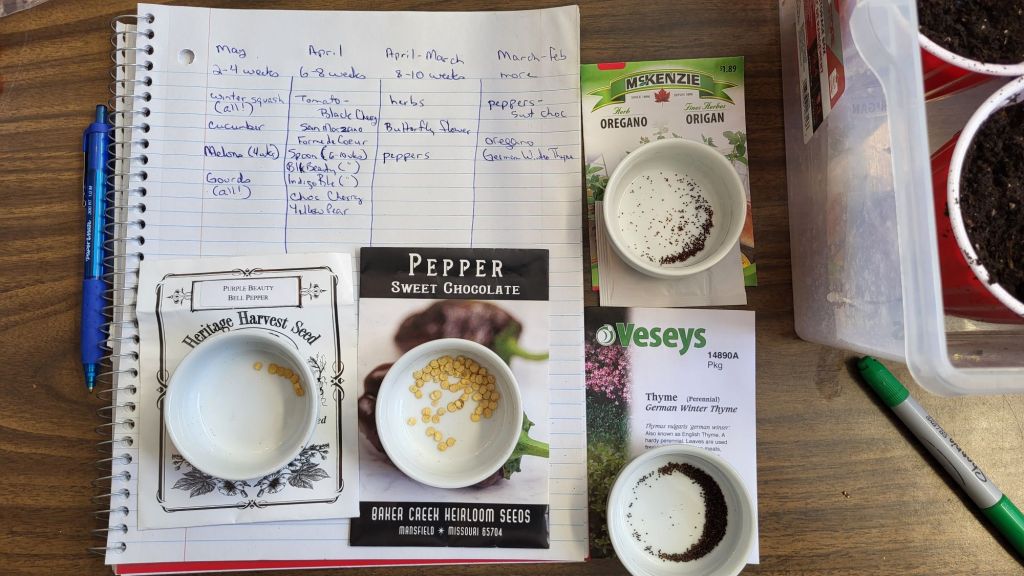
After marking out the weeks backwards from our June 2nd last frost date on our calendar, I then went through my bin of seeds and organized them by when they need to be started indoors. Then I picked out the ones I could get started now.
We won’t be starting everything that we have seeds for.
Starting from the 3-4 weeks list:
I still haven’t decided if we’re going to plant any gourds at all this year. There are several I really want to grow, but we just don’t have the space. With the winter squash, we have the new packet of mixed winter squash seeds to try, plus one type for pies my daughter asked for. With the mixed seeds pack, we will of course want to plant the entire package, and see what we’ve got! I would still like to try the Honeyboat Delicata squash again; the few we got didn’t get a chance to fully mature, but they were great in the pie my daughter made! We also really liked the Pink Banana and Georgia Candy Roaster. There are other varieties that didn’t do well that I want to try again, just so we can decide if we like them or not, but that will depend on how much space we have. The problem is, there are a LOT of things that need to be started in that 3-4 week time span. I’m still not sure if we’ll do cucumbers this year. I’d rather use the space for the melons and winter squash. We’ll be skipping the hulless seed pumpkins this year, but I really want to try the Crespo squash again. Last I saw, Baker Creek didn’t carry the seeds anymore, so I want to successfully grow at least one to collect seeds from!
As for the tomatoes in the 6-8 week list, we’ll not be planting all that we have seeds for. We’ll do the San Marzano paste tomatoes for preserving and the Black Cherry for fresh eating. The free seeds we got are tempting me greatly, and I always want to grow more Spoon tomatoes! They’re just fun. I want to start quite a lot of the San Marzano, but not as many of the cherry tomatoes. I don’t want a situation like last year, where we ran out of space and had to give away so many transplants!
From the 8-10 week list: the Butterfly Flower is a type of milkweed, so I definitely want to get those going. We have three varieties of “early” peppers that I waited to start last year. They have such a short growing season, technically we could direct sow them. It didn’t work out. They didn’t get to produce, though with most of them I now know that the grow bags they were planted in were invaded from below by roots from the nearby Chinese elm. So we’ll definitely need to keep that in mind, when deciding where to transplant them this year. I will be starting fewer seeds, shooting for at least 2 plants per variety in the garden, but between the 6 varieties I’ll be starting this year, we’ll still have plenty for our needs. Hopefully, my family will have peppers of each kind to try, so we can decide which varieties we like enough to keep growing, year after year.
You’ll notice there are no summer squash on my list. Those got moved to the direct sowing bin. I’m not going to have the space to start them indoors. As long as I can keep the slugs away from them, they should be okay to start outdoors.
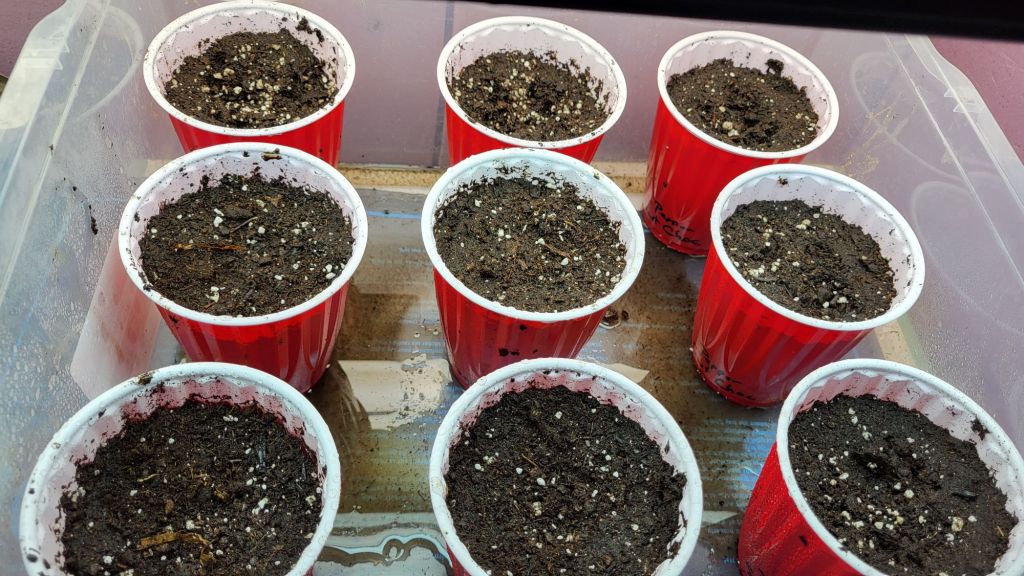
There were four things I could start today. Since I was after fewer plants per variety, I decided to go with the Red Solo cups to start them in, rather than the larger trays with smaller grow cells.
With the herbs, I’m just doing the oregano and German Winter Thyme again. The chamomile we planted last year should have self seeded, and we’ll see if the spearmint survived the winter in their pot. We ended up not using the lemongrass at all, so I’m not trying them again this year. We’ll plan out our herbs more, as time goes by. The herb seeds are so incredibly fine – especially the oregano! They got surface seeded over the pre-moistened seed starter mix, then covered with a light dusting of dry starter mix to just barely cover them, followed by a spritz to moisten the tops. Vermiculite would have been better, but I don’t have any. The herbs went into two cups each. With such tiny seeds, there’s no way to know how many I managed to sprinkle onto them. I still had seed left over, too, so if they don’t take, I can try again. The oregano really struggled last year, and I ended up with only one surviving seedling to transplant. That one plant did well, at least! They were started in the little Jiffy pellets last year, so I hope they do better in the larger cups and a different growing medium.
I decided to go ahead and plant the last of our Purple Beauty seeds, which are two year old seeds. The first time we planted them was a year of drought and heat waves, and they did very poorly. Last year, what was planted in that bed also struggled, so I think it’s more a problem with the soil in that bed. I split the last 7 seeds of Purple Beauty between two cups.
The Sweet Chocolate peppers were the one pepper that we were actually able to harvest mature peppers from last year, and they were also the only ones I started quite early. We saved seed from them, too, but there was still plenty in the packet, so I used those. There was enough to plant three seeds into each of three cups, with plenty of seed left over. I had intended to do just two cups, like the others, but the bin they’re in for bottom watering holds 9, and I just had to fill in that last space! Yeah, it’s a bit OCD, but I have an excuse. If there are gaps in the bins, the cups tend to fall over more easily when the bins get moved around.
So these are now in the big aquarium, on the warming mat.
The next seeds don’t need to be started until the second half of March, at the earliest.
I’m heading to my mother’s this afternoon, then taking her to a medical appointment, so I thought I would bring some things from our garden to her.
I picked the potatoes from under just one Irish Cobbler plant, which had a pretty decent amount of larger potatoes. There were also small ones, so I just buried them and the plant roots again. There’s a few orange carrots, a zucchini we harvested earlier, some Roma and Indigo Blue tomatoes and a Sweet Chocolate bell pepper. While cutting some thyme, I noticed a shallot that got missed, so I grabbed that, then added a couple more we’d harvested earlier. I also cut some spearmint for her. I decided to add one of the Black Beauty tomatoes we harvested earlier, too. The softest one I could find among the lot. After bagging it up, I remembered to grab a head of garlic for her, too.
My mother being my mother, I expect to get a lot of snarky comments and backhanded insults. 😄 She’ll have issues with the brown pepper and different coloured tomatoes. She did ask me to give her some of the tomatoes to try, but then launched into a long speech about how bad it is to have not-red coloured tomatoes. And, of course, she’ll tell me how my sister brought her soooooo much from her garden, and it’s so much better, and she’s just one person, so it’s all too much, and how bad it was for me to bring more.
My mother is very predictable. 😁
But I’m giving them to her anyways. Who knows. She might actually show appreciation for a change. 😄
We did have one really nice, ripe Indigo Blue Chocolate tomato for my daughter to taste test. I’d picked three and put them in my pocket so I could use both hands. One was so ripe, it split when I bent over, so it needed to be eaten right away.
My daughter found them absolutely delicious. Nice and sweet. Juicy, but not too juicy, with a rich tomato flavour. We have others harvested that will need to be eaten quickly, and I don’t think that’s going to be a problem at all! 😄
The Indigo Blues are an indeterminate tomato, so I can expect to be able to harvest small amounts of them more often, from now one. The Romas are starting to ripen in mass quantities, so I might just wait on processing the ones we’ve picked, so we can do larger quantities all at once.
On another note completely, we did try to use the new bread machine yesterday.
Something went wrong, but I don’t know what.
I came into the kitchen to check on it, and it was off. There was still power to it – the display was showing the exact settings I started with for a basic 1.5lb loaf. It should have been showing a count down on the time. It just wasn’t running. The bread dough had been completely kneaded and was just sitting and rising the pan, so I left it. Later on, my older daughter took the dough out and baked it in the oven, so we now have one, perfect little loaf in bread jail to try.
Hmmm… I wonder. We keep our bread in a bin – bread jail – to protect it from the cats. I wonder if maybe a cat stepped on the controls while we were not around, and shut it off? We’ve set the bread machine up on the counter near the microwave, where it could be plugged into an outlet on a different breaker, and plenty of space around it for when it’s hot and baking. It’s the one counter the cats are allowed on, as they like to sit and look out the window.
That’s about the only thing I can think of, other than mechanical failure.
My daughter plans to try again, later, so we’ll see!
Who knows. I might come home to some fresh bread to try. :-)
I had to go to the nearest Walmart to get cat kibble this morning, and took advantage of the trip to get a few more little things. It was insanely busy with people. We’re coming up on a long weekend which, for many people, is the traditional time to put in their gardens. It’s also when a lot of people open up their cottages for the summer, so it was busy everywhere! All the garden centres and greenhouses are open now.
For us, today is 2 weeks to our last frost date. That means it’s time to sow our Montana Morado corn!
Which, of course, is never as simple as just putting things in the ground!
I chose to plant these in the low raised bed we grew summer squash in, last year. As with just about everything else, the squash did very poorly last year. It was, however, the bed that needed the least amount of work done on it before I could sow.
Not by much, mind you.
After removing the grass mulch from last year, I had a whole lot of weeds to dig out. Mostly crab grass. That stuff is brutal!
The entire bed got worked over with a garden fork to loosen the soil. Then I had to go back over it to pull out as many weeds and roots as I could. Aside from using the fork to loosen the soil even more to get the roots and rhizomes out, it was very handy to support myself as I worked. I also used a board across the bed to step on, so I wasn’t stepping directly on the soil.
We really need to get more high raised beds built. This was very hard on the back. I suppose it would have been easier if I could kneel down to work, but my knees are shot, so I’m bending from the waist, for the most part.
While working towards the north end of the bed, I started finding more tree roots, from the nearby trees that my mother allowed to grow in what used to be garden space.
More reason to get those high raised beds done!
When the weeding was done, I went to get the seeds and a rake to level the bed. I brought a container to pour the seeds into and see how many there were. There was supposed to be at least 75 seeds.
I counted 94!
Once the bed was leveled, I took the board I had to support my foot while weeding, and used it to mark off three long rows. I wanted to stay well away from the edges. The crab grass is the worst along there, as the roots make their way under the log edging. Then I used the handle end of the rake to punch holes along the rows every 6 inches or so. Typically, it’s recommended to plant 2 or 3 seeds every 12 inches, but I’m doing dense block planting. I also hate wasting seed, so I planted one seed every 6 or so inches. This should be good for pollinating, and if some of the seeds don’t germinate, the resulting gaps won’t be too large.
I lost a seed while planting, though, so there’s “only” 93 in. 😄
Everything was well watered, of course. I always water before putting the seeds in, then again once they’re done.
Once planted, I put a thick layer of grass clippings all around the edges. The ends don’t have logs to hold the soil in, so hopefully the grass clippings will help keep it in place, too. Mostly, it’s to try and keep the weeds from creeping in from the edges. Once that was done, I put a very light mulch of grass clippings over the planted area. Basically, I just shook bunches of grass and let the wind blow it on. I wanted enough clippings to protect the soil, but still keep it light enough that the corn won’t have any problem pushing through.
Once the corn is up, I will might interplant some bush beans in between the rows. Maybe. I did that with the kulli corn we planted last year, and they got huge, but never reached the point of producing cobs. I now think that there was too much nitrogen in the soil in that bed. High nitrogen leads to lots of plant growth, but can result in lower yield. Or, in our case, none at all. With how densely these are planted, though, interplanting with something like beans might be too much.
Once that was done, I decided to take a chance and do some transplanting.
The Sweet Chocolate peppers that were started back in February have gotten nice and big. Normally, I wouldn’t dare transplant them before our last frost date, but I’ve been eyeballing the forecasts and decided to take the chance. It was either plant them now, or pot them up. The German Winter thyme that was started at the same time were also quite ready to be planted.
While I was transplanting, I got my daughter to cut the tops and bottoms off of some distilled water jugs for me. Since my husband needs to use distilled water for his CPAP humidifier, we have lots of those! Hopefully, they will help protect the peppers during any cool nights. In this bed, they will be easy to use row covers if we get frost warnings, too.
I had three pots with thyme to transplant – a fourth one was transplanted into a pot to stay in the house. I don’t think they’ll need any protective covers unless we get actual frost.
Eventually, I want to plant the chamomile in here, though it’ll be a while before those are big enough to do that. The spearmint and oregano we started from seed are not doing well. I might buy oregano transplants, which would also go into this bed. Spearmint is not something I usually see in stores as transplants, so we might skip those this year and try again next year. The second variety of thyme we planted at the same time as the chamomile doesn’t seem to be doing as well as the German Winter thyme has. We’ll see how they do over the next couple of weeks.
Once again, while working in this bed, I was quite impressed by how moist the soil was under the wood chips. The mulch is really doing its job!
Oh, there was one thing about transplanting the peppers that has made for a learning experience.
We started the seeds in bio-gradable pots that are designed so that they can be transplanted directly into the soil, pot and all, with no root disturbance. When the peppers needed to be potted up, they went into the larger Red Solo cups that way – except for a couple that were thinned by transplanting.
When taking the peppers out of the cups, the ones that were still in those bio-degradable pots… were still in the bio-degradable pots! They were actually rootbound inside a pot within a pot. So when I transplanted them, I removed the shells of pots they were in. The pots were very soft and easy to break off, but hardly any roots had tried to grow into them.
I still have some of these pots and seed start trays. I’ll use them but, in the future, I think we’ll skip buying those. A bio-degradable pot isn’t much use if the roots can’t get through them after being potted up!
So this is now done. The first corn is planted, and the first peppers and herbs are transplanted.
The corn is meant to be planted at this time. I just hope I didn’t jump the gun with those peppers!
I’ve been waiting for days before finally getting a picture with the newest drum gourds, then went again and got progress pictures of the rest.
I found a new baby this morning!
The red arrows are pointing to the barely visible first zucca melon!
The new drum gourds were taking a lot longer than the first ones to break free of the soil. When the first one did, the reason became obvious. It was still completely encased in the seed shell! After a while, I very carefully removed it and just dropped the pieces on the soil surface, but the seed leaves have still not started to separate. I can now see that the other one is also still encased in the seed shell. Once it manages to break free of the soil, I will carefully remove it, too. The risk in doing that is tearing the encased parts of the seed leaves right off, as they are so very fragile in there.
The earlier drum gourds are just barely starting to show their true leaves. The luffa’s true leaves are coming out nicely. Even the lemongrass is showing some true leaves. I think. They don’t look very different, other than there being more blades. I honestly can’t tell with the thyme.
That last cell of sweet chocolate peppers finally has a single seedling germinating, so we now have a total of four. Still just the seed leaves in even the oldest ones, though.
The onions and shallots are growing very slowly at this stage. No new haircuts needed! So far, they’re all surviving, too. Hopefully, we’ll be able to keep them alive! Last year, we had some issues with the yellow onions and shallots not doing well, but we have different varieties of both this year, and they seem to be doing better so far.
We’ve got two varieties of red onions, one of yellow onions, and one of shallots.
This morning I got a picture of some of our seedlings, after refilling trays to water them from below.
There are still only two little pepper seedlings. The thyme and lemongrass don’t seem to be growing much. I think this might be part of why they need to be started so early!
The two drum gourd seedlings in one pot are still the only ones to have germinated. With using these biodegradable pots, it’s been interesting to see how the pot the germinated seeds are in dries out so much faster than the other ones. Even the square cells the herbs are in show noticeable drying out in the ones with the most seedlings. For this reason, I still mist them as well as water from below.
Last year, I remember my first zucca melon seeds never germinated, and I had to try again. I’m hoping I won’t need to do that again this year. The zucca and the drums need as much growing time as we can give them.
We’re going to have to start other seeds soon. That means rotating things out of the aquarium greenhouses and, for that, we still need to make a trip to the city to pick up the materials we need to build barriers and keep the cats out of the living room. When picking up eggs yesterday, I noticed they had lumber in their truck and asked about prices. Lumber prices have gone down a LOT in the last while, which is encouraging. The prices are still high, but not astronomical anymore.
The trip to the city will have to wait until after the van’s date at the garage to get the temperature gauge sensor replaced.
Still holding out hope that we’ll qualify for financing on the Caravan, but if I’m going to be honest with myself, the odds are not in our favour. Mind you, our situation wasn’t much better when we got financing for the Grand Caravan we got, years ago. Oddly enough, my husband being on disability gives us a more reliable income now than when he was still working. Nothing like moving to a new city for a 2 year contract, only to have the contract end after 6 months, instead!
Ah, well. Whatever happens, happens. We just need to deal with what’s in front of us.
Which, at the moment, means turning the living room into a cat proof plant room. 😁
While turning off the lights on the aquarium greenhouses last night, I noticed the tiniest specks of green in one of the herb grow cells. This morning, there was a bit more, but still so tiny, I didn’t even try to take a picture.
A few hours later, there was more. Still hard to see, but here they are!
All four German Winter thyme cells have sprouts! They are so incredibly teeny – matching the teeny size of the seeds!
Gosh, it’s so exciting to see green things growing when there’s still snow on the ground! We’re supposed to reach 2C/36F this afternoon, and the warmer temperatures have me absolutely bouncing, wanting to get outside and do things. Things we still can’t do until the snow is gone and the ground at least somewhat dry!
So for now, I’m enjoying teeny little thyme sprouts.




 The Re-Farmer