They are now potted up into Red Solo cups. This time, I remembered to use warm water when pre-moistening the seed starting mix. I had the heater running on the area I was working on, too.
With the space I had in the drain tray, I switched the paper towel the eggplant seeds were on into a smaller container. So far, nothing on the peppers and eggplant. This is definitely a first. Usually, the luffa have always been among the latest seeds to germinate. Before using the pre-germination method, I often had to start new seeds, sometimes twice over, before we finally had something germinate.
Now we just have to see if they will survive being potted up!
For the next while, I’ll be going through my old posts and videos about our 2024 garden, looking at how things worked out, and use that information to decide what we will do in our 2025 garden.
Okay, I’m going to start with what turned out to be the largest category of food we grew in this year’s garden, as it really changed a lot for us. Oddly, that was because of how successful they started out!
One thing we had to seriously change up was how and what we started indoors. Last year, we were able to set up space in the cat free zone – aka: our living room – for the many trays and pots.
Too many trays and pots. We over did it.
That set up was no longer going to be an option this year, so we had to really consider what we would start indoors at all.
We also had a lot of issues with our large seeded starts, having to replant some things several times. So this year, we decided to try pre-germinating seeds. With large seeds, they were also scarified, first.
How it started
Let’s start with the melons.
We did still have some seeds left from previous years, but this year I decided to try the Vesey’s Summer of Melons Blend. We are still in the “try new varieties to figure out what we like” phase, though with this blend, we wouldn’t know what the varieties were. I figured we could look them up, once they ripened enough to be identifiable. The main thing was that the mix included early, mid and late season melons, for a more continuous harvest.
Which… didn’t quite work out as planned. More on that, later!
We also went with some we’d grown before; Sarah’s Choice and Pixie. We also added some Cream of Saskatchewan watermelon, a short season variety.
With the known varieties, I chose just a few seeds from each to pre-germinate. When it came to the Summer of Melons blend, not knowing what the varieties were, I started the entire package, which turned out to have 21 seeds in it. I figured there would be some losses, and we’d end up with less.
We ended up with a 100% germination rate on the blend, plus a near 100% germination rate on the rest.
That was a lot of seedlings!
It was much the same thing with the winter squash. We went with the wild bunch mix, skipping the other winter squash seeds we bought, and got another high germination rate using the pre-germination method. We also used it on some Crespo squash (a variety of Peruvian pumpkin), my last luffa seeds, some African drum gourds and the two free pumpkin seeds that are given out every year at the grocery store in my mother’s town, encouraging people to grow pumpkins for their pumpkin fest.
I am really, really happy with the pre-germination method, and will continue using it.
As for the summer squash, it was decided that these would be direct sown, rather than started indoors. I know my mother always direct sowed her zucchini here, and ended up with massive zucchini (she didn’t know they were supposed to be eaten while small), so I knew it could be done. My problem was, would the slugs destroy them, like the year before?
We ended up direct sowing the yellow Goldy zucchini in one of the chimney block planters by the chain link fence. In pots, we planted Magda squash (a pale green squash), Endeavor zucchini (dark green), and the new White Scallop pattypan squash seeds we picked up to try this year.
Later, when we found ourselves with a gap in a garden bed, it was filled with the last of our G Star pattypan seeds, and more Magda and White Scallops.
When it came time for transplanting, we had so many melons and winter squash, they filled four 18′ garden beds. A new growing area was added to fit the pumpkins and drum gourds, while the luffa went into the wattle weave bed in the old kitchen garden, where they had done so well last year, that we almost got a luffa to harvest! 😄
Oh, I almost forgot.
We also started Zucca melon seeds. That’s another experiment for me, as I’d really, really like to grow these massive melons. Then ended up being transplanted into a kiddie pool that got converted into a raised bed again. The Crespo squash went into a new bed in a completely different area.
The challenge
The first issue we had was having someplace to put the transplants. In the main garden area, my original intention was to expand with new beds that would eventually become trellis tunnels. However, the existing beds were in desperate need of cleaning up.
For a combination or reasons, including meeting mobility and accessibility needs, we will be making raised beds that are 4′ wide on the outside, with paths that are also 4′ wide. We also settled on them being 18′ long, and already had one new bed in those dimensions.
My daughter suggested that, since the existing beds needed to be cleaned up first anyhow, we should shift them into their permanent positions.
When we first made these beds, we basically eyeballed distances. They were roughly the same lengths, but slightly different widths, and some were crooked. The paths were not the same sizes either.
With some of the winter squash needing to be transplanted soon, we really needed to get at least one bed done quickly, and even had felled trees to prepare into logs to frame it with.
Of course, the job ended up being much bigger than expected.
Here is the start of the job.
Finishing it, however, had weather complications.
It eventually got done, but things were quite set back by the weather.
It took over a month to get the beds shifted, putting in transplants as we were able.
We did do interplanting as well. Peas and pole beans went in one bed of winter squash, corn in the other. The future trellis bed with melons planted in it shared the space with transplanted onions we found, and bush beans. The Crespo squash shared their bed with pole beans, too. I will talk about those in other posts, though.
How it ended
Late.
With the weather and late plantings, everything was set back about a month. The “Summer of Melons” blend didn’t give us any ripe melons until late in the season.
A trellis net had been added for them to climb and they grew pretty well. There were LOTS of melons developing, but it was ages before we could harvest any. In the end, we had to harvest most of then in an under ripe stage, before they could get killed by frost.
The winter squash were also late, but my goodness, they grew well! We ended up harvesting some that ripened on the vines and could be cured for winter storage, including one odd Crespo squash.
The two pumpkins we transplanted did fantastic, and we got some decent sized pumpkins out of them.
The African drum gourd had a really slow start. Then they started blooming like crazy, with fuzzy little gourds forming all over. Some even started to get pretty big. None made it to first frost, though. If we had not had everything set back so much due to the spring weather, we might actually have gotten some gourds this year.
The luffa gourds in the old kitchen garden were set back dramatically. Last year, they had grown really huge there, vining their way up into the lilac branches above. This year, they barely got tall enough to reach the lilacs at all. The weather just set them back way too much. We barely even got both male and female flowers out of the largest ones.
The summer squash was also set back and did quite poorly. The ones in the pots had to be replanted several times. Unfortunately, even with adding barriers, the kittens found their way onto the pots and would often use them for naps, so that sure didn’t help, either!
The White Scallop patty pans did not make it at all. I gave up after replanting three times.
The Magda did okay, but we only got to harvest a couple of squash from them. The green zucchini did eventually grow and produce, but we had next to nothing to harvest.
The Goldy zucchini in the chimney block planter by the chain link fence produced some harvestable squash, but very few.
In the main garden area, between the onions and shallots, I was sure we’d get nothing at all. The Magda squash never did germinate. We did get a few of G Star patty pans, and they grew really well. There were even a lot of little patty pans developing. Unfortunately, with everything set back so much, we never did get many in a harvestable size before the frost killed them.
The White Scallop squash took so long to germinate, I was sure they’d died off, but we did eventually get two plants. It took even longer for them to start blooming and developing squash. We did have a few just big enough to harvest, at about 2 – 3 inches across, but the frost hit not long after they finally began to produce.
The big surprise and success was the Crespo squash.
We ended up with three surviving transplants, with one having a damaged stem after the bin the transplants were in got knocked over by cats in the sun room. They went into a new small raised bed near the compost ring. We’ve grown there before, but found the area gets soggy, so it was built up a few inches. That alone made a huge difference when the spring rains flooded everything out.
The Crespo squash absolutely thrived in that location. The vines spread so far, I had to train them to not cover the paths I needed open. Some vines grew into the cherry trees behind them, started to climb the branches, and even started to produce dangling squash!
Once again, though, the late start and weather delays slowed the development of squash. The very first one to grow got to a certain size and just stopped growing, becoming a darker green and staying small. Others, however, kept growing and stayed the pale green colour they are supposed to be. The largest ones developed the deeply fissured lumps and bumps this variety is supposed to get.
In the end, only one got to a size that I would consider fully ripe, with two others that got pretty close. With the oldest one included, we got four squash off those vines, though where were quite a few more little ones that never got a chance to get big before the frost hit.
I’m absolutely thrilled. I’ve been trying to grow these for years, and finally succeeded! I look forward to growing them again – this time with seeds saved from the biggest of them.
Thinking of next year
In general, I would say this year’s melons, squash and gourds were an overall success.
We did eventually end up with lots of melons to enjoy, though some had to be left to ripen off the vine for a while.
In the end, though, we basically planted too many. With the melon and winter squash mixes having such high germination rates, there were so many more plants than we intended.
Next year, we will do far fewer.
I’d still like to do Crespo squash again, or maybe try the Zucca melon in the bed the Crespo squash were in.
We got seeds for winter squash my daughter actually requested, though, and never used them. So next year, I want to try those. There is one variety my daughter chose because it’s described as an excellent soup squash. The other two are the Mashed Potato and Baked Potato varieties. I forget which one she actually asked for, so I got both.
I plan much the same with the melons. We will definitely grow melons again, and try another short season watermelon (we had only a single Cream of Saskatchewan melon show up, and it was about the size of a softball). At most, I am thinking only two varieties of melon, plus a watermelon, and only a few plants each.
As for the gourds, those continue to be my “fun” thing to grow. I want to get more luffa seeds from another source – I do want to grow some sponges! – and I want to grow large gourds for crafting purposes. Next year, I’m thinking of trying Canteen gourds again, as those are from a Canadian seed company that grows their seeds even further north than we are.
Conclusion
Aside from some drastic failures, such as the Zucca melon, or semi-failures, like the summer squash, I’d say this past year was a real success. Especially for the winter squash, though the melons did really well, too.
Next year, however, is already going to be very different.
I still had a lot of summer squash seeds from when I accidentally bought three collections instead of one. These included Endeavor Zucchini, Goldy zucchini, Magda squash and Sunburst pattypan squash.
For next year’s garden, we’re trying a winter sowing experiment. For summer squash, all the seeds we have – both old and new, zucchini type and patty pans – were combined, then scattered on a prepared bed in the main garden area. They got planted with some adjustments for spacing, then covered with a deep mulch of leaves and grass clippings for the winter.
In theory, once the snow melts and the mulch is removed so the warmth of the sun can reach the soil, and they should germinate once soil temperature is right.
With so many of these seeds being older, I don’t actually expect a high germination rate. Which would be okay. Otherwise, the bed will become overcrowded and I’d have to thin it.
All I’d really like is to finally get a good crop of summer squash.
Next year’s winter squash will be all new varieties to try, using seeds that were meant for this year’s garden.
We still have melon and watermelon seeds, so I don’t think we’ll buy new varieties to try next year. Same with the gourds, except the luffa. If I want to grow those, I will need to buy more seeds.
The main thing is that we will be growing fewer of them, so that they don’t end up taking over so much of the garden! There are quite a few other things that we were never able to plant simply because we didn’t have the space. Until we can get more progress on those new garden beds and trellis tunnels, we will need to be more selective on what we grow, and how much, for plants that take up so much space!
I headed out early this morning, while it was still relatively cool, to do the watering and make use of the grass clippings that had been collected and spread out on the black tarp.
I was getting near the end of watering in the main garden area, about to move on to the strawberry bed, when I realized…
I have to admit, I was complacent. I’d seen a deer around the garden area a few times, but it never went to any of the beds and stayed in the tall grass. We’ve got spinners and flashy things and other distractions all over. It seemed they were making a difference…
Now, this.
Obviously, it’s late in the game, but I put a net around the bed so it won’t happen again. The plants will recover, and the runners are still there and rooting themselves. The main thing with the netting is to be able to lift it, as needed, to tend the bed. It’s held down with ground staples in the corners
*sigh*
The next time I can get to a Dollarama, I will see if I can pick up more of those green, plastic coated support posts. They are very handy!
The netting was put up last of all, though. Before that, as soon as the watering was done, I started filling the wheelbarrow with grass clippings and mulching things.
First I laid a pretty thick layer around the edges of the tomato and onion bed. Then I did the onion, shallot and summer squash bed. Setting handfuls of grass clippings between every onion took a while!
These two beds took up most of the grass clippings, but there was maybe half a wheelbarrow left, so I mulched around the onions going to seed, and around some melons at the end of the bed where the bush beans are trying to recover.
After that, I just had to get some photos of the huge vines we’ve got now!
The pumpkins are blooming enthusiastically, and I even hand pollinated a couple more. There’s one pretty large pumpkin developing, plus a few smaller ones. I got a picture of just the largest one.
There are lots of drum gourd flowers, but no female flowers, yet.
The winter squash that are developing right now are getting so big, so fast! So far, the only one I can identify – I think – is what is likely a Turk’s Turban squash. It will probably be a while before we can identify the others – two of which I think are the same variety. I was able to hand pollinate a couple of winter squash, too.
I also got some photos of the Forme de Coure tomatoes.
I think having the sump pump hose draining at one end of the bed is making a difference. A lot of the water does end up flowing down one of the paths, but the bed itself is benefiting from being watered indirectly like this. The tomato plants are lush and bushy, and the tomatoes seem to be growing much faster than other varieties.
It was about 17C/63F when I headed out to water the garden beds, at about 6:30-7am. It’s now coming up on 11, and we are at 24C/75F with the humidex putting us at 27C/81F. We are expected to reach a high of 29C/84F, with highs of around 30C/86F starting tomorrow and staying at or near that range into August.
Which means I’ll be out watering the garden in the cool of the morning pretty regularly.
Most of the prairies are under heat warnings and/or air quality warnings. We’ve got an increase in wildfires up north, but really, we’re doing all right, all things considered. Alberta is being hit hard, and Jasper had to be evacuated and seems to have mostly burned down! Thank God, there don’t appear to be any injuries or loss of life. The most recent article I can find, as of this writing, is here. (link will open in a new tab)
And that is why having a “bug out bag” is a good idea! As well as having emergency supplies in your vehicle, if you have one.
So we will do what we can with our own heat, and be thankful that it’s all we have to deal with!
Okay, I’m going to start with the eggplants, because I keep forgetting about them!
Last year, we grew the Little Finger variety of eggplants. Last year being our Terrible, No Good Growing Year, they never got to the size they would normally have been harvested at, but we did have little baby eggplants to try, and really enjoyed them. So they were worth growing again. I also picked up some Classic eggplant seeds to try.
This was not a good year for our eggplants.
I started the Little Finger seeds in the middle of March. The Classic eggplant seed packet, however, was mistakenly sorted in with the direct sowing seeds, and I didn’t find it and start them until the end of March.
We had trouble with both types, right from the start. With all the Little Finger seeds that were planted, only 3 germinated, so more were planted. It was even worse with the Classic eggplant, which also got replanted.
They were transplanted in between the gourds by the chain link fence, with the tiniest two, which were really too small to be transplanted, but I did, anyhow, going into one planter block.
With the Classic eggplant, we had only one transplant, and it went into the wattle weave bed.
In the above photo, it’s just to the right of the luffa that doesn’t have a plastic ring around it anymore.
I really thought the Little Fingers would do well, where they were. They had plenty of space and lots of sunlight. Instead, they didn’t thrive at all. The one at the very end of the row, next to the people gate, did sort of grow, but mostly they just stagnated. They never even got large enough to start producing flower buds. In fact, nothing did well in those blocks at all.
The Classic eggplant, however, did surprisingly well. The plant grew quite large and robust and started to bloom and produce!
Everything this year seemed to be behind, though, so while these were a variety that should have been able to mature within our growing season, they never quite got there. We did have a long, mild fall, which helped, and when we did get an unexpected frost, that one plant handled it quite well, though we did cover it, along with the peppers, during other nights we thought might get frost.
This is how big they got before we finally harvested them, knowing they wouldn’t get a chance to grow any bigger before a killing frost was expected. Which means we did get a chance to taste test them, and were quite happy with them.
Final thoughts on eggplant
While the Little Finger were a completely failure this year, and we got only one Classic eggplant, we like them enough to grow both again.
Just not in the planter blocks by the chain link fence!
Eggplant is not something we buy often, mostly for budget or space reasons, but we do like them. Growing them ourselves will allow us to do more with them, too. In the future, we will probably try other varieties, but for next year, I think we’ll just stick to the two we still have seeds for.
Next up – the gourds.
We had a real problem starting gourd seeds this year. Many didn’t germinate at all, and I don’t know why. These included varieties we grew last year that had no problems germinating.
Then they started dying off, and I replanted, but the new seeds didn’t germinate. In the end, I had just one survive. The growing medium in the other pots got reused when potting up other things, but I could find no sign of seeds in them.
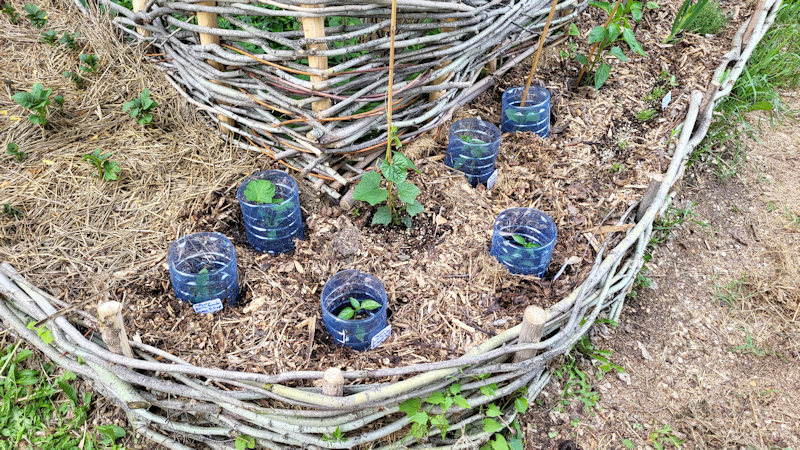
So that one surviving luffa got planted in the corner of wattle weave bed, where it could get good sunlight, and have the taller portion of wall, then the lilac bush, to climb.
Later on, however, some seedlings sprouted that looked an awful lot like luffa! So I planted them in the same bed.
How they did
This was the best year for growing luffa, yet!
Ideally, we’d be growing them in a polytunnel or greenhouse, because they need twice the growing season we’ve got, to reach full maturity. If we were just growing them as a summer squash for fresh eating, that would be fine, but I’m after the luffa sponges.
The two mystery plants did turn out to be luffa, but they were planted way too late to do well. That first transplant, though, grew so very well and was soon climbing high into the lilac bush where, hidden from view, we actually had several gourds start to develop!
Not all of them made it. In fact, only one did, really. We left it on the vine as long as we possibly could before harvesting it. As I write this, it’s currently curing over a heat vent in the living room. I keep forgetting it exists, so I haven’t tried to peel it and see if we got an actual mature luffa with usable sponge – and possibly seeds – inside.
Final thoughts on luffa
Luffa is one of my “just for fun” experimental plants, so I keep trying! We will eventually get some sort of polytunnel or greenhouse set up, which should make them easier to grow in our short season. I will keep trying to grow them for the challenge of it, but I think I will try seeds from other sources in the future.
Drum gourds, Caveman’s Club gourds, Zucca melon and Crespo Squash
We tried growing Zucca melon last year, but that bed was one of the ones that got flooded, so I wanted to try again. The African Drum gourds and Caveman’s club gourds were new ones to try. I want to grow gourds to use them for crafting. The first time we tried to grow Crespo squash, they did really well, even when recovering from being eaten repeatedly by groundhogs and deer. Both the Zucca melon and Crespo squash are experiments we are growing so we can at least try them and see if we enjoy eating them.
The Crespo squash and Caveman’s club were started in the middle of March.
Though I made sure to scarify the seeds, when they germinated, there were problems with the seed leaves not being able to free themselves from the shells. We also had losses and germination issues, and had to replant the pretty much all of them.
The ones that did take, did well, though, and soon got quite huge!
Here you can see where I used a straw as a splint to protect a breaking stem. It started to break, just from moving the pots around to get good light, when they were still smaller and in the living room. Once we were taking them outside to harden them off, there was a much greater risk of damage. So some of them got transplanted earlier than I normally would have, given our last frost date.
One Zucca melon and one African Drum gourd went into the block planters, along with the two surviving Caveman’s Club. The Crespo squash got their own bed, well away from the other squash, in case we were able to save seeds, as they don’t seem to be available anymore.
The last of the Zucca melon and African Drum gourds went into a reworked bed near the squash patch.
At least, that’s what I thought.
As things started blooming and developing, it because clear that there were only Zucca melon. With restarting seeds and putting up, I must have mislabeled things, because the pots that were labelled African Drum gourd began producing fruit that could only be Zucca melon.
Which means the only African Drum gourd transplant we had, was the one planted along the chain link fence.
How they did
As you can see from the photos above, the drum gourd, Crespo squash and Zucca melon did start blooming.
What was grown in the blocks by the chain link fence did not do well at all.
The Crespo squash also did not like their location. I was expecting the huge, lush plants we got the first year we tried them. Instead, they were spindly vines, with many male flowers but almost no female flowers. What few did appear, I hand pollinated. We did get a few that started to grow, but by fall, there was just one to harvest, and it was much, much smaller than these are supposed to get.
With the Zucca melon, they also produced mostly male flowers, but they did start to eventually produce a good amount of female flowers. I hand pollinated those, too! While the plants themselves didn’t thrive, either, they did do better than the Crespo squash, or the ones at the chain link fence. They started to produce fuzzy fruit, which is how we could finally say that what we thought were Drum gourds were actually Zucca. Some of them even started to get pretty big, but in the end, they all ended up with blossom end rot and dying off!
Update:
I knew I was forgetting something!
The Caveman’s Club gourds did slightly better, though far from healthy plants. They bloomed and pollinated, and at the end of the season, we had two – sort of – little gourds. After picking them, one got all wizened and was tossed. The larger one is currently curing in our sun room. The cats keep trying to play with it!
Final thoughts
These were all really disappointing. Those transplants were looking so good when they went in, but none of them thrived!
With the Crespo squash, a bit of research leaves me to conclude that they actually got too much sunlight. Where they were planted gets full sun, all day – no shade at all in the summer. This will be the last year we use that patch for vegetables, though, and next year we will be planting something for the food forest there.
I still have seeds and do what to try them again, but in a different location, where they will be less likely to get sun burnt.
As for what was planted in the blocks, this was the first year those blocks were used as planted, and something is definitely going wrong. It shouldn’t be the soil. One possibility is that the regrown branches above are cutting out too much sunlight. Another is that the blocks themselves are creating a hydration problem. We will grow completely different plants in there, next year.
The Zucca melons near the squash patch, though… that’s where we grew Crespo for the first time, two years ago, and giant pumpkins last year. The soil had been reworked and had manure added to it. They should have done well, and yet they didn’t. I’m not sure why. Next year, we will use that spot to grow something different.
I do still want to try growing all of these again, plus other gourds that we have seeds for. We are working on building trellis beds, but these are all supposed to produce really massive fruit, so I will likely try them in low raised beds, instead. Whether or not we try them again next year, or pause them for a year, will depend on just how many of the various raised beds we need to build, progress.
Summer and Winter Squash
I’m putting these together, but there isn’t much to say about the summer squash!
We had seeds for the same varieties we grew last year; green zucchini, yellow zucchini, yellow patty pans and Magda squash are all seeds we got from a variety pack we accidentally bought 3 of, so we’ll have seeds for these for a long time! We like all of them, too. Then there was the G-star patty pan that we grew last year, and was one of the few things that produced, in spite of the flooding. We got those seeds sent to us by mistake. A happy mistake, as we quite like them, too.
As these are shorter season varieties that we only plan to eat when they are smaller, I was going to experiment with starting a few seeds indoors, and direct sowing others. In the end, we didn’t have the space to start more seeds indoors, so they got direct sown.
Every red dot you see in the above photo marks a slug.
I’ve never seen so many slugs in my life – and we’ve lived in Victoria, BC, where the Banana slugs come out in herds, after a rainfall!
They absolutely devastated our sprouting summer squash. They did damage to the winter squash as well, but they seemed to leave the larger transplants alone more.
Ultimately, we did have a green zucchini, yellow zucchini and a yellow pattypan squash survive and actually produce some fruit. No Magda squash survived. The G-star, however, did surprisingly well; they didn’t seem to get hit by the slugs as badly, recovered very well, and had decent production.
There was the problem of only male flowers being produced, and when a female flower did finally show up, there were often no male flowers to pollinate them. So I ended up hand pollinating them with any male flowers I found on other summer squash plants.
We didn’t have a lot of summer squash to harvest, but there was at least some!
I think the biggest surprise was when they got hit by frost, but when we got more mild temperatures again, they started to recover and continue to produce!
Then there was the winter squash.
As with so many other things we started indoors, we had a really hard time with germination. Some squash and melons simply did not germinate at all, or when they finally did, the seedlings quickly died. In the above photo, you can see what was left to transplant. Just two Lady Godiva hulless seed pumpkins (we started 3 varieties of hulless seed pumpkins), two Winter Sweet (they were among those we tried last year that got flooded out), and two Boston Marrow (another from last year that got flooded). The Little Gem/Red Kuri are something we’ve grown for a couple of years now, and quite like, but this is the first time we’ve tried growing them without a trellis of some time.
More of the Honeyboat Delicata survived. This is a new variety for us, and is a variety of Delicata that is supposed to be good for storage. We’d tried Candy Roaster last year, too, but they, too, got flooded. The Pink Banana was a new one for this year.
The empty mounds got summer squash planted in them, plus another row was prepared for the rest of the summer squash, on the left of the photo.
The thing with winter squash, of course, is that there’s nothing to harvest until the end of the season!
What a difference between the plants, though.
How they did
The Pink Banana and the North Georgia Candy Roasters did excellent! I didn’t think they would, because their two rows were planted in an area that gets a lot more shade. The other winter squash were planted in rows that got much more sun, yet they were the ones that failed to thrive! Going back to what I learned in trying to figure out what happened to the Crespo squash, it looks like they actually got too much sun, while the rows that got shade for much of the day got just enough! Lesson learned!
We still managed to get small harvests out of some of the sun burnt squash. We did get to try both the Banana and Candy Roaster squash and found them delicious.
Final thoughts on summer and winter squash
When it comes to summer squash, these will remain a staple in our garden. We just have to find a way to deal with all the slugs!! We will try other varieties as we’re able – there are a few patty pan varieties I want to try, but what we have now are basic and we will keep growing them. Especially the G-Star. They seem to really thrive here, even under really horrible conditions!
With winter squash, we are still very much in the experimental stage in learning what what grows well here, and what we like. The Red Kuri/Little Gem squash are a winner – though they definitely need better growing conditions than what they got this year! The Pink Banana and Candy Roasters are both ones well worth growing again. I don’t know that we’ll bother with the hulless seed pumpkins again, though. I seem to be the only one that likes pumpkin seeds in the family! As for the other varieties of winter squash, we will try them again in different growing conditions. With the tiny fruit we got this year, we can’t really say if we like them or not, as they would not have developed their full flavour.
Next year, we will not be growing squash again in this location. They need to be rotated out. The trellis tunnel that will be built into the new mid-height raised beds we are working on will be strong enough to hold the weight of these climbing varieties, so hopefully, that’s where we’ll be planting them next year.
The Surprise Squash
We got some unexpected squash, too!
In our compost ring!
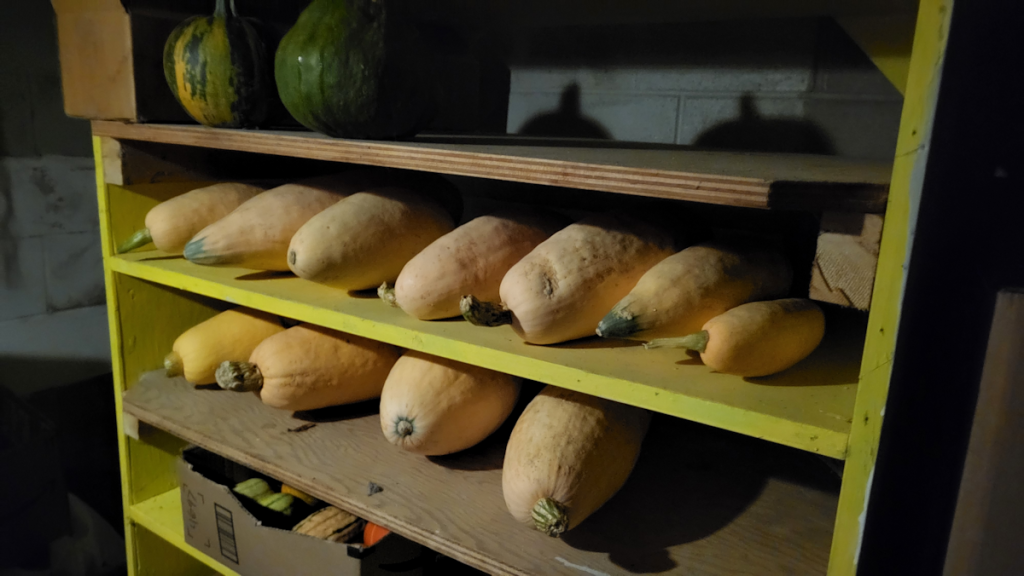
They were the biggest, healthiest squash of all! 😄 Unfortunately, we don’t really know what they are. Some looked like hulless seed pumpkins. Some looked like they might have been from some hybrid zucchini we were gifted with. We harvested them, but have yet to actually try any of them. If you look at the photo of squash in our root cellar, the two big green ones at the top are from the compost heap! Whatever they are, they are likely hybrids, or even hybrids of hybrids! 😄
We also got surprise beans in here. I left them to go to seed, and have no idea where they came from. We’ve never grown beans like those before!
It should be interesting to see what volunteers we get in our compost, next year. 😁
Melons
We were so eager to do melons again!
Two years ago, in spite of a drought, we successfully grew two types of melons, Halona and Pixie, and were looking forward to growing even more, last year.
Yeah. They were in beds that got flooded.
Total and complete loss.
This year, we hoped to be able to grow quite a bit more. We started the seeds indoors in early May.
This year, we tried the Halona and Pixie melons again, plus Sarah’s Choice, a new variety. We also tried Cream of Saskatchewan watermelon. The watermelon we tried the previous year – a short season variety, too – was among the losses.
The water melon was a loss this year, too! Zero germination. Bizarre!
The others struggled to start, too. In the end, we had only two Sarah’s Choice, and a couple of Pixia and Halona, each, none of which looked particularly strong.
These were intended to go into the new trellis bed, but that didn’t get built, so we got creative.
We have a kiddie pool we’ve been using for all sorts of things, from washing cat blankets outdoors, to harvesting potatoes out of bags into, to sifting soil into, to use elsewhere.
I made holes in the bottom and turned it into a raised bed, because the few melons we had really needed to get transplanted!
How they did
They did remarkably well! So well, we had to add more supports to the top of the makeshift trellis.
As with the winter squash, these just needed tending until the end of the season. They developed many flowers and we saw lots of little melons forming.
Unfortunately, like so many other things, they started blooming late. We did get a couple of larger melons that were fully mature, but most of them never had a chance to get to that point, even with our exceptionally long and mild fall.
This was our final harvest of all the melons, and you can see we did get some decently large ones!
The smaller ones, however, very quickly started to rot, so we didn’t get very many to eat.
Final thoughts on melons
We will continue to try and grow melons, because we really like them, but they tend to be too expensive to buy regularly. As we build more raised beds, and the trellis tunnels we are planning, we should have better growing environments for them over time.
The Halona and Pixie melons are varieties we know can grow here, so we will probably stick to those two.
We will try the watermelon again. I don’t know why they didn’t germinate; I don’t think the problem was with the seeds. It’s a short season variety developed in Saskatchewan, so it should grow here fine. I might even try direct sowing them instead of starting them indoors, to see if that makes a difference.
We will also try other varieties over time until we eventually settle on something we all really like, and can save seeds from. There are many short season varieties we can choose from!
Poppies
I almost completely forgot about these!
I really want to grow non-ornamental poppies. My mother used to grow them on the old kitchen garden, when I was a kid, and we had enough that my late brother and I would eat the seeds straight out of the dry pods, and my mother could still make filling for makowiec.
We had two varieties of bread seed poppies; one we’ve grown before, and one that is new to us. Previously, we’d grown Giant Rattle poppies, but where we grew them ended up getting highly compacted, was full of weeds, and they did not thrive, though we did get fully mature pods out of them. The other variety we got was Hungarian Blue.
As poppies reseed themselves easily, I wanted to make sure they were planted somewhere where they could be treated as a perennial, plus I also wanted to make sure the two varieties were planted well away from each other, so as not to cross pollinate.
We only got one in.
We had an area by the chain link fence where we’d first grown potatoes in bags. After the potatoes were harvested, the soil was returned to where the bags had been sitting to create a new bed. Last year, we unsuccessfully tried to grow white strawberries there. For this year, it got a thorough weeding, and then Hungarian Blue poppies were planted in it.
How they did.
At first, I thought for sure we wouldn’t get any at all. For all my efforts to remove weed roots, that’s what we got the most of. Eventually, however, poppies started to show up! Yes, some even got to fully mature, with dried pods developing.
We also had some self seeded poppies show up with the shallots. These were transplanted in a new raised bed built over where we’d grown Giant Rattle poppies before, so I thought they’d reseeded themselves and let them be. They turned out to be a variety that predates our living here! Still a bread seed poppy, so I collected seeds from those in the fall.
Final thoughts on poppies
With edible poppies available as seeds again (for a while, they were not available, because they are the source of opium), I want these to be a staple again. I don’t know what happened to the variety my mother used to grow – the ones that have come up on their own are different from the ones I remember. I’ve even found poppy seeds while cleaning up the place, but it seems my mother switched to ornamental poppies at some point. There’s no what to know what kind the seeds I’ve found are without planting them, and with how old they probably are, it’s unlikely they will germinate.
The bed where the Hungarian Blue were planted will need to be completely reworked, with the soil sifted to get out more weed roots. Then, they will be replanted there. Once the poppies themselves are established, they will choke out any weeds, themselves. Until then, we’ll have to battle the weeds for them. The soil also got quite compacted, which affected their growth as well., so we will have to amends it more.
As for the other varieties, we still need to find locations where we can plant them, and then just leave them to self seed. There are a few areas I can think of, but it will take time to take out grass and weeds and amend the soil before we can plant them.
Well, this one turned out much longer than intended! This is the last of what we grew, though.
Next time, I’ll be looking at what we intended to grow, but it just didn’t happen!
The garlic had been curing on the picnic table and last night I trimmed, cleaned, strung and hung them, keeping the different varieties apart. Several couldn’t be hung and I brought them in to be used right away. We have so little garlic this year! A little is better than none, though. We’ll leave them hanging in the market tend for a while longer before bringing them inside.
The chamomile in the wattle weave bed is blooming nicely!
I got a picture of the developing gourds from the drum gourd and zucca melon bed. That is most definitely a zucca melon, not a drum gourd. I most definitely got mixed up with the labels. Which means we have no drum gourds developing at all. Not even female flowers.
We do have a couple of Caveman’s Club gourds, though! Well. One, so far. I just hand pollinated another one last night. We’ll see if it takes.
The Purple Peruvian potatoes in their grow bags are looking absolutely lush! The Irish Cobbler are getting yellow and falling over, and the Red Thumb are getting into that stage, but the Purple Peruvian look like they’re going to be growing for quite a while longer.
Last of all was an unusual find, as I was checking the squash to see what might need pollinating. I found a double flower!
Today is the last day of July, and our growing season is quickly running out. I have seen people in my local gardening groups who are even further north than we are, posting pictures of their much larger squash. I wish I knew how theirs are so much further ahead! Things are growing well this year, but I still can’t shake the feeling we are behind. So many squash plants still aren’t even producing female flowers yet.
Ah, well. We’ll get what we get, and every year is another year to improve our soil and growing conditions.
Oh, something I forgot to mention. Last winter, a neighbour who is moving had offered us a shed they needed to get rid of, that I was hoping to use as a chicken coop. Unfortunately, it didn’t handle the rest of the winter well, and they ended up scrapping it entirely. Now that the renter’s cows have been rotated out, I should grab the wagon along with some tools and see about getting that antique wagon chassis in the car graveyard. I still have hopes to build a mobile chicken coop on there.
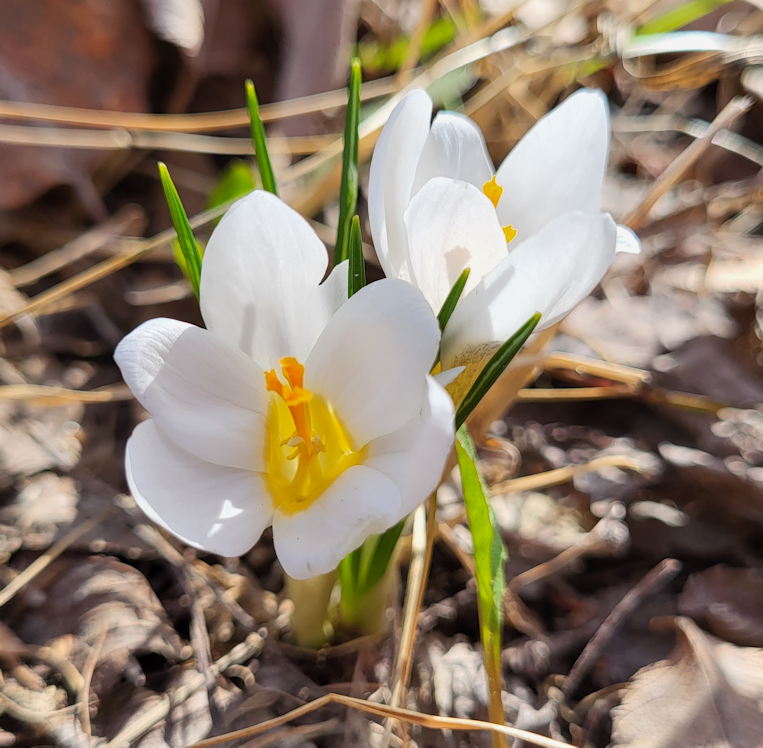
There are quite a few crocus buds popping up, and we’re also seeing lots of grape hyacinth greens emerging! Too early for the flower stalks to start forming, but the leaves come up in distinct little clusters that are easy to identify, compared to the grass and weeds that are in the same area. I’m looking forward to when the crocuses and hyacinths spread enough to start choking out the weeds and grass where they’ve been planted!
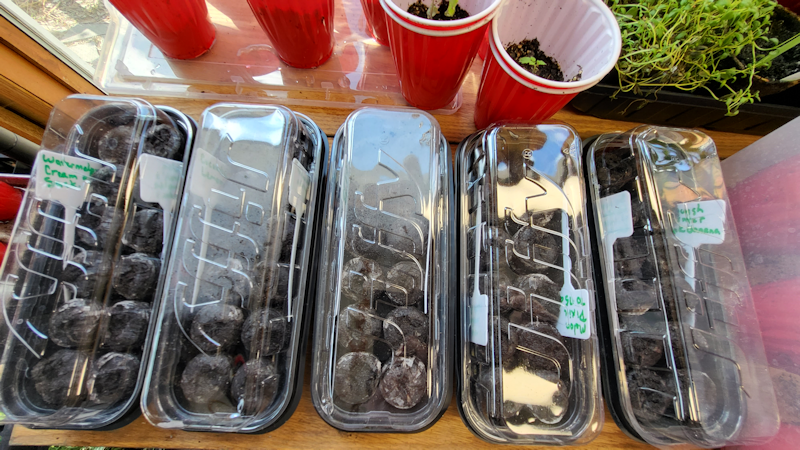
Last night, I started hydrating the seed trays with the Jiffy pellets, then headed into town this morning to pick up some more seed starting mix for the other tray.
There wasn’t any.
I tried a few places and found lots of potting mix, but no seed starting mix. I wasn’t willing to drive to another town, so I ended up getting more of the small trays with Jiffy Pellets in them. I did pick up a few bags of manure, though. Two of composted cow’s manure with peat, and two more of composted sheep’s manure with compost. These will be good for top dressing some of the beds, and for the trees we’ll be transplanting when they come in next week.
When I got home, I first had to start new trays hydrating, then I could work on the ones that were ready.
I had 5 trays, each with 12 pellets in them. I decided to do two different seeds in each tray, for a total of 20 new seed starts. Hopefully, we’ll have a nice, high germination rate, since each pellet got only one seed each.
These are what I chose for the first batch.
For melons, I’ve got the Sarah’s Choice, a new variety, Halona and Pixie, which we’ve successfully grown two years ago, and Cream of Saskatchewan watermelon, also new. Our attempt to grow melons last year was a complete failure, due to flooding. There are the two types of cucumber; Lemon, which we got as a freebie, and Eureka, a dual purpose variety for both fresh eating and canning. Then there are the winter squash: Pink Banana, North Georgia Candy Roaster, Honeyboat Delicata and Little Gem (Red Kuri). We tried the Candy Roaster last year, but they got drowned out. This will be our third year growing the Red Kuri squash, which survived last year because we planted them in a completely different location. I thought I’d ordered a new packet of those, but couldn’t find it. I ended up finishing off the few seeds in this older packet, then used seeds we’d saved ourselves from the first year we grew them.
I rearranged things a bit in the sun room to make room for these on the makeshift table. Later on, I’ll move the mini-greenhouse frame to the sun room to have more space for the trays.
As for the second batch, it will have:
The three varieties of hulless pumpkins, Kakai, Lady Godiva and Styrian, that we also grew last year. We’ve been slowly going through the ones we harvested last year – yes, we still have some! – but I lost track of two varieties that looked alike, so I haven’t been able to keep track of which seeds we like best. There is more winter squash: Red Warty Thing is new, while Boston Marrow and Winter Sweet were among those that got drowned out last year, though the Boston Marrow did start to recover somewhat. I’ve got more gourds, too. We started the Canteen gourd too early last year, and they were starting to bloom before we could transplant them, so they are being started later this year. Hopefully, they will actually get a chance to produce fruit this year. The Yakteen gourd transplants got killed off along with the melons, during our terrible, no-good growing year last year, and I hope to be able to actually try some this year. The Ozark Nest Egg and Apple gourds seemed to do well last year. We still have some Ozark Nest Egg gourds curing. The Apple gourds actually recovered rather well from the terrible conditions the squash were all hit with last year, and were producing quite a lot of gourds, but it was too late in the season by then. We were hit by frost before they could fully mature. I’m hoping we’ll have a better year this year.
I was tempted, but decided against growing the Tennessee Dancing gourd again this year. They are fun and do well, but we just have too many things going – and that’s not even considering what needs to be direct sown!
The new trays are being hydrated now. I’ve got another 5 going, though I have a spare available to hydrate, just in case. Hopefully, I’ll be able to plant into them tonight, and things can be moved into the sun room right away.
Once the last seeds are started, it’s back to working outside! I’ve still got the one last bed to work on in the old kitchen garden, then we need to build at least one trellis tunnel, with the raised beds that will be part of it, and prepare existing beds for planting, as well as grow bags for the potatoes, and containers for things like the lemongrass, some of the peppers and probably the eggplant as well.
Lots to do, and just a few weeks left to do them!
I’m so happy being able to get outside and get work done again!
For a while outside, the wind picked up and I could see the snow coming down horizontally out the window! From what I’m hearing the roads are in terrible condition, and quite a few people posted online that they started to go somewhere, only to turn around immediately. Everyone is being told to stay home. A number of roads have been closed, particularly in the South. For our area, it looks like the worst of it has passed by, and things should be getting better from now on, though there is a second system on the radar that might make it as far as us later. Maybe.
A good day to be inside and doing garden stuff!
The first thing I needed to do was start some new seeds.
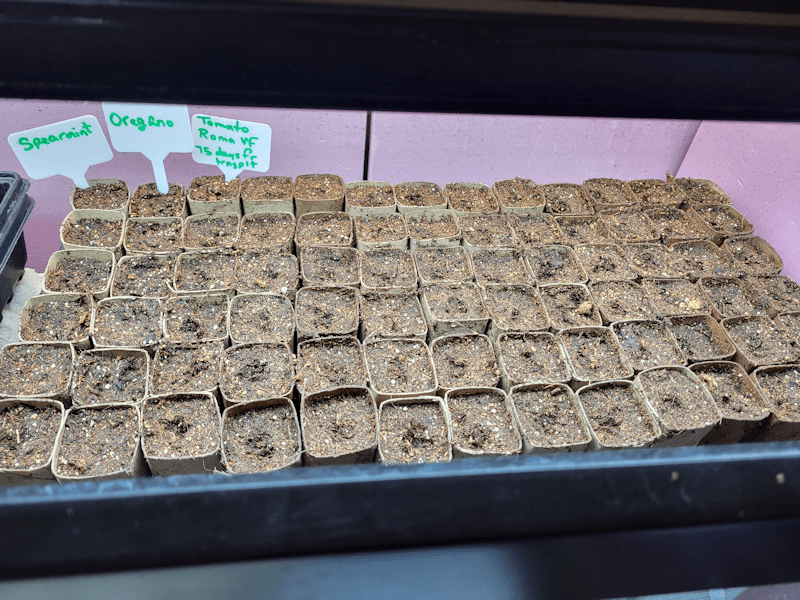
There were only three things that need to be started in the 6-8 week range; spearmint, oregano and the Roma tomatoes.
The oregano and spearmint seeds are so miniscule! We don’t need a lot of either, so there was more than enough for our needs. There weren’t a lot of seed in the tomato packet, so I actually counted them to work out how to use the tray. There turned out to be 67 seeds in the packet. Usually, for “pots” the size of these toilet paper rolls, I would plant two seeds per pot, but with so few seeds, only one got two seeds and the other 65 got a single seed each. Romas are a tomato I want to have a lot of, so we can do tomato paste and sauces again at the end of the year.
The herbs each gone one row in the tray. Here, the tray is on the heat mat, and it now has a dome over it, too.
This is the tray that had been on the heat mat. There are some cayenne, Dragonfly and Early Sensation peppers sprouting. And look at all those spoon tomatoes!
The strawberries and Classic eggplant got moved out entirely, and are now in the small aquarium greenhouse, still on the little bin to lift them closer to the light. The hardware cloth cover for the tank is no longer needed to keep the cats out, but it is still needed to hold the light fixture. We couple put the light back under the tank’s lid and use that, but this way, there is still plenty of air flow.
This done, I decided to do some potting up. First, I thinned by dividing the Crespo squash…
They are on the aluminum sheet in the photo. Of the two pots, one had all three seeds in it germinate, and they all have their own pot now. The second pot, I left for now. You can see a second seed did start to germinate, but it seems to have just stopped growing.
In the baking tray, you can see the Zucca melon, at the bottom right of the picture, are doing well! Those tendrils are reaching out to climb, and I’ve already had to unwrap the biggest one from the mini greenhouse frame. The drum gourds in the back are doing okay, but I think it’s just too cold for them to grow much right now.
I’d reseeded more Zuccz melon and drum gourd, but none have germinated yet. There was a drum gourd seedling that died after I’d put more seed in the empty pots, and I was considering adding more drum gourd seeds to it. Not anymore! That pot has now been “potted up” into the stronger, lighter coloured pot, and contains an experiment.
Last year, we had purchased seeds for Tulip trees and pawpaws. We had a single Tulip tree germinate, only to die soon after. Nothing else germinated. Their containers had been moved between the sun room and the shelf just outside the sun room. No surprise that cats would eventually knock them around, and that was it for any chance of germination. They were planted in a seed starting mix, which I ended up adding in to the big bowl I use to moisten the starting mix before putting it into pots to start new seeds. I ended up finding one of the pawpaw seeds that actually looked robust, so I stuck it into the available pot. Who knows? Maybe it’ll sprout!
Today, I had dumped our last bag of seed starting mix into the big bowl with what was left from before and was mixing water in with my hands when I found another pawpaw seed that looked like it was fresh out of the package we got them in. So I stuck that into the pot I’d put the first one in. The pot is damp, though, so it broke. I grabbed one of the new biodegradable pots I bought and the whole thing fit perfectly inside it. Cool! Now we have two pawpaw seeds to potentially sprout!
As I went back to mixing water into the seed starter mix, I found three more pawpaw seeds! None of them showed even the slighted bit of rot or damage!
They all went into the experiment pot.
I have no idea if they will germinate, but it would be awesome if they did!
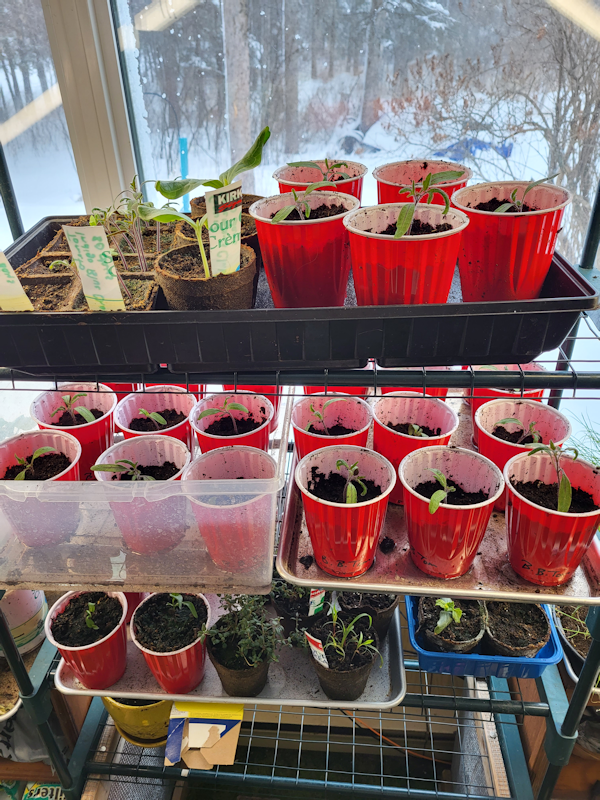
Once the herbs and tomato seeds were planted and things were shifted around, I decided it was time to pot up the Black Beauty tomato seedlings. The germination rate for those was really high, and they were starting to get too big for the square potting cells they were in. I had a bag of potting soil ready for potting up, and went with Red Solo cups to transplant them up into.
I filled them about half way with soil, and buried the stems of the seedlings about half way when transplanting. As they get bigger, we can keep filling the cups with soil, allowing for more roots to develop along the stems. The baking tray holds 12 cups, while the bin can only hold 9, which left 5 more to go back into the tray they had been in before. The smaller Indigo Blue tomatoes don’t need potting up yet. Sadly, there are still only three Little Finger eggplants; the pots I reseeded show no signs of germination yet. Again, I think it might just be too cold by the window, even though the whole thing is over a heat vent.
Lower down, you can see the tray that has the first peppers we planted, in the red cups they were potted up into, next to the German thyme and lemon grass. The yellow plant pot below has one of the pots of German thyme transplanted into it, which we will be keeping indoors. In the blue mushroom tray is the luffa. We still have just one plant. The other 3 pots were reseeded, but still nothing.
And finally, here are the onions and shallots! It’s been a while since I showed how they were doing. I suppose we could give them hair cuts, but that may not be beneficial. Gardening in Canada did a video about it, and I trust what she says.
My daughter’s orchids got moved to the shelf beside the onions. I hope they do okay, there. They’re pretty far from the heat vent.
That is it for now! The next seeds we will need to start are the 4-6 week seeds, and I think I have only 1 or 2 things that needs to be started in that range. After that, it’s all stuff that needs 3-4 weeks before last frost date. There are a few seeds in that range that I plan to experiment with, starting some indoors and direct seeding others, to compare how they do.
Being able to work on gardening stuff while it’s snowing outside feels really good!
The rest of the peppers got done today, along with the Spoon tomatoes. That bowl has all the Spoon tomato seeds left from last year, as well as the new seeds I got this year.
The tray has 6 long rows, and I considered also planting the remaining Purple Beauty pepper seeds from last year, but there weren’t enough seeds to fill a row, so I decided against it. There were not a lot of pepper seeds for any of the other varieties, but with just one seed per pellet, I still had some left over.
With the Spoon tomatoes, I used the last two rows, planting two seeds in each, and still had some seeds left over. (A wooden chopstick is really great for picking up individual seeds and planting them!) It’s potentially a lot more of these tomatoes than I was intending to plant of this variety, but they did go over very well the last time we planted them. If the germination rate is high and we have a lot of extras, I’m sure I can find someone who would like some transplants. 😉
As for the peppers, we’re not after a lot of each type, so if the germination rate is low, as long as we have a few plants of each to try, I’m good. I want to have an idea of which ones do well here, and which ones my family enjoys eating, and that will decide what we will grow again in the future.
After this photo was taken, I put the dome over this tray, and then switched out the tray on the warming mat in the aquarium greenhouse. I had thought I might be able to leave this tray, with the dome, by the window, but when I touched the Jiffy pellets, they were cold! These are heat loving plants, so onto the warming tray then went.
This is the tray that got switched out. The Crespo squash on the right will be potted up once the true leaves are more fully developed. We still have just the two Caveman’s Club gourds in the middle; I’m considering soaking a couple more seeds to add to the one pot where nothing germinated, just to have more transplants. I don’t expect everything that gets transplanted to survive, so having more just increases our chances of having at least one plant survive.
The Black Beauty tomatoes (middle) and the Indigo Blue Chocolate (left) are doing quite well. The Little Finger Eggplant (far left) are not. Of the few seeds that germinated, only two are growing, and one… I’m not quite sure if it’s going to make it. So I reseeded the pots. Hopefully, we’ll have a few more to transplant by June.
Oh, it looks like I’ll be heading out soon. A very excited daughter just came in to let me know her glasses ordered from Zinni have arrived. She has been absolutely miserable without glasses for so many weeks. I just have to wait for the post office to reopen for the afternoon. I’m really looking forward to seeing how these are for quality.
Today, I potted up most of our seedlings, among other things.
For the larger seedlings, I thinned by dividing, so the zucca melon and a couple of drum gourds are now in their own larger pots. The pots where nothing germinated now have new seeds in them, including the luffa on the side.
The four cells of peppers are now in 7 red solo cups. The thyme and lemongrass did not get thinned, just transplanted into deeper biodegradable pots.
I also got the strawberry kit done, and that little tray is in the aquarium greenhouse with the other seed starts. Every time I look at in there, the Black Beauty seedlings are bigger, and I can spot more of them breaking through the soil. They are practically exploding in growth! I even spotted a couple of Indigo Blue tomatoes breaking through, too!
In about a week, we’ll need to start the next batch of seeds, which will include all the remaining short season peppers and the paste tomatoes. I’m quite glad we have the living room cat proofed, so we can shift things around more freely. Yesterday, my daughter was using the room and Fenrir teleported in, as she tends to do. My daughter thought it might be okay, since she was in there to supervise. She turned her head for perhaps 30 seconds, and suddenly Fenrir had a mouth full of onion greens!
Onions are toxic to cats.
My daughter was able to catch her and get the greens before she actually ate them. Thankfully, there is no apparent damage to the onion seedlings!
So much for even one cat being allowed in, with supervision!
After a bit of adjusting, our new set up for the seedlings rotated out of the aquarium greenhouses is figured out.
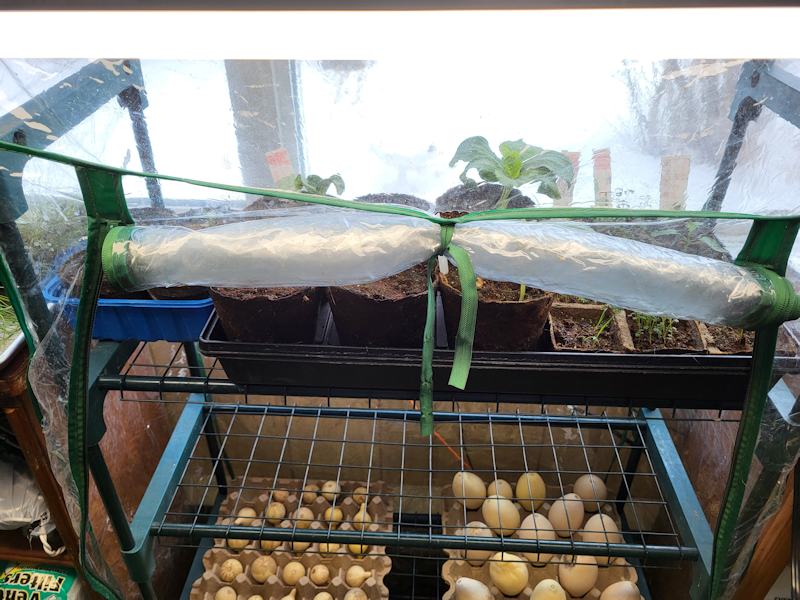
The seedlings that need more warmth are inside the mini greenhouse, which is set up over a heat vent. The plastic cover is there to help trap a bit more heat, and protect them from the cold window.
It looks like we’ve lost one luffa, likely due to the chill, and one drum gourd, but there are still 2 luffa left, and 3 drum gourds. There are also several pots that had nothing germinate in them, but I’m leaving them for now, because who knows? Now that it’s over here, maybe something will happen.
The rolled up door in the cover is hiding them, but the thyme is looking like it could be potted up already!
The onions and shallots get to be on one of the shelves, as they can handle the cooler temperatures better. They look ready for a hair cut!
We were able to use some paracord to bring the lights down lower, and their heights can easily be adjusted. With just the two areas with seedlings, only one light is needed for the space right now. The shelves are closer to the window than the lights, so the seedlings are getting lit up from both sides. That was a major problem with our seedlings last year, and I was using aluminum foil to try and reflect light back to the shadowed side of the trays.
Also, you can see the trays of gourds from last year, in the mini greenhouse. They’re one shelf level above the heat vent; the bottom level won’t be used at all, since it’s right over the heat vent and very dark. If, for some reason, we need the space, we’d have to elevate the entire greenhouse frame somehow. The Tennessee dancing gourds are drying up nicely, but it looks like the Ozark nest egg gourds may still have been a bit too green when harvested. There wasn’t much choice about harvesting when we did, since we were starting to get frost, and that would have wrecked them completely. I still have seeds, though, and we will likely be starting them with the batches we’ll be planting before the end of this month.
With the cat barriers in place, and the living room rearranged for the seedlings, it’s actually made the room more useable. The girls have taken to actually having their meals in there, and even watching shows on Tubi. At the moment, they are enjoying some birthday cake in there! I’ve actually allowed myself one exception to my Lenten fast from sugar/starchy foods, to have a piece of birthday cake. It’s been long enough since I’ve eaten any sugar or starch, it’s actually making me fill a bit dizzy!
Anyhow. That’s our garden progress for the day! 🍃🌿🌱














 The Re-Farmer