The predicted rain never came today, but then, neither did the predicted high of the day, so I went ahead and watered the gardens in the late afternoon.
Having mentioned the Ozark Nest Egg gourds in my previous post, I just had to get a picture when I found this.
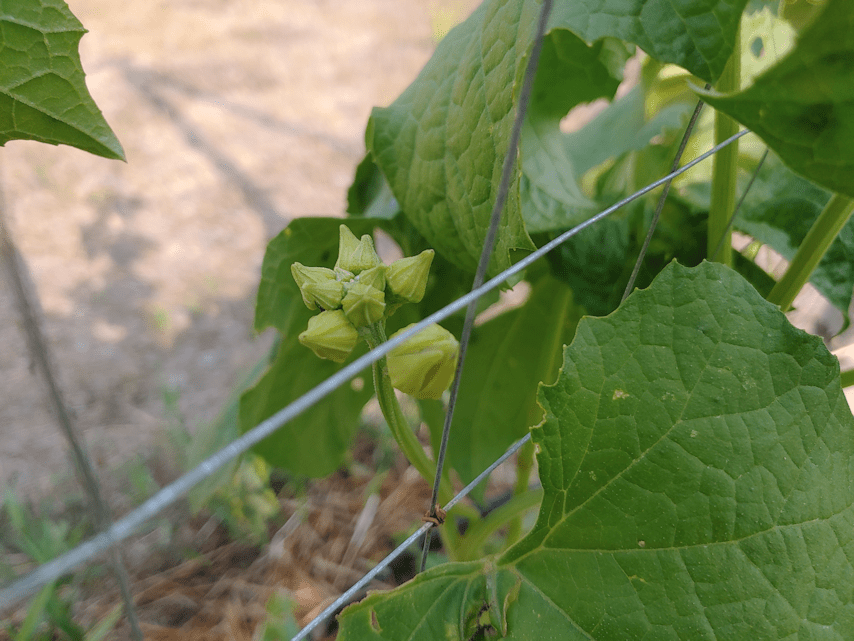
A single Ozark Nest Egg flower blooming. Still no gourds, though; all the buds appear to be male flowers, so far. There is nothing on the nearby Thai Bottle Gourd at all. If there are any flower buds, I can’t see them. The down side of having to add the mesh over these is that we can’t reach under it to handle the plants with undoing part of it!
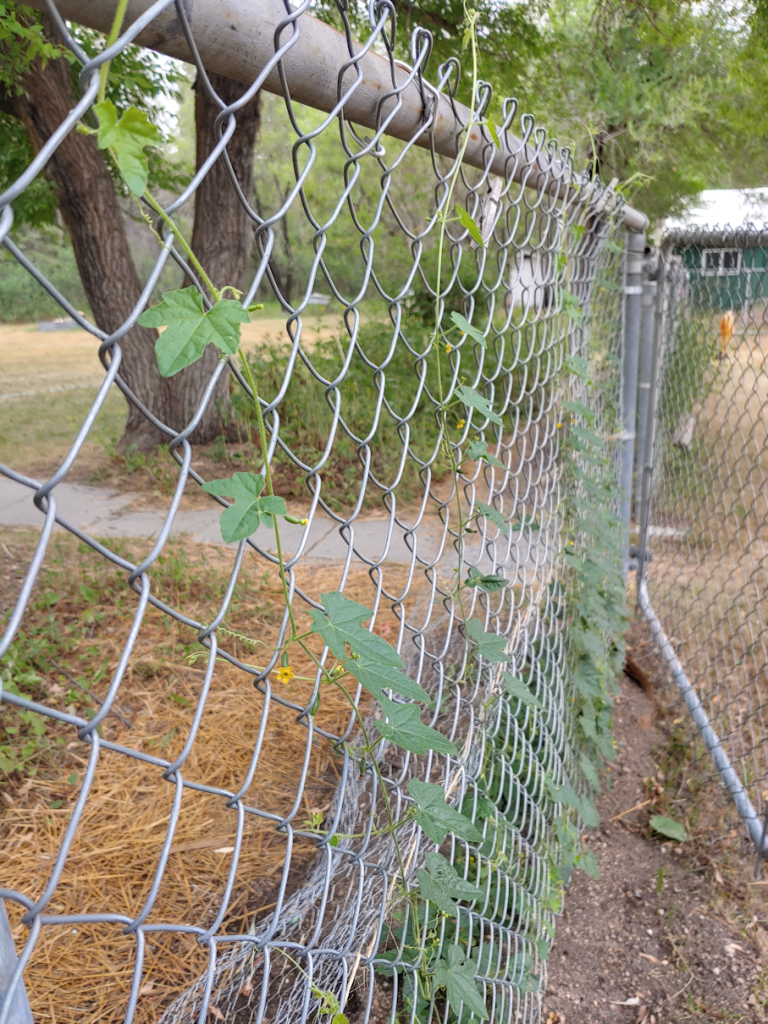
While the Ozark gourds are still just starting to reach a point where we can train them up the fence, the nearby cucamelons have shot their way to the top of the fence and are looking for more height! They are such fine, delicate vines, and you can barely see many tiny little yellow flowers all over them.
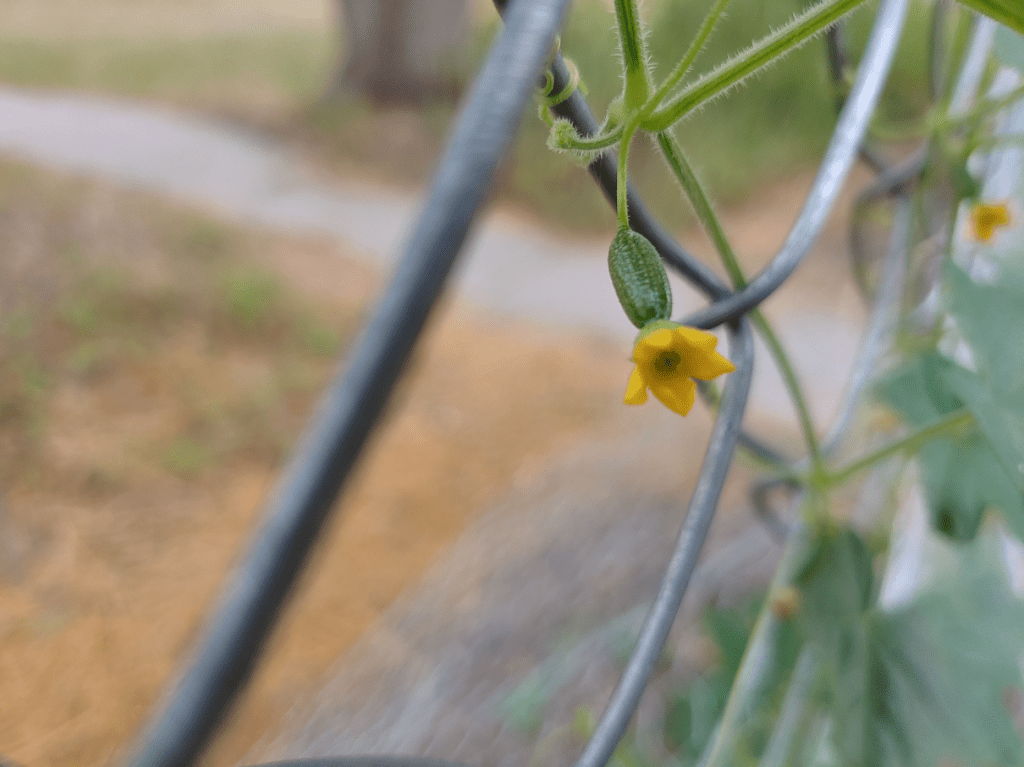
Many of the flowers have teeny little cucamelons under them. :-) They are such prolific plants!
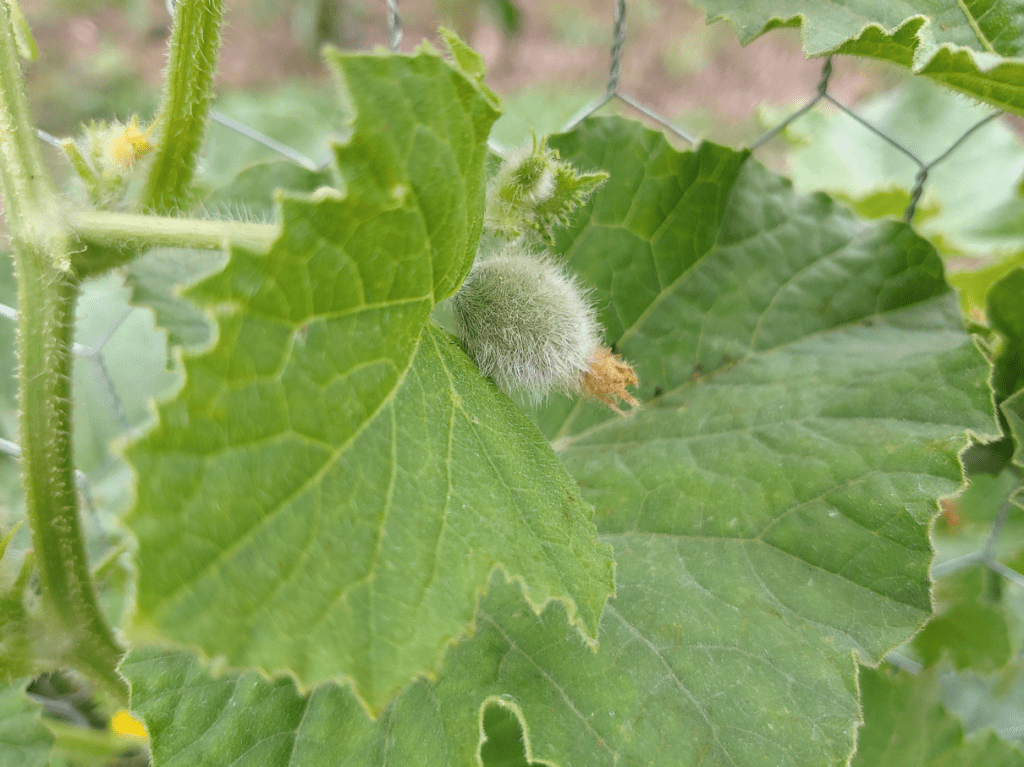
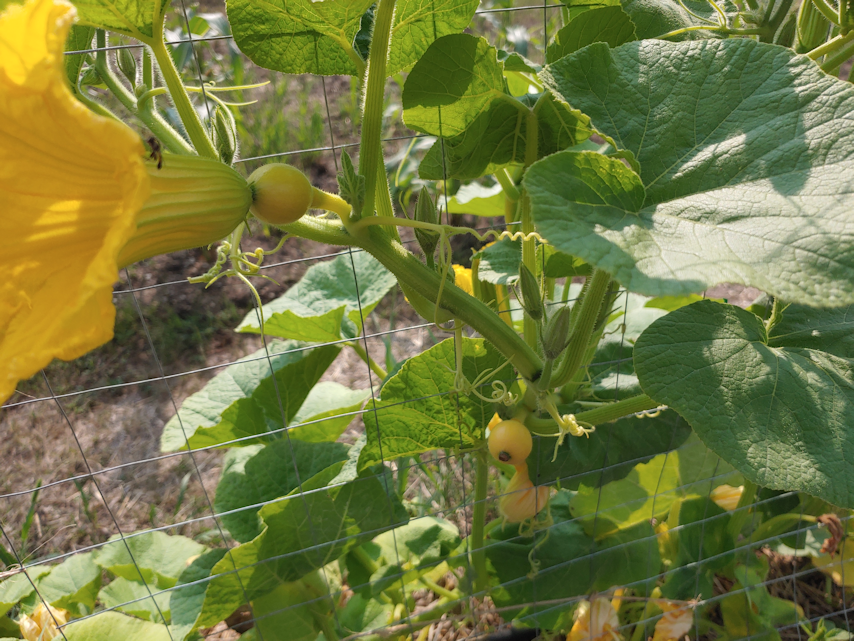
Speaking of prolific, the melons are certainly attracting a lot of pollinators to their many flowers! This is one of the Halona melons.
I love how incredibly fuzzy the baby melons are!
I decided to count what melons I could see. Not the little ones like this, but the larger ones, at least the size of a golf ball. I counted a dozen Halona melons, and another nine Pixies! If they keep up with their blooming, and their ratio of male to female flowers, we could potentially have a lot more than that, if they have enough growing season to fully mature.
There’s always that “if” factor, when it comes to gardening, isn’t there? :-D
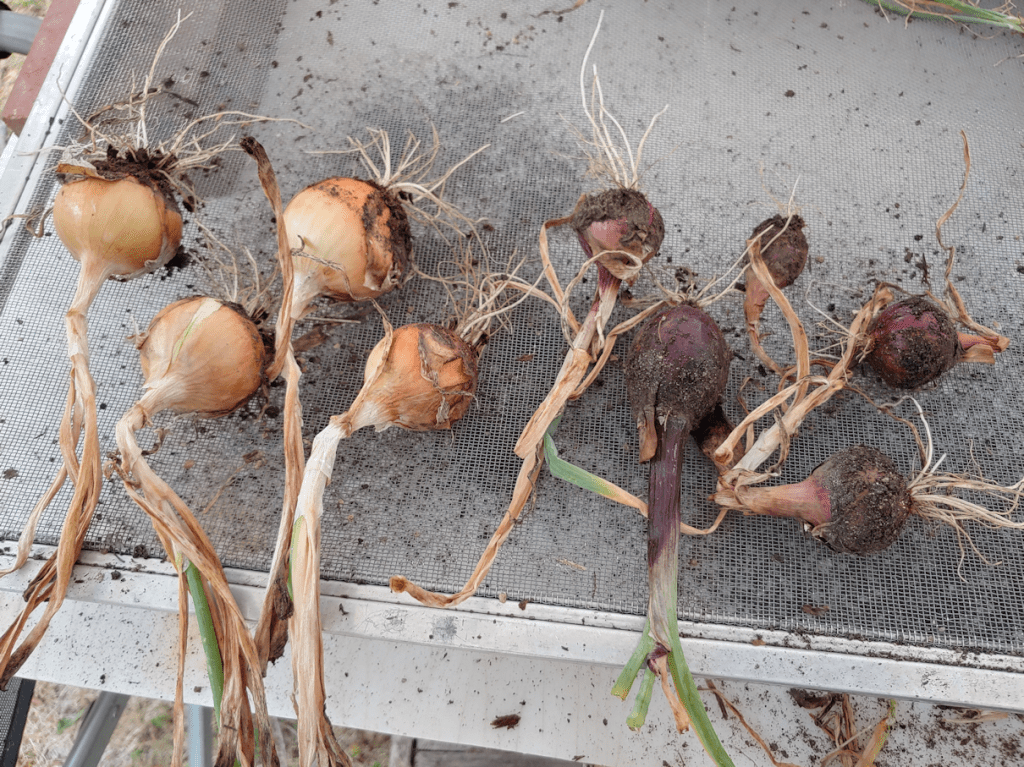
This morning, I decided to go through our onions and harvest the ones I was sure were done for the season. Here are the first ones I picked.
These are the yellow onions we planted from sets that I picked up at Canadian Tire, and planted in the same bed as the shallots. This is about a quarter, maybe a third, of what was in the bed. There were also a few that I pulled and left behind, as they had no roots and were starting to rot.
These ones are mostly pretty small, as they died off too early, I think.
There were enough of them that space on the drying screen was an issue, but they had enough stems left for braiding, so now they are hung up to cure under the canopy.
Then I went back to check the other onion bed.
Very few of these were ready to pick. On the left are the surviving yellow onions we grew from seed, and they are looking the best of all the onions. The ones on the right are the red onion sets we ordered from Veseys.
These have been left outside to dry for a while, but they will be for immediate use in the kitchen! :-)
I’ve been looking up how to tell if onions are ready to pick and finding conflicting information. Some say they are ready after their tops have fallen over, which I think is way too early. Others says after the dry outer skin has developed. Still others say once the youngest leaves – the ones in the very middle of the stalks – are dry, they are ready to pick. That one seems too late!
So the ones I picked were ones that had died off the most, and I could be sure they would not be growing any bigger. I’m also on the lookout for those with roots that have died off, and pull up easily. Those tend to already be going soft, and often have what looks like mold growing in them. From what I’ve read, that’s a sign of fungal infection, so they need to be taken right out.
It should be interesting to see the differences in flavour. I probably won’t be able to tell the difference, and the medications my husband is on has changed his ability to taste things, but the girls should be able to taste differences. I’ll have to trust them to tell me which varieties are worth growing again! :-D
After the issues we had with cats destroying so many of the onions we started indoors, I’m just happy to have any onions at all right now! :-D
Now that it’s “cooled off” again to 32C/90F (feels like 34C/93F), I headed back to the garden to remove the shade clothes and get those photos I promised.
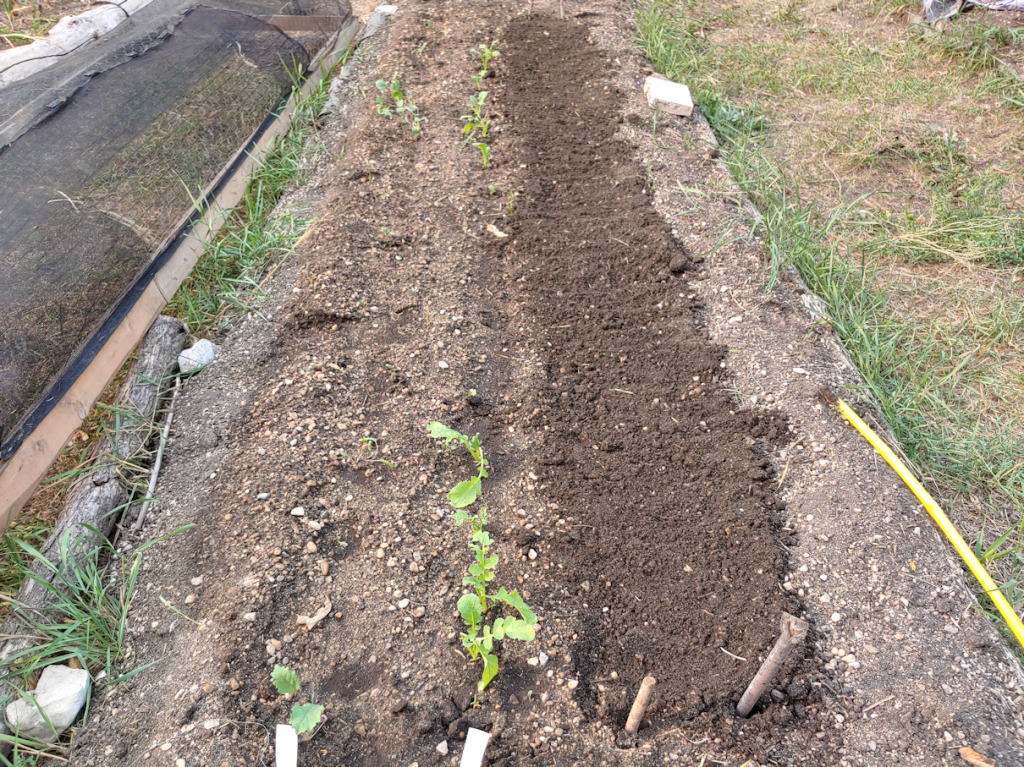
Our surviving (barely) French Breakfast radishes, and rainbow chard.
Now that one of the beds has a window screen mesh covering it, I decided to take a chance.
I planted lettuces.
On the far left are the surviving purple kohlrabi, and in the middle are radishes. I forget which variety at the moment.
I had our four varieties of lettuce together in a slide lock bag, and they spilled a bit, so I planted the mixed up seeds at the bottom of the bag. So we are going to have lettuce surprise when they start to sprout!
Moving the cover on and off is still a two person job. The length of the cover makes it a bit too wobbly. We definitely need to make the permanent beds shorter, just for that!
A nice thing about the window screen mesh is that it slows down and breaks up the water, so it lands more gently. We don’t have the hose nozzle set on anything high pressure, but these surviving seedlings are still spindly and weak from being under those water bottle covers to protect them from insects and critters. With the mesh covering the ends, I have at least some hope that these lettuces will have a chance to survive. At this point, it’s the grasshoppers, more than the critters, that are an issue.
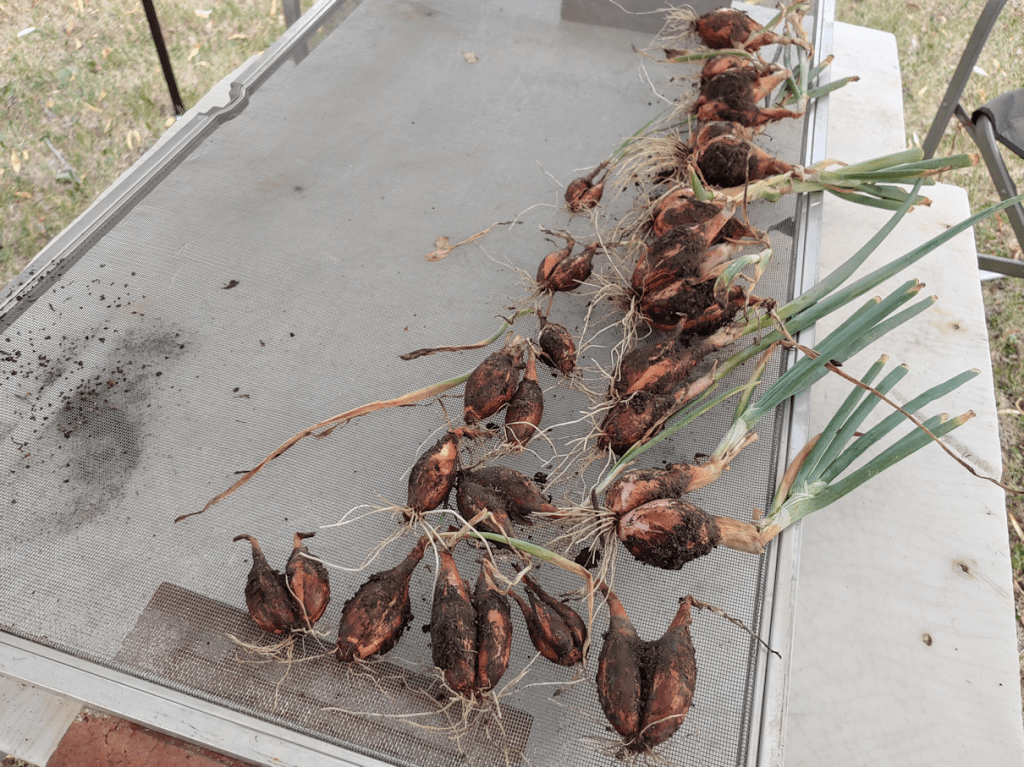
Once this was done, I decided to harvest the shallots. I’d been weeding the bed while watering this morning and accidentally pulled one up. I didn’t think they were doing well; many of the green parts had withered away completely, and I could no longer see where they were, while others just looked like they were struggling. The one I accidentally pulled up looked surprisingly large, so I left it there, to collect with the others this evening.
I was very pleasantly surprised!
As I started digging them up, I found they were much larger than expected. The one way at the far end in the photo is almost as big as an onion!
Then I accidentally dug up a shallot there there was no sign of any growing there anymore, and it was far larger than I expected, too. So I went back over the row and dug into each spot I knew I’d planted a shallot, and found several more! They are the smaller ones with no, or almost no, stems.
For now, they sit on a window screen, raised up on bricks for air circulation, to cure for a while. I’m quite pleased with what we got. Our original shallots, started from seed, were destroyed by the cats, so these ones are from sets I bought at the grocery store. There was only a dozen sets per bag, so I got two bags. A far cry from how many we would have had, if the ones from seed had survived, but way better than nothing at all! This is just awesome!
Tomorrow morning, I think I will start harvesting some of the onions. They are not all ready, but some of them definitely are. We have quite a lot of them, so I don’t mind harvesting and curing them in batches!
Being able to harvest things already, and even plant things for a fall harvest, kinda makes up for all the problems we’ve been having with the drought, critters and insects! We may not have as much as we hoped to in the spring, but we will still have food to harvest, and that’s the important part!
Thankfully, I did not find much critter damage in the garden at all today.
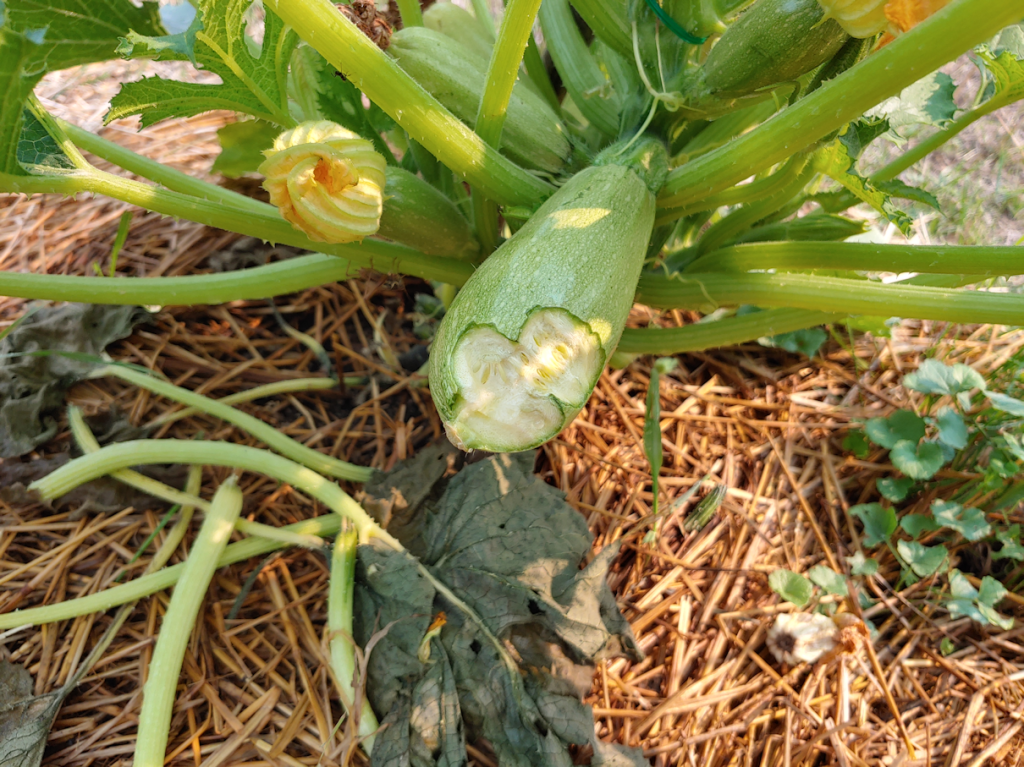
Sadly, this Magda squash got chewed on overnight. I had been really looking forward to picking it when it got bigger!
After doing the manual watering, then setting up the sprinkler on the corn, I pruned the bottom leaves on the summer squash. With growing them vertically, the idea is to not have any leaves touching the ground, thus reducing the chances of fungal infections. Ours are not tall enough for all of them to be at that point, but we’re close. I left the pruned leaves under the plants they were cut from, to add to the mulch, and maybe even discourage critters from coming too close and stepping on spiky stems.
Not that it helped the Magda squash, any!
More of the Mosaic Medley mix of tomatoes are starting to ripen. I didn’t pick any this morning, but I think we’ll have a fair number to pick by this evening!
We don’t know what varieties are in the Mosaic Medley mix and, so far, we’re only seeing red ones. In the photo on the site, there were some “chocolate” ones shown. I’m still holding out hope that some of these will ripen to colours other than red! :-) Not that it makes a difference to me. I don’t particularly like tomatoes. They’re one of the few things that are doing well, and NOT being eaten by something, so I’m pretty excited about them, anyhow. :-D
Today is supposed to get quite hot (we’re at 32C/90F as I write this, and we’re supposed to still get warmer), so I made sure to put the shade cloth over the fall crops. I neglected to take a photo, but I was very surprised to see bulbs forming in the row of French Breakfast radishes! I’ll be leaving them alone. We didn’t plant many, as they are for their pods, not their bulbs, and I’m amazed they survived the grasshoppers at all. Even the chard in that bed is recovering. I’ll have to get some photos when we uncover them when we do the evening watering.
One thing about all the struggles we are having with our garden this year is, we are learning a lot that we can use next year, to improve things. Some of them were things we already intended to do, and the only change is in priority.
With having such far flung beds, we knew that watering would be a challenge. Especially since we knew the furthest beds were in the hottest, driest part of the yard. The excessive heat and drought conditions certainly didn’t help, either! One of our ultimate goals is to have a garden that requires little to no watering. I was able to watch the Back to Eden documentary (free on Tubi), and it’s very much what I had in mind, when it comes to the heavy mulching. We have all these branch piles everywhere, just waiting to be chipped, that would have been so incredibly useful this year! Even with the modified hugelkultur method we plan to use with our permanent high raised beds, we intend to use a lot of mulch. Though we plan to work out some sort of irrigation system to make our watering as efficient as possible, if we do our beds right, we should rarely have to water them, even during drought years.
Which will be a huge improvement over having to water once or twice, every day!
Things have been a bit odd with our garlic this year. I am sure part of it is because of the drought, but others, I’m not so sure!
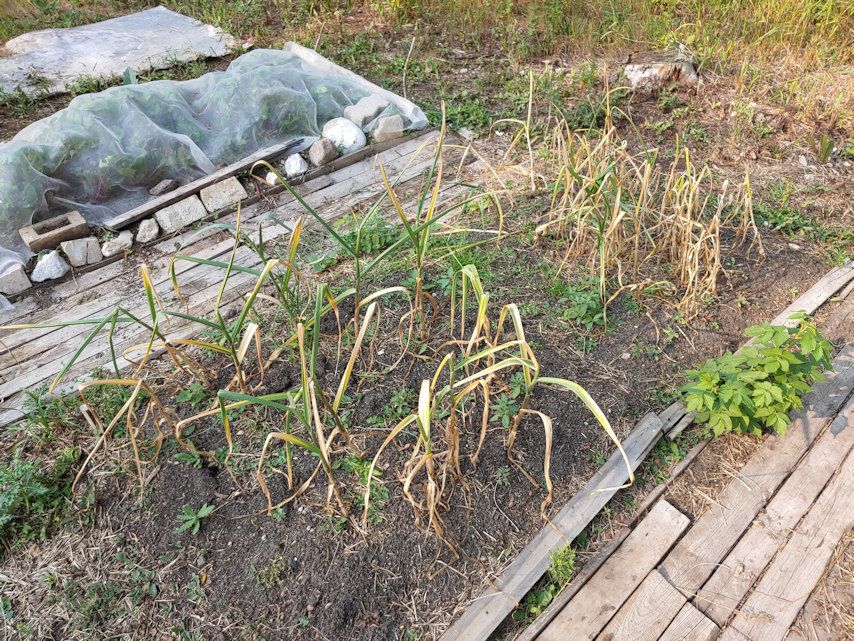
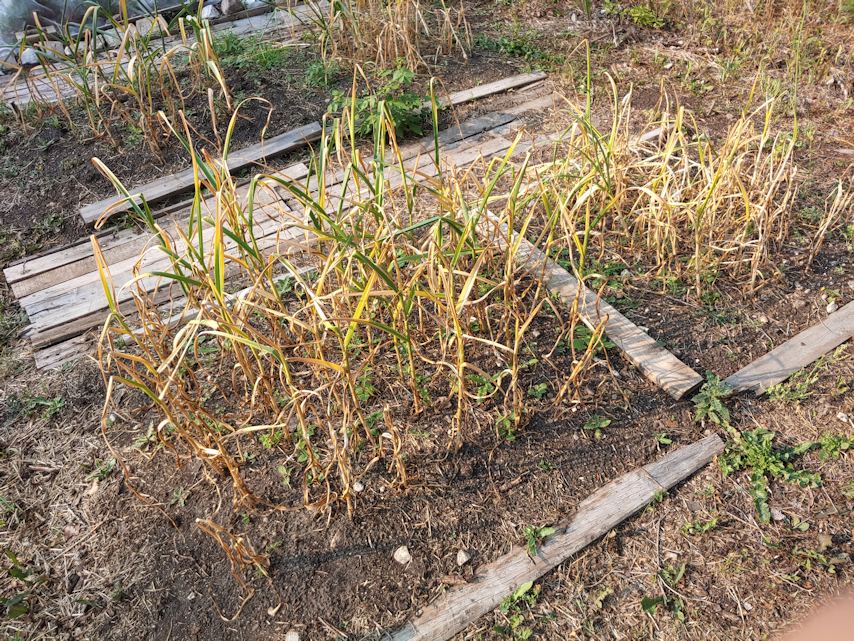
We did a partial harvest and curing of our Purple Stripe garlic a while ago. The remaining garlic looked like it was ready to harvest for the last week or so, but I wanted to be sure of them before I dug them up. Here is how the beds looked, before I started.
In the foreground are what’s left of the Purple Stripe garlic, and the other half of the bed is Rocambole.
This bed has the Porcelain Music in the foreground, and the other half of the Rocambole in the other side.
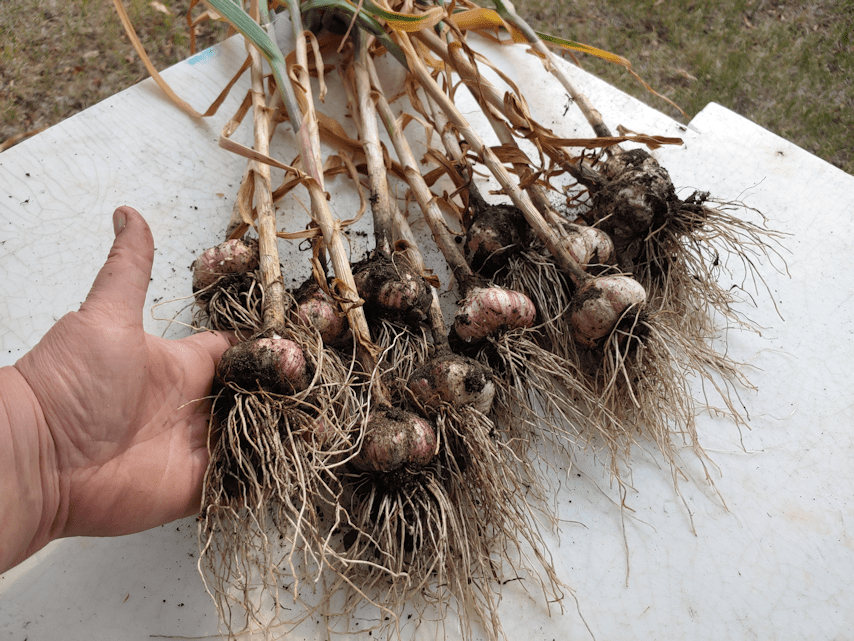
I started with the Purple Stripe, since I was curious to see how they compared to the ones that were harvested early.
I was very surprised and impressed! They are really nice and big!
The Porcelain Music has bulbs a fair bit smaller, and a lot more compact feeling. These probably should have been harvested maybe even a week ago.
Then it was time to start on the Rocambole, where I had a surprise waiting for me.
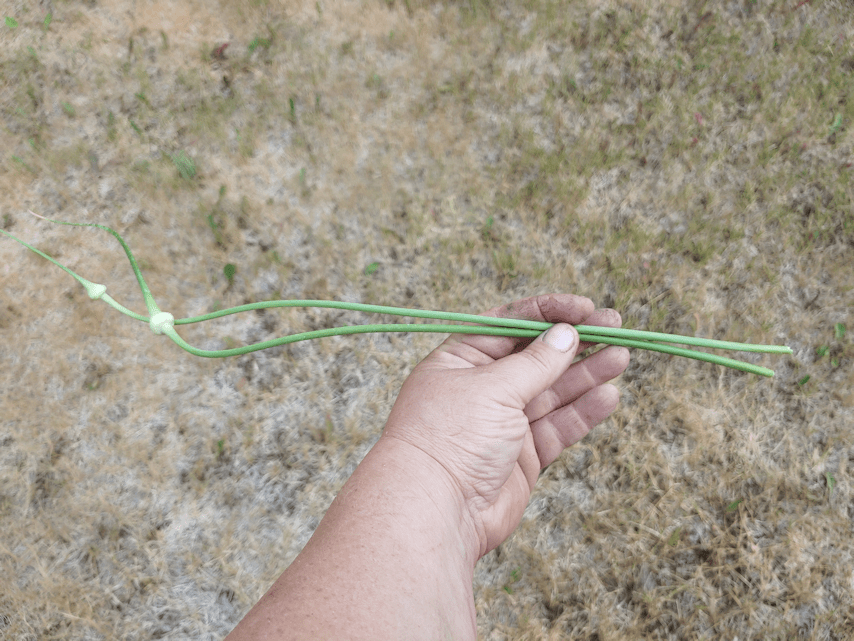
I found a pair of garlic scapes!
The Rocambole were the oddest of the garlic, and their scapes were part of that. We didn’t get a lot of scapes from them, since so many seemed to get stuck in the stems.
There was certainly a lot of them. They were the smallest of the garlic bulbs, though several of them were double bulbs. Quite a few of them had “bulbs” forming in their stems, of varying sizes.
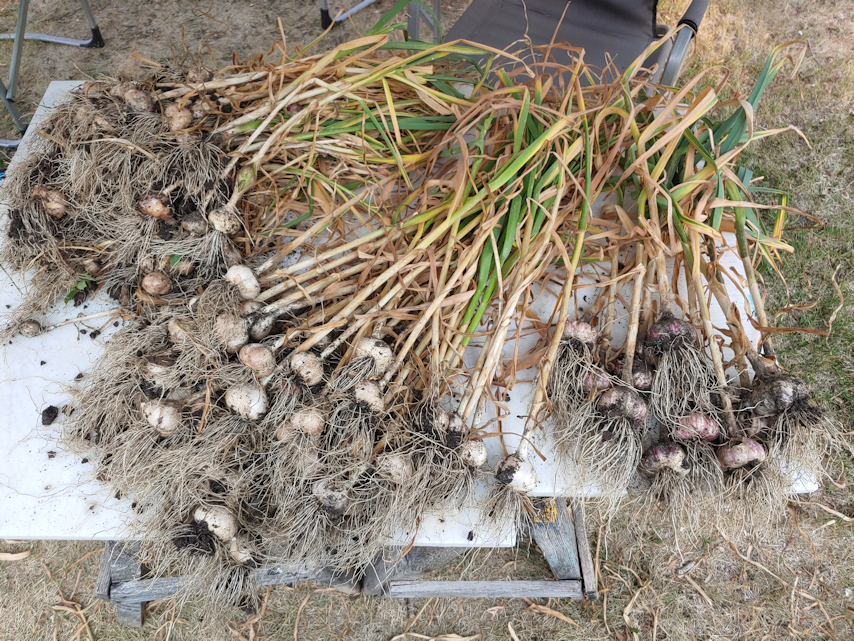
Here is the entire harvest. I’m rather pleased with it! :-)
Each garlic type got tied off and hung to cure inside the gazebo tent.
The Purple Stripe looks so meager compared to the others. :-D
You can see some of the mutant Rocambole here. One of them had really large bulbils forming in the stem – easily as big as a head of garlic! – and almost no bulb underground.
There’s so much garlic handing in the gazebo tent, I’m a bit concerned about the weight on the supports! I wonder if we can find a way to hang them in the basement with the dehumidifier or something. It’s been so dry, we haven’t had to use the dehumidifier in the old basement at all this year.
While those are hanging to cure, I brought these ones inside.
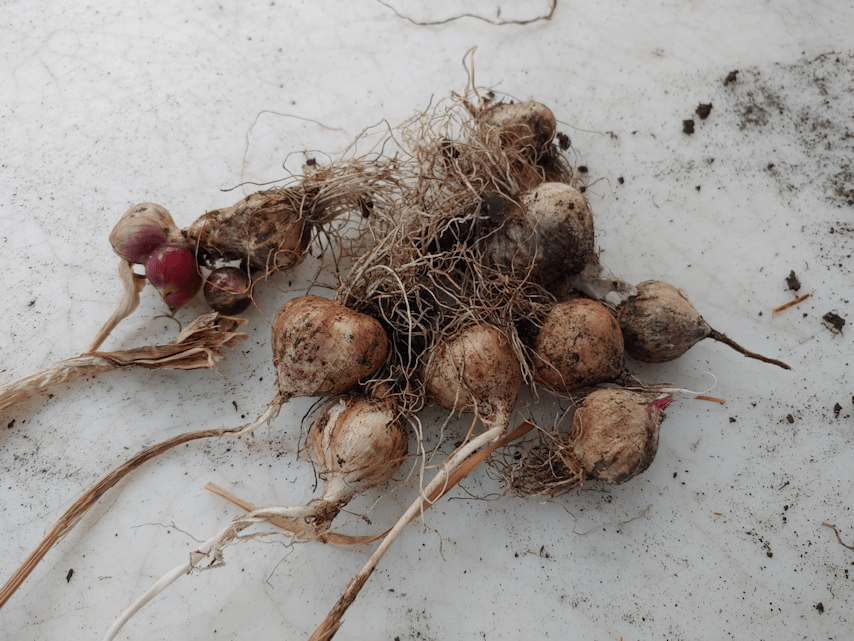
There were a few odd little bulbs that lost their stems, or the stems were really weak. There’s even a couple of bulbils that fell of the stems of Rocambole. That’s what most of these are, though there are a few Porcelain Music in there, too. These will be for using right away. :-)
That is now it for our garlic in the garden! Now I just need to clean up the beds. I am thinking of going through the barn to see if there is any scrap wood suitable to build box frames for these beds. I don’t think we’ll be doing high raised beds here, but I do want to keep the soil from falling down the sides and into the paths. :-) Then we can think about what to plant in them, next year! :-)
Yesterday evening was so lovely out, I spent as much time outside as I could! I took advantage of this to finished up the garlic we harvested some time ago. They have been hanging from the rafters under our gazebo tent to cure. It was not ideal conditions. They should be somewhere cool and dry. What we had available was outside, where it was hot and dry, or in the basement, where it was cool and humid.
I figured hot and dry was better than cool and moist!
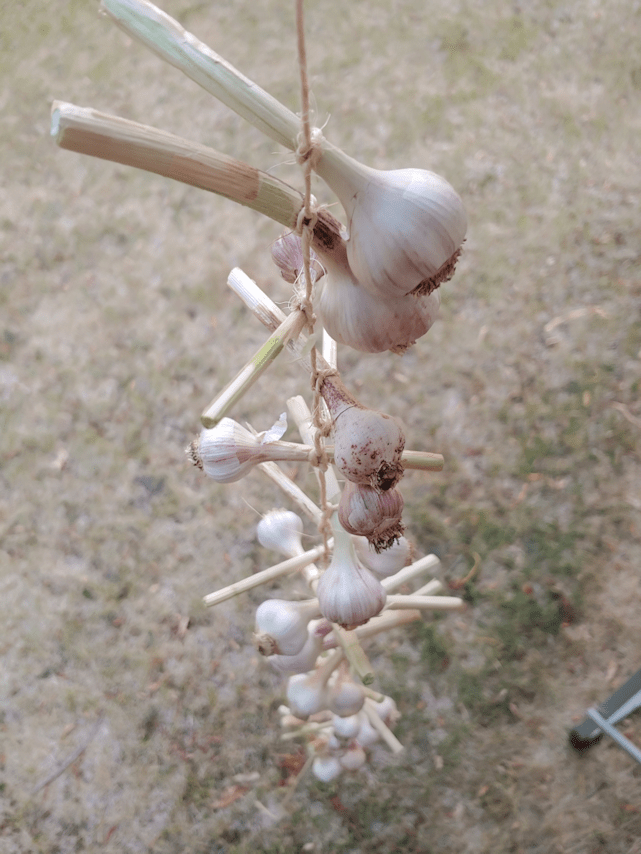
The stalks and roots were trimmed, the soil brushed off, then they were tied up in twine.
They are not as cured as well as they should – some of the stems are still showing a bit of green – so these will need to be eaten fairly quickly. Which is sssuuuccchhh a hardship… Ha! I look forward to using them. They are currently hanging from the ceiling in the kitchen.
I think garlic soup would go over very well! It’s usually made at the end of winter, as a sort of spring tonic, but I think it’s good, at any time! I use an entire bulb of garlic to make it, but these are so small, I might just use up a whole bunch of the littlest bulbs. :-)
While these were dying back way too early and had to be harvested, the rest of the garlic is now looking ready to harvest, too. It’s still early, and I don’t expect very large bulbs, but that’s okay. We’ll be buying more to plant for next year, rather than try and save bulbs from this year’s garden.
Oh, my goodness, what a difference a single day of good rain makes! No amount of watering with the hose can compete.
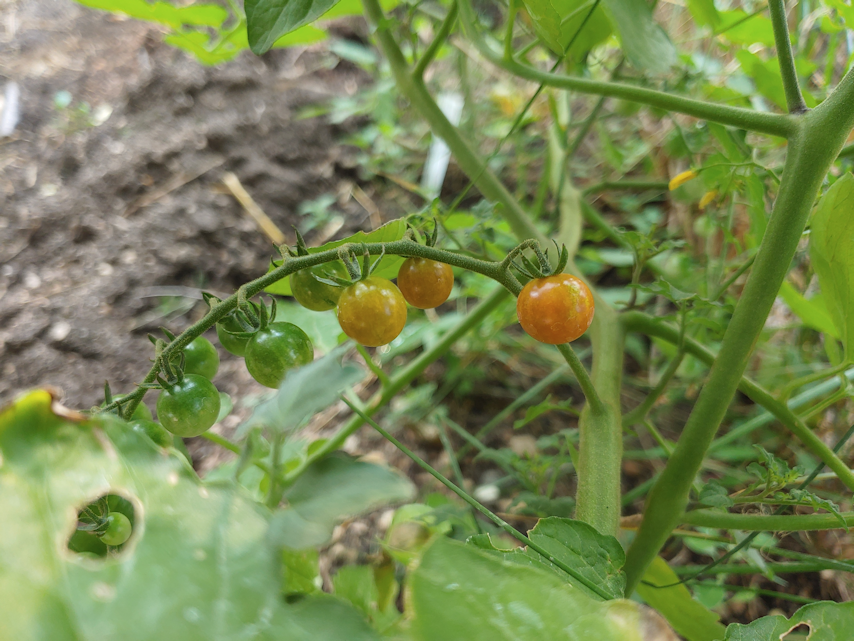
While we have been able to pick a Spoon tomato or two, every few days (there were three ripe ones yesterday, that my brother and his wife to go try. :-) ), the Mosaic Medley tomatoes still have a ways to go. Two plants have tomatoes that are starting to ripen, though, with this one being the furthest along.
Though pickings are slim right now, I can see that we will have lots ripening, all at once, soon! They are all indeterminate varieties, and with the Spoon tomatoes alone, we’re probably going to be picking lots, daily.
The Little Gem winter squash, in particular, got noticeably bigger overnight! There is easily several inches of new growth on the vines.
The Teddy winter squash has pretty much doubled in size since I checked it, yesterday morning.
Even the pea sprouts, among the sweet corn, are visibly bigger and stronger – and their stems are barely two inches high right now! :-D As short as they are, the sweet corn is starting to develop their tassels, too.
There were a few zucchini we were keeping an eye on and leaving to get bigger, but by this morning, some of them were almost getting too big!
Plus, I picked our VERY FIRST beans!!!! Just a few yellow and green beans. No purple beans were even close to being ready to pick, yet. I’m pretty thrilled with just the handful we have now, and seeing how many I could see developing on the plants. :-)
This morning, I uncovered the beet bed near the garlic. This was the first bed that got major damage, almost wiped out by a deer. After several attempts to cover it, we ended up putting on mosquito netting as a floating row cover, though I had to keep adding more weights around the edges to keep the woodchucks from slipping under and nibbling on them some more. Once the floating row cover was on, it basically remained untouched until this morning. We kept watering it, but that’s it.
It got a thorough weeding this morning, and I picked a few young beets as well. My daughters really enjoy baby beets and their greens. :-) The bed is covered again and will probably get ignored for awhile, other than watering. The other beet beds are also covered with mosquito netting as floating row covers, and they’re going to need some tending as well. That’s one down side of covering them like this. It’s a pain in the butt to move all the things we scavenged to weigh down the edges, so they are just being left alone.
In looking back at our gardening posts from last year (this blog is my gardening journal, too! :-D ), there were posts about the heat waves we got last July. It wasn’t as severe as this year, but it was the most severe we’d seen since our move at the time. By this time our sunflowers – which we’d lost half of to deer and replanted with other giant varieties – were growing their heads and some were even starting to bloom. This year’s sunflowers are nowhere near that stage! We had also been able to do quite a lot of clean up and fix up jobs that were out of the question in this year’s heat. The drought and heat waves have set us back quite a bit, as far as getting things accomplished. We were also harvesting carrots and sunburst squash, regularly, by the end of last July. It’s hard not to be disappointed with how things are turning out this year, but there isn’t much we can do about the weather, and very hungry animals that have lost their usual summer food and water sources.
Speaking of animals…
I had finished up at the furthest garden beds and was making my way to the main beds closer to the house, when I realized I was being stared at by a little furry face on the gravel over what used to be a den! A woodchuck, the littlest of them, was just sitting there, watching me come closer. I started to shoo it away, and it would run a few feet, then stop and look at me, run a few feet, stop and look at me… on it went until I finally got it to run through the north fence and off the property. By then, I was standing next to the purple corn, at the opposite end of the garden area. Since I was there anyhow, I decided to check on the purple corn, turned around and…
… discovered I was standing next to another woodchuck! It had just frozen in place until it realized I could see it, then ran off. I chased that one past the north fence, too!
Thankfully, there was no sign of critter damage in the gardens this morning, but my goodness they are cheeky little buggers!
After their visit yesterday, and seeing some of the issues we’ve been dealing with, my brother messaged me this morning with some photos. There’s a store they were at that had electric fence started kits. The one he showed me uses D cell batteries, but he knew of another store that has solar powered versions. The basic kit he sent me a picture of covers 50×50 feet, at a very reasonable price. It wouldn’t be enough to cover our farthest garden beds, but we could easily pick up the parts and pieces to cover more area. We’d need a second kit to cover the other end of the garden area.
Something to keep in mind. Particularly when we start building our permanent garden beds. We’d still need to find ways to stop the woodchucks, but it would be a good start, and cheaper than building tall fences!
Today is supposed to exceed 30C/86F, so I wanted to make sure the garden got an deep watering this morning. When I had removed the shade cloth from the three beds with fall harvest crops planted, the seedlings seemed to be doing pretty good.
When I returned to cover them this morning, I saw this on one of the beds.
There was no evidence of a critter getting under the chicken wire cover. That suggested whatever ate these leaves was either a really small, light critter, like a mouse (very unlikely, given how many hungry mouths our mama cats have to feed), or it was insects.
My money is on the grasshoppers. :-(
This was, however, the only damage found this morning. The rest was all fun stuff. I was absolutely thrilled to see this.
Our very first Tennessee Dancing Gourd!!!
Somehow, in seeing all the flowers in the plants next to the luffa, my brain just stuck them in the “melons” category. On looking more closely, I found lots of these.
It looks like we are going to have plenty of little spinner gourds growing! They only get a few inches long and, according to one of the reviews I read when I bought the seeds, they are very prolific. The writer claimed their one plant ended up with at least 250 gourds. This was someone with a much longer growing season than ours, so I don’t expect that sort of success, but we should definitely have quite a few from our several plants.
Meanwhile, the flower bud on the nearby luffa plant I saw yesterday, looking like it was starting to open, absolutely exploded into flower this morning! So awesome!
What is also awesome is being able to walk past the squash tunnel and, from any angle, be able to see melons, and knowing that there are more little ones, still hidden under the leaves.
I finally remembered to uncover and read the labels by the winter squash. The ones that are so enthusiastically climbing the wire are the Little Gem variety, with several small squash already forming.
This morning, I finally saw some fruit forming on the Teddy variety of winter squash.
Both of these varieties as supposed to produce small fruit, with a short growing season, so when I hadn’t seen any of the Teddy squash developing, I was beginning to wonder. I am really excited to see the fruit developing now. :-)
You know, I think we actually got a bit of rain last night! I didn’t have to water the garden beds this morning.
To start, I found something really, really exciting this morning.
Our first ripe tomato!!!!
There it is, hiding under some leaves. :-)
Our very first Spoon tomato!
From the photos on the seed packet, this is a really big Spoon tomato. :-D
I am saving it for my older daughter, for whom I’d bought the tomato seeds as a gift, to have first taste. The girls are still keeping reversed hours, so my older daughter can work in the cooler night hours without the computer overheating, or her drawing tablet glitching out, and sleeping during part of the day. I can’t wait to see their faces when they see this!
Other Spoon tomatoes are starting to turn colour, too, so we should be getting lots more over the next while. :-) The Mosaic Medley mix of cherry and grape tomatoes are still very green right now, but they should start ripening soon, too.
One of my favourite things to do during my morning rounds has become checking on the squash tunnel, training more vines to climb the mesh, and seeing what progress there is.
It looks like one of the luffa flower buds is starting to open. I actually expected this to do better in our current heat, since they are a warm climate plant. Or at least start flowering and growing fruit before any of the squash and melons, considering how much earlier it was started indoors.
One winter squash plant in particular is growing a lot more enthusiastically than the others, climbing the trellis on its own now, and producing fruit. I keep forgetting which is which, but the other winter squash seems to have a growing habit more like summer squash, and seems to have only male flowers and buds right now.
The Pixie melons are getting so “big”! They are a “single serving” sized melon, and really dense for their size, so I don’t expect them to get much bigger than this one, here.
This is the first Halona melon to develop, and you can see how it’s outer skin is starting to form that distinctive cantaloupe texture. These should get about double the size and weight of the Pixies, or more, when they are fully ripe.
I can hardly wait to try them!!
Yesterday, I found that I thought was, maybe, kinda, possibly, a pea sprout emerging from the soil next to one of the purple corn.
This morning, there is no doubt at all. There are peas sprouting all over the sweet corn beds! I’m actually quite impressed by the germination rate so far, considering the bag of seed peas had been in the storage bin by the water barrel through two heat waves.
Now, if we can just keep the woodchucks from eating them all, not only will they help fix nitrogen in the soil for the corn, but we might even get peas in quantities sufficient for harvesting. :-)
One of the things I’ve been trying to baby is our Montana Morado corn. I really, really want these to work out!
As these were started indoors, they are much further along than any other corn we have, and have been developing ears of corn for a while now. I’ve been a bit concerned about pollination, and have even been hand pollinating any cobs that look like they might get missed.
My concern?
Many of the silks have have dried up. This is supposed to be a sign that the cobs are ready to pick, but they shouldn’t be ready to pick until the end of August or so. The packet didn’t have a “days to maturity” on it, as the variety is just too knew, but in looking up maize morado, it says 120 days to maturity, so I figure this should be close.
As my daughter and I were looking the corn over and talking about our concerns over how many silks are dry, even on tiny little cobs, I went ahead and picked a cob from the plant that first developed one. This would be the largest, most mature, of all the cobs. The silks at the top were so dry, they came off as I started to peel off the husks.
So this tells me one thing, at least. Pollination is good. There are lots of developing kernels, and almost no gaps. It is also clearly immature, and just starting to turn to its mature colour.
I have to admit, that looks very… unfortunate… :-D
We did taste it, and while not particularly sweet (I was not expecting it to be), but it did taste… well… like corn.
So why are the silks starting to dry so early? Yes, it’s been dry, but we’ve been diligent about watering these.
Have we not been watering it enough? Has it been too hot, even for this variety that was developed in a warmer zone than us? Will the cobs continue to mature, even if the silk dries up as would normally happen when the cobs are ready to pick?
I don’t know, but I’ve posted the question on one of my local gardening groups. I’ve had some clarifying questions, but so far, no answer.
Crud.
Well, we’ll just keep watering them and hope for the best!
Meanwhile, on checking the Crespo squash nearby…
More, “oh, crud.”
One of the vines have been eaten, and it does not look like deer damage. The barriers we put around it might convince a deer to not bother, but they can’t actually stop anything. I’m guessing this is from one of the woodchucks.
Today was hot enough that everything has dried up again, so I set up the sprinkler on the purple corn for a while. As I was moving the sprinkler to the corn at the opposite end of the garden area, I spotted a woodchuck in the middle of one of the sunflower blocks!! It wasn’t eating anything, and there was no damage when I checked, so it may have been just passing through.
I greatly encouraged that notion, and chased it through the hedge, into the ditch. It can go to the empty house across the road!
Anyhow.
As for the corn, I guess the only thing we can do is keep watering it and hope the cobs will continue to mature.
When we first bought the corn seeds, the produce description was for maize morado. The site even had a video talking about how a cowboy from Peru brought some seeds to where he was living in the US, and was able to grow extra to provide seeds for the company. I thought I was getting a Peruvian corn. Then the story changed, and it turned out to be a purple corn developed in Montana, and now it seems the name has been changed to Mountain Morado.
While trying to look up what the days to maturity might be for this corn, I found a different seed company that is selling the actual maize morado from Peru, Kulli. I think I will try buying those for next year. The packets only have 25 seeds in them, so I’ll probably get two or three. I had hoped to have seeds to save from this year’s corn, which may still happen, but if I don’t, I will also try the Mountain Morado (again?). Between the two, I hope to have something that will grow in our zone.
Until then, we’ll see how things go with what we have now.
The Re-Farmer
update: well, that was fast! Having tapped into the wealth of knowledge in the local gardening group, I have a likely answer. The drying of the silk may show that they have been successfully pollinated.




















 The Re-Farmer