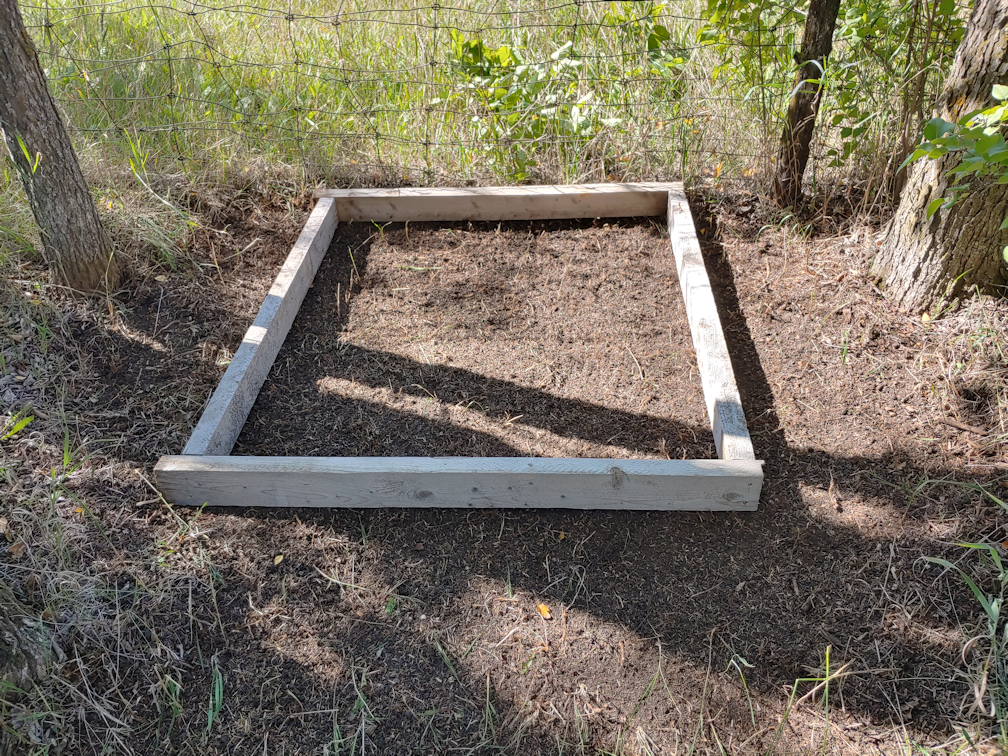
After sitting in water, with some molasses and a touch of salt, for a couple of days, our Giant Puffball spores were ready to be used to inoculate an area.
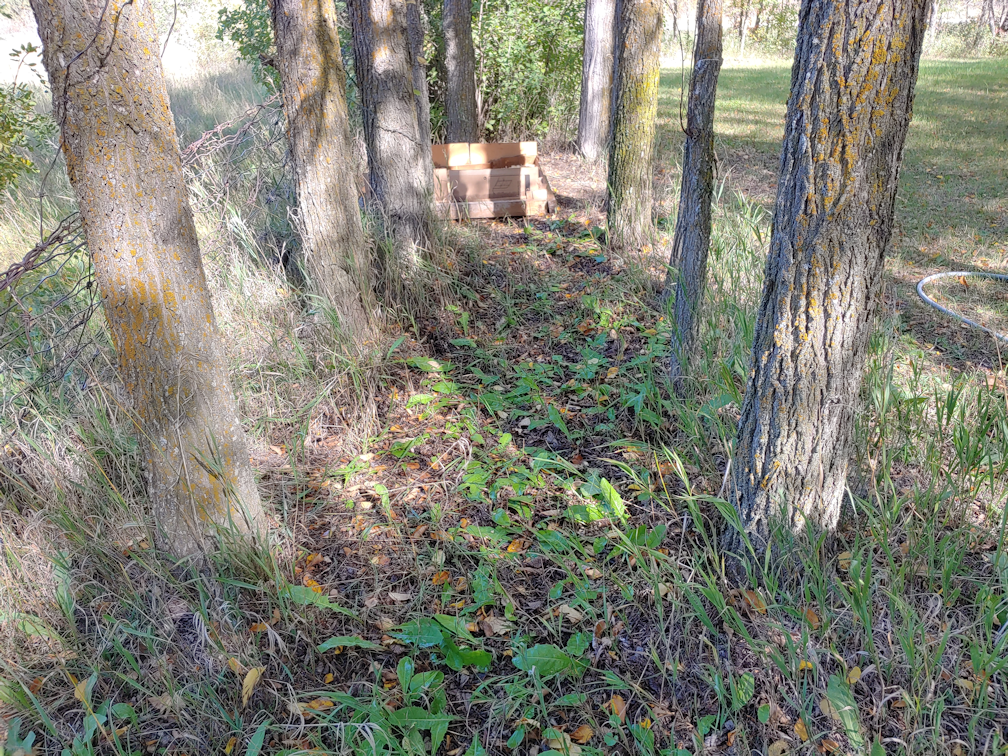
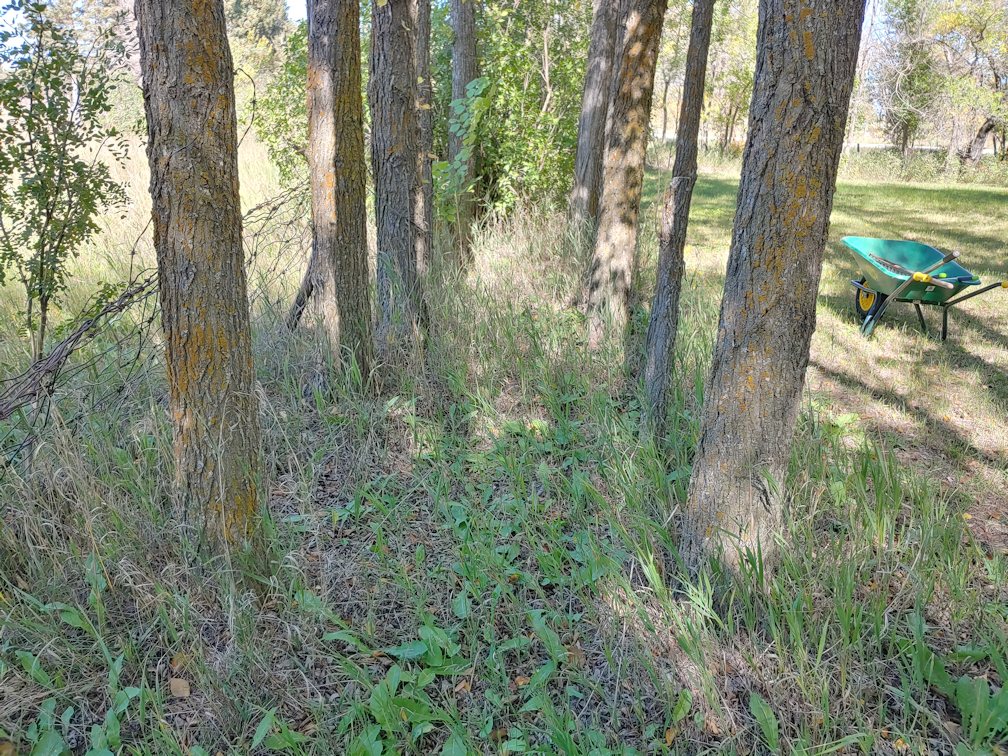
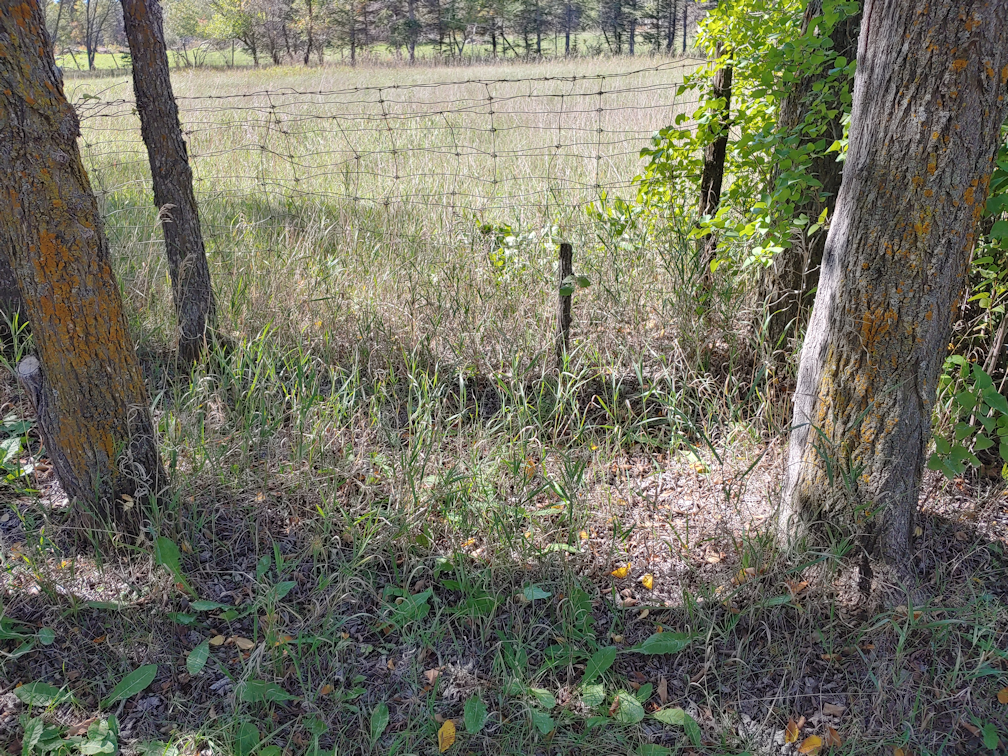
The instructions just said to pour over grass, but I did do two things to prepare the area we decided on. First, I pulled up the tall grass. There was barely any, and I didn’t try to pull them up by the roots or anything. Mostly, I figured I wanted the spores to be on the ground, not on tall blades of grass! :-D Then, I wet the area down with a hose. I wet down the morel bed, too, since the hose was handy.
When pouring the slurry out, I just swung the jug back and forth while walking backwards, paying more attention to spreading it evenly than to how large of an area I covered. It ended up being just enough to cover from end to end between the trees, from the morel box, down.
The temperatures have been just lovely, and we’re even getting passing showers, fairly regularly.
It’s been mild enough that, even with the first Ozark Nest Egg gourds withering away from last of pollination, new gourds are forming!
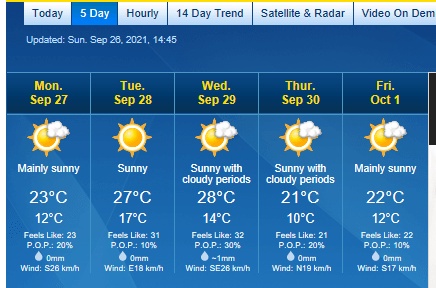
Looking at the long range forecast, I am just amazed.
We’re supposed to hit 28C/82F in a few days! With a humidex of 32C/90F! I thought we already seen our last days of temperatures this high. It’s the warm overnight temperatures that make the big difference, though. The app on my phone has long range forecasts to 24 days. Of course, the farther out they predict, the less accurate they can be, but even so, there are no frost nights predicted! It’s like we’re getting the weather we normally would have got, earlier in the year, instead of the drought. In fact, even with the few showers we’ve had, it looks like we still need to water the garden! We will still be getting beans and summer squash, more and more of the late sown peas are growing pods, more sunflowers are opening their seed heads, and even the Tennessee Dancing Gourd is producing more flowers and gourds. Of course, the beets and carrots are still growing. I was planning to leave those until around first frost, and it’s looking like they’ll have plenty of time to keep developing. The tomatoes are dying back, but still prolific, and the lettuce and surviving chard are thriving. I’m almost tempted to plant some more lettuces!
Almost.
This does mean we won’t be broadcasting the wildflower seed mixes we have for quite some time; they aren’t going to go out until there is no chance of germination.
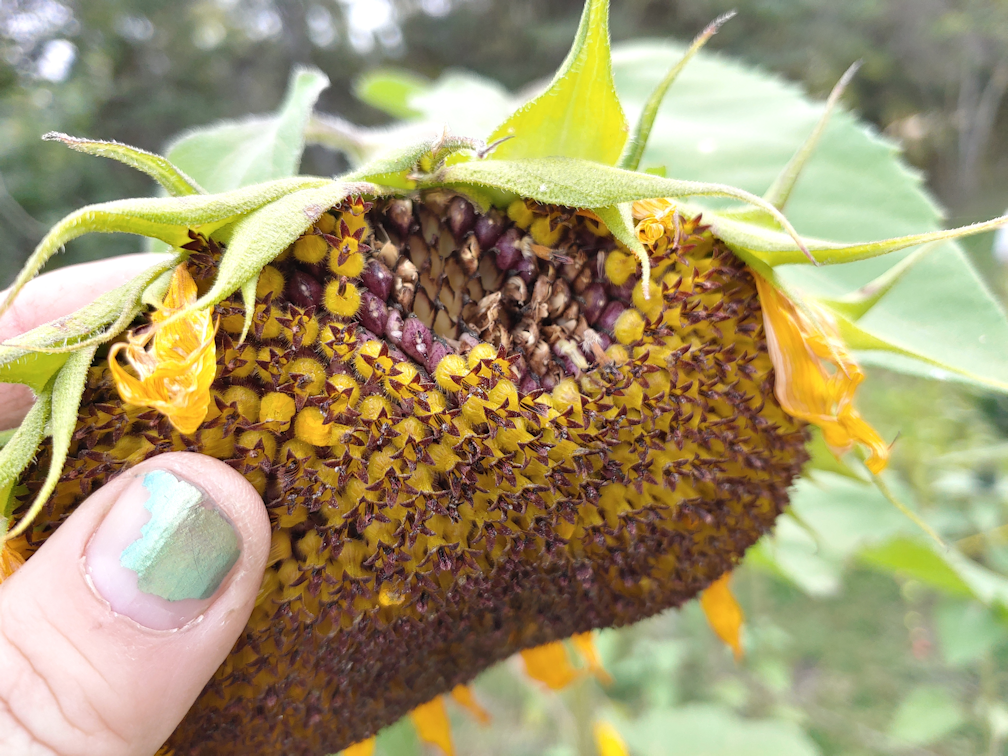
This is the Hopi Black Dye sunflower that has the one seed head that I think will have time to fully mature – and it has four more bright and cheerful seed heads opening!
I don’t know why my phone’s camera blew out this shot, but you can still see what a deep, dark purple is developing as the seeds mature.
When my mother found out I was planting sunflowers, she immediately mocked me, telling me that the birds would eat them all. This is the first sign of birds eating them I’ve seen this year. :-D
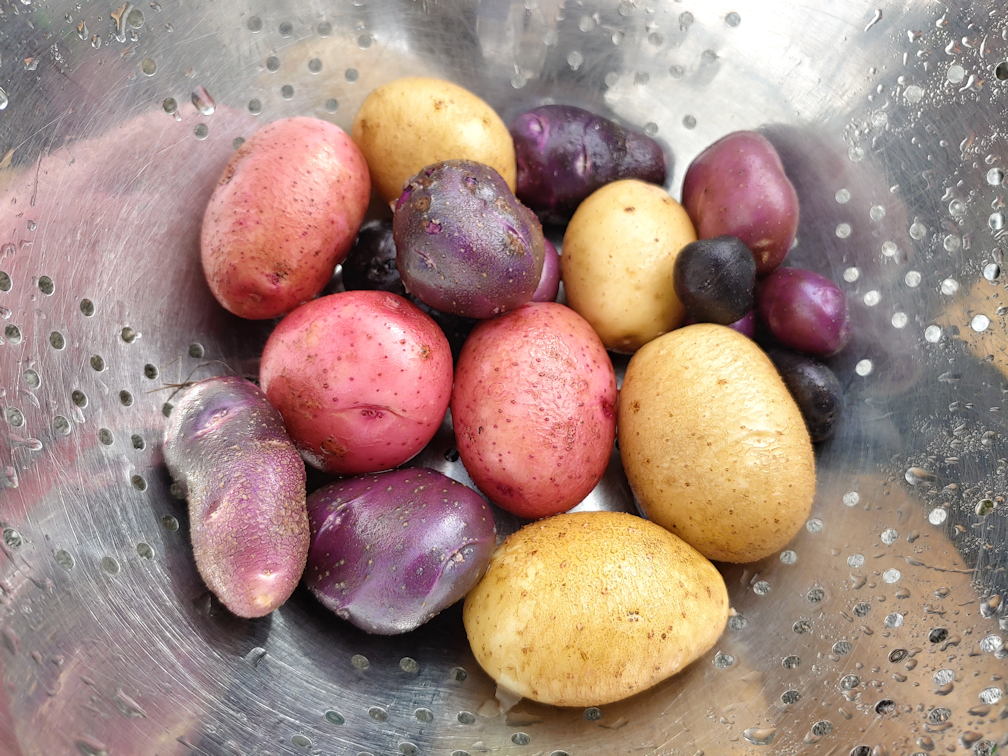
Not too long ago, while working on supper, I decided to dig into the potato bags and see what I could find.
The Norland (red skin, white flesh) and Yukon Gem (light brown skin, yellow flesh), we have picked before, but this is the first time I tried to find any of the fingerling potatoes, Purple Chief (purple skin, white flesh) and Purple Peruvian (purple skin, purple flesh). I did not find a lot, but I’m hoping it’s because I just wasn’t digging around in the right places.
I currently have them roasting in the oven with our own onions, both red and yellow, three types of summer squash, and purple beans. The only thing in there we didn’t grow ourselves was celery. Oh, and the dill we got from my brother. :-) I’ve got three chickens roasting, too, so we shouldn’t need to cook for the next couple of days! :-D
Okay, I should have done this yesterday, or at least earlier today, but too many other things kept distracting me away. So now I finally have it started.
Puffball slurry.
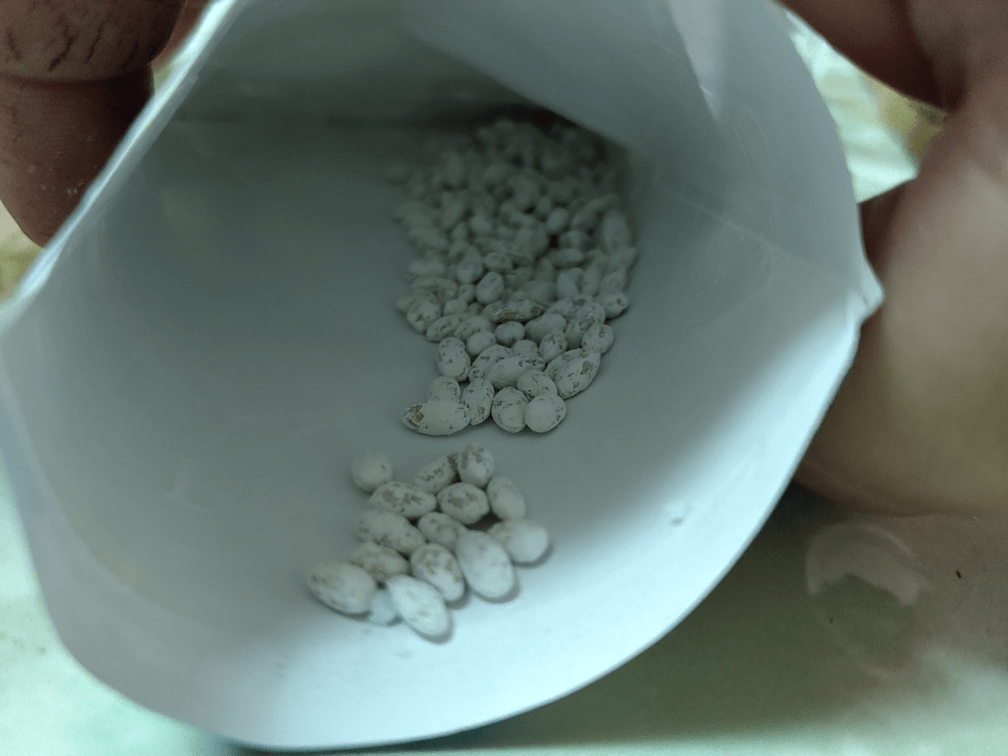
The spores in the packet are done the same way as the morels were; as little grains.
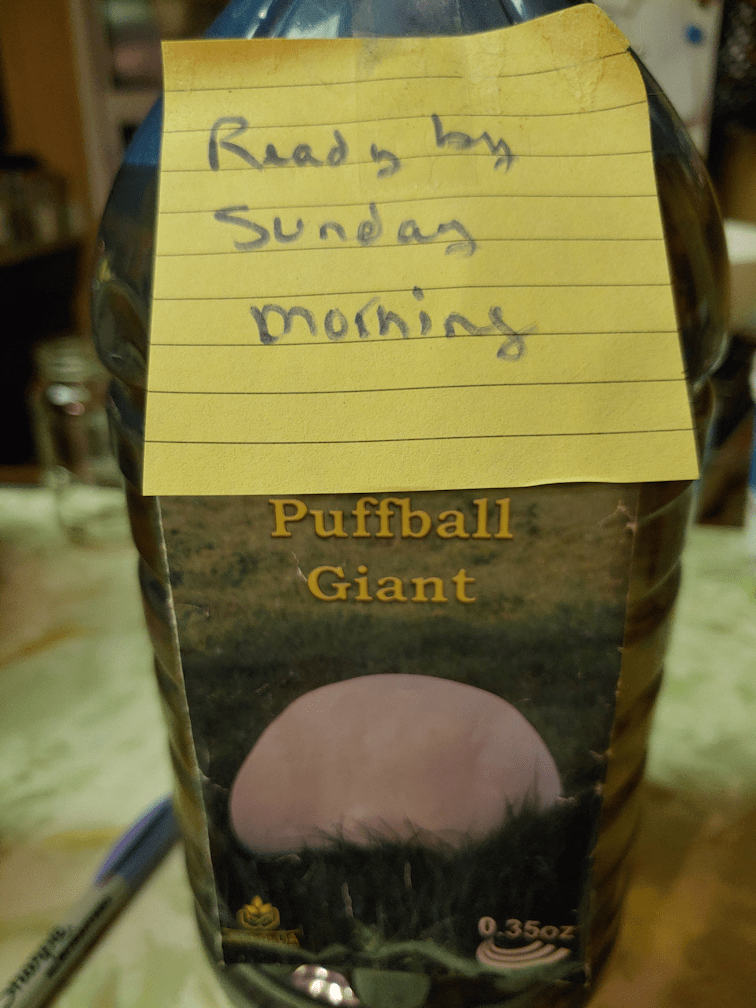
The package instructions said to put water in a gallon glass jar. I don’t have a gallon sized glass jar available, so I ended up using one of the gallon sized jugs from the distilled water we get for my husband’s CPAP humidifier. It’s food grade plastic, so that should be fine.
The instructions called for distilled or any other non-chlorinated water, so well water it was. Then they called for a pinch of salt (?!?!) and a small spoonful of molasses, which was then to be mixed with a clean wooden spoon until the salt was dissolved.
Such a strange mix of precise and imprecise instructions! :-D
Well, there was no way to use a spoon in the jug I was using, so after adding a bit of salt and a pouring in a blob of molasses, I put the cap back on and shook it until the molasses was dissolved. The salt dissolved pretty much right away, so that wasn’t an issue.
The instructions then said to “brush” the spores in, but since the spores were in those handy pellets, I just dumped them in. Now it is supposed to sit, undisturbed, for two days.
Actually, the instructions said to place the slurry “… where it will be disturbed…” :-D I suspect translation issues!
Anyhow.
Two days would actually be Saturday night, but since I’m not going to go pouring puffball slurry around in the dark, Sunday morning it is!
Like the morels, it could be a couple of years before these fruit, and it’s entirely possible they won’t take at all. No loss in trying, though, and if it works, we could find ourselves with puffballs big enough to cut into steaks! :-D Much easier than the little ones we normally get around here. :-)
Meanwhile, I have taken today as a break from heavier manual labour to give my body a chance to recover a bit. My husband, darling that he is, has been treating my hands with his zapper (needle-less acupuncture). One hand is pretty much back to normal now, but the ring finger on my right hand is still a problem. I may have actually injured it, somehow, aside from the usual arthritis. Whatever I did to it, I can at least say with confidence that nothing is broken, and I can at least still type. It’s a good thing I’m left handed in most things, too.
Aside from running some errands, we’ve been working on processing that big bag of dill my brother and his wife gave us. Our entire dining table is covered with towels, and my younger daughter and I have been working it in batches, as we’ve had the chance. There are a lot of mature seeds in there, and we’ve been talking about what to do with them. We want to basically set aside an area for the dill where they can self-seed to their heart’s content, and we don’t have to worry about them popping up when we’re trying to grow something else. We seem to have settled on the area next to the low raised beds that are being set up. It has been partially cleaned up, and because of various old tree stumps and roots, as well as spreading roots from those cherry trees that are not right for our climate, it’s not like we’re ever going to expand garden beds further in. If, for some reason, that spot doesn’t work out, I can think of another area where it might work to have a dill jungle. :-)
I am hoping to get back to taking down more dead trees and breaking them down for the high raised beds we will be building over the next while. I also want to do a thorough weeding of the empty beds, and letting them sit to allow any missed weeds to start growing, so I can pull them when it’s time to actually move the top soil and build the beds. We don’t have a lot of material left to use when refilling the bottom layers of the beds, but we will soon be able to start raking leaves, which will be good to use. Plus, we should be able to get another lawn mowing in before the end of the season, and have fresh grass clippings as well. So for now, the more dead trees we can cut and process, the better.
Well, so much for trying to support the sunflower in the old kitchen garden.
We had high winds again this morning, and the last of the three flower stalks on the remaining sunflower in the old kitchen garden finally broke. It was actually still upright when I came out this morning, but by the time I came back to the house, it was lying on the ground.
Sadness.
While checking the garden beds, I did get a little bit of a harvest this morning.
It all could fit in my pocket! :-D
This is the largest I’ve ever let a pattypan squash get. Any bigger, and they start developing their seeds. One of these days, I should try letting some fully mature. At that point, when the seeds are removed, they leave a cavity that can be stuffed for roasting, which I do want to try. We just really like them at this stage, though. :-) For next year, I plan to try other varieties of pattypan squash, and hope to grow some to save seeds, too. Since I accidentally bought three summer squash collections for this year, instead of one, we don’t actually need to buy more squash seeds, but I like to try new varieties.
That is definitely one of the biggest benefits of having a garden. There are so many varieties that are just never in the stores!
After working on the low raised bed yesterday, I was not physically up to working on another one today, so I figured I would do a project that was less physically taxing.
In other words, I’m a bit of an idiot. :-D
It’s gotten to be that time of year to do something with the mushroom spores my awesome husband got me for Christmas. Today, I started with the morels.
The package doesn’t have a lot of information about how to inoculate an area with them. One thing it did recommend was several different types of trees to inoculate under. The only one we have around here is elm.
I spent some time online, seeing what other people did, and came up with a plan of action. I used one of the remaining sections of the old goat catcher we made, a couple of summers ago, and made it into a box frame.
Then it was time to work on the location we finally settled on.
This double row of elms in one area is too narrow and lumpy to mow well, and far enough away that I really don’t want to bother with the weed trimmer. So both the morels and the giant puff balls will be going here.
Since the morels will be going into a framed bed, they were going into the widest, most open part of the area.
First, it needed to be cleaned up. The stump of a dead little elm tree got trimmed flat to the ground, and a thatching rake was used to remove leaf litter and other debris. The remaining quack grass was so sparse, I ended up going over the area and pulling them up by hand, getting quite a bit of the rhizomes out in the process. Then I went over the area again with the thatching rake, loosening things up even more and getting a bit more debris out.
Next, the frame was brought over and placed in the most level spot that could be managed here. I wasn’t too worried about being perfectly level, since the next step would make that a non-issue.
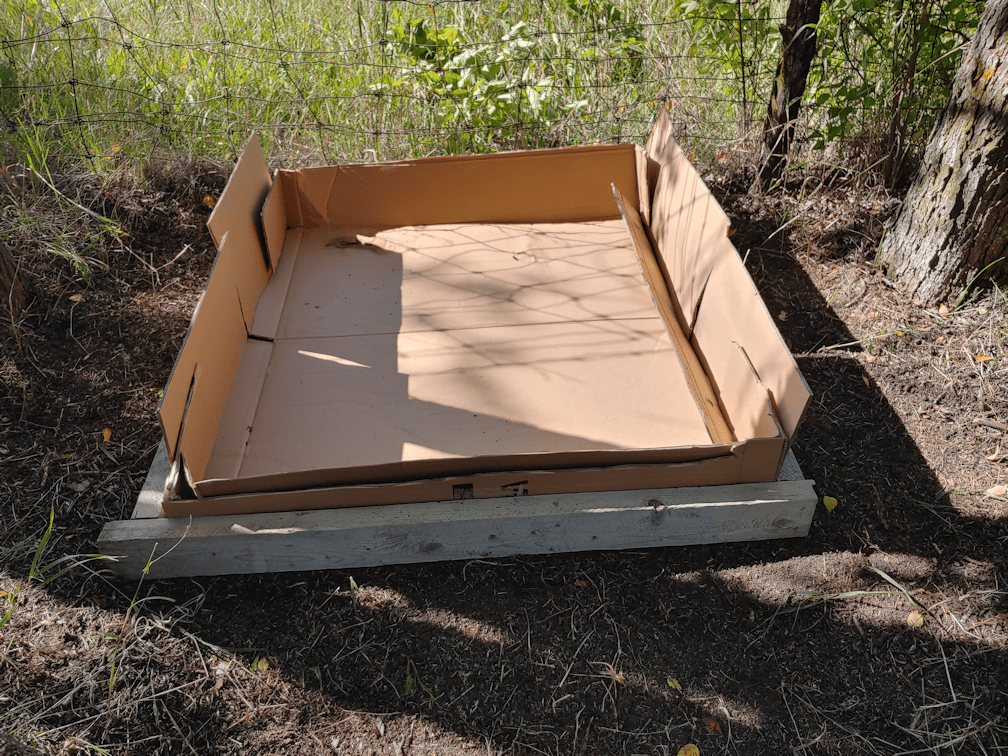
We had kept the box the new washing machine came in, with its wonderfully thick cardboard. I was able to cut it in half, and use it to line the framed space in two layers. This should not only keep the crab grass from coming through, but ensure that little elm stump won’t start sending out suckers, either.
The next step was to give the cardboard a thorough soaking. As it is two very thick layers, I just left the hose running while I prepared for the next step. Morels like wood ashes; there is always a bumper crop after a forest fire. In the time it took me to get wood ashes from the fire pit and mix it with some of our purchased garden soil, there was a bit of a pool inside the cardboard! :-D
The wood ashes and soil combination made only a thin later on the bottom, and that’s okay. From what I was finding online, this could have been filled with straight wood pellets or shavings, and no soil at all.
Speaking of which.
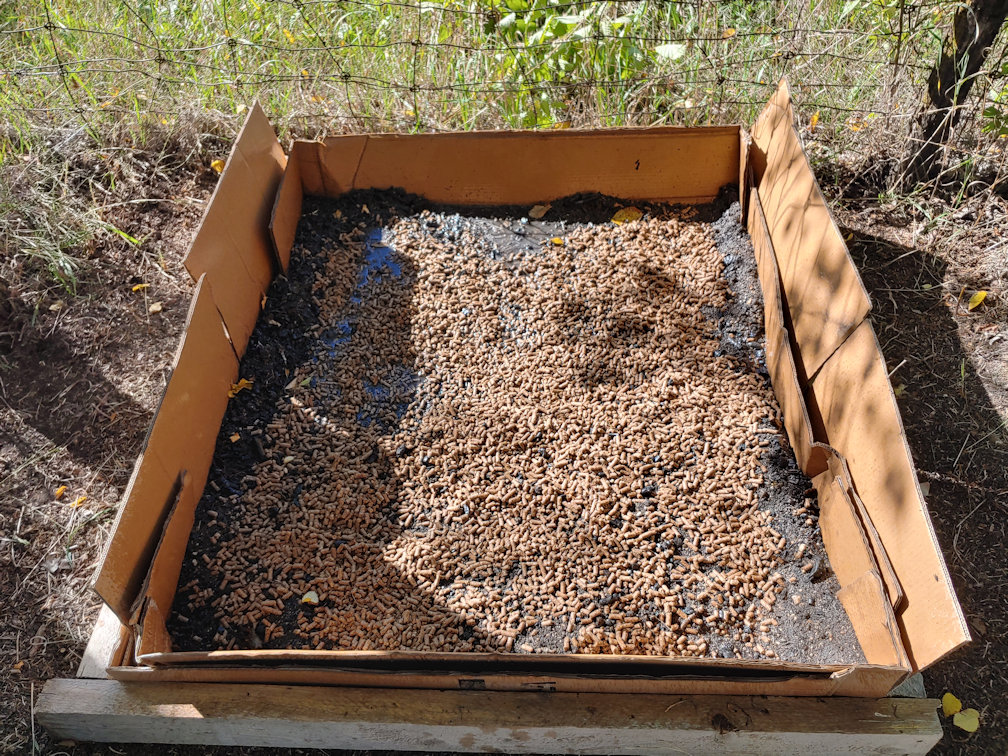
After thoroughly soaking the ash/soil mixture, I used the remaining half of the 40 pound bag of wood pellets I’d used in the low raised bed I made yesterday. Once those were spread out, they got a thorough soaking as well.
Then, while the pellets absorbed the moisture and began to break apart, I opened up a bag of wood shavings. Our general store/post office has them, probably for chicken coops. It’s the same sort of stuff you can get at pet stores for animal cages, except in a bigger bale.
A very thin layer of the wood shavings was added, more to cover the ash/soil mixture, and it got yet another soak with the hose.
Time to inoculate!
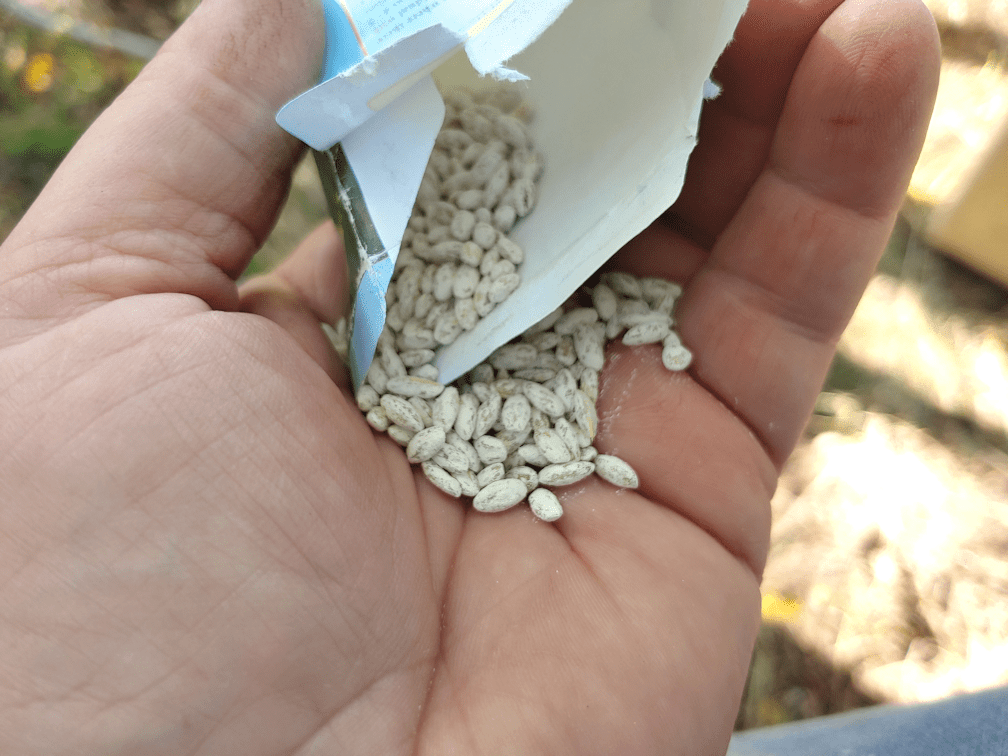
The packet the spores were in was the same sort of packet most garden seeds come in. Usually, mushroom spores come in blocks that get broken apart, so I was very curious as to what I would find when I opened the packet.
Huh. Interesting! These are about the size and shape of Orzo pasta, or some types of rice.
They got scattered over the shavings and wood pellets as evenly as I could. Can you spot them in the picture?
Those wood pellets have really expanded and broken apart. Perfect!
Once the morel spores were scattered, the bed got a light misting, more to make sure nothing would blow away.
Finally, a thick layer of the wood shavings was laid down and gently raked out evenly. Most of the bag of shavings got used up for this part. Once it was spread out, the whole thing got one final, very thorough, soak with the house.
And that’s it! It’s done! Now, we just wait and see. Hopefully, we will see morels in here around May next year, though it may take a year or two for anything to show up. That’s one thing that the package did say; it can take years for the spores to actually fruit. Or, nothing may show up at all. It’s hard to know.
As for the giant puff balls, those did come with more instructions, and need to be soaked in a water and molasses solution for a couple of days. After that, it just gets poured over grass. No advance preparation of the soil needed. If I can find a suitable container the cat’s won’t knock over, I’ll get those started tonight.
Meanwhile, now that I’ve had a delicious supper my daughters prepared, I think it’s time to pain killer up! This may have been less physically demanding than digging out a garden bed, but I probably should have given my broken old body a day to recover, first! :-D Actually, it’s not to bad. The thing that’s bothering me the most is the arthritis in my finger joints, which is more of a problem while typing than while shoveling. :-D
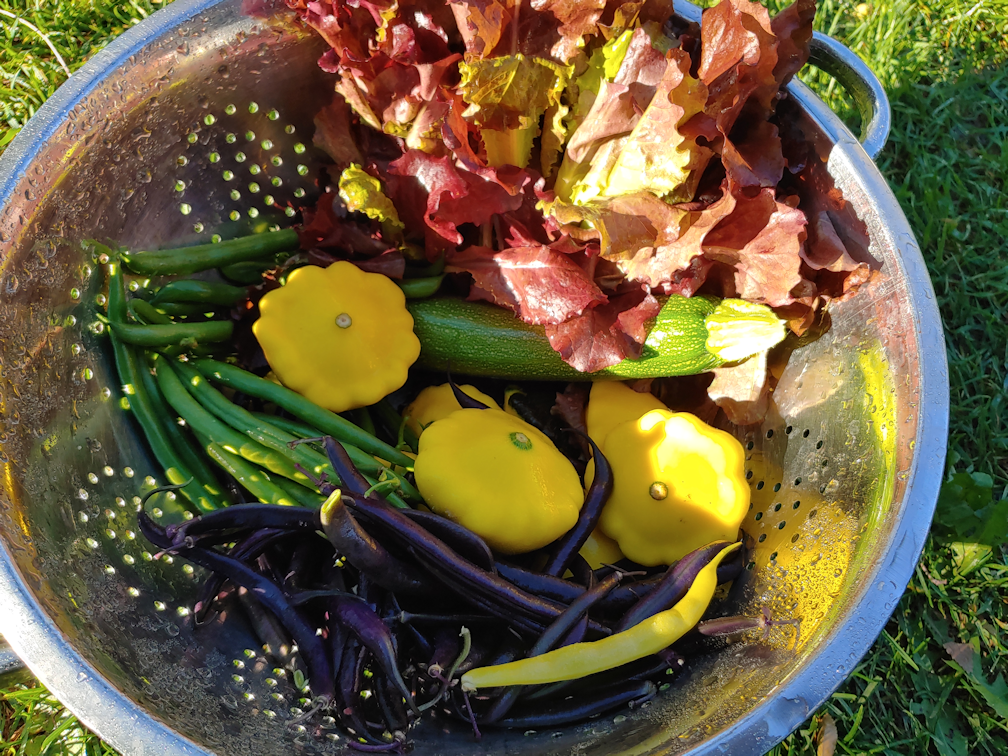
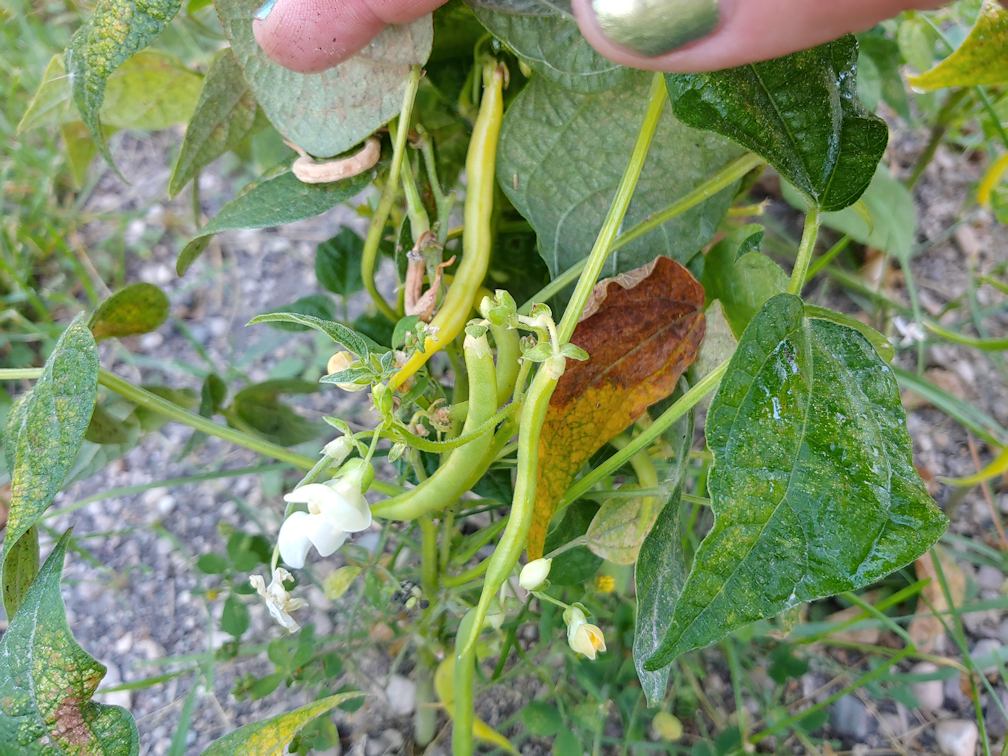
I am just amazed that we still have beans to pick, this late in the season! Even a single yellow bean. :-D
If the mild temperatures continue, we will be getting more yellow beans, too. There are new beans growing, all over the row! From what I could see while picking the green and purple beans, we will have more to pick for at least a couple of weeks, unless a frost hits, first.
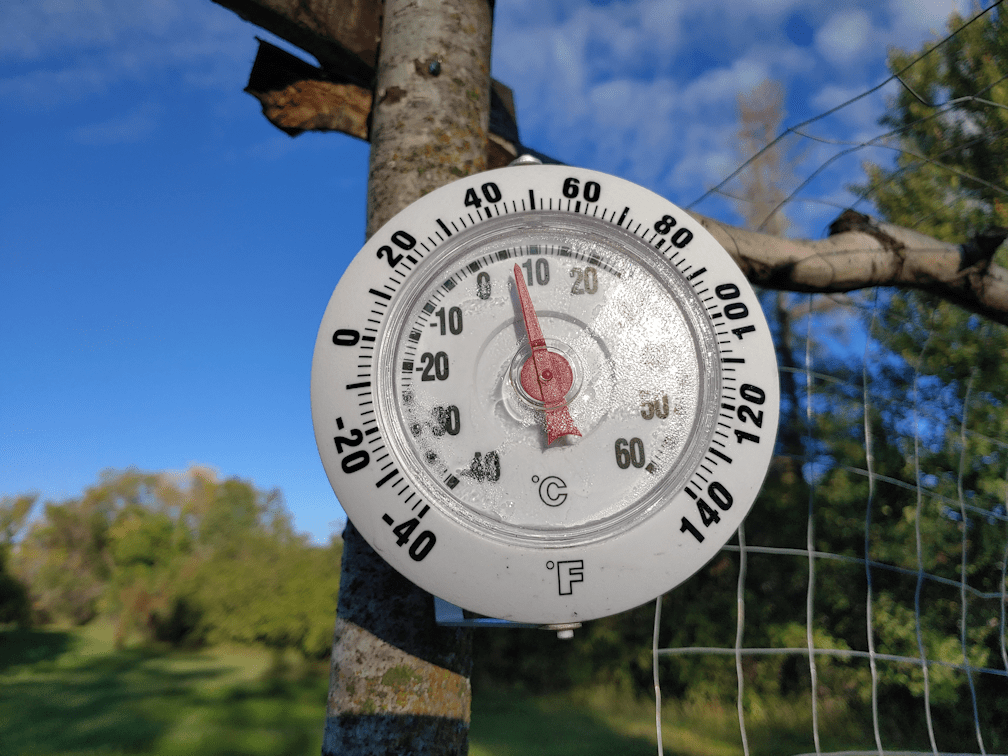
After seeing that insanely high reading on this thermometer a few days ago, I’ve been making a point of checking it more often. This time, it seems to be reading low. It was chilly this morning, but not that chilly!
Ah, well. It’s a Dollar Store thermometer. As long as it’s close, it’ll be useful.
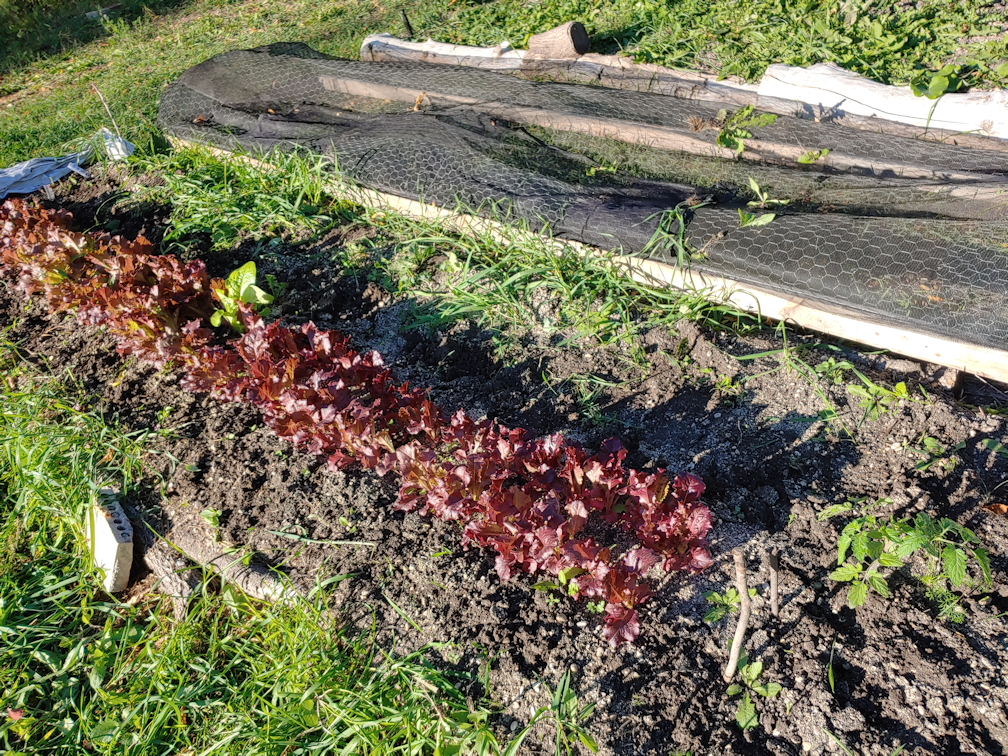
This morning was the first time I uncovered the lettuce to weed and thin them. The cover may keep the critters out, but it’s so long, it’s awkward to move on and off, unless there are two people.
These seeds had been from the bottom of a baggie they had spilled into, so I was expecting a mix. It looks like they are almost all the same type, with the exception of two Buttercrunch. Today is the first time we have been able to harvest lettuce this year! The first time we planted them in the spring, the groundhog got to them before we could. The lettuce is just loving these cooler temperatures.
What I am most curious about is this…
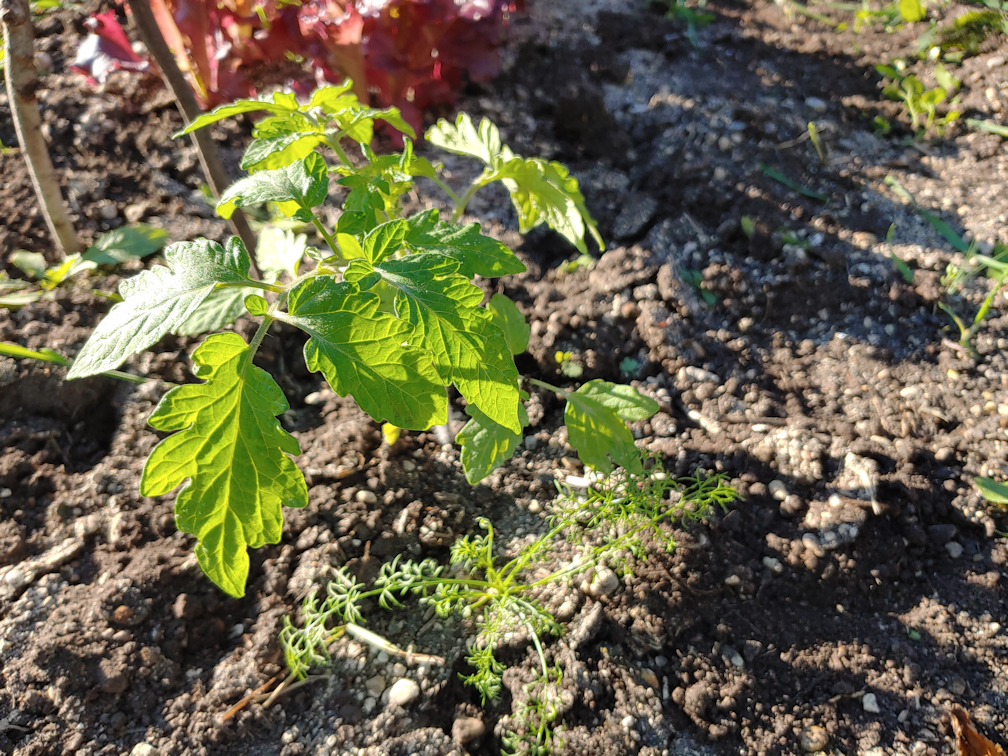
There is a tomato plant growing here! It’s looking very strong and healthy, too. I think that’s a dill growing beside it. Dill self seeds easily, but a tomato? Where did that come from? And why did it sprout so late in the season? This bed had spinach in it, first, and this tomato is growing past the sticks marking the ends of the rows I sowed the lettuce in. No additional soil had been added. Very strange!
While weeding this bed, I was on the lookout for the radishes we’d planted in the other half. I found a couple, but they were really tiny. I have no idea what happened to them.
The Bright Lights chard is doing well. We’ve harvested leaves a couple of times from these. They are liking these cooler temperatures.
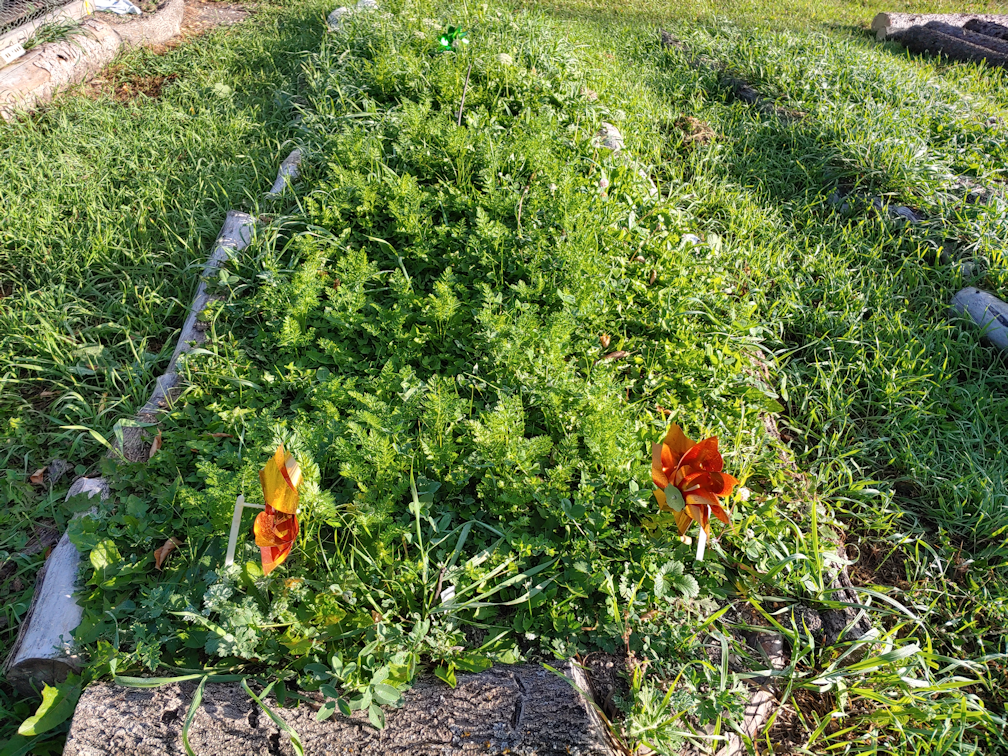
We have completely abandoned the carrot bed the woodchucks had decimated repeatedly. I’d tried to at least keep weeding it a bit, but it was just too much. And yet, you can see carrot fronds among the weeds! It should be interesting to see what we have, when this bed gets cleaned up for next year.
The Hopi Black Dye sunflower in the old kitchen garden had three stalks with flowers on it. In our recent winds, one of them broke, so I added the supports for the plant to try and save the rest. This morning, I found a second stalk, broken on the ground.
We didn’t really have a lot of wind last night.
I suspect kittens.
I’ve been catching them playing in this garden, right on top of the netting over the carrot bed and the beets by the retaining wall. The carrots are on the edges of the bed, and the kittens have been playing in the middle, so those aren’t as affected, but the beets are being flattened. That bed was already struggling to recover from being et by grogs, and not doing well, so I guess it’s not really a loss, but I find it interesting that the kittens seem to really like playing on top of the netting, instead of on the ground or paths beside it!
Thinking ahead to next year, I believe we have enough salvaged boards in the barn that can be used to make low raised beds here. It would be a good place to make contained areas, such as with square foot gardening, as we turn this into a kitchen garden, and we start to plant more herbs that may have a spreading tendancy. If we have actual frames on the beds, that will make it easier to set up sturdy covers to protect from voracious critters and insects – and playful kittens!
I think we should dig up the rhubarb and transplant them somewhere else. They are not doing well here, likely because they are right under the ornamental crab apple trees.
As difficult and sometimes disappointing as things have been with gardening this year, particularly with the drought, it has showed us a lot about what works, and we can do to improve things for the future.
When I did my morning rounds, I didn’t harvest anything, as there didn’t seem to be any need, yet. Then I did my evening rounds, and found that a lot can change by the end of the day!
Spoon Tomatoes (and Potato Beetle)
Mosaic Medley tomatoes
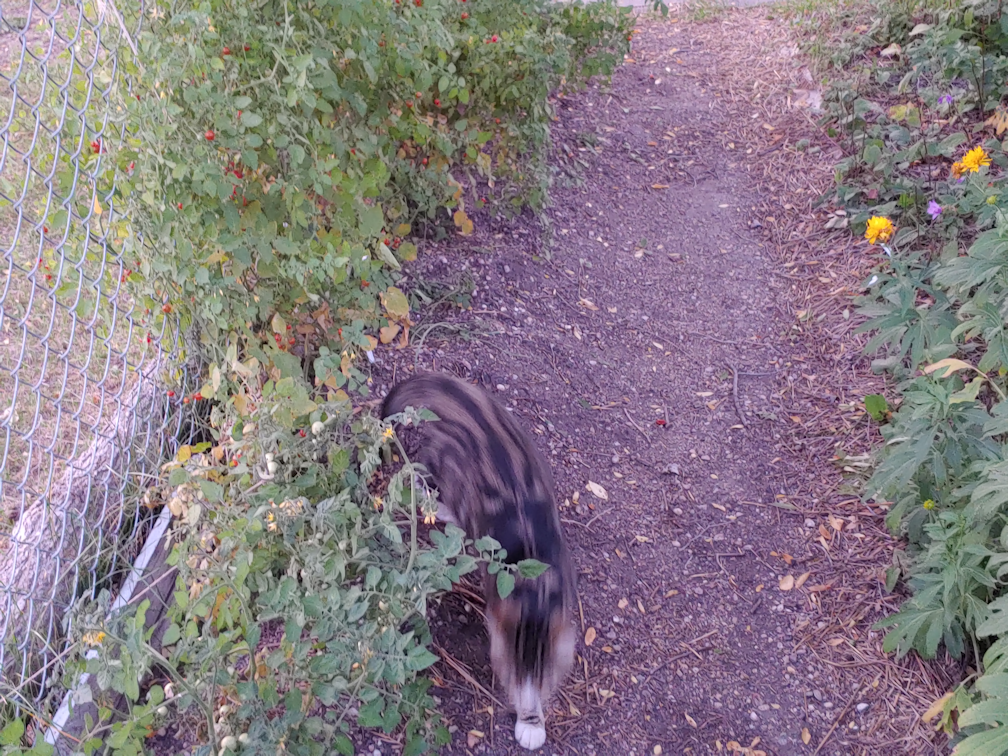
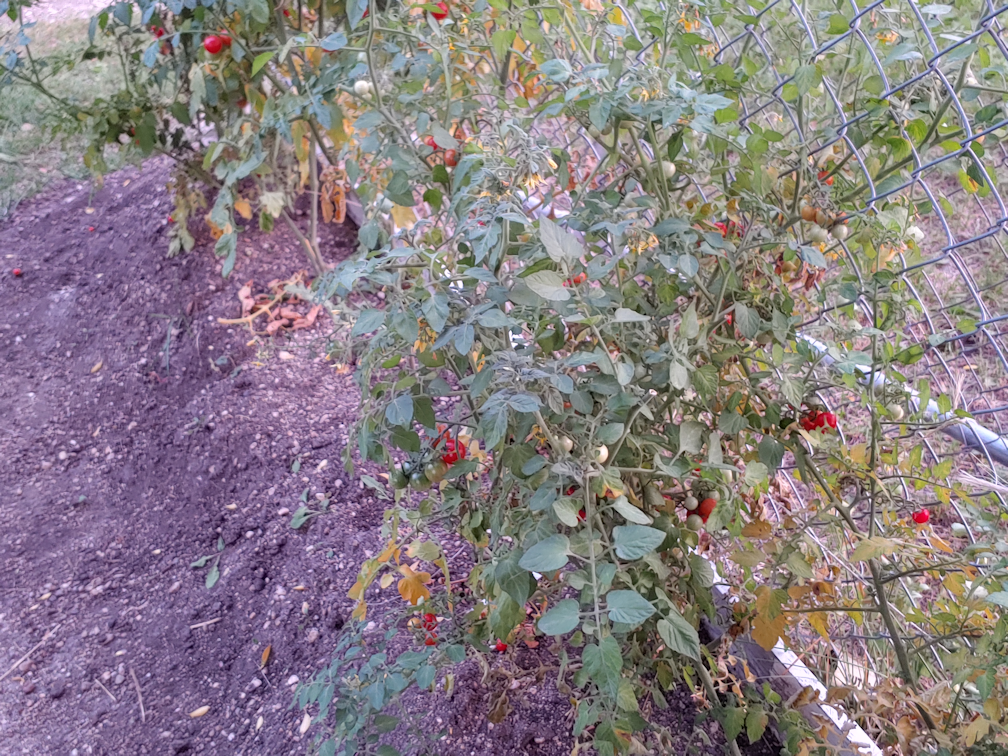
As you can see, the tomato plants are dying back, and yet there are so many tomatoes! In the photo with the Spoon tomatoes, I had already picked the ripe ones, so all the red you see are ones that are still not quite ready.
One of my daughters joined me, and we ended up filling two red Solo cups, almost to the top – our biggest haul of these tiny tomatoes, yet!
I was really surprised when we checked the summer squash, and I saw the Madga squash. It was noticeably bigger than when I checked it this morning! Same with the zucchini. We won’t get much more zucchini this season, but there are so many little pattypan squash. It was starting to get dark fast, though, so I’ll see what we can pick tomorrow morning. I think there are even beans to pick, too!
When I placed our order for fall garlic, I also ordered a pack of seeds for next year’s garden.
It felt kind of weird to order just one pack of seeds. Especially since the garlic will be shipper later, when it’s time to plant them in our zone.
This is a variety of tomatoes my daughter really wanted to try. We now have seeds for two colourful varieties of little tomatoes for next year. We will also be getting two other, larger sized varieties. For me, I will be getting paste tomatoes, while my daughter wants to get some sort of big, lumpy heirloom variety. :-D I think this time, we will start them indoors a bit earlier, so I don’t mind getting seeds will in advance. Last year, we ordered the majority of our seeds in early December, because so many were already selling out. I don’t expect there will be quite the same level of shortages as last year, but I still want to place our orders as soon as our budget allows.
Alas, one thing we won’t be ordering this year are the bushes we were talking about planting where the corn and sunflower blocks are now. We missed the deadline; they have already stopped taking orders for the year! We will need to make sure we can place an order as soon as they open up for orders again, next year. The saplings wouldn’t be shipped until spring, anyhow.
I think half the fun of gardening is planning for the next year’s garden! :-D
The Re-Farmer
ps: the package under the packet of seeds is a set of 12 inch drill bits my darling husband got for me. He’s the best!!
Today is likely to be the last hot day of the year. As I write this, we are currently at 26C/79F, with the humidex at 30C/86F. We are expected to reach 28C/83F with the humidex making it feel like 31C/88F. We are supposed to get a couple more days in the mid to low 20’s before the highs start dropping to the mid to high teens. So far, overnight temperatures are also still supposed to remain high enough that there are no frost warnings.
I headed out to do my rounds later than usual this morning, and we had already reached 22C/73F.
There has to be something wrong with the squash tunnel thermometer. It may have felt warmer than the 22C it was when I took this photo, but there is no way it was feeling like 42C/108F! Not even being in full sun, like it is, should result in that extreme of a difference. I suspect the dial is stuck. I haven’t been looking at it since the temperatures finally cooled down, so it may well have been sitting at this reading since our last heat wave.
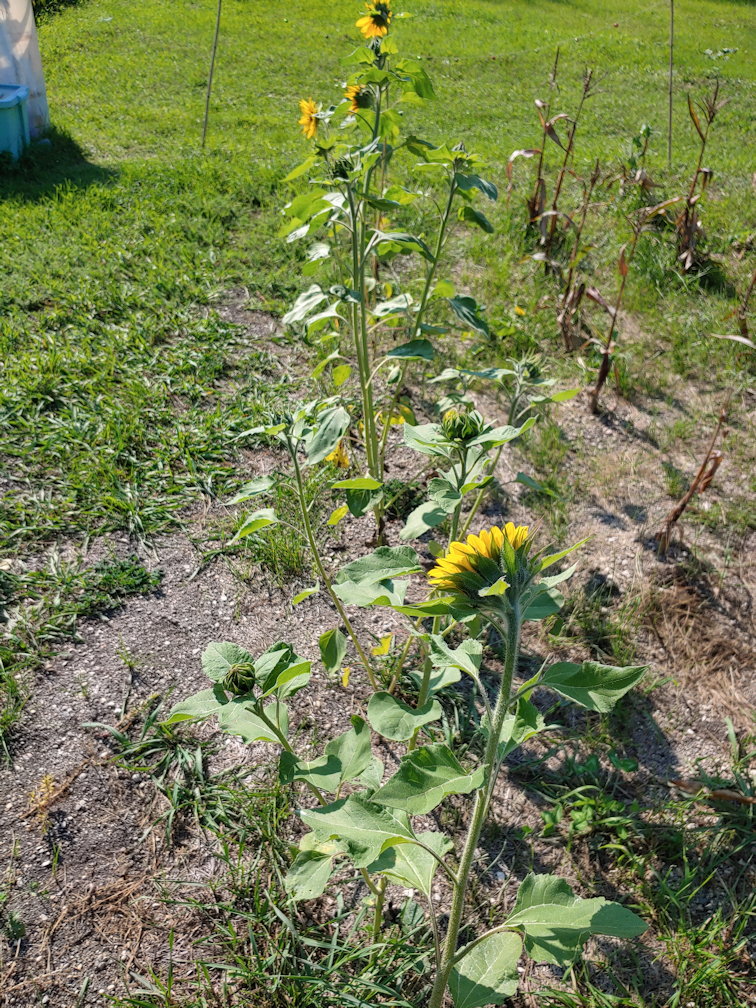
In checking the sunflowers, there was only one little pollinator that I saw! I think the heat waves we had over the summer killed off a lot of our pollinators. There just wasn’t enough food to sustain them. The mild temperatures we are having means more of our sunflowers are actually budding and opening their seed heads, but I don’t know that they’ll have a chance to be well pollinated.
Some of the Mongolian Giants are finally taller than me. Hopefully, the opening sunflowers will lure any remaining pollinators to them. They may not have time to fully mature, even with our predicted mild temperatures, but they will at least provide some food for our surviving pollinators.
These are the Hopi Black Dye transplants that got chomped by a deer. They have all recovered surprisingly well, and are budding and blooming. They don’t need as long of a growing season as the Mongolian Giants, so it should be interesting to see if any of these get a chance to mature.
The green peas are enjoying the cooler temperatures we’ve been having, and I’m seeing more pods developing. This photo is of one of the pea plants growing among the Dorinny corn, the remains of which are being left to go to seed. The three blocks of sweet corn are still green, but they aren’t really growing. At this point, I don’t expect anything from them, really. They’re just there for the peas to have something to climb. Any pea pods we get is just gravy, as their main purpose is to fix nitrogen into the depleted soil in this area.
The winter squash and melons are the ones I am monitoring the most right now.
Remarkably, even as the plants are dying back, we are still getting fresh blooms, and the newer Red Kuri squash are getting noticeably bigger.
The mutant seems to have stopped getting bigger, and is now deepening in colour and developing a harder skin.
As this other, larger Red Kuri is still doing.
I did a nail test on the oldest of the developing Red Kuri, and you can see the mark left behind. Still not ready.
The Teddy squash are also still managing as well.
If we do end up getting frost before any of these larger squash can fully mature, we will still be able to harvest them and eat them. We just won’t be able to store them for long.
The melon vines are dying back faster than the winter squash vines, but their fruit are still hanging in there! I was able to pick this Pixie melon, only because the vine it was attached to had died back completely. I suspect it isn’t quite ripe.
My daughters discovered something about these little melons. After they are cut in half and the seeds scooped out, they make perfect ice cream bowls! I’m not big on ice cream, but I finally had some last night, in half of a Halona melon. It was quite excellent! :-D
I am glad we found these little, short season melons. They have been among the most enjoyed producers this year. I think we will try different short season varieties next year, but the Pixie and Halona are definitely varieties we would grow again. I’ve also saved seeds from some grocery store melons that I plan to try. They are larger varieties, but if we start them indoors early enough, and we don’t have another drought, we should be able to grow them. :-)
Heading out to do my morning rounds is pretty awesome these days. ALL of the kitties come running!
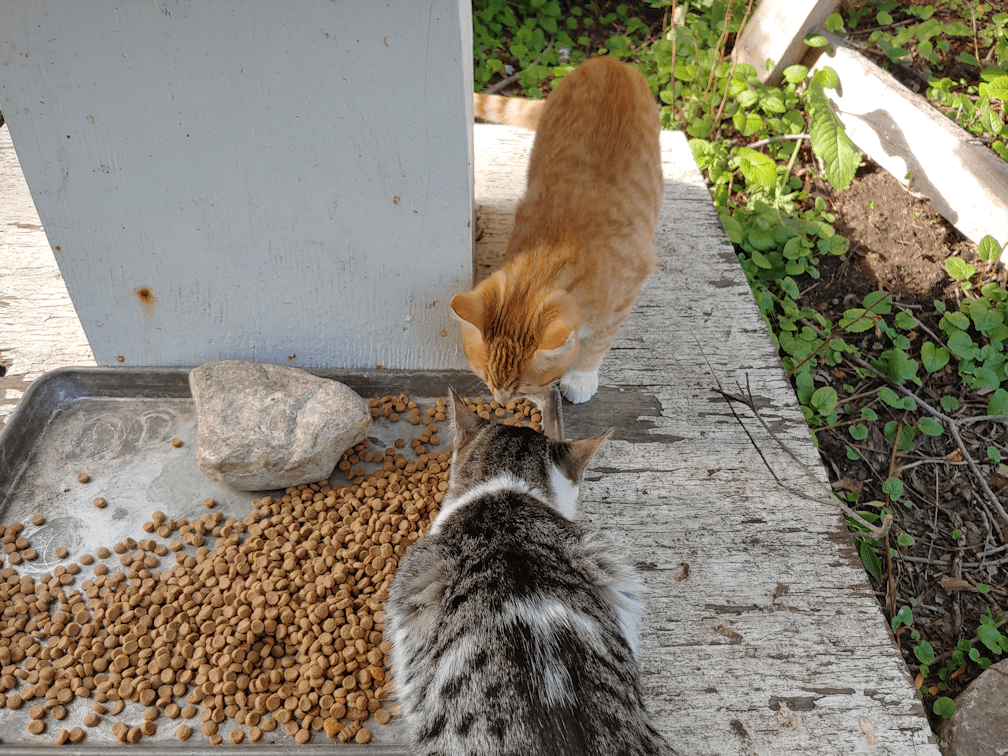
I even got to give Nosencrantz full body pets – but only while she was eating! Toesencrantz started to come close, but she was too nervous with me being so close, and kept going away. So I left, to give her a chance to eat.
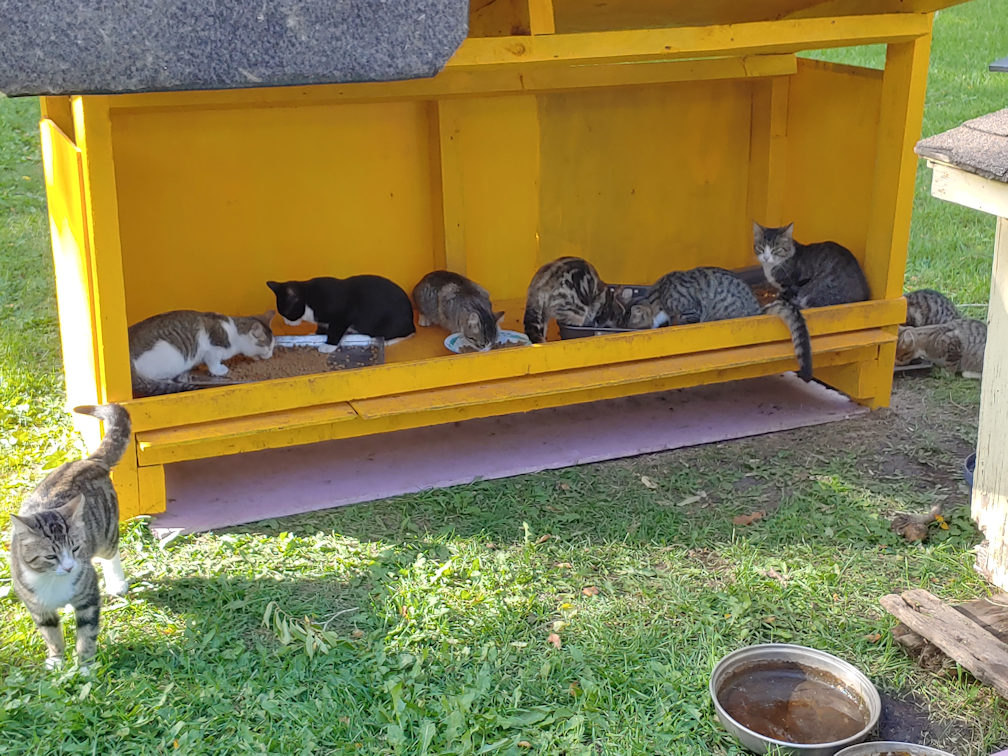
The other eight kittens, plus Potato Beetle, converged on the kibble house! :-D What a crowd! Gosh, they’re getting big. :-)
While I was out by the furthest garden beds, I started hearing some exciting meowing. It took a while, but Rolando Moon came over from wherever she had spent the night across the road, all excited. She let me pet her, then followed me as I went around the garden and made my way back to the house. As we got closer to the house, she would start hissing in between her meows, even though there were no other cats in sight. She was sure on the lookout for a nasty Potato Beetle!
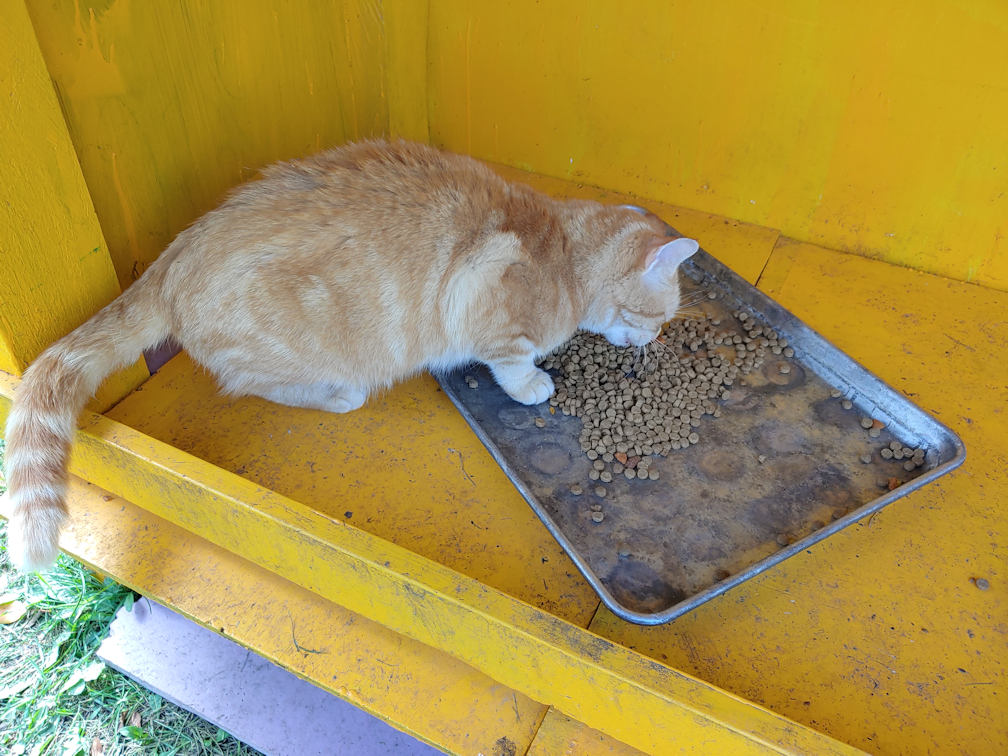
By the time we got to the kibble house, all the other cats were done eating and were gone, so she had a chance to have breakfast in peace.
There were a few squash large enough to pick this morning; a small enough harvest that I could fit them in my jacket pockets! :-D
I found another Madga squash ready to pick, and even one of the mutant sunburst patty pans – the one that’s part green, part yellow – was a nice size to pick, and even one zucchini was ready.
Just one.
While going through the squash tunnel, Rolando Moon ran ahead of me to the end, then flung herself to the ground, waiting for pets.
Right next to a zucchini.
When I had picked squash yesterday, I was carrying them in my arms rather awkwardly, and it looks like I dropped one! :-D
With the fix on our main entry door hinges giving out, we’ve been using the sun room to go in and out of the house. This requires going through a door into the old kitchen, where the cats are not allowed. The door is an old style door with a skeleton key lock on it – though there is no key for it anymore. From there, there is a pair of doors going into the sun room; in the summer, we leave the solid, inner door open. The outer door, which has a window with a screen that we keep partly open for air circulation, is a sort of buffer between the old kitchen and the sun room, in case an outside cat is in the sun room, or an inside cat sneaks into the old kitchen. There are a couple of them that REALLY want to get into the old kitchen!!
Finally, there are the sun room doors. Once again, for the summer, we leave the inner, solid door open, while the outer door, with its screen window partially open for air circulation, is one last barrier. I used to leave the sun room doors open while working outside and have to go in and out frequently, but sometimes an outside cat slips in to investigate and I accidentally close them in when I’m done, so I try to keep that one closed most of the time, too.
When I came into the sun room after finishing my rounds this morning, I spotted a cat jumping off the old wood cook stove in the old kitchen, though the window in the old kitchen door. My initial thought was the Fenryr had once again slipped by me so fast I didn’t see her.
Boy was I wrong.
You see, the old door leading from the house to the old kitchen has… issues. Sometimes, when it seems to be closed, the latch doesn’t actually catch. Then, after a while, the door simply pops open.
By the time I came back, it was wide open, and most of the cats were in the old kitchen, exploring.
As soon as I opened the door from the sun room, there was a rush of cats going into the sun room.
Thank goodness that outside door was closed!!
It took a spray bottle and a few minutes, just to get the cats out of the sun room and into the old kitchen, so I could close that door. Then it took a few more minutes to get them out of the old kitchen and into the rest of the house, so I could close that door. Only then could I empty my jacket pockets of vegetables onto the big freezer, though as I hung my jacket up, I spotted a Nicco in the little niche by the wood cook stove, hiding under my late father’s folded up wheelchair. At that point, I left her along, put things away and, by the time I came back, she came out on her own and I was able to get her to leave.
Inside and outside cats all together, I had 28 cats to deal with this morning! And I didn’t even see the three mamas, yet. :-D