Zucchini and sunburst squash I gathered this morning.
Yesterday, I made a sort of hash, first browning potatoes, cubed small, in butter, then adding leek and frying until softened. I cubed sunburst squash, a green zucchini and a grey squash (the lighter coloured, kinda striped, kind of zucchini; our grocery stores label them as grey squash). Once those were cooked until soft, I added seasonings and maybe half a cup of whipping cream. It turned out awesome!
I’m out of cream, though, so I think I’ll just pan fry them in butter with leek.
I was out doing my rounds a lot earlier than usual, though I skipped tending to the kittens for later. My husband needed to go into town to get his blood work done – something that has been postponed several time already – and we were planning to get there for when the lab opened.
Of course, since I had something scheduled in the morning, my brain decided that sleep was not going to happen.
Yeah. I was up all night.
It turned out to be a gorgeous morning. We were at 9C! (48F) It was absolutely wonderful!
Not wonderful enough to make me a morning person, but I did appreciate it. :-D
One of the things I made sure to check was our haskap bushes. The flowers in the bed around them have grown high enough to almost completely hide the bushes, even though I made a point of pulling up anything growing near the haskap. In time, the haskap will be taller than the flowers, but that might take a couple more years.
I was sure the female haskap had died last fall, but it has recovered remarkably well. I had noticed a couple of flowers, and then some berries forming, so I wanted to see how they are doing.
There are actually 2 berries here; one is still green, and is hidden by the ripe one. In another spot, I found a couple more berries, one ripe, one green.
It looks like that’s all we’ll get this year. Which I am happy with, since the alternative would have been trying to find a replacement female plant, and I just haven’t seen them at all in the garden centres this year. I had hoped to get 1 or 2 more female plants anyway (the ratio for pollination on these is 1 male for every 3 females), but there were none to be had.
That’s okay. Next time, I want to order them from Vesey’s instead. I think I’ll get better quality plants from them.
Until then, I am happy with our bitty baby berries!
I just got back from a much needed walk outside, to do at least part of my evening rounds. I would happily have stayed out longer, but the mosquitoes were out in their masses, and I didn’t want to cover myself with bug spray, this late in the day.
While out, I checked on a different sort of babies we’ve got growing right now.
Baby grapes!
Our first summer here, I had no idea my mother had grapes. They were completely engulfed in spirea. They did produce some bunches of grapes, though, which was really awesome. They were pretty small, but quite delicious. :-)
I did a lot of clean up around there, including cutting away the spirea from the grape vines (there turned out to be 2 of them) the next spring, and making a trellis for them. After a very harsh winter, I wasn’t sure they had survived, but I fastened what I could to the trellis and was diligent about watering them.
They did survive, but there wasn’t a single grape.
We had some harsh conditions this past winter, too, and for a while, I wasn’t sure they’d made it through, but they are finally leafing out, and there are quite a lot of little grape clusters showing! Now that they are no longer being strangled by the spirea, I am hoping we will have nice big bunches of grapes.
It was cheering to see them, after a rather frustrating and unproductive day. I had two time dependent things on my schedule; one was an afternoon telephone doctor’s appointment. Nothing urgent; just some follow up questions. Once that was done, I was going to pick up the rest of my husband’s prescriptions, which needed to be done before the pharmacy closed, but otherwise was just slated for “the afternoon”.
I got a call from the pharmacy late in the morning. They didn’t have enough of one of the meds to fill all the bubble packs, but they would have more tomorrow. Did I want to just get a week’s worth today, or wait until tomorrow?
Thankfully, my husband has enough to last him the rest of the week, so I said I would come in tomorrow.
With the timing of things, I was never able to get outside to do the transplanting I had intended to in the morning, and by afternoon, it would have been too hot for the job, anyhow. I figured, since I no longer had to go into town, I could do it after the phone call.
The time came and went, and there was no call.
After about 45 minutes, I finally called the clinic myself. Was there a problem? Was I the one who was supposed to call? No, I was still scheduled, and the doctor would still call me.
So I waited. It meant I couldn’t start anything that couldn’t be stopped instantly, so nothing particularly useful could be started while I waited.
And waited.
Eventually, it got late enough that the clinic would have been closed, but I still waited a bit longer, in case he stayed late.
Nothing.
I can’t fault the doctor. He was the on call doctor, so for all I know, he ended up in the emergency or something. It still left me feeling like my entire day was wasted.
Here’s hoping I can get at least the transplants done tomorrow!
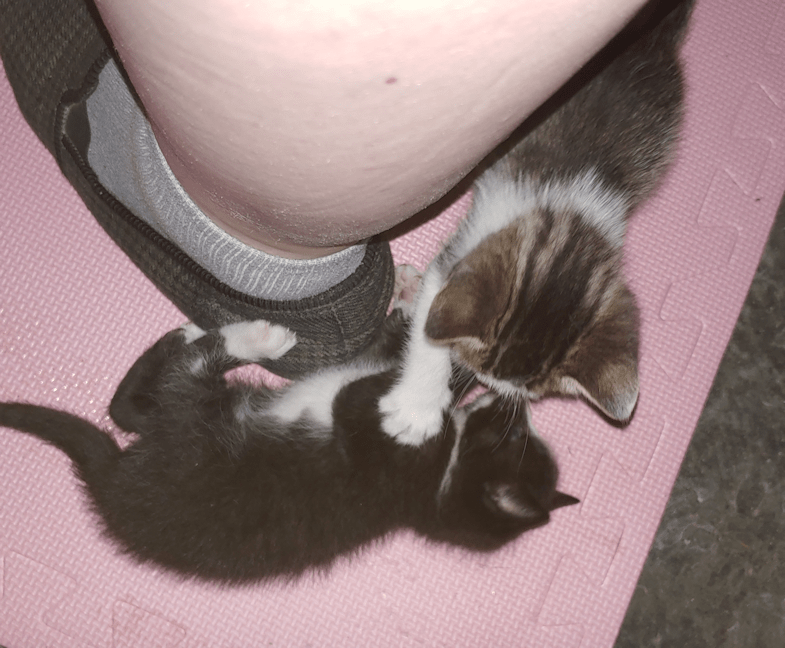
Of course, the kittens are growing into ferocious little ankle biters.
They also love climbing on and clawing the grandpa slippers. :-D
Once outside, I checked the new garden bed and discovered carrots!
Unfortunately, there are also plenty of other things sprouting. At least the thistles are easy to pull out.
These carrots were done using a method found on a YouTube video, where the seeds were sprouted in water first, then put into a cornstarch gel in baggies, to be piped into the ground like icing.
These, along with the parsley, were planted on May 17. It is now the 24th. It took only 1 week for the sprouted seeds to break ground. Direct sown, they could take anywhere from 14 to 21 days.
Not only was the parsley also starting to show, but I think I’m even seeing some of the beets, which were planted 2 days later. I didn’t do anything special with them, other than cover the plots with plastic. Beets can take 7 – 14 days to sprout when direct sown.
It seems things are doing quite well in this location! I was able to remove the plastic on all the little plots. Even the kohl rabi. I just looked those up and they can germinate anywhere from 3 – 10 days.
I’m quite pleased with this!
Yesterday’s downpour has really revived everything! While doing my rounds, I found more blooming trees!
Yesterday, it was plum blossoms. Today, it’s Saskatoons. :-)
Of course, the grass is also growing like mad. Time to break out the lawn mowers! :-)
Welcome to my “Recommended” series of posts. These will be weekly – for now – posts about resources I have found over the past while that I found so excellent, I want to share them with you, my dear readers. 🙂 Whether or not I continue to post these, and how often they are posted, will depend on feedback. Please feel free to comment below, and if you have a favorite resource of your own, do share, and I will review them for possible future posts.
I hope you find these recommendations as useful and enjoyable as I have!
You’d think that, having grown up on this farm and with my family being subsistence farmers, I would already know how to garden here. And I guess I do, really. The thing is, I want to do things differently than my parents did. Some simple things, like trellising, which my parents never did. One of my jobs as a kid was to flip the rows of pea plants, so the sun could get at the other side. We also want to grow new things I have no experience in, use no-till methods my parents never used, and eventually have raised beds.
So basically, I’m learning how to garden, all over again.
Part of this learning curve is figuring out how to grow what we want in our climate zone, which is a zone 3. It takes extra measures to produce food in our short growing season. We can’t even take advantage of any urban heat island effects.
With that in mind, I have been looking up resources for cold climate gardening. In my searches, I have found many sites and YouTube channels dedicated to cold climate gardening. How wonderful, I would think, as I eagerly began to explore them.
Right up until I discovered that these “cold climate” gardeners were in…
Zone 5.
Really?
Just about everything I look at that I’m interested in growing is rated to zone 5. How is zone 5 considered a cold climate?
Okay, okay. I realize that these sites are almost all based in the US, and northern states are rightfully considered cold climates compared to the southern states. But I’m in frikkin’ central Canada. To us, zone 5 is almost tropical. :-D
All joking aside, it did make my searches frustrating. It turns out there just aren’t a lot of active Canadian gardening resources out there.
Maritime Gardening is run by Greg Auton, in Nova Scotia. It’s basically one person and 2,500 square feet of back yard garden! He’s been making these videos since 2016.
The only down side?
It’s still a zone 5 climate region… but it’s far closer to our situation than anything else I’ve found! There are lots of videos on how to lengthen the outdoor growing season, like getting the soil to thaw out faster, or dealing with high winds.
There are also a lot of videos on specific crops, such as garlic, onions, potatoes, and strawberries, and techniques, such as no-till gardening, using cold frames, different types of mulches, and so on.
There are videos on planning out your garden spaces, dealing with weeds and insect problems, saving seeds, harvesting and preserving.
There are even cooking videos, fermentation videos, videos on how to make tool handles, and so much more.
There is just SO much to learn from here! I highly recommend this channel as a resource.
Well, I’m glad I’d already written out which seeds needed to be started indoors and when. For some reason, I thought I’d need to be doing 3 starts, but I will only need to do 2.
At about 4 weeks before last frost (give or take a few days, depending on which town I look at), I had 2 things to start. Cucamelons and fennel.
I’ve never grown either, so this is a complete learning experience.
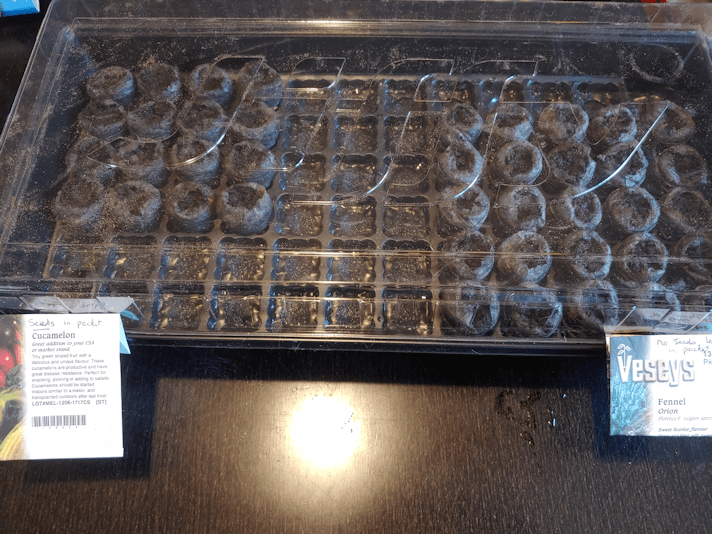
I got a couple of those domed seed starter trays with the pellets. These are self watering trays with a capillary mat between the pellet trays and the main trail.
For this seed start, I don’t need to use an entire tray.
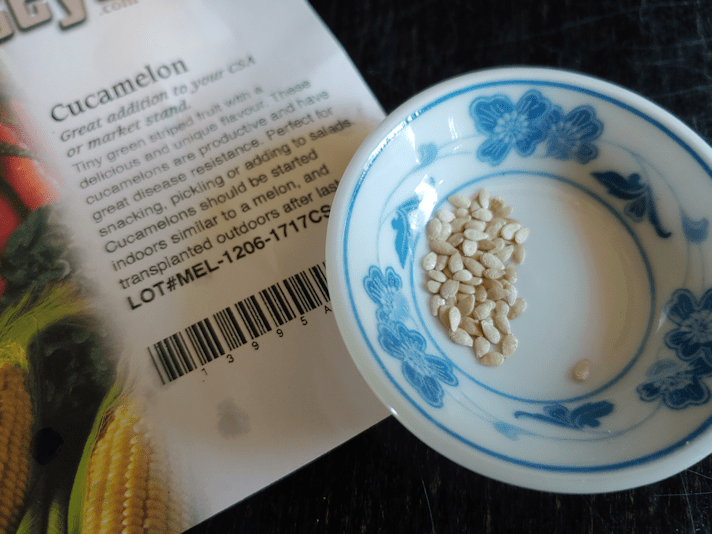
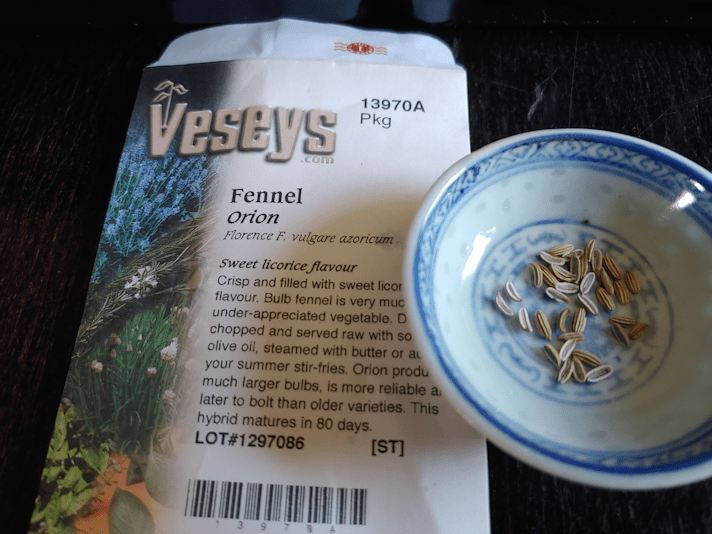
The cucamelons will be planted in the chimney blocks currently sitting in the old basement. I have 8 of those left. With the spacing needed, I could plant 1 cucamelon per block. Maybe 2. So I am starting seeds in 16 pellets and will hopefully get at least a 50% germination rate. If I get more, I’ll figure it out when the time comes! It’s a completely new plant for us, so I don’t even know if we’ll like them, so I didn’t use the whole packet. I know we like fennel, so I kept more pellets for those. Then I added water to start hydrating the pellets while I looked at the seeds.
Hhhmmm…
With how few pellets I’m doing for the cucamelon, there are enough seeds even if I put in a couple in each one, but fennel packet turned out to have fewer seeds than I expected.
So I took a few of the pellets out.
Then I had to wait for the pellets to hydrate. I was also waiting for a call from the garage (more on that in another post), etc., so I kept myself busy with something that could handle interruptions.
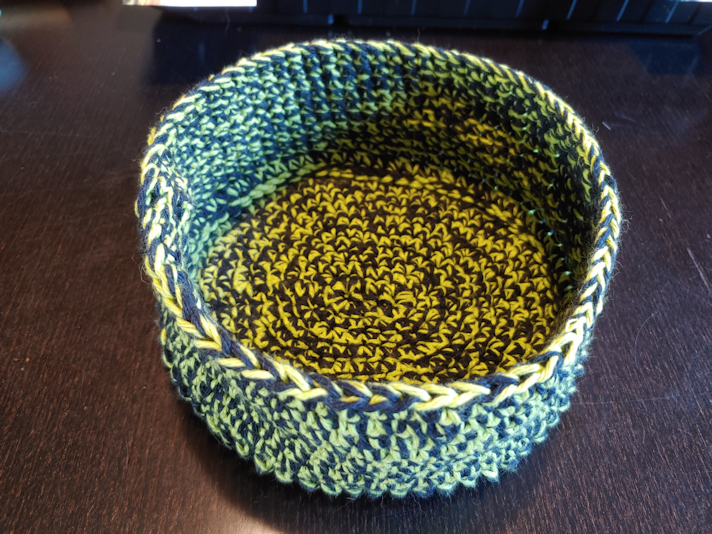
I crocheted a basket. :-D
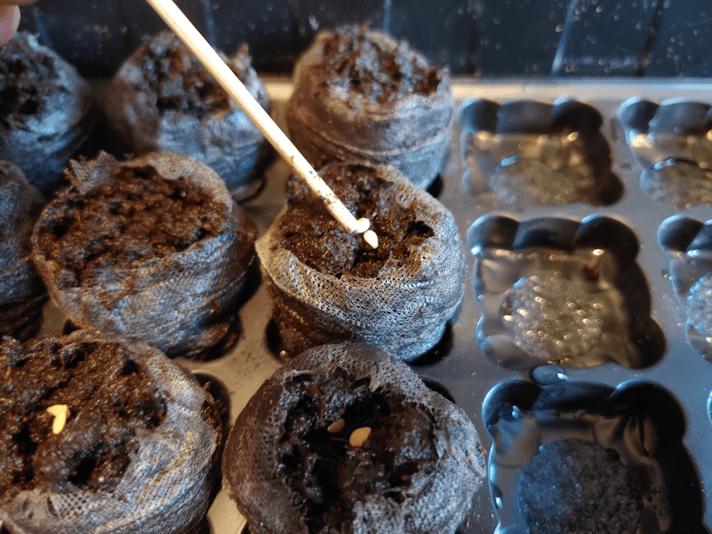
Once the pellets were hydrated, I used a pair of shorter bamboo skewers to lift up the mesh at the top, because I know my clumsy fingers would just tear things. *L* Then, I used the blunt end of a skewer to push the seeds to the right depth into the loosened pellets.
If I felt the need, I could have marked the skewer for different depths, but I was only doing two. The cucamelons needed 1/2 – 1 inch, while the fennel needed 1/4 inch.
I made sure to mark the packets for their seed status, because I know I’ll forget. :-D While I had extra for the cucamelon, I used up all the fennel seeds, and most of the pellets have only 1 seed in them. Hopefully, they will all germinate and be strong little seedlings.
Though the tray comes with its own cover, it will still go into the mini-greenhouse my daughter bought for me. That’s more to protect it from the cats, at this point!
My daughters and I ended up finally rearranging the living room, since my husband moved his computer set up out, before setting the mini-greenhouse up where we knew it would get direct sunlight.
Which is basically in the middle of the living room! :-D
I will eventually move the mini-greenhouse outside, but it’s still way too cold for that.
In one week, I will start the squash and gourd seeds. The remaining seeds we have will be direct sown outside, once it’s warm enough.
While I was working on this, my husband did some research and found a relatively local company that sells gravel and soil, with a price calculator on their website. Using that, we calculated that the amount of garden soil we would want to get, which is quite a bit, we are looking at about $650. We could probably get away with about half of that amount, though, and get more in another year. In time, we’ll have enough organic material to build up the soil ourselves, but we’re just not there yet, and probably won’t be for another couple of years. Buying garden soil would be a short cut.
Then we looked up their driveway gravel.
To get enough gravel for the driveway from the road to about the gate into the yard, including all of the front front of the garage, we’re looking at about $2100.
Ouch.
The main thing, though, is that the first batch of seeds are started for our first attempt at growing food since we’ve moved out here! It took a lot of work to get to this point, so it’s pretty exciting. :-)
Now, if we can just have a good weather year, this year, and not another drought!
Welcome to my “Recommended” series of posts. These will be weekly – for now – posts about resources I have found over the past while that I found so excellent, I want to share them with you, my dear readers. 🙂 Whether or not I continue to post these, and how often they are posted, will depend on feedback. Please feel free to comment below, and if you have a favorite resource of your own, do share, and I will review them for possible future posts.
I hope you find these recommendations as useful and enjoyable as I have!
Last week, I recommended a resource that would be very useful for anyone interested in homesteading, geared towards rural living.
This one is for you city folk who are also interested in growing things, either for your own use, or as a way to make an income; BC based Urban Farmer Curtis Stone.
Curtis Stone is the owner of Green City Acres, a commercial urban farm, so this is someone who actually is making a living as a city farmer. Being in Kelowna, BC, this is also someone who manages to do it in our Canadian climate, with all its extremes of heat and cold. They also offer online courses, workshops and have a newsletter available.
There are also podcasts and lives shows. I’ll be honest, though, I haven’t been able to watch these longer videos – some going to 2 hours – simply because of limited data available on our internet.
There is a lot of practical information from growing food, to growing a business.
There are videos about farm software, using hedgerows, using solar, building greenhouses, growing mushrooms, and even videos about the issues farmers and land owners in Canada have to deal with, in regards to our laws and regulations (we’ve got some pretty insane ones here in Canada).
With the sudden shortages and rations that have happened because of the Wuhan virus lockdowns, a lot of people are looking at ways to grow their own food. With that in mind, Curtis Stone has made videos to address these concerns directly, and has also started up a new farm project, to see how much food people can grow themselves quickly, on a small parcel of land, that will be very interesting to follow along.
So if you’re someone living in an urban environment, and would still like to find ways to grow food, Urban Farmer is the resource I would recommend.






 The Re-Farmer