Yesterday evening was so lovely out, I spent as much time outside as I could! I took advantage of this to finished up the garlic we harvested some time ago. They have been hanging from the rafters under our gazebo tent to cure. It was not ideal conditions. They should be somewhere cool and dry. What we had available was outside, where it was hot and dry, or in the basement, where it was cool and humid.
I figured hot and dry was better than cool and moist!
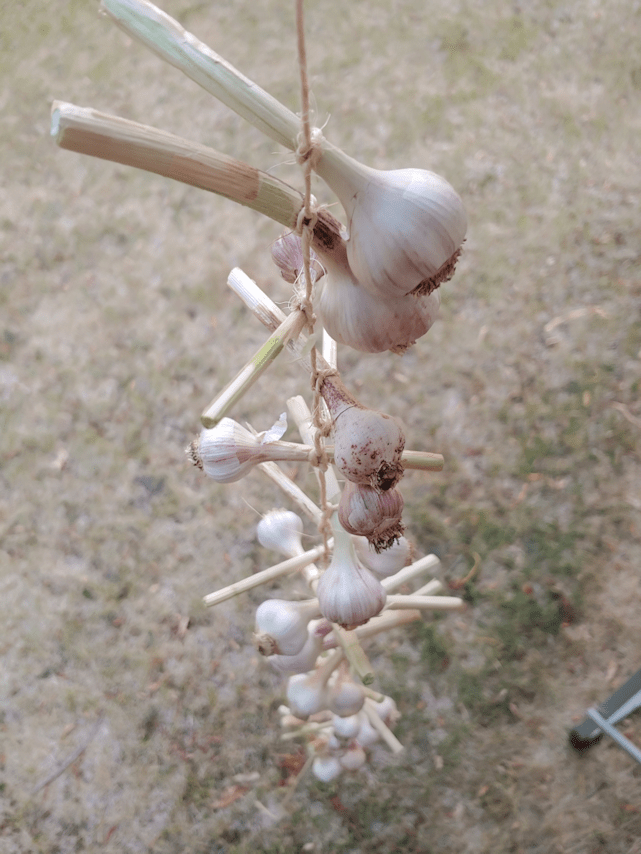
The stalks and roots were trimmed, the soil brushed off, then they were tied up in twine.
They are not as cured as well as they should – some of the stems are still showing a bit of green – so these will need to be eaten fairly quickly. Which is sssuuuccchhh a hardship… Ha! I look forward to using them. They are currently hanging from the ceiling in the kitchen.
I think garlic soup would go over very well! It’s usually made at the end of winter, as a sort of spring tonic, but I think it’s good, at any time! I use an entire bulb of garlic to make it, but these are so small, I might just use up a whole bunch of the littlest bulbs. :-)
While these were dying back way too early and had to be harvested, the rest of the garlic is now looking ready to harvest, too. It’s still early, and I don’t expect very large bulbs, but that’s okay. We’ll be buying more to plant for next year, rather than try and save bulbs from this year’s garden.
I’ve been eying one of our garlic beds closely for some time now.
This bed has the Purple Stripe garlic. Most of them started dying back a while ago, which was very strange. It seemed very early for them to be doing that. Especially since some of them were still growing scapes. I’ve been reading as much as I can, and everything tells me that once, with so many of their leaves died back, the bulbs are done growing. When even the scapes seemed to have stopped growing, I decided it was time to dig them up.
But just the ones that had died back.
I left behind the ones that were still green. Hopefully, their bulbs will continue to grow bigger.
It’s normally recommended to leave them on the ground to cure, but we have too many critters of various kinds that could get into them, even if they aren’t likely to eat them, so I laid them out next to the kibble house under the tent.
As you can see, most of them are very small. There’s only one or two larger ones. I wish I knew why they stopped growing so early. They had the same soil, sun and water as the other two varieties. No matter. While we won’t have anything to keep for planting in the fall, I’m sure they will still taste good!
Also, when I came over to set these out, Rosencrantz’s grey and white kitten was at the kibble house. It wasn’t until I started setting out the garlic that he took off. Last night, I topped up their kibble dish near their junk pile home. When I came back to top up their water, Rozencrantz and both of her kittens were eating. She and the orange tabby left, but the grey and white stayed and kept eating, even as it watched me closely while I refilled their water bowl next to him. Progress! Junk Pile’s four kittens have also been spotted in the kibble house, eating, too. We’ve decided not to give it another coat of paint, but might do some decorative painting on the outside, so the floor boards have been put back in place, and their food bowls are now in the shade of the kibble house, instead of on the baked lawn. Junk Pile’s kittens dash off as soon as they see us, but the fact that they are coming to the kibble house to eat at all is more progress.
I’m glad I picked up this tent. It’s coming in handy for painting, for critter shelter, and now garlic curing, already! :-D
It was a rough night for me, last night. Very little sleep, and the pain levels are just high enough to make any position uncomfortable after only a short time. Thankfully, my husband was well enough this morning to head out do all the food bowls for the cats, and refill the bird feeder, allowing me to postpone the rest of my morning rounds until later in the day.
Once I did get out, the first thing I noticed was the haze. I know we don’t have fires nearby, but we’re getting smoke. I’ll have to check the fire maps later, and see what the current status is.
The other thing I noticed was Junk Pile cat. Who looked at me and growled.
Now, why would she do that?
Because she had brought her kittens over, and they were around the cat shelter! I saw some furry little butts disappearing behind it, so I carefully went around, giving them lots of space, to check on the potatoes and grapes. I saw a little grey and white kitten run across to the storage out, while a little tuxedo squeezed under the cat shelter.
A tuxedo?
Yup. She had more kittens with her this time! There were at least three, possibly four. I was just catching glimpses of them, though later on I saw the tuxedo under a tree by the storage house, watching me from a safe distance.
I am so glad she’s bringing her babies over to the food bowls!! Hopefully, they will be moving into the inner yard now.
Before finishing my morning rounds, I got the hose going to refill the water barrel at the far beds. Unfortunately, it is still leaking. I’ll have to pinpoint exactly where, then empty it enough that it can dry and I can try sealing them again.
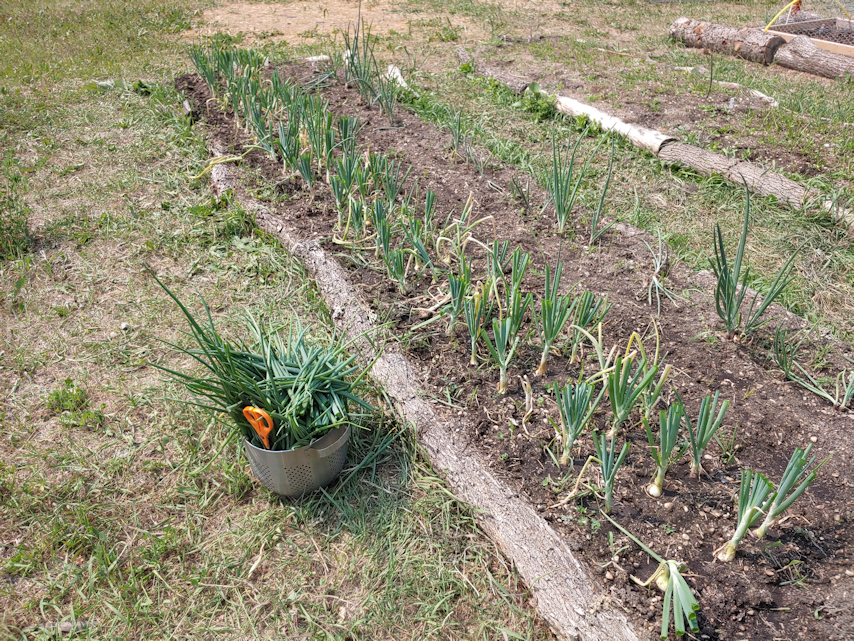
Once everything else was done, I came back outside to give the onions a hair cut. :-D
It was on one of the gardening groups I’m on that I saw someone post pictures of the green onions they had just harvested and bagged up for the freezer. I know it’s recommended to trim onions grown from seed, down to about 3 inches, before transplanting. I hadn’t thought about trimming them, other than to gather greens for the day’s cooking, before harvest. The gardener that posted the pictures said that trimming them meant more energy going towards growing the bulbs. If the greens start falling over, the onions stop growing for the season. I knew that last part, but it never occurred to me that the growing season could be extended by trimming. I’ve never grown onions before, and the onions my mother grew were left in the ground to come back, year after year, so I never saw her doing that, either.
The yellow onions sets that I bought locally got really large greens. I quickly ran out of space in my colander, and had to come back to do the bigger shallots, then the other onion bed. The red onions (from sets) and the other yellow onions (from seed) did not have as many large greens, but the colander still got pretty full again! All the greens completely filled our giant metal bowl. Thankfully, it has a lid, because the cats were VERY curious! It’s full enough that the lid is sitting on top of greens, but at least that cats can’t get at them. Onions are toxic to cats, but that doesn’t stop them from being very curious about them!
We’ll have a lot of washing of greens to do, and then they’ll be coarsely chopped. We will probably dehydrate a couple of pans of them in the oven, and the rest will get frozen.
We’re going to have enough to last us quite a long time! :-)
Looking at them this morning, I thought we could just harvest the plants that had started to go to seed and leave the smaller ones, but when we were ready to start, we realized that the smaller ones were going to seed, too!
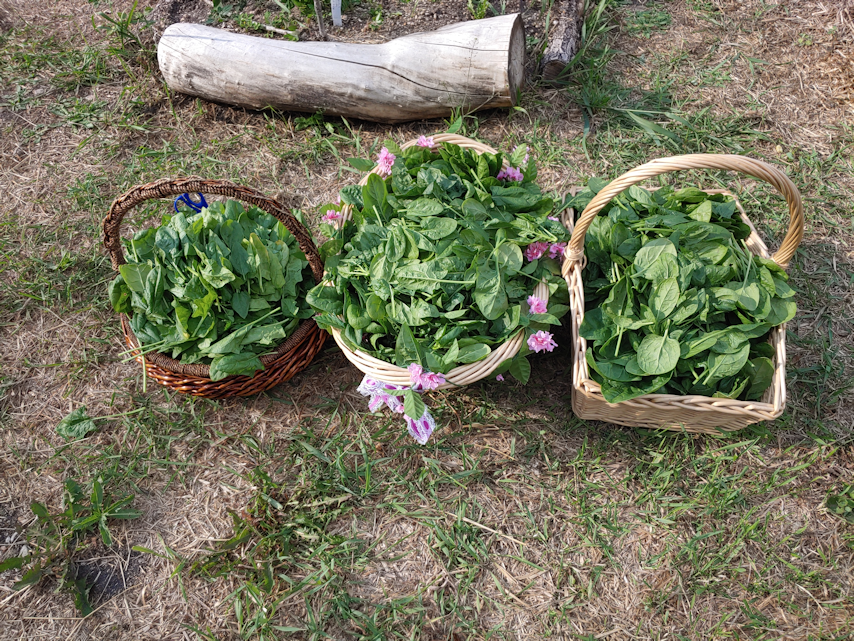
We ended up using our three biggest baskets to hold it all.
Yes, these are our Easter baskets, and one of them still has its decorations. The flower garland is woven through the basket, so it doesn’t come off. :-D
Each of those baskets is filled with a different variety of spinach, though to be honest, I can’t tell any difference. They were even supposed to mature at different rates, but between the deer, the heat and the lack of rain, they all matured at the same time.
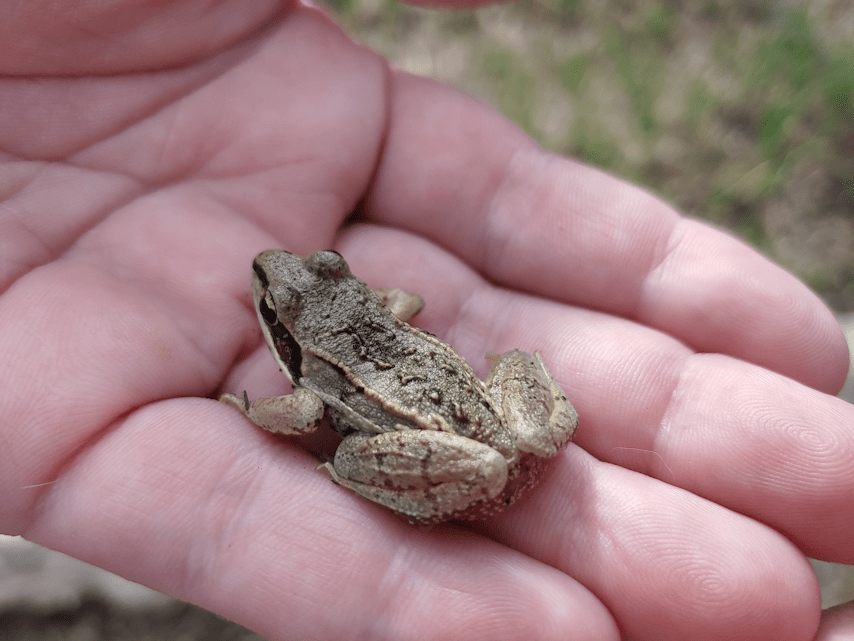
Nutmeg was hanging around while we were working, and my daughter noticed he was playing “cat and mouse” with something. It turned out to be a frog!
She rescued it.
We see frogs fairly regularly in the garden beds. That makes me happy. More frogs means less bugs eating our produce! :-)
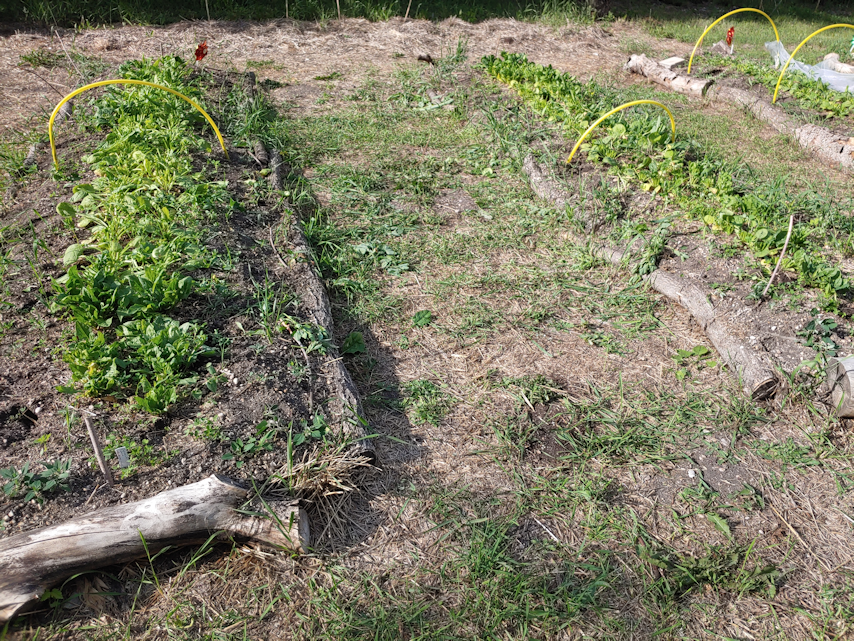
We used shears to cut the spinach, so all the roots, along with the plants that weren’t suitable to harvest (like the teeny ones the deer got to), are still there. The beds will get a thorough clean up, probably tomorrow, so we can plant lettuces, next.
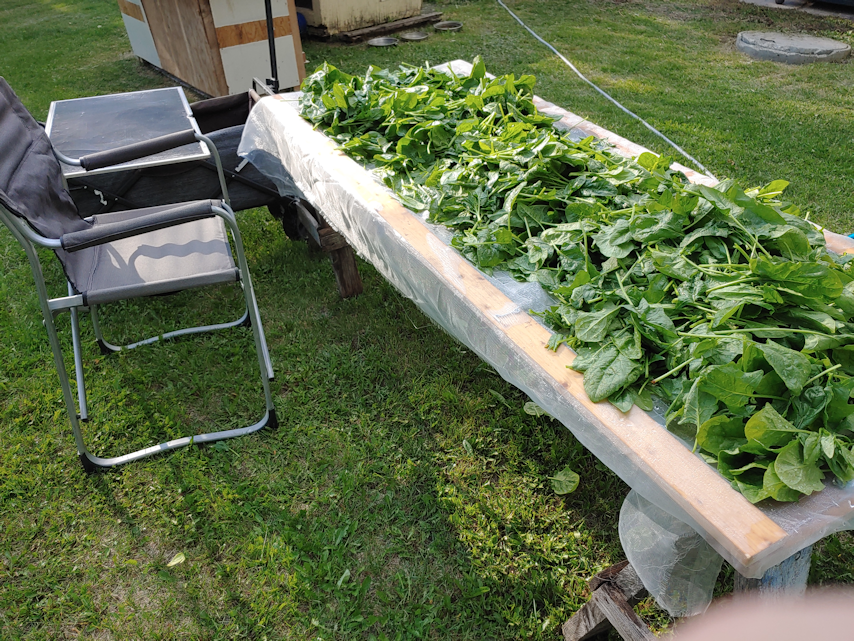
We dragged out the screen “door” that fits at the top of the old basement stairs, and covered it with the mosquito netting we’d been using to protect one of the beds. We also brought out a couple of our largest bowls. The spinach got washed in the bowls in batches, which also gave us a chance to start taking out any weeds that came along for a ride, and removing some of the yellowing or damaged leaves. After being washed, they got dumped on the mesh and got another rinse with the hose.
Then it was time to start picking over the spinach and destemming them. I set up the wagon to hold the screens I’d washed earlier, to dry spinach on.
My daughter and I then started going over the whole pile, picking out the best ones for dehydrating or into bowls, and dropping the rejects with the snipped stems for composting. We worked for about an hour, hour and a half, before my daughter went in with a filled bowl, to start supper while I kept working on the rest of the spinach.
The filled screens were left on the roof of the kibble house to drain for a while. They went into the sun room when it started to rain a bit, though we never got more than a smattering.
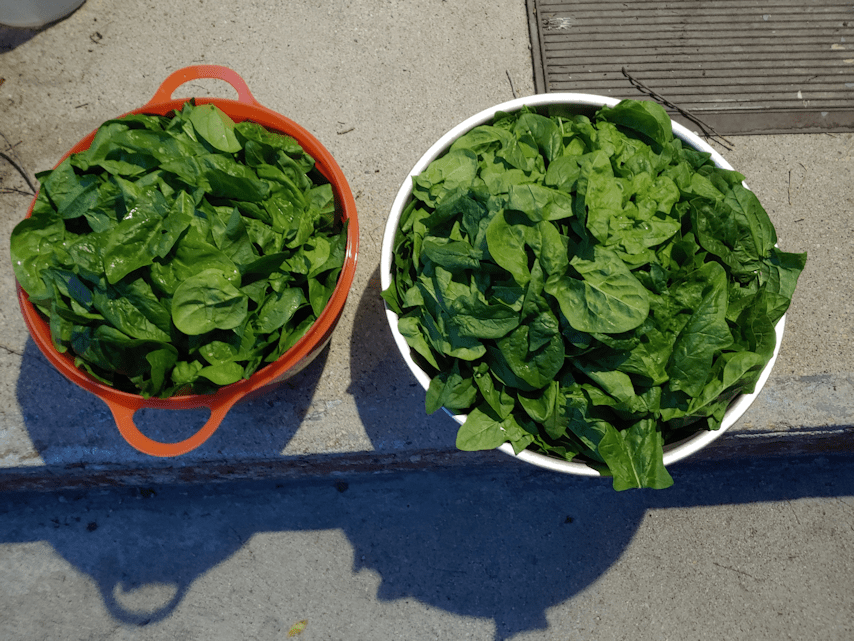
After about three hours, here are two of the three bowls that were filled. They are all really big bowls. Big enough to mix a 6 loaf batch of bread dough.
I’m hoping to be able to set up more batches to dehydrate out of this, but it depends on how well it works in the sun room. I’ve got the light I used to keep transplant trays warm on for the night, plus the ceiling fan. Tomorrow we’re supposed to get really hot, which means the sun room will be even hotter. I’m hoping that means they will dehydrate fairly quickly, and I can set up at least one more batch.
As for the rest, we might blanch some for freezing if we can’t use it up fast enough, but mostly, we plan to just eat it. :-D The girls have been looking of recipes for things like spinach soup to try, or maybe make another batch of their modified palak paneer sauce. We don’t have paneer, though.
I’m rather happy with our first garden harvest – and with being able to have one so early in the season!
While it may have taken a long time to clean it all, we were most entertained.
By skunks.
We had a whole parade of them, coming and going, including the mama and her babies.
All SIX of them!
I don’t know where she’s getting them all from! She started coming by with two. Then we saw her carrying a third. Today, she showed up with five – or so we thought. I took some video and, after I uploaded it and watched it, I realized there was six.
Gosh, they are so adorable! They came back several times, including just to run around an play.
As for the other skunks that showed up, I did end up stopping to take a hose to them. From where I was sitting, I couldn’t see them in the kibble house, but I could hear them, and they were not getting along. It turned out that only one of the containers had kibble left in it, and they were all trying to get at it. Then there was the one greedy guts that just wouldn’t stop eating.
Oh, and a question I had was answered. In the mornings, when I would go to refresh the cats’ water bowls, I would find one of them with kibble half dissolved in the water. It was always the bowl closest to the kibble house, but they’re far enough away that it couldn’t fall in by accident, as I had assumed was how it got into the heated water bowl, when we were still using that. The skunks, of course, use the water bowls, too. This evening, I saw one of the skunks come up to a water bowl, drink some water, then basically pick its teeth with its claws before drinking some more.
The reason it isn’t good for skunks to eat kibble is because of how their jaws are hinged. But they’ve got that figured out. The skunk was getting kibble stuck in its teeth, and was using water to get it out. The kibble would then fall into the bowl it was drinking from, for me to find in the morning.
They’re smart little buggers!
They also made what could have been a long and dreary job quite fun. :-)
Today, I finally got to harvesting the garden beds we planted where the old wood pile used to be.
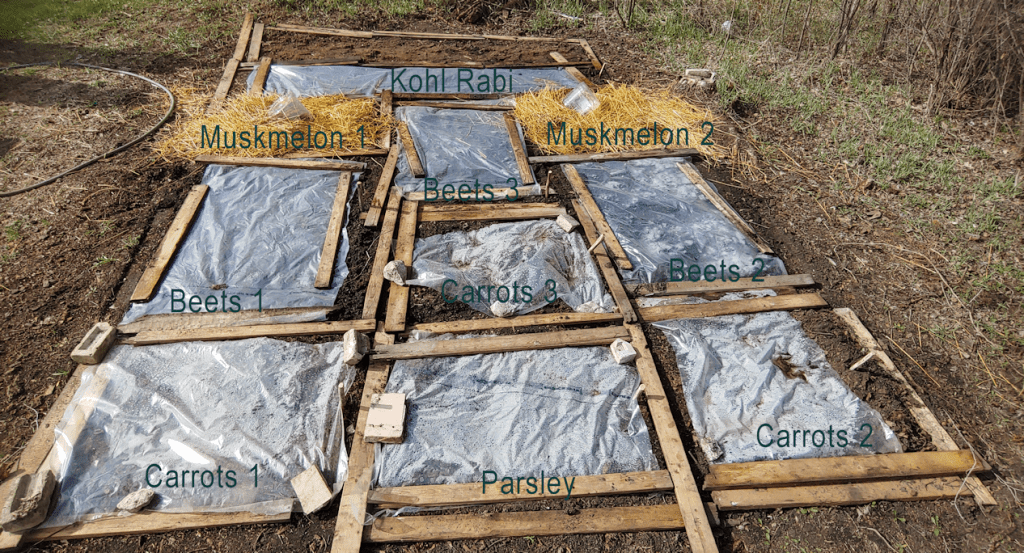
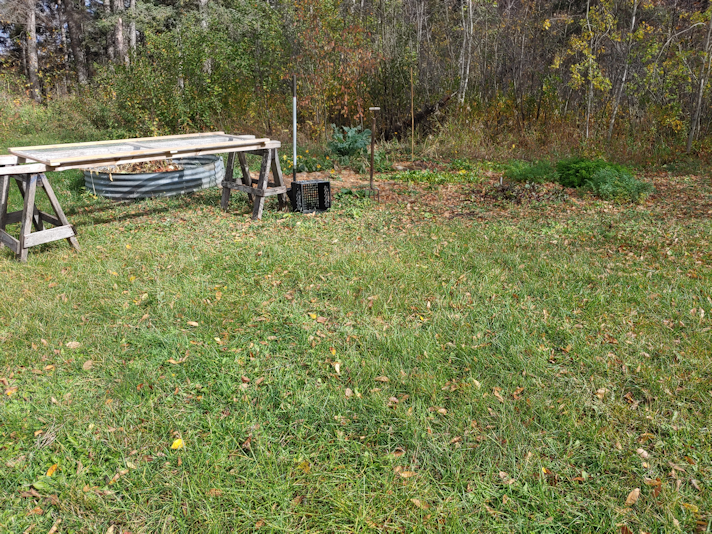
This is what we started with, in the spring.
You can read about how the garden plots were doing by August, here, so I won’t repeat myself in this post.
One of the things I’ve been thinking of, while working in the rocky soil of the old garden area, is that we need a soil/compost sifter. That would make clearing the rocks and debris out much easier.
While looking up different design ideas to build one, I suddenly realized…
We already did build one.
The screen “door” we made for the old basement doorway is basically the same idea as the steel mesh sifter my dad had made for gravel, decades ago. It just uses 1 inch mesh instead, and has a support bar across the middle. I’ll just need to reinforce the mesh before using it for something bigger or heavier, since it’s basically just stapled on in between where the wood holds it in place.
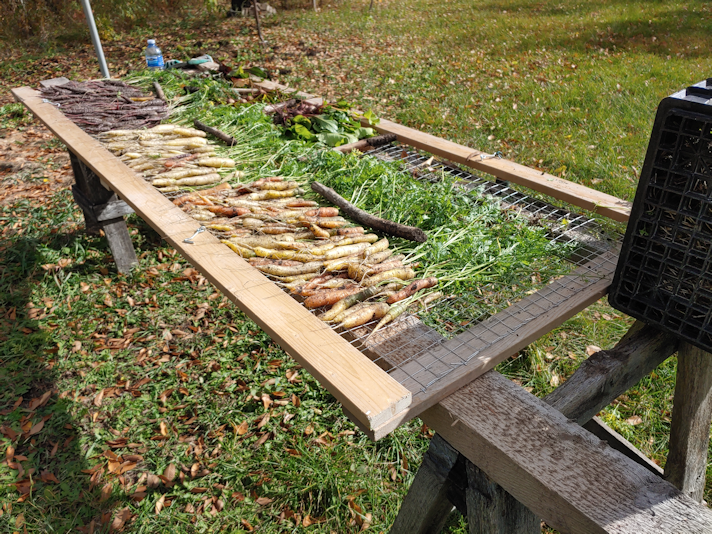
Last night, I realized it would also be great to use to lay out the carrots and beets after I harvest them.
It turned out to be perfect for the job.
Here is how I set up to start.
The saw horses were too narrow to support the screen, so I laid out a couple of 8 ft boards we didn’t use when building the goat catcher this past summer, to support the frame. I set up near the new compost pile, as I figured there would probably be a lot going into there!
It turned out to be less than I expected.
The few kohl rabi plants went straight in. That was a disappointment. So few came up and, between the bugs and the deer, only two got big, and then they got eaten. For those, I knew there would be nothing to harvest, so there were no expectations in that regard. I do want to try growing it again, but I’m not sure we’ll try again next year. I think it would benefit from a cold frame to plant earlier, and definitely something to protect from deer. Nothing we grew got attacked by insects the way these were, so we’ll need to keep that in mind before we try growing anything in the cabbage family again.
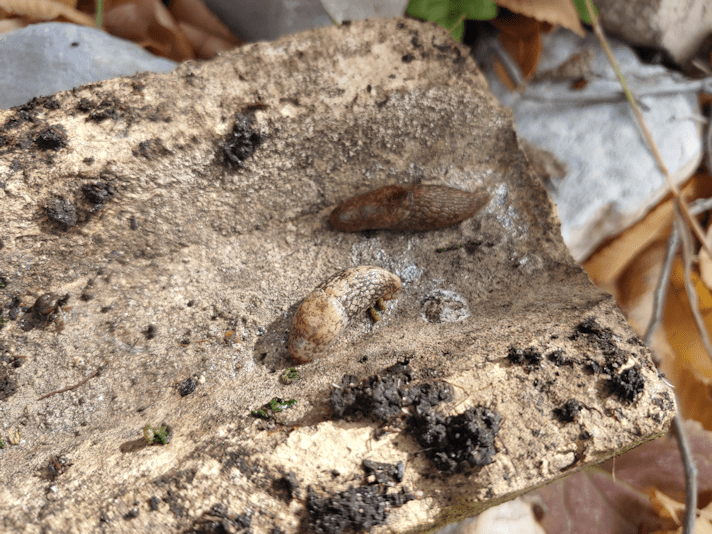
Of the one remaining musk melon, the frosts killed that off, and it didn’t even make it to the compost pile. It just shriveled away to almost nothing! When clearing away the bricks that were supporting the cloche that doubled as a slow watering container, I found some … friends…
Slimy friends!
That left the carrots, beets and parsley.
As far as expectations, I figured we would get a decent amount of carrots. We’ve been nibbling at them all summer, so I had a good idea of what I would find. I wasn’t expecting many, though, and not very many large ones.
With the beets, I was expecting nothing. Not long ago, the girls picked the biggest ones they could find and cooked them, and with the deer continuing to eat the greens, I didn’t expect any worth keeping at all.
I was pleasantly surprised!
We actually got quite a few decent sized carrots. Not the full size the varieties had the potential to grow to, to be sure, but still more than I expected.
As for the beets, I did actually find some of each variety that were big enough to not go on the compost heap. The smaller ones, this late in the season, were pretty leathery and not salvageable. I expected that of all of them, so getting the few we did was bonus. There’s basically enough for one meal, if we combine then all together. :-D
The last thing to harvest was the parsley.
Parsley is something that I could have left alone. They would come up next year, and I do plan to do that eventually. When I do, I will choose a permanent location for the plants. We don’t actually use parsley all that much, so these will be dried.
Since these were not hidden underground, I got exactly what I expected. A whole lot of parsley! I had to do some cramming to get them in that crate!
These all got left outside while I worked on cleaning up the garden beds – which ended up being completely different than planned, so that will get its own post! At the end of the day, because it’s been getting pretty chilly at night, we brought the entire screen into the old kitchen. The beets will be cooked soon, but we have to figure out what we want to do with all the carrots. :-)
The parsley, on the other hand, will have the greens picked over and trimmed, washed, then laid out on trays to dehydrate in the oven overnight. The new oven has a “warm” setting, which should be the perfect temperature for the job.
Once everything was harvested, the beds needed to be prepped for when the fall garlic finally comes in – hopefully, not too late!!
And… I went a bit nuts on that.
You’ll be able to read about that in my next post…
It’s working out to be a very unpleasant morning, weather wise! Thankfully, I was out earlier to do my rounds outside, so I could make sure the gate was open. We’ve got a septic company coming in to clean out our tank for the winter, some time this morning.
Checking on the sunflowers this morning, I just had to get some pictures to share.
The stalks have been stripped bare of any leaves under about 6 1/2 – 7 feet!
From the fresh pile of deer droppings visible at the bottom of the above photo, you can guess why!
The leaves were mostly frost damaged and already drooping. You can’t see in the photo, but the ground in places was littered with stems left behind after the soft parts were eaten.
It’s looking like we’re not going to get any actual seeds out of these. This seed head is one of the best that’s out there. Many never had the chance to fully open and get pollinated. Even the two I harvested and brought inside to dry are looking no different, really, than this one. I plucked a seed out of one of the dried ones, and it had pretty much nothing in the shell. I’m leaving these outside for now. The weather is going to cool down for a few days, then warm back up again, and the sunflowers are pretty much the last thing we’ll be cleaning out. Mind you, their role as wind breaks are rather defeated by the lack of leaves!
Our sunflowers may not be doing well, but it’s been a great year for farmers’ crops this year. After such a horrible year last year, this is wonderful news. A lot of people planted corn again, including our renter. Yesterday, we were hearing and seeing a LOT of traffic by our place. Checking the trail cam files this morning, I was seeing gravel trucks, hay bale trailers, trucks full of fire wood and farm equipment. It wasn’t until I’d gone through a number of images that I realized what I thought were dump trucks full of gravel were actually full of corn. Or, at least, they couldn’t possibly be gravel. The images aren’t very good at that distance and speed of subject! :-D I have one of the trail cams now set to stills instead of video, and going through that one, I counted 23 full loads going by! Those are just the ones that were captured. There could easily be more that got missed by the camera delay. At one point, the road was so busy, two dumpt trucks had to squeeze past each other in front of our driveway. That road is barely wide enough for two cars, never mind two dump trucks!
Sometimes, I kinda wish we lived even further into the boonies. Too many neighbours! Too much traffic! :-D
Today, we took advantage of the warmer weather and dug up our two potato beds.
The first one got done fairly early in the morning, before we headed to the city. Having already dug up a few of them earlier, I had some idea of what to expect, but I have zero experience with growing potatoes the “Ruth Stout” way.
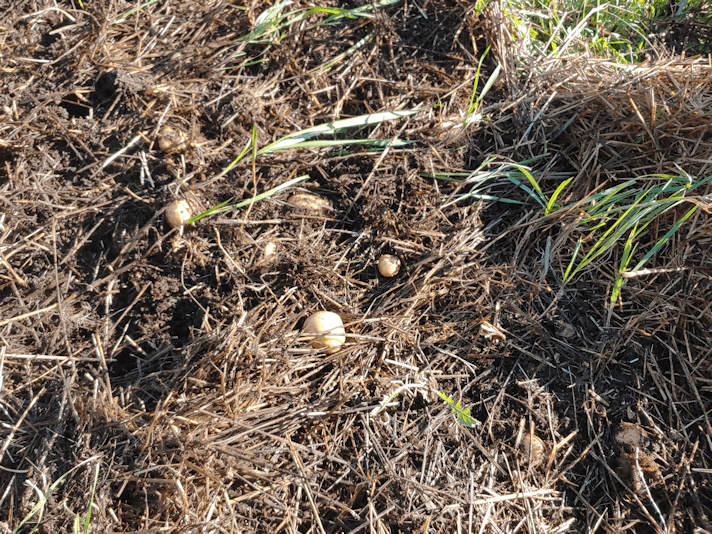
I first pulled up the potato plants, then carefully used my potato fork to lift off, then “rake” the mulch away. Here, you can see some of the potatoes I uncovered in the process.
I also uncovered several chilled little frogs! I carefully moved them to the mulch by the squash, where they could warm up in the sun.
I also uncovered slugs.
I did not rescue them. ;-)
Almost all the potatoes I found were just sitting on top of the soil! Some took a little more raking away of the mulch to find, but not much more.
What had been rock hard ground when we started, the mulched soil was so much easier to work – even with all the rocks.
I took advantage of the situation and dug up the entire plot, so I could pull out as many weed roots as I could. The crab grass came out pretty easily. Then I hit a solid mass of roots near the surface, with a tap root of some kind that continued deep into the ground. I could not get it out with the fork! If I’d had the spade handy, I might have been able to cut through it, but since it seemed to be dead, I left it. It will be buried.
I did find a couple more potatoes in the process!
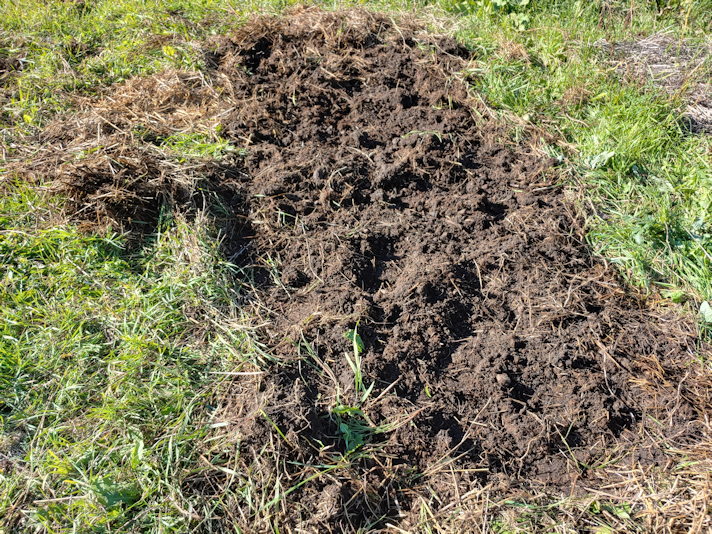
The end result looked like a 4×8 foot grave! :-D
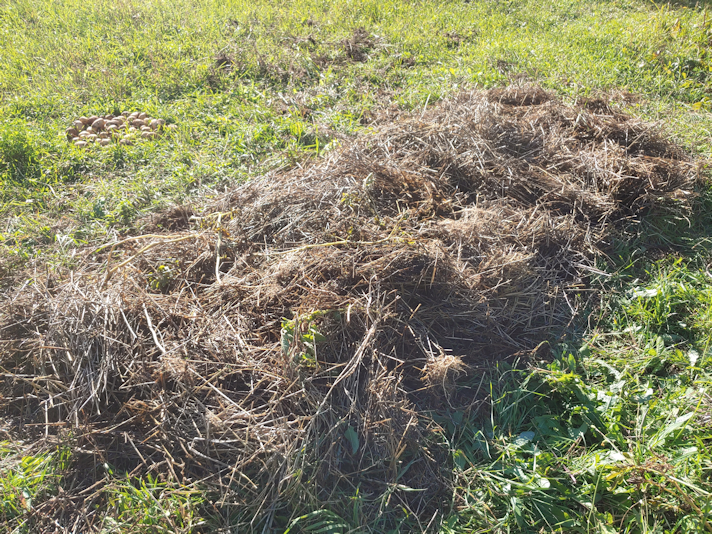
When I finished pulling up as many roots as I was able, the mulch all went back – along with the potato plants that had been pulled up.
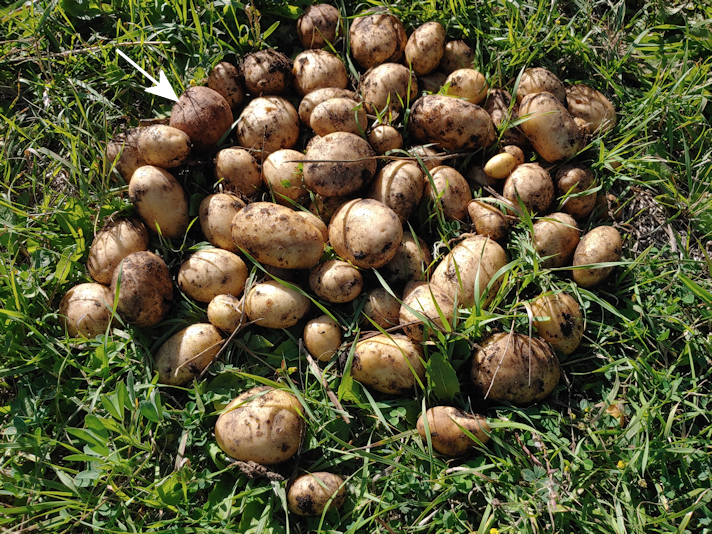
These are all the potatoes I got out of the one bed.
Also, note the one slightly darker potato with the arrow pointing to it. I’ll explain that, below!
When we got back from the city, I continued working on the second bed.
Once again, I was finding most of the potatoes on the surface of the soil as I pulled away the mulch.
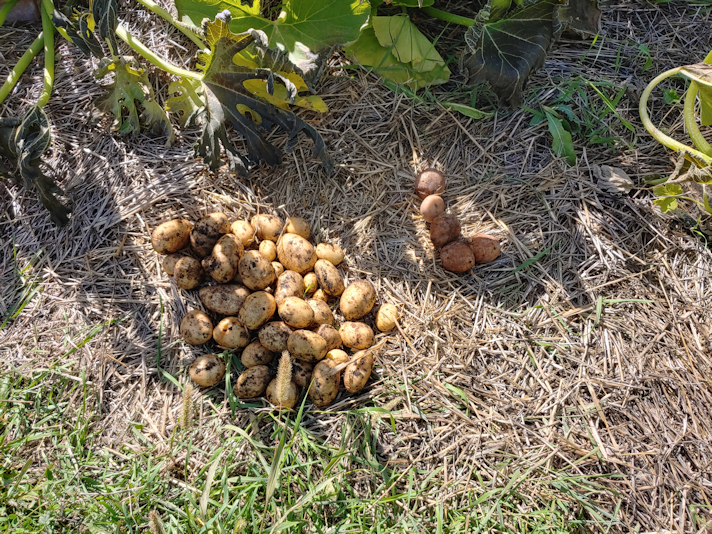
These are all the potatoes I found, before I did any digging at all. Unfortunately, quite a lot of them had holes eaten into them. :-( After digging, I found maybe 5 more.
Speaking of 5, do you see those 5 darker potatoes on the side?
Those are the original seed potatoes! The other bed had only one. While they had stems and roots that I broke off of them, they are just as hard as the day I planted them. I found the remains of some other seed potatoes, all mushy and used up like one would expect at the end of the growing season.
I got two 3 pound boxes of seed potatoes, which gave me 3 row of 6 potatoes in one bed, and 3 rows of 5 potatoes in the other, plus an extra. That’s 34 potatoes – and 6 in total never grew more potatoes!
As with the previous bed, I dug it all up, finding a few more potatoes, a whole lot more slugs, and pulling out weed roots.
Would slugs be the cause of those holes in the potatoes?
This bed had quite a few more rocks near the surface that I got rid of, too. My fork was hitting many more as I dug down, but I didn’t try to get them out, since we will continue to build these beds up. The mulch and old potato plants went back over the soil.
I then took all the harvested potatoes and laid them out on the dry straw mulch between squash beds, so they can cure (is that the right word for it?) in the sun. Except for the tiniest ones, which will be cooked and eaten right away. :-)
I then had the 6 original seed potatoes. What to do with those??
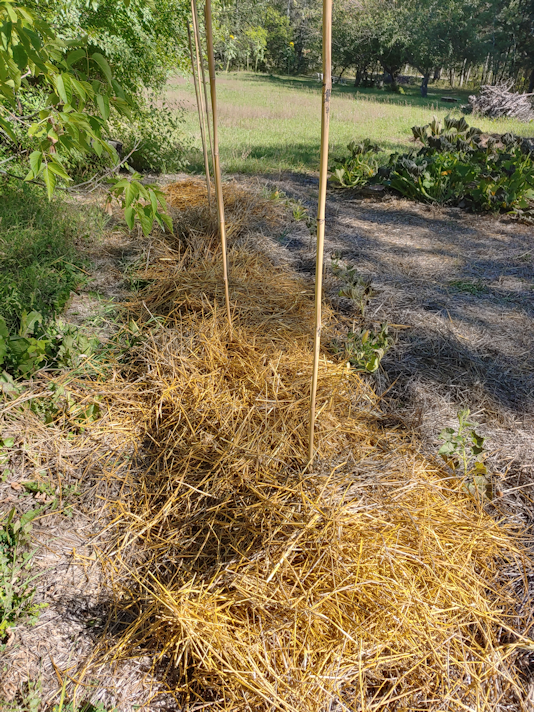
Yeah. I planted them, almost the same way they were planted in the original beds. The only difference is that I did loosen the soil a bit, first. Not to bury the potatoes – there are so many rocks along this end, I could barely do more than scrape away the mulch on top! No, it was so I could push in the bamboo poles to mark where they are. Even then, I don’t think the poles will be able to stay up for long. I could barely get them into the soil at all. No matter how I shifted and searched, I kept hitting rocks just inches below the surface.
What will most likely happen is that the potatoes will freeze over the winter, and nothing will come of them. Another possibility is that they will be protected by the mulch and, as soon as it gets warm enough next spring, they will start growing and we’ll have early potatoes started.
We’ll find out next year!
As for now, the potato beds are put to bed for the winter. I don’t know what we will plant in those spots next year. We do intend to do potatoes again, but in a different location. We don’t want to entice the Colorado potato beetle by planting in the same location again. We didn’t see a single one this year, but one of my neighbours a mile up the road mentioned that his potatoes had been decimated by them! My parents always planted lots and lots of potatoes, and I well remember going through the rows, picking off the beetles or their larvae, and hunting for the eggs to crush. Even with several of us doing that every day, some years my mother had to resort to using a poison powder of some kind, to get them under control.
I’d really rather not have to deal with them at all, if I can avoid it!
As for the squash, for now I have stopped harvesting any more of the sunburst squash, though there are a couple of zucchini that are almost large enough to pick. I prefer them when they are quite small, but with the sunburst squash, I want to give them as much of the remaining warm weather as I can for them to grow. As I write this, past 6pm, we are still at 21C/70F. We are supposed to stay fairly warm over the period covered by the long range forecast, with no more frosts expected overnight. That should give our produce a bit more time before we have to harvest what we can, then prep for the winter – and next year’s gardening! :-)
Our first year gardening since moving here has been quite interesting, and quite the learning experience. We will, for sure, continue using the Ruth Stout method until we are able to start making the accessible raised beds that are the ultimate goal. The extensive use of mulch is making a very noticeable, positive difference in the soil, even after just one year. My mother may be disappointing in our gardening, compared to what she had here, years ago, but I’m happy with our progress so far! :-)
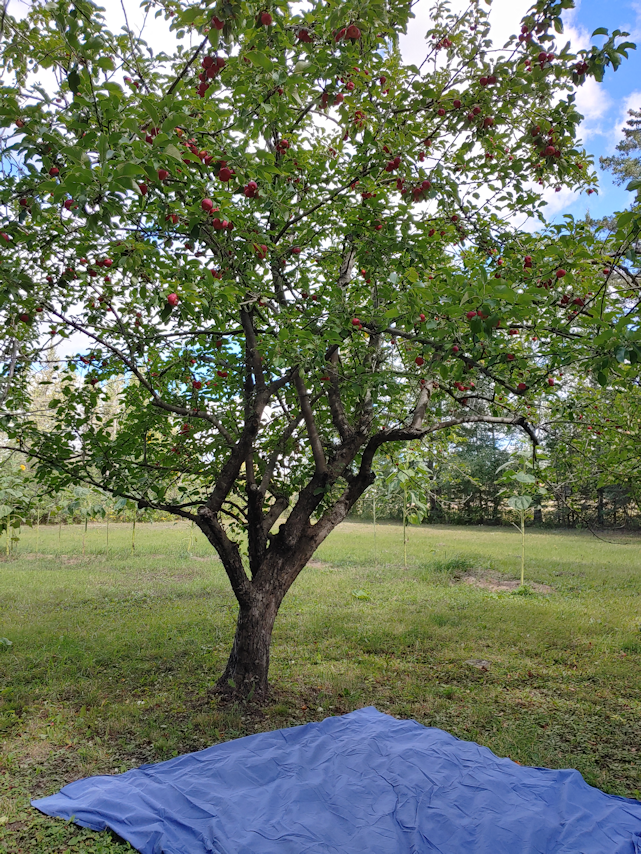
Today, I headed out to pick the apples off of one of our crabapple trees.
This is the one that has such bright red, sweet apples. It also ripens earlier than the other trees.
Last year, most of the apples disappeared before I had a chance to harvest them, so I wanted to get them before the … deer? … get them first.
When we were cleaning things out, I was flummoxed by finding a grabber with spoons attached to it. My mother eventually remembered that my dad used it to pick apples.
I’m happy to say that it works absolutely beautifully!
Since there were so many apples to pick this year, I laid out a sheet on the ground for them to fall on. It also made it much easier to move the apples into a bucket.
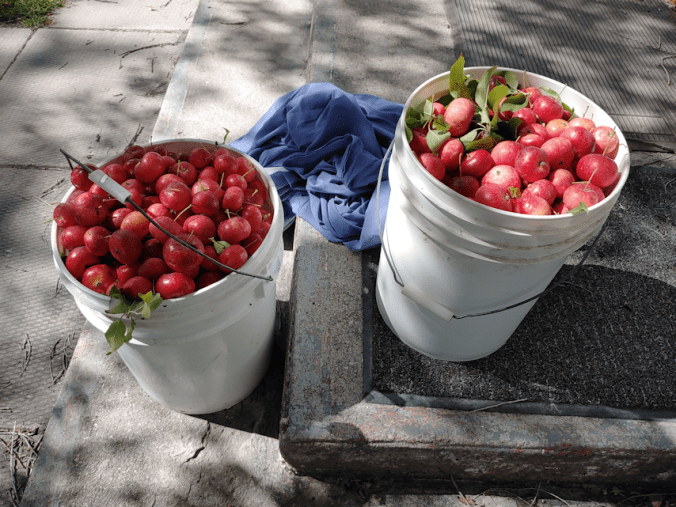
I was able to fill a 5 gallon bucket just with the apples I could reach with my hands, or the grabber. I did try shaking the trees, too, but the branches are a bit too thick to be able to shake much at that height, so I didn’t get a lot that way.
Using the step ladder, I was able to fill another 5 gallon bucket. I could have gotten more, but by then, it was getting too dangerous to try and get the apples, even with the grabber. The remaining apples will be for the birds. :-)
Ten gallons of apples is so awesome! Last year, I used the apples from this tree to make apple cider vinegar. After trimming and chopping, I filled a quart jar 3/4s full.
That’s it. That’s all we had.
This year, I plan to make more apple cider vinegar, then juice at least a gallon, to make hard apple cider. There should still be plenty to give to my family, when they come out this weekend, if they want some.
For the hard apple cider, we have gallon jugs, bungs and airlocks to use. When we made apple cider vinegar in a quart jar last year, it was a success, but there was a problem with fruit flies being attracted to the coffee filter covered jar in the cupboard. So this year, I plan to use an air lock (they’re so cheap, I’ve been buying extras).
I’ll be using a repurposed gallon sized pickle jar for this, which means I need to find a way to get an airlock into the lid.
Which I’ve already gotten started, and will show how in my next post. :-)
What a difference in how they looked, two years ago, and now! The above photo is from 2 years ago. This year’s grapes are easily double in size – and these are not a large fruit variety!
It’s even more appreciated, since after cleaning out and trellising them last year, we didn’t get any grapes at all last summer. Not a one.
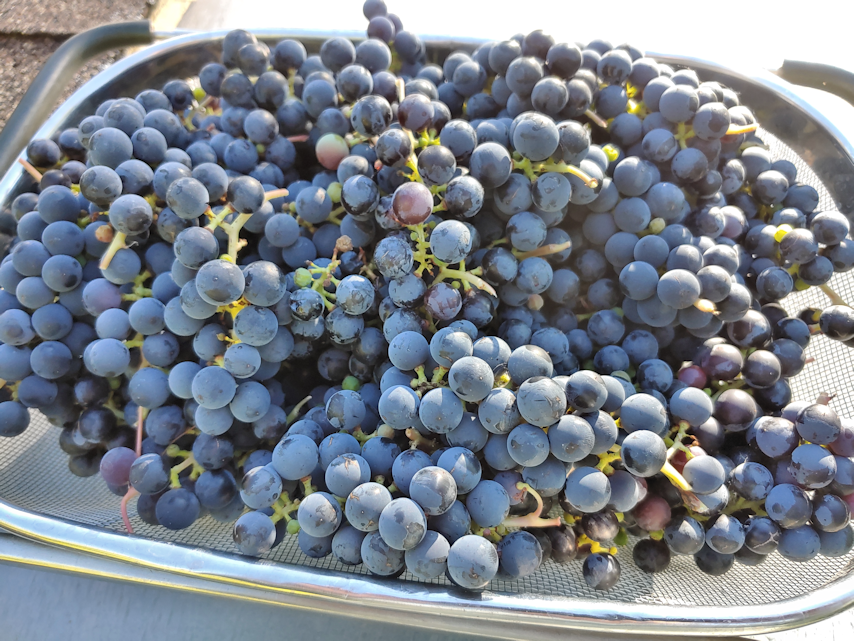
In picking the grapes this morning, I did have a bit of a problem. Most of the grapes were on the other side of the trellis. Which is when I realized the trellis was so close to the wall, I couldn’t get at them.
Thankfully, the trellis is just on a couple of bars pushed into the ground for support. I was able to move them a few inches away from the wall, and that was enough for me to be able to get back there to harvest the grapes. I’ll have to go back to them to pound the supports into the ground more, but I will likely do that when I prune the vines before winter.
At the moment, we’re not really sure what we want to do with the grapes, so they’ll be given a wash, then frozen, like we did with the chokecherries. If we do decide to do something like a jelly or syrup, or add them to the must when making mead, freezing them first will make it easier to extract the juice.
I must say, for a variety that clearly isn’t a table grape (my mother doesn’t remember what they were), they taste quite good, just as they are!

















 The Re-Farmer