Analyzing our 2024 Garden: odds and sots

For the next while, I’ll be going through my old posts and videos about our 2024 garden, looking at how things worked out, and use that information to decide what we will do in our 2025 garden.

Okay, here is where we talk about everything else. The perennials, the food forest and so on.

Sunchokes, asparagus, grapes, zucca melon and walking onions

Sunchokes: last year, I didn’t harvest any at all so that we would have more growth and a larger harvest this year.

That plan worked out rather well! We got quite a lot of sunchokes, and the largest ones were replanted for next year. We’re still learning what to do with them, but this is something we know grows here and will come back every year.

The only downside is that I found quite a few tubers with chonky caterpillars burrowed into them. Some burrowed all the way in, where they died. Some, with half their bodies still sticking out of the tubers! I have no idea what these are, and need to figure out how to get rid of them.

Asparagus: We planted these purple years ago, and should be harvesting them by now.

We are not.

In planting the crowns, a trench was dug about a foot deep, then the bed itself was hilled to give them depth they are supposed to have.

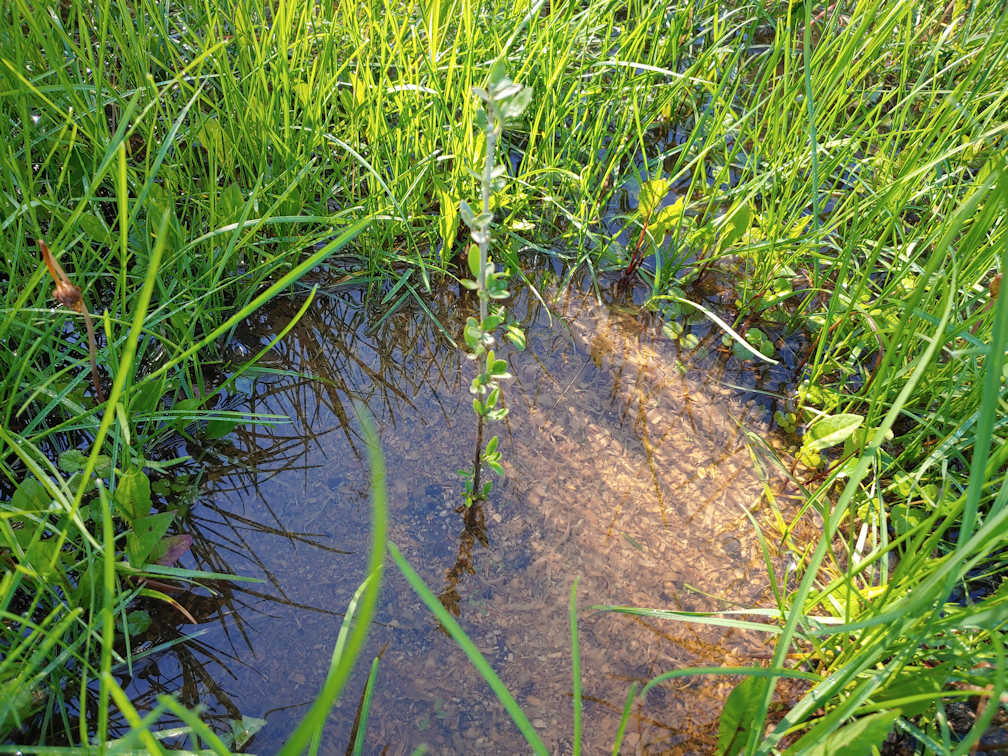
Then we discovered that, in wet springs, a moat forms around our garage, including through the vehicle gate into the yard.

Which is where the asparagus is planted.

At that depth, even though the bed itself is above water, the crowns would be saturated.

We need to find another place to grow asparagus. I don’t know that we’d be able to salvage this purple variety. The challenge is finding a place where they can be left to grow for the next 20 years – and not get flooded out!

Grapes: In cleaning up around the storage house, we found two grape vines my mother had planted. We made a trellis for them and have been trying to keep the spirea from invading them, every since. Last year was the first year we looked to be getting a really good harvest.

The very morning I was planning to harvest them, I came out to find the trellis knocked down on one side, and all the grapes gone.

Racoons.

This year was shaping up to be even better.

Then one morning – while taking recordings for a garden tour video! – I discovered all the grapes gone, again. They had disappeared overnight.

Racoons.

I want to transplant these, perhaps on either side of an arbour they can climb on. Maybe closer to the house, where we can better protect them from racoons!!!

Zucca melon: This is one of those things I’ve been trying to grow for years. They are supposed to get huge – up to 60 pounds – and actually grow in our climate. They never seemed to do well.

This year, I thought we’d finally get some. We had strong and healthy transplants, and they went into the kiddie pool raised bed, so they wouldn’t get the elm tree roots invading them.

The slugs got them.

*sigh*

Next year, I want to try them again, but this time in the new bed the Crespo squash did so well in.

I just have to find a way to keep the slugs off!

Walking onions: When we first moved here, every spring, a single walking onion would appear along the edge of the old kitchen garden. There used to be a fence and a tire rim planter, with a tire cut in half and flipped inside out as the “pot” near that spot.

Every year, this one onion would grow, then something would smash it flat.

One year, I managed to keep it from getting broken long enough that it formed bulbils. I took some of those and planted them along the south side of the tiny raised bed nearby, where they would get full sun while being protected by the logs making up the raised bed wall.

At the same time, that side of the old kitchen garden was cleared as best we could, and my daughter planted flower bulbs as a border. We eventually added logs on the outer edge as a protective border, with a couple of openings line with rocks or bricks to walk through. In placing the logs, I was very careful to place one log outside of where I knew that one onion was.

It never came up after that.

The bulbils we planted, however, grew and thrived. When they formed bulbils, those were harvested to cook with, rather than allowing them to reach the ground and spread. We don’t want them to take over! These should continue to come back, year after year.

Milkweed, saffron, tulips and other flowering bulbs, wildflowers and … salsify?

Milkweed: When starting seeds indoors, I started some Shades of Orange Butterfly flower – a type of milkweed. Very few seeds germinated, and the ones that did, did not do well. When we were finally able to start transplanting outside, I was at a loss on where to put these sad little seedlings, as these were something I wanted to reseed itself, year after year.

Then I found one of our yard cats, passed away. He was buried in a bed that was supposed to get poppies in it, but we completely lost control of the weeds in it. After he was buried, I transplanted the milkweed on his grave, in hopes they would survive. They did not.

Tulips: My daughters planted tulip bulbs in an area of the west yard, not far from the old kitchen garden, several years ago. We had gotten rid of some dead crab apple and other trees around there, and there is a lilac hedge behind it – lilacs that are doing much better, now that they are not overshadowed by dead and dying trees! It’s a well sheltered and protected area – from the weather, at least!

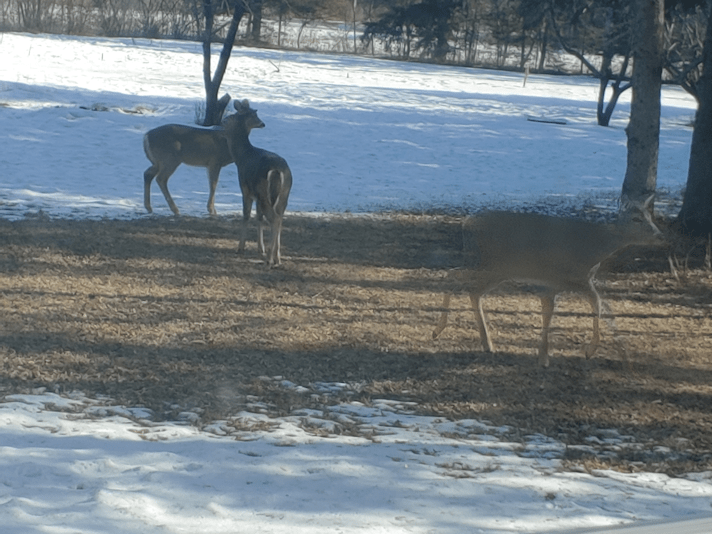
Deer love to eat tulips.

After several disappointing years of tulips being eaten just before they started to bloom, we were starting to think the poor bulbs weren’t doing well enough to store energy to survive the winter.

After having to remove one last diseased crap apple tree, and the remaining stump of one that died long ago, we put in some fence posts and surrounded the entire area with bits and pieces of salvaged wire fending and chicken wire, with one side tied in place to serve as a gate for accees.

This year, much to our surprise, we had the most tulips blooming, ever! We even had some coming up in areas they hadn’t been in ages, and we thought for sure they had died.

Best of all – no deer damage!

I look forward to the tulips finally being able to spread through the area, as we originally planned for them.

Grape Hyacinth and snow crocuses: On the other side of the lilac hedge where the tulips are, is part of our maple grove. A few years ago, in one section, we planted 200 grape hyacinth bulbs. In another section, we planted snow crocuses. The hope was that they would spread and grow and eventually take over those areas, so we wouldn’t need to mow or weed trim it anymore.

This year, we did get both, but neither did as well as the year before. I think our late spring, with heavy rains and flooded out areas, was too much for them. They should continue to come back, year after year, though, and hopefully continue to spread and fill the areas they were planted in.

Wildflowers: I had picked up Western Wildflower and Alternative Lawn mixes of seeds. After we had a couple of branch piles chipped, we were left with bare patches of soil in the maple grove, and we tried planting them there. If any of them survived, though, I don’t know. We did have some things come up this year that might have been from these mixes, but I can’t say for sure. There was one that came up that I was very diligent about pulling and destroying, though. I don’t know if it was part of the mix, but we have them all over in the spruce grove. They have beautiful sprays of tiny flowers that turn into tiny little burs. If you walk anywhere near them, you’ll find your pant legs and sleeves covered, and they do NOT want to come out! Worse than burdock! They are almost as invasive as creeping bellflower or creeping Charlie.

We have an insulated tarp that we put over our septic tank. It’s large enough that we fold it in half to use it. When the tank was uncovered in the spring, I laid it out in the maple grove nearby and weighted it down. It stayed there all summer, in hopes of killing off anything growing under it, which was mostly creeping bellflower.

When it was pulled off, I found some things were still growing along the edges, but most of the weeds under there did seem to have died. I put the Western Wildflower mix into a shaker with some seed starting mix I still had and, after clearing and loosening the soil first, scattered the seeds over the area, raked it again to cover the seeds, then mulched it, as was done with the winter sown garden beds.

Hopefully, it will work this time, and we will have native wildflowers growing in this patch. If all goes well, I would want to harvest seed heads from it to scatter throughout other areas of the maple grove. There are just a few areas where we want to maintain clear paths of grass. The rest, we want to be taken over with flowers of all kinds.

I have not yet decided were to try the alternative lawn mix, again.

Salsify?: In preparing garden beds, I found a plant growing in an area I needed to dig up. I recognized the leaves as something that has been growing and blooming pretty wild. They are quite pretty, so I dug it up and transplanted it into one end of the low raised bed with the seed onions and Summer of Melons mix.

It grew very well, bloomed beautifully, and developed huge seed clusters.

Any time a seed cluster looked like it was ready to be blown away with the wind, I plucked the seeds and scattered them in the same area at the far end of the bed, where they could sprout next year.

As for what they are, it was suggested they might be salsify, which is something we actually have seeds for that we wanted to try growing. The roots apparently taste like seafood. The seed catalogs only had photos of the roots, not the flowers, but in looking online, the flowers did look like they could be salsify. When cleaning up the bed in the fall, however, the roots were completely different. Certainly not a tap root that one could use like a carrot or parsnip! It’s possible that just means they are a different variety of salsify, but I don’t know. Whatever they are, though, we might have ourselves quite a lot of them in that one spot where I was dropping the seeds!

The Food Forest: apple, haskap, mulberry, raspberries, sea buckthorn, silver buffaloberry, highbush cranberry and Korean Pine

Liberty Apple: this is the first variety of eating apple we’ve planted. It is a zone 4 apple, but we planted it near the lilac hedge by the old kitchen garden, where it should be more protected. It survived its first winter. Hopefully, it will survive this winter, too. It will be a few years before it starts producing fruit, though. We just need to keep it alive! As it grows, I’m hoping to be able to esplanade the branches, too.

Haskap: We planted these years ago, and we should have been getting lots of fruit by now. Unfortunately, they are not doing well where they are planted. I suspect it is because they are between an elm tree and a lilac bush, and there is too much competition for resources. There are also flowers that come up around them every year, but their root systems are very different, so I don’t think they could be a problem. I am thinking we should transplant them where we will be having the bulk of our food forest, but my daughters are concerned that transplanting them will kill them off.

The main problem, though, is that the “Mr. Haskap” variety, which is meant to cross pollinated with the “Mrs. Haskap” variety, blooms earlier. At most, we’d find a couple of berries, here and there, and that’s it. This year, we actually had the most berries yet.

A small handful of them. Which meant we at least had a chance to taste them!

They are very tasty.

I still think we need to transplant them.

Mulberry: last year, we ordered a Trader mulberry – a zone 3 variety. This is the second time we’d tried mulberry, and the first was killed off by a late and severe spring frost.

They were out of the 2 year size, though, and were instead sending out two 1 year seedlings, instead. They were so tiny, we didn’t transplant them at all. Instead, we potted them up and kept them indoors through the winter.

This spring, they were planted along the north edge of the property, in our main food forest area. Because these can get quite big, I wanted to make sure they were positioned where they would not overshadow other fruit trees. There is a lilac hedge along the fence line, and one of them was strategically planted in front of a gap in the hedge, where the deer have been getting through. This allowed me to plant it slightly tucked in among the lilacs for extra protection from the elements, until they get bigger. The other one was planted the distance recommended for the size they can get. There, I pruned back the lilacs to tuck it further in, in line with the first one. Both got well mulched, and have some salvaged wire fence around them, to protect them from critters.

This is their first winter. Hopefully, they will survive, and in a couple of years, we will get to find out what mulberries taste like!

Raspberries: My mother has grown raspberries here for as long as I can remember. They also pretty much grow wild. She had last transplanted raspberries in an area on the south side of the main garden area, under a crab apple tree and a chokecherry tree.

Not a good place for them.

There are also other trees planted between the house and the main garden area; my parents added more of the years, encroaching on what used to be part of their garden, rather than on the north side of the property. As a result, they create a lot of shade in places that used to be able to grow lots of vegetables.

We did get small amounts of raspberries to enjoy, though and raspberries, being raspberries, spread. In this case, near the crab apple tree, there had been a compost ring. When it was full, I moved the ring to another location and started to dig into the old compost pile, expecting to be able to use it.

That’s when I found out someone had been using it for garbage. I also found lots of larger branches in it.

After cleaning out as much garbage as I could find, we left the pile to break down more.

Then the crab apple tree got the fungal disease that’s killing off so many of them and died. I cleared that away, which has actually improved things, as the raspberries on that end now get more light.

The raspberries have taken over the old compost pile and are thriving in it, so this past summer, we had quite a lot of raspberries.

Which is good, because the purple variety of raspberries we got for the food forest area did not do well.

They actually produced fruit last year, which was their first year. I was expecting to get berries in their second year; most raspberries produce on second year canes. This year, only one of them survived the winter, and being a first year cane, did not produce. It also didn’t grow well.

We also have a couple of raspberries I bought for my daughter. They were planted in the main garden area, near the trees that are causing us so much trouble.

It turns out, deer like raspberry leaves, too.

They are now protected, but we’ll have to transplant them somewhere away from those trees!

Raspberries are something we want to grow lots of. We are working towards having early, mid and late season varieties. Along with the purple and red varieties, we want to add in a golden variety.

We were supposed to get more for this year, but the budget did not allow for it.

What we might end up doing is transplanting some of the ones in the old compost pile into the food forest area, too.

Sea Buckthorn: We bought a 5 pack of sea buckthorn, which were planted in the north east corner of what is now our main food forest area. The lilac hedge sort of peters out by this point, creating another gap the deer were taking advantage of. After planting them, they got a buck and pole fence put over them to protect them and keep the deer from running through the space.

They didn’t all make it. I suddenly can’t remember if we have two or three left. Sea buckthorn, however, needs one male for every 4 females for pollination. No male, no berries. It’s unlikely we have one of each, so we need to replace the ones that died. Which we intended to do this year, but the budget did not allow for it. The ones that did survive, though, do seem to be doing okay.

Silver Buffaloberry: These were purchased as a bundle of 30. Their placement was deliberate to double as a privacy fence as they reached full size. So far, we have lost maybe 3 in total, which is pretty darn good. It will be a few years before they reach full size and start producing berries. The berries are edible, but if it turns out we don’t like them, they will be good for the birds.

Highbush Cranberry: At the start of the two rows of silver buffaloberry, we had a pair of highbush cranberry. For some reason, the deer kept eating one of them. It is currently protected by and old saw horse, directly over it. It has survived! Both will also need several more years before they start producing fruit.

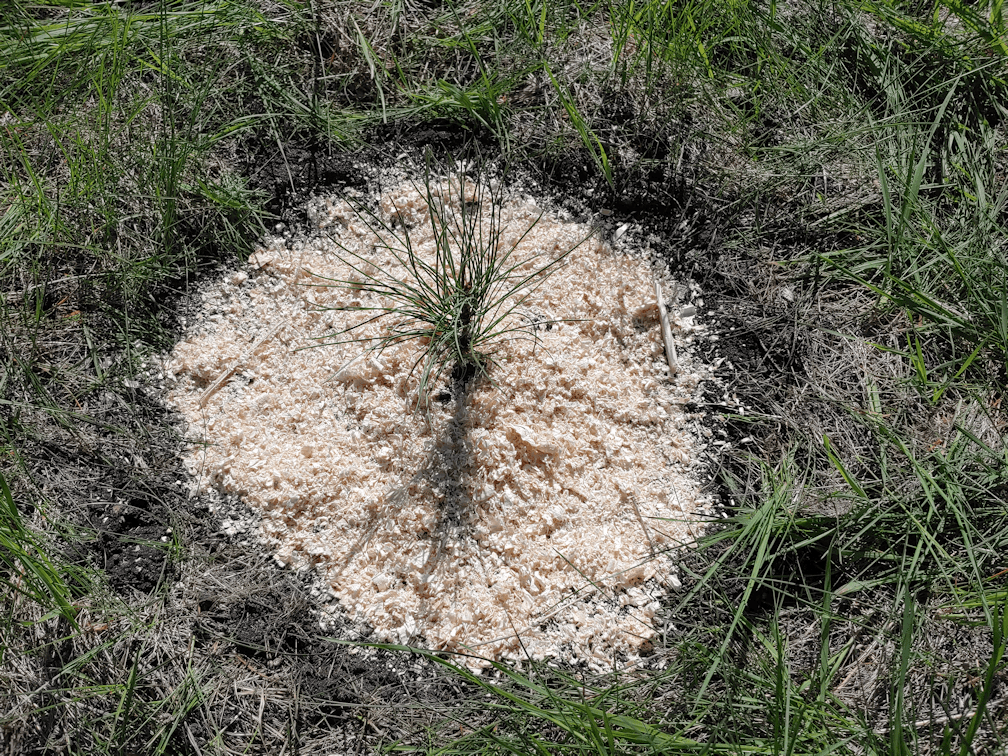
Korean Pine: I keep forgetting about the Korean pine, because they are the only things planted in the outer yard. We started off with 6 seedlings. We are down to three. They are supposed to be slow growing for their first few years, then start shooting up. This year should have been that first year of increased growth. They’re still quite small, protected under their chicken wire cloche. Unfortunately, we haven’t been able to give them the care they should be getting. If only one survives, though, I’ll be happy. It’ll be years before we’ll have pine nuts to harvest, but one mature enough tree would be able to provide more than we need.

Conclusion and planning ahead

It was certainly a mixed bag with how these things went this year.

When it comes to these more permanent things, both food and flowers, we are in for the long haul. These are things that can take years to get where we want them to be.

We had intended to expand this year but our biggest struggle has been with the budget. Aside from everything becoming more expensive, we had so many things that needed to be replaced or repaired this year.

Oh, I just realized, I forgot one more thing: our rhubarb!

We have two patches on opposite corners of the old kitchen garden. The one in the south corner has given us rhubarb to harvest every year, but the one in the north corner has struggled. They both have ornamental crab apple trees growing over them, but the south one manages to get more light. The north one had some dead branches that got cleaned away this year, though. Between that and, I believe, the heavy rain we got this spring, the rhubarb in the north corner was the best we’ve ever seen!

At some point, though, they will need to be transplanted to a better, more open, location. That can wait a few years, though.

Which is pretty much the thing with all our plans for growing food. The ultimate goal is to be as self sufficient as possible. Part of that goal is to have as many things that are either perennial, or will seed themselves, year after year. I’m no spring chicken, and I know my years of mobility are limited. I’m already pretty broken.

Along with planning what we will be growing year after year, we are also thinking 2 years, 5 years, 10 years ahead. We want to add more fruit trees, and even nut trees, though there are few that will grow and produce in our zone 3 climate. As we add animals to our mix, growing food for them will also be part of the planning.

We’re in it for the long haul, though.

It’s a bit different in our situation, in that we don’t own this property, but have the freedom to do this. In the long term, this property could end up belonging to my brother’s grandsons. So all these things that we are doing could ultimately be there to benefit two little boys currently living in another province!

Who knows?

We just do what we can for now. I’m just thankful that we are here, and that we have such a good working relationship with my brother. Everything we do here is a benefit for him, too.

That makes me very happy.

The Re-Farmer

Analyzing our 2023 garden: things that never happened

When we moved here, we had set out a five year plan with goals for various areas. It was in year five that we expected to finally be ready to plant a garden, which would have been last year (counting our summers, since we moved in so late in the year). My daughters, however, were keen on getting things started. Prep was done in the old garden area starting in 2019, with our first garden planted in 2020, which you can read about here.

With our goal to eventually be able to grow and produce as much of our own food as possible, the gardens have been expending every year since.

Until this year.

This year, it was probably half the size of last year’s garden.

There are several reasons contributing to this.

The first were the far flung beds that were done as part of our food forest plan. With the exception of one newer bed where the Crespo squash were transplanted, this meant the squash/bean tunnel, the pea and bean trellises, and the corn and sunflower patches were not used for growing vegetables. In that area, we’ve progressed in our food forest plans, and will continue to plant more trees and bushes in that area as the budget allows.

Last year, we got three new large areas prepared, where we planted potatoes, melons, squash and corn.

All of which got flooded out.

We did have things to harvest in the old garden area, thanks to the raised beds we had. We already wanted to go to all raised beds because of how rocky and nutritionally poor our soil it. My mother was able to garden here because my dad had a tractor to plow the area with and spread manure from our herd of cows over it, plus she had 5 kids to help her pick rocks! That and my mother has two green thumbs. 😄 The soil condition was much better back then, but that was many years ago. Yes, there were still gardens grown here over the years, but they grew ever smaller, and eventually my parents stopped gardening and it was the younger of my brothers that grew a few things. It did also get plowed at times. I only know that because the last time it was plowed, some time before we moved in, it was done by the person that would become our vandal, and my sister thinks he had to have been drunk when he did it. We’re still dealing with the mess, and just trying to mow the area has been damaging our lawnmowers, no matter how careful we try to be.

After seeing where water collected the most during the flooding, the new areas we’d claimed last year were going to be converted to a series of raised beds joined by trellis tunnels. We were supposed to build the first ones in the fall of last year.

That didn’t happen.

Which I didn’t mind too much, since it gave me time to rethink how we wanted to build them.

So they were going to be built in the spring.

That didn’t happen, either.

These are going to be built mostly out of dead spruces we need to harvest out of the spruce grove, but felling these trees is not as simple as it sounds. With the help of my brother, we did eventually get some down (though one of them got stuck on other trees, and I still haven’t gotten it completely out yet), but it still took forever to finally process the trees. In the end, we only managed to get one low raised bed framed out. The high raised bed is four logs tall and 9 ft long. The new bed is two logs tall and 18 ft long. This series of beds – hopefully there will be six in total – will all be 18ft long, joined in pairs with trellis tunnels. The way we’re building them now, if we want to make them higher, that can be easily done.

In the end, the areas we’d reclaimed the year before, did not get used this year. They were just too overgrown and we won’t be able to do anything in those areas until the new raised beds are built.

Which meant we were using about as much garden space as we had maybe two or three years ago, instead of expanding as planned.

It was very frustrating for me. I’d bought so many seeds, in preparation for having a larger garden! Plus, we still had seeds from previous years to use.

I go through all of those in this video.

So here are some of the things we didn’t grow, mostly because we just didn’t have the space, but also the things that failed.

These are seeds we’d ordered from Veseys.

We planted pretty much everything in the paper envelopes in the above photo. The beets failed completely, but the rest did pretty well. In the beans, we had yellow and green bush beans that got planted in the high raised bed that did well, even after they got eaten by deer, but we had planned to grow varieties of poles beans, drying beans, and even some beans my mother gave me that go trace back to her own days of gardening here. The Red Swan beans were only planted late in the season, with the purple corn, for their nitrogen fixing properties, though we did get beans to harvest out of them.

We did plant the Dalvay peas, but not the Espresso corn. We have several varieties of short season sweet corn, but didn’t plant any of them at all. There was simply no space for them.

We did get more of these wildflower mixes. The areas we’d tried to grow them previously got flooded, so we wanted to try again in another area.

The bare earth in these photos is where we’d had branch piles that finally got chipped, making an already blank slate for us. My daughters prepared and planted the alternative lawn mix here.

If anything sprouted, they didn’t survive long enough to be identifiable.

The biggest problem turned out to be the cats. They love to roll around in bare earth, and even used the loosened soil as litter boxes.

We still have the Western Mix. I’m still wanting to plant those in the strip of flat, open land between our fence line and the ditch. Perhaps in the coming spring, I’ll be able to broadcast them. This is not an area we can prepare the soil. We just plan to keep broadcasting native wildflowers to attract pollinators, and whatever takes, takes, what doesn’t, doesn’t.

Then there were these seeds from Baker Creek.

Out of all these, we planted the corn and the tomatoes. That’s it.

With the sunflowers, we just didn’t have any prepared space for them. With the poppies, we’ve grown this variety before, so this year we tried the other variety I found. We hadn’t planned to grow lettuce this year at all, so those free seeds were set aside. The salsify was meant to be planted in deep containers. I did find a couple of old garbage cans we could have tried, but we never got around to cleaning them up, drilling drainage holes, and filling them with soil.

This next batch of seeds were from Heritage Harvest. I like this seed source in particular, because they grow their own seed, and their zone 3 location is even further North than we are! So when it comes to growing season, we can be sure anything we get from them should be able to grow here, too.

*sigh*

We had massive germination problems, and I don’t think the problem was the seed quality. I think there was something wrong with our seed starting set up.

The Red Wethersfield onions started out fine, but basically disappeared after they were transplanted. That same bed had the Roma tomatoes, which got blight, so that might be a soil health issue.

The salsify, like the seed from Baker Creek, never got the containers they needed ready in time.

With the Lemon Cucumber – a free gift – one did germinated. I transplanted it where we’d grown ground cherries last year, and it seemed to do okay for a while, until something killed it.

As mentioned previously, the Little Finger eggplants that did finally germinate did not do well, which I think was a location/sunlight problem. The chamomile did well, as did the Tom Thumb popcorn, though the kernels won’t pop for some reason I can’t quite be sure of. As for the rest…

These are just some of the winter squash and gourds we tried.

Nothing on the Red Warty Thing, Styrian and Kakai pumpkins, nor the Apple, Canteen and Yakteen gourds. Either no germination, or they germinated, then died. We had a couple of Lady Godiva’s and Boston Marrows that made it into the squash patch. Eventually, a couple of Ozark Nest Egg gourds germinated, and got transplanted near where the Lemon Cucumber went, but by then, it was so late in the season, we didn’t expect much out of them.

There was also the Cream of Saskatchewan watermelons from Heritage Harvest that had zero germination.

There were other things we intended to plant, but just never got done, because these area annuals that easily self seed, so we want to find a permanent location for them, and treat them as perennials. Along with the poppy seeds, we have strawberry spinach, plus a couple of varieties of dill. One variety is better for their leaves, and the other for their seed heads.

I’m sure I’m forgetting other things. There was so much!

Final thoughts on what didn’t happen

A lot of our issues came down to not having prepared garden space, and that’s a huge frustration for me. It’s one thing to not be able to add more, but to not be able to use spaces we used last year, too?

Building raised beds is becoming a greater necessity. The current low raised beds in the main garden area are not doing well, as time goes by, even though we’ve been amending the soil every year. Soil compaction is a major problem, I think. Those beds are all sort of temporary, anyhow, so the logs along their sides tend to roll away, and the crab grass grows under them easily. Little by little, we will be rebuilding them as mid-height and high raised bed. We need to keep some beds lower, for tall plants like climbing beans and peas, corn or tomatoes, but for the sake of our backs, we need high raised beds for things like bush beans, lettuces, and other plants that don’t get very tall.

Over time, our garden expansion will extend into the outer yard, too. The idea is to have the things that get harvested throughout the summer, closer to the house, while the things that get harvested at the end of the season can be further from the house. That will take a few more years, though. We need to get the stuff close to the house addressed, first!

We also need to rethink how we start our seeds. I’ve been using compostable pots that are designed to be planted right into the ground, but they aren’t breaking down as advertised. That was particularly noticeable in things that were potted up in them. We also used Jiffy Pellets for many of the melons, squash and gourds, and I think they were just too small for the bigger seeds.

The Red Solo cups have been working well, though. They’re just so much bigger, it becomes a space problem to have them all set up under the lights in our living room. Ideally, we’d have shelves set up in the new basement with grow lights, as there’s lots of room down there, but the cats would destroy everything. The old basement has the benefit of access to water, but it doesn’t have the space.

Just a few more reasons why a greenhouse is on our list of things we want to set up! We can get one of the inexpensive portable greenhouses but, in the long term, we will most likely go with a polytunnel, or maybe even a Polycrub. Those seem to be a UK only thing, but would be ideal for our high winds and climate. My older daughter is looking to save up for a small, permanent greenhouse but, unfortunately, she’s been paying for a lot of vet bills and stuff, instead. 😥

For now, we need to get more of those dead trees cut down to use as building material. With our winter being as mild as it has been so far, we might actually be able to get progress on that before spring. We still have some garden soil that we purchased two dump truck loads of left, though the thistles and other weeds have been taking it over, so the soil needed to be sifted every time we collect some. We’ll probably need to get another dump truck load in a year or so, with the expansion plans we have.

There is lots of work ahead of us, just to be able to maintain the garden space we have now!

The Re-Farmer

Analysing our 2022 garden: ground cherries, wonderberry, Korean Pine, sea buckthorn, silver buffalo berry and highbush cranberry

Okay, it’s that time! I’ll be working on a serious of posts, going over how our 2022 garden went, what worked, what didn’t, and what didn’t even happen at all. This is help give us an idea of what we want to do in the future, what we don’t want to do in the future, and what changes need to be made.

2022 saw us making some significant steps towards our perennial and food forest plans. This included getting nitrogen fixing berry bushes that will also act as privacy barriers and wind breaks, and annuals that are known to easily reseed themselves and can be potentially treated as perennials.

Let’s start with the berry bushes.

The majority of what we got in 2022 were silver buffalo berry, which came in a pack of 30 bare root plants.

As you can see by the first picture, they certainly got affected by the flooding! Mostly just at one end, though – around where you can see the old saw horse in the second picture.

We also got a package of 5 sea buckthorn, which were planted along the lilac hedge, to fill in a gap in the hedge that the deer jump through.

Those are the nitrogen fixers, but we also got a couple of highbush cranberry, which were planted at the ends of the rows of silver buffaloberry, not far from the sea buckthorn. Unfortunately, one of the cranberry saplings got chomped by a deer.

Twice.

That sapling now has the sawhorse over it, to protect it.

The deer seem uninterested in any of the other saplings.

Unfortunately, of the 5 sea buckthorn, one transplant didn’t seem to take at all, and another died soon after. A third got broken somehow and never recovered. So we are down to just two sea buckthorn.

As for the silver buffaloberry, they all seemed to survive. We might loose one of them, but that’s my fault. While I was weeding around them, I accidentally pulled one up. I replanted it immediately, but we won’t know if it survived until next year.

Conclusion:

I’d say our first food trees did okay, for their first growing season here.

We will need to get more sea buckthorn, but we were going to do that, anyhow. Sea buckthorn requires 1 male plant to pollinated up to… I think it’s 5 female plants. The problem is, there’s no way to sex the trees until they are at least a few years old. It’s entirely possible all the saplings we got were female. We were planning to get more later on, which would increase our chances of having both male and female plants.

With so many silver buffalo berry, even if we loose some, there should still be plenty to have the privacy barrier they are partly meant to be.

Now, if we can just keep those two highbush cranberry alive, that would be a good thing!

Thanks to getting the branch pile chipped this summer, we also had plenty of wood chips to place a thick mulch on the carboard around the berry bushes. That should help them a great deal.

It will take a few years before we know how well these do. They are all supposed to be prolific berry producers. If it turns out we don’t like sea buckthorn or silver buffalo berry, they will still serve to help feed the birds, and as nitrogen fixers, privacy screens and wind breaks.

As for increasing our food forest, we currently have two different varieties of apple trees on order. We have a lot of crab apple trees, but we’ve found only one of them tastes good. The very small apples are good for making vinegar and hard cider, plus we have made apple sauce with them. There was a second crab apple tree that had tasty apples, but it seems to have died over the summer.

We’ll have to cut down others that have either died, or have a fungal disease. We will likely end up with just two crab apple trees in the row along the main garden area. Those will be able to serve as cross pollinators that the eating apples we ordered will need.

Also on order is a pair of mulberry bushes specific to our zone, which will arrive in the spring, about the same time as the apple trees. Little by little, we’ll be adding other cold hardy fruit trees, such as plums and pears, but we really need to get started on planting nut trees, as those can take a decade before they start producing.

Speaking of which…


We also planted 6 Korean pine, in the outer yard.

Of the 6 we planted, one promptly got dug up by something. I found the seedling and replanted it, but it did not survive. After that, I picked up some dollar store picnic protectors to put over them. The white fabric made them easy to see, too.

Over the summer, one other seedling died, so we are now down to four. They started to get too tall for their covers, so I used chicken wire, sprayed with orange marking paint for visibility, to create larger protective cages for them. My mother gave us an ash tree she’d grown from seed, and that was planted in one of the spots where a Korean pine hadn’t made it, also with a chicken wire protector around it.

Conclusion:

With the Korean pine, loosing 2 out of 6 is not a major concern. One mature tree would be enough to meet our needs. Anything beyond that is gravy. It’ll be a few years before we really know how they do. These are 2 yr old seedlings, making 2022 their 3rd year. I’ve read that they grow slowly for the first 5 years, then suddenly start getting huge. They are still considered a slow growing tree, and we’re looking at another 6 years before we can expect to harvest pine nuts.

These trees can potentially reach 30 ft wide and 60 ft high, which meant we had to plant them far apart, and take into account other ways we use the area – such as keeping a vehicle sized lane open to access the secondary gate. Over time, we will probably plant other nut trees in the area, as many of them have a chemical they release into the soil, so they have to be planted well away from our vegetable garden and fruit tree areas.

This is all long term stuff. Let’s take a look at the short term stuff now!


This year we planted Aunt Molly ground cherries, and Wonderberry.

The ground cherries are something we’ve grown in containers on a balcony when we were still living in the city, so we at least knew we like them. I’ve seen this on lists of things not to grow, because they reseed so easily, but for me, that’s a bonus.

The Wonderberry is something we’d never grown before, but they were also described as being something that reseeds itself easily, and comes back year after year. We had never tried them before, but the berries are supposed to be good for many things and, if it turned out we didn’t like them, they would still be a good food source for birds.

Which meant that, for both of them, we had to consider planting them in locations where we could allow them to come back, year after year.

The Result:

Based on research, we started the Wonderberry indoors quite early. They were among the seedlings that got damaged by cats and had to be restarted. In the end, we had three plants that could be transplanted, and they actually were doing a bit too well!

The Wonderberry quickly became too large for our indoor growing spaces, including the plant shelf we set up in the sun room. They ended up having to be on another shelf on the side, where there was nothing above to constrict them. They were blooming and forming berries before we could transplant them! We put them around the stone cross in the yard, after pulling up the invasive bell flowers as best we could. Hopefully, the Wonderberry will crowd out the weeds, instead of the other way around!

The ground cherries were planted in a new bed near the compost ring. I had concerns that the transplants would not make it, as the ground was so incredibly saturated. Make it, they did, and they thrived in that location! They got so big that they could barely hold themselves up. After high winds knocked some down, I had to set up supports on one side. They kept right on growing and blooming, and setting fruit.

Conclusion:

After transplanting, the Wonderberry seemed to take a while to recover, and they never got much bigger. However, they continued to bloom and produce berries until the frost finally got them.

The berries themselves are… not anything special. They didn’t live up to their descriptions. They were surprisingly prolific, considering how small the plants remained. We were fine with eventually leaving them to go to seed, and we shall see if they come up again in the spring. The only problem is their location: I kept forgetting they were there, when I was weeding and watering! So they were a bit neglected. I think they can handle that all right, though!

The ground cherries, on the other hand, were amazing! They got very large, and started continuously producing so many flowers and berries! The plants got so thick, it was actually difficult to reach and harvest the berries. Mostly, I picked what had fallen to the ground, as I knew those would be ripe. Ultimately, though, I just let it go, so that more could fall to the ground to grow next year.

If they do start growing, I want to put in a support structure using some horizontally placed 4″ square fence wire we found, to help support the plants as they grow taller. In fact, I might put two layers of the wire supports, given how tall the plants got!

These berry bushes, whether shrubs or annual plants, are all part of plant to feed not only ourselves, but birds and even the soil. I think we got a good start on the whole thing. This is definitely an area that requires long term planning, and careful decision making. As much of a problem the flooding was, it did give us information that will be quite useful as we make these decisions.

The Re-Farmer

Let it snow, let it snow…

… okay, it can stop now. I’m good.

😄

Actually, we’ve got it pretty good. A friend of ours is on the East coast, and they got hit with a major storm and no power. As I write this, they still don’t have electricity! Thankfully, they have a fire place to keep warm around, and are in an urban area, so they can drive to places that do have power, to recharge their devices, have a hot meal and stay warm!

We’ve been getting a gentle snowfall all day yesterday, and it’s continuing today. It is supposed to continue for the next three days, after which the temperatures are supposed to drop quite a bit. Nothing unusual for our region, but it’s going to be when we’ll get a good idea of whether or not the new roof will make a difference in how cold it gets upstairs. Looking at our 30 year records, on this date we reached a record high of 6C/43F in 1997 – and a record low of -36C/-33F in 2013!! So I’m quite content with our current -2C/28F.

The outside cats don’t seem to mind it, either!

Thanks to the cat lady’s donation of wet cat food for them, I’m still doling out a large tin of cat food, with lysine mixed in, twice a day. After I put the last and largest amount of it in the tray inside the cat house for the bitties, the bigger kittens are quite content to clean the bowl and spoon for me!

Yesterday, I counted 27, including the bitties. This morning, I “only” counted 23. I couldn’t see the bitty tuxedo in shadows, so I’ll just assume the head count was actually 24. 😁

As for the inside cats, Marlee is still doing very well. When the girls come in, she’ll go right over for pets. With one of my daughters, she really likes to hop up on the bed and start rolling around, showing us her belly.

Which had been shaved! When the cat lady trapped Marlee and was finally able to get a vet to look at her, one of the things they did was see if she need to be spayed. She had already been spayed, but had no tattoo, so along with getting other basic treatments, they gave her a tattoo. The cat lady didn’t mention they’d shaved her belly in the process, but there is a very distinct area of shorter fur still growing back. It’s a reminder of just how short the time has been, since she was rescued.

She is such a sweet little lady!

She still snarls at the other cats, though. Of course, she’s only been here less than a week, so that’s not much of a surprise!

In other things, the girls and I finally were able to do some decorating for Christmas. They’d hung the tree against the dining room door a while back, before everybody got sick. Since then, the only decorations on it where the berlingot decorations I’d hung up while the glue I’d hung while the tips dried.

Because of the cats, my daughter had to hang the tree pretty high against the door, which made adding the tree topper a bit of a challenge! 😄

Aside from the tree, we added lights and garlands along the walls and cabinets, up near the ceiling, where the cats can’t reach.

I think that’s about all we’ll do for decorating the house. It’s just too much of a pain to try and protect everything from the cats! As it is, during the night, they knocked one of the boxes of decorations onto the floor. My daughter found most of them and put them away, but I found an apple decoration somehow jammed into the toe of one of my snow boots this morning!

The girls and I also had a chance to talk about future plans. For me, it’s getting a chicken coop built and getting chickens as quickly as possible. They, on the other hand, keep trying to delay it until we can adopt out more cats. My daughter is the one that’s been paying most of the more recent vet bills, and we’ve had some very expensive cats. They’re just going on the assumption that if we get chickens, they’re all just going to get sick and we’ll have lots of vet bills. So that’s another objection they have.

When I was a kid, we had lots of chickens. At least 50, probably closer to 100, at any given time. Not once did we call a vet for them. If they died, they died. Very few of them ever got sick. Which is pretty amazing, considering my parents really didn’t make any extra effort to prevent it. We had more losses due to skunks than anything else. I keep forgetting. My daughters are essentially city girls.

One of the main reasons I want to have a mobile chicken coop that is suitable for our winters, rather than just a chicken tractor, is because I want to incorporate the chickens into prepping soil in our gardens for us. They would be excellent for eating up weed seeds, insects and other pests, while loosening the soil and fertilizing it at the same time. For that, I want to be able to move their coop to different locations, and have electric chicken fencing to keep them in place – and most predators out. My daughters, however, are concerned about things like coyotes, the cats, hawks, eagles and owls. So they are thinking of having a completely enclosed chicken yard. Which we would definitely have for the winter months.

So… I expect to be on my own when it comes to getting ready for chickens.

What they are really interested in getting started on is building our outdoor kitchen. My younger daughter and I spent quite a bit of time talking about it, while she sketched things out. We’ve worked out where we want to build it – basically, about where the shed with the collapsed roof is. If we can dismantle that and build it in the same spot, that would be great. Otherwise, right in front of it would be good, too. Among the things we need to consider is that it’s a space free of trees, and where the prevailing winds are. In that location, it’s wind from the south that we’d have to shelter from the most.

One wall will have a multi-function cooking area. We want to incorporate an oven, much like the earthen or cob ovens, where the fire gets built up inside, then the ashes removed for baking and roasting. There will be an area with a grill, and my daughter specifically wanted an area where we can incorporate a wok, both of which would have their own smaller fire areas under them. We will also incorporate a smoker, so smoke from the cob-style oven and under the wok will be directed into the smoker. We’ll just have to make sure we can allow the smoke to escape if we’re cooking, but not smoking anything.

The question is, what will we build all this out of? For the shelter itself, it will likely be a timber frame, and we’ve agreed that a metal roof, with the rafters and any other wood above treated against fire. We plan to incorporate stone a lot – we have so much of it! – but for the cooking area, we will probably hit a salvage yard for bricks. We wouldn’t be able to “harvest” our own stones for that, as what we have is porous and can absorb moisture; it has been known to explode when exposed to heat. It would be great to find fire bricks from a salvage yard, too, but that’s something I’d consider worth buying new. The cooking area would also basically make up one wall, but for the other sides, we’re thinking to have at least half-walls. Likely of stone – again, because we have so much of it!

We’ll need a lot of mortar.

For the top half of the walls, I’d like to have the option of switching between screens in the summer, and wall panels in the winter.

Along with the cooking area, we will have another wall with a work table from end to end. That can be mobile, along with any seating. We’re also going to include a sort of cut-out corner for an open fire pit, too. Something we can sit around and have a nice, sheltered, wiener roast. Our current fire pit is much enjoyed, but over the years, the trees have grown too large, and there are too many branches the sparks could potentially ignite. Winds from either the northwest or the southeast can be quite a problem, too. For that area, we will likely build a gazebo shelter that we can use for things like hanging garlic, or laying out potatoes to cure, and not have to worry about it getting rained on. We’ve used our 10×10 market tents for that, but we want a permanent structure.

Somewhere around the outdoor kitchen, my younger daughter also wants to built a forge for the blacksmithing she wants to do. We found some of my late fathers old blacksmithing tools while cleaning up around the pump shack, but what he used for a forge had been gutted, and no longer had the blower fan that had been in there. Who knows, though; perhaps my daughter can still find a way to use that old thing!

So we were able to hash out some plans and ideas. My daughter is now doing more research on blacksmithing and building a forge, while I’ve been doing more research on building a timber frame shelter, and different ideas for the cooking area. There are actually a few multi-function designs out there – some even incorporating a smoker – but of course there are none with all the stuff we have in mind. Which is fine. It’s the different ways to build them that interests me.

When we’ll actually be able to start building this is the question. We’ll need to start accumulating the materials. Once we know what materials we can find or acquire, we’ll be able to make final decisions on the construction and know which materials we’ll have to buy, as well.

I did find an entire playlist on YouTube with a guy building a timber frame “forest kitchen”, by himself. I’ll be spending some time watching those!

That’s one benefit of our long winters, when you can’t do much outside. It’s a good time for making plans and doing research!

The Re-Farmer

Thoughts on being prepared

With all the crazy stuff going on these days, the price of food skyrocketing, and so many people losing their sources of income, all those “crazy preppers” out there are looking pretty vindicated!

There was a time, not all that long ago, when everyone was encouraged to be prepared for emergencies – usually around the time when whichever city we were living in at the time was faced with flooding or wildfires or some other natural disaster. I don’t know when reasonable prudence started being viewed as “crazy prepper” (and no, I’m not talking about the super paranoid doomsday types that have always been around). You know things have really gone bizarre when people on canning groups on Facebook start getting pop ups advising to report people who looked like they are becoming too prepared. !!

Going into our fifth year living here on my childhood farm, a lot of things now being recommended as preparedness was basically how I grew up, and not much different from how we live now. I mean, we’re already doing bulk shopping once or twice a month, with modest local shopping in between, so stocking up for at least a month is our normal. Stocking up for 2 or 3 months over the winter is also a necessary part of living here. We are nowhere near where we want to be, yet, but that’s where all the gardening and other plans are fitting in!

While the needs of living here hasn’t changed much since I was a kid, the resources and technology available sure has! I’m just loving the various groups I’m on for leading me to some excellent sites. Recently, someone shared a link to this Food Storage Calculator. It’s a really awesome tool for figuring out how much shelf stable foods you would need, for various lengths of time. This is for the absolute, minimum essentials recommended. I found this bit at the beginning interesting;

The below calculator is based on estimates from organizations like the CDC and recommendations from the Church of Jesus Christ of Latter-Day Saints Home Production and Storage manual. 

Years ago, in an early email support group for homeschoolers, the topic of emergency preparedness had come up. One of the members had been a Mormon, and said that they were encouraged to have at least a year’s worth of food stored up. Though she had left the church, that was a habit she kept up. It came in very handy when her husband suddenly lost his job and was unable to find a new one for months. The one thing they did not have to worry about was how to feed themselves and their kids, and she talked about what a boost to morale it was to be able to whip up a pan of brownies, while in the middle of such hard times. Her story really stuck with me. Seeing that the Latter-Day Saints manual was used for this was a huge plus, to me.

In the end, though, it’s still just a guide. Something to use as a starting off point, when planning one’s own supplies. (Also, it’s a fantastic site, and I encourage checking out the many useful and informative posts in there!)

So I figured it would be a good idea to go through the calculator results for ourselves, and talk about how I would modify it to our own particular circumstances and why. Hopefully, this will give you an idea on how you might modify your own results to your own situation.

Let’s start with the demographics. We are a household with 4 adults, and no very young children. I chose 3 months as the time frame, as we could potentially be stuck here for that long, if we had a particularly bad winter. Here is what the calculator came up with, and how I might modify the results.

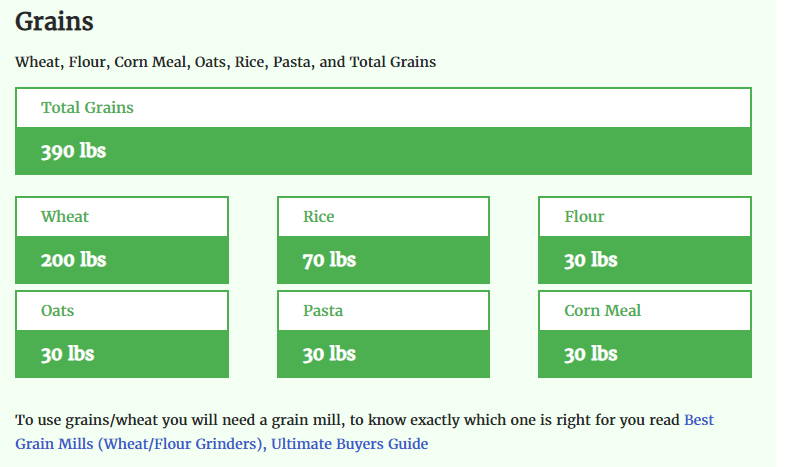
The first section is for grains: a total of 390 pounds.

For us, 200 pounds of wheat just isn’t going to happen! While it might be worthwhile to have some wheat berries to cook as a cereal, this is an amount intended for grinding into flour. We don’t have a flour mill. We do intend to get one, but for now, it would be a waste for us to have that much wheat. It’s the same with 30 pounds of oats. At the same time, 30 pounds of flour is laughably low, since we do quite a bit of baking. A lot of that wheat weight would get transferred to flour. I might get 15 pounds of rolled oats, then otherwise transfer the weights to rice and pasta. Both of which come in quite a few varieties, so there’s no need to be bored with just white rice and spaghetti. For our uses, I’d probably either stay the same with corn meal, or even reduce it.

That, of course, would change once we do get a mill. As losing power is something that is likely to happen, I would go with a hand crank mill, and since we are working towards growing flour corn, it has to be something strong enough to handle such a hard grain. Also, manual mills would be quieter than electric ones.

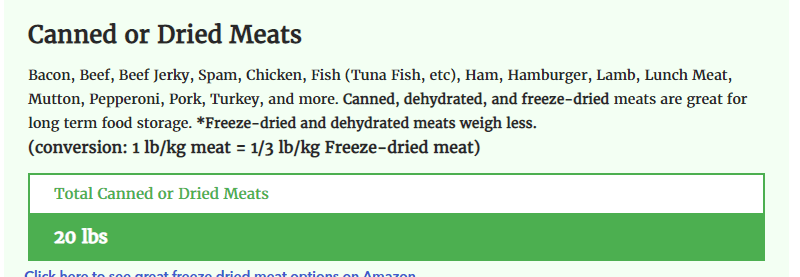
The next section is canned or dried meats.

Twenty pounds for three months? That seems so very low! Especially for 4 adults.

As we do have a chest freezer and I’m finding local sources for meat, we’re moving towards buying in bulk until we are able to start raising meat animals ourselves, so this is a flexible area for us. For now, we actually should be buying more canned meats for those “just in case” times, and we do need to take into account that if the electricity goes out for too long, we risk losing whatever is in our freezer. Hence the need for shelf stable supplies. Canning meat ourselves is something we are working towards.

So for our needs, I would increase this amount substantially, but not until we are at a point where we are canning our own meat.

Twenty five pound of fats and oils. Hmmm. Interesting that it lists more fats and oils than canned or dried meats!

The two gallons of vegetable oil would, for us, become a gallon of vegetable oil, another of olive oil, and probably a mix of other oils in smaller quantities. For a 3 month period, I would probably add in another gallon of vegetable oil. We don’t buy salad dressing. It’s an easy thing to make an oil and vinegar dressing. We do buy mayonnaise, but it is also easy to make, and can be a base for dressings, too. That’s where the “extra” oil would be used. Oil and fat can also be used for emergency fuel and lighting, so more would never go to waste.

We don’t buy shortening. Or margarine, for that matter. Just butter. We buy 8-10 pounds of butter for 1 month. More if we plan to do a lot of extra baking, like before certain holidays. For our usage, a 3 month supply would mean 24-30 pounds of butter. Not realistic! Butter is not shelf stable, so it would probably be a good idea to have a few pounds of shortening. If we were unable to get out, we could probably get away with using oil in place of where we might normally use butter, so we could play with the quantities and ratios a bit. The quantity of peanut butter could stay the same.

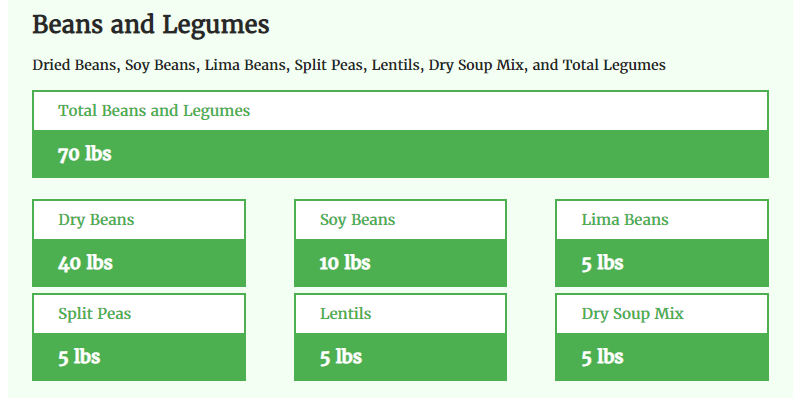
Beans and legumes: 70 pounds total.

That’s probably more than we would need, for how much we eat them. Soy beans and lima beans would be dropped completely. We don’t eat them. Also, I’d probably make my own dried soup mixes. It’s something I’ve done before, in quart jars, including things like dehydrated vegetables, mushrooms and bouillon cubes. They worked our very well, though I would do them in smaller jars in the future. Also, no black beans. They turn the end result a very unappetizing grey! :-D

One of the things I have been picking up at Costco is cases of baked beans. The prices of those has pretty much doubled recently. It would be cheaper to buy dry beans and cook them ourselves. Among our gardening plans is to grow beans for drying as well as fresh eating. Along with just keeping dry beans, I hope to can plain beans, as well as making baked beans for canning, too. I would add chickpeas to this list, canned or dried. There are chickpea varieties that grow in our zone, so that’s something else we could someday, potentially, supply ourselves.

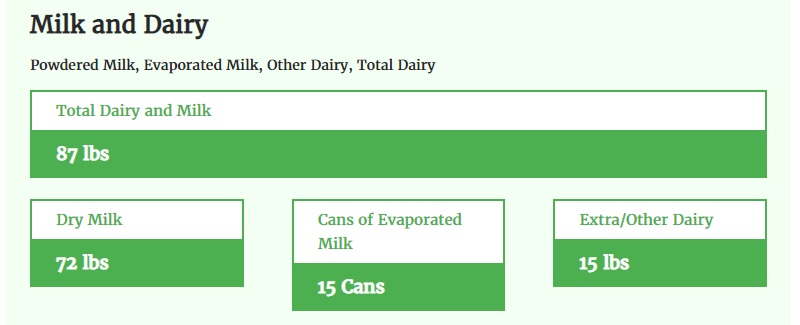
Milk and Dairy: 87 pounds

Shelf stable dairy products are a huge gap in our pantry. We should at least have some powdered milk. I don’t even know what to do with evaporated milk. And what does “other dairy” mean, in the context of shelf stable products? We don’t drink a lot of milk; it’s mostly used in cooking. What we do use a lot of is dairy products, such as cheese, sour cream, yogurt, more cheese, whipping cream… and more cheese. None of which is shelf stable. Well. I guess the cheese is, if stored properly. And we do love our cheese!

Sugars: 60 pounds.

I did not expect to see jams, powdered juice mixes or Jello in the sugars list.

White sugar and brown sugar are things we use quite a lot, since we do so much of our own baking. For honey, the 1kg (2.2 pounds) container we last bought from my bee-keeping cousin disappeared fast, so if we were to stock up on honey, we’d be getting more than what’s listed. Probably a 5kg (11 pounds) bucket, which is the largest my cousin sells. We’d probably get more molasses, too, though we don’t really use it all that much. Corn syrup would be off the list. We don’t use it. That amount of jam is probably more than we would need. I don’t know that we would include the Jello at all.

I wouldn’t not have thought of powdered juice mixes. Now that I think about it, though, it would be a good idea to have a supply of drink mixes, as their own category; juices, iced tea, lemonade, hot chocolate, coffee and tea would all be good things to have in the pantry. Plain water gets tiresome, fast!

Cooking essentials! Gotta have these.

For the amount of baking we already do, I’d probably increase all of these. The vinegar would be used along with the fats and oils for those salad dressings we would be making ourselves. For salt, I’d want to have a variety, but if I had to choose just one type of salt, it would be course salt. We have salt grinders for seasoning meals, but I like to use course salt for a lot of things. If space allowed, I’d include a variety of vinegars, too. Salt, vinegar and baking soda can all double as cleaners, too, so extra of those would never go wrong.

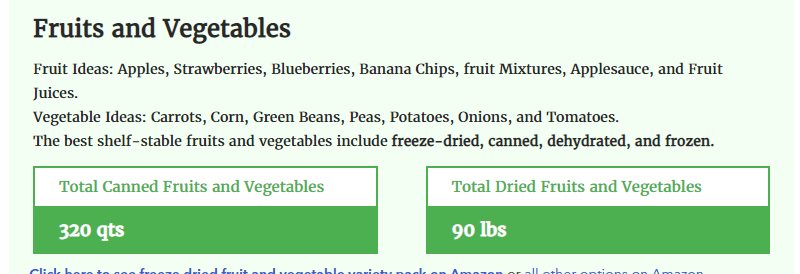
Canned fruits and vegetables: 320 quarts, plus 90 pounds of dried.

This is another area where we tend to be too dependent on our freezer, and why we want to move towards canning our produce. We do have a root cellar, so that helps. Almost all the fruits and vegetables we eat are fresh, with a small amount of frozen. We pretty much never buy canned, but once we’re growing enough to make it worthwhile to can them ourselves, it would make a big difference in the winter months. Before we moved out here, I had a dehydrator and used it to dehydrate purchased frozen vegetables. It works really well; the vegetables are already blanched and most are cut to size, so they can be laid out on the trays while still frozen, with no extra work needed. They were great in our jar meals.

While I’ve bought dehydrated vegetable mixes once in a while (they always include peppers in them, which is irritating for me), we’ve never really bought dried fruit. Sometimes I’d get dates, with their pits still in them, for snacking, but they’re quite expensive. We hardly even bought fruit leathers for the girls when they were little. We don’t buy raisins. Dried fruit in particular is something I would forget about when it comes to emergency supplies, but they would be good to have on hand. Ninety pounds, however, would be way more than our family would use.

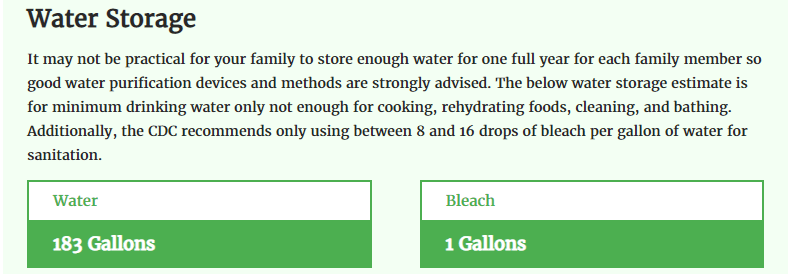
Water storage. This is our weak spot! We are already buying drinking water, so at least we do have the big water jugs. Storing 183 gallons, just for drinking, simply is not an option. This is a big part of why we want to get that old well repaired, so that we have access to water even if the power goes out. The bleach is something we don’t buy. We found a half empty bottle of bleach among the laundry supplies while cleaning up the old basement, and for the amount we use bleach, we’re still using that bottle we found! Still, it would be good to have bleach on hand. It’s something I would have forgotten about, so I appreciate it’s in the calculator.

That 183 gallons is the minimum water required for drinking. Much more would be needed for everything else. A safe supply of water is, typically, the biggest and most common hurdle in emergency situations for most people, I’m sure. At least for us, we have the possibility of getting the original well working again. Even here in the boonies, most people have wells that rely entirely on an electric pump.

Of course, in our situation, we would also have to add in wet and dry cat food. Since switching to the wood pellets for litter, we’ve been going through that a lot more slowly – and it’s a product that is actually a fuel, so it can do double duty. A single 40 pound bag goes a long way.

This calculator makes for a very interesting tool. I like that it’s just the shelf-stable essentials. There are so many lists out there that include everything but the kitchen sink – and then tell you what to use for a kitchen sink. Even just this list, for a 3 month period, can look overwhelming. However, it’s a place to start, to modify for our own circumstances, and the sort of thing that can be achieved, little by little, without taxing the budget too much.

It’s good to be prepared.

Even if Facebook thinks your a scary extremist for putting up a bit of extra food!

The Re-Farmer

2021 Goals: Review and Reset

It’s that time of year again!

As the year winds down, it’s time to review the goals we’d set, see what worked, what didn’t and what we want to accomplish next year.

Among the goals we had:

Starting a cordwood shed to use as an outdoor bathroom, with a composting toilet, to replace the outhouse over a pit.

Well, that didn’t happen. Which is turned out to not necessarily be a bad thing.

The location we want to build it is in that open space behind the compost ring. One of the things I did this past summer was go through the spruce grove and mark most of the dead spruce trees I found. I marked almost 2 dozen, and there were several others I didn’t bother marking, or couldn’t get at. These were trees that were intended to be used for the cordwood walls, however priorities have changed. They will now be used to build high raised garden beds. Right now, the space we want to build in is going to be needed to drag logs out of the spruce grove. Thanks to my mother, we now have a wood chipper that we can use to break down the branches, so we’re not adding to all the branch piles, and will have plenty of wood chips for mulch.

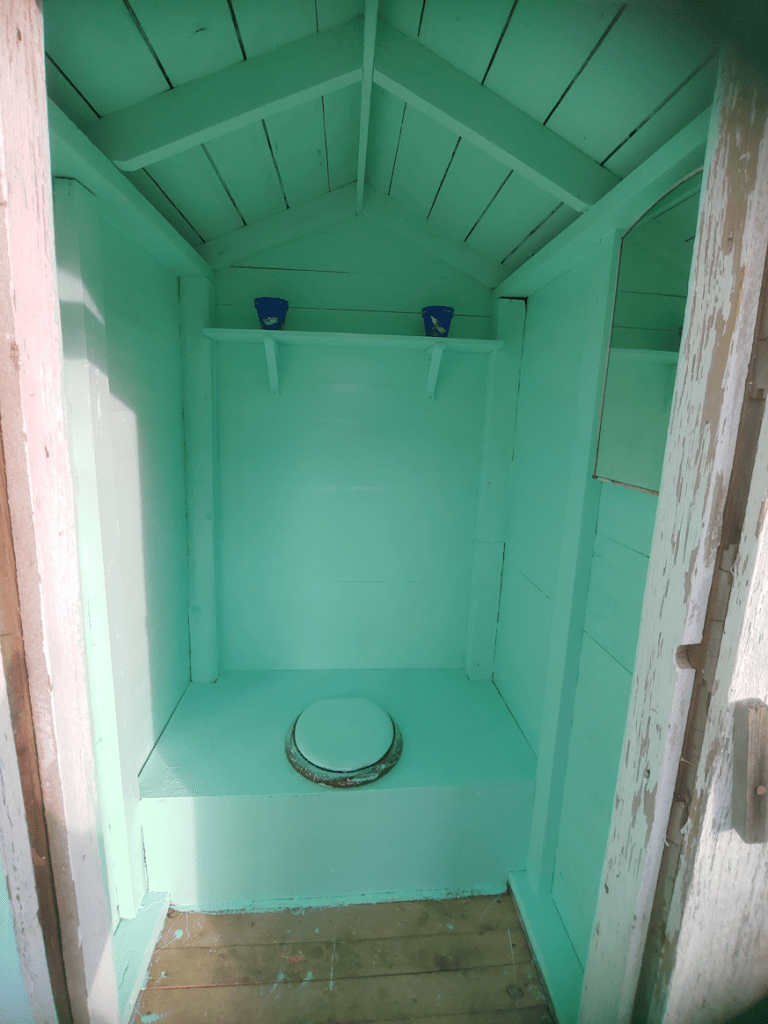
Until we can build the outdoor bathroom, we do still need something to use the next time we have plumbing problems, so the inside of the old outhouse was fixed up and made pretty (the photo here is from before it was finished). A goal for 2022 is to remove the old, moss covered shingles, extend the roof to create an overhang above the door, re-shingle it (or use some of the left over bits of metal roofing we still have in the barn), and do any repairs on the outside before giving it all a final paint job.

We did find that a groundhog had got into the pit and dug a den under the floorboards somewhere. Sadly, if we get an average amount of snow, this will likely result in a drowned groundhog. Our first two springs here, we found that snow melt would form a large puddle in front of the outhouse, and I could see in the hole under the door, which is now fixed, that the pit filled completely with water. There is nothing we can do about this. Hopefully, the groundhog will wake up early enough and leave the den before this is an issue.

Another of our goals is to have the branch piles chipped. While we now have this awesome new wood chipper, which can chip branches up to 3 inches thick, it is very slow going. The branches have to be trimmed of any sticky-outy bits, and be straight, or it won’t go through. For the sake of efficiency, it will be better to hire the tree guys and their massive chipper. When we got their estimate, they figured it would take 6 hours to chip all our wood piles. For our budget, I’m hoping that we can have them come out for three hours in the spring, to get at least the big pile in the outer yard done, and maybe the little ones in the maple grove. Then we can see about hiring them again, maybe in the fall, to do the remaining big piles. With the new wood chipper, we should at least not be adding more to the branch piles, as we clear dead trees out of the spruce grove!

Another goal that we once again failed to meet, was hiring someone to haul the junk pile away to the landfill. This irritates me, because that pile is getting so large, and we are getting to a point where we need to start cleaning up on that side of the chain link fence. If our budget allows, I’m hoping to at least have smaller loads removed, as we can afford it. The name I have for a guy that hauls junk uses a pick up truck, so if we can get him to come by a few times throughout the year, even that would be a help.

Our gardening goals were mostly met, as far as drought conditions allowed. We used poplars we’d cleared out of parts of the spruce grove to build trellises, and those will be used for another year. We planted in areas far from the house, partly to prepare the soil for permanent plantings. The corn and sunflowers were potentially there to provide privacy screens, too, but the drought and poor soil conditions prevented that. Having to use 300 feet of garden hose to water things, and still just barely being able to reach some corners, during a drought and heat waves, was something we could have done without! Add in damage from deer and groundhogs, and it’s a miracle we had as much produce as we did.

For 2022, our garden plans will continue, and this year we will start with the permanent plantings. We are pouring over websites and looking over what bushes we will be planting in those far flung areas. In one section, we will be closing off a gap in the hedge along the north fence line that the deer go through. My mother had been planting lilacs along this fence, but we are looking to plant berry producing shrubs and bushes, instead. We will also be planting them along the east side, both to help keep deer out and to create a privacy screen. We still need to make sure we can access the east fence line, and there has to be a lane kept open, over where the telephone wires are buried, so we will use other methods to close that off to the deer. We’ll have a better idea of what we can buy in January, when many of the nurseries will have their new inventory available. We might be going with sea buckthorn, if the other varieties we were looking at don’t come back into stock.

Other things we intend to order for 2022 are raspberry canes and, if all goes well, Korean Pine. These require shade for their first 5 years, so they will be planted just north of the spruce grove. If budget allows, we’d like to get new Saskatoon bushes, too.

We will have to take out more of the crab apple trees, to remove diseased trees. There are two trees that produce the best apples. If I can protect those, I will be happy. However, we will also be getting other types of fruit trees including, hopefully, a hardier variety of mulberry tree to replace the one that we bought last year, that got killed off by that one cold night that also killed off all the flowers that would have given us fruit and berries this past year. I’m not sure how many we will be able to squeeze out of our budget this year, but the more fruit trees we get, the better, as they can take many years before producing fruit. Berry bushes are also high on our list, as they will start producing much faster.

This past year, we expanded our garden plots significantly, but with our long term goal of growing as much of our own food as possible, we will need to continue to expand and prepare new ground. Now that we have a working chain saw, we’ll be able to clear dead trees out of the spruce grove and clean that up faster. Many of these dead trees appear to have no rot in them yet, and we plan to turn many stumps into benches and tables. We will also need to clear out the fallen rotten trees, and other fire hazards. Once things are cleared out, we will be planting more spruces in the spruce grove, as well as fruit and berry trees that require more protection from the elements. We’re also looking at getting some Rugosa roses, though they will likely be used more as a deer barrier!

Where the trellises are now will eventually be converted to our food forest, except for the lane that needs to be kept open over the buried phone line, but we will use them where they are for one more year. We ordered quite a lot of seeds already, from Vesey’s (including replacement seeds) and Baker Creek again, plus two orders from Heritage Harvest, which is a new company for us this year. The only seeds we’ve ordered that are still en route are the kulli corn. The only other seeds I still plan to buy are peas, but I will pick those up from a local store when they come available, rather than ordering them in. We will also be making use of seeds from our inventory left over from last year. Which means we will need to build more trellises, once we decide where, because we’ll have quite a few vining plants, and there’s only so much we can plant along the chain link fence. ;-)

Along with the saplings, canes and root stock we plan to order, we will be ordering potatoes and sunchokes. This time, we will not try to grow potatoes in bags, but will use the Ruth Stout method again, as part of preparing new areas for either more garden plots, or permanent plantings, the following year.

At this point, we have three low raised bed boxes built, and one high raised bed. Next year, we will continue to use the current beds in the main garden area. The goal is to cut the dead spruce trees to size so that, after things are harvested in the fall, the remaining beds will be converted to high raised beds before next winter. With how much watering we had to do during the drought, filling the beds hügelkultur style will be an important part in moisture retention. Even under normal conditions, high raised beds are notorious for drying out too quickly, but with how we fill them, coupled with the judicious use of mulch, we should be able to prevent that from being a problem.

We will also be making new beds for corn and the many types of squash we have for this coming year, but those will be in areas that will eventually have trees planted in them. Ultimately, we will be building accessible high raised beds in the outer yard to the south of the house, where they will get more sunlight. Eventually, we intend to build a greenhouse or polytunnel out that way, too. It’s not something we’ll be able to start building in 2022, but we should be able to start preparing where they will eventually go. The renter plans to build new fences next year (maintaining the fences was part of the deal they’d originally made with my late father), since their electric fence has been not working as well as intended. I hope to talk to them again about putting a new fence line across the old hay yard, which will be much shorter (therefore, cheaper) than rebuilding the existing fence, but also takes away an area of pasture. We would need a gate in there, though, so that we can eventually haul away those old vehicles to the scrap yard. As that would not be something they’d normally include, I’d be offering to pay for the gate portion. If they are willing to do the new, shorter fence line through the old hay yard, we will be able to get rid of some old, messed up fences and a shed that looks ready to collapse pretty soon. Then we can start building new garden beds out that way. This is also the general area where we want to build the outdoor kitchen, as well as planting a wind break. None of which are worth starting, while there is a chance the renter’s cows can get through. There are also old, collapsing fences around the inner yard we want to take out completely, rather than repair or replace, but again, it can’t be done until the outer yard is fenced in. Long term, though, we won’t have an inner and outer yard anymore, but just one really big yard.

Which means that, on top of continuing our work in the inner yard and garden, we need to get more work done on cleaning up the outer yard. There’s a limit to what we can do, without heavy equipment, but we can at least get a start on it. That was something we should have worked on this past year, but accomplished very little. Hopefully, this coming year will not have the drought and heat waves that made heavy manual labour a very bad idea!

With what we’ve learned from the past year, we know that this year, we will need to focus on protecting our plants from deer, groundhogs and racoons. We will also be focusing on permanent plantings that are drought tolerant and can handle poor soil conditions, even with the amendments we’re working on. We are also looking into planting forage trees and fodder well away from the house and gardens, to give wildlife less reason to invade our yards, looking for food.

As we build our raised garden beds, we will also be ensuring they will all be the same size at the top, so that any covers we build can be interchangeable. The low raised beds are boards and are 3′ x 9′. The high raised bed is 4′ x 9′, and we plan to build them all that size. With the thickness of the logs, the actual growing space inside is closer to 3′ x 8′. So if we build covers to fit the low raised beds, they should also fit the high raised beds.

While most of our goals are going to be expanding or continuing previous goals, a new goal I want to add is to have chickens. For our egg needs, we would only need about half a dozen birds. The problem is, we don’t have anything to keep them in. I am wanting chickens to be part of our soil reclamation progress, which means being able to move their coop and enclosure regularly. Buying a new chicken tractor is well beyond our budget, but we don’t have the materials to build one, either, and with the cost of building materials right now, it’s as out of reach as buying a new one. Of the many, many videos I’ve looked at for making quick, easy and inexpensive coops and shelters for chickens, none of them are suitable for our climate. Oh, they could be temporary structures for the summer, and I do plan to build versions of them that will fit over our raised garden beds, but none of them would keep chickens alive during our winters.

That is something I need to work on. I’d love to get able to get chicks this spring, but if we can’t shelter them once they’re big enough to leave a brooder, there’s no point.

So there we have it. We did accomplish some of our goals for 2021, but many of our goals are multi-year things, so it’s more progress than accomplishment.

Now we’ll see how much we manage to get done next year!

The Re-Farmer

Fun stuff and catalogue review

Today has been one of those days of getting things done that were also enjoyable. Like a morning spent converting feed bags into grow bags while watching/listening to videos about crossbow safety. More listening than watching, since I was, after all, hand stitching the bag bottoms into shape. :-D

I also got to enjoy watching deer through my window, making their way to the feeding station.

I saw a couple, earlier, but that early in the day, our East facing living room window is so full of reflections, I can’t get any good shots, but I could get some shots with my phone through the North window. At one point, I was seeing 4 deer, and I think there was a fifth hidden away in the maple grove.

I made a quick trip into town to refill a couple of our 18.9L water bottles, then pick up prescription refills. I timed it so that I could hit the post office on the way home. My husband had been expecting a parcel all week, and today we found out why it hadn’t come in earlier. The padded envelope it came in was sealed in a plastic bag with “apologies from Canada Post” on it. I had no idea what my husband had ordered, so seeing oil stains on the package was a bit alarming.

It turned out he’d ordered honing oil, and the bottle leaked! No harm done, thankfully. :-)

I was excited to see a catalogue I’d ordered had arrived. This is from a company I had included in my list of cold climate seeds sources, which also included nurseries. Whiffletree Farm and Nursery. They specialize in “Cold hardy, disease resistant, fruit trees, shrubs, vines and canes.”. I love how the back page includes phone numbers, a physical address (in Ontario), a map, plus their latitude and longitude!

How very… rural Canadian. :-D

I actually went through the Irrigation Instructions insert, first. They’ve got add on kits designed for new plantings, mature plantings and tree plantings. I found it a lot more informative, both textually and visually, that most of the kit sources I’ve been looking at. Though we don’t plan to plant our fruit and nut trees for a while, yet, where we are extending the garden to this year is well away from the house, and an irrigation system would be well worth the investment, even if we have to McGyver something cheap for the first couple of years.

As for the catalogue itself, I was very impressed.

First off, it’s just plain beautiful. It is printed on the heaviest paper of any catalogue I’ve seen. More than sturdy enough to withstand cats clambering all over it, demanding my undivided attention! Even how the photographs are lined up with the write ups is the best I’ve seen. There is a also LOT of extra information included.

The range of products they have available is amazing. After just a few pages, I started over again with a highlight marker, marking off everything that was Zone 2, Zone 3 or Zones 2/3. I didn’t bother marking Zones 3/4 or higher, because there were SO MANY Zone 2 and 3 choices, it wasn’t necessary. The only exception I made was for a mulberry tree that was Zone 3/4.

Did I mention how informative it is?

I learned something new that really caught my attention. There is a section on Buffaloberries, Peashrubs and Autumn Olives.

I was curious about what Peashrubs were, but it turns out that we already have some! They are caraganas! In our clean up, I’ve had to cut away and cut back a lot of caraganas that were either dying or overtaking other trees and shrubs. It’s been a balancing act between clearing them away and keeping them.

Though I am familiar with the shrub, I discovered that the seed pods are actually edible! At least the Siberian Peashrub (caragana arborescens) are. They have two other varieties. The Siberian variety is “A multi-stemmed upright growing shrub covered with delicate yellow flowers in spring, followed by small edible seedpods which can be eaten as a vegetable. By late summer the dried seedpods snap open, dropping the seeds which are 36% protein and make good chicken feed. So it is sometimes planted in poultry yards.”

Who knew?

I also learned that they are good nitrogen fixers, and wind breaks. We should see if we can figure out what variety we have here!

The catalogue also displays an excellent sense of humour. As an example, in the section on edible lilies and high bush cranberries, there is this write up for the Common Snowball.

“Okay, we admit it – this plant is neither edible nor medicinal to the best of our knowledge. In fact, it produces no fruit at all, not even for the birds. Our only excuse for offering it is for the nostalgic memories is evokes for many folks. Every year in early summer, these old-fashioned, carefree bushes become covered with fleecy, white pompoms. The ‘snowball’ name is visually very fitting, but that’s not all. Perhaps we should market it as a weather prognostic – according to a local, time-honoured adage, there is always a brief, unseasonably cool spell when the snowball bush begins to bloom. Like many weather maxims, you can count on it, it always holds true – except when it doesn’t!”

Ya gotta love it! :-D

While we are not in a position to start ordering food trees for this year, we are shooting to do so as soon as possible, given how long it can take for trees to mature enough to start producing fruit. And let’s face it; at my age, pretty much any fruit or nut tree we plant is for our daughters and future generations, because my husband and I will probably be long gone by the time some of them reach maturity!

There is so much information in this catalogue, we can use it for planning purposes. Especially when it comes to their orchard growing equipment and supplies.

With that in mind, these are some of the things that interest us, that also grow in Zones 2 or 3.

Apples: there are many varieties suitable for our zone, including larger eating apples, edible crab apples and cider apples. They have columnar varieties, dwarf varieties and varieties that are good for espalier training. When it comes to apples, they are not something we tend to eat a lot of, on their own, but we would be using them for things like apple cider vinegar, hard apple cider, or freezing them to use for baking later on. We will have to take into consideration that we need to cut down a lot of our crab apple trees due to fungal disease. It may be worthwhile to get rid of the diseased trees, then wait several years before planting new varieties, or planting new varieties in locations well away from where the diseased trees are.

Plums: This is one of those things that we almost never eat, but if we had them, we would eat them. We do have plum trees, but they are not an edible variety – more stone than fruit – that my late father used to make wine, but having larger, fleshier plums that can be eaten fresh would be really nice.

Pears: I remember we had a pear tree when I was a child. It was a variety that produced small, hard fruit that needed to be exposed to frost before they could be eaten. They are another type of fruit we rarely buy, mostly for budgetary reasons, but would eat more of if we had our own trees, so having cold hardy varieties that can be eaten fresh would be enjoyed, and this catalogue has several such varieties that can grow in our zone.

Cherries: the variety of cherry are from a tree from Poland, which has a warmer climate than we do. They bloom wonderfully, but in the time we’ve been here, produce almost no fruit. Their bloom time doesn’t match when the pollinators come out. So getting a variety or two that is good for our zone is something I would like. They do tend to spread through their roots, though, and can become invasive, so we would have to carefully plan where they would go. Some varieties make good hedge trees, wind breaks and privacy screens, so that’s an option, too.

Nuts: there are only two types of nuts suitable for our zone; several varieties of hazelnuts, and butternuts. We are still looking into planting other varieties. They may not have a long enough season to produce edible nuts, but the trees themselves are an investment.

Rugosa Roses: we already have wild roses growing in the spruce grove that we will be encouraging, as other types of underbrush will be cleared away, but these varieties are specially noted for their large hips, and high nutrient contents. These are for the “apothacary” plants we will also be adding, over time.
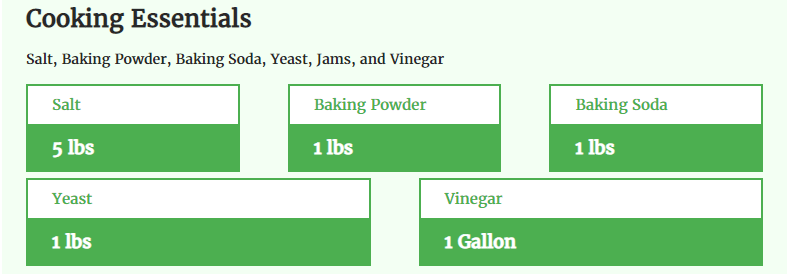
Kiwis, grapes, gooseberries and currants, saskatoons, haskaps, raspberries and blueberries: we already have some of these, but will be adding more over time. Some are poorly situation and need to either be taken out, starting over with new, or transplanted.

Companion plants and wildlife packages: they’ve got a number of different plants that are beneficial to plant near trees, for various reasons. Some because they attract pollinators, or attract predator insects that will eat nuisance insects. Others because they are good to plant in paths instead of grass, can handle foot traffic, but don’t need to be mowed. There are even seed mixes to provide grazing for deer and other wildlife, and even have wildlife tree packages, made up of a mix of excess trees, or trees that didn’t make the grade for orchard/yard use, which may not even be labelled. They would be useful for a food forest or permaculture set up to feed both humans and wildlife. These are all things that fit in with our long term goals.

All in all, I am very excited by this catalogue, and look forward to being able to order from this truly unique company as soon as possible!

The Re-Farmer