Our “second bathroom”; footing

Today, temperatures dropped quite a bit from yesterday’s warmer than forecast day. We reached a degree or two warmer than forecast, with rather high winds. I used it to do a bunch of jobs outside. One of them was to finish putting rigid insulation around the bottom of the house, in preparation for winter. The only area I didn’t finish was around the back tap for the hose, since we will be using it for a while longer.

We seemed to be short some insulation pieces, though. My daughters had brought them from summer storage in the old barn for me, so I went to see if maybe some pieces got missed among the junk.

There wasn’t any, but I did use the opportunity to grab some stuff I decided to use on the floor of the outhouse, with an extra piece for outside the door.

I’d noticed these scrap pieces a while ago and thought they were some type of black, high density foam. Sort of like the super durable stress reliever stuff used on shop floors. Well, that’s probably what these were originally used for, but they turned out to not be foam, but some sort of synthetic rubber.

The pieces I grabbed had already been hacked to smaller sizes, though still bigger than the outhouse floor. They also turned out to be far heavier than expected, for their size.

I trimmed one of them to fit on the outhouse floor, then washed them down with a hose…

… and discovered they were actually blue!

I didn’t scrub them any more than this, because I really don’t care about their colour. What scrubbing I did was good enough for the outhouse floor!

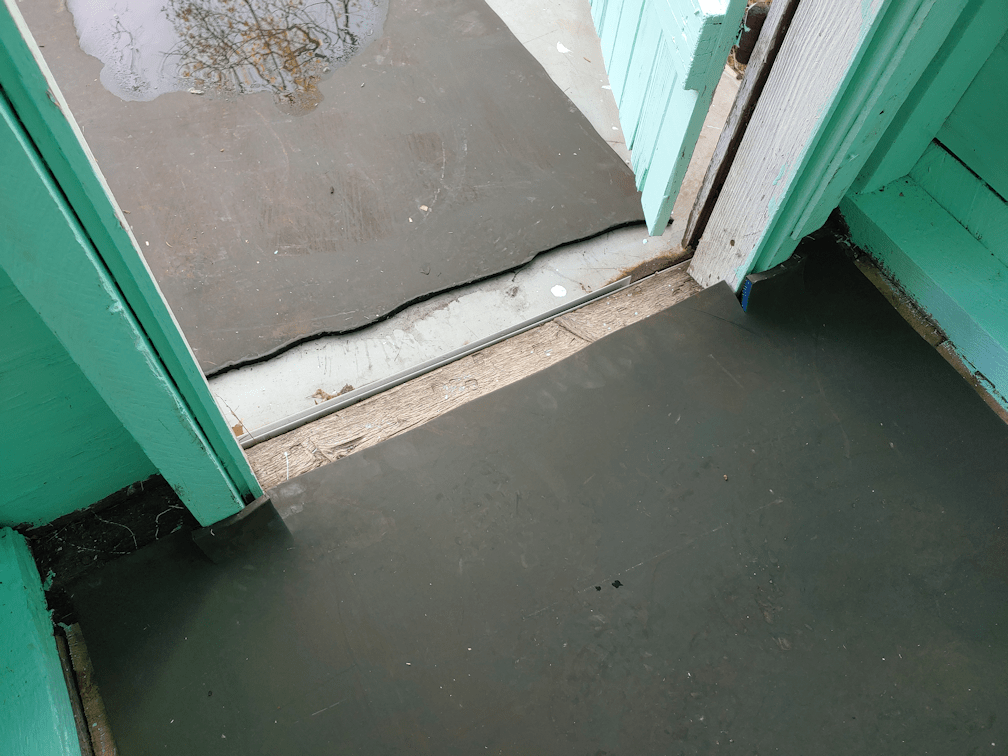
I didn’t bother trimming the second piece at all. This stuff is not easy to cut! It just got a bit of a cleaning to get the big stuff off. This piece is to for a non-slip surface on the metal sheet that’s covering the gravel used to patch and fill the hole was under the door.

I had trimmed the rough edge on the piece of inside, then cut slits to match the door frame, so it would fit around it.

This stuff should work well to protect the floor. If one of the boards ever does go, it’ll keep a person from having their foot go through! Plus, it’s not so thick that it would make it uncomfortable to sit while using the… facilities. ;-)

Though it does look like we’ll need to paint the floor, after all. Which will get done when we’re ready to paint the outside, which is a project for next year.

The Re-Farmer

Low raised bed: path patch

My darling daughter was able to do a patch job last night, beside the low raised bed I finished yesterday.

That pile of salvaged boards is coming in very handy! We are getting it down to a point where we are starting to reach wood that isn’t rotted out or weather damaged, too. We might actually be able to start using some of it to build things!

There is a much smaller gap on the other side of the box. That one just got a bunch of rocks that had been pulled out of the soil.

I look forward to when we can top the paths with gravel.

The Re-Farmer

Second low raised bed: done!

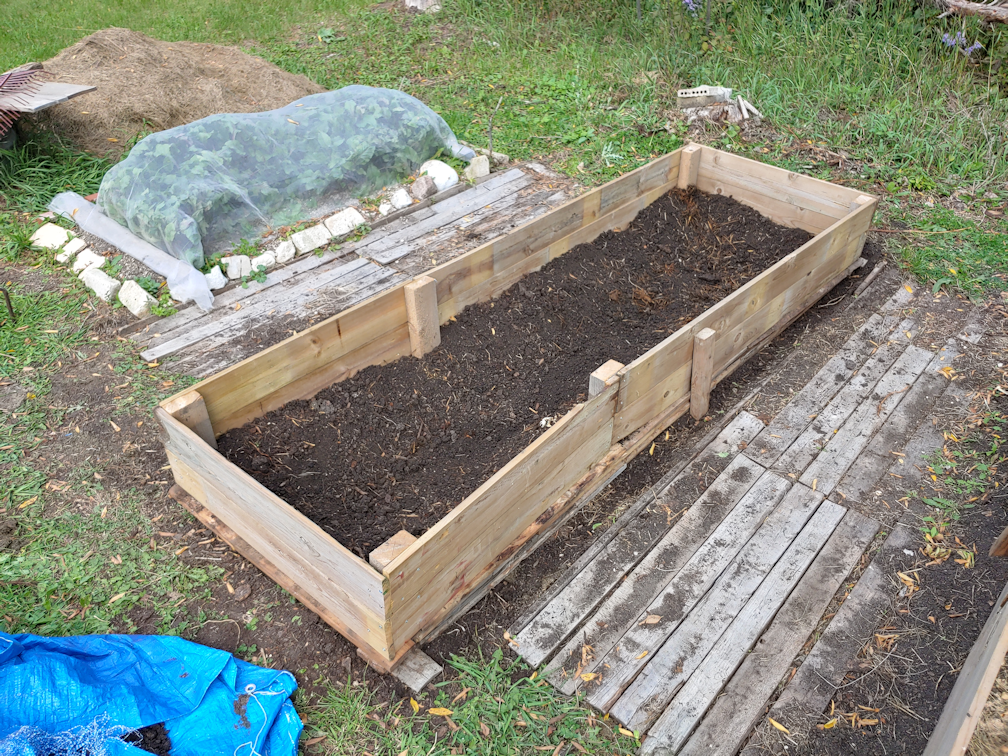
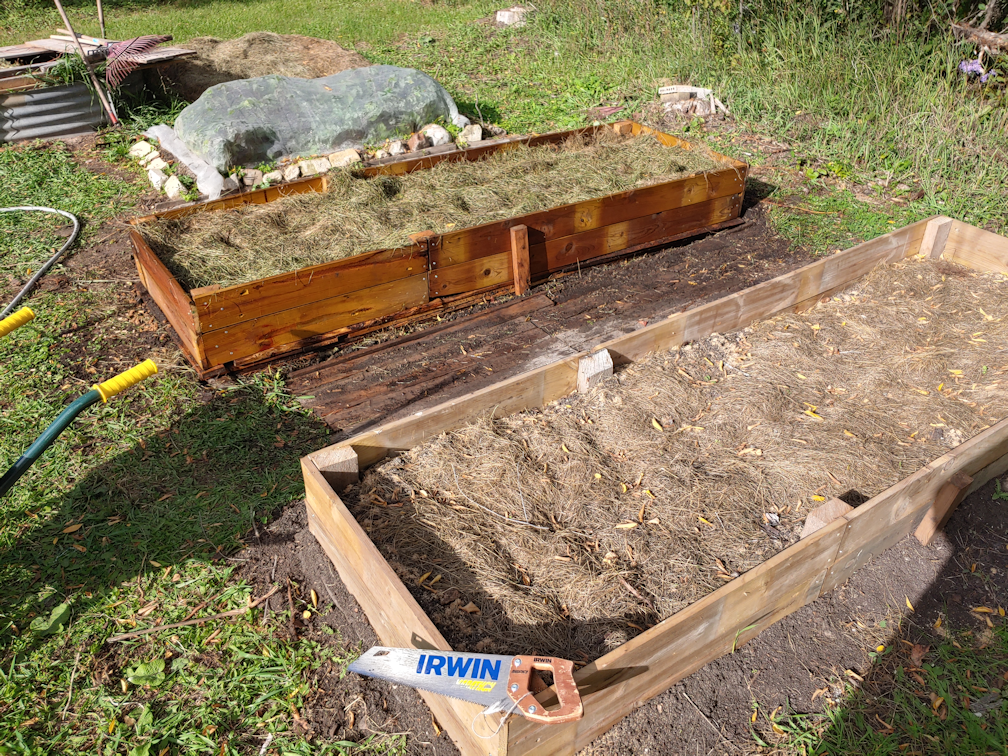
You can read about the first raised bed I did, here and here. Things were done a bit different this time, so here is another step-by-step post with lots of photos! :-) I actually started this bed over a week ago. This is how it looked then.

This bed has been almost completely untouched since the garlic was harvested, letting the weeds get fairly large. This made them easier to pull.

Along with pulling the weeds, with as much of the roots as I could, I lengthened the bed to match the size of the box. Right away, I could tell this one was going to need a “foundation” under the box, too. I was definitely hitting rocks, and a whole lot of roots, while trying to loosen more soil and remove grass and weeds.

Once the weeding and loosening of soil was done, it was left to sit so that any weeds I missed would have a chance to start growing again.

When I started working on it today, the first thing I did was go over the area again, pulling out any new growth by the roots. Then it was time to start shoveling!

Like the previous bed, this one had been originally amended by burying the contents of our compose pile and straw. So I only wanted to remove up to the straw, basically.

In the process, I was finding a LOT more roots! It looks like the cherry trees are encroaching again.

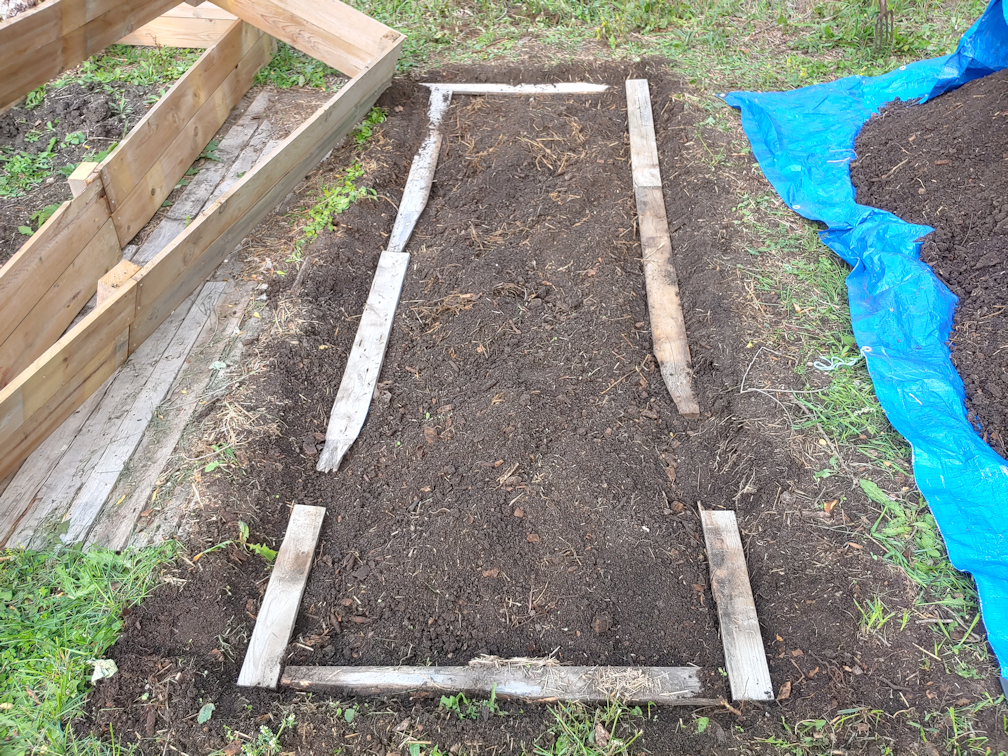
Once I was satisfied with how much of the topsoil I had removed, I raked around the edges to try and level the soil where the box would be resting, as much as possible, while heaping it all in the middle.

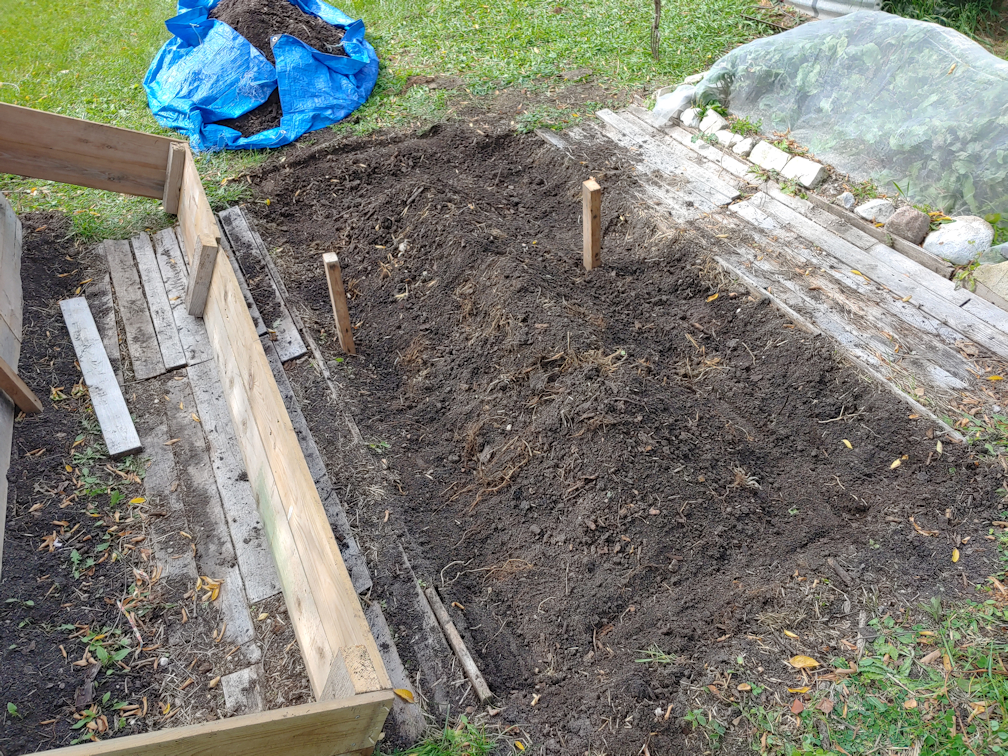
Then the box was laid down and, once I had it where I wanted it, I used a sledge hammer to hammer in the supports on either side, at the middle, to prevent the long sides from bowing out when filled with soil. I also hammered down the corners and such, to leave marks in the soil that I could use as guide lines.

The ground wasn’t anywhere near as level as I probably should have made it, but that’s okay. Things will settle and adjust over time, and these boxes can be easily replaced in the future, if need be.

The next step was to raid the pile of old, salvaged boards that the groundhogs have made their den under, and build up a foundation to support the box. Once that was in place, a daughter came out to help me carefully place the box on top of the foundation, and in between the support posts.

Then it was just a matter of shifting the foundation boards a bit, to make sure the box was fully supported. Again, not quite level, but that’s okay.

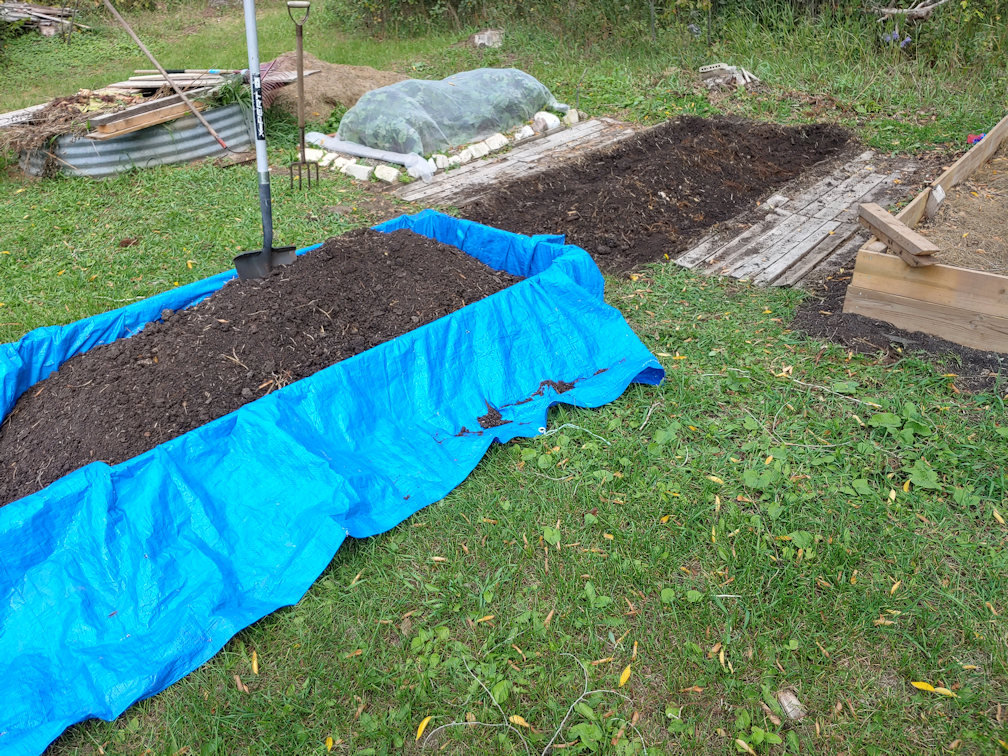
The soil heaped in the middle was then raked out to the sides, covering the foundation boards and creating more of a recess in the centre.

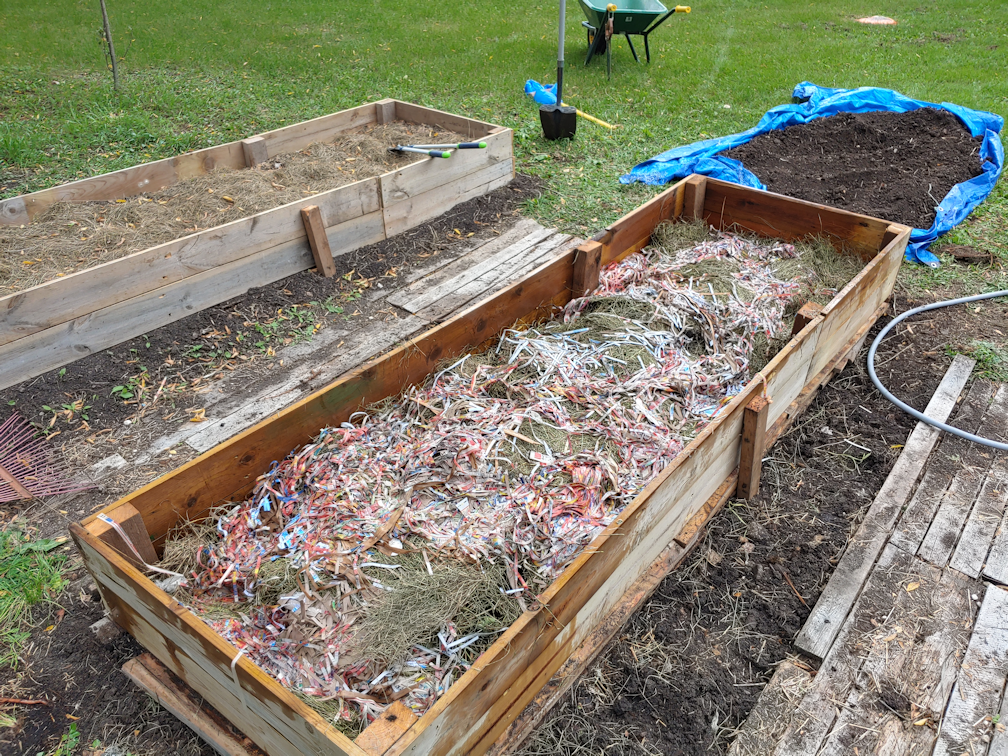
Then it was time to add the first layer of fill, and raid the branch pile. This time, I added more and larger branches than with the first bed I did.

This, unfortunately, left a lot of gaps and air pockets. They will fill in as the wood decomposes and everything settles and sinks, but that will take time. To help fill in spaces and speed up the decomposition process, I started adding back some of the soil. After returning about a quarter of the soil, I hosed it down thoroughly, so wash it further down into the gaps, then added about another quarter of the soil and soaking it down again.

The next layer was contents from the compost heap, most of which was greenery I’d cleared from around the dead spruce trees that were cut down. This got another soak, another scattering of soil, and yet another soak.

The next layers were grass clippings and shredded paper. This time, after soaking it all down, I walked back and forth over the whole thing, to try and compact and break the buried branches more.

It as at times like this that being a woman of generous proportions comes in handy. ;-)

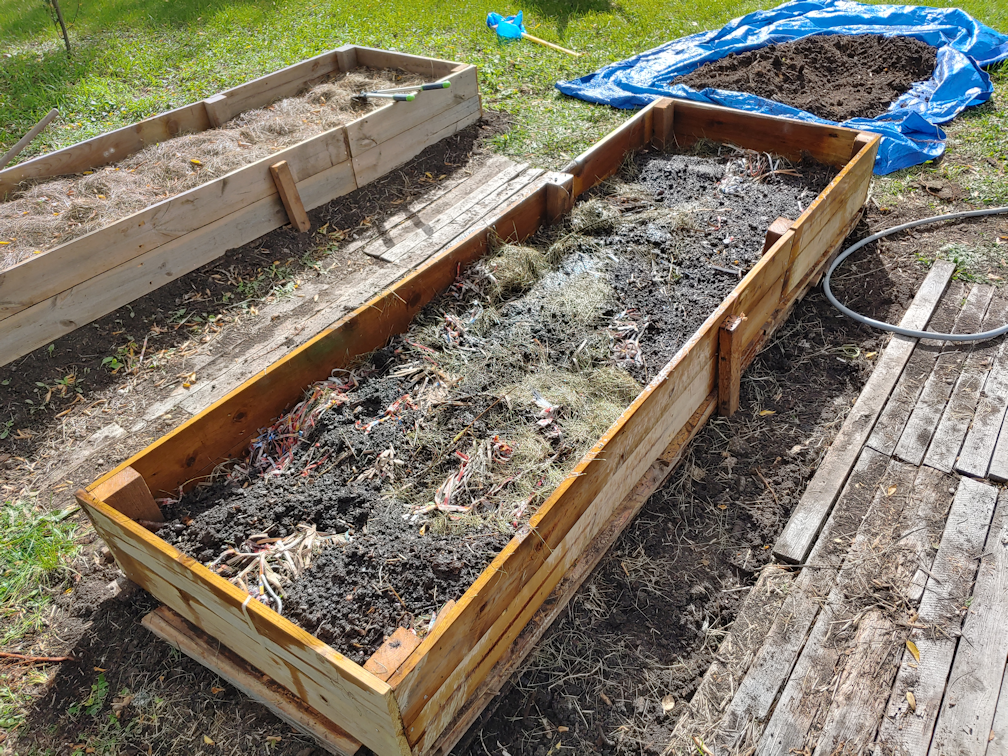
Yet another thin layer of soil was added and soaked down.

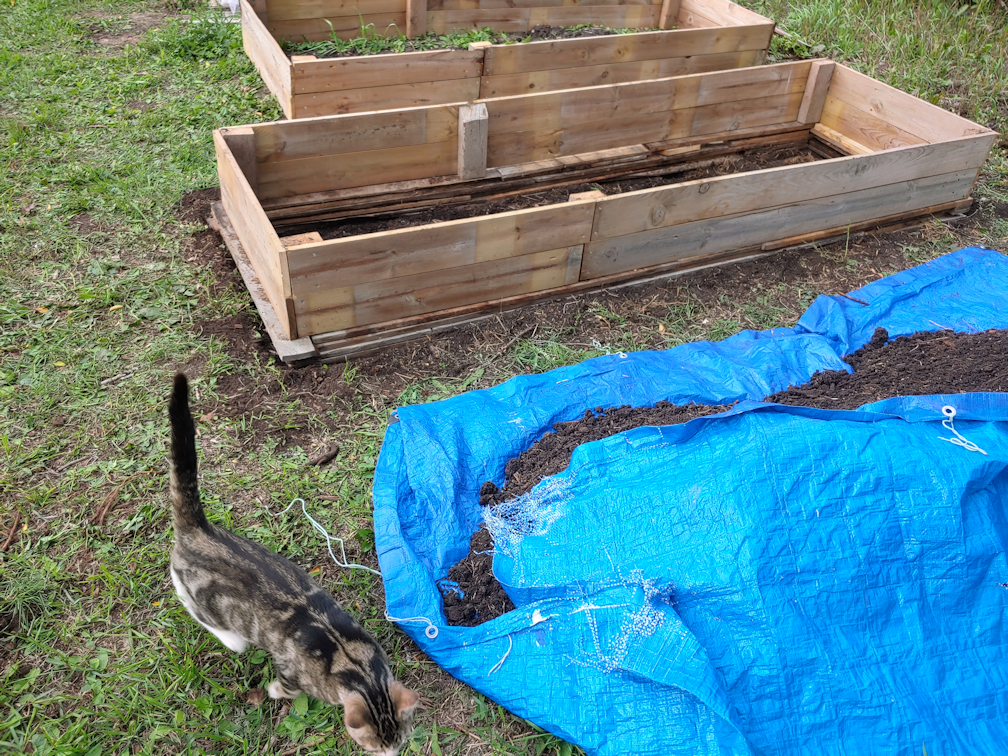
Note the gap between the box and the board path. By this point, it had become a bit of a safety hazard! Without the soil to hold them in place, the boards at the edge kept moving and catching on my feet, and I was constantly catching myself to avoid twisting my ankle in the loose and lumpy soil in the gap.

Another thin layer of grass clippings was added and hosed down. At this point, the fill in the new raised bed is about the same level as in the first one. Adding the extra and larger branches made a noticeable difference, even after being tromped down.

Once this was done, it was time to amend the remaining soil on the tarp. I added about half a 40 pound bag of wood pellets, as was done in the first raised bed, and then a couple of wheel barrow loads of new garden soil was brought over; one added to the soil and wood pellets on the tarp, and the other added directly on top of the grass clippings, then raked out as evenly as I could.

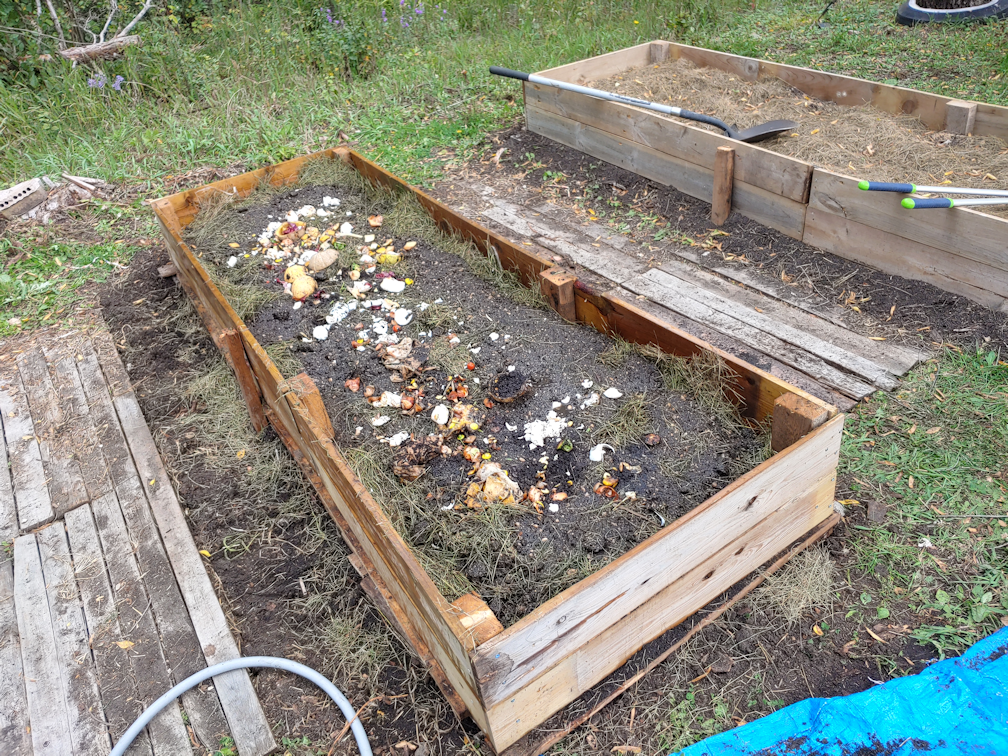
It was about this time that a daughter came out with the kitchen compost buckets, so that got added straight into the raised bed and spread out, then hosed down again.

The next while was spent mixing the soil and wood pellets together, as much as I could, before adding it to the bed.

Once the soil was added, it was raked out evenly. This layer was NOT hosed down, though.

One more layer of grass clippings was added as mulch, then it got one last, very thorough, soak with the hose. This was the time to clean up the sides and edges, too.

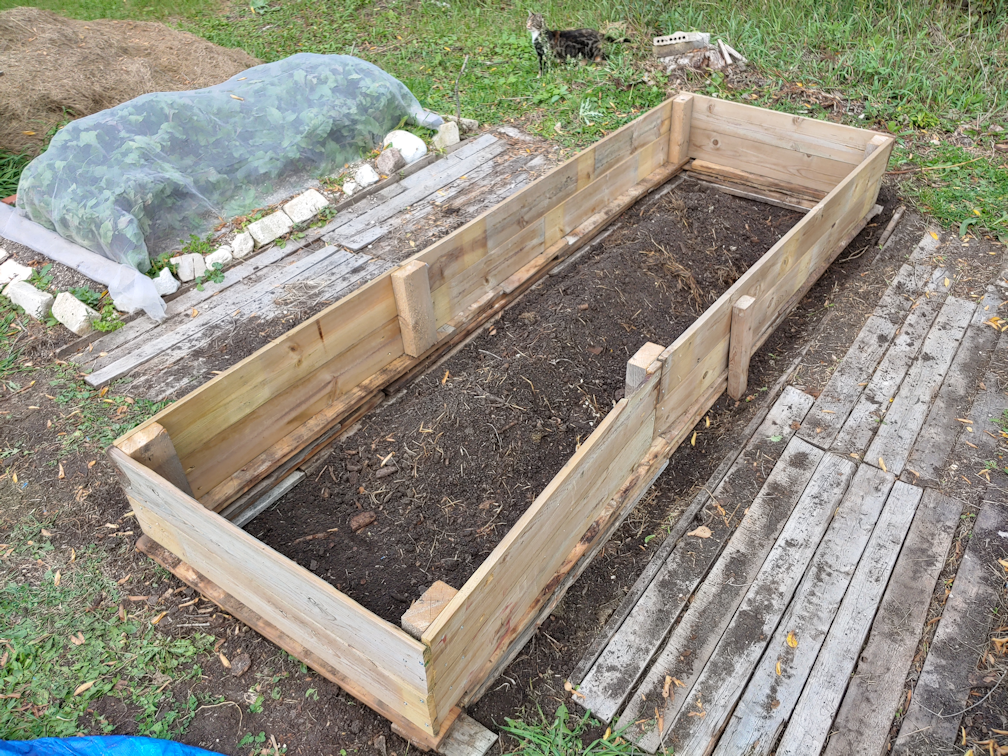
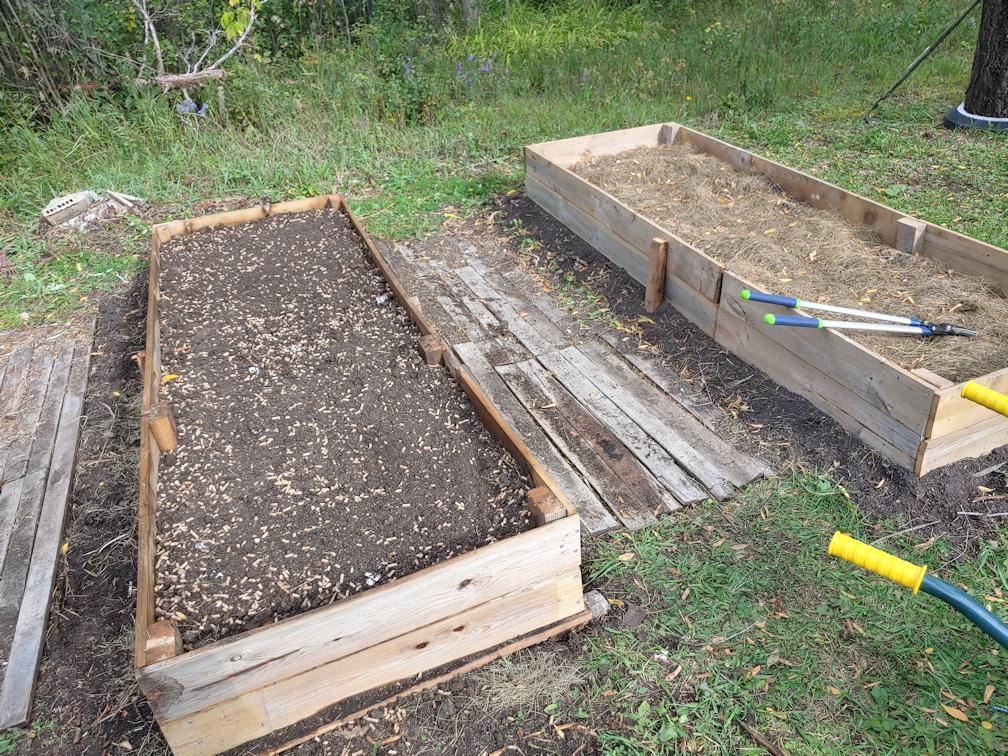
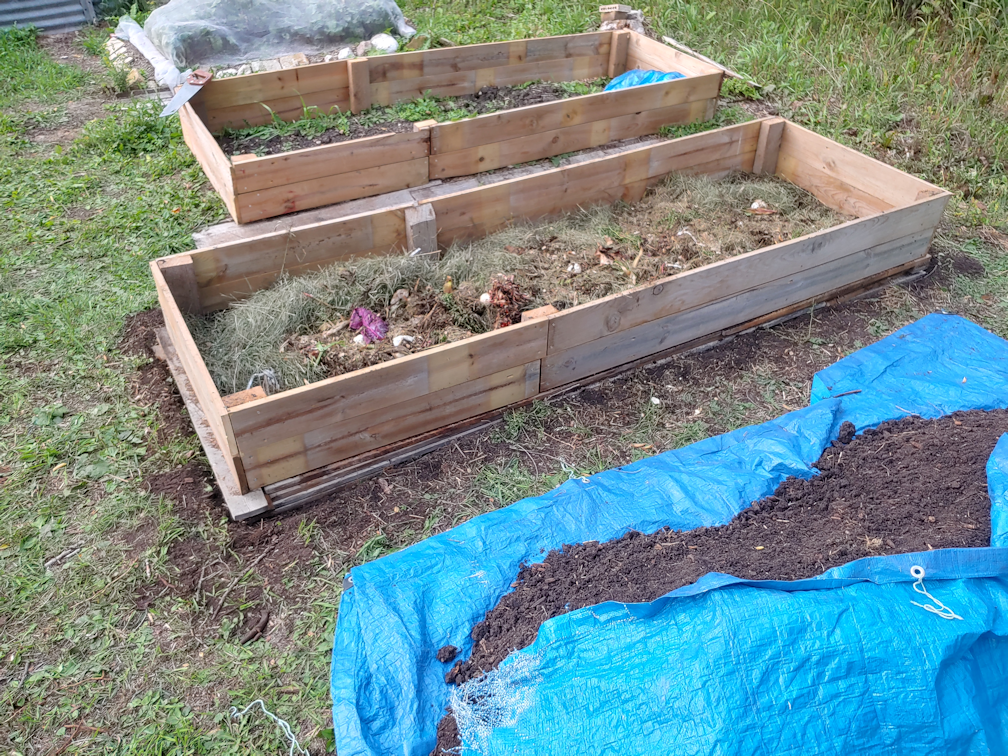
This is as much as will be done in the bed, this year. Both beds will get more amendments added to them in the spring, after they’ve had a winter to settle and sink.

Also, remember the gap in the path on the other side of the bed?

I was going to work on filling that to make it safe, but I had reached my limit. A daughter will be working on that for me later. As these beds have been worked on, and rocks were found, I had been tossing them next to a nearby stump; you can see it in the background, with some bricks on it. Those can be gathered to use as fill in the large gap on the far side of the bed, and more boards will be added, and whatever else my daughter can thing of to make it safe to walk on. The eventual plan is to cover the board paths with sand and gravel.

After this, there is still the third bed in this location to be made, but with the beets still growing, there is no hurry. The last bed will be just one board high, as that is all the wood of this type we have left, but these boards are slightly wider, plus we still have plenty of the scrap wood bits to use as a foundation, so it shouldn’t be too much of a difference.

Two raised beds down; seven more to go! :-D

The Re-Farmer

First low raised bed: part one. It’s good to be flexible!

This evening, I finally got around to working on the first of the low raised beds in what had been our garlic beds this year.

The boxes are ready and waiting, and the beds had been left for any weeds to get larger, so they would be easier to pull.

The plan: dig out all the soil and buried layers of compostable material beneath, set up the box frame, then add the layers back, Hugelkultur style, with wood at the very bottom layer.

The first order of business was to loosen the soil a bit further than the new length the bed will be, and clear out all the weeds by the roots.

The first problem was in adding length. I was originally going to make it longer just at one end, only to find myself hitting large roots and rocks. So I did a bit at one end, then extended the other end, only to have the same problem!

Once the soil was as clear of weeds and roots as I could, it was time to remove the topsoil onto the waiting tarp.

The original plan had been to remove the soil up to the buried straw and compost pile contents into one pile, then remove the straw and other matter onto another. With the extended length, there was already the problem of not being able to dig far because of the roots and rocks I was hitting.

As expected, the straw was barely decomposed. It takes a long time for straw to rot away. That made it harder to dig down further.

I decided to leave it and modify my plans. If it wasn’t practical to dig down further, I would just have to build up higher!

Using a garden hoe, I flattened and somewhat leveled the perimeter, pushing the soil into the middle.

The box was then laid over the bed and stomped on, to create guidelines.

Then, it was time to raid the junk pile of old boards and create a foundation.

A first layer was placed on the guide lines, leveling the soil out more in the process. Then it was just a matter of digging out more boards and adding more layers. The boards are in varying states of condition and length, and a few were cut to size to fill in gaps.

I stopped at 5 layers of boards, which put the foundation at about level with the ground.

Then the box was lined up on top of the foundation.

That was definitely a two person job. :-D

The next step was to use the hoe to move the soil from the middle to the sides, burying the foundation on the inside.

Now it was time to do our use-watcha-got, Hugelkultur layering.

I raided one of our branch piles and brought small branches and twigs to cover the bottom. If we were doing a high raised bed, I would have used larger branches and logs, but these will do for a small bed. The idea with the wood is that, as it decomposes, it acts like a sponge, absorbing moisture that later becomes available to the roots of the plants above, and reducing the need to water.

The next layer was shredded paper. We’ve been saving and shredding our compost safe fliers and other paper, just for this purpose.

Then a layer of grass clippings from our new little “haystack” got added.

Then, the contents of our compost pile was added. Plenty of egg shells, coffee grounds, banana peels – all sorts of things that “garden hack” lists include. :-D

The last step for today was to hose the whole thing down, partly to keep things from blowing away. We have thunderstorms predicted for tonight. If we do get rain, it will help soak down the layers and get a kickstart in decomposition. If we don’t get rain, it will get saturated with the hose before the soil is returned.

Before the soil is added, however, I’ll have to find something I can pound into the ground on the outside of the long sides of the box, to prevent the boards from bowing out.

As lovely as the soil here is, it did test low in nitrogen, so before returning the soil to the bed, I will be mixing in some of the new garden soil, as well as more grass clippings, plus some of the pellets we’re using for cat litter now. It’s just compressed sawdust. As they get wet, they expand and break apart. This will add organic matter to the soil to keep it from compacting, plus the sawdust will absorb moisture and act as a sponge. The clipping and pellets will have the fall and winter to break down, and help increase the nitrogen levels.

If we had wood chips, they would have been included in the layers, and would be added as a layer of mulch at the very end. Alas, that will have to wait until we either get a wood chipper, or hire the tree guys to come out with their massive chipper for a few hours, and break down some branch piles for us. :-)

Which, weather willing, I should be able to work on tomorrow. :-) Unless something else comes up. Which happens often! :-D

The Re-Farmer

Our 2021 garden: tending the old kitchen garden

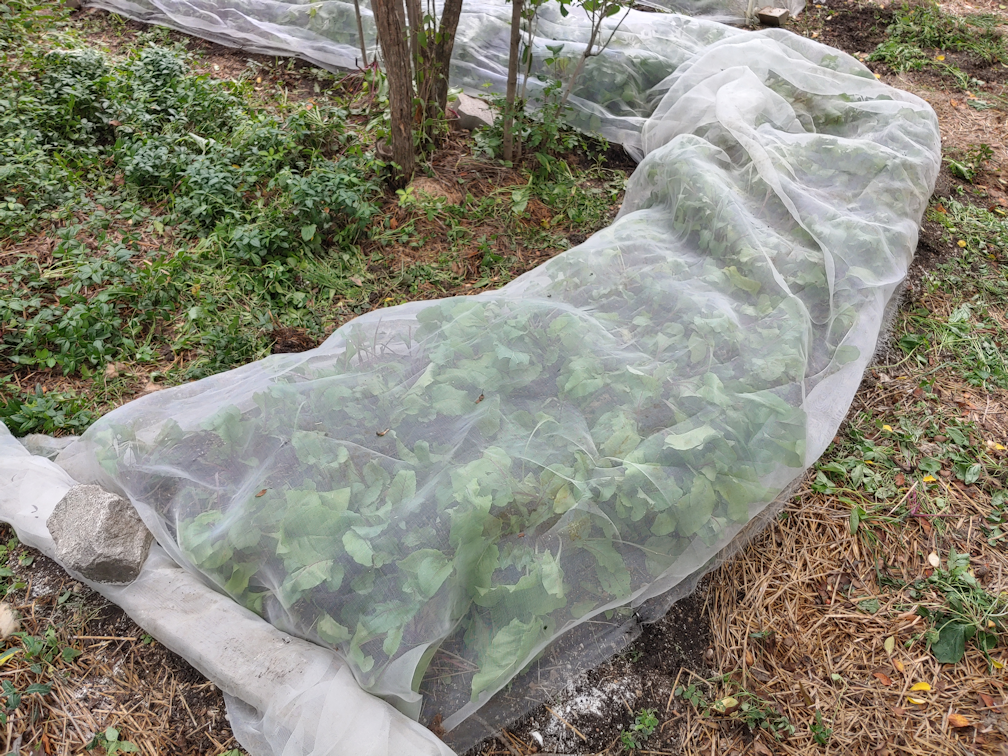
As much as I love all the rain we’ve been having, I was happy to have a mild, sunny day to get some work done outside. I finally got around to tending the big L shaped beet bed in the old kitchen garden.

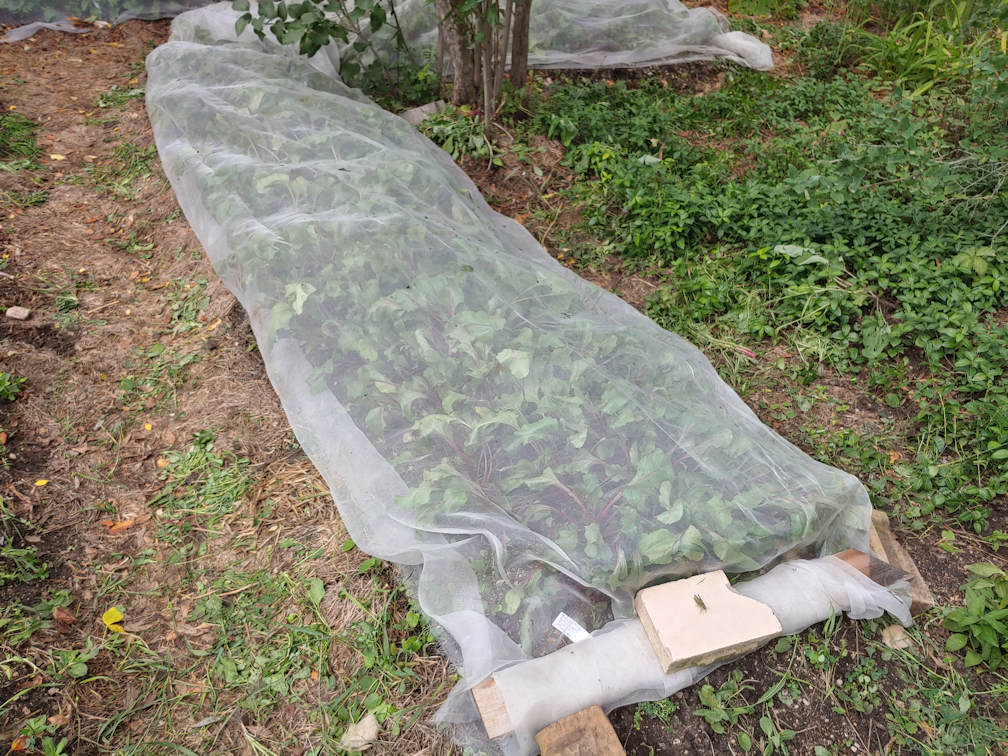
This bed has had almost no tending, since we put the floating row cover on it to keep the critters out. This is how the two sides looked before I started.

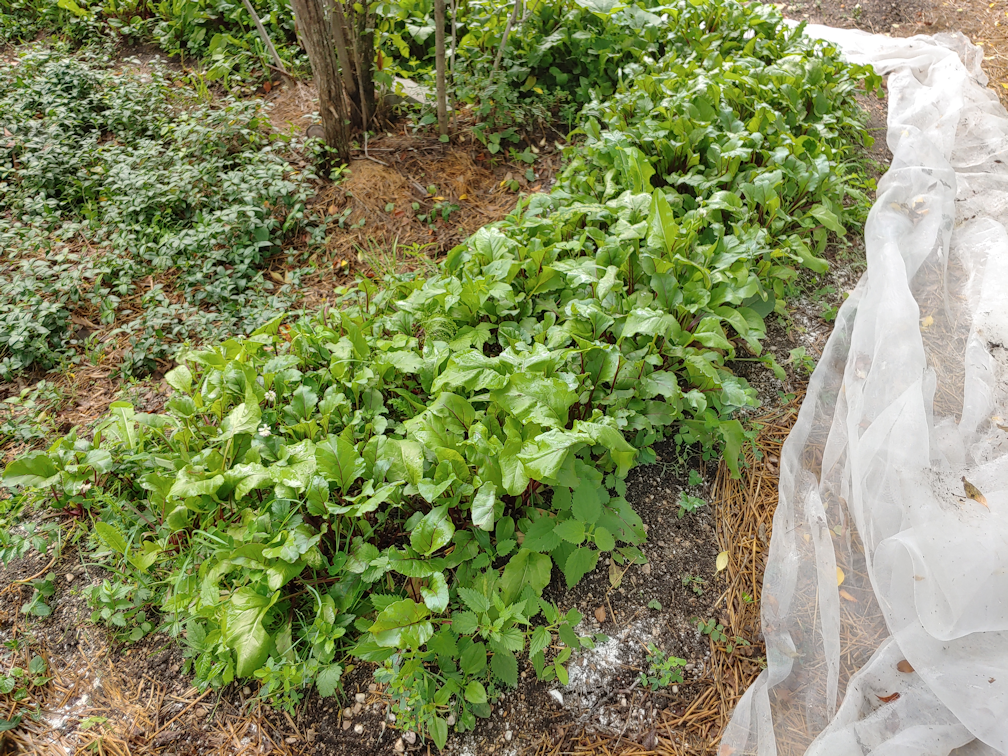
Here is how it looked after a good, solid weeding!

There actually wasn’t a lot of weeds in there. After fighting my way through all the beet greens, following strands of weeds to their bottoms so I could pull them out by the roots, I found that there wasn’t much to pull out. The beets were actually choking out the weeds! Most of them were long and leggy and spread out, trying to reach the light, so when I pulled something out by the roots, I found I was removing quite a lot more plant than expected. The exception were all the sprouting Chinese Elms. It’s remarkable how deep and solid the roots are for a sapling that’s just a couple of inches high.

The beets themselves did not need any thinning, though I did accidentally pull a few out with the weeds. I wasn’t seeing a lot of beet roots developing, though. Hopefully, all the rain we’ve been having will result in a growth spurt!

When it came time ot put the netting back on, I took advantage of the big package of tent pegs I found in the garage. The sides of the netting was pulled tight and snug to the ground, so nothing can casually push its way under the netting. No more rocks and bricks to try and keep it down. For the ends, I wrapped the netting around boards, then weighted those down. There is lots of slack in the netting for the leaves to grow, though I don’t expect them to get much taller than they are now.

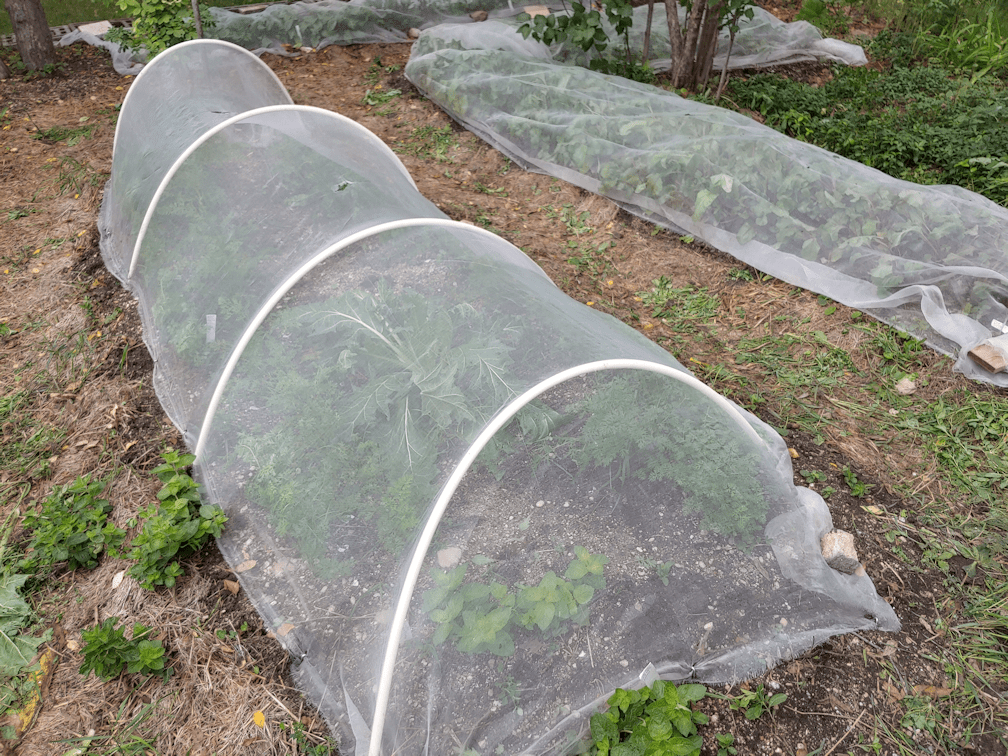
That done, I worked on the carrot bed next. One of the inner hoops had come down, the doweling holding it in place breaking off completely. Another was well on its way down, too.

Which made for a good time to tend the carrots, too.

There are two types of carrots in this bed, and these ones have been going to seed. Carrots do to see in their second year, so it seems the grounhogs eating their greens has fooled the carrots into thinking they are in their second year.

Carrots gone to see do not produce much of a root!

These carrots got weeded, but did not need any thinning. The other variety did need thinning.

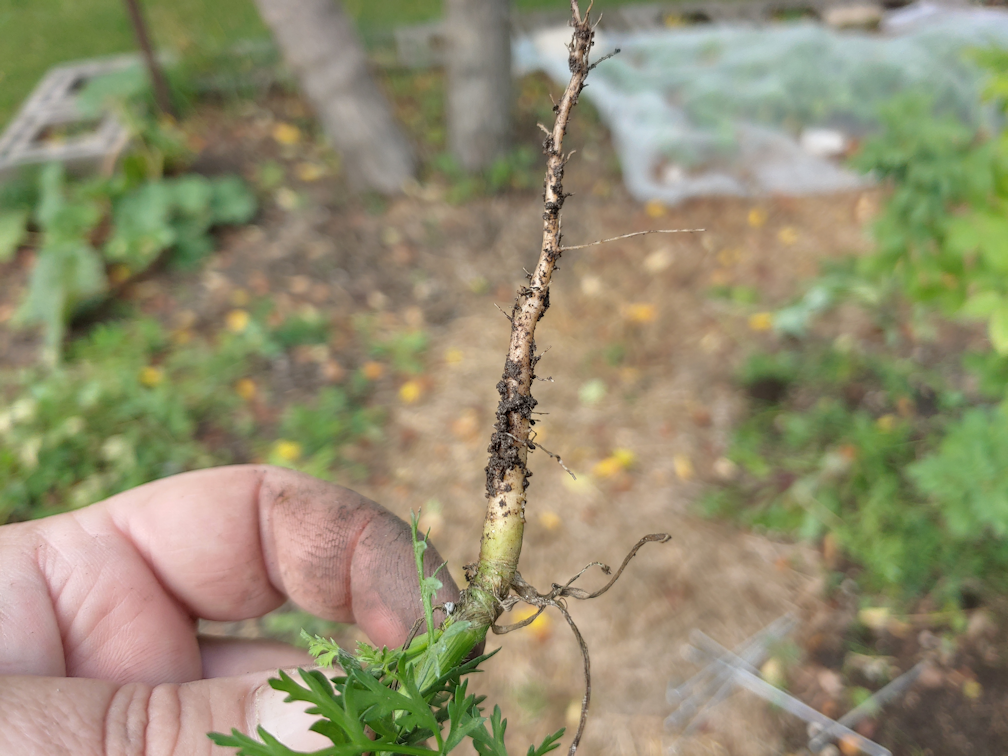
Check these out!!! This is a variety from Baker Creek called Lounge Rouge Sang.

The two orange ones at the top of from the other carrots that had gone to seed, but had enough root that I wanted to keep them.

I checked my records, and those are supposed to be the Deep Purple carrots, from Veseys!

Here you can see what the Longue Rouge Sang carrots should look like, when fully mature. I just love the colours in them, and am happy to see that even the little carrots that got thinned out are showing them.

I’m so excited to see carrots! After the groundhog devastation, I really didn’t know if they would recover enough for us to have any at all. It’s a shame we couldn’t cover the larger carrot bed in the main garden area, too!

Once the bed was cleaned up, and I found new sticks to use to hold the PVC pipe hoops in place, the sides were pegged down tighter to the ground. The only places I used rocks to weigh the netting down was at a couple of corners, where there was excess netting to gather.

I still don’t know what the big green thing in the middle of the bed is. I had hoped it was the White Vienna kohlrabi that was planted there, but I not longer think that’s what they are. I’ve seen them pop up in a few other places, too. They don’t look like a weed, is about all I can say! I’m leaving them, just to hopefully see what they are. I’ve also left quite a bit of the mint that has been making it’s way through. In time, I hope to transplant them somewhere contained. For now, I just try to keep it under control so it won’t take over the garden – and we will still have at least a bit of mint to harvest if we want! :-)

There is still one more bed of beets by the retaining wall, covered in netting, that needs to be cleaned up, but that will have to wait for another day.

The Re-Farmer
All tucked in

There was a break in the rain, giving me a chance to test out my squash hammocks.

This is a melon, not a squash, but “melon hammock” doesn’t roll off the tongue as well. :-D

I’ve made three of these so far. I think I got the size right. None of the melons or winter squash will get much bigger than this. The ties need to be a bit longer, though.

For those who want to know, it’s basically just a filet crochet square, with chain stitch ties woven through the openings on opposite sides that act as drawstrings, to keep the fruit snug. I used medium weight cotton yarn and a 6mm – J/10 hook.

I think I’ll make a few more to have handy, if needed.

The Re-Farmer

Clean up: our “second bathroom”, part one

Today turned out to be a very pleasant day, weather wise, so I used it to do a job that I’ve been avoiding for a long time.

I started cleaning up our “second bathroom.”

Yup.

The outhouse.

Now, we do have plans to build an outdoor bathroom that can be used should we ever lose power or water. We are wanting to build a cordwood practice building, with the intention that it will have a composting toilet in it, and no pit under it. That way, in the future, it could be converted to something else without too much difficulty. We were supposed to at least start preparing the base last year, but that didn’t work out, and now I’m glad it didn’t. We have a whole lot of dead trees to cut down not far from the location we chose for it. A location that is the most open space that we would want to fell the trees towards.

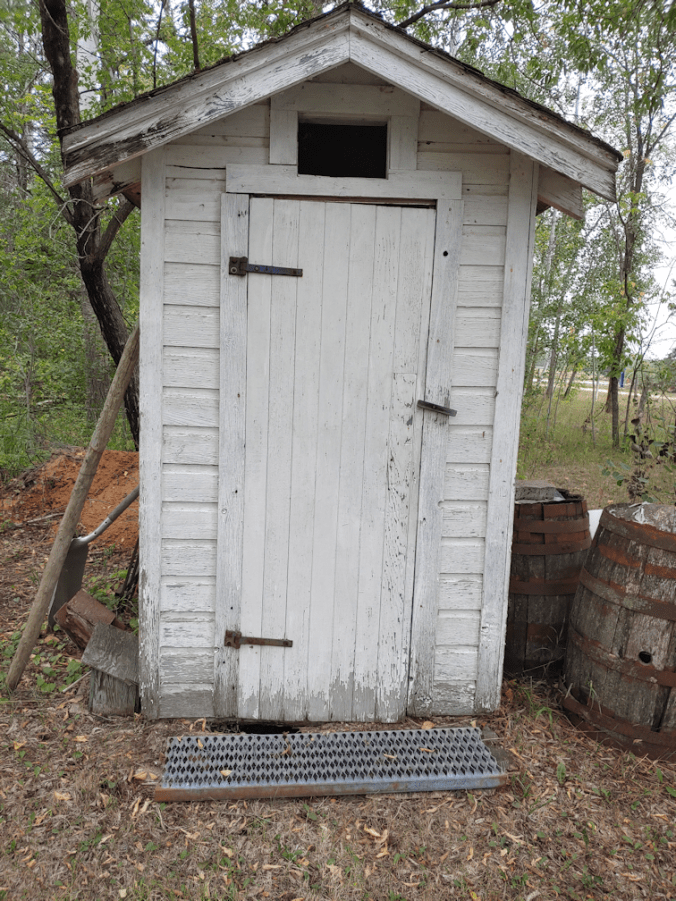
Meanwhile, we have this old thing.

This post will be about working on the outside. Part two will be about working on the inside.

This right here is the main issue with the outhouse. I placed the metal (I can never remember what those area called!) in front of the door because it would sometimes open in severe winds, but also because of that hole.

Our first two springs after we moved here, we discovered that when the snow melted, it would pool in front of the outhouse. I was able to see through that hole that the pit would fill with water. Another reason why we want to have an outdoor bathroom elsewhere, and no pit!

One of the delays in getting this done was trying to figure out what to replace this with! I didn’t want it to be an issue again in the future, so not wood, for starters. But what could I use that would be big enough to cover the front, solid enough to walk on, yet thin enough not to block the door from opening?

Barn salvage to the rescue.

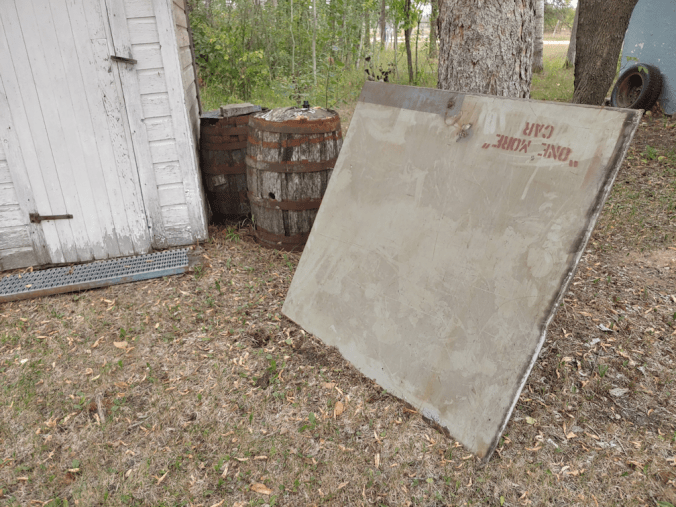
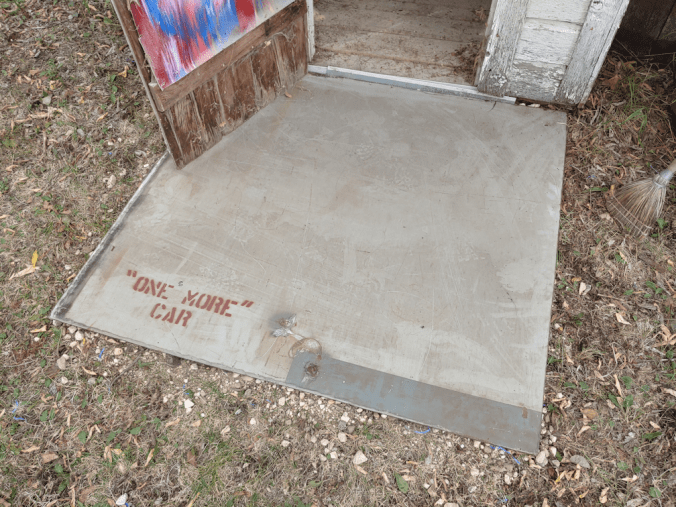
There were several large sheets of steel in the barn and, tucked in between, was this smaller piece.

Yeah. That’s the smaller piece.

Now, when I was looking at the sheets, all I saw was rust. They’re heavy, so I hadn’t moved them enough to see their other sides. It wasn’t until I was bringing this over, turning it end over end, that I realized the other side had no rust on it.

Also, it had writing on it.

What a curious thing!

Once the steel sheet was brought over, I removed the top piece that was in front of the door.

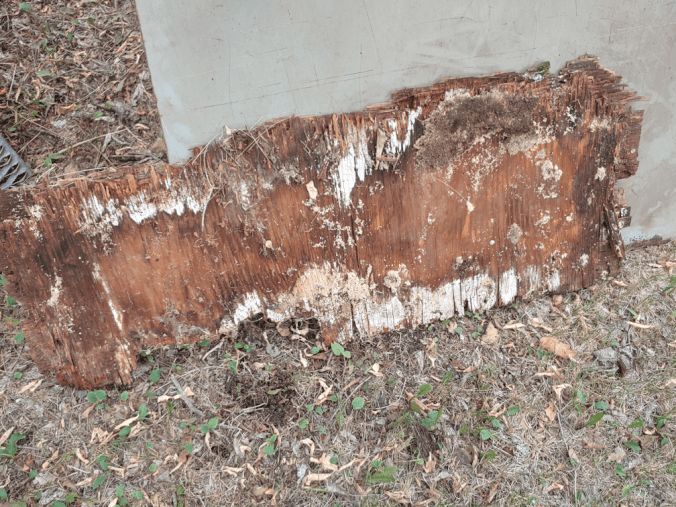
So… that’s disgusting. !!!

The outhouse is sitting on top of two large beams, which extend in front. The piece I’d removed was nailed to those beams, but everything was so rotted, there was nothing holding anything anymore.

Also, that sawdust is from ants.

Time to clean up and assess what’s underneath.

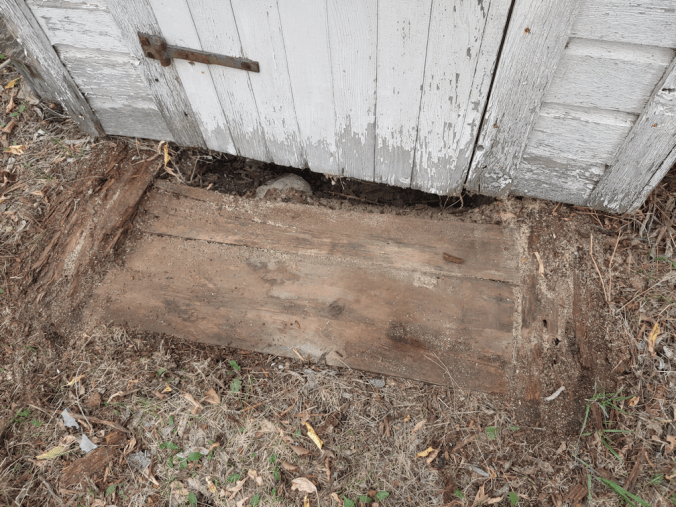
The boards I uncovered felt surprisingly solid. They were also quite thick.

And very rotten. They only felt solid because they were supported by the soil beneath.

Also, that’s a very large opening under the door! It seems the edge of the pit had started to collapse. No surprise, since the pit was filling with water in the spring.

The first order of business, then, was to block that opening.

The garage is nearby, and there were some pieces of metal roofing leaning against the side. There was also a strip of what I think was the top cap for the metal roof. I’m not 100% sure, only because I’ve never seen one up close. I just see them at the top of the outbuildings we have with metal roofs.

Thankfully, we have some really heavy duty metal cutting sheers. I used them to cut the piece to fit under the door, between the two beams. The metal was already bent slightly in the middle, which made it easy to bend it to a 90 degree angle. It turned out to be the perfect width, as the top of the metal is flush with the floor of the outhouse. It will not get in the way of the door, nor be a tripping hazard.

It is also supported by that rock, so it’s not going anywhere.

There is, however, still a gap under it. Which is where the rest of the metal piece got used.

After bending it to a 90 degree angle, it also fit perfectly flush with the floor, and covered the largest part of the gap. The little bit of space under the door hinge is mostly filled with that big rock.

Now it’s time to fill the space.

This is where I got to take advantage of the hard work the groundhogs have been doing, building their den under the junk pile, leaving some beautiful rocks and gravel for me to use!

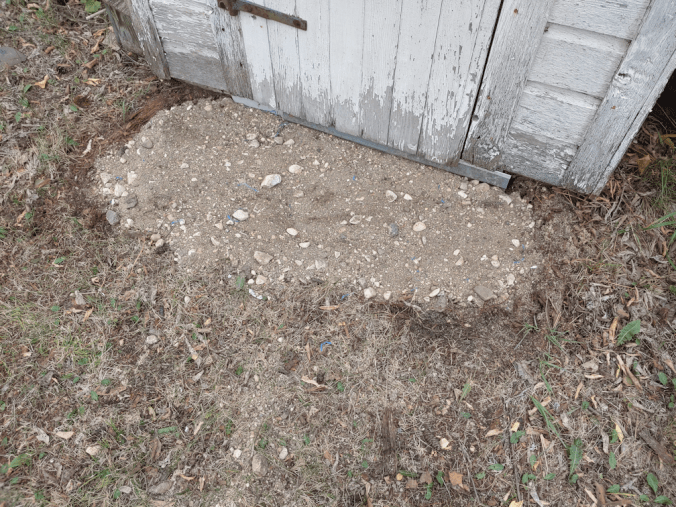
First, I collected the biggest rocks that were visible. I also grabbed one of the flat rocks I’d found under the old half wine barrel planter I’d cleaned up from near the junk pile. That was used to cover the small gap near the big rock under the metal pieces. Then the rocks were added to keep everything in place.

Then I brought over a load of sand and gravel – and a few more larger rocks – from the groundhog den.

Most of it went to filling in the space left behind from removing the rotted wood and tamping it down.

The rest was spread out to go under the metal sheet. At this point, the sheet was laid down and removed a few times, until I got it fully supported by gravel and rocks, and level. I did end up having to get a bit more sand and gravel before I was done.

And there we have it! We can now to into the outhouse, and not worry about anything collapsing under our feet and getting hurt.

I just had to make sure the text on the metal sheet was facing so that it could be easily seen and read. I am curious as to why it says “one more” car, and why the words “one more” are in quotes, but the word “car” is not. :-D

Now that it’s safe on the outside, time to see if it’s safe on the inside!

Find out, in my next post…

The Re-Farmer

Our 2022 garden: second box done

Sadly, we didn’t get any more rain today, but it has been very windy. Enough that we lowered the canopy tent as far as it can go, so reduce the chances of wind damage. It still has our camp chairs and makeshift table that we were using to cure onions on a screen, under it, and we can still duck under to sit in it.

I feel like a little kid in a fort. It’s awesome!

But I digress!

There was a break in the wind, and I took advantage of it to build the second low raised bed box to go where the garlic had been.

The build went much faster than the first one, now that we’ve got it figured out.

With stuff we’ve got going on over the next few days, we won’t be able to work on the third one, nor prep the empty beds for next year, until after the weekend. Which rather sucks, because the next couple of days are going to be really nice, then by Sunday, we’re expected to hit 33C/91F, and stay above 30C/86F for at least a few days. At least there is the possibility of more rain as well.

The third box will be a very quick build, since it will be only 1 board high. The bed it’s going to go on still has beets growing in it, so there is no hurry on that one. :-)

The Re-Farmer
Oh, those little buggers!

Or should I say, big buggers?

The raccoons have been at the bird feeders again.

I found the big feeder on the ground again, the screws yet again ripped right out of the base. This, even after adding newer, stronger wood to the bottom, and using more and longer screws!

Then I found the other feeder.

Well, parts of it, anyhow.

Thankfully, this feeder is actually designed to come apart, so this is not broken. Just in pieces.

But one piece was missing! The part with the cable it hangs from.

I finally found it, some distance away, under a lilac bush.

The parts and pieces were all wet and splashed with mud and dirt, so it got a cleaning and is now sitting to dry before I refill it and hang it back up.

Then I turned my attention to the big feeder.

Part of the problem with it is how much it wobbles on the top of the post. I’d added foam covered wire, wrapped around the top of the post, to reduce the wobbling. This reduced the wobble, but it was still there. The raccoons are rather large, weighty critters, so if they’re climbing the post to get onto the bird feeder, they would be causing it to tip quite a bit. That is likely what is putting so much stress on the screws and the wood. Of the six screws holding the base, which had slid to the bottom of the post again, to the underside of the feeder, pieces of wood were still stuck to a couple of them, while one of the screws was gone completely. I found half of it in the ground. It had snapped right off!

So along with putting the base back on using even longer screws, which are now long enough to be going right through the added wood and into the bottom of the feeder itself, I had to do something about that wobble. Something that wouldn’t slide out of position, thicker and with less give than what I used before.

I found a solution.

I use twine, and some of my husband’s navy rope work that he taught me, years ago, that secures the ends in a way that they cannot come loose and unravel.

It took wrapping three layers of twine to get the thickness needed. The base is now solid on the post, with no wiggle, and I can still slide it on and off the post as needed.

This, together with the even longer screws, should prevent the base from being torn off the feeder again.

Of course, that leaves us with the problem of the raccoons getting into the feeders in the first place.

That will require a bit more thinking.

The Re-Farmer

2021 garden: into the root cellar

With the blessed rain we’ve had, our garlic and onions hanging in the canopy tent did not get rained on, but when I checked them this morning, I was concerned about the effect the humidity might have on them. They need cool and dry to cure, but our options were hot and dry, or cool and damp. Suddenly hot and humid changes things. :-)

We did not get more rain today, and by the end of the afternoon the bulbs felt dry again, so I prepped them to bring into the root cellar.

The garlic got their tops trimmed, and everything got their roots trimmed off as well. The job was very quick and easy to do, with them all hanging in the tent!

It seems like so little, when they’re in the grocery bag I used to bring them inside!

I left them as they were on their twine, so they could be hung in the root cellar.

The root cellar is under the entryway, which is two steps lower than the rest of the new part of the house. I’m about 5’4″, and I had to make sure not to hit my head on the floor joists for the floor above! It’s definitely cramped in here!

There are quite a few large nails hammered into the floor joists. I used those to hang the strings up again, so they can continue to cure. You can’t see it in the photo, but there is a duct running between a pair of floor joists to outside, for air circulation. The duct is covered with mesh on the outside, to keep the critters and insects out.

We had been thinking of converting this room into a cheese cave and monitored the temperature and humidity in here for about a year, taking once a week readings. We missed a few weeks here and there, but still spanned a year.

The average temperature in here was 12C/54F, and the average humidity was 62%. The highest temperature was 18C/64F, which is what it was at while I was hanging the garlic. The lowest temperature was 6C/43F. The highest humidity reading was 88%, and the lowest was 28%. While I was hanging the garlic, it was just under 80% humidity.

The ideal average temperature for a root cellar should be between 0C – 4C (32F – 40F) with the humidity ranging from 85%-95%

So the conditions we should be getting, for a good root cellar, are winter temperatures and summer humidity levels.

:-/

One of the things I noticed while ducking around the ceiling to hang the garlic, is that the light bulb in there is putting off a lot of heat.

I was thinking of setting a fan up in here, but there is no outlet.

After scrounging and digging around, I found a low lumen “chandelier” LED bulb, and an outlet adapter for the fixture. My husband isn’t using his box fan right now, so I set that up in the root cellar, plugged into the outlet adapter. The adapter has a pull cord so that the light can be turned off while the outlet still gets power, but because of the type of light bulb in there now, it didn’t want to shut off, and just blinked on and off. So I left it on. It won’t add to the heat, and won’t use much power. We’ll just have to check the garlic and onions regularly, until they are cured.
Once the garlic is finally cured, they will be taken off their twine and packed into cardboard boxes or paper bags, depending on what we have available at the time, for storage. The onion braid will probably just stay hanging. I expect, before those are ready, we’ll have harvested the rest of the onions and will have them hanging in the canopy tent for a while, before moving them into the root cellar, too.

Hopefully, by winter, we will have more food stored in here, such as melons, winter squash and potatoes. We had high hopes of being able to store canned goods here, too, but between the critters and the drought, we’ll be lucky to be able to do some refrigerator pickles. :-( Anything else we have will be in quantities that will be more practical to freeze or dehydrate, rather than can. Even if we won’t be able to can much from the garden, I am planning on pressure canning heat and eat meals, at least, like chili or stew. Things like that are just really handy.

We shall see how things go over the next couple of months!

The Re-Farmer