As I write this we are at an almost balmy -26C/-15F with a wind chill of -34C/-29F, and we’re supposed to continue to get warmer over the next couple of days.
Remarkable how our ideas of “warm” and “cold” change, when living somewhere that has such temperature extremes throughout the year!
Yesterday evening, I’d treated the outside cats with a warm, meaty broth over their kibble top up, but this morning I found quite a bit of the kibble in frozen broth! It froze before the cats could eat it all, and the crowd of them was eating fast when I went back inside.
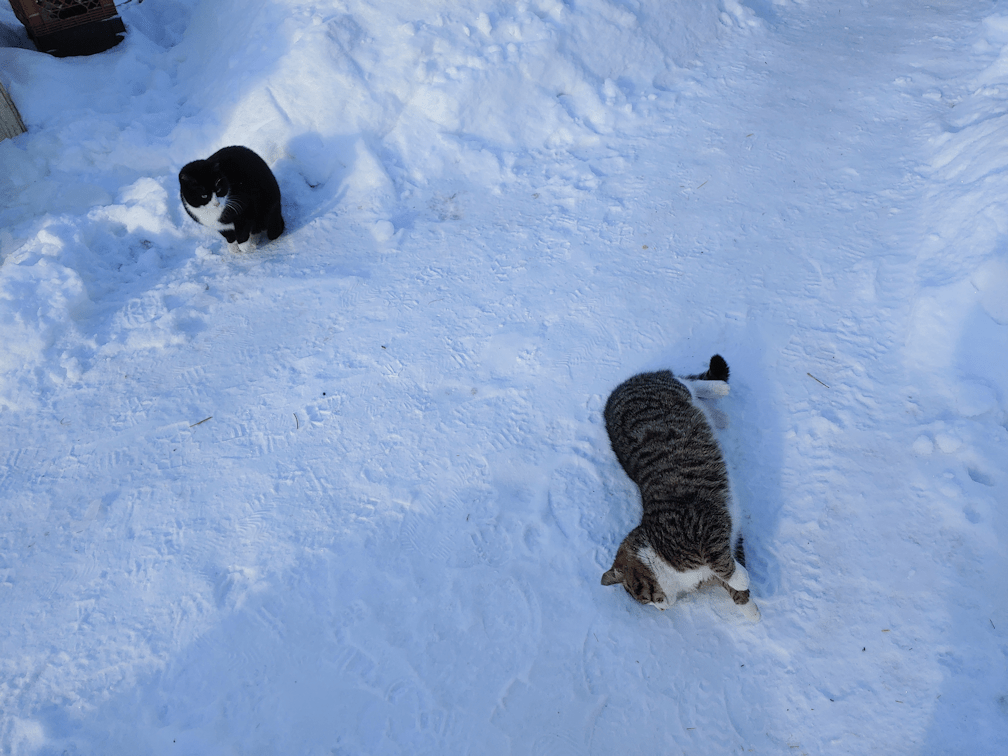
While the outside cats clearly don’t like the cold, they are doing quite all right, and spend a lot of time outdoors, instead of in one of the many shelters they have available for them. Seeing Chadicous exuberantly rolling on the snow sort of hits home how different the outside and inside cats are. It’s also a reminder of how important it is to let the outside cats develop their natural defenses against the cold. These are from generations of outdoor cats. They have the genetics to develop that insulating fur and body fat they need. Yes, they can still freeze, and having the heated cat shelter is a good thing, but it is equally important that it not be too warm in there, as that would seriously mess them up and potentially harm or kill them.
If our inside cats ever got outside in the temperatures we have now, most of them wouldn’t last more than an hour, even though most of them either started out as outdoor cats, or are from the same gene pool. Then there’s Fenrir. She has her long fur, but no undercoat, and that’s why we brought her indoors during her first winter. I don’t know where she came from or what breed she is, but it certainly wasn’t from any local cold-hardy genetics! A cat like David, with his long fur and deep, thick undercoat, would last longer, but having been in a warm house all the time, not even he would last long if he suddenly ended up outdoors. This is where going out through the sun room has its benefits, as it gives us two buffer zones, should the cats try to dash outside. Oddly, only Fenrir seems to actually be trying to do that. While other cats make a run for it, they’re more interested in exploring the old kitchen. Fenrir has managed to get as far as the sun room before we’ve caught her. In fact, going for the sun room door is the one sure way to get her out from under the couch in the old kitchen, or from behind the old wood cookstove, where we can’t reach her. I try to watch out for her before opening the door into the old kitchen, but it’s like she’s waiting for me. Many times, the moment that door opens, she appears out of nowhere and is in the old kitchen before I have a chance to react in any way. Knowing we’ll try to get her out, she immediately hides in places we can’t reach her. Sometimes, the only way I can catch her is to go into the sun room and leave the door open behind me. She always goes for it, and I can usually manage to catch her rather quickly after that.
When we win the lottery ;-) and can finally renovate this place, one thing I would want to keep and repair is all the doors between sections of the house, and add even more in places. None of this “open concept” stuff. :-D We once lived in a house that had doors between every room, including at the bottom of the stairs to the second level. I ended up really appreciating being able to so easily close off portions of the house, partly because it was even worse to heat than this one, and closing up rooms helped keep things warmer. We stopped using the second level completely in the winter, closed off the door at the stairs and added a draft blocker at the bottom to stop the waves of cold coming down. It was an awesome house, but yikes!
Ah, memories… :-D
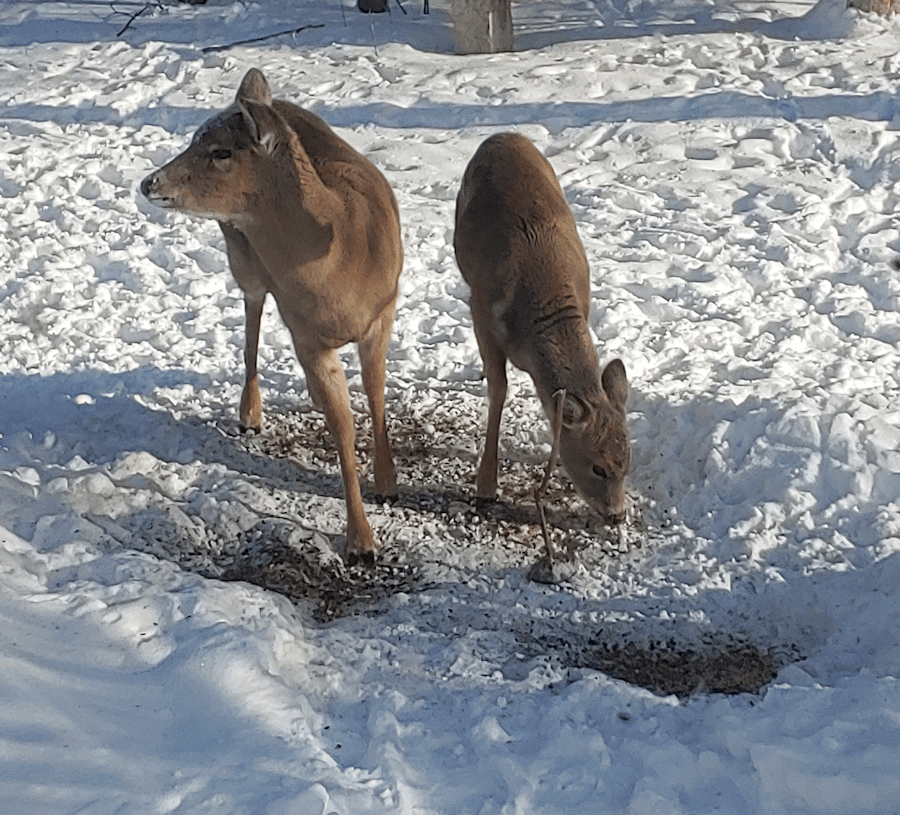
Before I headed outside this morning, I saw deer at the feeding station. The usual doe and her little one, looking for any seeds the birds hadn’t finished off yet. I wasn’t at all quiet while setting food and water out for the cats, so it was a surprise when I came around the corner with feed and scared off two deer! I think they’ve gotten used to the routine, though. After putting feed out, I went back inside, and already could see the doe through the living room window. I quickly hung my coat, then went to watch when I saw the little one come bounding joyfully along the edge of the spruce grove to join Mom.
These two come back several times a day, now. Every once in a while we’ll see a buck but, so far, that’s about it. Later in the season, I expect we’ll start to see more deer coming by and will probably start to leave out more feed again.
I’ve left the remains of a sunflower there, because the birds like to perch on it. :-)
The 14 day forecast is interesting. Of course, it changes pretty much every time I check it, but the middle of the month is looking like it’s going to be quite mild! For all the cold we’ve been having in the last little while, this winter is shaping up to me so much nicer than the last couple of years, and a lot more like our 30 year average than the unusual cold we had during those polar vortexes.
We have been working towards being set up and ready, should we be stuck at home for weeks again, but this winter is looking like we’ll actually be able to get out and about like normal. No frozen vehicles! Hopefully, this will run through February, too. The way things are going, I’m hoping to pick up some (not-frozen) soil and maybe even a warming mat, to get some seeds started in our aquarium greenhouse. People in my cold climate gardening groups have already started things like peppers and tomatoes, but I’m mostly looking to start onions and shallots, first.
Plus, we still have to decide what seedlings or root stock we’ll be ordering this month for planting in the spring. :-)
As the year winds down, it’s time to review the goals we’d set, see what worked, what didn’t and what we want to accomplish next year.
Among the goals we had:
Starting a cordwood shed to use as an outdoor bathroom, with a composting toilet, to replace the outhouse over a pit.
Well, that didn’t happen. Which is turned out to not necessarily be a bad thing.
The location we want to build it is in that open space behind the compost ring. One of the things I did this past summer was go through the spruce grove and mark most of the dead spruce trees I found. I marked almost 2 dozen, and there were several others I didn’t bother marking, or couldn’t get at. These were trees that were intended to be used for the cordwood walls, however priorities have changed. They will now be used to build high raised garden beds. Right now, the space we want to build in is going to be needed to drag logs out of the spruce grove. Thanks to my mother, we now have a wood chipper that we can use to break down the branches, so we’re not adding to all the branch piles, and will have plenty of wood chips for mulch.
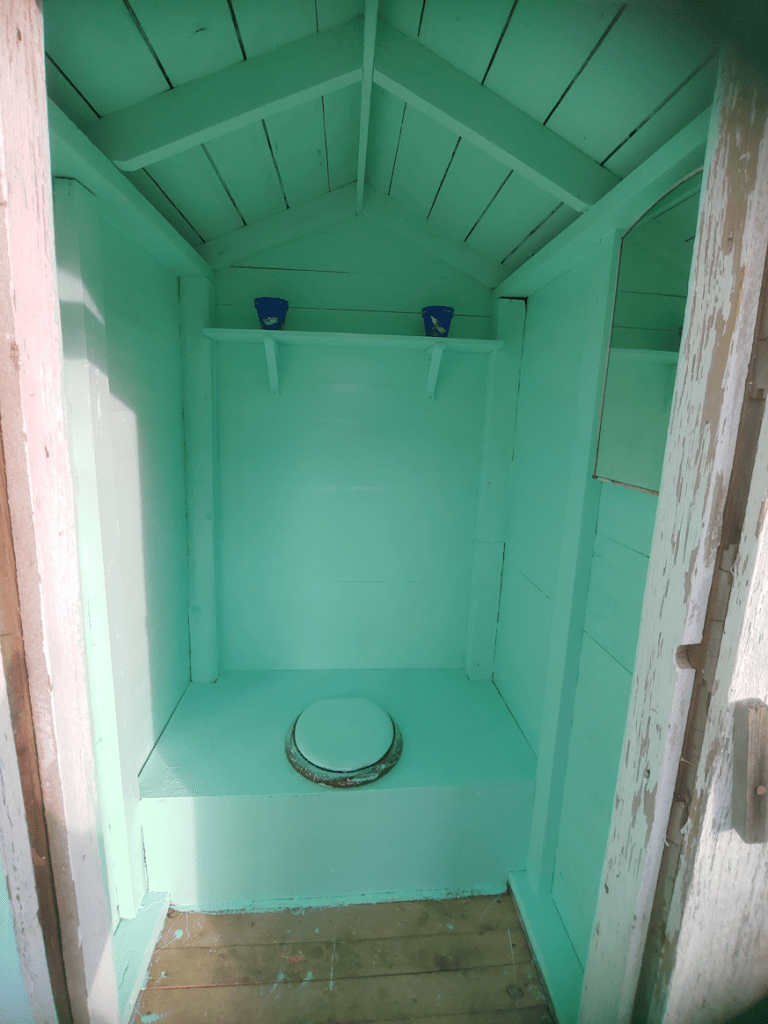
Until we can build the outdoor bathroom, we do still need something to use the next time we have plumbing problems, so the inside of the old outhouse was fixed up and made pretty (the photo here is from before it was finished). A goal for 2022 is to remove the old, moss covered shingles, extend the roof to create an overhang above the door, re-shingle it (or use some of the left over bits of metal roofing we still have in the barn), and do any repairs on the outside before giving it all a final paint job.
We did find that a groundhog had got into the pit and dug a den under the floorboards somewhere. Sadly, if we get an average amount of snow, this will likely result in a drowned groundhog. Our first two springs here, we found that snow melt would form a large puddle in front of the outhouse, and I could see in the hole under the door, which is now fixed, that the pit filled completely with water. There is nothing we can do about this. Hopefully, the groundhog will wake up early enough and leave the den before this is an issue.
Another of our goals is to have the branch piles chipped. While we now have this awesome new wood chipper, which can chip branches up to 3 inches thick, it is very slow going. The branches have to be trimmed of any sticky-outy bits, and be straight, or it won’t go through. For the sake of efficiency, it will be better to hire the tree guys and their massive chipper. When we got their estimate, they figured it would take 6 hours to chip all our wood piles. For our budget, I’m hoping that we can have them come out for three hours in the spring, to get at least the big pile in the outer yard done, and maybe the little ones in the maple grove. Then we can see about hiring them again, maybe in the fall, to do the remaining big piles. With the new wood chipper, we should at least not be adding more to the branch piles, as we clear dead trees out of the spruce grove!
Another goal that we once again failed to meet, was hiring someone to haul the junk pile away to the landfill. This irritates me, because that pile is getting so large, and we are getting to a point where we need to start cleaning up on that side of the chain link fence. If our budget allows, I’m hoping to at least have smaller loads removed, as we can afford it. The name I have for a guy that hauls junk uses a pick up truck, so if we can get him to come by a few times throughout the year, even that would be a help.
Our gardening goals were mostly met, as far as drought conditions allowed. We used poplars we’d cleared out of parts of the spruce grove to build trellises, and those will be used for another year. We planted in areas far from the house, partly to prepare the soil for permanent plantings. The corn and sunflowers were potentially there to provide privacy screens, too, but the drought and poor soil conditions prevented that. Having to use 300 feet of garden hose to water things, and still just barely being able to reach some corners, during a drought and heat waves, was something we could have done without! Add in damage from deer and groundhogs, and it’s a miracle we had as much produce as we did.
For 2022, our garden plans will continue, and this year we will start with the permanent plantings. We are pouring over websites and looking over what bushes we will be planting in those far flung areas. In one section, we will be closing off a gap in the hedge along the north fence line that the deer go through. My mother had been planting lilacs along this fence, but we are looking to plant berry producing shrubs and bushes, instead. We will also be planting them along the east side, both to help keep deer out and to create a privacy screen. We still need to make sure we can access the east fence line, and there has to be a lane kept open, over where the telephone wires are buried, so we will use other methods to close that off to the deer. We’ll have a better idea of what we can buy in January, when many of the nurseries will have their new inventory available. We might be going with sea buckthorn, if the other varieties we were looking at don’t come back into stock.
Other things we intend to order for 2022 are raspberry canes and, if all goes well, Korean Pine. These require shade for their first 5 years, so they will be planted just north of the spruce grove. If budget allows, we’d like to get new Saskatoon bushes, too.
We will have to take out more of the crab apple trees, to remove diseased trees. There are two trees that produce the best apples. If I can protect those, I will be happy. However, we will also be getting other types of fruit trees including, hopefully, a hardier variety of mulberry tree to replace the one that we bought last year, that got killed off by that one cold night that also killed off all the flowers that would have given us fruit and berries this past year. I’m not sure how many we will be able to squeeze out of our budget this year, but the more fruit trees we get, the better, as they can take many years before producing fruit. Berry bushes are also high on our list, as they will start producing much faster.
This past year, we expanded our garden plots significantly, but with our long term goal of growing as much of our own food as possible, we will need to continue to expand and prepare new ground. Now that we have a working chain saw, we’ll be able to clear dead trees out of the spruce grove and clean that up faster. Many of these dead trees appear to have no rot in them yet, and we plan to turn many stumps into benches and tables. We will also need to clear out the fallen rotten trees, and other fire hazards. Once things are cleared out, we will be planting more spruces in the spruce grove, as well as fruit and berry trees that require more protection from the elements. We’re also looking at getting some Rugosa roses, though they will likely be used more as a deer barrier!
Where the trellises are now will eventually be converted to our food forest, except for the lane that needs to be kept open over the buried phone line, but we will use them where they are for one more year. We ordered quite a lot of seeds already, from Vesey’s (including replacement seeds) and Baker Creek again, plus two orders from Heritage Harvest, which is a new company for us this year. The only seeds we’ve ordered that are still en route are the kulli corn. The only other seeds I still plan to buy are peas, but I will pick those up from a local store when they come available, rather than ordering them in. We will also be making use of seeds from our inventory left over from last year. Which means we will need to build more trellises, once we decide where, because we’ll have quite a few vining plants, and there’s only so much we can plant along the chain link fence. ;-)
Along with the saplings, canes and root stock we plan to order, we will be ordering potatoes and sunchokes. This time, we will not try to grow potatoes in bags, but will use the Ruth Stout method again, as part of preparing new areas for either more garden plots, or permanent plantings, the following year.
At this point, we have three low raised bed boxes built, and one high raised bed. Next year, we will continue to use the current beds in the main garden area. The goal is to cut the dead spruce trees to size so that, after things are harvested in the fall, the remaining beds will be converted to high raised beds before next winter. With how much watering we had to do during the drought, filling the beds hügelkultur style will be an important part in moisture retention. Even under normal conditions, high raised beds are notorious for drying out too quickly, but with how we fill them, coupled with the judicious use of mulch, we should be able to prevent that from being a problem.
We will also be making new beds for corn and the many types of squash we have for this coming year, but those will be in areas that will eventually have trees planted in them. Ultimately, we will be building accessible high raised beds in the outer yard to the south of the house, where they will get more sunlight. Eventually, we intend to build a greenhouse or polytunnel out that way, too. It’s not something we’ll be able to start building in 2022, but we should be able to start preparing where they will eventually go. The renter plans to build new fences next year (maintaining the fences was part of the deal they’d originally made with my late father), since their electric fence has been not working as well as intended. I hope to talk to them again about putting a new fence line across the old hay yard, which will be much shorter (therefore, cheaper) than rebuilding the existing fence, but also takes away an area of pasture. We would need a gate in there, though, so that we can eventually haul away those old vehicles to the scrap yard. As that would not be something they’d normally include, I’d be offering to pay for the gate portion. If they are willing to do the new, shorter fence line through the old hay yard, we will be able to get rid of some old, messed up fences and a shed that looks ready to collapse pretty soon. Then we can start building new garden beds out that way. This is also the general area where we want to build the outdoor kitchen, as well as planting a wind break. None of which are worth starting, while there is a chance the renter’s cows can get through. There are also old, collapsing fences around the inner yard we want to take out completely, rather than repair or replace, but again, it can’t be done until the outer yard is fenced in. Long term, though, we won’t have an inner and outer yard anymore, but just one really big yard.
Which means that, on top of continuing our work in the inner yard and garden, we need to get more work done on cleaning up the outer yard. There’s a limit to what we can do, without heavy equipment, but we can at least get a start on it. That was something we should have worked on this past year, but accomplished very little. Hopefully, this coming year will not have the drought and heat waves that made heavy manual labour a very bad idea!
With what we’ve learned from the past year, we know that this year, we will need to focus on protecting our plants from deer, groundhogs and racoons. We will also be focusing on permanent plantings that are drought tolerant and can handle poor soil conditions, even with the amendments we’re working on. We are also looking into planting forage trees and fodder well away from the house and gardens, to give wildlife less reason to invade our yards, looking for food.
As we build our raised garden beds, we will also be ensuring they will all be the same size at the top, so that any covers we build can be interchangeable. The low raised beds are boards and are 3′ x 9′. The high raised bed is 4′ x 9′, and we plan to build them all that size. With the thickness of the logs, the actual growing space inside is closer to 3′ x 8′. So if we build covers to fit the low raised beds, they should also fit the high raised beds.
While most of our goals are going to be expanding or continuing previous goals, a new goal I want to add is to have chickens. For our egg needs, we would only need about half a dozen birds. The problem is, we don’t have anything to keep them in. I am wanting chickens to be part of our soil reclamation progress, which means being able to move their coop and enclosure regularly. Buying a new chicken tractor is well beyond our budget, but we don’t have the materials to build one, either, and with the cost of building materials right now, it’s as out of reach as buying a new one. Of the many, many videos I’ve looked at for making quick, easy and inexpensive coops and shelters for chickens, none of them are suitable for our climate. Oh, they could be temporary structures for the summer, and I do plan to build versions of them that will fit over our raised garden beds, but none of them would keep chickens alive during our winters.
That is something I need to work on. I’d love to get able to get chicks this spring, but if we can’t shelter them once they’re big enough to leave a brooder, there’s no point.
So there we have it. We did accomplish some of our goals for 2021, but many of our goals are multi-year things, so it’s more progress than accomplishment.
Now we’ll see how much we manage to get done next year!
I’m feeling very fortunate right now! For ourselves and for the critters.
When I checked the weather first thing this morning, my app’s weather radar was showing us well under an area of snowfall, and yet when I looked out my window, there was none coming down! We did have some during the night, and it started up again later.
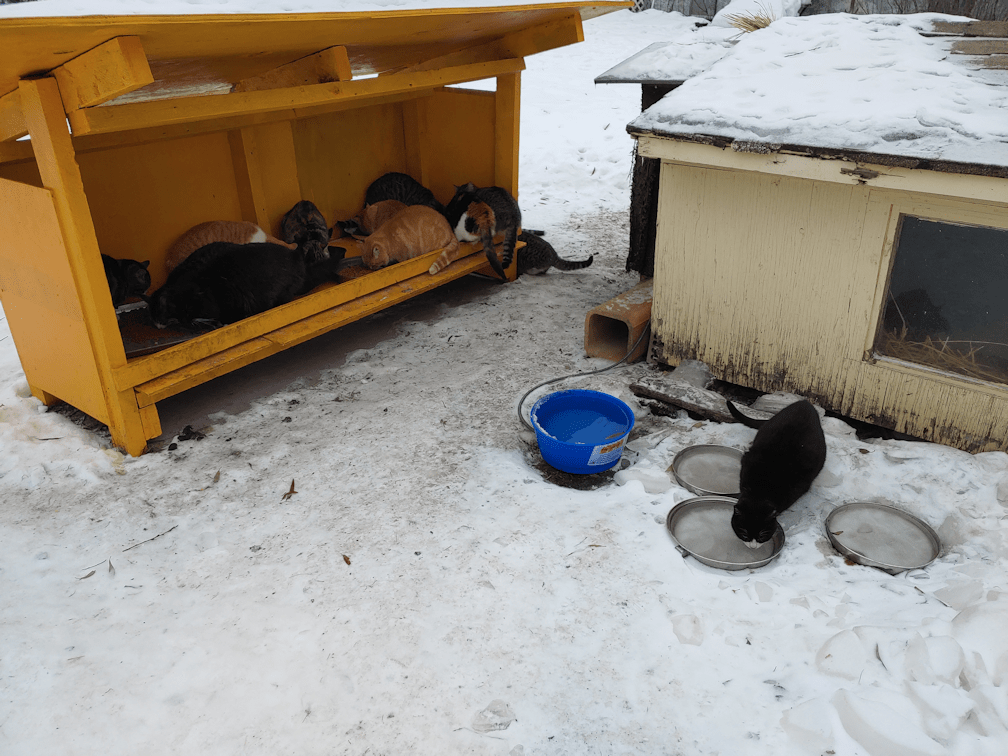
The extra water bowls were completely covered. :-D
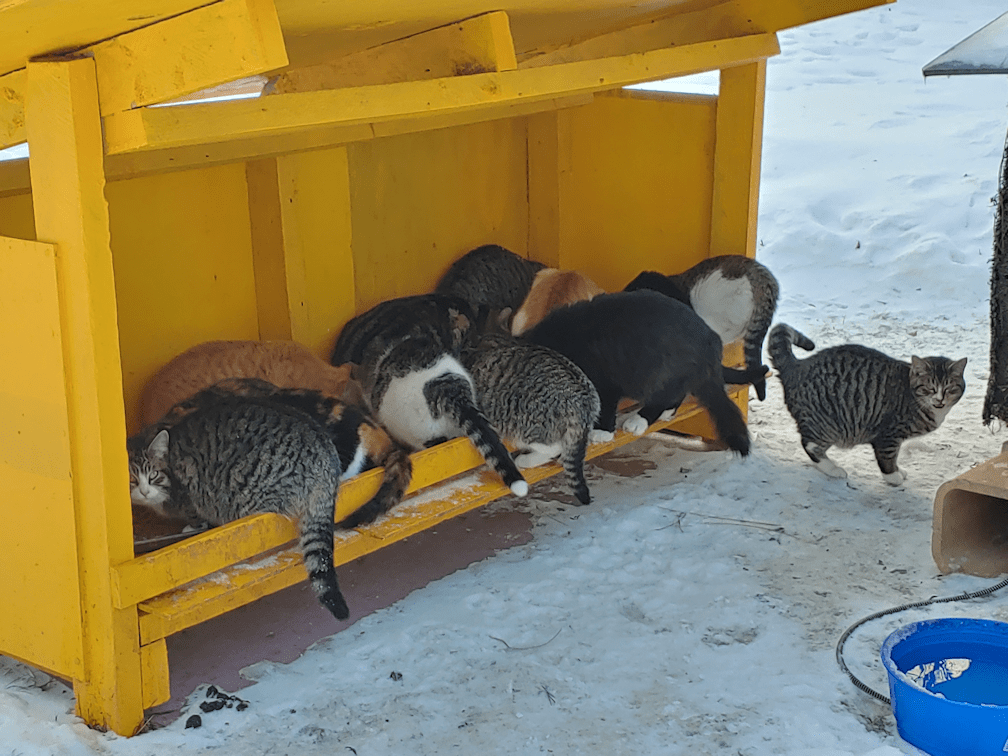
Funny how the cats all like to crowd into one side like that; even the ones that don’t get along well with others! :-D
They were quite happy to have warm water! The heated water bowl keeps it from freezing, but what we bring out is warm to the touch, and they really like that, this time of year!
We’re having a warmer than predicted day today. We’ve been hovering about -11C/12F for most of the way. As I write this, the wind chill is only -17C/1F Not only does that make life easier for the critters, but the lovely snowfall we’ve been getting is much needed, to help the water table recover in the spring, from last summer’s drought. Hopefully, this will keep up, throughout the winter. Especially the mild part. The city we moved way from was at -35C/-31F this morning! While we are expected to get colder over the next couple of weeks, we’re not supposed to drop below -30C/-22F during the day. After being hit with polar vortexes through January and February, the last couple of winters, this is a welcome relief for us – and our electricity bill! Even so, this house is so inefficient, the furnace is on a lot. Not that it makes much difference upstairs, but the little ceramic heaters my husband got for them is making a huge difference.
Oh, before I forget!
Keith got his last anti-biotic dose last night, so his treatment is complete, and he is the picture of health! This is such a relief. The vet was pretty sure she’d seen a heartworm in the ultrasound, but not completely sure. The fact that he’s doing so well now, on just anti-biotics, confirms that it was “just” an upper respiratory tract infection that had him coughing up blood. His breathing is completely clear now, but he is quite upset with us and his nightly doses! It never did get any easier, and by the end of it, he was getting very hard to find when it was time for his medication!
All the cats, inside and out, seem to be recovered. There are just a couple of indoor cats we sometimes hear having a coughing or sneezing fit, but I don’t usually see which one it is when I hear it. No more crusty noses, either. On the down side, they’re all really active again, and Fenrir has discovered that she can jump straight up into the tree hanging against the wall! I don’t know who did it, but last night I heard a noise and when I came to check, the bottom of the tree was on the ground. I didn’t even know it came apart there! The tree doesn’t come down until after Three King’s Day, so we’re going to have to keep monitoring it.
Anyhow.
We are still getting snowfall warnings, and my desktop apps keep flashing red alert symbols at me. From the weather radar, though, it’s already well past us, and there is no more visible. The road crews will be out, which means I should be able to run some quick errands for my mother, and pick up some more deer feed. I don’t leave much out, and the birds eat quite a lot of it, but we still get regular visitors. There’s a doe and her almost adult sized baby that comes by every morning, and yesterday I saw a buck going past my bedroom window. He antlers are just growing in again, so he had these 6 or 8 inch long spikes sticking out of his head. :-D
We are in a nice, quiet and boring time of the year right now, and I’m quite appreciating it! We’re making use of it to plan what we’ll be ordering with our “seed” budget, next. I’m done ordering actual seeds right now, and the girls and I have been talking trees and bushes. A lot of the nurseries don’t start taking orders until January, though, so their websites are still filled with “out of stock” listings, so it’s hard to make decisions right now. It’s only a little bit longer to wait, though. Until then, we can still plan!
Of course, we’re into the 12 days of Christmas, now, so we’ll be celebrating until the Feast of the Epiphany, aka: Three King’s Day, on Jan. 6. :-)
Even the kitties get to celebrate with special treats from the kitchen. I’ve got more in the fridge waiting for them, too. :-)
We did our big dinner on Christmas Eve and I was planning to bring a turkey dinner to my mother’s on Christmas Day. My sister (who belongs to a denomination that doesn’t celebrate Christmas) brought my mother over to her place for a Christmas dinner. I’m glad she was able to do that, and that my mother was up to the trip. So I visited Mom today, instead. I still brought her a turkey dinner for later. When getting groceries for her for the last while, I noticed she hasn’t been getting any protein, so I brought her one of the 2 pound packaged of ground beef from our freezer pack, too. Since she’s just feeding herself, that should last her a while.
I am happy to say she really liked the crochet mushrooms I made for her!
She even commented on how much it looked like her drawings. :-) I’m glad she liked them. She had wanted them carved of wood, but it turns out she meant for the younger of my brothers to carve them for her. He does chainsaw carving out of repurposed cedar power poles. He makes really great morels, but I’m not sure how he’d have chainsaw carved porcini mushrooms using his tools and techniques! :-D
I’m glad I was able to visit her today. We’re getting heavy snowfall warnings for tonight, into tomorrow. It doesn’t look like the worst of it will reach as far north as we are. After that, the temperatures are supposed to drop quite a bit again, ranging between -20C/4F and -27C/-17F for the highs. Mostly closer to -20C. Still pretty average for this time of year. I will make sure to get another grocery trip for my mother in there, at least. I don’t want her to be going out in these temperatures, if I can help it!
It’s going to be a nice, quiet Christmas season for us, which is just how we like it. :-)
For at least a decade, there has been an increase in people who have decided to move out of the cities, get themselves an acreage, and live as self-sufficiently as possible.
Which is basically, how I grew up.
Things have really changed, though, and modern homesteaders have a lot more resources, options and choices than was available when I was a kid, 50 years ago, never mind what our pioneers had. I found this very encouraging to see.
A couple of decades ago, while part of an online homeschooling support group – pre-social media, when everything was by email (and dinosaurs roamed the earth) – I often saw people waxing poetic about how we all need to go “back to the land”, and live these organic, subsistence lives, and all our food would be free and we would barter for everything else, and so on. It had a lot more to do with ideology than anything else. Going back to the farm was a dream of mine since I moved away in my late teens, so I could appreciate many of the sentiments they expressed. Unfortunately, this romanticized view was wildly unrealistic, and I found myself trying to remind people that there are reasons people, including farmers, moved away from that life.
Most of them didn’t get it.
Once we moved to the farm, 4 years ago, in a caretaker role, how things were done when I was a kid just wasn’t an option, and I’m quite okay with that. Most of the land is rented out, so we just have our corner to work on. My mother had a massive garden that had been slowly neglected for many years, as my parents retired from farming and age reduced their mobility, no matter how much my siblings tried to help. We can finally work on our dream to be as self-sufficient as possible, but we have to do a lot of things differently than how we did it when I was a kid.
It was in researching this that I found this dynamic and growing homesteading community. These were people who may have gone in starry eyed, but were also realistic and determined, and they were making it work. The aging hippies I couldn’t get through to all those years ago, with their ideological blinders, could never have done what these awesome people were doing. It was very exciting!
Then, the last couple of years happened.
As people saw their jobs disappearing, their livelihoods destroyed, prices skyrocketing, and government restrictions stifling people’s ability to do some of the most basic things, a lot of people are suddenly having real concerns about being able to feed themselves and their families.
During WWII, governments actively encouraged families to grow Victory Gardens, and even gave out information and resources to help people do it. That sort of thing isn’t happening now. Instead, we are having to rely on each other to figure out how to grow what, for too many people, are literally survival gardens.
Whatever your reasons for wanting to start growing as much food for yourself as you can, I heartily encourage you! You won’t get any sermons or lectures from me. I do hope that I can, at the very least, provide some information and inspiration.
Start where you’re at
Your circumstances are going to be unique to you. If you’re already on an acreage, great. If all you’ve got to work with is a hall closet and some makeshift grow lights, great. You can start where you’re at, even if it’s just poking some holes in a bag of potting soil to grow some greens in a sunny window. Little by little, it’ll get done!
What I will be sharing here is going to be geared mostly to people living in colder climates – and by that, I meant Zone 2 or 3 (depending on what Canadian zone maps are being used, we live in either 3a or 2b).
I will add one thing I’ve heard quite a number of very experienced, prolific gardeners say. If they had to depend on their gardens for survival, they’d starve! It takes a lot to grow enough food to actually provide enough for even one person to last from preservation to the next year’s harvest, and it will still need to be supplemented with other things. I’m still somewhat amused and perplexed by my mother trying to lure us out here by saying we could grow a garden and not have to buy groceries anymore. Even as big as her garden was, plus having chickens and cows, sometimes pigs, turkeys and geese, a root cellar and lots of canning and freezing, we still had to buy groceries.
So you’re still going to need to buy stuff. Hopefully, just a lot less!
With that in mind, as you plan what to grow in your own personal survival garden, here are some things to consider when making decisions.
Grow what you will eat.
I’ve looked at so many lists out there, for things like what to grow to feed a family for a year, or what to grow in your climate, and so on, and frankly, a lot of stuff on those lists are foods I just don’t like. Others, I can’t eat. There are four of us in our household, and we have very different tastes. Which means that our focus will be more on growing things all of us enjoy eating, then including smaller amounts of things only one or two of us like to eat. As wonderful and appetizing as I find tomatoes and bell peppers, they both make gag, but two people in our household enjoy eating them, and all of us can eat processed tomatoes. Now, those two people REALLY like their tomatoes, so growing more of those than peppers for fresh eating makes sense, as well as growing a lot of tomatoes that are good for making tomato paste to last us for months. It’s a sort of juggling game.
Try new things
What we find in the grocery stores is there because those varieties can handle large scale growing and transportation. When you’re growing your own, you can have a lot more choices. This is a time to grow new varieties of things you know you like, and if you have the space and resources for it, grow something you’ve always wanted to try, but couldn’t for one reason or another. Which kinda ties in with my next point to consider.
Grow at least one thing for fun
Yes, growing food to ensure your family has something to eat when times are tough is serious business. The whole point of the list I’ll be presenting to you is to be able to get as much bang for your buck as you can. At the same time, growing something just for fun is a great morale booster. As you go through what various seed companies and nurseries have to offer, you’re bound to find something that just puts a smile on your face. If you have the space and resources for it, go for it!
Keep in mind your region, climate and particular circumstances.
While the zone maps are very handy, that doesn’t mean there aren’t exceptions. There are things my mother successfully grew in our Zone 3 that were rated at Zone 5. She didn’t even doing anything different for them, either! This is a good time to find and get involved with a community of people in your region and zone, online or off, to learn from. If you are growing outdoors, look at what is rated for your zone, but also consider whether you can create microclimates. If you have only a balcony or patio, there are lots of places where you can learn about container gardening or vertical gardening. If you are growing indoors, there are resources geared specifically for that.
Storage and preservation
If you’re growing food to feed your family, and trying to grow as much as possible in your space, it’s not going to be much good if you grow more than you can eat, but can’t preserve it! There are many options available; freezing, dehydrating, water bath canning, pressure canning and even freeze drying, if you can afford the machine! You might even be able to create a root cellar in some corner of your home. Refrigerator pickling and fermenting are options, if you don’t have canning equipment.
If you’re going to store and preserve food, you’ll need somewhere to put it. What methods you have available to save your food will help you decide what makes the most sense for you to grow.
Things will go wrong. Do it anyway
One thing that is going to happen is, there will be failures at some point. It’s inevitable. Sometimes, you’ll make a mistake. Sometimes, there will be circumstances completely out of your control. It happens. The beauty is, you can still fail “up”. Honestly, you’ll probably learn more from the failures than the successes! Of course, it’s always a good idea to learn from others as much as you can to avoid failures, but it’s still going to happen. Since being here at the farm for 4 years, and only gardening for 2, we knew we were trying to grow in far from ideal conditions, and had some setbacks, yet we still managed to have food from our own garden that we could enjoy.
When it came to making a list of things that might work well in a survival garden, I looked for things that could be grown in colder climates, had high yields, and could be stored or preserved, while also keeping time in mind. So let’s start with the fastest growing things, first!
There are quite a few things that can go from seed to plate in less than a month. Some in less than 10 days! Micro-greens and sprouts can be grown very quickly, can be grown indoors in trays or jars, continually throughout the year. Many seed companies now has sections for sprouts, and quite a variety of things can be grown for their sprouts. Many sprouts can be grown in jars – alfalfa, mung beans, lentils, radishes, and more. Gelatinous seeds, such as flax, chia, cress, arugula and psyllium, can be sprouted in trays. For microgreens, you can try beets, swiss chard, broccoli, cress, peas, radishes and sunflowers.
If you want to give things a bit more time, leafy greens such as pretty much any type of leaf lettuce, spinach, chard, kale, bok choi and radishes can be grown and harvested very quickly. Many of these don’t like heat much, so they can be planted outdoors early in the spring and sowed successively until the heat of summer, then sowed again for a fall crop.
These quick growing plants are nutritional power houses, but they don’t have a lot of calories. They’re not going to keep anyone going for long, so it’s good to think of these as a supplement, and something that can provide nutrition until other foods can be harvested.
Short term
By “short term”, I am talking about the things we typically think of in our annual vegetable gardens. These are things that can take a few months before you can start harvesting anything, and can potentially keep feeding you and your family throughout the winter, with proper storage and preservation.
Root vegetables: carrots, parsnips, beets, radish bulbs, turnips, rutabagas… there are many to choose from, and many varieties of each! Stored properly, they can last for months on their own, but they can also be pickled, pressure canned, frozen, and dehydrated. With these, they are one seed, one plant (except beets; their seeds are actually clusters of seeds), but they produce so many seeds, most packets will provide more than needed for a typical household.
Bulbs and tubers: potatoes, sunchokes/Jerusalem artichokes, sweet potatoes – yes, there is a cold hardy variety of sweet potatoes out there! – bulb fennel, celeriac and more.
There are many varieties of potatoes, some more prolific than others, and some better for storage than others. A good source of seed potatoes will give that information. Potatoes also come in determinate and indeterminate varieties. Indeterminates are good for potato bags and towers, while determinate are good for hilling or Ruth Stout growing methods. Sunchokes will grow in just about any type of soil, and can be so prolific, they are sometimes considered invasive.
Special mention: the alliums are excellent bulbs to grow, but tend to require a lot more time, unless you are starting onions and shallots from sets, or spring garlic. Hard neck garlic needs to be planted in the fall, while onions and shallots from seed – which gives a lot more choice in varieties – need to be started indoors very early. In my garden groups, I’ve found Zone 3 gardeners that start their onions from seed as early as January! Onions also come in long day and short day varieties. If you are in a northern Zone, look for long day varieties. Of course, some varieties store longer than others but, properly cured and stored, they can last a very long time! Onion greens can be eaten as the bulbs mature, and hard neck garlic produces scapes that need to be removed to produce bigger bulbs, and they are delicious, making them dual crops to grow.
Summer squash and zucchini: There are many varieties of summer squash, and they all tend to be quite prolific. Just a couple of plants can provide plenty of baby squash that mature fairly quickly, and if they are left to grow larger, some varieties can be stuffed and baked. Most summer squash start to get tough as they get larger, and are not a storage vegetable, but they can be pickled, canned, frozen and dehydrated. Zucchini is a bit of an exception, in that it can be used as both a summer squash while small, or a winter squash if allowed to grow to full size.
Winter squash and pumpkins: These are squash that can grow to sometimes colossal sizes, but there are also varieties that are small, fast maturing and very prolific. Once they reach maturity, the fruits are cured and can be stored for the winter months. Some varieties reach their best flavour after weeks or months in storage. They can also be frozen, canned, shredded and dehydrated.
Legumes: there are few vegetables out there that provide more bang for your buck than legumes! Especially beans. Bush beans can be grown for their pods, and when they’re done producing is about when pole beans are ready for harvesting, and of course there are shelling beans, which are grown for their fully mature and dry seeds. Peas, chick peas and lentils can also provide a lot of food from just a few plants. Dried legumes, stored properly, can last for years, making them one of the most efficient foods to grow.
We could fit about a hundred of these tiny Spoon tomatoes into a single Red Solo cup.
Tomatoes: tomatoes are a fruit that deserve their own category. The varieties available is staggering! However, if you are looking to get the most pounds per plant, look at growing a mid sized variety. Aside from fresh eating, they can be frozen, canned or dehydrated on their own, or be used as an ingredient for sauces and salsas, and so much more.
Cucumbers: As with tomatoes, there are a really amazing number of cucumber varieties available, but most fall into one of two categories; slicers, for fresh eating, and picklers, for preserving. They all tend to be fast growing and very prolific, too.
Peppers: I wasn’t sure about including peppers on this list. They are excellent producers, but growing them in our colder climate seems to be touch and go. I’ve heard from people who have had great success with them, while others have tried for many years, but have never had a harvest. Peppers can be canned, preserved in oil, frozen, dehydrated, pickled and made into relishes.
While being able to grow food quickly is important, it is also useful to consider the long haul. If you have the space for it, there are things that may take several years before they begin producing, but once they do, the harvests will be bounteous!
Asparagus: asparagus can be grown from seed or you can buy crowns to transplant into trenches. It can take three years before they can be harvested, and even then, for the first year or two, harvests should be minimal. Once they are established, however, asparagus will keep producing for up to 20 years!
Raspberries, currants, gooseberries and haskaps: Haskaps are the new berries on the block, and are exceptionally cold hardy. They require male and female plants to produce, and can potentially begin producing berries in their first year. Raspberries are available as regular cane (new canes produce berries in their second year, then die back) or primal cane (new canes produce berries in their first year). Choosing varieties that mature at different times can give you fresh berries for months. Currants and gooseberries, once established, can produce fruit for many years. Berry bushes can provide a great deal of fruit per plant. Along with being used fresh, frozen or dehydrated, as well as made into jams and jellies, they can be used to make vinegars, syrups and wines.
Grapes: yes, there are Zone 3 grape varieties. I’ve even seen a Zone 2 variety. Grape vines are very long lived, and have the potential to provide fresh and frozen fruit, jelly, and wines for many years.
Hedge bushes and trees: There are a number of larger berry bushes that can double as shelter belts and natural boarders. Some, like sea buckthorn and bison berry, do well in poor soils, and while they may be considered invasive in warmer climates, they tend not to be, in our Zone 3. The Rugosa rose produces large edible hips, and their flower petals are edible, too. Saskatoons are a more of a tree than a bush, and absolutely delicious. Chokecherries produce many berries, but are better used in syrups, vinegars, etc. than eaten fresh. Many of these will provide enough berries not only for your own use, but for birds as well!
Now we’re really going for the long haul! Here, we are looking at things that can take five or ten years before they start producing food – but once they do, they will continue for decades to come.
Fruit trees: there are a remarkable number of fruit trees that can grow in colder zones. Apples, pears, apricots, cherries and plums can all be grown here. While a single mature tree can provide enough fruit for the entire family, many need to be planted with a pollinator, which can be a different variety.
Nut trees: there are not a lot of nut trees that can grow in Zone 3, but some, like the Korean Pine, are hardy to Zone 2! Hazelberts and beaked hazelnuts are also very hardy. Others, such as the black walnut, can grow in Zone 3, but the nuts may not have enough for a growing season to fully mature.
Okay, so all this is a lot more than just a “survival” garden, but we all start somewhere, right? :-) Little by little, it’ll get done!
I hope you find these useful in working out what are the best things for you to start growing in your own particular situation.
For those who have already been doing this for a while, please feel free to leave a comment, sharing your own experiences. What worked best for you? What didn’t work? Is there anything you would tell someone who is just starting out now? Let us know!
Yes, we were a lot warmer than yesterday. Technically, it was -10C/14F when I went out to feed the critters.
Stepping outside was like being smacked in the face with ice. We have GOT to do something about that gap in the wind break from the south! I think the wind chill was at around -23C/-10F at the time, but it sure felt a lot colder.
Then it started snowing, and for a while, I considered rescheduling the shopping trip with my mother. However, we were supposed to warm up even more by this afternoon, and it’s supposed to be our last day warmer than -10C/14F for the rest of the year.
By the time I headed out, it wasn’t snowing anymore, but there was so much blowing snow, the highway disappeared for most of the distance. My mother’s car is such a light little thing, I was fighting the wind the whole way. At least the highway was otherwise dry and clear. The gravel roads and the streets in my mother’s town were icy, with drifts forming.
I made a point of putting some gas in her tank and grabbing some of her favourite chicken and wedges, and got there early. She had just come back from church and hadn’t started lunch yet, thinking I might just do that again. :-D So that worked out perfectly.
My mother was not actually feeling very well and had seriously considered skipping church this morning. It is right across the street from her place, though, so she did attend. By the time we were finished lunch, though, she decided to just give me her list and some cash, and I did her shopping for her. My mom is doing very well for 90, but she is definitely having a harder time of things. Especially in the winter! I’m extra glad I didn’t reschedule.
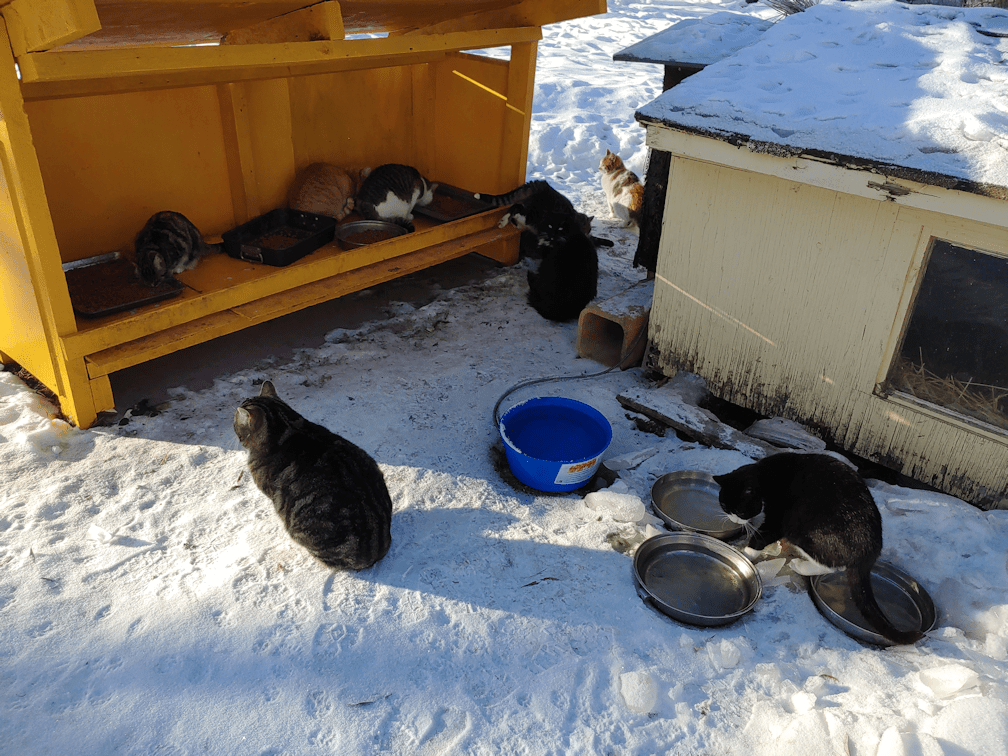
When I got home, I had quite the crowd, ignoring me as much as they could. :-D One of my daughters had just topped up the kibble trays. There are 13 cats in that picture, and I’m sure I saw at least 2 more at the window in their house. I must say, the outside cats are doing really well right now. There was a while when a lot of them were coughing and sneezing and had runny eyes, though none that had eyes that went blood red like Tuxedo Mask’s. Now, they are all hale and hearty. I think only Creamsicle Baby has a leaky eye still, and it’s been like that since he reappeared a couple of months ago. Some of the inside cats are still struggling with stuffy noses and sneezing, but they are getting better. Including Keith, which is a huge relief. I’ve been setting up the heated pad that we used while Ginger was isolated in the sun room, before and after his amputation. I think he remembered it, because he’s been using it fairly regularly. The others take their turns on it, and it’s not unusual for me to glance over and find three cats, with only their chests on the heating pad, enjoying the warmth. :-)
As much as I’d like to turtle, disappear into my shell and not go out again until next year, we’re going to have a few trips to make over the next few days. I even remembered to plug in the van and my mother’s car, just in case things turn colder than predicted.
We’ll have the quarter beef to pick up tomorrow, then I expect to go into the city the next day. I plan to do some gift shopping, so I intend to head out on my own, which means likely another trip before Christmas for the girls to do any last shopping they need to do. Hopefully, we will then, finally, not have to do any more long trips until after New Year’s.
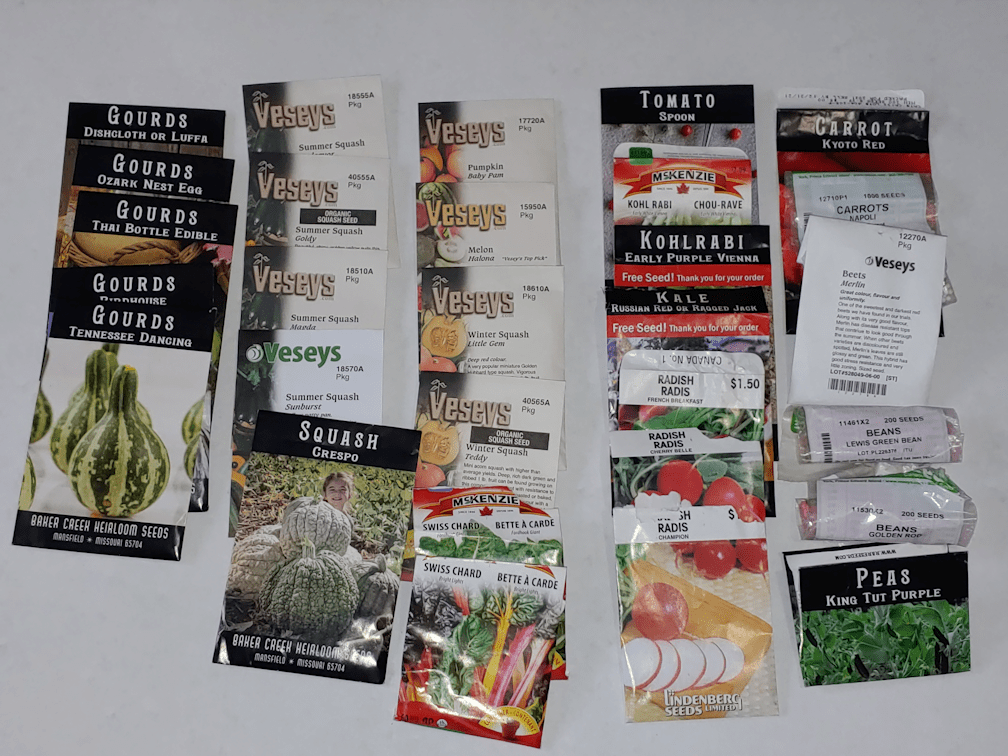
With all but one order of seeds having arrived, I decided to do an inventory of what we have, including what we have left over from this past year’s garden.
I was a bit surprised by some of them.
One surprise was the Spoon tomatoes. We had two packets of those, and while I thought we had planted all the seeds, I found a surprising number of seeds at the bottom of each packet. So I combined them into one. There isn’t a huge amount, but it does mean we could start some indoors, if we felt like it. I don’t think we will, since we have so many other tomatoes. Plus, I wouldn’t be surprised if a bunch showed up on their own in the bed we grew them in this past summer!
I didn’t think we had any kohl rabi left, either. One of my daughters had done a second planting of those, and I thought she’d used the last of the seeds. The White Vienna is actually from the year before. We got two free packets of the Early Purple Vienne, and both got opened for some reason; my daughter probably missed the one I’d opened to do an early planting. We had no luck at all with kohl rabi this year and I plan on starting them indoors instead of direct sowing.
For the gourds, I want to do the Tennessee Dancing Gourds again. They did really well. I want to try the Ozark Nest Egg again; were it not for the drought delaying their development, we would have had lots of those. I also want to try the luffa again, because I’m a sucker for punishment, but will probably skip the Birdhouse and Thai Bottle gourds.
Though we still have seeds left from the summer squash collection, we also still have the other two collections I’d ordered by accident. I like having a good variety, and this year we’ll have green patty pan squash, too, so we’ll start just a few seeds of each. The Baby Pam pumpkin never germinated at all, but I think that had more to do with growing conditions. We have so many others, I don’t know that we’ll try them again. There are still Halona melon seeds left, but I also saved seeds from both the Halona and the Pixie, both of which did very well, plus some other seeds I saved from other melons we enjoyed.
I will happily grow more of the Teddy and Red Kuri (Little Gem) winter squash again, along with the new varieties we ordered. They may have had a hard time with the drought, but they were quite good, and they are much smaller varieties that – in more ideal conditions – are supposed to be prolific producers.
Not in the photo are the varieties of spinach and lettuce we still have lots of. They, and the chard, are for spring and fall planting, so we’ll have to plan those out – if we try growing chard again. We didn’t really eat them much. As for the radishes, I want to plant a just a few of each, much earlier, and leave them, as it’s the pods I’m after, not the root.
The carrots here are pelleted seeds, and there are still quite a lot. It’s easier to space the pelleted seeds when planting. With thinning not as much of a concern, I don’t think I used even half of each variety this past year. I will happily plant them again, along with the new varieties we got.
I was surprised to find the Merlin beets. I thought I’d mixed all the remaining beet seeds together to plant into the L shaped bed, but I guess I missed these. We were planning to plant only one variety next year, but it won’t hurt to have two. :-)
We have quite a bit of the green and gold bush beans left, but that packet of King Tut purple peas only has about 5 seeds in it, and those are seeds I’d saved myself. If I do plant those, they will be only for seed saving. I didn’t order any other peas this time, but those are something I can easily buy locally in the spring. As for the beans, we do have several varieties of pole beans, but bush beans tend to mature faster, so I might go ahead and do both.
These are all our new seeds, except for the Kulli corn that is still on the way. It seems like a lot, but for things like the squash and gourds in particular, we will only be starting a few seeds indoors for each. I would rather plant fewer of many varieties and see how they do, than have lots of one variety then discover it doesn’t like growing here. That, and it would get pretty boring eating the same variety of vegetable all year! For things like the onions… well, I’m finding we just can’t have too many of those!
The beginnings of our culinary herb garden is something I need to think about. We already have a mint that we found in the old kitchen garden, but I don’t know what kind they are. Not spearmint, is the most I can say for sure. Probably peppermint. I want to have permanent places for our culinary herbs, and the old kitchen garden makes the most sense, since it’s right at the house, but unless we start taking out the ornamental crab apple trees, and the double lilacs, roses and honeysuckles – which I have no intention of doing – there’s not a lot of well lit space left in there. I might try growing them in buried pots at first, so that as we build raised beds in there, they will be easy to transplant, and things like the mint will be contained.
One of the things about the squash is that, with their spreading habit, we can use them to reclaim more garden area. We’ll be growing potatoes using the Ruth Stout heavy mulching method again, for much the same reason. With so many climbers this year, we’ll need to build more trellises, too.
I’ve been talking to quite a few people who are looking to start gardening for the first time, out of necessity. There is a lot to consider. Especially in our Zone 3 growing zone. So if it seems like I’m spending an inordinate amount of time talking about gardening of late, that is partly way. I’ll be writing a post specifically for those who are suddenly finding themselves having to grow their own food, so if you have something specific you’d like me to include on that, or experiences you’d like to share, please feel free to mention it in the comments.
Though our high of the day is expected to be a relatively mild -17C/-2F, when I headed out to do my morning rounds, it was -22C/-8F.
The cats actually didn’t seem to mind it too much!
I counted only 15 this morning, though. I also got to pet the Distinguished Guest a bit.
Thankfully, there wasn’t much of a wind child, but even so, changing the batteries on one of the trail cams this morning was not fun! I had fingerless gloves, at least, but my goodness, the tips of my fingers were feeling the chill by the time I was done!
Tomorrow (Sunday)_, we’re supposed to warm up to -7C/19F, then it’ll drop right back down again. Monday is supposed to be -18C/0F, but the wind chill is supposed to reach -27C/-17F.
I’ve got word from where we ordered our quarter beef, that they will be getting cuts from the butcher that morning, so we are now scheduled to pick ours up at 5pm. We will be doing a bi city shopping trip next week. This is intended to be our January shopping trip, so we don’t have to try and do it at New Year’s. Thankfully, CPP Disability always comes in early in December, so we can do that. When it was arranged to pick up the meat at 5pm, I considered heading into the city in the morning, but it’ll be much colder that early in the day, so I think I’ll put that off until Tuesday. It’s much closer to Christmas than I would like. I dislike shopping at the best of times, but around Christmas and New Year’s is the worst. However, it needs to be done. Our van does not like the cold, so if I can save the trip for when it’s a few degrees warmer, I’ll wait. Yes, we do have my mother’s car as a back up, but it’s not big enough for our city shopping trips. Especially with all the bags of cat food! :-D
I look forward to a time when we are so well stocked, we can skip the city shopping trips more most, if not all, of the winter!
You can read about what we ordered from Baker Creek, and why, here.
The free seeds we got this time are an interesting addition! I was looking at them on the website, and had heard from people in local gardening groups that successfully grew them this past year. I decided against ordering them, since I was already ordering the Black Nebula carrots, and we still have seed left over from this year’s garden. However, now that we have them anyway, I’ll be happy to try them!
The delectable, lemon-yellow roots have a unique shape! These carrots have a fine-grained texture that is crispy and juicy with plenty of natural sugar. This variety hails from Uzbekistan and is popular across central Asia. Widely adaptable, this variety produced sweet roots even in the hot summer months during our Missouri greenhouse trials, but it is equally vigorous and tasty when grown in cool weather. Called “Mshak” in Uzbek, this variety is easy to grow in a range of soils and temperatures and the flavor is superb. We love this as a snacking or cooking carrot, and in Uzbekistan and Central Asia it is an essential ingredient in plov, or pilaf, a signature dish of that region.
Sounds like something that should grow all right in our region. The reviews for it are good, too.
At this point, we have only one more seed order still en route; the Kulli corn. Our next orders will be perishable stock, such as tubers, saplings and root stock. Those tend not to be shipped until ready for planting in our zone, but I still want to order them as early as I can!
It’s a good thing we’re planning to continually expand our garden over the years! We’re going to need more beds for everything we plan to grow this coming year, above taking into account the areas we grew in last summer will be used for planting berry hedges instead of vegetables next year. And we won’t even be planting everything I ordered this year! We still have a lot of work ahead of us before we reach our goal of growing sufficient vegetables and fruit to feed the four of us through the winter and spring, until the following year’s garden starts producing, with enough to share, too. I think we’re off to a pretty good start, though! As long as the weather co-operates. As much as I enjoy our relatively mild temperatures, we need more snow to help the water table recover in the spring, from this past summer’s drought!
We dropped from 0C/32F yesterday, to -16C/3F today – with a wind chill of -27C/-16F! I did NOT want to do a dump run today, that’s for sure, but we weren’t able to get it done on Saturday, since that’s when my awesome brother came over to mount our Starlink dish on the roof. So today, it was!
Since we were out anyhow, we swung by the post office. I am expecting my Baker Creek order in tomorrow, but I still got seeds, today! My second order from Heritage Seeds was in! That was really fast. :-D You can read about our first order, here, and our second order here.
There was an extra packet of seeds in there – and this time, I noticed the “free gift” sticker. I went back to our first order and, sure enough, the extra packet of seeds we’d found last time did have the sticker, too. I just missed it entirely!
Of course, I had to look up what it was they sent us! This is their description for “Gold Ball Turnip”.
Gold Ball Turnip (1854) (aka Orange Jelly)
Introduced around 1854, this wonderful heirloom turnip has yellow fine grained flesh and reaches peak flavor when harvested at 3” although the yellow globes will reach 4-5” at maturity. Great storage variety. One of the best tasting turnips. (45 days to maturity)
I had been considering turnips as a good storage vegetable. It’s not something we normally buy, but not because we don’t like it. We just like other things better, and I usually get rutabagas instead, because they tend to be smaller. However, no grocery store carries this turnip variety! I look forward to trying them. It certainly meets what we look for when deciding what to grow.
This order coming in was just the thing I needed to cheer me up on a chilly day!












 The Re-Farmer