Not very long ago, after walking around and seeing that our dugouts were completely dry, I had given permission to the renters to dig them deeper, if they wanted to, to have water for their cows. It wouldn’t be much use this year, but I wanted them to at least know they could.
Since this looked like something that wouldn’t be done this year, if they decided to at all, I forget to tell my brother I did this.
You know. The guy who actually owns the property. :-D
I was talking to him on the phone this morning when I got a message from the renter. They had decided to hire someone to deepen the old gravel pit and I was informed that the guy should be there in a few hours, so I would know what the commotion was. The funny thing is, I was already hearing the “beep, beep, beep” of heavy equipment backing up!
So… I told my brother I’d given them permission, then headed out to take a look.
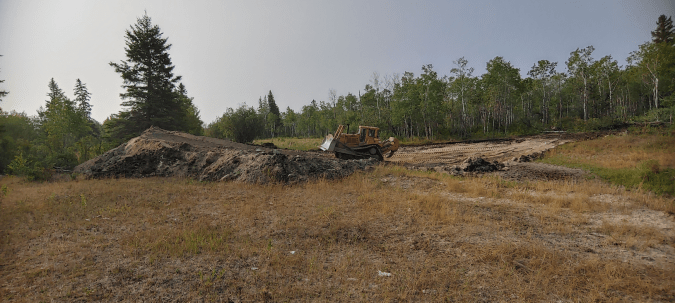
A pretty good start was made, by the time I got out there.
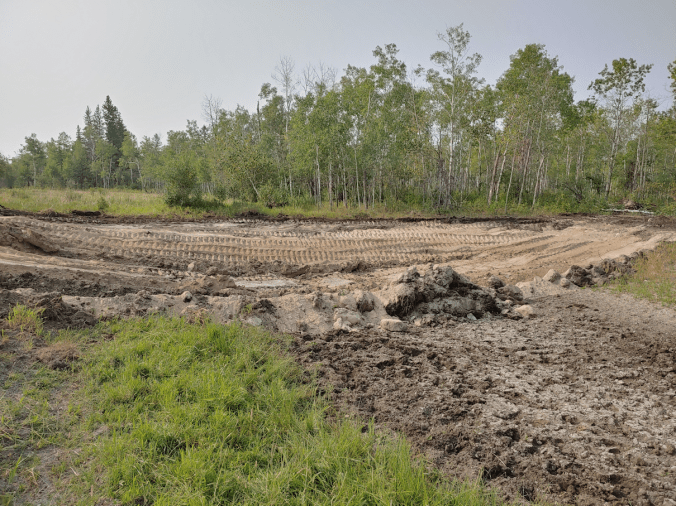
As I moved around and took pictures, I was noticing that there were some really nice pockets of beautiful sand.
When the guy saw me, he stopped and came over and we chatted for a bit. When I mentioned the sand, he pointed out one area in particular that had really, really nice, fine sand.
I remember, as a child, playing in pockets of sand among the gravel. Those were all on the north side of the pit. I don’t think we’d ever dug that far on the south side before, and that’s where he’s uncovered the nicest sand.
I’m really excited about this.
I asked if he expected to reach water, and his immediate response was, NO! He did mention there was an area that was a bit damp (you can sort of see it in the picture), and that he was hitting clay on the bottom. If there is rain, it might collect in there, and there might even be seepage. He also said it might take a few days to finish. I’ll have to come back later to take more pictures.
Since we were standing right next to what had been a muddy area (of all two places they could have dug deeper, they made the right choice by deciding on the old gravel pit), I mentioned that this was the first time I’d seen this old pit completely dry. I actually do think that, given how deep he’s going, water might start to seep in. Here’s hoping! Otherwise, this is basically being done for next year, and to prevent future water issues like we’re having this year, but if water can start seeping in now, that would be a big benefit to our renter and his cows. I’m sure the deer and other wildlife would appreciate it, too!
Me, I’m just so excited by what I’m seeing. My brother had been told that this gravel pit was basically depleted, but he can’t remember who told him that anymore. Clearly, it is not. The renter may eventually be getting water for his cows from here but, at the same time, we’re going to get sand and gravel we can use. Very much a “win win” situation!
I’m already daydreaming of sand covered paths between garden beds, infill around the house, and if we can get plywood for the floor of that trailer frame we’ve got, we might even be able to get enough gravel to spread on our driveway.
Of course, if the Bobcat were still here, we could have dug into the pit ourselves, though not at this level, of course. Having it would have made getting gravel to where we need it a lot easier.
Of all the things that got taken while this place was empty, that Bobcat is the one that I pine for the most. Maybe because a part of me still hopes it might get returned. Most things we can make do, one way or another, without them. It’s a lot harder to make up for the loss of that one, large piece of equipment. The Bobcat is on the list of items we know our vandal took, included in my response to his suit against us. The optimist in me hopes the judge would see fit to not only throw the case out, but order our vandal to return some of this stuff. Much of it can’t be; the lumber, for example, was used in buildings on his property. But things like the Bobcat and it’s attachments, or even some of the tools he took, would make our lives much easier when it comes to taking care of this place! Since the property now belongs to my brother, all this stuff would have been included with it, so he would be the owner of it all, too.
Ah, well. One can dream, right?
For now, however, I will happily dream of sand and gravel, and the things we can do with it!
With the garlic all harvested, we’ve got two empty beds that need to be readied for next year’s garden.
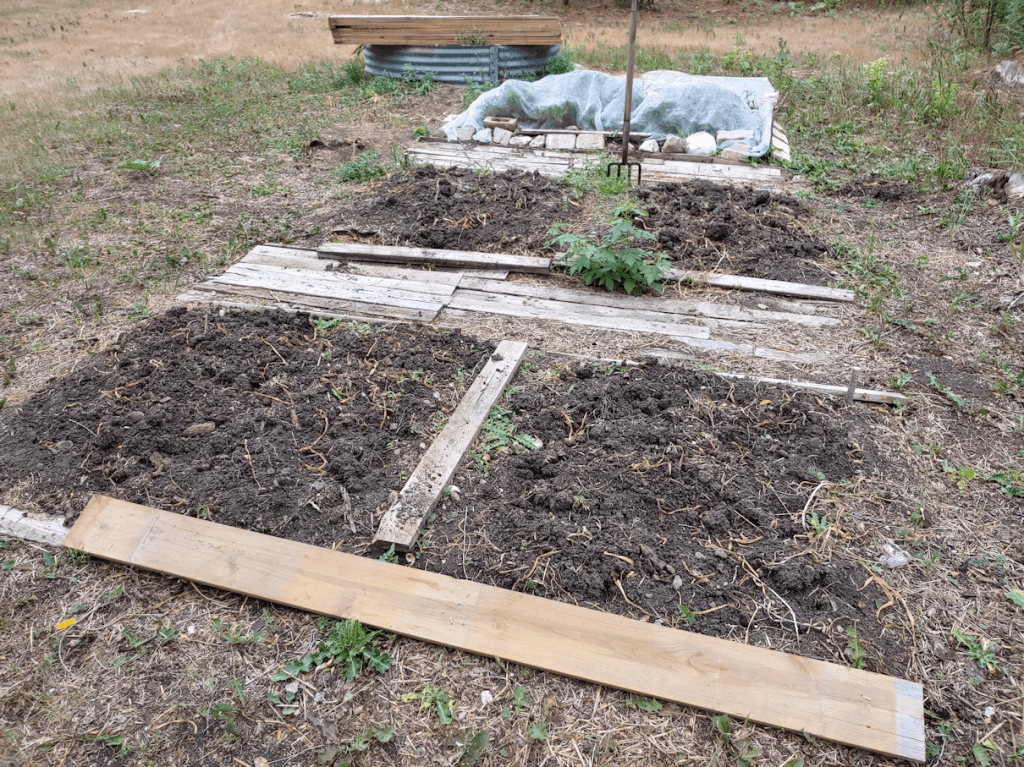
With these beds, we had dug into the soft soil we found under the wood pile, mounding soil into beds and making paths in between. This worked out quite well, but there were a couple of issues. One was, for such low raised beds, I found them too wide. They were about 4 feet wide, which would be fine for a high raised bed, but awkward to reach the middles on a low bed. That was partly solved by putting a board across the middle, which served to both mark where the different varieties of garlic were, and to give something to step on while trying to reach into the middle.
What can I say. I’m short.
The other issue was that the soil along the edges would end up in the paths, either from watering or from when the birds were digging around the garlic, early in the season.
The solution to both issues was to build a narrower box frame.
After scavenging in one of the sheds, I found some boards that would serve the purpose.
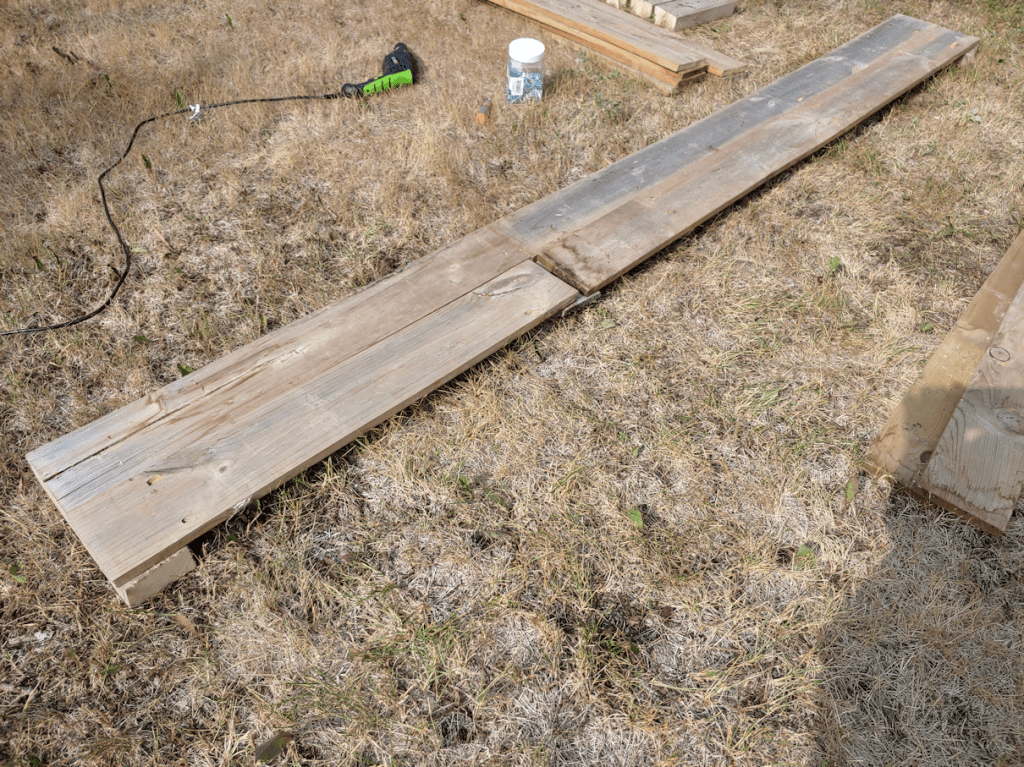
I dragged them all over to the beds. Here you can see one of them laid at the first bed I want to frame.
In total, I had 17 boards like the one in the foreground, plus 4 more that were the same length and thickness, about about an inch wider.
I decided to keep things simple.
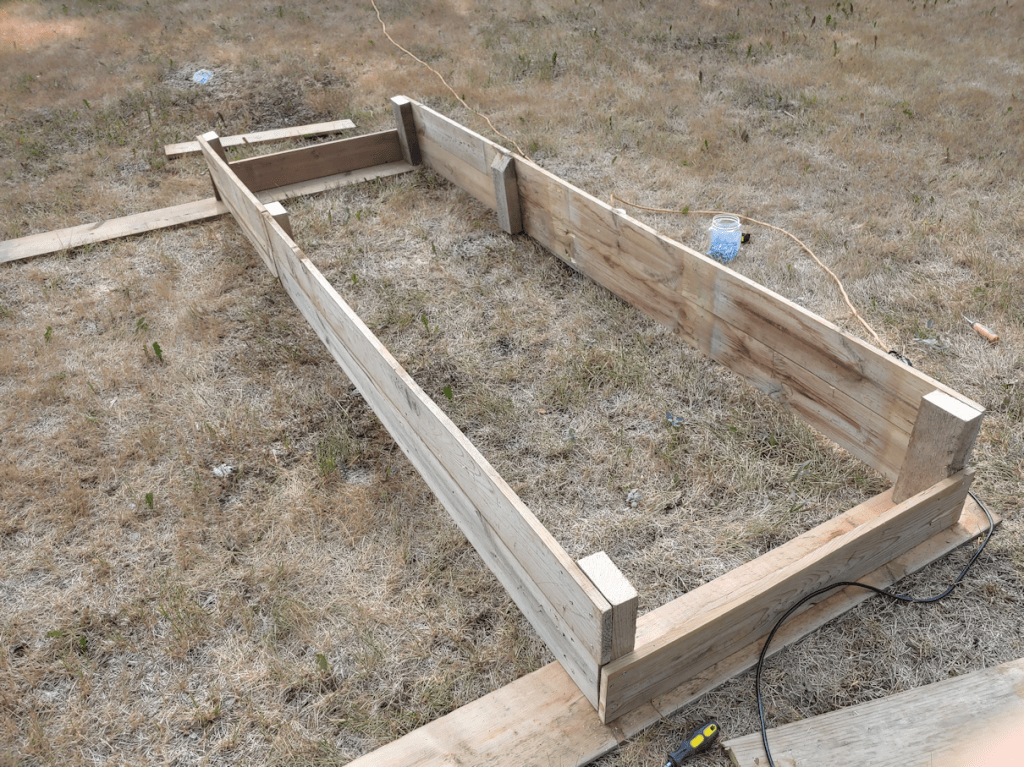
I left four boards as is, then cut another four in half. The boards were all 6′ 1/2″ long and 5 1/4″ wide. Some of the half pieces would be used to increase the length, while the rest would be for the ends of the bed. I cut support pieces for the corners and to join the lengths together from some wood leftover from another project. Those were cut to match the width of two boards together.
The long sides were made by screwing the boards to the support pieces. The boards all have damage to them, ranging from old water damage and some rot, to splitting and cracking from being so very dry. Which is fine. They will do the job, and will last a few years, at least.
What wasn’t fine was flipping a board and almost catching my hand on these!!! They look like the screws were broken off on the other side, so there is no way to unscrew them from the wood. I have to think about the best way to get rid of these, using what tools we have, but for now, we’ll just have to watch out for them!
Once the side pieces were screwed together, making sure they matched in length, I brought over a couple of the wider boards to give a flatter, more even, surface to work on while putting on the end pieces.
Then I quickly tacked it together with just a single screw at each corner, to hold everything together while I worked.
Oddly, one piece was almost an inch longer than the others! Which is okay; the excess can be sawed off, later.
Here we have it! The finished box, next to the bed it will be placed at.
Here, you can see the difference in the dimensions quite clearly.
The box is about 9 feet long by 3 feet wide, and about 11 inches high.
In preparing these beds before planting the garlic, we dug out the soil and buried layers of straw and compost material at the bottom. Since the dimensions are being changed so much, I plan to dig out the beds again, then once the box frame is in position, will start filling it, hugelkulture style, by burying some of the branches we’ve been pruning for the past few years at the bottom, then layering the contents of our compost pile on top of that. Straw decomposes slowly, so I expect to find it when digging the bed out. If I do, I’ll be keeping it separate from the soil, so it can be layered back on again. As for the top layer of soil, I’ll take advantage of the situation to get rid of the weeds by their roots, then mix in some of the garden soil we purchased this year, before returning it to the bed. This soil tested healthier than anywhere else we took samples from, but it was still low in nitrogen, so adding the fresh soil will be a benefit. Once we have the materials again, the top will get layers of mulch to protect the soil.
I have enough wood to make a second box frame just like this one. I plan to build the second box before I start digging out soil. With the wider boards, there is enough to make a third frame for the bed that still has the beets in it, though it will be only one board high.
When this area is done, there will be three longer, narrower, framed beds with wider paths in between. This will make them much more accessible, even at their relatively low height.
Hopefully, I will be able to continue working on this tomorrow, but we’ll see how the day goes. I’ve got our rescheduled court date for the restraining order against our vandal in the morning. Hopefully, it’ll actually happen this time – and if the security guards try to tell me to leave and come back later, I will stay close this time.
Thankfully, I did not find much critter damage in the garden at all today.
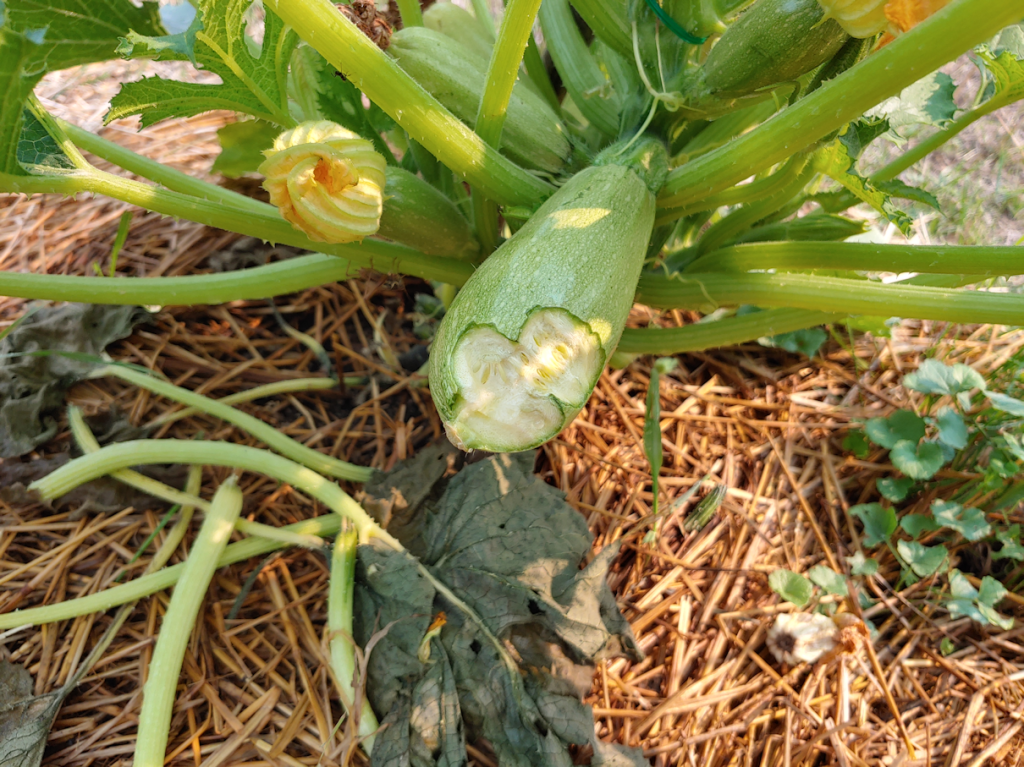
Sadly, this Magda squash got chewed on overnight. I had been really looking forward to picking it when it got bigger!
After doing the manual watering, then setting up the sprinkler on the corn, I pruned the bottom leaves on the summer squash. With growing them vertically, the idea is to not have any leaves touching the ground, thus reducing the chances of fungal infections. Ours are not tall enough for all of them to be at that point, but we’re close. I left the pruned leaves under the plants they were cut from, to add to the mulch, and maybe even discourage critters from coming too close and stepping on spiky stems.
Not that it helped the Magda squash, any!
More of the Mosaic Medley mix of tomatoes are starting to ripen. I didn’t pick any this morning, but I think we’ll have a fair number to pick by this evening!
We don’t know what varieties are in the Mosaic Medley mix and, so far, we’re only seeing red ones. In the photo on the site, there were some “chocolate” ones shown. I’m still holding out hope that some of these will ripen to colours other than red! :-) Not that it makes a difference to me. I don’t particularly like tomatoes. They’re one of the few things that are doing well, and NOT being eaten by something, so I’m pretty excited about them, anyhow. :-D
Today is supposed to get quite hot (we’re at 32C/90F as I write this, and we’re supposed to still get warmer), so I made sure to put the shade cloth over the fall crops. I neglected to take a photo, but I was very surprised to see bulbs forming in the row of French Breakfast radishes! I’ll be leaving them alone. We didn’t plant many, as they are for their pods, not their bulbs, and I’m amazed they survived the grasshoppers at all. Even the chard in that bed is recovering. I’ll have to get some photos when we uncover them when we do the evening watering.
One thing about all the struggles we are having with our garden this year is, we are learning a lot that we can use next year, to improve things. Some of them were things we already intended to do, and the only change is in priority.
With having such far flung beds, we knew that watering would be a challenge. Especially since we knew the furthest beds were in the hottest, driest part of the yard. The excessive heat and drought conditions certainly didn’t help, either! One of our ultimate goals is to have a garden that requires little to no watering. I was able to watch the Back to Eden documentary (free on Tubi), and it’s very much what I had in mind, when it comes to the heavy mulching. We have all these branch piles everywhere, just waiting to be chipped, that would have been so incredibly useful this year! Even with the modified hugelkultur method we plan to use with our permanent high raised beds, we intend to use a lot of mulch. Though we plan to work out some sort of irrigation system to make our watering as efficient as possible, if we do our beds right, we should rarely have to water them, even during drought years.
Which will be a huge improvement over having to water once or twice, every day!
Oh, my goodness, what a difference a single day of good rain makes! No amount of watering with the hose can compete.
While we have been able to pick a Spoon tomato or two, every few days (there were three ripe ones yesterday, that my brother and his wife to go try. :-) ), the Mosaic Medley tomatoes still have a ways to go. Two plants have tomatoes that are starting to ripen, though, with this one being the furthest along.
Though pickings are slim right now, I can see that we will have lots ripening, all at once, soon! They are all indeterminate varieties, and with the Spoon tomatoes alone, we’re probably going to be picking lots, daily.
The Little Gem winter squash, in particular, got noticeably bigger overnight! There is easily several inches of new growth on the vines.
The Teddy winter squash has pretty much doubled in size since I checked it, yesterday morning.
Even the pea sprouts, among the sweet corn, are visibly bigger and stronger – and their stems are barely two inches high right now! :-D As short as they are, the sweet corn is starting to develop their tassels, too.
There were a few zucchini we were keeping an eye on and leaving to get bigger, but by this morning, some of them were almost getting too big!
Plus, I picked our VERY FIRST beans!!!! Just a few yellow and green beans. No purple beans were even close to being ready to pick, yet. I’m pretty thrilled with just the handful we have now, and seeing how many I could see developing on the plants. :-)
This morning, I uncovered the beet bed near the garlic. This was the first bed that got major damage, almost wiped out by a deer. After several attempts to cover it, we ended up putting on mosquito netting as a floating row cover, though I had to keep adding more weights around the edges to keep the woodchucks from slipping under and nibbling on them some more. Once the floating row cover was on, it basically remained untouched until this morning. We kept watering it, but that’s it.
It got a thorough weeding this morning, and I picked a few young beets as well. My daughters really enjoy baby beets and their greens. :-) The bed is covered again and will probably get ignored for awhile, other than watering. The other beet beds are also covered with mosquito netting as floating row covers, and they’re going to need some tending as well. That’s one down side of covering them like this. It’s a pain in the butt to move all the things we scavenged to weigh down the edges, so they are just being left alone.
In looking back at our gardening posts from last year (this blog is my gardening journal, too! :-D ), there were posts about the heat waves we got last July. It wasn’t as severe as this year, but it was the most severe we’d seen since our move at the time. By this time our sunflowers – which we’d lost half of to deer and replanted with other giant varieties – were growing their heads and some were even starting to bloom. This year’s sunflowers are nowhere near that stage! We had also been able to do quite a lot of clean up and fix up jobs that were out of the question in this year’s heat. The drought and heat waves have set us back quite a bit, as far as getting things accomplished. We were also harvesting carrots and sunburst squash, regularly, by the end of last July. It’s hard not to be disappointed with how things are turning out this year, but there isn’t much we can do about the weather, and very hungry animals that have lost their usual summer food and water sources.
Speaking of animals…
I had finished up at the furthest garden beds and was making my way to the main beds closer to the house, when I realized I was being stared at by a little furry face on the gravel over what used to be a den! A woodchuck, the littlest of them, was just sitting there, watching me come closer. I started to shoo it away, and it would run a few feet, then stop and look at me, run a few feet, stop and look at me… on it went until I finally got it to run through the north fence and off the property. By then, I was standing next to the purple corn, at the opposite end of the garden area. Since I was there anyhow, I decided to check on the purple corn, turned around and…
… discovered I was standing next to another woodchuck! It had just frozen in place until it realized I could see it, then ran off. I chased that one past the north fence, too!
Thankfully, there was no sign of critter damage in the gardens this morning, but my goodness they are cheeky little buggers!
After their visit yesterday, and seeing some of the issues we’ve been dealing with, my brother messaged me this morning with some photos. There’s a store they were at that had electric fence started kits. The one he showed me uses D cell batteries, but he knew of another store that has solar powered versions. The basic kit he sent me a picture of covers 50×50 feet, at a very reasonable price. It wouldn’t be enough to cover our farthest garden beds, but we could easily pick up the parts and pieces to cover more area. We’d need a second kit to cover the other end of the garden area.
Something to keep in mind. Particularly when we start building our permanent garden beds. We’d still need to find ways to stop the woodchucks, but it would be a good start, and cheaper than building tall fences!
As I write this, we’ve had several rainfalls, and even a couple of downpours. We’ve had more rain today than we have had all year until now! It is so exciting!
We actually got our first bit of rain this morning, while I was quickly doing my rounds. In fact, it was a bit of a problem at the time. While changing the micro disc cards on the driveway cam, the card I took out of the camera slipped through my fingers and fell to the ground.
I never found it.
I had a fresh card to put in and came back several times today, and nothing. I have extras, but I’d really hate to have lost it completely!
When checking the garden beds, I found a couple more sunflowers got nibbled on.
Almost every one of the transplanted Mongolian Giant sunflowers in this row have had their head bitten off. :-(
The culprit was caught on the garden cam!
Anyhow.
This morning, I made a trip to the smaller city to do the Walmart part of our monthly shopping, then swung by town on the way home to pick up my husband’s prescription refills. It wasn’t until I got home that I realized mine weren’t in there. I’ll have to remember to call them and get mine delivered. I only have one prescription, compared to my husband’s bubble packs and injections.
I wanted to make sure I got all the errands done early, because we were going to have visitors this evening. My brother and his wife were going to swing by, on their way to somewhere else. I’ve been sharing photos of the garden progress with them, and they wanted to see it in person.
It was while they were on the way over that the first thunderstorm hit. It stopped and started a couple of times, then stopped before they arrived. Meanwhile, during their drive, they saw no rain at all! It wasn’t until they got close that they finally saw wet highway. When they got here, we did the tour, including my showing them where the groundhogs have been hiding out.
I saw one crossing by the spruce grove just before they arrived, heading under the junk pile. When I took a look, there it was, watching me!!!
The cheeky little bugger.
While checking out around the junk pile, I was disappointed to see this.
These are Saskatoon bushes. We have a couple of them here, and they are in terrible shape. Not only do they show signs of fungal disease, but their leaves are riddled with insect damage, and little growths where insect eggs are. There is even a sudden grown of lichen on the trunks and branches! Lichen is supposed to be slow growing, yet these bushes, and even the dead branches on nearby spruce trees, have suddenly turned bright green and thick. Or perhaps it’s just the rain waking up what was already there? That sounds more likely.
There are a few places where we will have to clear out the diseased trees and bushes, then not plant anything nearby for a few years.
We were just finishing off our tour of the garden beds with my brother and his wife when it started to rain heavily again. We still have the gazebo tent set up, where we had painted the kibble house. The kibble house it back where it goes, so we had plenty of room to be sheltered from the rain, while still enjoying the lovely cool wind and freshness. They were really hoping some of the rain would make it their way; they’ve been pretty much as dry as we have, and while they have had a bit more rain than we have this year, it’s been more like a tease than anything else.
When the rain let up a little big, we made a dash to the pump shack. I had asked my brother if he remembered when the pump got changed, and he wanted to see what I was talking about.
He had no idea.
He remembers better than I do, what the set up was like before, when there was a motor to operate the pump with electricity. When I pointed out that the current pump was not attached to anything, but just sitting on the pipes, loose enough to move while I was pumping, he mentioned something interesting. It seems the pipes into the well are “floating”, and the pump itself will actually move up and down with the water table. !! He also described the piston system at the bottom of the well. The fact that I could get water but couldn’t keep it going suggest to him that the O rings are giving out.
We are still left with the mystery of what happened to the motor and the frame that supported it.
Later this evening, my mother phoned and I remember to ask her about it. Not only does she not remember, but as far as she knew, there was never electricity to that pump. She insisted it was only ever manual. This tells me that it was my dad that had it set up, after they moved out here. As far as I remember, there was always the electric system, which suggests that it was installed in the 5 or so years before I was born, but my mother no longer remembers this at all. I find that a rather strange thing to forget!
Which leaves us with the mystery of what happened to the old pump system. I suppose it’s possible my late brother had it removed, perhaps with plans to get the old well repaired? I can’t think of any other reason someone would have removed it. If he had, however, the parts and pieces would still be around, and they aren’t. So what happened to it?
It seems that there is no longer anyone alive that could tell us.
By the time we were done looking at the pump, it was starting to pour again, and my brother and his wife still had other places to do, so they had to quickly head out. I’m really happy they were able to stop by, and we could show them how things have been going. Including with the woodchucks. My brother brought up a possible solution, and it’s one I’d already taken steps towards. Hopefully, it’ll work and I’ll be able to post about being free of woodchucks! We shall see. Until the problem is solved, however, I’m not even going to try to plant the fall spinach and lettuces I was planning on. I’m not going to go through the effort, only to have it eaten!
I think I may have come up with a way to keep the grasshoppers off, too. They are decimating our poor radish and kale seedlings as thoroughly as the groundhogs have been wiping out our carrot beds!
At least our garden beds have finally had a thorough soaking. No amount of watering with the house can match a good, solid rainfall!
Here’s hoping the rain helped with the wildfires to the north of us, too!
Today, I finally had a chance to move my dad’s old welder aside, so I could access and test the well in the old pump shack.
Do I want to know why there is apart of a toilet seat there?
No. No, I do not.
I moved a few more things around, then set the old cream can under the pump’s spout, just in case I actually got water flowing.
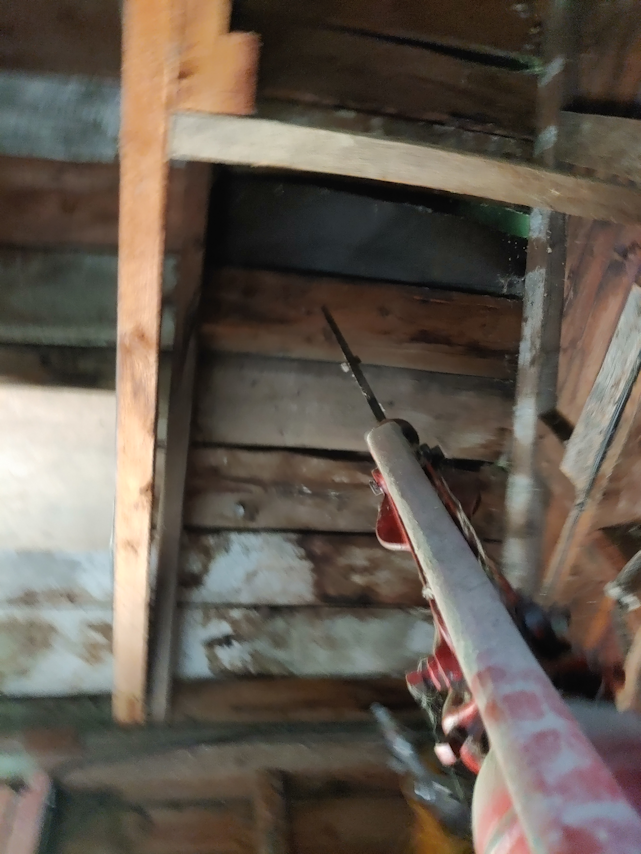
I took an accidental picture while pumping the handle. I thought it looked very dramatic, so I kept it! :-D
We got water!!!
Sort of.
This well was here before my parents bought the property, and it is a design that does not need to be primed. After much pumping, I was able to get water flowing, but if I so much as slowed down, the water would stop and I would have to start pumping hard, all over again. Which meant I wasn’t able to get a photo of actual water flowing from the spout. :-D
On the one hand, this is very encouraging. If something ever happened to our well, we will still have access to water. We should get the water flowing more to clear it out a bit, and then just get it going regularly. There is a problem, though, and you can see part of it in the above photo.
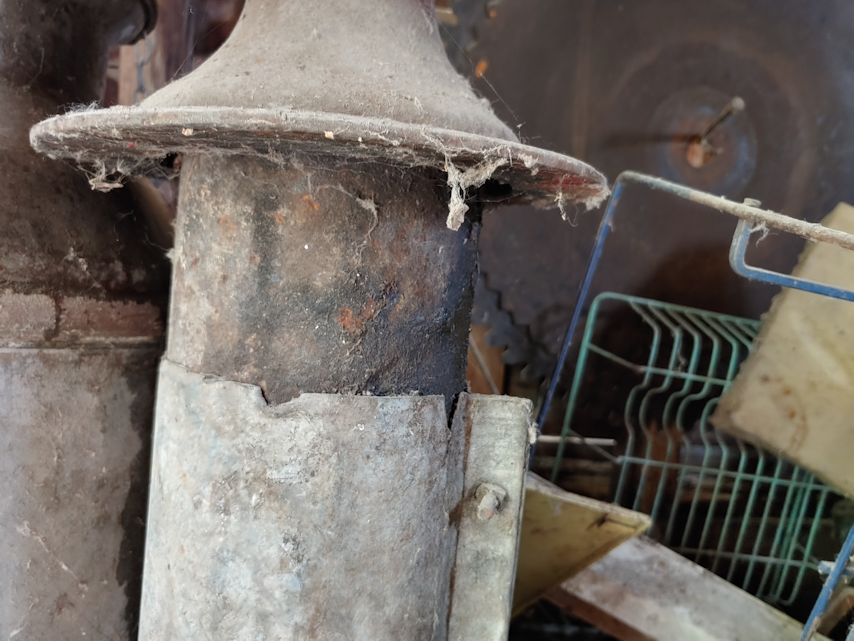
The pump is not fixed. It’s just sitting on top of the pipe. It actually rotated while I was pumping!!
When I was a kid, we had a different pump completely. It had a sort of frame around it, supporting the mechanical pump mechanism, which was run with electricity. If the power went out, we could attach a handle and pump it manually.
I don’t know when or why the old pump was removed, and I am flabbergasted that this manual pump was hooked up, without some sort of base to attach it to, so it won’t move.
My brother tells me there are repairs to the well pipe needed. I suspect that getting that done would result in it becoming much easier to pump water.
It would be worth getting that done. I would also like to set up the electric/manual system we had before, too. We still have the attachment for the spout of the pump that we used to divert water out a hole in the wall, to a water trough for the cattle outside.
Being able to use electricity to pump the water would make life easier in general, but if I had to choose only one, I would go with a manual pump over electric, as this would be a back up source of water should we ever lose power.
Today, I did something I haven’t done in quite a while; check things out beyond the outer yard. Everything beyond the fence surrounding the outer yard, plus the old hay yard, is rented out, and somewhat less than half of that is used for pasture.
This first photo was actually taken from within the outer yard.
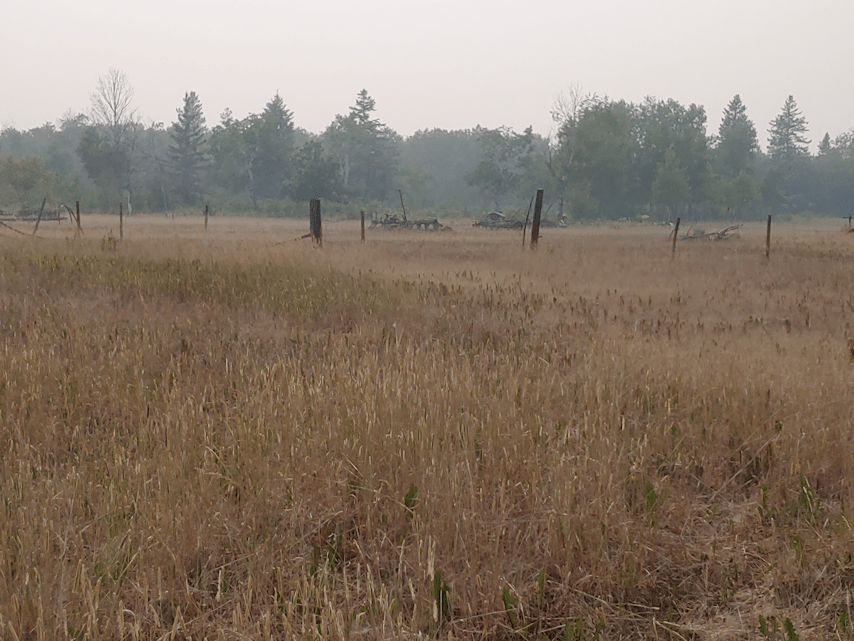
Everything is bone dry and crispy, and you can see the haze of smoke from wildfires that are nowhere near us! Keep in mind that the camera automatically cleans up haze, so the view was actually smokier than this.
This photo was taken at the “gate” by the barn. You can see the renter’s electric fence wire ends here. The only green that shows among the dormant grass is dandelions, and even they are burnt red.
This is facing the areas behind the old barn. By the time the renter rotates his cattle here, this grass is typically 2, almost 3, feet high.
This old pond is typically a source of water for the cattle. I walked to the deepest part, and even there, the ground is bone dry.
Also, we would normally be able to see the neighbour’s tree line in the distance, about a mile away. In the photo, it’s just barely visible as a shadow.
This is the deepest areas of what used to be a gravel pit, but which became another dugout to provide water for the cattle. At the far end is a marshy area that eventually reaches as far as the roadway by the pond.
This is in the deep part of the old gravel pit. Most of the tracks look like they were made by deer, but I think I saw some that looked like there were claw marks. All the tracks are old. There hasn’t even been mud here for some time.
This pit used to be quite a bit deeper. Since it wasn’t being used for gravel anymore, there’s at least a couple of decades of pond sediment, decaying plants and cow manure building up at the bottom. One of these years, I would like to have it, and the pond, excavated again. Since we moved back here, this is the first time I’ve seen the old gravel pit completely dry. Even in last year’s drought conditions, there was still water in the lowest area, making it one of the few sources of water for wildlife in the area.
Here, I’m standing at the “end” of the gravel pit area. Behind me is more marshy area that extends to a “creek” that is part of the municipal drainage system, but tends to have water only with the spring runoff.
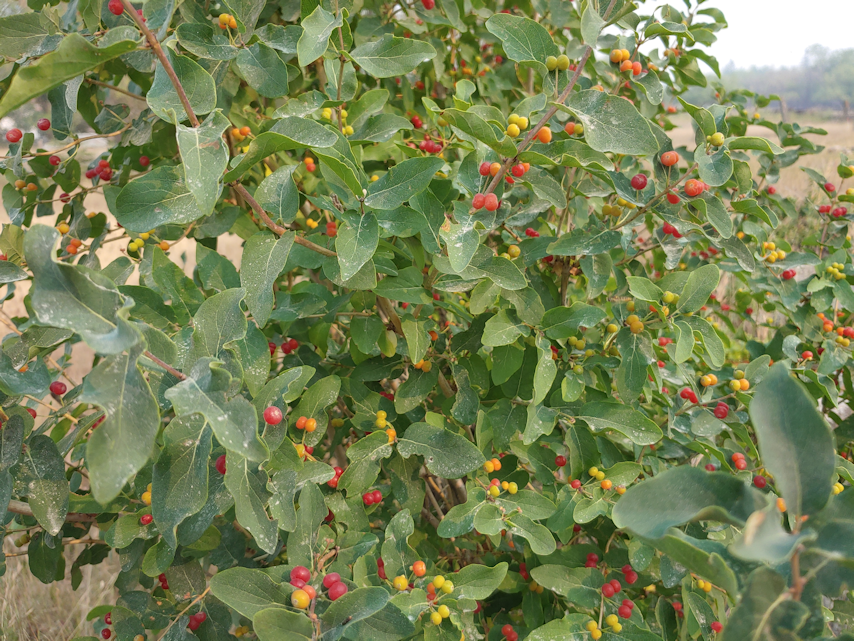
Heading back towards the house, I checked out an area that is mostly rocks and broken concrete that is overgrown with hawthorn and other bushes. This is the only thing there that has berries on it, and they’re not doing very well.
The white that you see on the leaves is dust kicked up on the gravel road, every time something drives by.
There has been a lot of road dust this year.
Another view of the pasture area, looking towards the pond.
Walking through all this, not only was everything crispy and crunchy, but ever step I took sent masses of grasshoppers flying. With things this dry, I don’t think even the grasshoppers can eat it!
There is but one area of relatively lush, green growth.
The septic field.
This is out towards the barn. Unlike a gravity field, our system pumps the greywater from the tank by the house, all the way out here. You can see the white pipe that is the outflow. It just sprays out from there. There is an entire low area beyond this that, in a wet year, forms another pond. It had been fenced off to keep the cattle out, since any water there would have septic water in it, too, but those fences have long since fallen down.
After I finished my walkabout, I set up the soaker hose at the squash tunnel, then decided to try an experiment.
Our green peas in particular are pretty much toast. Or should I say, toasted. They are still blooming and trying to grow pods, but between the heat and whatever is eating them, we aren’t going to get a crop from them.
The Dalvay peas are sold by weight, not seed count. Which means we had a LOT of seeds left over. Part of why I wanted to plant so many peas and beans near the corn, and to do it in this far flung area, was for their nitrogen fixing qualities.
So I decided to take the leftover seeds and plant them with the sweet corn.
Interestingly, not long after I started, I realized I was hearing the sound of a small engine vehicle moving around on the property. It turned out I was not the only one who decided to check conditions today. The renter had come over on his utility vehicle and was checking out all the pasture areas.
If he does rotate his cows here, I suspect he’s going to have to provide both food and water for them. Last year, he only had to provide water.
One of the things I’d like to do in the future, if we ever have the money to do it, is get those two water fountains going again. It would mean replacing our pressure tank with a much bigger one, as there had been in the past, and hiring someone to make sure all the pluming and the tanks themselves are in working condition. We don’t have cows of our own, but they would be good for wildlife, as well as the renter’s cows.
That’s something for the dreams list! :-)
I was almost done planting peas when my daughter came out to set up the sprinkler. Using a sprinkler feels like such a wasteful way to water, but for this area, we simply couldn’t water them as thoroughly as they needed, any other way. The other beds don’t have the same issues. It’s remarkable how different soil can be, even in a short distance. Since we started using the sprinkler, the corn and sunflowers have been doing visibly better.
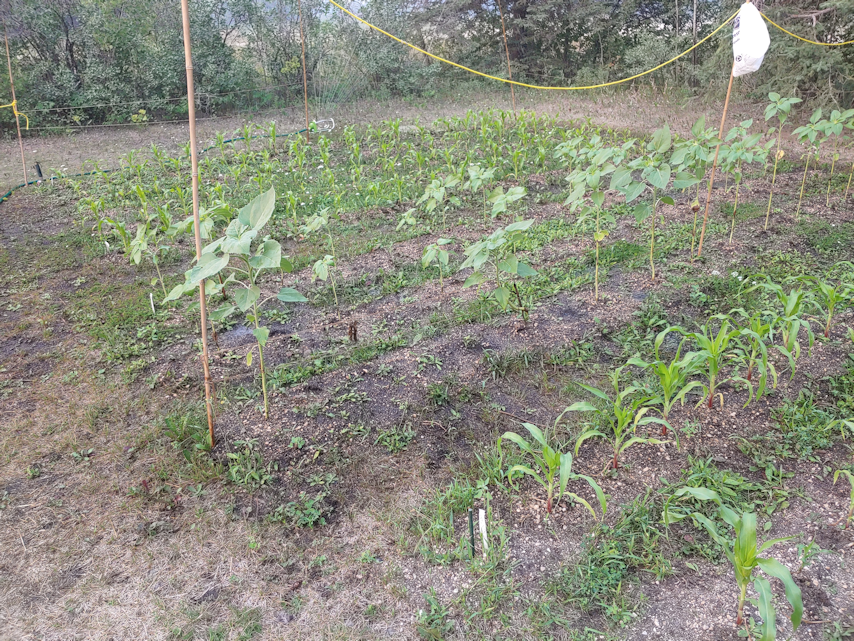
There were so many peas left in the package, I was able to plant one pea for every corn in the block-and-a-bit visible in the photo. In these, I had planted a couple of seeds of corn a foot apart, then thinned them later. In the last block, I just planted a corn seed every six inches. Most of them germinated, so there wasn’t the space to plant one for every corn plant, so I planted one every 1 – 1 1/2 feet, depending on the spacing.
I still had enough seeds to plant more among the surviving Dorinny corn. Then I still had enough to plant with the Montana Morado corn (which seems to have been replaced at Baker Creek with Mountain Morado corn). And I STILL had seeds left over! Only about a dozen or so, but wow, was Veseys ever generous with their quantities!
Now, these seeds had been left behind in a storage bin we keep by the rain barrel next to the pea trellises. Which means that they’ve been out in this heat all this time. It’s entirely possible they won’t germinate. Or only a few will germinate.
Though planting peas for a fall crop this time of year, to get a fall harvest, is something that can be done in our zone, this year is so hot, we might still have the same problem as with the ones I planted in the spring, even if they do germinate. However, that’s not what I’m planting them for. I’m planting them for their nitrogen fixing qualities. Corn are nitrogen hungry plants, and our soil is nitrogen depleted. Yes, we can use a high nitrogen fertilizer, but having a plant that will do that job is preferable. Plus, if they do germinate, the corn plants will provide shade for them, while also providing a natural trellis for the peas to grow on, as with beans in Three Sisters plantings. We only have bush beans, though, so they won’t climb the corn. People had been talking about the Three Sisters method of planting in some of my gardening groups. Some people found it worked well. Some found that the squash made getting at the corn difficult, or that there was just too much competition for nutrients, and some found peas worked better for them than beans.
So we shall see how this turns out.
As I’ve mentioned in the past, all of these far flung beds are temporary. We’re basically breaking and amending the soil in perpetration for future plans. With what we are learning this year, we are already adjusting some of those plants. We were talking about planting a nut orchard and fruit trees, which we’re going to have to do soon, because those can take years, in some cases a decade, before they start producing.
We’re going to be adding a step.
My daughters and I have been going through the Whiffletree catalog, repeatedly. With the soil conditions we have, we’re now thinking to start by adding hedges. There are several options available for zones 2 and 3 that not only produce edible fruit and do well in poor soil, but also help fix nitrogen in the soil. If they’re still available next year, we’ve decided on three different ones. Silver Buffaloberry, which is a zone 2 bush, Autumn Olives (also called Autumn Silverberry), which is a zone 3 bush that is semi-fertile, and Sea Buckthorn, which is a zone 3 bush that requires 1 male variety for every 5-9 females varieties. On top of producing edible berries, being able to grow in poor soil conditions, and acting as nitrogen fixers, these will also form a barrier that will not only give us a privacy screen from our peeping vandal, they are dense enough to form a barrier that deer can’t get through. Plus, they will be dense enough to act as dust barriers. We’ve worked out the areas we can plant in, leaving a gap over where we thing the buried telephone wires are. We never did hear back from the Call Before You Dig people, but I figured out an easy way to do it. My brother’s property is right across the road, and the lines run though his place, too. He has a gap in his spruce grove, over the phone lines. All we have to do is line up our gap with his! :-D Anyhow, after we start with these nitrogen fixing, berry producing bushes, we will then start adding fruit and nut trees in what is currently a big void in the old garden area. Little by little, year after year, we will be adding more food trees, strategically placing each of them, so serve multiple purposes. At least, that’s the plan right now! :-D
Meanwhile, by the time I was done with all the pea planting, the smoke in the air had gotten to the point that there was a haze in the yard. As I write this, I can see the live feed from the garage security camera, and I can see smoke in our driveway. We’re still getting rain in our forecast, but in millimeters. Some areas did get rain today, which I am happy to hear about, but none of it is reaching us. I would actually be okay with that, if we could at least get rain over those northern fires.
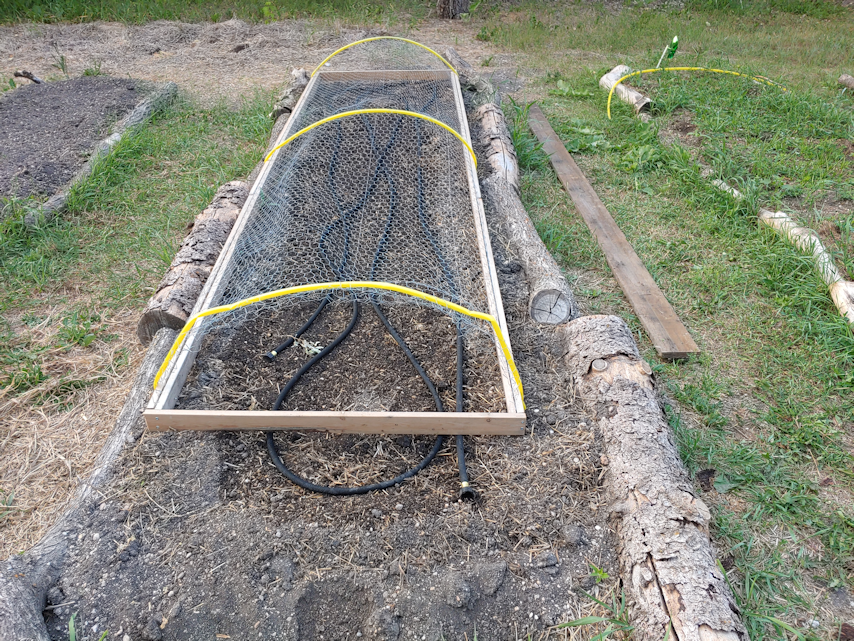
One of my goals for today was to modify one of the wire mesh covers for the main garden beds. I will be planting in this bed soon, and have set up the soaker hose in it for now.
I had one board left of what we used to make the long sides, and used it to make end pieces just over 3 feet long, so it will fit in the narrowest part of this bed. The lengths of hula hoops are woven through the wire and their ends are screwed in place. It’s still kinda floppy, but it won’t collapse completely.
We might still add chicken wire to the ends of the cover, to keep small critters out. Of course, it won’t stop the woodchuck, since it can just dig under it, but I hope to at least reduce the chances. I did see it briefly this evening, dashing under the garden shed when I came around the house. I have not seen any new nibbled on plants today, thankfully.
I have to go digging around to see if I can find more of this wood, so I can do the other wire cover as well. It’d be good if I can find enough to make a third cover, but I doubt it. We’ve picked over the area we found those boards in pretty thoroughly.
The board on the ground is something I found in the barn. This bed is a bit wider than the others, so I plan to lay the board down the middle, so that we’ll have something to step on, to make it easier to tend the bed.
Now that this has the end pieces, it will be easier for one person to move it aside to do weeding, then put it back again. It was the “put it back again” part that was the most awkward, without a second person to help.
If all goes well, we will have some radishes and chard planted in here tomorrow. :-)
The girls did the evening watering while I was doing this, and called my attention to something that I did not see this morning.
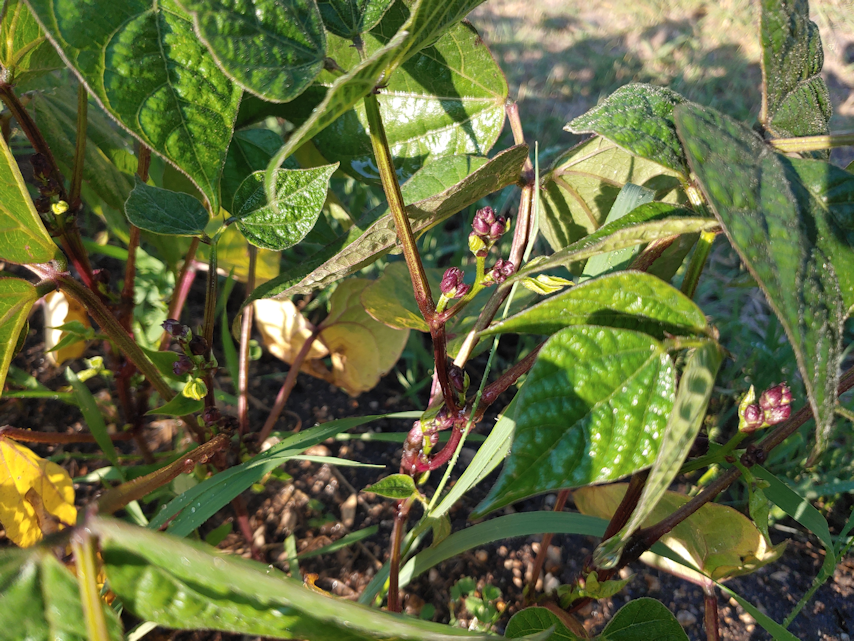
Our beans are showing flower buds!
So awesome! It looks like we’ll have more of the purple beans than the green or the yellow.
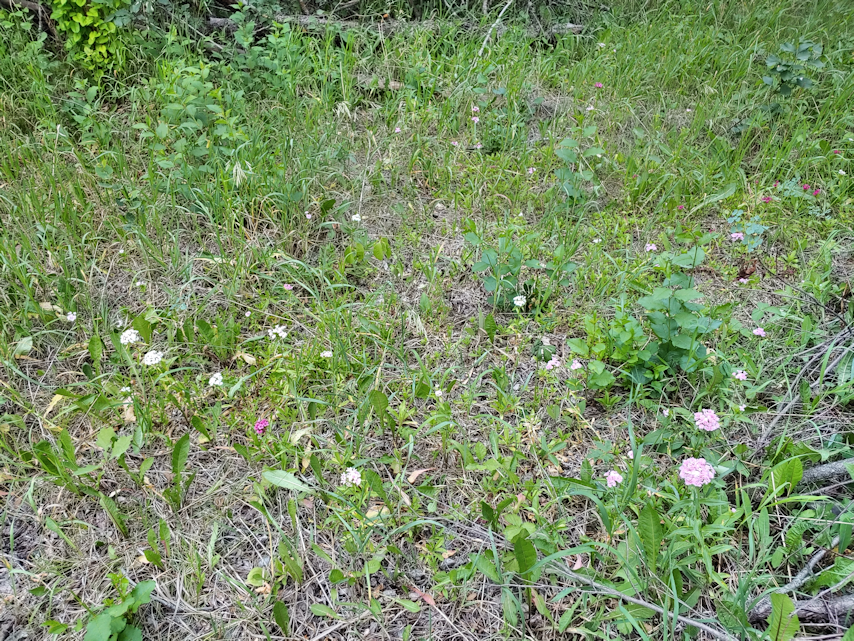
While flower buds are forming here, we have flowers blooming somewhere else.
This is part of the area at the edge of the spruce grove that I cleaned out this spring, partly to get materials needed to build the squash tunnel. With all the little trees and dead branches cleared away, they finally have enough light to be able to bloom. I expect this to happen more, as we continue to clean up the spruce grove.
When we first moved here, we worked out a plan: the first two years, we would focus on cleaning up the house and inner yard. In the third year, we would start on the outer yard, and then in the following years, we would start working on things beyond the outer yard, as warranted. In the first year of working the inner yard, we would clean up the maple grove, which we did. The second year of working the inner yard, we were to clean up the spruce grove. Then things happened, and we only got parts of it done. As time goes by, however, we’re realizing just how much bigger of a job the spruce grove is. This is now an area we’re going to have to chip away at, little by little, as we can. We need to work on the outer yard more, in the process. Particularly since we plant to build permanent raised bed gardens in the outer yard.
We still have a multi-year plan to get this stuff done. It’s just been adjusted quite a bit! Plus, with our starting to garden ahead of “schedule”, the time and resources we have available has had to shift, too. As much and things need to be cleaned up, and we have to get the junk hauled away, doing things that will actually feed us has become more of the priority. It was always the goal. It just went from a mid term goal, so a short term goal!
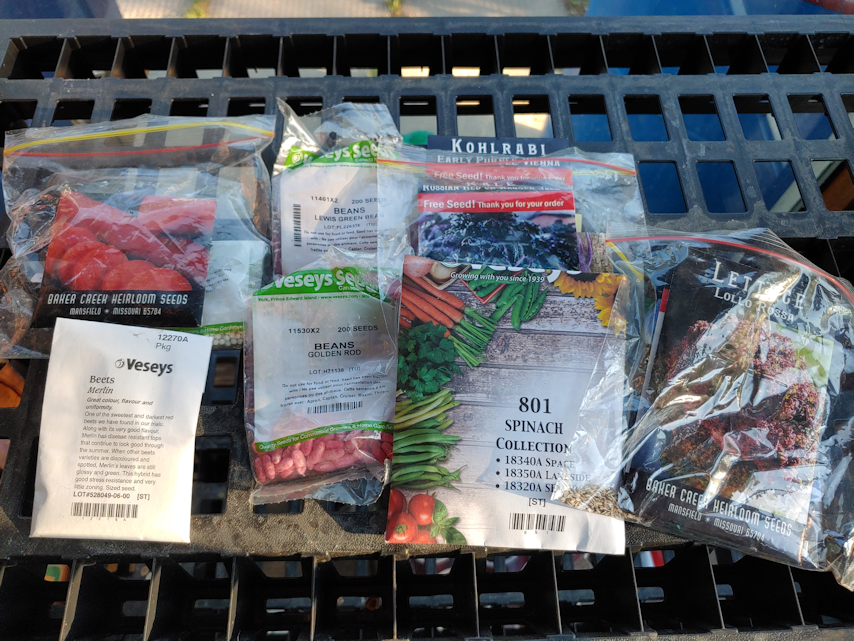
Before heading out to do the watering, I went through our remaining seed packets to do a bit of planning.
First, there’s what’s left of things we planted in the spring.
To the right, we have the two types of carrots in pelleted seeds. I keep reading that we can still plant carrots this late in the season, and I had debated with myself about replanting the carrots decimated by the woodchuck, but really… what’s the point? It seems to have a special love for carrot greens, and until we get rid of the woodchuck, there will be no new plantings of carrots!
To figure out what we can plant for a fall harvest, I looked up our first frost date, which is Sept. 10, and worked out how much of a growing season we have left. Then I checked out the germination and days to maturity to see what we can plant now, and what will wait until later. We could plant the remaining Merlin beets, but we have so many beets planted, there is no need. The two types of beans could also be planted, but again, there is no need. Not in the photo are the remaining green peas, which apparently can also be planted this late in the season, but we won’t. If we wanted to, we could plant any of the summer squash, too, if we wanted to. All the seeds we will not be using this year got set aside for next year.
We had received the purple kale and purple kohlrabi as free seeds with each of our orders from Baker Creek. We ended up with two packs of kohlrabi seeds, but still have seeds in the one we did open. There are still kale seeds, too. These are both cool weather crops, and the kale can hand frost. While I plan to try kohlrabi again next year by starting them indoors, I’d forgotten we still had seeds. I’ve decided I will go ahead and plant the rest of the open packets of seeds, in hopefully better conditions, and actually get some growing!
The 3 types of spinach adn 4 types of lettuces will be planted, but not until the end of July.
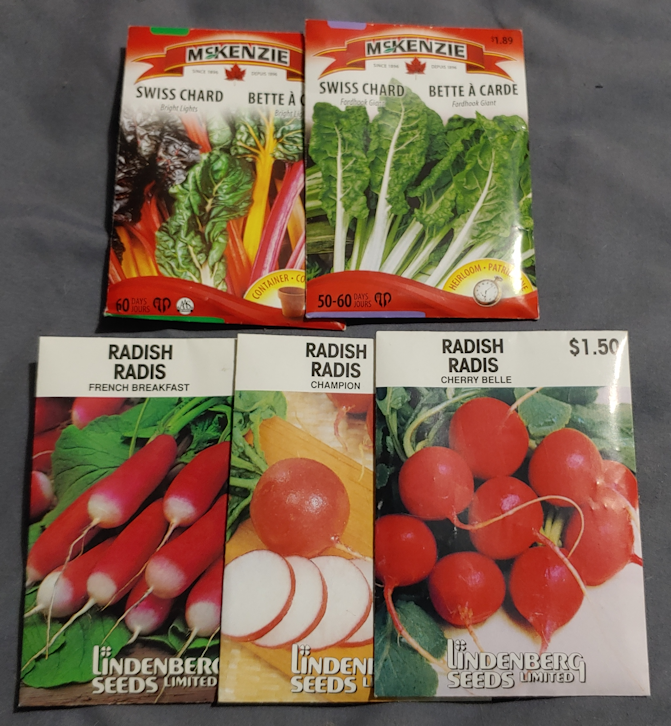
Then there are these.
I’d picked up the radish seeds when I was last helping my mother with her grocery shopping. I intend to plant those as soon as possible; just a few of each. From what I’ve read, I should not expect to get bulbs developing in the heat of summer, and will be growing them for their pods.
The chard was something I picked up a few days ago. While waiting in line at the grocery store, I found myself next to a couple of boxes of seed packets, all jumbled together, instead of in their display cases. I rifled through them and found the two types of chard, which will be planted right away, too. I’ve read that they are tolerant of summer heat.
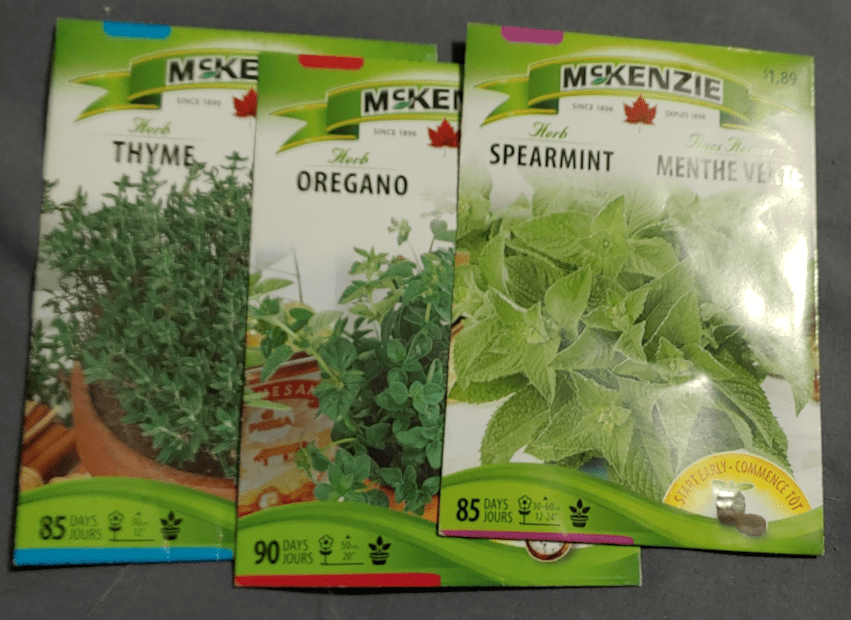
While going through the seed packets, I also picked these up.
Little by little, we intend to have an herb garden, likely in the old kitchen garden, so these are seeds for next year. Unless we want to try growing them in pots indoors, but I don’t imagine they’d survive the cats.
So we now have our first herb seeds, and more seeds to join the Yellow Pear tomatoes I picked up earlier.
The 5 day forecast has us back to around average temperatures for July, which means we should be able to catch up on things we’ve set aside because of the heat. But then, the forecasts have been so off for the past couple of weeks, I wouldn’t be surprised if the forecasts were completely off! Still, those empty beds need to have something planted in them, and it needs to be done soon!
The weather forecast said that we would be cooler today.
They lied.
When I did my morning rounds, it was already above 20C/68F, and we easily hit 28C/82F this afternoon, with a humidex above 30C/86F. Which meant that we spent as much of the day indoors, out of the heat, as we could. Thankfully, the way things are oriented, we can keep certain windows open to allow a cross breeze without heating the house up.
The cats appreciate that.
Yes, we leave the little step ladder at the door, just so they can look out the window! It was so funny to watch these to, with their matching positions, heads turning and tail tips twitching, in unison! Hard to believe that little Layendecker is now just as big as Cheddar! With the smaller cats, three of them can fit up there, but these big boys fill up the whole stop step! :-D
I did have to make a run into town, as we ran out of kibble for the outside cats. While I was there, I picked up some ingredients for my daughters. Yesterday, they finished off one of the giant bowls of spinach to make a spinach soup.
We’d already finished off one giant bowl, mostly through dehydrating (using the screens in the sun room didn’t work, so we did batches in the oven). When making the soup, that huge bowl cooked down to a remarkable small amount in the stock pot! :-D With my trip into town, the girls have enough to make a huge batch of baked spinach dip, which we plan to enjoy while watching watching Sherlock Holmes, with Jeremy Brett and David Burke.
It’s going to be a late one, though. We didn’t get back from working on the garden until past 10pm. I had tried going out a bit earlier to start prepping the spinach beds to plant in again, but those beds are in full sun. I wasn’t interested in getting heat stroke! It didn’t get cool enough to head out again until past 8:30pm.
The girls did the evening watering while I worked on the beds.
The logs were added after we’d started making the beds, so once I’d cleared away the remains of the spinach plants and the weeds, I took advantage of the situation to level the beds out, and create a bit of a ridge around the edges, to help keep the water from draining down the sides – and taking the soil with it. I used a garden fork to loosen the soil, to more easily pull the roots out. I was most pleased with how keep the tines could go, without any sort of resistance. This bed would handle root vegetables very well!
I had “help” while I was working.
Nutmeg could not get enough attention! :-) While I was pulling out roots and weeds, he kept getting under me, demanding pets, and rolling around in the freshly turned soil, sometimes rolling right off the edge of the garden bed – just like his brother does on our beds, indoors! Unfortunately, when I was using the garden fork, he had a terrible habit of suddenly lunging at the fork to “catch” it, even as I was stabbing it into the soil.
This bed was surprisingly different from the first one. When pushing the fork into the soil, I would quickly go through the raised part of the bed – about 8 inches – then hit solid. I wasn’t hitting rocks. Just rock hard soil! The last bed was much the same, though not as bad as this one. There is a difference between them. The first bed I worked on had been a squash bed, mulched with straw, last year. These two beds were a last minute change. When I’d prepped the area last fall, I’d made three smaller beds oriented East-West, where three pumpkin hills had been. This spring, I decided to make these two larger beds, oriented North-South. The soil beneath would be a mix of soil that had been turned in the fall, and walking paths. It’s remarkable what a difference that one season of use the previous year has made in the soil of that first bed.
All three beds are now prepared and ready for planting! We will be planting lettuces in succession along one side of each bed.
Since the radishes we interplanted with the corn all disappeared, and I ended up picking up more. Three different varieties to try, though I couldn’t find a daikon type that my daughter likes. They are fast maturing, so we should be able to grow some radishes, and still be able to grow more spinach in these beds for a fall crop.
We’re not actually fans of radishes in general, so we won’t be planting many. I do want to leave some to fully mature. I’ve read that radish pods are very tasty, but it’s not something available in stores, and I’d like to try them. From what I’ve read in the past, radishes used to be grown for their pods, not their roots, and the pods can be canned as well. It should be an interesting experiment. I’m still disappointed that none of the ones we planted earlier survived, even though they did germinate so quickly. I had specially ordered those varieties for my daughter. :-(
We’ll just have to try them again, next year!
Well my other daughter had just swung by to inform me that the baked spinach dip is ready! I am really looking forward to it! :-)



















 The Re-Farmer