Morning harvest, and another one down

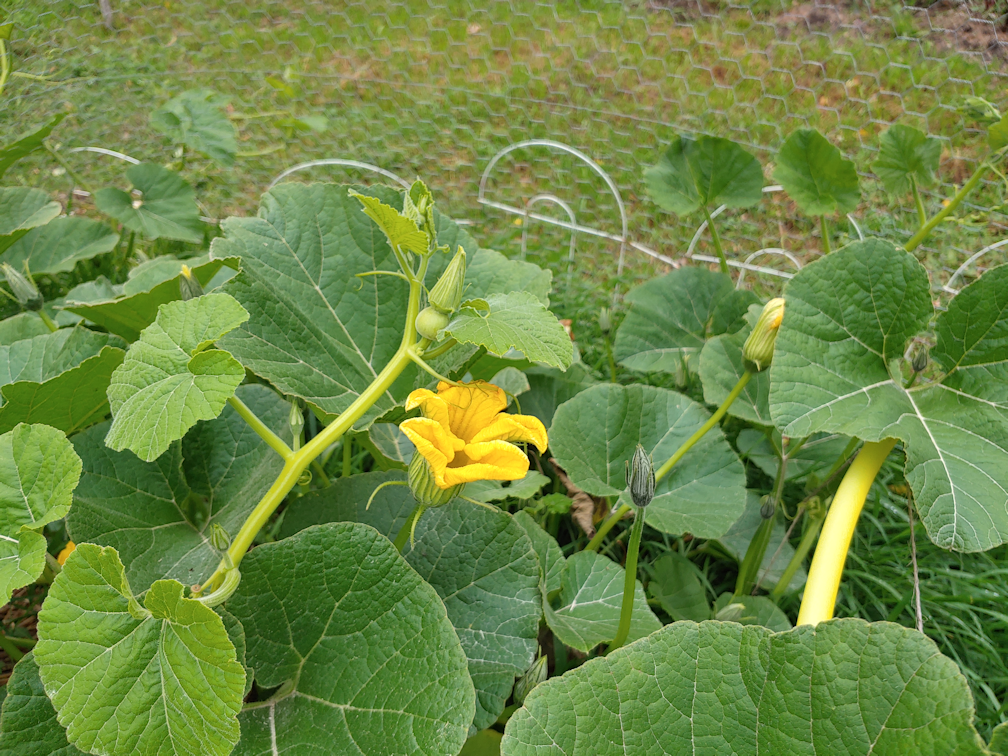
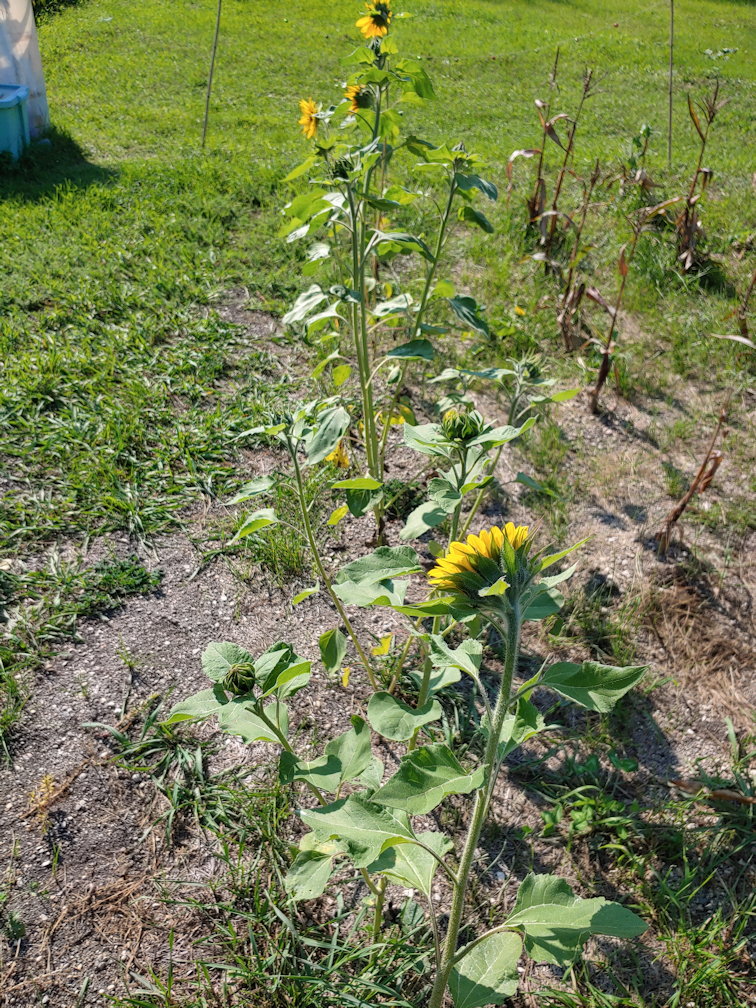
Well, so much for trying to support the sunflower in the old kitchen garden.

We had high winds again this morning, and the last of the three flower stalks on the remaining sunflower in the old kitchen garden finally broke. It was actually still upright when I came out this morning, but by the time I came back to the house, it was lying on the ground.

Sadness.

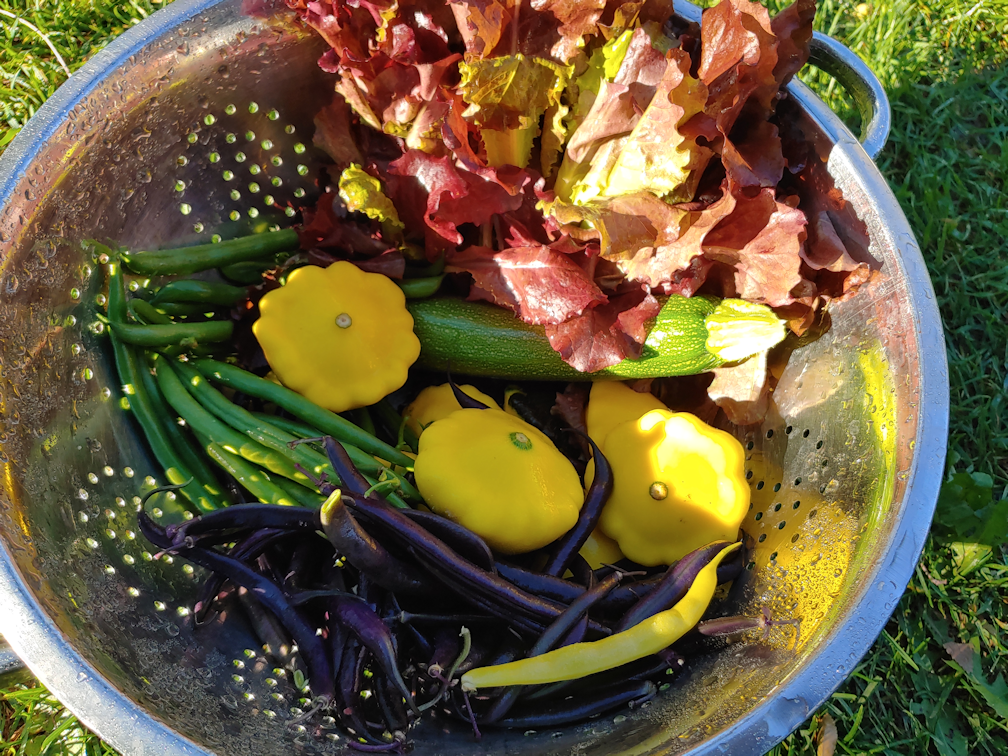
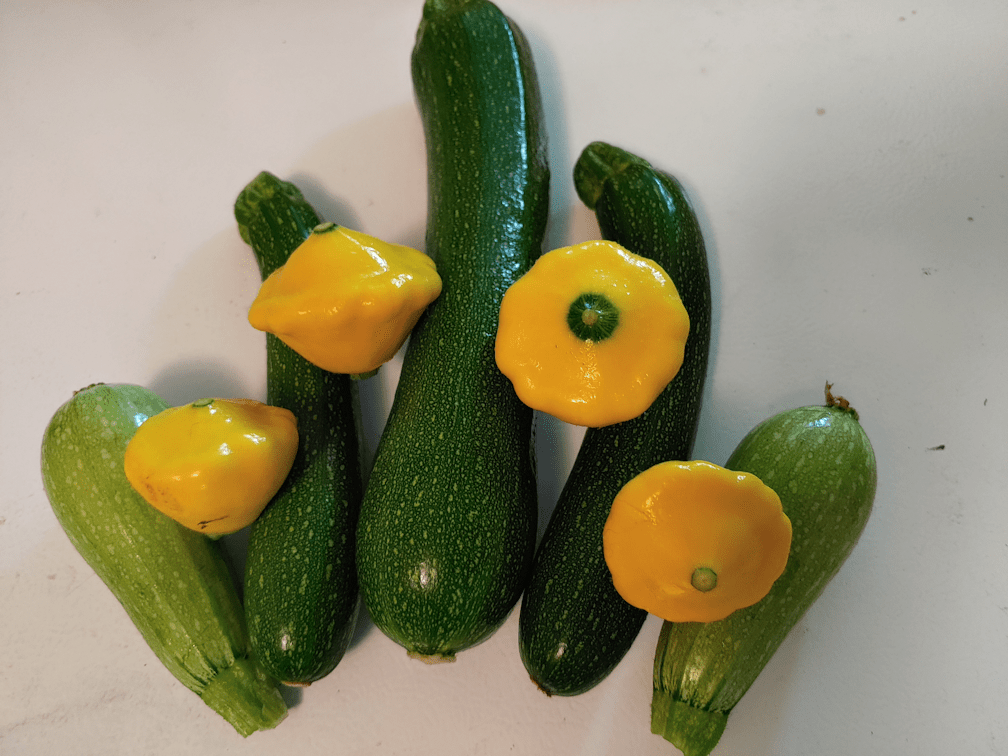
While checking the garden beds, I did get a little bit of a harvest this morning.

It all could fit in my pocket! :-D

This is the largest I’ve ever let a pattypan squash get. Any bigger, and they start developing their seeds. One of these days, I should try letting some fully mature. At that point, when the seeds are removed, they leave a cavity that can be stuffed for roasting, which I do want to try. We just really like them at this stage, though. :-) For next year, I plan to try other varieties of pattypan squash, and hope to grow some to save seeds, too. Since I accidentally bought three summer squash collections for this year, instead of one, we don’t actually need to buy more squash seeds, but I like to try new varieties.

That is definitely one of the biggest benefits of having a garden. There are so many varieties that are just never in the stores!

The Re-Farmer

Our 2021 garden: morning in the garden, and first lettuce!

I was rather pleased with this morning’s harvest!

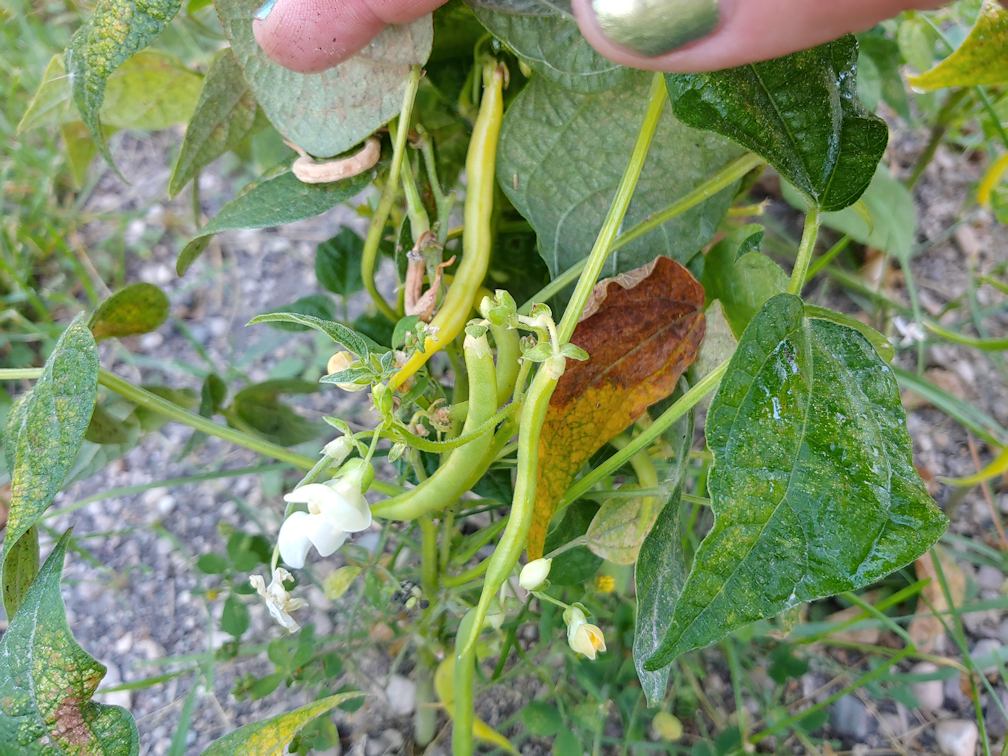
I am just amazed that we still have beans to pick, this late in the season! Even a single yellow bean. :-D

If the mild temperatures continue, we will be getting more yellow beans, too. There are new beans growing, all over the row! From what I could see while picking the green and purple beans, we will have more to pick for at least a couple of weeks, unless a frost hits, first.

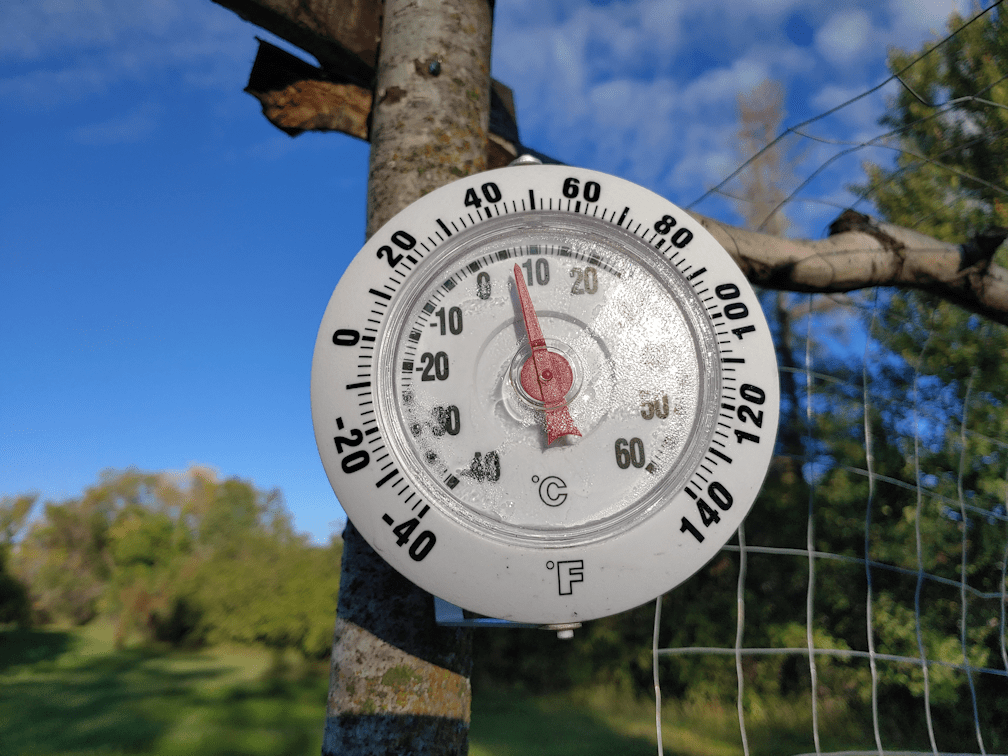
After seeing that insanely high reading on this thermometer a few days ago, I’ve been making a point of checking it more often. This time, it seems to be reading low. It was chilly this morning, but not that chilly!

Ah, well. It’s a Dollar Store thermometer. As long as it’s close, it’ll be useful.

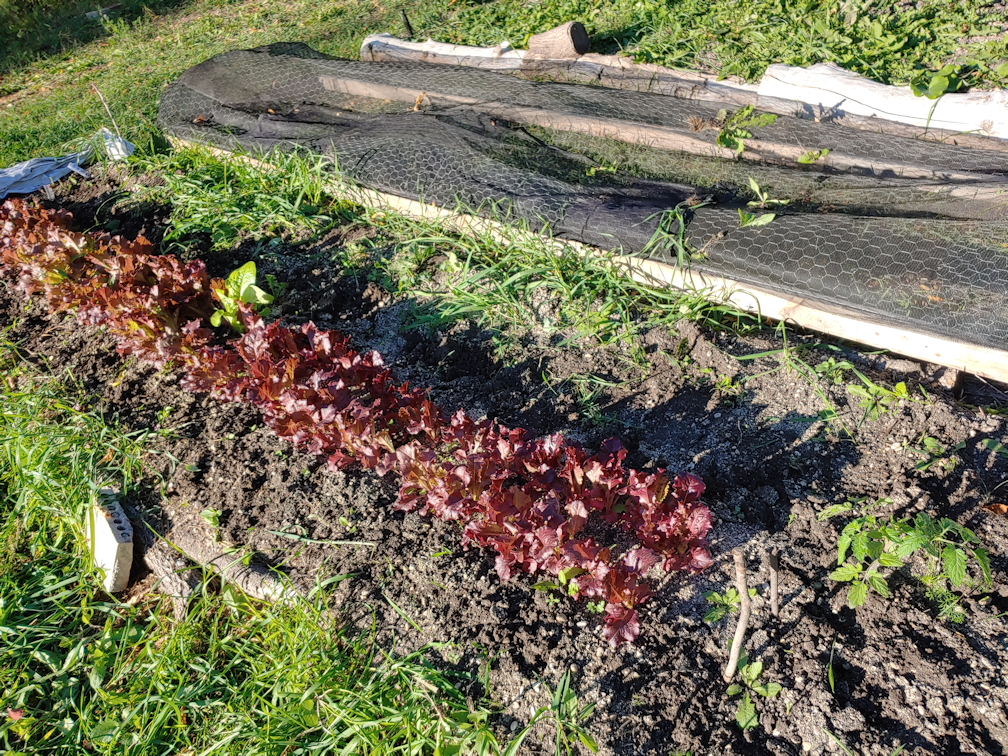
This morning was the first time I uncovered the lettuce to weed and thin them. The cover may keep the critters out, but it’s so long, it’s awkward to move on and off, unless there are two people.

These seeds had been from the bottom of a baggie they had spilled into, so I was expecting a mix. It looks like they are almost all the same type, with the exception of two Buttercrunch. Today is the first time we have been able to harvest lettuce this year! The first time we planted them in the spring, the groundhog got to them before we could. The lettuce is just loving these cooler temperatures.

What I am most curious about is this…

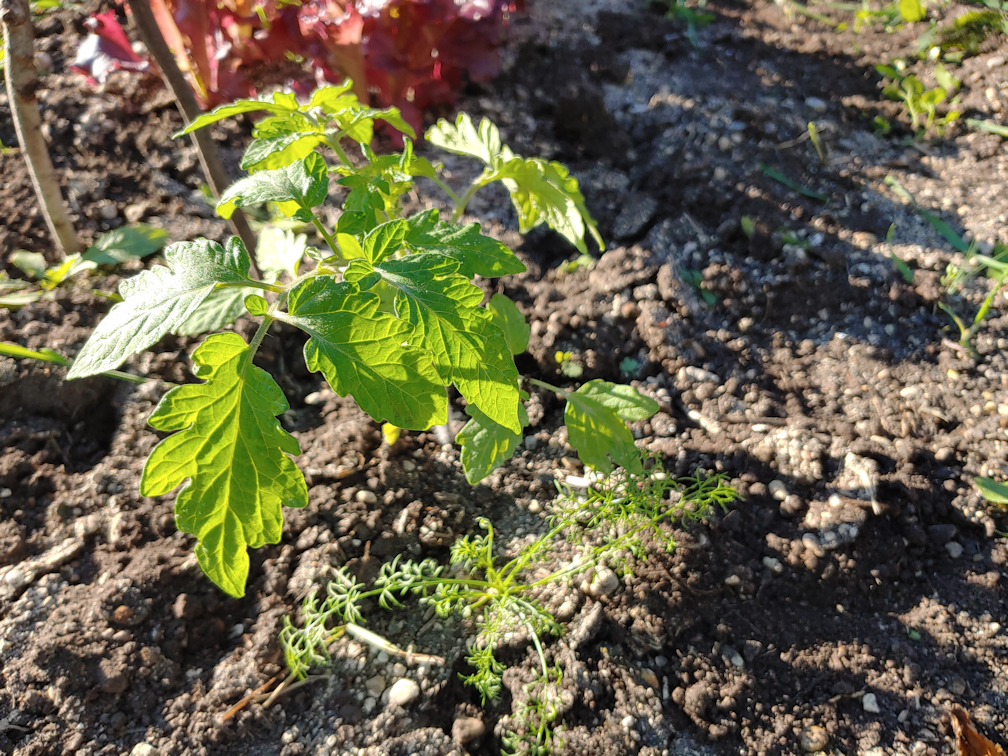
There is a tomato plant growing here! It’s looking very strong and healthy, too. I think that’s a dill growing beside it. Dill self seeds easily, but a tomato? Where did that come from? And why did it sprout so late in the season? This bed had spinach in it, first, and this tomato is growing past the sticks marking the ends of the rows I sowed the lettuce in. No additional soil had been added. Very strange!

While weeding this bed, I was on the lookout for the radishes we’d planted in the other half. I found a couple, but they were really tiny. I have no idea what happened to them.

The Bright Lights chard is doing well. We’ve harvested leaves a couple of times from these. They are liking these cooler temperatures.

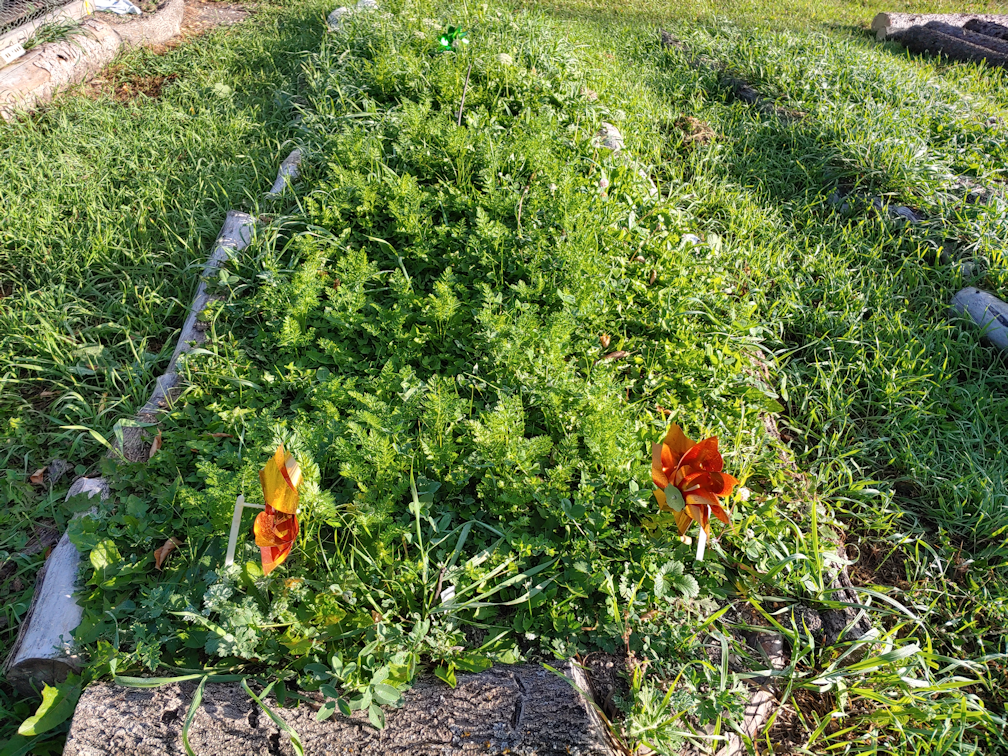
We have completely abandoned the carrot bed the woodchucks had decimated repeatedly. I’d tried to at least keep weeding it a bit, but it was just too much. And yet, you can see carrot fronds among the weeds! It should be interesting to see what we have, when this bed gets cleaned up for next year.

The Hopi Black Dye sunflower in the old kitchen garden had three stalks with flowers on it. In our recent winds, one of them broke, so I added the supports for the plant to try and save the rest. This morning, I found a second stalk, broken on the ground.

We didn’t really have a lot of wind last night.

I suspect kittens.

I’ve been catching them playing in this garden, right on top of the netting over the carrot bed and the beets by the retaining wall. The carrots are on the edges of the bed, and the kittens have been playing in the middle, so those aren’t as affected, but the beets are being flattened. That bed was already struggling to recover from being et by grogs, and not doing well, so I guess it’s not really a loss, but I find it interesting that the kittens seem to really like playing on top of the netting, instead of on the ground or paths beside it!

Thinking ahead to next year, I believe we have enough salvaged boards in the barn that can be used to make low raised beds here. It would be a good place to make contained areas, such as with square foot gardening, as we turn this into a kitchen garden, and we start to plant more herbs that may have a spreading tendancy. If we have actual frames on the beds, that will make it easier to set up sturdy covers to protect from voracious critters and insects – and playful kittens!

I think we should dig up the rhubarb and transplant them somewhere else. They are not doing well here, likely because they are right under the ornamental crab apple trees.

As difficult and sometimes disappointing as things have been with gardening this year, particularly with the drought, it has showed us a lot about what works, and we can do to improve things for the future.

The Re-Farmer

Our 2022 garden: chocolate

When I placed our order for fall garlic, I also ordered a pack of seeds for next year’s garden.

It felt kind of weird to order just one pack of seeds. Especially since the garlic will be shipper later, when it’s time to plant them in our zone.

This is a variety of tomatoes my daughter really wanted to try. We now have seeds for two colourful varieties of little tomatoes for next year. We will also be getting two other, larger sized varieties. For me, I will be getting paste tomatoes, while my daughter wants to get some sort of big, lumpy heirloom variety. :-D I think this time, we will start them indoors a bit earlier, so I don’t mind getting seeds will in advance. Last year, we ordered the majority of our seeds in early December, because so many were already selling out. I don’t expect there will be quite the same level of shortages as last year, but I still want to place our orders as soon as our budget allows.

Alas, one thing we won’t be ordering this year are the bushes we were talking about planting where the corn and sunflower blocks are now. We missed the deadline; they have already stopped taking orders for the year! We will need to make sure we can place an order as soon as they open up for orders again, next year. The saplings wouldn’t be shipped until spring, anyhow.

I think half the fun of gardening is planning for the next year’s garden! :-D

The Re-Farmer

ps: the package under the packet of seeds is a set of 12 inch drill bits my darling husband got for me. He’s the best!!

Our 2021 garden: still growing!

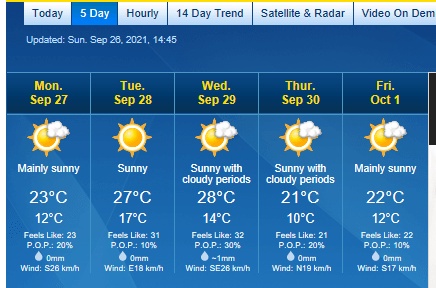
Today is likely to be the last hot day of the year. As I write this, we are currently at 26C/79F, with the humidex at 30C/86F. We are expected to reach 28C/83F with the humidex making it feel like 31C/88F. We are supposed to get a couple more days in the mid to low 20’s before the highs start dropping to the mid to high teens. So far, overnight temperatures are also still supposed to remain high enough that there are no frost warnings.

I headed out to do my rounds later than usual this morning, and we had already reached 22C/73F.

There has to be something wrong with the squash tunnel thermometer. It may have felt warmer than the 22C it was when I took this photo, but there is no way it was feeling like 42C/108F! Not even being in full sun, like it is, should result in that extreme of a difference. I suspect the dial is stuck. I haven’t been looking at it since the temperatures finally cooled down, so it may well have been sitting at this reading since our last heat wave.

In checking the sunflowers, there was only one little pollinator that I saw! I think the heat waves we had over the summer killed off a lot of our pollinators. There just wasn’t enough food to sustain them. The mild temperatures we are having means more of our sunflowers are actually budding and opening their seed heads, but I don’t know that they’ll have a chance to be well pollinated.

Some of the Mongolian Giants are finally taller than me. Hopefully, the opening sunflowers will lure any remaining pollinators to them. They may not have time to fully mature, even with our predicted mild temperatures, but they will at least provide some food for our surviving pollinators.

These are the Hopi Black Dye transplants that got chomped by a deer. They have all recovered surprisingly well, and are budding and blooming. They don’t need as long of a growing season as the Mongolian Giants, so it should be interesting to see if any of these get a chance to mature.

The green peas are enjoying the cooler temperatures we’ve been having, and I’m seeing more pods developing. This photo is of one of the pea plants growing among the Dorinny corn, the remains of which are being left to go to seed. The three blocks of sweet corn are still green, but they aren’t really growing. At this point, I don’t expect anything from them, really. They’re just there for the peas to have something to climb. Any pea pods we get is just gravy, as their main purpose is to fix nitrogen into the depleted soil in this area.

The winter squash and melons are the ones I am monitoring the most right now.

Remarkably, even as the plants are dying back, we are still getting fresh blooms, and the newer Red Kuri squash are getting noticeably bigger.

The mutant seems to have stopped getting bigger, and is now deepening in colour and developing a harder skin.

As this other, larger Red Kuri is still doing.

I did a nail test on the oldest of the developing Red Kuri, and you can see the mark left behind. Still not ready.

The Teddy squash are also still managing as well.

If we do end up getting frost before any of these larger squash can fully mature, we will still be able to harvest them and eat them. We just won’t be able to store them for long.

The melon vines are dying back faster than the winter squash vines, but their fruit are still hanging in there! I was able to pick this Pixie melon, only because the vine it was attached to had died back completely. I suspect it isn’t quite ripe.

My daughters discovered something about these little melons. After they are cut in half and the seeds scooped out, they make perfect ice cream bowls! I’m not big on ice cream, but I finally had some last night, in half of a Halona melon. It was quite excellent! :-D

I am glad we found these little, short season melons. They have been among the most enjoyed producers this year. I think we will try different short season varieties next year, but the Pixie and Halona are definitely varieties we would grow again. I’ve also saved seeds from some grocery store melons that I plan to try. They are larger varieties, but if we start them indoors early enough, and we don’t have another drought, we should be able to grow them. :-)

The Re-Farmer

Clean up: salvaging logs, and bonus clean up

Today was dry enough that I could work on cutting up the dead tree that had finally fallen, thanks to recent high winds.

This time, I could use power tools! I used my baby chainsaw (aka: cordless pruner), with it’s 4″ blade, to trim off branches, then a reciprocating saw, with a 12″ blade to cut the measured lengths. Unfortunately, my reciprocating saw is giving up the ghost. It cuts, but it doesn’t stop. Sometimes, it’ll slow down when I release the trigger, but other times it would just keep right on going. I had to unplug it to turn it off!

At the last minute, I changed my mind on the longer lengths I would be cutting. These will be used to make high raised beds in the main garden area, and I had been thinking of building them at 10 feet long. As I was measuring, however, I decided to make them 9 feet long. The boxes we built for the beds where the garlic had been planted are 9′ x 3′. I figured if I did these at 9 feet long, any future cover frames we build will fit on both. I kept the short ends at 4 feet, though. With the width of the wood, the inside of the beds will be roughly 3 feet wide, so any covers would still be interchangeable.

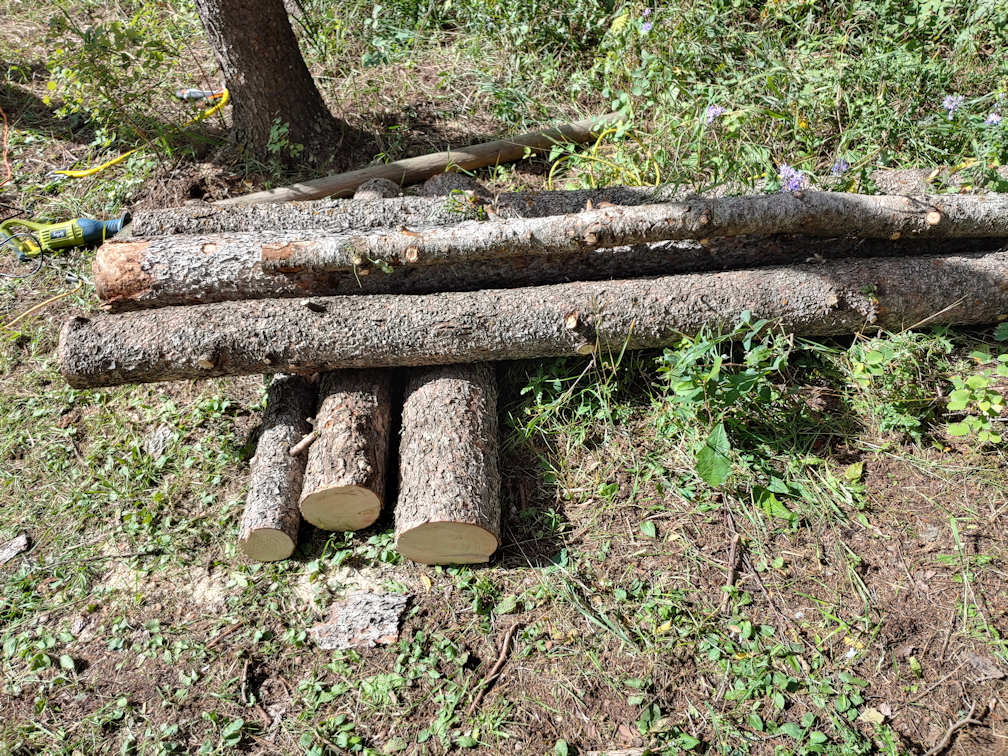
So here we have two 4′ and two 9′ lengths. Enough to make one course of logs to frame a high raised bed.

By the time I cut these, the rest of the tree was light enough that I could drag it closer to cut a couple more pieces.

That gave me another 9′ and another 4′ piece. At the top of the long pieces is the remaining top of the tree, which is about 7 or 8 feet. I set that aside for potential future use. When I was trimming the branches off, I found another 6 or 7 feet of the top had broken off and was dangling from a nearby tree. With three 9′ lengths, three 4′ lengths, plus another, say, 7 feet of trunk, and 6 feet for the top that broke off, we’re looking at a tree trunk that was roughly 52 feet. Add in the roughly 3 feet of stump left behind, we’re looking at a dead tree that was about 55 feet tall when I cut it down.

The one that’s still stuck on another tree was a bit taller.

At this point, I had salvaged logs to do 1 1/2 courses to build a raised garden bed. I needed two more pieces.

I didn’t have to cut down another tree, though. I still had the trunk of the dead tree I’d cut down and used the stump to make a bench.

After I finished trimming the branches, the trunk was eventually rolled up against the patch on the right, where there is a currant bush, chokecherry tree, raspberries, some flowers and a crab apple tree that died this spring. So after dragging/carrying the first pieces over to where the garden bed will be built, I cut a couple more lengths from this tree trunk, then set the remaining top piece aside with the top of the other tree, for potential future use.

You can see that the new raised bed will be quite a bit shorter than the low raised beds we had this year. Those are about 13 feet long. We will be losing planting space, but we should also be able to plant more densely, once they are at a more accessible height. For now, I want to make these at least 3 logs high, then see how they work. I expect to finish them off at 4 logs high.

Which would translate to roughly 3 or 4 trees to harvest, per bed. In this area, there are six low raised beds that will be converted to high raised beds, so that means as many as 12 trees to replace all the low raised beds with high raised beds.

Considering that we have more than 20 dead trees that need to be cut down, having enough logs won’t be a problem, even if some of them turn out to be too rotten to use. Some of those trees are thicker and taller than the two I used today, so I’ll probably need even fewer. With the new beds being several feet shorter than the current beds, we could potentially have a double row of beds. That will depend on the space for paths. These are meant to be accessible raised beds, with room for a walker or wheelchair in between, so the paths need to be 4′ wide.

The one thing we do have is the luxury of space. While we are starting with raised beds in this area we are already gardening in, as time goes by we will be adding more beds in this area. Not a lot more, though, as there are too many tall trees on the south side casting shadows. The plan is to build more permanent raised beds in the outer yard, where they will get full sun.

But that is for after we’ve done a lot more logging of dead trees in the spruce grove!

Once the last of the logs were dragged over, I took advantage of having the tools handy and finally took down the dead crab apple tree.

For this job, I was able to use the baby chain saw, and didn’t need anything else. I love that thing!

In the photo, you can somewhat see where the bark as split off the trunk at the bottom. This tree had started to get leaves in the spring, but then just died off, and seeing that damage sure explains why. The tree itself was showing signs of disease, even last year, so all this wood is for burning, not the chipping piles. I noticed that even the raspberry plants near it were also showing signs of disease, so what we will likely have to do is remove any plants growing around the tree and not plant anything at all here for a few years. That should be time enough for whatever disease has gotten into the soil to die off.

Once cutting and clearing away to the base, I could see that this tree was actually the sucker of a larger tree that had died, long ago! The inside of the old stump was so rotted out, I could brush it aside with my hands.

I kept cutting and breaking up bits and pieces for a while, but what I will ultimately do is bring a small metal ring I found and have been using as a portable fire ring, and light a fire on top of the remains of the tree. That will prevent any suckers from trying to start growing and, hopefully, sterilize the soil of whatever disease has gotten into it, at least a bit.

It was good to finally get this cleared up. There are a few other dead and dying crab apple trees that will need to be cleaned up, too. Over time, once enough time has passed, I hope to replace them with other fruit trees that are more disease resistant. This spot, however, will not get anything tall planted in it. There are already too many tall trees shading the area. An awful lot of garden space was lost to shade because my parents planted so many new trees on the south side of the garden, instead of the north! Most frustrating is that they also planted them too close together, so none of them thrived, and quite a few died. I removed a lot of these when I cleaned up the maple grove, our first summer here, but I think I will have to take out an entire row of crab apple trees I discovered in the process. They simply aren’t getting enough light to bloom and produce, even after I cleaned the area up. That’s not a priority right now, though.

But I digress!

I’m happy to have gotten as much done as I did today. Tomorrow, the girls and I have an outing with my mother planned, so we won’t be able to get more done then. I’ll have to use Sunday to take down another tree and hopefully get enough wood to start on the first permanent high raised bed before winter. With several days of rain predicted next week, we shall see how far we will be able to get on that!

The Re-Farmer

Little by little, and a Crespo surprise

It has remained too damp to try cutting wood, so I worked on a few other things today. One of them was to start getting the remaining chimney blocks out of the old basement, to where they will be set up for next year.

The blocks themselves are not too much of a problem. I can carry them well enough. The main problem is the stairs. If I could simply walk up the stairs, it would have been fine. However, I don’t do stairs well at the best of times, and these stairs have unfortunate dimensions, as well as being unusually steep, to fit into the space available. Which meant setting the blocks down on a step, then cautiously lifting it up, one step at a time, with one hand, while hanging on to the rail with the other. Slow going, and rather dangerous. :-/ Once at the top of the stairs, my husband would open the door for me, keeping the cats away, and slide it aside while I went for another. With his back injury, even sliding them was probably more than he should have done, but he managed.

For now, I only got three out. There are four more left in the old basement. There’s one more in the new basement, but I’m keeping that. It was the perfect height and solidity to use as a surface when I was doing some wood carving.

As I was carrying them out to the yard, with my husband getting the three doors I had to go through for me, while also keeping the cats at bay, I got curious as to how much they weighed. My husband estimated about 25 pounds, but I knew they had to be heavier than that. So I brought over our scale to weigh the last one before taking it out. It turned out to be 53 pounds, so not bad at all. Mostly just awkward. As I sit here writing this, I am starting to feel issues with my right shoulder, from lifting them up the stairs the way I I had to, though. :-/ Fifty three pounds is a bit much for one arm, while scrunched over and squeezed between two walls and a rail!

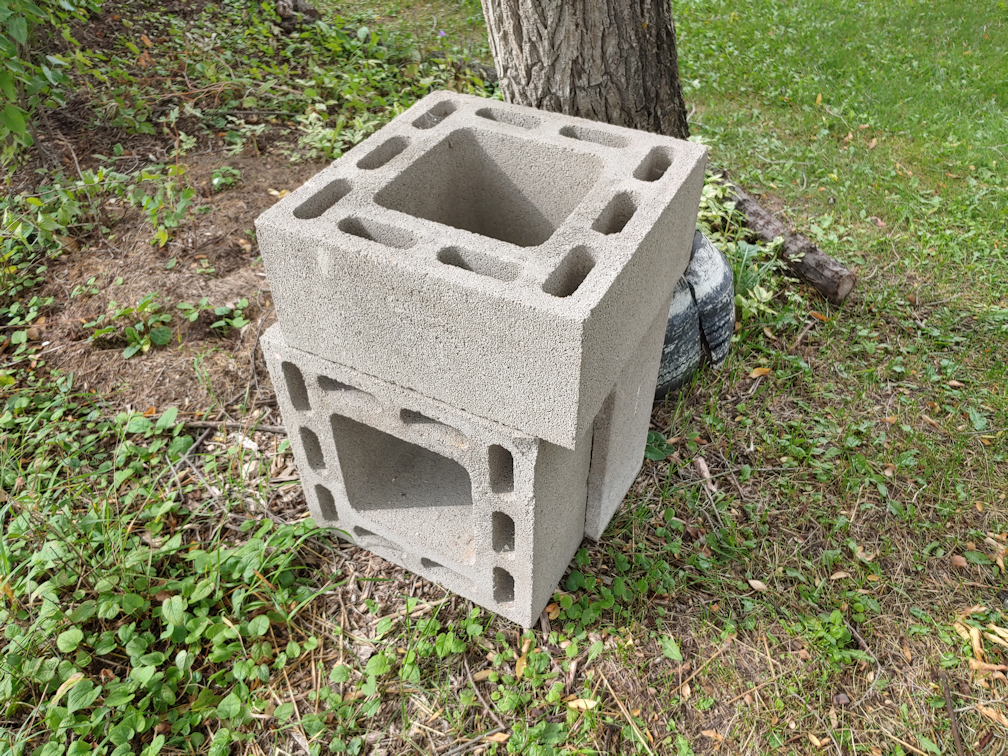
Of the ones that were outside, all but one were used for the retaining wall in the old kitchen garden. The last one is hidden behind the three I brought out, leaning against the tree. We will have a total of eight blocks by the time the rest are brought up from the basement.

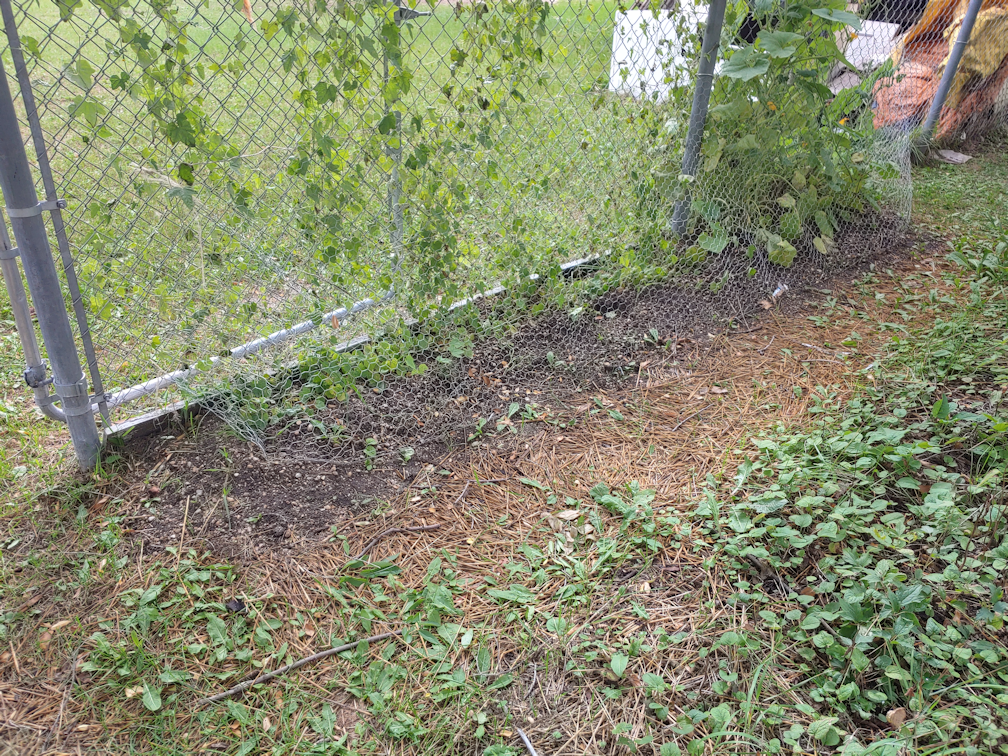
This is where they are going to go, when it’s time to clean up the cucamelons and gourds. We were intending to have them here for this year’s garden, but were not able to get them out of the basement in time, so I want to get that done little by little until they are needed. In this spot, the ground slopes just enough that there is a larger gap under the chain link fence. The cardboard flaps we pushed up against the fence before adding the soil ended up falling under, and the soil started washing away when we watered, so I had to use boards I found in the barn to short it up. The blocks will eliminate that problem, and will make good “containers” to plant into next year.

With that done, I got a few other things done, including picking up more fallen branches from yesterday’s wind, eventually heading over to check out the Crespo squash. I’d noticed more flowers opening, and I wanted to see how the two squash that were forming were looking.

It was a pleasant surprise to look at one of them, and find another little squash developing!

Then I spotted another one, high above the hill they are planted in.

Then I spotted another…

And another…

And another!!!

Which is when a started to walk around the critter barriers, looking closely for any more, and counting.

I spotted twelve. !!! A full dozen, that I could see, baby Crespo squash!

Some were very tiny – even smaller than the one pictured above, while others were surprisingly large.

I did not expect a variety that produces such large fruit would also be so prolific!

The problem, of course, is this.

The first official day of fall is only 5 days away, and leaves are already starting to turn.

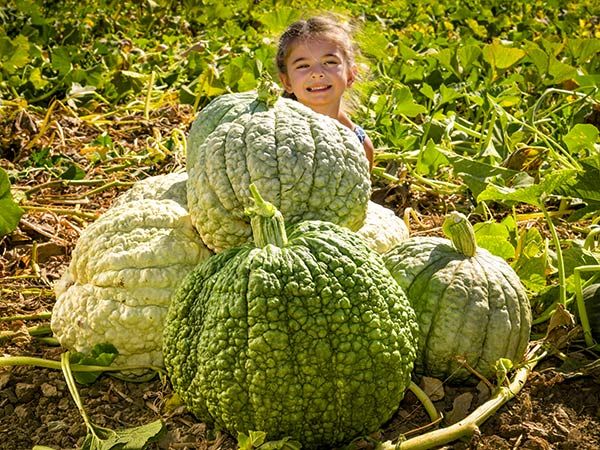
The certainly won’t have enough growing season left to reach the size shown in this photo from Baker Creek.

Well, at least I know that, if started indoors early enough and protected from critters, it will grow well in our area. I want to try these again, next year!

The Re-Farmer

Unexpected harvest, and other things

We were having a lovely rain when I headed out to do my morning rounds. Though we have been getting the odd showers for the past while, things were still starting to dry out. With the high winds yesterday, I actually watered the old kitchen garden, when I noticed all the beet greens were wilted.

With the cooler temperatures and things in the garden winding down, we’re gathering things every few days or so, and the amount we harvest is getting smaller. Mostly, it’s just summer squash. My daughter had recently picked summer squash, so when I went through the garden beds this morning, I wasn’t expecting to actually pick anything.

I was rather surprised to find even a few larger summer squash! The Magda squash have been slow growing this year, so finding two of them large enough to pick is a treat. There are lots of little sunburst pattypans, and after my daughter had already picked the larger ones, I certainly didn’t expect to find more so soon. Yes, I know they can get much larger, but this is the stage we like them best. The only thing that wasn’t a surprise was the big zucchini. Usually, we pick the squash soon after the flowers fall off, but the flower on this one was solidly attached. Even though it was of a size we would normally pick it at, we left it. When I saw it this morning, I just had to pick it. Any bigger, and it’s going to start getting becoming a winter squash! :-D Maybe some day we will let some zucchini reach that point, but not this year. :-)

We are supposed to continue to get showers through the afternoon, but I’m hoping things will have a chance to dry up a bit. I really want to tackle that tree that came down in the wind. We really need to get started on any high raised beds for next year. If we can get even just one bed done, I will be happy. I also need to prepare three beds for the garlic we ordered. I were intending to order double what we got last year, but after talking about it with the girls – and looking at our budget – we got the same amount as before; a collection of racombole, purple stripe and porcelain music, 1 pound each. Though the beds they were planted in before are available, we want to rotate them into other beds that did not have alliums in it. Unfortunately, those beds are still being somewhat used right now! However, if I am able to get enough out of the tree to build a high raised bed, it will have fresh garden soil and amendments added to it, so it won’t matter if it’s in a location that had onions this year.

If it’s too wet to break down the tree today, I should still have tomorrow. The weekend is supposed to get quite hot, and we’ve got plans for Saturday. Next week, we’re supposed to get several days with rain, and then things start cooling down a fair bit. As long as I can get enough pieces cut, while it’s dry, we can get some progress on a bed.

Though our overnight temperatures have not been cold enough for frost, some of the more delicate plants were showing signs of what I would otherwise consider frost damage. Some of the cucamelon leaves are showing signs, and part of a Ozark Nest Egg plant had a vine that was growing the highest, suddenly start dropping this morning.

Everything is all winding down, which means things are getting busier. There’s a lot of work to prepare beds for next year, and getting it done often depends on the weather.

In other things, I’m happy to say that since we installed that shut off valve and, in the process, adjusted the pipe so it wasn’t touching another one, and padded it with vibration reducing material, that very disturbing noise we would sometimes hear seems to be gone. It’s hard to say for sure, since the noise didn’t happen every time the well pump turned on, but so far, it’s encouraging.

Something else seems to have gone away.

The woodchucks.

I haven’t seen any of them in almost a week, now. Usually, I’d at least see one peaking out of the entry to their den under the pile of wood, or eating the bird seeds near the living room window but, lately, nothing. I was wondering if they might have gone into hibernation, so I looked it up. They tend to hibernate from October to February, so it’s still too early for that. But then, the sites also said they mate after the come out of hibernation, and we so them going at it in the summer, so who knows.

Very strange.

Not that I’m complaining! :-D

Future wildflower area, and something’s missing

After breaking the lawn mower in the strip along the road, I finally got back to it, today.

Here is how it looked before I started, from each end.

I suppose one good thing about the drought conditions is that this area has never gotten overgrown. There were saplings starting, so I went over the area with the lopper first, cutting them as close to the ground as I could. The last time I had to do that, we didn’t have loppers, so a lot of these saplings were growing out of the ragged ends of smaller saplings before, that had been mowed over rather than cut with pruning shears. The larger ones had been cut with pruning shears, and there was enough of them that I had needed a wheelbarrow to clean up. This time, I could just pick up the larger ones by hand and didn’t even get an armful.

Here is how it looked when I was done.

The plan for this area is to convert it to native wildflowers for the pollinators. The mix we have has 16 annuals and perennials, chosen for Western Canadian climates. We intend to start at the far end (where the lawn mower can be seen in the one photo), as that end is near the garden. Over time, I intend to continually scatter more seeds down the line, with a goal of this entire strip being full of wildflowers. Once that is established, we won’t need to mow it regularly any more, and we will just need to keep on top of cutting away any saplings that try to establish themselves, and do a single mow, at the highest setting, at the end of the year.

What we can’t do is follow the instructions. This is the method we had intended to follow.

Method Three involves more planning but requires no chemicals. Till in the late summer or early fall the year before planting. You may allow the soil to lie fallow or plant a cover crop after tilling. A cover crop may be important if your site is on a slope. A green manure cover crop such as buckwheat or annual rye grass will hold the soil until spring, help add beneficial organic matter and help snuff out germinating weeds. In the spring, light cultivation will be needed to loosen the soil and turn under all existing growth just prior to planting. ‘

https://www.veseys.com/us/westernmixwildflowers.html

Well, we can’t till this area. Even if we had a working tiller. You can’t see them in the photos, but there are several large rocks peaking through the soil, and I have no doubt there are more that cannot be seen. I had hoped to at least go over the area with a harrow, but we still need to figure out a safe way to get under the riding mower, which has a tow hitch, to put the chain back on, so it will move. It hasn’t exactly been a priority.

Then there are these instructions:

Sowing: 

Once your ground is bare and loose, you are ready to sow. Following are a couple of tips that will make the whole process simple and successful. First, choose a nearly windless day and, second, separate the seed you’re planting, no matter the amount, in roughly two equal parts. Put the first half in a clean bucket or coffee can and add in roughly 10 parts of light sand or vermiculite. There are two reasons for the sand. It will dilute the seed and help you spread it more evenly. More important, since it is lighter-colored than the freshly-tilled soil, you’ll be able to see where you’ve been as you sow. You can simply hand-sow, keeping the seeding as even as possible. Or use a hand-crank seeder. The amount of seed you sow depends on the sort of flower display you want. Many people sow up to two or even three times the minimum seeding rates on seed packages to assure heavy bloom. Avoid planting higher densities since this will inhibit good growth. Sow the first half of your seed/sand mix over the entire area to be seeded. Then go back, mix the second half of your seed with sand and spread that seed over the whole area. This way, you’ll avoid bare spots. Once the seed is evenly sown, you can rake to barely cover the seed with soil. Or, simply compress the seed into the freshly-tilled ground. A lawn roller is perfect for the job, and for smaller areas, a piece of plywood laid down and walked on will do.

Okay, so we can broadcast the seed easily enough, but things like getting rid of all the roots of what’s already there, and having “bare and loose” soil first is out of the question. We’ll be lucky if we can loosen the soil at all. As for raking or tamping down to compress the seed into the soil? Ha! Nope. Not gonna happen. It’s just too large of an area. We will also not be able to do any watering here, at all. We have enough hose that we can reach the furthest corner of the furthest garden bed with the spray nozzle on the hose. I have no intention of buying yet another length of hose, to water outside the garden area.

Nope.

The instructions say to prepare the soil, then plant in the spring, after last frost. Since we can’t water the area, I’m going to throw caution to the wind and broadcast the seeds in the fall. I had expected to be doing that around now, but we are having relatively warm temperatures for the next while, and we’re also getting rain. I don’t want the seeds to germinate. I want them to go dormant before getting covered with snow. Then, when the snow melts in the spring, they will get their moisture.

This goes against all the instructions but… well, these are wildflowers. Wildflowers manage to propagate themselves without freshly turned soil, tamping down or clearing of other plant roots. I’m going to be trying to copy nature, here.

So we will do as much as we can first – which, unless we can get under the mower, is basically what I’ve done today. I’ll be using garden soil instead of sand to help broadcast the seed more evenly. Since I don’t want the seeds to germinate, I will probably wait until the end of the month, or even into October, to do it. Whatever survives, survives. If we keep broadcasting seeds, year after year, eventually the area will get filled. Hopefully with a good variety.

So that’s done as much as possible for today.

This is the first time I’ve been out this way, on foot, all year, which means today was the first time I was able to check out, and get a photo of, this.

This is the corner post of the property’s fence line.

It needs replacing, as does most of the fence, but that is not what I was taking a pictures of.

I was taking a picture of what isn’t there.

My father’s name.

Many years ago, my dad took a piece of red plastic and used gold coloured, metal, self adhesive, letters to put his initial and surname on it. The sign was mounted on this post. Back in the day, before any of these roads had names, and well before the driveway marker system was implemented, the sign was used as a landmark when giving people directions to our place.

We don’t go out often, and the sign can be easily seen only when we are on the return trip, but seeing that flash of red while turning the corner always made me feel good. It was a memory of my father.

Some time ago, however, I realized I wasn’t seeing that flash of red anymore. Today, I got to look around to see why.

There isn’t a trace of that sign. The reflector at the top got broken in half, though, and the rest of it is on the ground, but that’s all I could find.

The road that goes past our driveway has our family name, as well as a numerical name. When we first moved here, the road sign with our family name was at the top of the stop sign across the intersection. One day, the stop sign was lying broken on the ground, and the road sign with our family name on it was gone. I am 99% sure this was done by our vandal, and I’m just as sure that he is responsible for the sign on this fence post being gone. When it happened, I have no way to know.

What a childish, petty thing to do.

If we ever do get the road sign replaced (I’ll have to contact the municipal council again about that), or replace the sign on the fence, we’ll have to set up a trail cam on it, because I just know that our vandal will go after it again.

Switching out memory cards in this location would be much more inconvenient, that’s for sure!! But it would need to be done.

What a pain.

The Re-Farmer
Our 2021 garden; pixies and our grape harvest

The girls joined me for the evening rounds last night, and my daughter found a ripe Pixie melon!

I had checked them in the morning, and none were coming loose from their stems, but by the end of the day, one of them finally did. :-) It isn’t even the biggest one that has a hammock to support it. Hopefully, this means the other Pixie melons were ripen soon. While we did pick one Pixie melon to taste test, it was still under ripe (still delicious, though!), which makes this the very first ripe Pixie we have picked.

Meanwhile, this morning, I finally picked grapes. Here is our harvest for this year.

Yup. That’s it. About a week ago, I did find another cluster with a whole three grapes on it, and I ate them.

This year, we will cover and insulate the grapes for the winter. These are supposed to be hardy to our zone, as far as I know without knowing the exact variety they are. However, even the hardy ones have a hard time things like month-long polar vortexes. Not even that one cold night in May that left us with no berries and almost no crab apples could be blamed for the lack of grapes. It took these so long to start budding, I feared the polar vortex had killed them off.

The Re-Farmer

Our 2021 garden: morning in the garden, and thinking ahead

What a lovely morning to finish up my rounds in the garden!

There are quite a few Mongolian Giant sunflowers opening their seed heads. Hopefully, we will see the Hopi Black Dye rows in this area opening soon. They are so cheerful! :-)

I’m just so happy with how the Red Kuri squash are doing! Judging from how the stem looks, the oldest of the ripening squash, in its little hammock, is progressing quite well, and the other two larger ones are catching up nice and fast. Looking at the long range forecast, our overnight temperatures will continue to stay mild, with no frost on the horizon, which will be a huge benefit for all the plants that are recovering from the heat and drought conditions we had this summer. Lately, we’ve had enough rain that we have not needed to do any watering at all, which is helping a lot, too.
The largest of the Halona melons was ready to pick this morning, so…

… the hammock that was supporting it is now holding the larger of the new Red Kuri squash.

It has been a few days, so this morning, I spent some time picking beans.

I also thinned more of the Lounge Rouge Sang carrots.

I ended up using what vegetables we had in the fridge, as well, to make a use-watcha-got version of Hodge Podge. I used bacon fat instead of butter, all the carrots in the photo, some of all three types of beans, cut into smaller pieces, yellow onion, shallots and garlic, a bunch of little sunburst squash, a zucchini, and the chard we’d picked recently; the stems were removed and chopped to about the size of the beans, while the chopped leaves were added near the very end. Also, chunks of sausage for the protein. For a bit of texture, I tossed in some lightly crushed mixed nuts, too. Instead of water, I used vegetable broth, and the dairy at the end was a mix of sour cream, into which I’d stirred in the flour for thickening, and heavy cream. Since I used broth, no other seasonings were added.

The only downside is that the carrots turned the cream pink! :-D It was not the most visually appealing of dishes as a result, but is sure was tasty!

While going over the garden and checking things out in general, we are going to have to start working on things that need to be planted at or just before fall. We have the two wildflower seed mixes that won’t be sown until fall, but we need to start preparing the areas now. We won’t be able to do actual seed beds, as the packets recommend, but we can still clear the areas as best we can and, for one set of seeds, hopefully use the riding mower to drag the little harrow I found under the spruce trees and loosen the soil a bit.

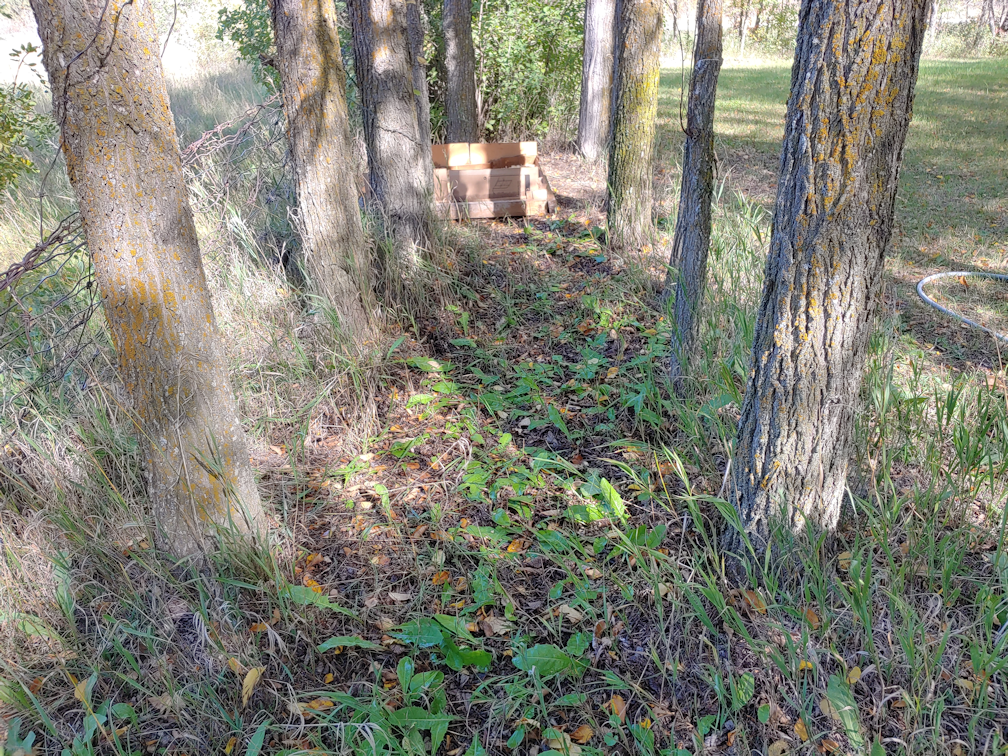
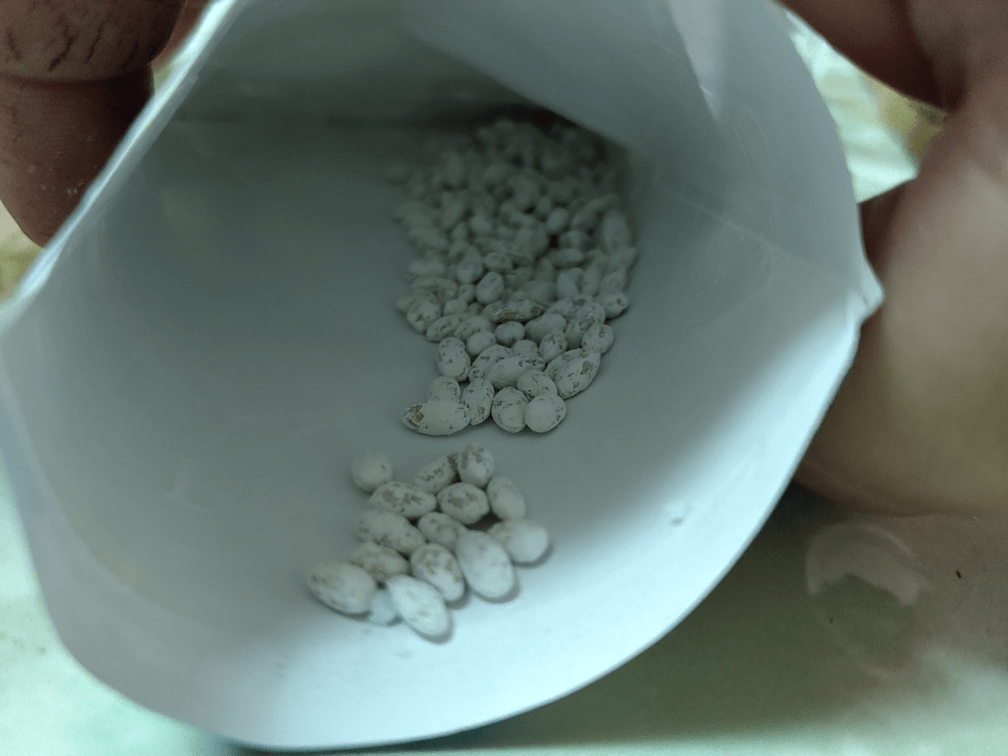
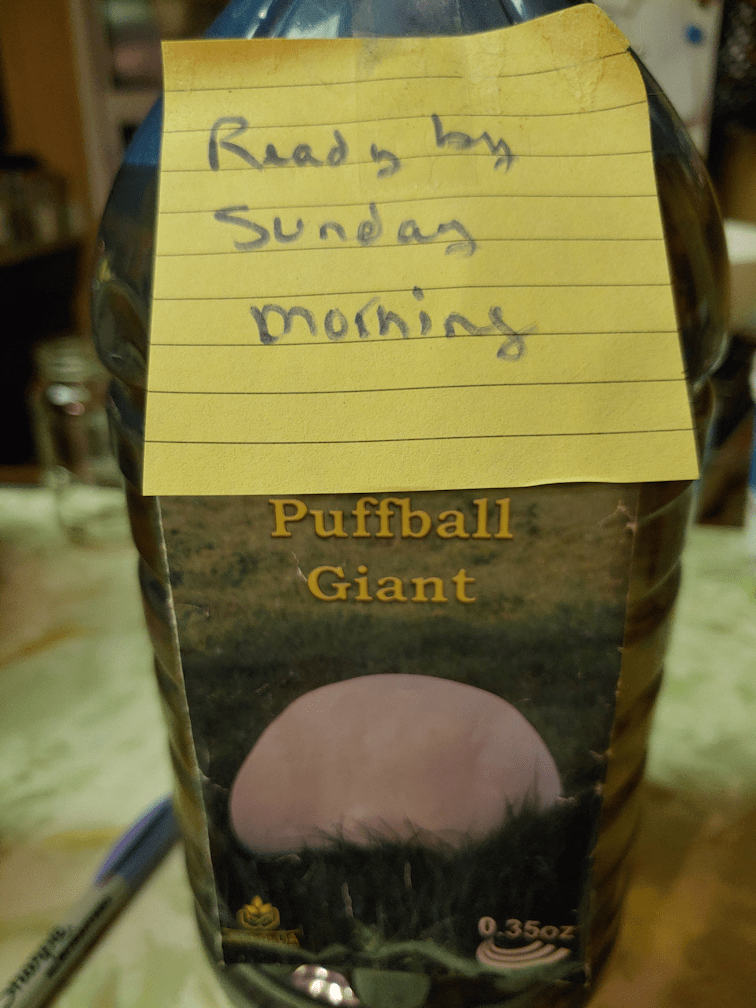
We also have the morel and giant puffball spores to “plant”. They need to be done by about the middle of September, if I understand the package directions properly. Unfortunately, where I wanted to put the morels still has a couple of branch piles that were supposed to get chipped. The giant puffballs needs a grassy area, and we have a few options, there. We just need to make a decision before preparing the spores.

We should have good weather for working outside for the next week or so, which will be a huge help.

The Re-Farmer