Our 2021 garden: more firsts, and silly kitties!

Before I headed out to do my morning rounds, we had already hit 25C/77F. By the time I was done, it was already 30C/86F! Thankfully, there was still a breeze and some shade, so it didn’t feel too bad.

I made a couple of discoveries in the garden this morning, but before I get to those, I’ll back track to yesterday evening.

I used the cut off strip of mosquito netting left over from covering our lettuces and beets, some dollar store hula hoops, and lengths of old hose to cover part of the third spinach bed. This is just until we can make a wire mesh cover for it. I also took the trail cam from the tulips and moved it to overlook most of the garden. The only critter I saw in the files this morning was Nutmeg. :-D

After setting the netting up, I moved on to the far beds and blocks to water them. The water in the rain barrel is usually cool, but it was quite warm by the end of yesterday’s heat! On the plus side, it meant being able to use the watering can instead of the hose, and not shocking everything with cold well water, for almost everything. As the water level dropped below half, I started to refill it while still using the watering can, so it would be just cooler water instead of having to switch to the cold hose to finish watering.

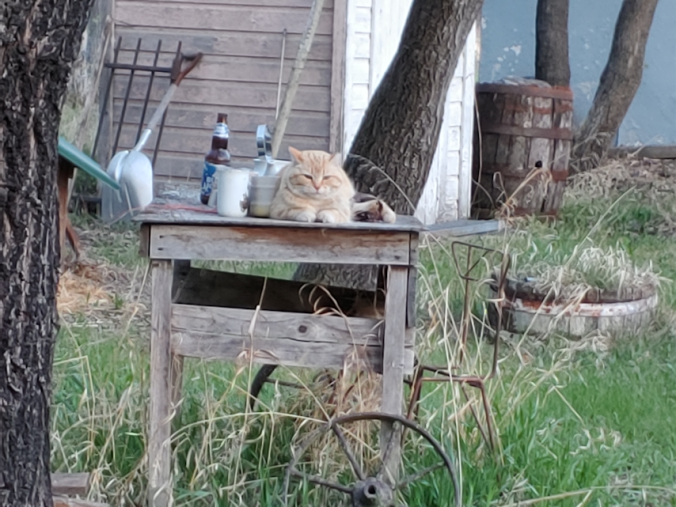
I had company.

Rolando Moon has a thing about drinking from puddles! Once the water was absorbed by the soil, she decided to roll on the damp soil, then just hung out. I guess it’s nice and cool. At least she tended to stay in the middle, which is more of a trench for water, as the beans are planted on the sides. No beans are coming up yet.

Nutmeg was also hanging around. I caught him lying across some pea plants, chewing on the trellis twine! The little bugger! :-D

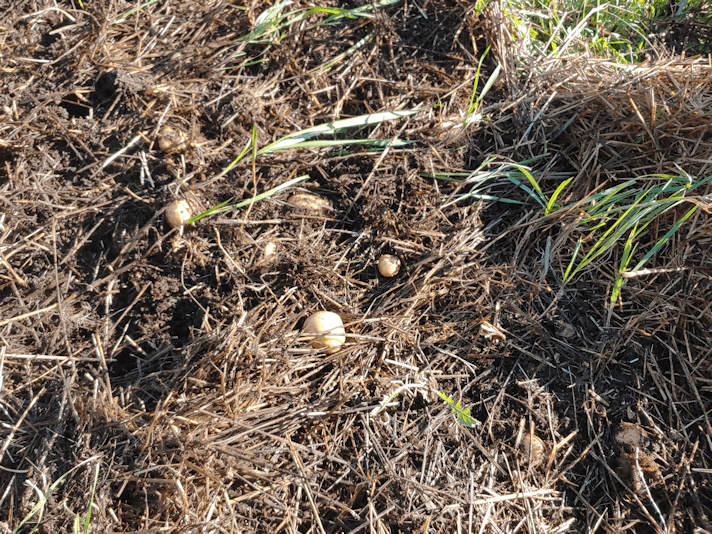
When I checked everything this morning, things were still damp and didn’t need to be watered, but I also spotted a whole lot of these…
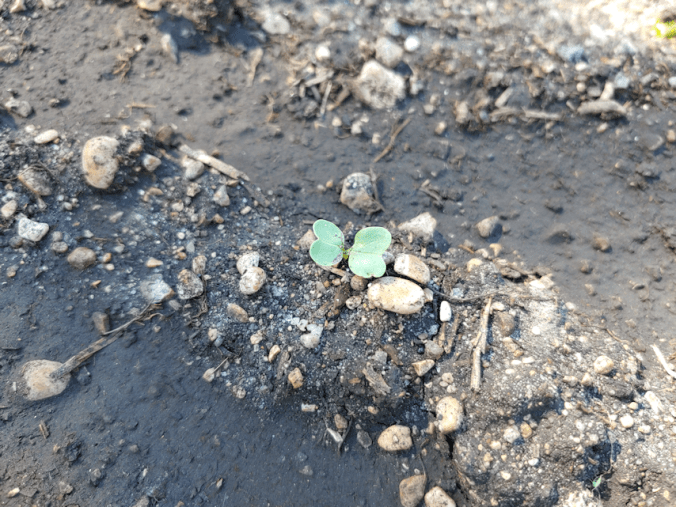
The radishes are sprouting! The one in the photo is of the daikon type radishes, but I was seeing sprouts for the watermelon radishes in all the rows they were planted in, too. I was aware that radishes sprout quickly, but I’ve never grown them before, so this was a very pleasant surprise. They most certainly were not there when I was watering last night. :-)

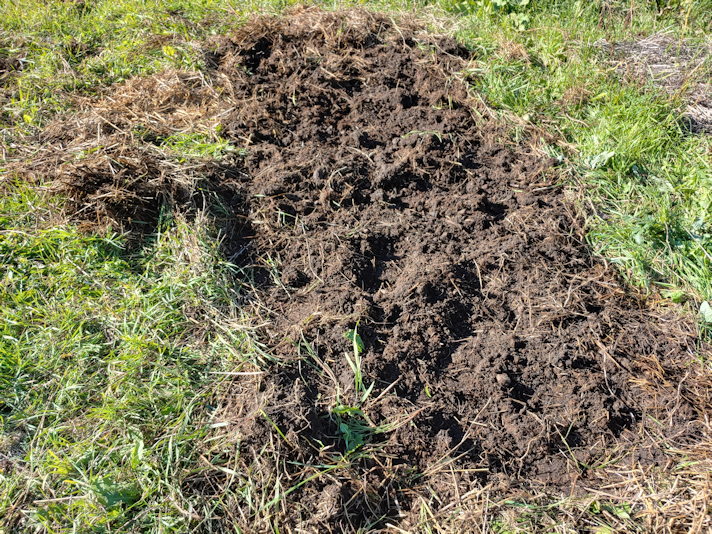
Then I found another lovely sight.

The first potato leaves have emerged through their mulch! There are the purple fingerling potatoes. Sifting around in the mulch in the grow bags, I found other shoots coming through the soil, but these are the first ones to break through and leaf out. :-) I really look forward to seeing how these do in their grow bags.

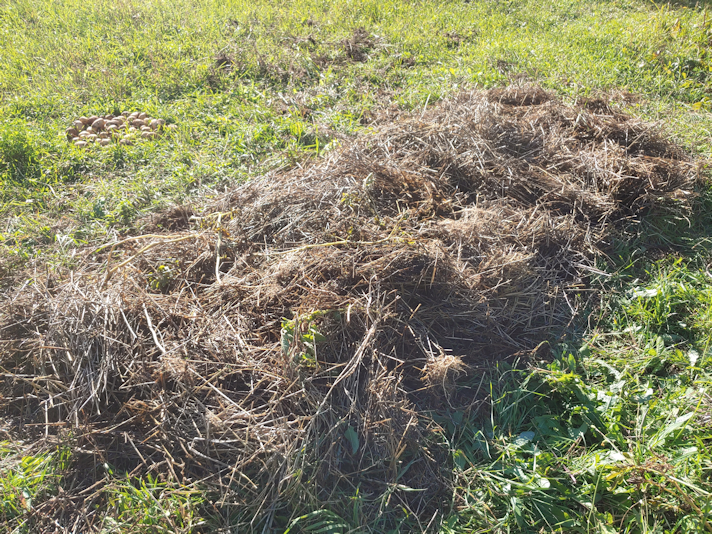
We have a whole lot of squash transplants ready to go out, but I’m starting to rethink what to do with the summer squash. The plan was to make more beds like with the beans and peas. However, we have that long arc where we’d planted the sunflowers last year. In removing some of the old grass clipping mulch to use under some new beds, I couldn’t help but notice how much better the soil is, underneath. It’s still rocky, but we basically have a long row of soft soil, bordered by concrete hard soil. I’m thinking we should take advantage of this. It will need far less amending than starting new beds. I’m also planning to try staking the summer squash this year, but with our without stakes, deer don’t like those prickly squash plants, so it could act as a sort of fence for the rest.

I sorted through our transplants while hardening them off, and we have a lot of nice, strong melons. Between those and the winter squash, and the two types of gourds that successfully germinated, we might not actually have room for it all on the squash tunnel. So I’m thinking we can plant as much as we can fit of each type at the squash tunnel, then whatever is left over can be planted in other areas. Without trellising, these should spread out quite a bit over the ground, and we’ll be able to give them lots of space, and we would just need to haul soil over to make hills, rather than beds. This would allow us to compare how well they do, between left to grow on the ground, or up a trellis.

What I might end up doing is getting the Montana Morado corn done, first. They are doing very well, but will start outgrowing their cups soon. Since the toilet paper tube pots didn’t work out, I’m really hoping they won’t suffer from transplant shock too badly. In zone 3 gardening groups. I’ve read from people who warn against transplanting corn completely, because they don’t handle it well, to people who say they do it all the time, every year, and have never had issues. I suspect type of corn can make a difference, and I seem to be the first person in all of these groups to try and grow purple corn in our zone!

I’m really excited to see how they do!

The Re-Farmer

Our 2021 garden: beating the heat, transplants, potatoes and … stalking goldfinches?

Today, we definitely heated up fast! I was outside early to do my rounds, the watering, and hardening off the seedlings, managing to finish before things started getting too hot. We easily reached 30C/86F and probably went a bit higher. We even got heat alerts, and air quality warnings for those places dealing with wildfires right now. We’re supposed to hit 30C again tomorrow, then the temperatures are expected to drop to highs below 10C/50F, with overnight lows of 2C/36F, so frost is still a possibility!

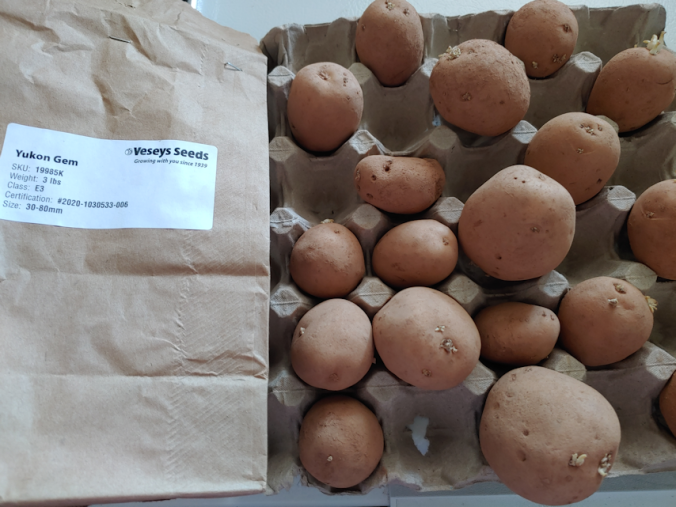
Our order of potatoes came in. It was expected to come in tomorrow, but when I checked the tracking number, I found out they had arrived on Friday! So they sat at the post office over the weekend. I was going to chit the potatoes this year, but it looks like I won’t have to!

We got only one box of each type, so we are not expecting to have a long term supply, even if they do turn out to be very productive. The Yukon Gem, which we tried and enjoyed last year, are likely a type we will grow more of in the future. We shall see how the others do. To have enough to last the winter for 4 adults who really like potatoes would require a lot more seed potatoes!

This afternoon, my daughter and I braved the heat to do some transplants.

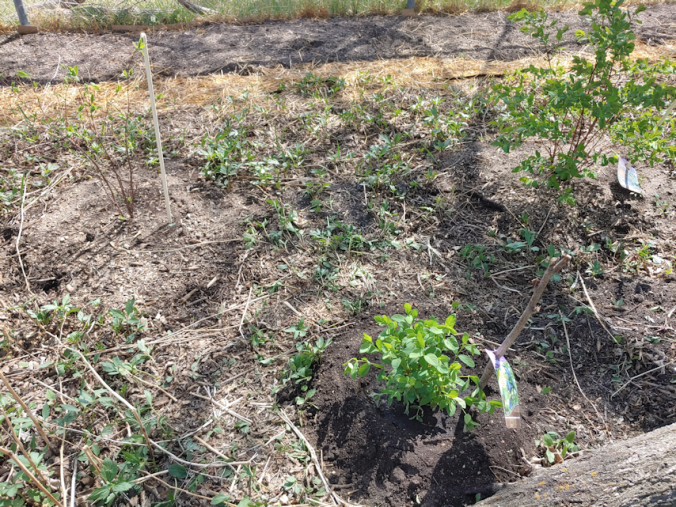
The new lady haskap is now in. You can see the other two in the photo. The other female haskap is harder to see, since it has so few leaves! At least it is growing. Watering everything twice a day is making a big difference all over, but it’s really helping with the struggling haskap.

My daughter chose a spot for her raspberries. They’re now in front of the row of trees in the old garden. The ones that self seeded among my mother’s raspberries that she transplanted. I still don’t quite understand why she moved them from a full-sun location, into the shade. No matter. We now have our first two raspberry bushes planted! As we add more, we will build trellises for them, but that will slowly happen over the next couple of years.

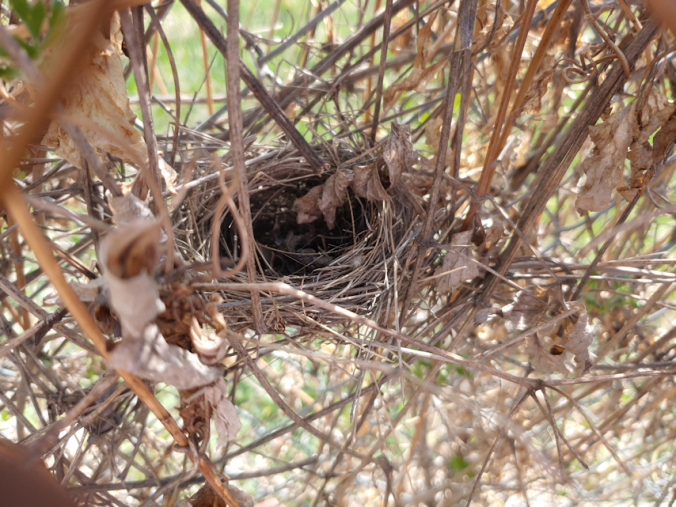
Before we headed in, my daughter and I checked out where the potatoes and their grow bags are going to go. This is near an area of the chain link fence where we are allowing vines to grow. We’re tearing them out, everywhere else we find them, as they are so invasive. Right now, there’s last year’s dead vines on the fence, and we found a tiny little surprise.

This old nest was only about 2 or 3 inches across! We don’t have many birds small enough to have a nest like this. In fact, I can only think of one, and I find myself wondering if it was a hummingbird nest. What a delightful surprise!

After finishing the transplanting, we headed into the cool of the indoors for a few hours. My husband recently picked up a Roku media streaming device. We have Amazon Prime for the free shipping, but now we can watch shows on the big screen TV. That thing hasn’t been turned on in months. :-D I’ve been watching Poirot lately, and settled down to watch an episode while having breakfast… er… lunch… whatever. Which is when I got another surprise.

A bright, yellow, feathered stalker!

It stayed there for a surprising length of time, watching me through the window!

This is not the first time we’ve had a goldfinch decide to perch on a window sill and check out the humans inside. The last time it was last summer, and the bird was trying to look in at my bedroom window. Too funny! And very adorable.

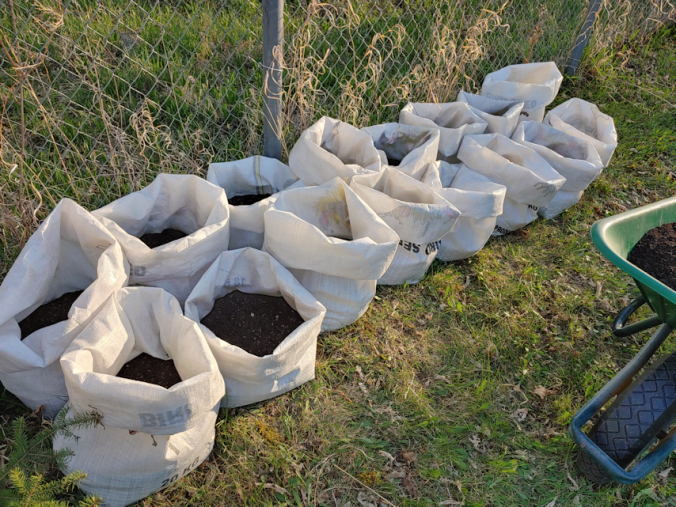
After things started to cool down (which is a relative statement; it’s past 11pm as I write this, and we’re still at 23C/73F), I started setting up the home-made grow bags for the potatoes.

We’ve got 4 bags for each variety. For now, they’ve just got a few inches of soil on the bottoms, which I hosed down thoroughly, after this picture was taken. Tomorrow morning, before things start to heat up again, the potatoes will be added to the bags and topped off with a few more inches of soil. As they grow, we’ll keep adding either soil or straw mulch, and the bags can be unrolled as more height is needed. Hopefully, this will give us a better yield, as well as protecting the potatoes from slugs. We shall see!

Once this was done, I did the evening watering.

I had company.

Rolando Moon kept following me around, then settled herself in the middle of our “found object” art display to watch me. :-D She is so funny!

Once back inside, I had less fun things to deal with; a call with my brother, talking about the upcoming court date this Friday for the restraining order against our vandal. Last time, my brother took a day off work for the court date, only for us to discover everything got cancelled again, due to the province increasing restrictions again. We just had Mother’s Day and have a long weekend coming up, so the province increased restrictions again. :-/ I will call the court office on Wednesday to find out if court dates are cancelled again. It’s hard to know what will happen, but we’re trying to be as prepared as possible. Most likely, our vandal’s lawyer (which he can somehow afford, while claiming I’ve put him almost $200,000 in debt…) will just try to delay things to a trial date. If we are offered a mutual restraining order, I would only accept it if he agrees to stop drinking, and relinquishes his guns for the year the order applies. If possible, I’d request a psychiatric assessment, too. He’d never agree to any of that, though. In past experience (granted, in another province, but I really don’t expect this one to be any better), a lot will depend on whether we get a judge that’s able to set aside his/her own personal biases or not. The hard part is going to be staying focused on the matter at hand, and not allowing the lawyer to distract away with our vandal’s many imagined grievances. A judge, of course, would have no way of knowing that they’re imagined. Nor would his lawyer, for that matter. We shall see how it goes. If it doesn’t get cancelled again, of course. :-/

At least we’ve got lots of hard physical labour in the garden as a distraction and stress reliever!

I like manual labour! :-D

The Re-Farmer

Potato beds put to bed

Today, we took advantage of the warmer weather and dug up our two potato beds.

The first one got done fairly early in the morning, before we headed to the city. Having already dug up a few of them earlier, I had some idea of what to expect, but I have zero experience with growing potatoes the “Ruth Stout” way.

I first pulled up the potato plants, then carefully used my potato fork to lift off, then “rake” the mulch away. Here, you can see some of the potatoes I uncovered in the process.

I also uncovered several chilled little frogs! I carefully moved them to the mulch by the squash, where they could warm up in the sun.

I also uncovered slugs.

I did not rescue them. ;-)

Almost all the potatoes I found were just sitting on top of the soil! Some took a little more raking away of the mulch to find, but not much more.

What had been rock hard ground when we started, the mulched soil was so much easier to work – even with all the rocks.

I took advantage of the situation and dug up the entire plot, so I could pull out as many weed roots as I could. The crab grass came out pretty easily. Then I hit a solid mass of roots near the surface, with a tap root of some kind that continued deep into the ground. I could not get it out with the fork! If I’d had the spade handy, I might have been able to cut through it, but since it seemed to be dead, I left it. It will be buried.

I did find a couple more potatoes in the process!

The end result looked like a 4×8 foot grave! :-D

When I finished pulling up as many roots as I was able, the mulch all went back – along with the potato plants that had been pulled up.

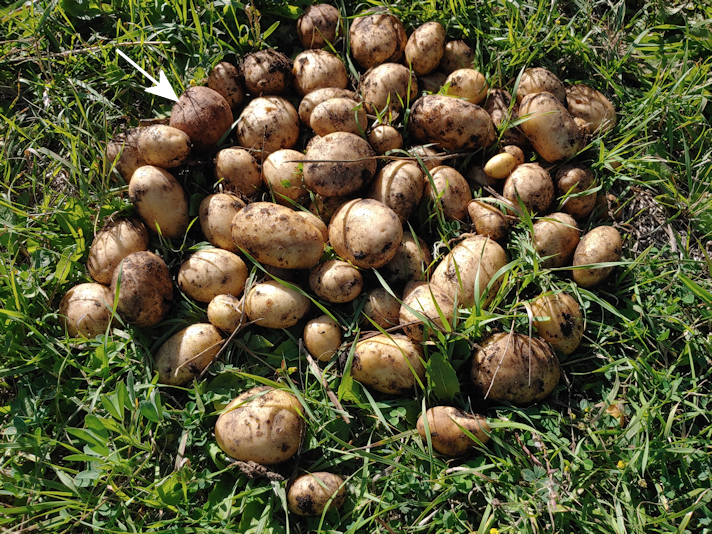
These are all the potatoes I got out of the one bed.

Also, note the one slightly darker potato with the arrow pointing to it. I’ll explain that, below!

When we got back from the city, I continued working on the second bed.

Once again, I was finding most of the potatoes on the surface of the soil as I pulled away the mulch.

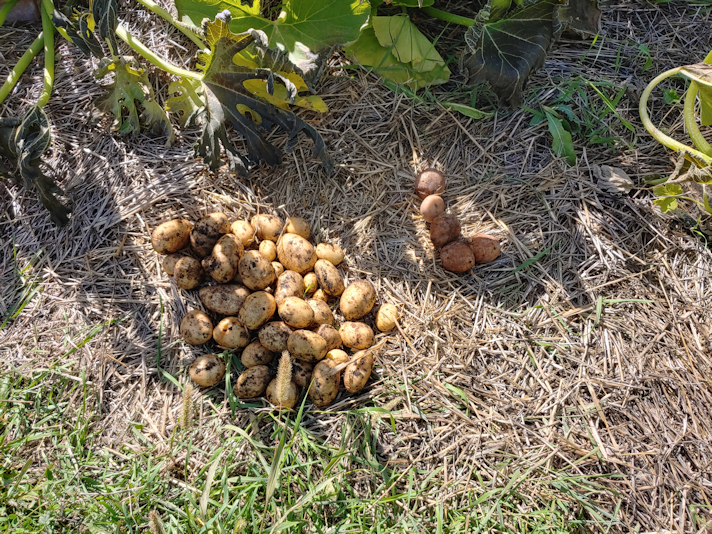
These are all the potatoes I found, before I did any digging at all. Unfortunately, quite a lot of them had holes eaten into them. :-( After digging, I found maybe 5 more.

Speaking of 5, do you see those 5 darker potatoes on the side?

Those are the original seed potatoes! The other bed had only one. While they had stems and roots that I broke off of them, they are just as hard as the day I planted them. I found the remains of some other seed potatoes, all mushy and used up like one would expect at the end of the growing season.

I got two 3 pound boxes of seed potatoes, which gave me 3 row of 6 potatoes in one bed, and 3 rows of 5 potatoes in the other, plus an extra. That’s 34 potatoes – and 6 in total never grew more potatoes!

As with the previous bed, I dug it all up, finding a few more potatoes, a whole lot more slugs, and pulling out weed roots.

Would slugs be the cause of those holes in the potatoes?

This bed had quite a few more rocks near the surface that I got rid of, too. My fork was hitting many more as I dug down, but I didn’t try to get them out, since we will continue to build these beds up. The mulch and old potato plants went back over the soil.

I then took all the harvested potatoes and laid them out on the dry straw mulch between squash beds, so they can cure (is that the right word for it?) in the sun. Except for the tiniest ones, which will be cooked and eaten right away. :-)

I then had the 6 original seed potatoes. What to do with those??

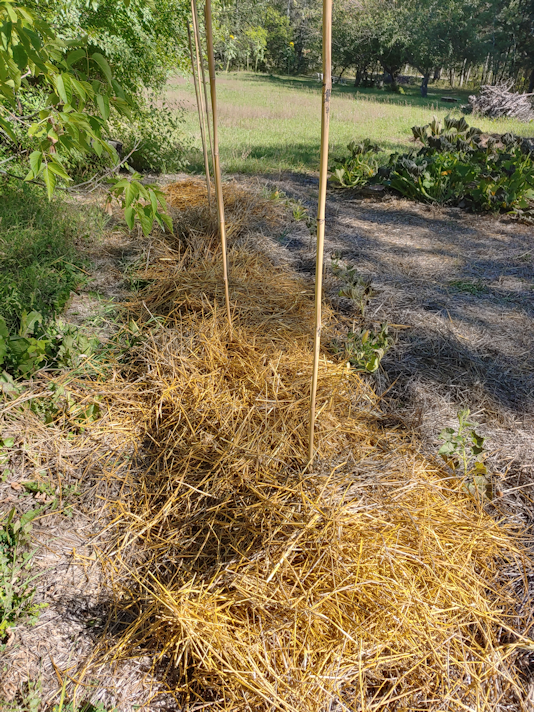
Yeah. I planted them, almost the same way they were planted in the original beds. The only difference is that I did loosen the soil a bit, first. Not to bury the potatoes – there are so many rocks along this end, I could barely do more than scrape away the mulch on top! No, it was so I could push in the bamboo poles to mark where they are. Even then, I don’t think the poles will be able to stay up for long. I could barely get them into the soil at all. No matter how I shifted and searched, I kept hitting rocks just inches below the surface.

What will most likely happen is that the potatoes will freeze over the winter, and nothing will come of them. Another possibility is that they will be protected by the mulch and, as soon as it gets warm enough next spring, they will start growing and we’ll have early potatoes started.

We’ll find out next year!

As for now, the potato beds are put to bed for the winter. I don’t know what we will plant in those spots next year. We do intend to do potatoes again, but in a different location. We don’t want to entice the Colorado potato beetle by planting in the same location again. We didn’t see a single one this year, but one of my neighbours a mile up the road mentioned that his potatoes had been decimated by them! My parents always planted lots and lots of potatoes, and I well remember going through the rows, picking off the beetles or their larvae, and hunting for the eggs to crush. Even with several of us doing that every day, some years my mother had to resort to using a poison powder of some kind, to get them under control.

I’d really rather not have to deal with them at all, if I can avoid it!

As for the squash, for now I have stopped harvesting any more of the sunburst squash, though there are a couple of zucchini that are almost large enough to pick. I prefer them when they are quite small, but with the sunburst squash, I want to give them as much of the remaining warm weather as I can for them to grow. As I write this, past 6pm, we are still at 21C/70F. We are supposed to stay fairly warm over the period covered by the long range forecast, with no more frosts expected overnight. That should give our produce a bit more time before we have to harvest what we can, then prep for the winter – and next year’s gardening! :-)

Our first year gardening since moving here has been quite interesting, and quite the learning experience. We will, for sure, continue using the Ruth Stout method until we are able to start making the accessible raised beds that are the ultimate goal. The extensive use of mulch is making a very noticeable, positive difference in the soil, even after just one year. My mother may be disappointing in our gardening, compared to what she had here, years ago, but I’m happy with our progress so far! :-)

The Re-Farmer

First!

Among the things we chose to plant for our first garden since moving out here were Yukon Gem potatoes. My view when it comes to planting potatoes is, since they are so inexpensive and easy to find in the grocery stores, we’ll choose a variety that are not available unless we plant them ourselves. Yukon Gem are a yellow flesh variety that is supposed to be more resistant to disease, and are good for both fresh eating and storage.

We only got 6 pounds for our first try, so we’re not expecting to have any to store. At least not for long! :-D

The biggest thing we did differently, though, was to use the Ruth Stout method. When my mother had her garden in this location, she had my dad or my brothers to plow it for her, every year. She had a working tiller (we’ve got 4 or 5 lying about, and none work), and 5 kids to help pick rocks.

While the area did get plowed before we moved here, no one’s been picking rocks for ages, and the plow job was a bad one. So what we’ve got to work with is rock hard soil, full of rocks, and very little equipment. The traditional method of growing and hilling potatoes was simply not manageable.

Among my recommended posts is a Canadian gardener who tried the Ruth Stout method in his own garden. He sowed his potatoes on top of hard, grassy ground, covered them with a thick layer of hay for mulch, and at the end of the season, he had lots of potatoes, and the ground beneath was greatly improved.

I figured it was worth a try!

We didn’t have hay, so I used straw from the bale we got last fall. What we don’t use to cover our septic tank gets used for mulch, and we still have plenty left this year. Mulch was already a big part of our plans to improve and amend the soil.

Well, the potato plants seem to struggle through the mulch, and never got really bushy. They did bloom, however, and at one point I dug around under the mulch to see if I could get some baby potatoes to try.

Even though this was after a rainfall, and the straw was damp, the ground beneath was bone dry. The only potato I could find was the mushy seed potato.

So… I was beginning to think this was a write off. I don’t know if it was because I used straw instead of hay, but it seems like the straw absorbed all the moisture, and it never made it to the soil.

While going through the garden over the past few days, I’ve been watching the potatoes. Some of them have already died back completely.

This morning, I decided to dig up the 3 potato plants that had died back on one end of a potato bed.

After moving the straw, there wasn’t much to see.

That is the seed potato, and no sign of any others. Only after digging, did I find one tiny potato under this plant.

It wasn’t a complete loss, though.

A few others were visible once the straw was moved, and they were looking pretty good.

Time to carefully dig around with the potato fork and see what I could find.

The first thing I noticed was how different the soil was. Even with plenty of rocks to dig around, the soil itself was much, much softer. I even found worms, as well as a single slug. :-D

So even if we don’t get a lot of potatoes out of here, we will have at least improved the soil!

How many potatoes did I find?

Here they are! Our first potatoes!

I’d say these were from 3 plants but, really, they’re from 2 plants. You can just see the itty, bitty potato that I found by the seed potato of the third one.

Of all the larger potatoes, one had a hole in it from a bug. The rest were solid.

I’m rather pleased! After what I found earlier, I was really wasn’t expecting to find much of anything.

Now to think about how to cook them for supper this evening. :-) I’ll likely make them very plain, so we can get a sense of how this variety tastes, compared to what we usually have.

I’m really looking forward to them!!

The Re-Farmer
First!

The kittens were too active to get good photos this morning.

Plants, on the other hand, are much more co-operative.

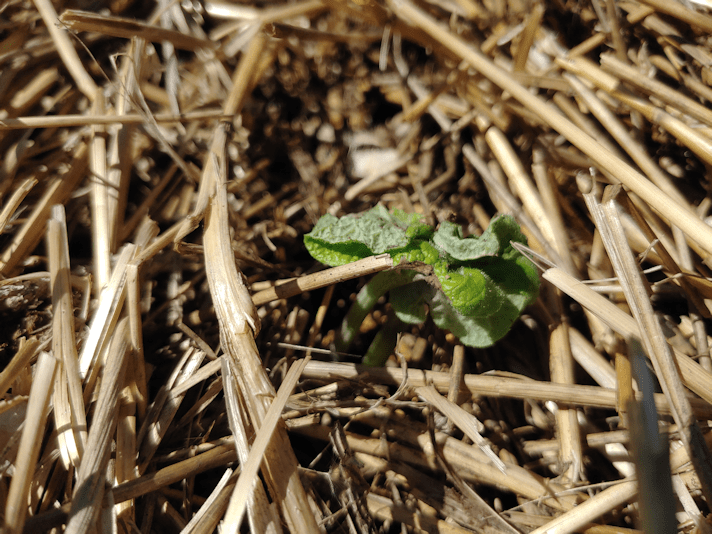
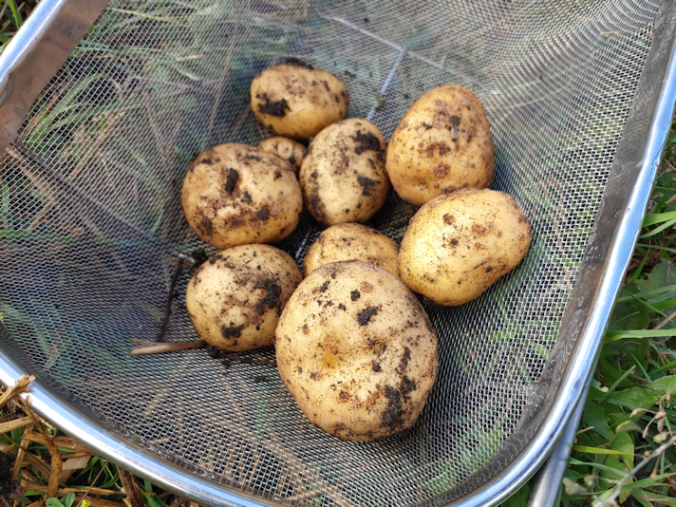
The first potato leaves have made their way through the mulch!

Yay!

Sadly, we are also down another sunflower. We found another one with just a stem, the leaflets gone. Total count is one less than yesterday.

We’ll still have a decent “wall” of sunflowers, but it will definitely have large gaps. If we do this again next year, we’ll know to get at least twice the number of seeds to start, and maybe even start them indoors, first. The sunflowers that have developed their true leaves seem to be left alone.

The Re-Farmer

Flame Roasted Potatoes

I roasted potatoes in yesterday’s cookout, and I thought I’d share. :-D

To make these, you will need;

20180604.fire.roasted.potatoes1

  • Large potatoes (1 per person)
  • Butter and seasonings
  • heavy duty aluminum foil, pieces sized to wrap each potato in a double layer
  • fire

Start by thoroughly scrubbing the unpeeled potatoes, then stabbing them all over with a fork.

For the butter and seasoning, you can use plain butter, then add coarse salt (how we usually do it), or you can make a flavored butter using whatever 20180604.fire.roasted.potatoes2seasonings you like.  This time, I added paprika, fresh ground pink Himalayan salt and fresh ground pepper, dill and garlic powder.

Generously cover the potatoes with the butter and seasonings.  Tightly wrap each potato in a double thickness of heavy duty aluminum foil.

Don’t skimp on the foil.  ;-)

Time to go outside!

Prep a small fire and let it burn down.  When you have a layer of coals, place the foil wrapped potatoes directly on top of the hot coals.

Build the fire up again on top of the potatoes.

Enjoy your fire for about an hour, letting it burn down to coals. Gently move the foil wrapped potatoes out of the coals and remove to a container that can handle high temperatures.

The time is completely a judgement call.  A lot depends on the size of the potatoes and how hot the fire gets.  You might want to try for 45 minutes the first time you do it, and adjust for the next cookout.

Because there will be another cookout! :-D

20180604.fire.roasted.potatoes7

Carefully unwrap the foil (I used two forks) and cut a potato in half.

As you can see, this potato was VERY well done!  Which I’m okay with, as the skin serves as a bowl.

While the potato is cooling, roast some wieners over the fire.

20180604.fire.roasted.potatoes8

Add flavorings to taste.  I had some of the flavored butter used on the outside of the potatoes left, so I put some of that on one half, and sour cream on the other.  Then I used a fork to mix in the flavorings, in the skin “bowl”.

I think, the next time we do this, I’ll roast 2 potatoes per person instead of one!  It was SO good!

These can also be left to cool and eaten later.  Just unwrap and reheat in the microwave, or chop into cubes to use to make hash browns, or to make a potato salad.

Enjoy!  And please remember to exercise fire safety precautions, at all times.

The Re-Farmer