Our 2025 Garden: sugar snap peas are in!

I’m looking forward to taking some pain killers and going to bed early, though! ๐Ÿ˜„

But first, the cuteness! While feeding the cats this evening, I got to see the grublings while their mama was outside. They are getting way more active!

While getting the container out of the cat house for Caramel and her babies, I saw a surprise through the window.

Three kittens, snuggling together in the cat bed.

The sun room kitten has found her siblings!

She didn’t say, and was soon back in the sun room for feeding time, but I’m glad that she found and was immediately accepted by them.

Also, Kale and Sir Robin are 1) insanely fast and 2) determined to go into the old kitchen. As soon as the door is open, they come bounding for the doorway. It’s actually really quite dangerous for them, because they’re doing this while I’m carrying the kibble bowl with one arm, opening the outer old kitchen door (the one with the screen window, with no screen) with the other, and trying to get through fast enough to close the inner door (the solid one) and keep the cats out. They keep getting under my feet while I’m juggling all this. I’ve already accidentally closed a door on a tail because Sir Robin basically teleported from across the sun room.

Kale and Sir Robin want people, and they want inside!

So that’s what feeding time is like these days. ๐Ÿ˜

One of the things I wanted to do today was get our push mower to the small engine shop in town. Last summer, it got harder and harder to start until finally, after stopping to refill the gas tank, I just couldn’t start it anymore. It’s possible this is related to the fact I was unable to change the air filter all summer, because there were none to be had. I finally found one this past winter and made sure to bring it with me. While I was at the counter, this was one of the things I mentioned. The woman filling out the paperwork was very glad that I brought the filter. It seems I was not the only one to have problems finding these, last year!

Along with basic servicing (oil change, blade sharpening, etc.) they will check the self propelling mechanism, which is broken, but not in any visible way, and look for anything that could be causing the starting problem. This time of year, she told me they probably won’t have a chance to look at it until next week, which is pretty much what I’m expecting. The nice surprise was when I gave my name and contact information, and she recognized me. We haven’t met in person until now, but “know” each other on local Facebook groups. When our truck suddenly lost oil pressure and started giving the “shut engine off now” warning, her husband was the person who stopped and helped us out. I made sure to tell her to thank him again for us, briefly mentioning some of the problems we found from this happening.

That done, it was a run to the grocery store to refill our 5 gallon water jugs and pick up a few things before heading home.

By the time I was able to head outside and work in the garden it was, unfortunately, reaching the hottest part of the day. Which, thankfully, was only 17C/63F. Still hot in the sun, though. Tomorrow is supposed to be 22C/72F with high winds again, then 27C/81F on Mother’s Day, then 32C/90F on Monday! Or 32C/90F on Sunday and 34C/93F on Monday, depending on which app I look at! So now was the time to get this done.

The first thing to do was finished getting all the weeds out of the second half of the bed. By now, the soil had baked hard and had to be broke up with a garden fork again, so I could get as much of the tap roots and rhizomes out as possible. I am so thankful for that rolling seat! It’s not comfortable to sit on while reaching down that far, but still much easier on the body than bending at the waste. My doctor may want me doing squats, but my knees are too unstable to bend that far for that long!

In the first photo of the slideshow above, the bed is cleared and leveled, and the centre marked out. I wanted to set trellis support posts down the middle, along the twine you can barely see in the image. The posts I used were old T posts we found while cleaning up around the property. They’re not in good shape and several of them are way too tall for this, but they’ll do. With the first one (set at the end at the bottom of the photo), I hit something in the soil below, and it just would not go any deeper. I tried using my chisel tip digging bar. That wasn’t getting very far, either, and I ended up having to use a spade to loosen whatever it was I was hitting, before I could set the post. Thankfully, I didn’t have to do with any of the others. You can see all 5 posts in the second image of the above slide show.

At that point, I had to stop, get out of the sun and take a break. Before heading back out, I prepared my seeds.

My original though had been to do a row of peas down the centre, then plant potatoes on either side. I changed my mind and decided to do two rows of snap peas; the Sugar snap peas and the Super Sugar snap peas. I prepped markers and set the seeds to soak while I continued.

I decided to use wire mesh for the trellis instead of the plastic trellis netting that I used last year. I found that too saggy. I went to the old squash tunnel that should have been taken down a couple of years ago, and grabbed the 1″ square wire mesh from one section of it. That leaves one more section of 1″ mesh, plus another with hex chicken wire. It’s turned out to be a rather handy way to store the wire on there. ๐Ÿ˜„

I wasn’t sure if it would be long enough, so I laid it out on the grass to check, and was very happy that it wasn’t too short! Then I realized I’d set all the “teeth” of the T posts facing the other way, and had to drag it around to the other side of the bed. ๐Ÿ˜„

In the old garden shed I had a bungle of garden twist ties and brought those out to fasten the wire to the posts. The next while was spent first getting it up, then adjusting one way or the other, to get the wire snug between the posts, without pulling them one way or the other. There was enough excess wire to actually wrap around the posts at each end, and fasten it to itself. The other posts got twist ties at the top and bottom to secure it in place.

One thing about using this wire for the trellis. When the wind blows through it, it can get pretty loud!

Hopefully, we won’t need to secure the posts with tie downs. It will depend on how much trouble the wind becomes, once there’s peas actually growing up the trellis and acting like a sail.

I took a picture of the trellis after the wire was up, but you can’t really see the wire at all!

That done, I used a garden stake to draw a trench for seeds on each side of the posts, then used the jet setting to deep water the trench only. This would also break up and clumps, plus the water would naturally level the soil a bit.

Then it was time to set out the pre-soaked seeds evenly down the trenches. There were more of the Super Sugar snap peas, but this bed is long enough that they got pretty normal spacing, while the other wise got more space between each seed. Hopefully, we’ll have a high germination rate, and there won’t be any gaps!

After pushing the seeds into the ground, the trenches got another watering, this time with a flat spray; gentler than the jet setting, but still enough pressure to settle the soil over the seeds.

While I was working on this, of course there were cats going across the freshly loosened soil – and trying to use it as a litter box! So after the seeds were planted, I took the boards that were used to weigh down the solarizing plastic and set them along the sides of the bed. Hopefully, that will be sufficient, and they won’t go under the wire in the middle and start digging there. Later, mulch will be added.

I will plant something under where the boards are, later. I haven’t decided what, yet. The potatoes I’d planned on will get their own bed, I think. If they get planted at all. I may have to buy new seed potatoes. When I prepped the potatoes for chitting, they seemed to be find, but have just… stopped. No sprouts, no leaf buds, no growth. Some of the potatoes have even started to shrivel up and dry out, instead. They were sprouting in their bag when I bought them, and then just… didn’t.

I suspect our basement set up has something to do with it. I hoped they would start growing once in the warmth of the portable greenhouse, but nope. No change at all. I could – and probably will – still plant them, but I think getting more potatoes is in order. It’s not like we can have too many potatoes! It’s just a matter of space.

For now, I’m thinking and early bed time and an early start tomorrow, before the heat hits, which is supposed to be in the early evening. I’d like to get some more walnut seeds in, but I also need to start digging a trench for the asparagus crowns and bare root strawberries I picked up awhile ago. Then there’s the trellis bed that needs to have the rest of its vertical supports attached, the log frame of another bed assembled, then the bed cleared of weeds… and then… and then… and then… Lots of work to do before we can do more direct sowing and transplanting!

For all the heat we’re supposed to get within the next few days, in the long range forecasts, the temperatures are supposed to drop quite a bit, again, with overnight temperatures barely above freezing.

What we really need is rain. It’s wildfire season, and there are quite a few going right now. The closest ones to the north of us are mostly now listed as under control, but the further north you go, the bigger they are, and they are all listed as out of control. Rain and no wind. That’s what we need!

From the 10 day forecasts, we might get some next week, but just for a couple of days.

We shall see.

For now, I’m happy to have gotten that bed done, and some direct sowing accomplished! Peas really could have gone into the ground quite a while ago, but this should be okay – as long as the heat doesn’t kill them! It sure feels good to be digging in the dirt again.

Even if my body is now saying very nasty things to me right now. ๐Ÿ˜„

The Re-Farmer

Today’s garden and tree planting progress

It’s been a looooong day!

My husband had a medical appointment this morning, so that was our first order of business.

Unfortunately, it didn’t happen.

We got there maybe 10-15 minutes early for his 10:15am appointment. After checking in and settling into the waiting room, a receptionist came by and said, “you know you’re appointment is at…” I’m not sure if she said 11 or 11:30. We double checked our calendars and confirmed, we had 10:15 – which was the time his doctor gave him when he had his last telephone appointment. She then said it should be okay, they might be able to fit him in. So when we were taken to the examination room at 10, we figured things were worked out and we’d have his appointment at the time we expected it to be at. We just had to wait a bit.

And wait.

And wait.

After half an hour, my husband was simply in too much pain and had to leave. He took the truck keys and headed out, while I rescheduled. He now has an appointment later in the month – and we have a physical printout of the time and date, this time.

I remember when we first got a doctor after the move, in this same clinic, that there were several times we’d come in for an appointment, only to be told it was a different time. The thing is, we are very diligent when it comes to getting the appointments correctly into our calendars. Getting to an appointment is not always easy; particularly for my husband. The last thing we’d want to do is make a wasted trip.

Which is what today turned out to be.

I was not impressed.

After we got home, I had lunch (my husband can’t eat when he’s in this much pain), then headed outside.

My goal for the day was to plant the walnuts, or get as close to planting them as possible. The first thing I wanted to do was mark where they would be planted. The markers will remain after they are planted, so we know where they are, so I found some older bamboo stakes and other markers and added bright orange paracord to their tops for visibility. Then I headed to the outer yard, to the area the Korean Pine are planted.

The first photo is the “before” shot. The bamboo stake in the foreground is at one of the Korean pine. There are two others straight down the right of the image. The bamboo stakes marking them are pushed through chicken wire cages protecting them – somewhat, at least! – from critters.

You can just barely see in the top left corner, a hint of orange. That’s marking a chicken wire cage surrounding an ash tree my mother gave me a couple of years back. There used to be three more Korean pine on that side, but those did not survive, and the ash tree is planted where one of the Korean pine used to be.

That ash tree was my starting point. From there, I paced off and marked off every 20 feet or so to the north. There was space for two markers. I marked off one more to the south of the ash tree. There was room to mark another, but we discovered that area is low enough to flood in a wet spring – and that’s what killed off the last of the Korean Pines planted on that side!

I’ve got 8 walnut sees and one sapling, which left me with five more areas I needed to mark off. I started off in line with the Korean pine, but ended up changing things up. I ended up marking three spots in a triangle; not quite 20 feet apart, but close. I then needed to leave a gap at the gate into the main garden area. I ended up marking spaces closer to the inner yard fence line than the Korean pine, and spaced them so they were staggered with the two pines in this area, rather than in line with them. The Korean pine have a potential spread of 30 feet, so I needed to take that into account when it came to the spacing.

The next two pictures show the markers, though most of them are very hard to see.

The corner where I set a triangle of markers then needed to be worked on. There were a LOT of poplars trying to take that space over.

I ended up filling two wheelbarrow loads of the poplars for the branch pile, and one of those probably should have been two loads! I kept finding more and more of them as I worked my way through.

Getting into the corner area, I found the remains of fence wire in the tall grass. It looks like there might have been a sort of double fence there at some point. If there was, it would have been to protect newly planted trees from cattle. If that’s what it was there for, it didn’t survive. Aside from some lilacs at the property line fence, there’s just poplar lots of tiny self-seeded spruce.

I’ve left the spruces for now. We’ll let them get bigger and eventually transplant some of them into the spruce grove, after we’ve been able to clean and clear away the dead trees and underbrush.

There was also a pile of old tires against the corner of the fences.

Because of course there is. Is there any part of this property where we don’t find old tires strewn about???

Once that corner was done, I went across to the other markers and cleared more poplars. That side didn’t have anywhere near as many to clear out, thankfully.

In the long term, assuming these all survive, we will have a row of four walnuts along the west side of the outer yard, plus one ash, there will be an open space for driving through – someday, it would be great to put gravel down and have an actual driveway to the second gate – then three walnut in the corner, a space to drive into the main garden area, then two move walnut next to two Korean pine. The last Korean pine is planted on the other side of the gate to the inner yard by the fire pit.

If they don’t all survive, well… we’ll find something else to plant out there. These will serve not only as food forest trees (except the ash, of course), but as part of the shelter belt.

By the time I got the poplars cleared out, I was done with this job for the day. The temperature was apparently just 11C/52F, with a “feels like” of 17C/63F, but it felt a lot hotter than that to me! Mind you, I was working in full sun the whole time, so that might have something to do with it!

I may not have been up to digging holes after that but, after a hydration break, I was up to doing some less strenuous stuff.

We’ve had some more rain overnight recently, but the covered beds couldn’t get any, of course, so today I took the covers off the old kitchen bed and the one in the east yard, then gave them a thorough watering before covering them again. I ended up watering the mesh covered bed at the chain link fence, too. We may be getting rain, and even have standing water in ponds and ditches, but the soil surface still dried out insanely fast. So far, nothing winter sown seems to be sprouting in that bed. The East yard bed has lots of things sprouting in it, and they all look exactly the same. I’m guessing they’re radishes. The old kitchen garden bed still seems to only have spinach coming up in it.

Then it was time to get a couple more winter sown beds covered, too. I got out the Pex pipe cutter we bought when we had to fix the bathroom plumbing and set to measuring and cutting the pipe I’d picked up to use as support hoops.

I’d picked up a couple of 10′ pipe to use over the 4′ square beds. Those got cut in half, and will be placed in an X formation over the beds they’re intended for.

The roll of pipe I got was supposed to be 50′ long. I cut it to 5′ lengths and ended up with an extra piece almost 3′ long.

The first image above is all the 5′ lengths, plus the leftover short bit. I’m sure we’ll find somethin that will be useful for!

I then raided the old garden shed and found short pieces from broken bamboo stakes. These fit into the 1/2 inch pipe quite nicely. I used those to set up four pipes as support hoops in the high raised bed, then joined them across the top with a couple of not-broken bamboo stakes. I repeated the process over the area where mixed flower seeds were planted in the fall. Each bed got 4 hoops, so I had 2 left over.

One of the reasons I wanted to cover these beds was to protect them from critters. The ground level flower bed in particular gets catted a lot. Protecting from critters just needed netting, but I went with plastic covering, instead. While the plastic would serve as a mini greenhouse, what I was really after was something to keep the humidity in. The soil surface – right where the seeds are – is way too dry. It’s possible some stuff had started to germinate, only to dry out and die. All I can say is, I’ve seen seedlings start, and then they disappeared.

After the supports were in place, I brought over a couple of watering cans and have the high raised bed a thorough watering. Then I used one of the 8’x12′ plastic sheets to cover it.

The wind was a major issue.

In the end, I found some more broken pieces of bamboo stakes and set up the two leftover pieces of pipe over the plastic, to help keep it from ballooning in the wind and blowing away! You can see how those are set up, with Syndol next to one of them, giving everything an inspection. Even with the extra hoops over top, I had to grab rocks and scrap pieces of boards to weight down the edges.

When it came time to do the ground level bed, I got one of my daughters to give me a hand this time! Covering that bed went much, much faster with help! The wind was still a major issue, but not as bad as with the high raised bed.

My hope is that the plastic will keep the humidity levels higher over the beds, so they don’t try out and things can finally germinate.

I have a couple of much longer sheets of plastic and I want to put one of them over the bed with summer squash winter sown in it. That bed already has netting over it to keep the critters out. As with the other beds, it’s completely dried out on the surface. I can see some things germinating in there, but no summer squash. I think overnight temperatures are going to be warm enough that I can set the hoses up, too, so that should make watering things in the main garden area much easer!

So that is on my to-do list, hopefully for tomorrow. Deep water and cover the summer squash bed. I’m trying to figure out how I can do the same for the end of the garlic bed that was also winter sown. There’s just a few feet that would need covering, while the garlic doesn’t need covering at all. This bed is also already covered with netting, so it’s protected from critters, but that one end could really use the humidity being covered with plastic would give it.

We’ll figure it out.

The priority is getting those walnuts planted. Once those are done, then we can shift back to finishing the trellis build, and get other beds prepped and ready for planting. It will be a few weeks before we can put the transplants into the garden, but there are some things that can be direct sown, before then. The area the asparagus crowns and bare root strawberries will be planted needs to be prepped, too. More digging! ๐Ÿ˜„

The next few days are supposed to be quite a bit hotter. Sunday is even supposed to hit 27C/81F! The 10 day forecast shows us as having quite a few days hotter than 20C/68F. The overnight lows, though, are still looking to be below 6C/43F for most of May, so even with it being hot during the day, it’s still going to be too cold at night to leave the transplants overnight in the portable greenhouse.

Well, we’ll see how it goes. Things are going to be very busy in the garden for the next while!

I’m loving it!

The Re-Farmer

Modifications

So… Magda escaped the isolation shelter again.

As did Kohl.

Once again, I found a top corner of the sliding window by the food bowl out of its track again. That corner can be reached if a cat is on the shelf above the food bowl. That Kohl fit through there too was a bit of a surprise, though!

I spotted her while I was feeding the cats and got her back into the isolation shelter, where she promptly discovered the wet cat food I’d put in for her and The Grink. That gave me time to grab some wood lathe and nails to reinforce that corner.

So this window now has a piece of wood lathe on both sides of the opening, to keep the window in its track. For now, I’ve added a strip of clear duct tape to one side of the panel for something to pull it with, since there is no longer an exposed edge to use to slide it.

Problem solved.

Almost.

Advance polls opened today and my younger daughter and I headed out to vote. On my way to the truck, I checked the isolation shelter and found The Grink, all alone again! Both sliding windows were still in place. That left only one way she could have gotten out.

Through the roof.

After we got back, I found Magda and put her back into the isolation shelter. I then took the bricks that the box we put over the entrance to shelter from the wind were sitting on top of, and put them on the roof to weight it down. You can see that in the next image in the above slide show. These bricks are salvaged from the chimney to the wood burning furnace that was removed when the new roof was installed.

Hopefully, that will keep Magda Houdini in the shelter! (You can just see her in the last picture; those windows need to be cleaned, inside and out!) It is not good for her at all to be squeezing through things and jumping down from such a height, when she is so fresh from surgery. Plus, we still need to dose her ears until we’re out of that medication.

Once we are able to move the shelter away from the house and give it a thorough cleaning, I hope to do a few minor modifications to it. One of them is to figure out a way to latch the roof so it can’t be pushed open from the inside. I also want to find some strong handles to attach to it – the ones I have on hand are not heavy duty enough for the job – to make is easier to maneuver. Eventually, I want to replace the wheels with larger ones, as well. We got the best that we could afford, and they’re good, but the shelter is heavy enough that the wheels want to sink into the ground when it’s being wheeled across the lawn. All in all, though, there is very little that needs to be modified. I’m quite pleased with how it turned out.

Today has been a surprisingly cold day. When we were out and about earlier, it was around -2C/28F, but the wind chill put it at -9C/16F We’re supposed to reach a high of 2C/36F today, but it will still be very windy.

A good day to stay indoors and get ready for Easter.

We’ve got a turkey thawing out for Sunday, and the sourdough loaf for our basket is also thawing out. After a bit of organizing and cleaning up, we’re going to select a basket from our collection and start assembling it to be blessed tomorrow, and then we will enjoy the contents on Easter morning. Today being Good Friday, it is also a day of quiet and contemplation.

On that, note, my daughter has been working on things while I write this, and it’s time for me to go help her out!

The Re-Farmer

Our 2025 Garden: pre-germination and preparing to pot up

Well, it has stopped snowing – for now. We’re supposed to get a brief snowfall again later this evening.

I am so glad we got our first stock up shopping trip done yesterday. I got a call from home care saying there wasn’t anyone to do my mother’s med assist in the evening, due to unsafe road conditions. !!! The problem is, if the road conditions are too unsafe for the home care worker to drive to my mother’s town, it would be equally unsafe for me or my siblings to do it. After explaining the situation to the shift supervisor that called me, she said she would look into things can call me back. Thankfully, they were able to find a home care worker that didn’t have to drive into my mother’s town, and could juggle schedules so she could do my mother’s two evening med assists.

While waiting for her to call me back, I checked the road conditions, just to be sure. Our provincial government website for road conditions is notorious for not being up to date, so when I saw it listing our highway was “partially snow packed”, I checked a local highways group on FB. Some people had made the drive on the highway I’d be taking and things were certainly not very safe. Our gravel roads, of course, have not been plowed yet, but I did see cars driving past our place. The danger isn’t so much the snow, but that it’s snow on top of ice from our recent warm weather melting things all over.

So I was very, very happy and thankful when I got the call back saying they’d found a way to get my mother’s med assist done!

What better way to spend my time when it’s too snowy to do anything outside, besides shovel?

Work on garden stuff, of course.

With the basement being as cold as it is, I headed down to get the heater going and seeing what I could do to prepare for potting up the pre-germinated seeds. Premoistening the seed starter mix works great, but it has resulted in the mix being far colder than if it were dry. I set things up so that the heater was blowing right over my giant metal mixing bowl to help warm it up, along with the rest of the room. Then I checked on the seeds.

They are looking great! We have a near 100% germination rate!

In the first photo, we have the Sunshine squash. It’s hard to see on a couple of them, but yes, all four of them have radicals emerging. The other, with six seeds, are the Mashed Potato squash. It’s hard to see with some of them, but they have all germinated.

In the second photo, you can see that all three Arikara squash have germinated. The five seeds are the Baked Potato squash, also all germinated.

Next are the luffa, and so far, two of four have germinated. I would not be surprised if the last two also germinated by tomorrow.

In the last photo, I have a large-celled tray prepared and set up in front of the heater to pot all but the luffa into. That will leave three empty cells.

I might have to invest in another heat mat, though. That little heater can only do so much in such a big room! We don’t have any bigger heaters. The basements are not heated. The old basement is where the furnace is and it actually does get warmer. I considered setting up in there, but it doesn’t have enough outlets available to plug in a heat mat or grow lights.

For now, in the tray I’m using to hold the seed starts now, I made sure to add warm water to the base for the eggplants and peppers in peat cells. With the heat mat, the peat was drying out, which would draw moisture out of the seed starter mix, so I have to made sure those stay damp. The heat mat would also keep the water in the tray warm, which helps. The luffa will be potted up into individual peat pots, since they will be transplanted into large pots in the little portable greenhouse we got, while the winter squash will go into various garden beds. The luffa pots can go back to the tray the eggplant and peppers are in and will stay warm, but the second tray with the winter squash is going to need to be warmed up as well.

I should be able to get a second heat mat in town, but there’s no going anywhere today. Possibly tomorrow, if road conditions are improved. Otherwise, Sunday would be the earliest.

The seeds should be okay in their damp paper towels for now. Even if the first leaves start to emerge, they can be potted up. I just don’t want them to pot them up, only to get killed off by cold!

Well, we’ll see how it works out over the next couple of days.

The Re-Farmer

Costco extra stocking up: this is what $899 looks like

I am exhausted.

It was a good trip. The actual shopping wasn’t too bad, considering the time of year. I’m just getting drained, and it’s starting to have an effect on me.

With Christmas and New Year’s coming up, which changes when my husband’s disability payments come in, I decided to go into next month’s budget and get as much as I could on this trip. So this shopping trip included larger packages or extra items to stock us up into January. Plus, I’ve started to get things that we will be having for New Year’s in particular. We have decided to make our Christmas and New Year’s celebratory meals to be as stress free as possible. So there will be a lot of frozen appetizers as finger foods, heat and eats, etc. We will likely do some charcuterie as well, so some items, plus any fresh foods, will be picked up locally, closer to Christmas.

We already have a turkey in the freezer, plus we are getting our 1/8 beef next week. We’d been making monthly payments against that until the ranch told us they thought there was enough. The beef has been butchered and is being cut and frozen now, so they got the final weight, and it turned out we overpaid for our share. We will be getting a credit on that. I would have preferred extra beef, but they don’t butcher for general sales anymore; just pre-ordered beef shares, so there was no extra available. So we didn’t need to get a lot of meat this trip, not did we need to get as much cat food.

On the way out, the truck’s tank was below half, so I did stop at a gas station in my mother’s town along the way. I got $30 of gas, at $1.309.

As had been my plan when I tried to do this trip last week, I stopped at a shopping mall, first. It was past 11 by then, and I hadn’t had breakfast yet. This time, the food court was all open, though, and I ended up getting some Chinese food. That cost about $18 and change.

Once at the Costco, my first stop was to fill the tank. The Costco price for regular gas was $1.119 and it cost me $47 and change to fill the tank. So before I even started shopping, I already spent $77 in gas and $18 on food.

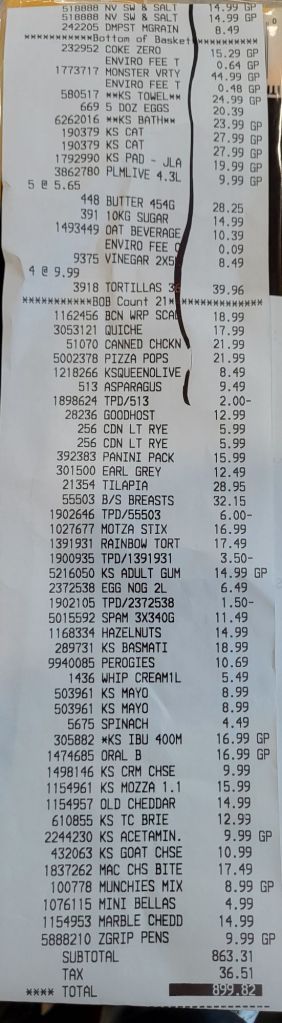
This is what $899.82 at Costco looks like.

I got a shot from each side, because so much was hidden from view.

So what did I get for almost $900

For the cats, I got two 9kg bags of kibble and a box of puppy pads. There is a case of Coke Zero for my husband and I, plus a case of energy drinks, which my daughter paid for. Also among the drinks list was a large box of Earl Grey tea and some iced tea mix. I also got some Eggnog, which was on sale, mostly for the girls, and a case of oat milk, completely for the girls.

Paper produces included toilet paper and paper towels. I probably should have got more facial tissues, but I didn’t want to take up too much space on the flat cart. I needed room for the big bag of sugar and the case of vinegar.

Also among the non-food items is some dish detergent, toothbrushes and a package of pens. I was out of normal coloured pens.

In the pharmacy section, I got both acetaminophen and ibuprofen, plus adult gummie multivitamins for my daughters.

For bread products, I got a couple of 2 pks of rye bread, four packages of tortilla warps and a 3 pack of sunflower and pumpkin seed, multigrain sliced bread.

For protein, I got a package of chicken breasts that was on sale, plus some tilapia fillets for the girls. I also got a panini pack for sandwiches, with canned chicken and pack of Spam for the pantry. There’s also a double flat of eggs (5 dozen).

In dairy, I got 5 pounds of butter, whipping cream, a 3 pack of cream cheese, mozza, Old cheddar, marble cheddar, goat cheese and a wheel of brie.

There’s also a bag of spinach and mini portabellas (aka: cremini mushrooms).

Among the jarred items, there are two big jars of mayo, olives and pickled asparagus, which was on sale. The pickled asparagus will be used, along with tortilla warps and cream cheese, to make appetizer pinwheels for our celebratory dinners.

There is a bag of Basmati rice and some hazelnuts. Oh, and a 3 pack of 4 cheese, rainbow tortellini, which was on sale.

For snacks, I got my husband a big back of Munchies Mix, and two boxes of Sweet and Salty granola bars for the four of us.

Then there are the frozen items. Along with a box of perogies and a box of Pizza Pops for quick heat and heats, we have the appetizers for our celebratory dinners. There are Mac n Cheese bites – something we’ve never tried before – mozza sticks, bacon wrapped scallops and mini quiche.

And that’s everything.

Hopefully, I won’t need to go another Costco trip until February! Or at least not until mid-January.

So it was a very productive trip, though part way through the shopping, I realized I was not doing well. I was over heating, but also getting very dehydrated. I did use their public water fountain about half way through my shopping, which helped a lot, but by the time I was standing in line to pay for the stuff, I was starting to feel dizzy and getting the shakes. I was at least getting a breeze from the giant fan above, while half taking off my coat and removing my hat, which helped.

While my items were being rung through and they were doing the stuff still on the flat cart, I dashed over to a water bottle vending machine and got one to start hydrating once back at the till. It wasn’t a large bottle, so by the time I loaded everything into the truck, I’d finished it off. I also keep water in the truck, and still had half my drink from my lunch, so I was able to continue hydrating for the ride home, and was feeling much better.

My back was also starting to give out, well before I reached the till, but that was also much better by the time I got home. An hour or so of sitting instead of walking around, wrestling the flat cart, helped a lot.

I was able to back the truck up quite close to the house, making it easier to unload. My daughter’s knee was still hurting her from her fall yesterday, but she was no longer using a cane. Once the truck was empty, I had to feed the outside cats to get them away from the truck – by then, it was starting to get dark and time to feed them, anyhow – so I could park it. Once I got back to the house, I also got some warm water to top up their bowls. The big water bowl in the sun room just had sheets of ice left in it, and the working heated water bowl in the shelter was almost dry!

The babies in the isolation shelter still had plenty of water. They got canned cat food with their morning feeding, along with the kibble. There was still kibble left in their bowl, but the wet food was long gone!

Unfortunately, as I was unloading bags to the door, I spotted Kohl digging around on the cat bed on the lower level. The little bugger had just pooped on the cat bed, instead of the littler box, right next to her!

Both of them seem much calmer now, but Kohl would not let me touch her, never mind pet her, or check her incision. I’m not too concerned about her, though. I’m more relieved the male it no longer panicking and trying to bash his way out through the wire mesh walls. They were both watching us closely, as we unloaded the truck, right near them.

When I topped up their kibble, neither tried to escape or anything like that. When I reached in to try to pet Kohl, I could feel it is nice and warm in there. I’ve been keeping the Cat Lady up to date on how they are doing, and she was very relieved to hear they are doing well. For all the effort we’re making to provide them with a safe, warm shelter during their recovery, the isolation shelter is still basically just a small box outside in the winter. She would really like to find homes for them. I told her to go ahead and share the photos I’d been sending her, and to tell people these two will be released to the yard again, after their recovery period. Hopefully, that will encourage someone to want to adopt and rescue them from the outdoors and give them an indoor forever home. It doesn’t hurt that they are both so incredibly adorable!

So, that’s my running around for today. Tomorrow, the dump is oven longer hours, and we are overdue for a trip, so I am hoping to get our garbage and recycling finally out. From there, I should be able to continue on to the feed store with the brand of kibble in 40 pound bags that the cats like better. As of right now, the high for tomorrow is expected to be 3C/37F, which makes it the ideal time to repair the wind torn vinyl around the catio. Plus, there are some tears in the vinyl around the bottom of the isolation shelter, where other cats were trying to get in. We should be able to patch those up with the extra vinyl table protectors I picked up while I was waiting for the vet to finish with the spay and neuter, yesterday.

Which means tomorrow will be another day of running around. Thankfully, I will be able to stay home on Sunday. I’ll be going to my mother’s on Monday. She has a telephone doctor’s appointment, and she wants me with her, since I help her remember things, and can understand what the doctor tells her and can spend the time to explain it to her later.

Meanwhile, I really, really glad to get this stock up shop done, even if it did get pretty expensive. This is meant to last us longer than usual, and will hopefully result in a quieter time over the holidays.

I’ve reached that stage in life where quite and boring is all I want! ๐Ÿ˜„๐Ÿ˜„

The Re-Farmer

Some evening clean up

My original plan for the day had been to go into the city for our second stock up trip, but that just didn’t happen. Not only was I very tired from being up so late making and canning the tomato paste, I was in a load of pain. Arthritis sucks at the best of times, but everything else was hurting, too!

By the afternoon, I was feeling a bit better, so I went outside to do some clean up. I figured I would give the water bowl shelter a quick scrub down, and tomorrow we could start painting it.

Ha!

That worked out well enough until I went to flip it upside down to scrub the bottom.

The first time I flipped it on its roof, two floor boards fell off.

Most of the boards are nailed in place, but this salvaged wood is pretty warped and starting to dry rot, so they don’t hold well. I did have 1 3/4 inch screws in a few of them, and those ones held, so I flipped it back again, nailed the boards that fell off back in place, then added some screws.

Then I flipped it upside down, and a different board fell off. And that one did have screws already!

I fixed that and added more screws, flipped it back and…

That board has several screws in it, and it still fell off. It’s basically too warped for the screws to hold. I need longer screws, but the next size up I’ve got are 3 inch screws, and those are just too long. Especially since I’m doing this by hand.

So tomorrow, I’ll pick up some 2 inch wood screws and get those back on. It only has to hold long enough for us to paint it. After that, it won’t matter.

I let the girls know the status of things, including that I was unable to scrub the inside back wall, because I couldn’t reach it, then moved on to something else.

I did some chop and drop around the haskap berries, now that my mother’s flowers are past their prime. I’ve never bothered to do this before, leaving the stems to clean up in the spring, but this year they got SO tall, the completely covered the haskap berries. So now they will be a mulch, and the haskap are finally getting some sunlight.

I had lots of company while I worked.

I like this baby. He spends most of his time just hanging out nearby.

We had haskap

We had no berries at all this year. The male plant bloomed, but I never saw flowers on the females. Hopefully, next year will be better, but I think I just need to move these to a better location.

While I was working on that, one of my daughters came out and worked on the water bowl shelter.

She tacked the floorboard back on, crawled in and got that back wall scrubbed.

If we’d had the paint earlier, we would have scrubbed and painted all the parts and pieces first. That would have made things much easier!

Ah, well. We’ll manage.

That tuxedo really likes the water bowl shelter. He’s always hanging around in or under it!

Once the shelter is dry, it’s going to need another brush down to get the stuff currently stuck in place because it’s damp. With the condition of the wood, we don’t want to use a hose on it any more than we absolutely have to. It’ll be good to finally have it painted and set up in its spot by the kibble house and cat shelter. We’ll be creating a sort of U shape with them, which should help reduce drifting, too.

Little by little, it’s getting done!

The Re-Farmer

Before the heat hits?

Well, I tried.

I headed outside earlier than usual, to try and get some work done before things got too hot. My goal of the day was to take the weed trimmer to where the berry bushes are. Tomorrow, I’m getting another load of cardboard and plan to lay it down around them as a weed barrier.

This is how it looked when I started.

I shoved the stick into the ground as a post to mark the end one of the rows of bushes.

Can you see the silver buffalo berry?

The row on the left, you can see the sawdust mulch around several of them, but the row on the right just disappears in the trimmed weeds and grass.

I ended up using sticks that were used to hold trellis lines last year, to mark where the saplings are. A few of them got two. They were so buried and trimmed material, I didn’t want to risk accidentally hitting them with the weed trimmer! I’ll be looking to make sure they all have at least two sticks marking each of them, when the cardboard get laid down.

From this end, the two saplings marked in the foreground are the two highbush cranberry.

It took adding one more length of extension cord, but I was able to trim around the sea buckthorn, too.

Since I had the trimmer in the area anyhow, I used it around all the trellises, the hulless pumpkin patch, and the bean tunnel.

The goal was to beat the heat, but I failed. By the time I was working on the bean tunnel, the thermometer attached to it was reading 30C/86F in the sun. Our high of the day is supposed to be 25C/77F, and we are now under a severe thunderstorm watch. When I headed out this morning, we were being warned of possible thunderstorms on the weekend, and just possible showers later today!

I kept at it, though, and was able to use the trimmer around the crabapple trees. The one I’m standing next to, to take this picture, died over the winter and will need to be cut away. There are a couple other sickly ones down the row that need to be removed, and the others need some pruning, but that will have to wait.

I’m hoping to be able to head out again with the lawn mower, set as high as it can go, to finish around the garden area. Even the lowest spot near the branch pile in the background is finally dry enough to mow.

The metal ring in the foreground was something I brought to do burns over old crabapple tree stumps that were infected with a fungal disease. It’s over a taller one that hadn’t been burned completely away. Currently, the ring is full of an ant hill!

We have SO many ants this year!

In other things, whatever happened to our phone last night was no longer an issue this morning. We can use our land line again. I did get an email response from the phone company to try disconnecting all but one phone and seeing if it was still an issue, which I’d done (there’s only 2 lines to disconnect; the extra handset for the cordless phone doesn’t connect to the land line on its charger base). I wrote back to explain that it was working again this morning.

It sounds like there is a short somewhere. Possibly due to rodent damage somewhere. I’m guessing the cause of the problem is outside the house itself. If it’s a short, we could lose our connection again, at any time. In my email response, I did include that possibility. It would require a tech to come and test the lines, though. They’d be able to do that at the pedestals at the fence lines, one of which is hidden by trees in the first two photos at the top of this post, at first. From there, they would know if they have to come to the house and test again or not.

For now, I’m just happy the phone started working again on its own!

The Re-Farmer

Watching the radar

Things are still looking pretty good out there, though the daytime temperatures are definitely on the colder side. The storm alerts remain, with snow predicted to start in the wee hours, tonight. The local “looking ahead” notification on my phone’s app now reads, “A snowstorm from late tonight into Friday afternoon with blizzard conditions tomorrow and accumulations of 40-60 cm.”

That’s 16-24 inches. Yesterday, the high end of the local prediction was up to 45cm/18in.

The main alert has changed a bit. I no longer see the warning for up to 80cm/31in in some areas.


Winter Storm Warning

Issued at 04:27 Tuesday 12 April 2022

Hazardous winter conditions are expected.

Major spring storm poised to wallop southern Manitoba beginning overnight Tuesday into Wednesday morning and lasting until Friday morning. Widespread snowfall accumulations of 30-50 cm accompanied by northerly winds gusting 60-70 km/h giving zero visibility at times in snow and blowing snow.

A Colorado low will move towards Minnesota Tuesday night bringing a heavy swath of snow through most of southern Manitoba. The snow will start early Tuesday evening near the International border then push northward throughout the night. By Wednesday morning heavy snow will be falling in much of the area as the storm continues to push northward. Strong northerly winds will develop with this system and persist into Friday morning as the low slowly pivots through Minnesota on it’s way into northwestern Ontario.

For the City of Winnipeg and points southeastward, a break in the snow may occur on Wednesday afternoon or evening before snow re-intensifies overnight into Thursday. 15 to 20 cm is likely by Wednesday afternoon, with a further 15 to 20 cm likely with the second area of snow overnight Wednesday through Thursday and Thursday night.

By Friday morning, widespread snowfall accumulations of 30 to 40 cm are likely.

Travel will become increasingly difficult as the day progresses Wednesday, with widespread highway closures a near-certainty. By Wednesday evening even travel within communities may become impossible as the heavy snow and strong winds continue… and more of the same is expected on Thursday.

Do not plan to travel – this storm has the potential to be the worst blizzard in decades. Stock up on needed supplies and medications now. Power outages are likely, rural areas in particular should be prepared for extended outages.

Conditions should begin to improve on Friday as the winds taper off and the heaviest snow moves into northern Ontario…although the clean-up after this storm will likely last well into next week.

###

Rapidly accumulating snow will make travel difficult. There may be a significant impact on rush hour traffic in urban areas. Heavy snowfall accumulation combined with strong winds may cause damage to trees or other structures. Poor weather conditions may contribute to transportation delays.

Winter storm warnings are issued when multiple types of severe winter weather are expected to occur together.


As I write this, the main body of the system is over North Dakota as mostly snow, shifting to mostly rain across Minnesota. Though the system is being pushed almost straight North, it’s going East enough that it looks like the most severe weather will pass over the southern border where Manitoba and Ontario meet, with the rain in Minnesota turning to snow quickly, as it heads into Ontario. The system is very wide, from East to West, but it’s now looking like Saskatchewan is going to be spared the worst of it. My nephew and his family are still thinking of making the drive out, but a day later than originally planned.

We’ll see how things actually turn out.

Until then, things continue as usual.

Ghost Baby has been coming out every morning, of late, and not being a ghost at all. My guess is that it’s because she’s pregnant and very hungry.

Just look at those silly kitties, crowding around the one tray on the ground, when there are four other trays inside the kibble house! Altogether, I saw 14 kitties this morning.

While switching out the memory card on the sign cam, I was finally able to find something – it just had to wait for more snow to melt, and the leaf litter to dry before I could see it.

This is one of the closures from the trail cam. I’d been able to find the wire latch, but the black plastic leaver with the hinge were too dark to see on dark wet ground.

Of course, it’s the top latch that broke. The bottom latch is still intact and should be enough to keep the camera closed enough for the weather seal to keep working, but with this latch broken, there is more of a possibility that moisture will get in.

There are a lot of things I like about this camera, but it has one major failing. I cannot handle our cold. When the temperatures drop, the LED screen stops working, and I have to warm it up with my hands to be able to see the settings while changing the micro disc card. Any colder, and it simply stops recording and the batteries freeze. At least it does start working again on its own, when the batteries warm up again. And now I find the plastic becomes more brittle due to the cold, too. At least I hope it’s due to the cold. Otherwise, it’s just cheap plastic.

Ah, well. Live and learn.

I would still recommend this camera is you live somewhere with warmer winters than what we get. For most of Canada, however, I’d say don’t bother. There are other brands with the features this one has that I like. They cost a lot more, but you get what you pay for!

Meanwhile…

We are still working on our Easter preparations. I don’t know if I’ll be able to go to the blessing of the baskets on Saturday, but we’re still making it. This year, we’re doing the eggs differently. Instead of dying them in the shell, we’re doing different types and colours of pickled eggs. Right now, we’ve got pink pickled eggs in the fridge, using the brine from our out pickled beets. We’re also going to do a soy sauce brine for brown, and turmeric brine for yellow. I boiled up a whole bunch of eggs already, and finished peeling the last of them this morning. We have just enough mostly-undamaged eggs to do 6 of each type of pickle… and a bunch of ugly ones for egg salad. :-D After that, the only thing we have left to do is bake our fancy Easter bread. :-)

Easter has always been my favourite Holy Day, and our basket tradition the one I’ve always looked forward to the most!

The Re-Farmer

Getting stuff done outside

Though today has gotten a bit colder than yesterday, at -15C/5F, it’s a lot calmer out there, and bright and sunny. We are actually reading a wind chill of -21C/-6F, but the wind is from the north, and we are well sheltered in that direction.

Which means I got more done outside!

Of course, feeding the critters was top of the list.

I counted 18 this morning. I did not see Ghost Baby, and I think Junk Pile is the other “missing” cat. I was quite happy to see both Butterscotch and Nosencrantz this morning.

Nosencrantz doesn’t look too happy to see me, though! :-D She’s all “stop petting me, and taking my picture. I’m trying to eat!”

I was able to do a burn this morning, scrape the sidewalk clear, and dig out some of the blown over paths.

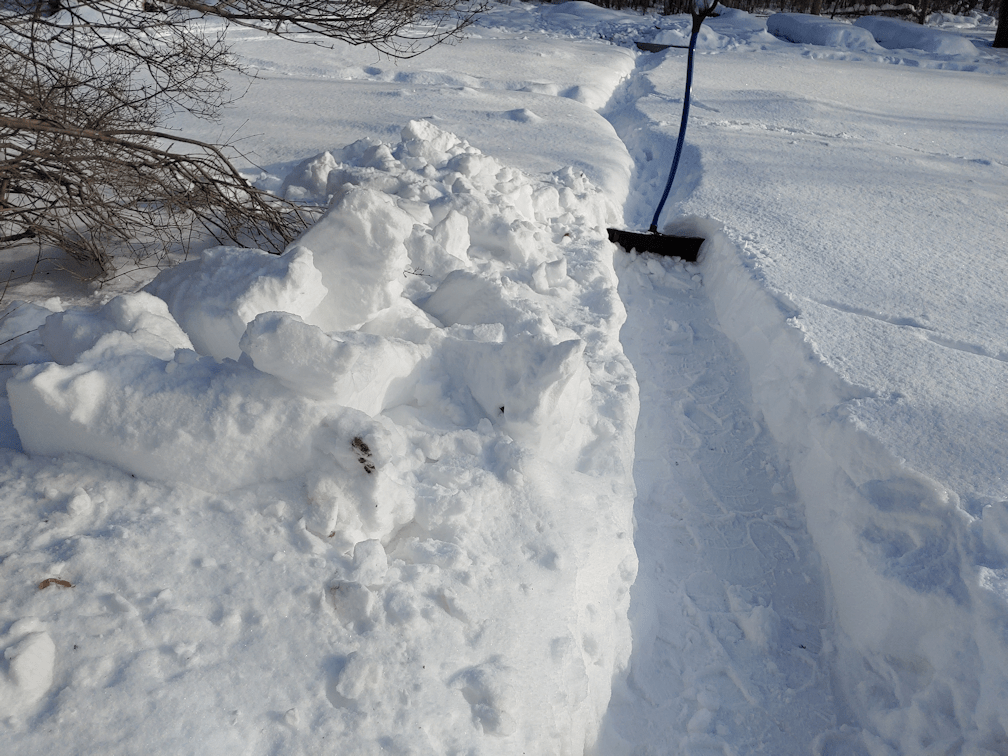
Though we didn’t get much snow, the blowing winds made a big difference. I was lifting out solid chunks of snow. I actually took advantage of that while shoveling around the burn barrel, to make a higher “wall” around it. This is snow fort building snow! :-D

The path to the compost was so solid, I ended up having to bring the ice scraper to break it up before I could use the shovel. Because of the wind direction, the path from the compost ring to the back door of the garage was almost clear, and the shelter of the garage kept the path to the outhouse from getting drifted over.

We’re supposed to get snow starting tomorrow evening. I’m now seeing snowfall warnings of 20-35cm (8-14 inches), however they are mostly for the south and eastern parts of the province. We shouldn’t get anywhere near as much, where we are. Local forecast is currently for 5-10cm (2-4 inches).

So if there’s anything we need to get in town, just in case, now is the time to do it!

Well. Maybe after we’ve shoveled the end of the driveway again.

The Re-Farmer

So you want to grow a “survival garden”

For at least a decade, there has been an increase in people who have decided to move out of the cities, get themselves an acreage, and live as self-sufficiently as possible.

Which is basically, how I grew up.

Things have really changed, though, and modern homesteaders have a lot more resources, options and choices than was available when I was a kid, 50 years ago, never mind what our pioneers had. I found this very encouraging to see.

Photo by Greta Hoffman on Pexels.com

A couple of decades ago, while part of an online homeschooling support group – pre-social media, when everything was by email (and dinosaurs roamed the earth) – I often saw people waxing poetic about how we all need to go “back to the land”, and live these organic, subsistence lives, and all our food would be free and we would barter for everything else, and so on. It had a lot more to do with ideology than anything else. Going back to the farm was a dream of mine since I moved away in my late teens, so I could appreciate many of the sentiments they expressed. Unfortunately, this romanticized view was wildly unrealistic, and I found myself trying to remind people that there are reasons people, including farmers, moved away from that life.

Most of them didn’t get it.

Once we moved to the farm, 4 years ago, in a caretaker role, how things were done when I was a kid just wasn’t an option, and I’m quite okay with that. Most of the land is rented out, so we just have our corner to work on. My mother had a massive garden that had been slowly neglected for many years, as my parents retired from farming and age reduced their mobility, no matter how much my siblings tried to help. We can finally work on our dream to be as self-sufficient as possible, but we have to do a lot of things differently than how we did it when I was a kid.

It was in researching this that I found this dynamic and growing homesteading community. These were people who may have gone in starry eyed, but were also realistic and determined, and they were making it work. The aging hippies I couldn’t get through to all those years ago, with their ideological blinders, could never have done what these awesome people were doing. It was very exciting!

Then, the last couple of years happened.

As people saw their jobs disappearing, their livelihoods destroyed, prices skyrocketing, and government restrictions stifling people’s ability to do some of the most basic things, a lot of people are suddenly having real concerns about being able to feed themselves and their families.

During WWII, governments actively encouraged families to grow Victory Gardens, and even gave out information and resources to help people do it. That sort of thing isn’t happening now. Instead, we are having to rely on each other to figure out how to grow what, for too many people, are literally survival gardens.

Whatever your reasons for wanting to start growing as much food for yourself as you can, I heartily encourage you! You won’t get any sermons or lectures from me. I do hope that I can, at the very least, provide some information and inspiration.

Start where you’re at

Your circumstances are going to be unique to you. If you’re already on an acreage, great. If all you’ve got to work with is a hall closet and some makeshift grow lights, great. You can start where you’re at, even if it’s just poking some holes in a bag of potting soil to grow some greens in a sunny window. Little by little, it’ll get done!

What I will be sharing here is going to be geared mostly to people living in colder climates – and by that, I meant Zone 2 or 3 (depending on what Canadian zone maps are being used, we live in either 3a or 2b).

I will add one thing I’ve heard quite a number of very experienced, prolific gardeners say. If they had to depend on their gardens for survival, they’d starve! It takes a lot to grow enough food to actually provide enough for even one person to last from preservation to the next year’s harvest, and it will still need to be supplemented with other things. I’m still somewhat amused and perplexed by my mother trying to lure us out here by saying we could grow a garden and not have to buy groceries anymore. Even as big as her garden was, plus having chickens and cows, sometimes pigs, turkeys and geese, a root cellar and lots of canning and freezing, we still had to buy groceries.

So you’re still going to need to buy stuff. Hopefully, just a lot less!

With that in mind, as you plan what to grow in your own personal survival garden, here are some things to consider when making decisions.

Grow what you will eat.

I’ve looked at so many lists out there, for things like what to grow to feed a family for a year, or what to grow in your climate, and so on, and frankly, a lot of stuff on those lists are foods I just don’t like. Others, I can’t eat. There are four of us in our household, and we have very different tastes. Which means that our focus will be more on growing things all of us enjoy eating, then including smaller amounts of things only one or two of us like to eat. As wonderful and appetizing as I find tomatoes and bell peppers, they both make gag, but two people in our household enjoy eating them, and all of us can eat processed tomatoes. Now, those two people REALLY like their tomatoes, so growing more of those than peppers for fresh eating makes sense, as well as growing a lot of tomatoes that are good for making tomato paste to last us for months. It’s a sort of juggling game.

Try new things

What we find in the grocery stores is there because those varieties can handle large scale growing and transportation. When you’re growing your own, you can have a lot more choices. This is a time to grow new varieties of things you know you like, and if you have the space and resources for it, grow something you’ve always wanted to try, but couldn’t for one reason or another. Which kinda ties in with my next point to consider.

Grow at least one thing for fun

Yes, growing food to ensure your family has something to eat when times are tough is serious business. The whole point of the list I’ll be presenting to you is to be able to get as much bang for your buck as you can. At the same time, growing something just for fun is a great morale booster. As you go through what various seed companies and nurseries have to offer, you’re bound to find something that just puts a smile on your face. If you have the space and resources for it, go for it!

Keep in mind your region, climate and particular circumstances.

While the zone maps are very handy, that doesn’t mean there aren’t exceptions. There are things my mother successfully grew in our Zone 3 that were rated at Zone 5. She didn’t even doing anything different for them, either! This is a good time to find and get involved with a community of people in your region and zone, online or off, to learn from. If you are growing outdoors, look at what is rated for your zone, but also consider whether you can create microclimates. If you have only a balcony or patio, there are lots of places where you can learn about container gardening or vertical gardening. If you are growing indoors, there are resources geared specifically for that.

Storage and preservation

If you’re growing food to feed your family, and trying to grow as much as possible in your space, it’s not going to be much good if you grow more than you can eat, but can’t preserve it! There are many options available; freezing, dehydrating, water bath canning, pressure canning and even freeze drying, if you can afford the machine! You might even be able to create a root cellar in some corner of your home. Refrigerator pickling and fermenting are options, if you don’t have canning equipment.

If you’re going to store and preserve food, you’ll need somewhere to put it. What methods you have available to save your food will help you decide what makes the most sense for you to grow.

Things will go wrong. Do it anyway

One thing that is going to happen is, there will be failures at some point. It’s inevitable. Sometimes, you’ll make a mistake. Sometimes, there will be circumstances completely out of your control. It happens. The beauty is, you can still fail “up”. Honestly, you’ll probably learn more from the failures than the successes! Of course, it’s always a good idea to learn from others as much as you can to avoid failures, but it’s still going to happen. Since being here at the farm for 4 years, and only gardening for 2, we knew we were trying to grow in far from ideal conditions, and had some setbacks, yet we still managed to have food from our own garden that we could enjoy.

When it came to making a list of things that might work well in a survival garden, I looked for things that could be grown in colder climates, had high yields, and could be stored or preserved, while also keeping time in mind. So let’s start with the fastest growing things, first!

Super-short term

Photo by Zdenek Rosenthaler on Pexels.com

There are quite a few things that can go from seed to plate in less than a month. Some in less than 10 days! Micro-greens and sprouts can be grown very quickly, can be grown indoors in trays or jars, continually throughout the year. Many seed companies now has sections for sprouts, and quite a variety of things can be grown for their sprouts. Many sprouts can be grown in jars – alfalfa, mung beans, lentils, radishes, and more. Gelatinous seeds, such as flax, chia, cress, arugula and psyllium, can be sprouted in trays. For microgreens, you can try beets, swiss chard, broccoli, cress, peas, radishes and sunflowers.

If you want to give things a bit more time, leafy greens such as pretty much any type of leaf lettuce, spinach, chard, kale, bok choi and radishes can be grown and harvested very quickly. Many of these don’t like heat much, so they can be planted outdoors early in the spring and sowed successively until the heat of summer, then sowed again for a fall crop.

These quick growing plants are nutritional power houses, but they don’t have a lot of calories. They’re not going to keep anyone going for long, so it’s good to think of these as a supplement, and something that can provide nutrition until other foods can be harvested.

Short term

By “short term”, I am talking about the things we typically think of in our annual vegetable gardens. These are things that can take a few months before you can start harvesting anything, and can potentially keep feeding you and your family throughout the winter, with proper storage and preservation.

Root vegetables: carrots, parsnips, beets, radish bulbs, turnips, rutabagas… there are many to choose from, and many varieties of each! Stored properly, they can last for months on their own, but they can also be pickled, pressure canned, frozen, and dehydrated. With these, they are one seed, one plant (except beets; their seeds are actually clusters of seeds), but they produce so many seeds, most packets will provide more than needed for a typical household.

Bulbs and tubers: potatoes, sunchokes/Jerusalem artichokes, sweet potatoes – yes, there is a cold hardy variety of sweet potatoes out there! – bulb fennel, celeriac and more.

There are many varieties of potatoes, some more prolific than others, and some better for storage than others. A good source of seed potatoes will give that information. Potatoes also come in determinate and indeterminate varieties. Indeterminates are good for potato bags and towers, while determinate are good for hilling or Ruth Stout growing methods. Sunchokes will grow in just about any type of soil, and can be so prolific, they are sometimes considered invasive.

Special mention: the alliums are excellent bulbs to grow, but tend to require a lot more time, unless you are starting onions and shallots from sets, or spring garlic. Hard neck garlic needs to be planted in the fall, while onions and shallots from seed – which gives a lot more choice in varieties – need to be started indoors very early. In my garden groups, I’ve found Zone 3 gardeners that start their onions from seed as early as January! Onions also come in long day and short day varieties. If you are in a northern Zone, look for long day varieties. Of course, some varieties store longer than others but, properly cured and stored, they can last a very long time! Onion greens can be eaten as the bulbs mature, and hard neck garlic produces scapes that need to be removed to produce bigger bulbs, and they are delicious, making them dual crops to grow.

Summer squash and zucchini: There are many varieties of summer squash, and they all tend to be quite prolific. Just a couple of plants can provide plenty of baby squash that mature fairly quickly, and if they are left to grow larger, some varieties can be stuffed and baked. Most summer squash start to get tough as they get larger, and are not a storage vegetable, but they can be pickled, canned, frozen and dehydrated. Zucchini is a bit of an exception, in that it can be used as both a summer squash while small, or a winter squash if allowed to grow to full size.

Winter squash and pumpkins: These are squash that can grow to sometimes colossal sizes, but there are also varieties that are small, fast maturing and very prolific. Once they reach maturity, the fruits are cured and can be stored for the winter months. Some varieties reach their best flavour after weeks or months in storage. They can also be frozen, canned, shredded and dehydrated.

Legumes: there are few vegetables out there that provide more bang for your buck than legumes! Especially beans. Bush beans can be grown for their pods, and when they’re done producing is about when pole beans are ready for harvesting, and of course there are shelling beans, which are grown for their fully mature and dry seeds. Peas, chick peas and lentils can also provide a lot of food from just a few plants. Dried legumes, stored properly, can last for years, making them one of the most efficient foods to grow.

We could fit about a hundred of these tiny Spoon tomatoes into a single Red Solo cup.

Tomatoes: tomatoes are a fruit that deserve their own category. The varieties available is staggering! However, if you are looking to get the most pounds per plant, look at growing a mid sized variety. Aside from fresh eating, they can be frozen, canned or dehydrated on their own, or be used as an ingredient for sauces and salsas, and so much more.

Cucumbers: As with tomatoes, there are a really amazing number of cucumber varieties available, but most fall into one of two categories; slicers, for fresh eating, and picklers, for preserving. They all tend to be fast growing and very prolific, too.

Peppers: I wasn’t sure about including peppers on this list. They are excellent producers, but growing them in our colder climate seems to be touch and go. I’ve heard from people who have had great success with them, while others have tried for many years, but have never had a harvest. Peppers can be canned, preserved in oil, frozen, dehydrated, pickled and made into relishes.

Photo by PhotoMIX Company on Pexels.com

Mid term

While being able to grow food quickly is important, it is also useful to consider the long haul. If you have the space for it, there are things that may take several years before they begin producing, but once they do, the harvests will be bounteous!

Asparagus: asparagus can be grown from seed or you can buy crowns to transplant into trenches. It can take three years before they can be harvested, and even then, for the first year or two, harvests should be minimal. Once they are established, however, asparagus will keep producing for up to 20 years!

Raspberries, currants, gooseberries and haskaps: Haskaps are the new berries on the block, and are exceptionally cold hardy. They require male and female plants to produce, and can potentially begin producing berries in their first year. Raspberries are available as regular cane (new canes produce berries in their second year, then die back) or primal cane (new canes produce berries in their first year). Choosing varieties that mature at different times can give you fresh berries for months. Currants and gooseberries, once established, can produce fruit for many years. Berry bushes can provide a great deal of fruit per plant. Along with being used fresh, frozen or dehydrated, as well as made into jams and jellies, they can be used to make vinegars, syrups and wines.

Grapes: yes, there are Zone 3 grape varieties. I’ve even seen a Zone 2 variety. Grape vines are very long lived, and have the potential to provide fresh and frozen fruit, jelly, and wines for many years.

Hedge bushes and trees: There are a number of larger berry bushes that can double as shelter belts and natural boarders. Some, like sea buckthorn and bison berry, do well in poor soils, and while they may be considered invasive in warmer climates, they tend not to be, in our Zone 3. The Rugosa rose produces large edible hips, and their flower petals are edible, too. Saskatoons are a more of a tree than a bush, and absolutely delicious. Chokecherries produce many berries, but are better used in syrups, vinegars, etc. than eaten fresh. Many of these will provide enough berries not only for your own use, but for birds as well!

Photo by PhotoMIX Company on Pexels.com

Long Term

Now we’re really going for the long haul! Here, we are looking at things that can take five or ten years before they start producing food – but once they do, they will continue for decades to come.

Fruit trees: there are a remarkable number of fruit trees that can grow in colder zones. Apples, pears, apricots, cherries and plums can all be grown here. While a single mature tree can provide enough fruit for the entire family, many need to be planted with a pollinator, which can be a different variety.

Nut trees: there are not a lot of nut trees that can grow in Zone 3, but some, like the Korean Pine, are hardy to Zone 2! Hazelberts and beaked hazelnuts are also very hardy. Others, such as the black walnut, can grow in Zone 3, but the nuts may not have enough for a growing season to fully mature.


Okay, so all this is a lot more than just a “survival” garden, but we all start somewhere, right? :-) Little by little, it’ll get done!

I hope you find these useful in working out what are the best things for you to start growing in your own particular situation.

For those who have already been doing this for a while, please feel free to leave a comment, sharing your own experiences. What worked best for you? What didn’t work? Is there anything you would tell someone who is just starting out now? Let us know!

The Re-Farmer