It’s a good thing we started so many squashes, and ended up transplanting them as such different times. The ones that sprouted later and got transplanted later got missed by that last frost of the season, and have been quite prolific. A couple of frost damaged ones in the first bed, both zucchini, recovered enough that they got quite large and are producing green and yellow zucchini for us.
Others…
They’re still working in it.
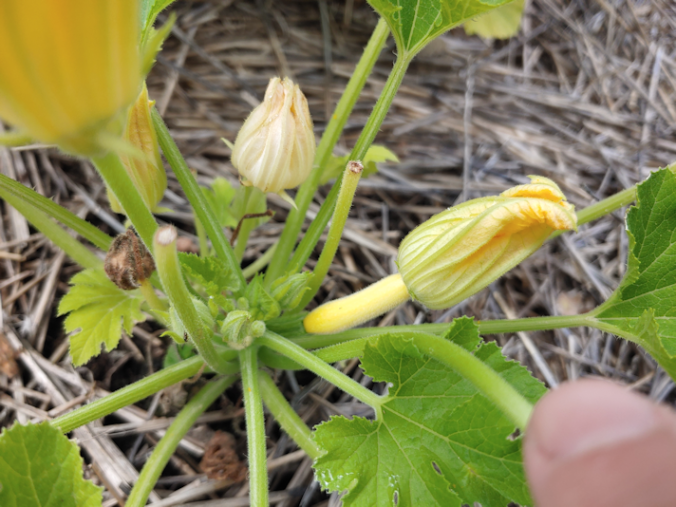
Some have started bravely blooming, putting out flowers bigger than their leaves!
With the tiniest of yellow zucchini!
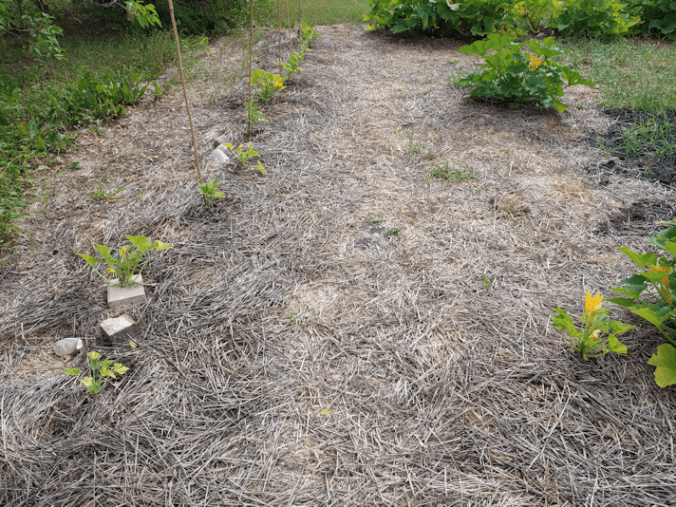
I finally remembered to get a picture of the back row. The plants with the bamboo poles marking them are all ones I have been able to confirm as the birdhouse gourds. I put bricks or rocks under some of them, to support the weight of where the leaves are growing out, as the stems are a bit long and gangly.
You can see a pumpkin mound to the right of centre in the background, and way at the far end are the squashes from the second planting that have done so well.
While there were very few squash to collect this morning, there are so many new flowers right now, and lots of pollinators, so I am expecting a second wave of squash to harvest, soon.
I am looking forward to having enough to make more of the quick pickles!
Last night, a massive storm system passed over us. In parts of the province, there were tornado warnings.
Here, we had rain.
Finally.
It started to rain somewhere around 2am, and didn’t stop until about 7am, and we might still get more, later.
For all the watering of the gardens we’ve been trying to keep up on, it couldn’t match last night’s deep soak, and it really showed!
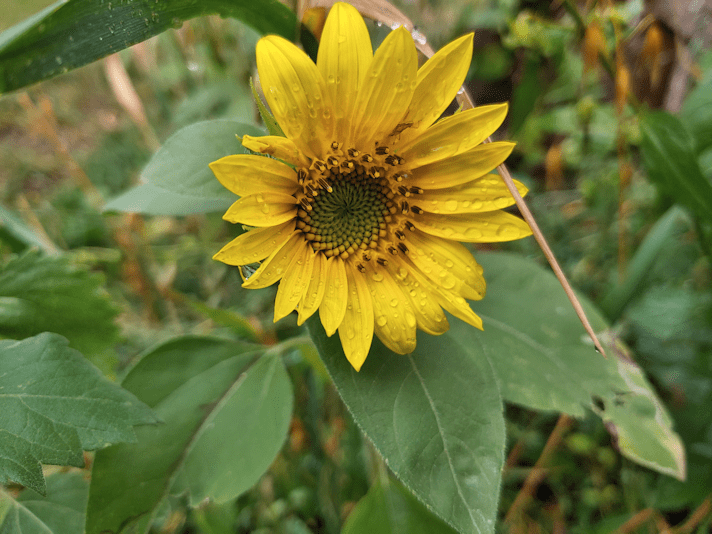
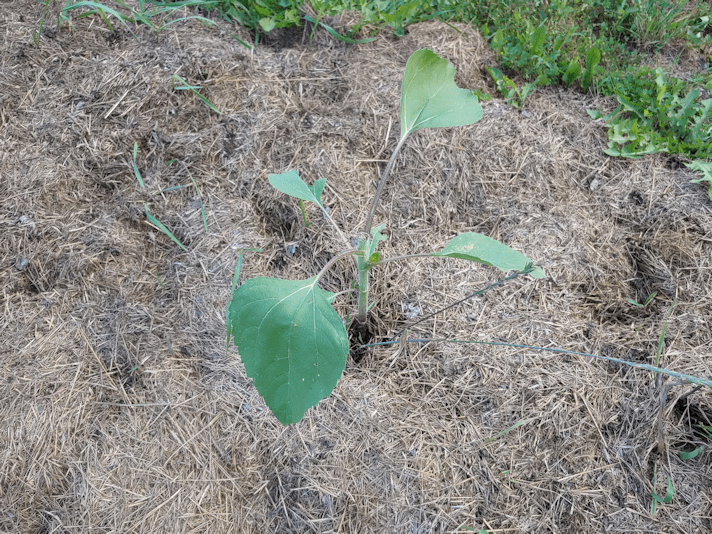
We now have several of the self-sown, tiny sunflowers under the platform bird feeder with seed heads opening up.
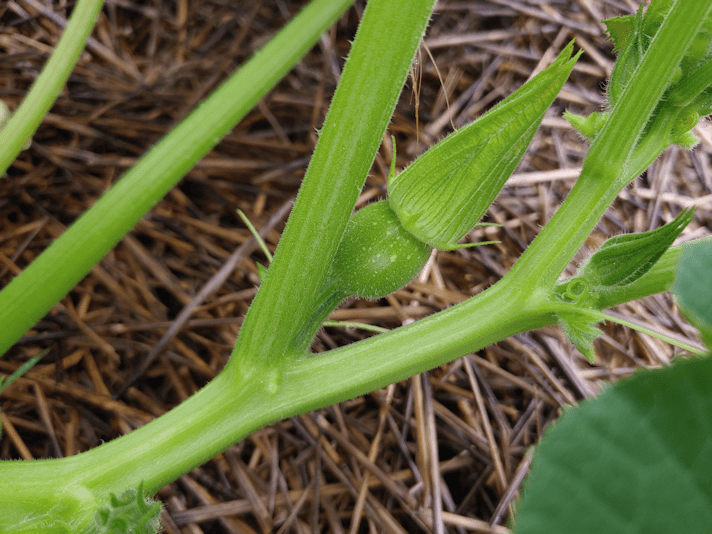
The pumpkins had been starting to bloom for a while, but I was only seeing the odd male blossom here and there. This morning, there was an explosion of flowers and new buds, and…
Our very first baby pumpkin.
This is on one of the first pumpkin plants that sprouted. I found a second one, on the mound that took so long to sprout one of the 5 seeds planted in it, that I had begun to think none would come up there.
We’ll keep an eye on them to see how many more begin to develop, then select one or two on each plant to keep growing. It’s still highly unlikely they will have a chance to fully ripen, but who knows; we might have a long and mild fall this year.
The big sunflowers have been pretty remarkable.
More and more seed heads are developing, which I would expect with these ones that are well above my head.
There are others that are quite a surprise.
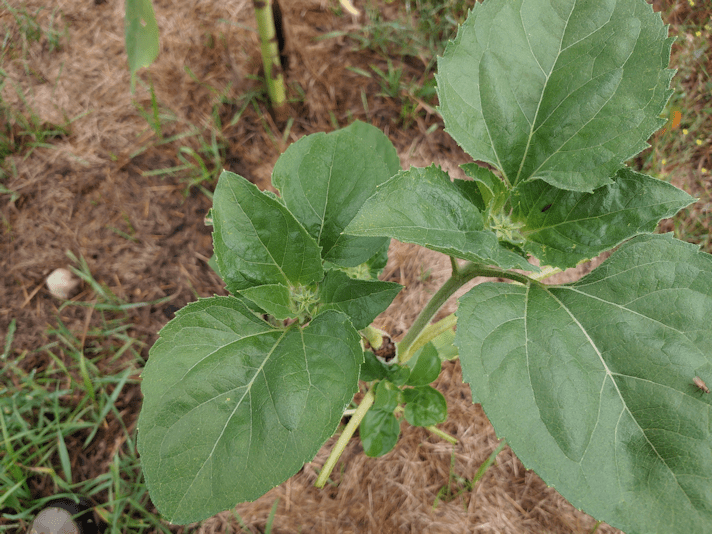
This is one of the deer damaged sunflowers. You can see the dark spot in the middle, where the original top of the plant had been eaten off. Two branches have now developed into stems, and have their own tiny seed heads starting to develop among the new leaves.
Which is impressive, but this next one shows resilience at a whole new level!
You can see, lower down, where the original top had been eaten off. Of the two new stems that developed has also lost it’s top, and basically all the leaves have been eaten off – and yet there it is! A seed head, developing among the tiny cluster of new leaves.
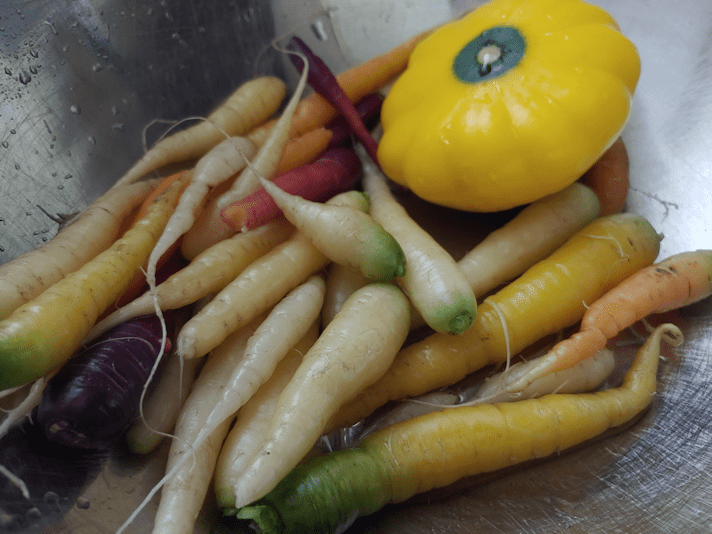
Zucchini and sunburst squash I gathered this morning.
Yesterday, I made a sort of hash, first browning potatoes, cubed small, in butter, then adding leek and frying until softened. I cubed sunburst squash, a green zucchini and a grey squash (the lighter coloured, kinda striped, kind of zucchini; our grocery stores label them as grey squash). Once those were cooked until soft, I added seasonings and maybe half a cup of whipping cream. It turned out awesome!
I’m out of cream, though, so I think I’ll just pan fry them in butter with leek.
I realized I’ve neglected to take progress photos of some of our garden beds, so I got a few this morning.
Here are our two potato beds.
I was shooting blind, because my phone’s screen went completely black in the sunlight. Still, you can see the potatoes among the mulch, separated by a path of grass. Some have bloomed and the plants are starting to die back. We could probably harvest baby potatoes now, if we felt like digging under the layer of straw. I’ve never grown potatoes this way, so it should be interesting to see how they did.
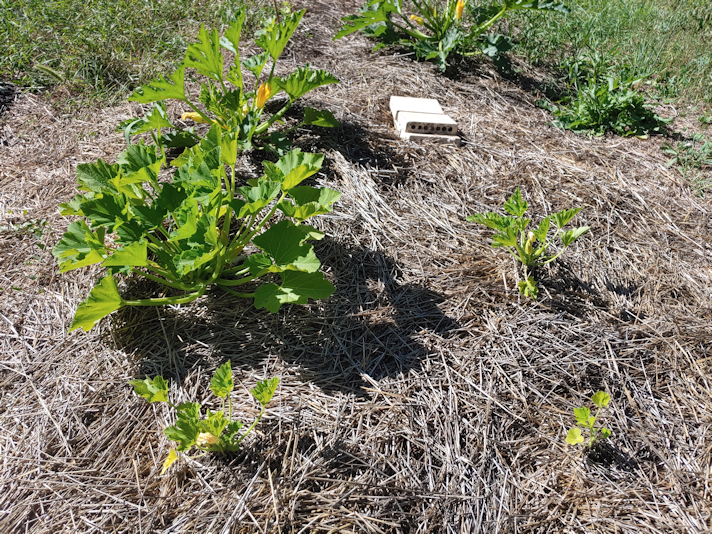
This next photo is the second squash bed.
I just happened to catch a locust flying by in the picture!
We are currently inundated with grasshoppers and locusts right now. Hopefully, they won’t eat up too many of our vegetable plants.
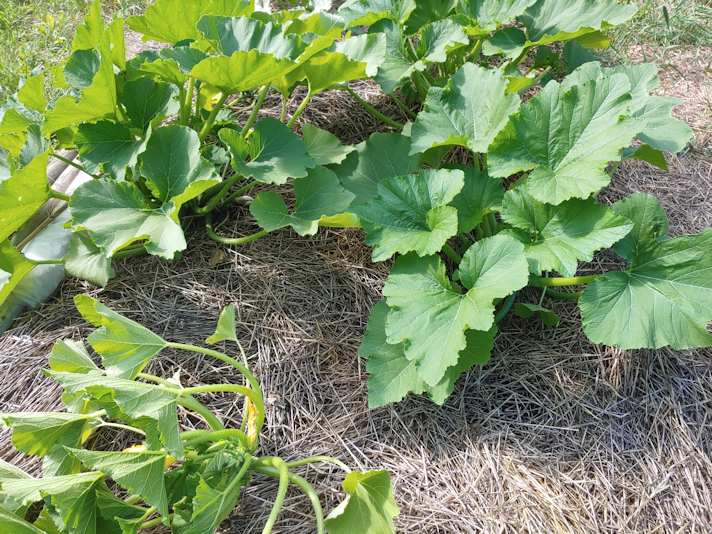
This second bed is the one we planted the day after we were hit with one last frost. The sunburst squash are huge, with many flowers and many little squashes. The mixed summer squash has a couple of plants that are doing well. Interestingly, it seems that plants on the south end of the bed are struggling more than the ones at the north end, rather than any particular type of squash having a more difficult time.
Here is the first bed that got planted.
These are the ones that got frost damaged, even though we had covered them for the night. Some died completely, but a surprising number have managed to survive – with some downright thriving!
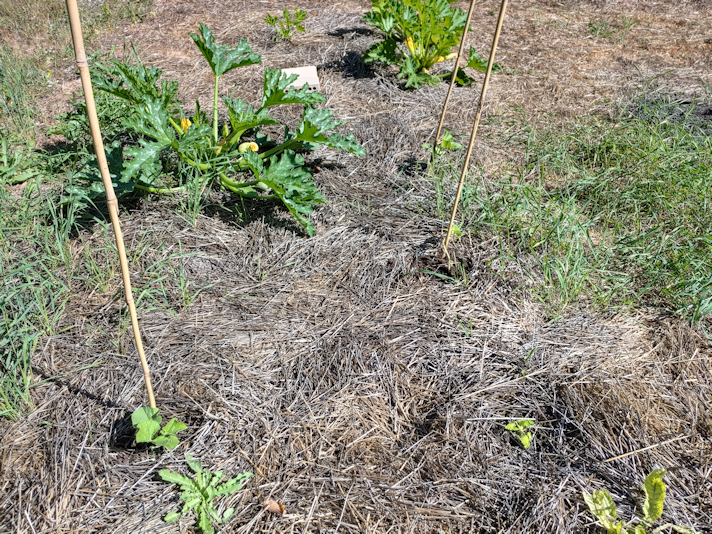
This picture is the same bed, from the other end.
The transplants had died at this end, so when some gourds in the seed tray actually germinated, I transplanted them here. Three of them are marked with bamboo poles. Much to my surprise, the one that got dug up by a skunk digging for grubs is surviving. Given how late they germinated and got transplanted, I’m not actually expecting much from them at all, but it will be interesting to see how much the manage to grow.
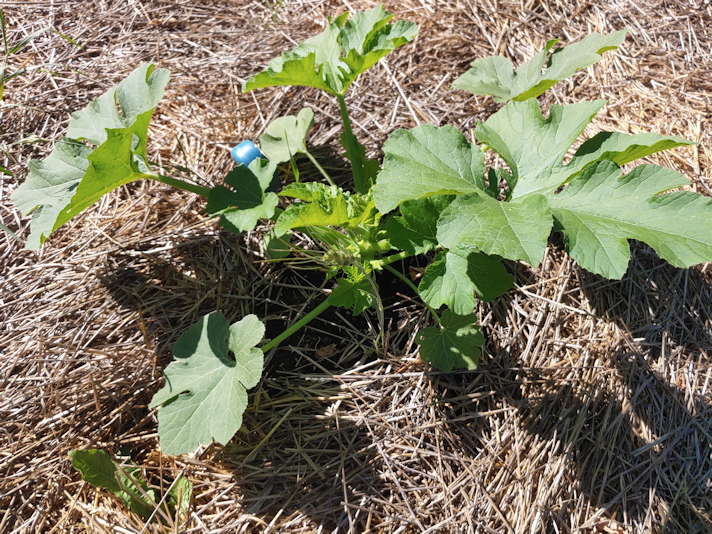
Then there are the pumpkins.
These were from seeds that were being given away for free at the grocery store near my mother. I had taken one (it even had a sign asking people to take only one), and then my mother gave me two more. Clearly, she didn’t read the sign, because she still had a pack she kept for herself and planted in her own little garden plot that she has this year!
The pumpkin in the above photo is the one from a pack that had 5 seeds in it (the others had 3 seeds). This is the only one of the 5 that germinated, and it came up much later than the ones that germinated in the other two mounds. One mound had 2 seeds germinate.
In spite of such late germination, this one is probably the biggest of the bunch.
It is also the Northernmost mound.
When we started planting here, I’d made a point of planting in the Northern 2/3rds of the area we had mulched. The south side of the area has a lot more shade from the spruces my parents had added to the north side of the maple grove. I didn’t even try planting at that end for that reason. The middle third of the area still gets a lot of sun, but the north third gets basically no shade at all, at any time of the day.
I think that might actually be why I’m seeing differences within the same beds of squash, and the pumpkin mounds.
Something to keep in mind for any future planting in here!
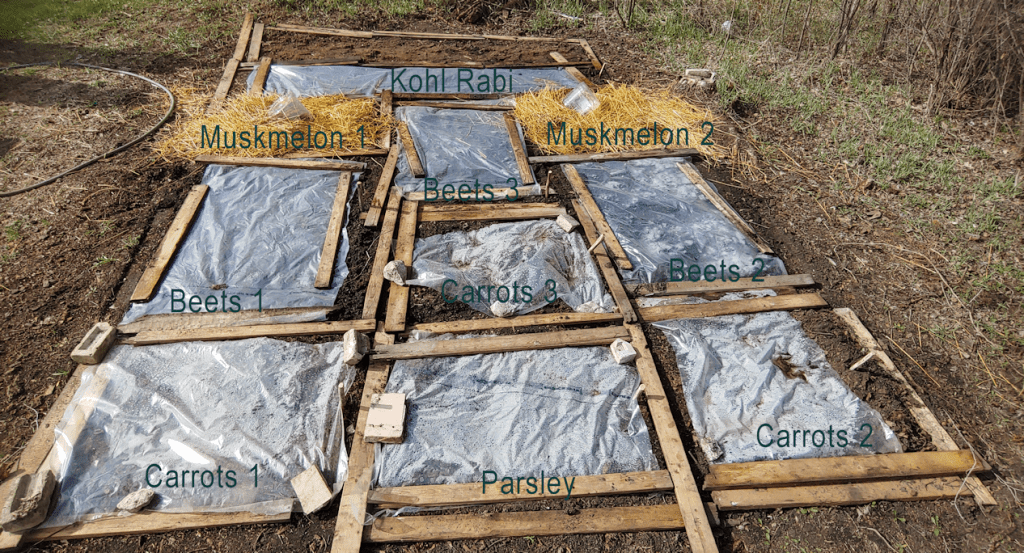
Then there are the beds we made where the old wood pile used to be.
The beets we got were a collection with Merlin (a dark red), Boldor (golden yellow), and Chioggia (alternating rings of purple and white)
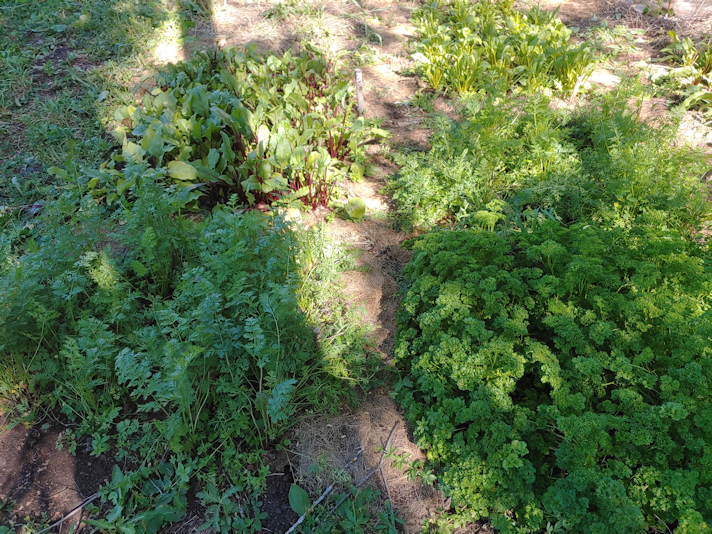
In the foreground, you can see the parsley bed in both photos. It is doing very well. To the left of the parsley bed are the deep purple carrots, with white satin carrots on the right. The carrots could be doing better, but overall, they’re okay.
In the midground of the photos, there is a bed of rainbow carrots above the parsley bed, and beets on either side . Another bed of beets is in the background, beyond the rainbow carrots.
I don’t know how well you can tell in the photos, but there are not a lot of beet greens. The deer have really done a number on them. :-( We should still have some to harvest, though.
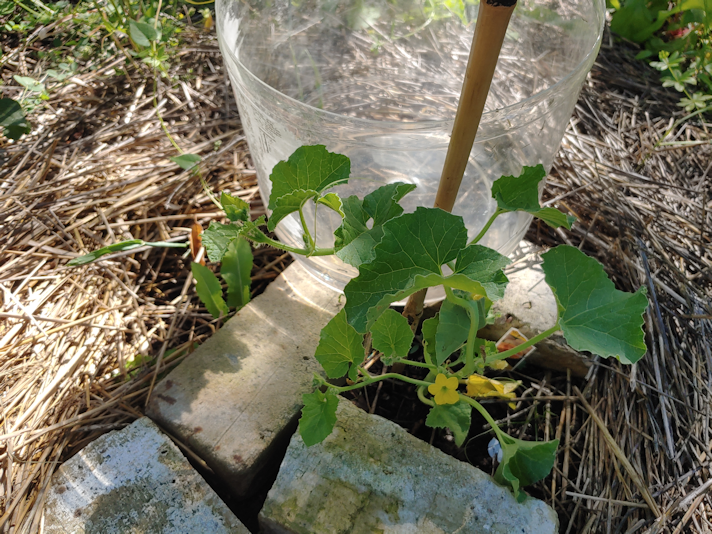
Of the two muskmelon we bought to transplant, one died. This is the survivor.
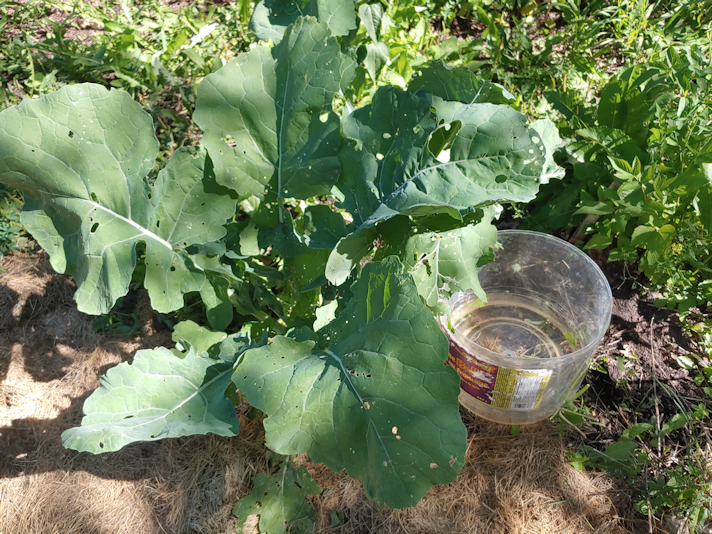
We planted a lot of kohl rabi, but this is all we have that came up and survived.
The large leaves that you are seeing are from 2 plants.
Yup. Out of all that we planted, only 2 survived.
Actually, there had been four.
It turns out that deer like kohl rabi, too. You can’t even see the second one that was nearby; it, too, was reduced to a spindly stem!
In case you are wondering about the plastic containers…
Those are what I used as cloches to cover the muskmelon overnight, to protect them from colder temperatures after transplanting. The containers used to hold Cheese Balls that we got at Costco. I just cut the tops off, then drilled holes around near the bases for air circulation.
I now have them set up near the surviving muskmelon and the kohl rabi. When watering the garden beds, I fill those with water. The water slowly drains out the holes I’d made for air circulation, giving a very thorough watering to the plants. The first time I’d tried this was with the muskmelon, which was pretty small and spindly. The next morning, it had grown noticeably bigger and stronger! So I put the second one by the struggling kohl rabi, and the difference the next day was just as dramatic.
Until the deer ate the two littlest ones.
This worked so well, I’m trying to think of ways to use other cloches we have, most made from 5 gallon water jugs I’d bought for the fish tank, to set up near some of the more struggling squashes.
This morning is the first time I’ve harvested some of the parsley, along with a few carrots. What I don’t use right away will be set up to dry. Which is what will happen with most of the parsley we planted, as we tend not to use fresh parsley all that much.
And now I’m going to stop struggling with our nasty internet connection, which really doesn’t like inserting photos right now, and start on the scalloped potatoes I have planned for supper. I think I’ll find a way to layer some carrots in with the potatoes, too! :-)
As we work on clearing, cleaning and reclaiming the yard and planting our first garden beds, I’ve been keeping a close eye on details to keep in mind for the future. Things that will help us decide what needs to be done next, what to change or what to keep the same.
This morning, I found myself making a lot of comparisons.
The cutest one is the cucamelons.
This is the largest one that is developing, with my fingers giving an idea of just show small these are!
Isn’t that just the cutest thing? :-D This is the first one big enough to start seeing the patterns developing.
The trellis I made for these is just cotton yarn. It is working very well, except for on thing.
The cats.
When I am out there and the boys come over for some attention, they will plow their way through the trellis, pulling tendrils off in the process, then look at me all confused over why I’m flipping out at them. :-D They also try to lean and rub against the strands of yarn, only to flop over onto the plants. !!!
We already know that this location doesn’t have enough sun for cucamelons. If we grow them in the future, they will be planted somewhere with full sun. Our original intention was to plant them against the chain link fence for them to climb, and the cats are showing us exactly why that’s a very good idea! If not there, then we will have to make sure to have trellises that are sturdier, with strands much closer together. Not because the cucamelons themselves need it, but because of the cats!
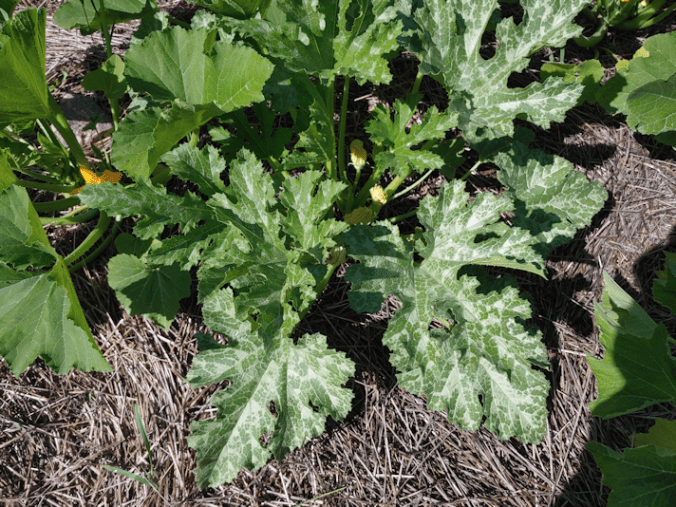
Here is another comparison. These two squash plants, with the mottled leaves.
They look pretty much like the same kind of plant, don’t they?
Now look at the developing squash.
They’re completely different!
I’m looking forward to being able to start harvesting these. My favourite way to eat them is raw, with dip. No need for anything else, when they’re at just the right stage. :-)
It was looking at the chokecherry trees that I am really seeing what a difference even minor changes in conditions makes.
This first one is at the south side of the garden where the squash beds are.
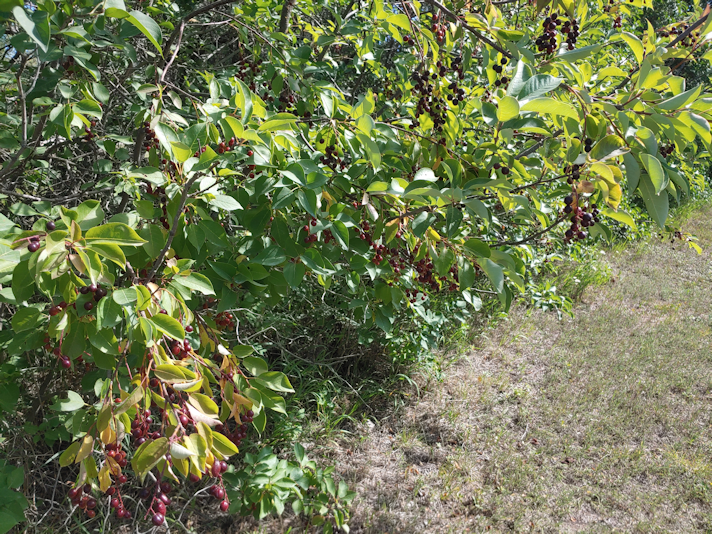
This one gets sun in the mornings, but for most of the day, it is shaded by spruce and maple trees to the South and West of it. It is not crowded by other trees. It has quite a lot of berries that are looking big and juicy (well… as much as chokecherries can be! ;-) ). Even last year, during the drought, it had larger berries. While I do not specifically water this tree, I do sometimes water the little patch of flowers and raspberries on one side of it, and the black current bush (my sister confirmed what it was for me) on the other side, so it does get extra water from that. While is has larger berries, it also ripens later. As you can see, the berries are still very much on the red side of things.
This next one is the chokecherry tree that is engulfed by lilacs.
This one gets full sun for most of the day, though it does get slightly shaded at the end of the day, by the trees my mother left to grow after she moved the raspberries they’d self-sown in between, years ago. This whole area gets quite dry, and we do not make any effort to try and water anything here.
The berries themselves are noticeably smaller than in the previous tree, and there are less of them, but they are also ripening faster.
Then there is this tree, right nearby.
This is the top of a young, small tree that was self-sown and allowed to grow (rather than get mowed over, like all the other saplings) in a grassy band between the old garden area (with the row of trees mentioned previously) and the lilac hedge. It might get some shade towards the end of the day, but otherwise gets full sun. Our first summer here, it did not produce fruit yet, and I wasn’t even completely sure what kind of tree it was. Our second summer, it had a few berries. This year, it has matured enough to produce quite a lot of berries. With full sun most of the day, not at all crowded, and little moisture, the berries are still not as big as the ones closer to the house, but the clusters are dense and ripening quickly.
You can see how this tree is situated in the background of the next photo, below. This next chokecherry is also among the lilacs, but on the edge of the hedge, not in the middle of them.
Here, it gets no shade at all. It has lots of berries that are already ripe. As you can see, though, some of the leaves are turning yellow. Only a few branches are like this, not all of them. It’s not stopping them from heavily fruiting! Like the other two along this side of the old garden, the berries are not as large as the trees nearer the house.
This next one was a surprise find, along with the Saskatoon berries. This area had been full of spirea that I had pulled up. It’s starting to grow back, so I’ll have to do it again, as pulling them up has been a good thing for other trees. The Saskatoons thrived this summer, and we discovered another chokecherry tree among them.
This area is under spruce trees, both living and dead, getting very little sun. In the above photo are the berries on the North side of the tree, where it gets even less sun. As you can see, they are just turning from green to red here.
This next photo is of the same tree, but on the South side.
That little bit more sunlight sure makes a noticeable difference in how fast they ripen!
Again, while I have not really been watering these trees, they are near the horseradish, and with the spirea taken out, wildflowers have come up and I’ve been watering those. So they will have benefited a bit from that, too. Mostly, though, being under the spruces as they are, they don’t get the full heat of the day, so the soil doesn’t dry out after a rainfall as quickly, either.
Then there is this one…
That’s a chokecherry in the middle of the photo. I had cleared a path to the junk pile you can see part of, to try and find useful pieces of wood in it, but that’s as far as I got so far. The tree itself is not crowded by other, large trees, and is shaded only in the morning hours. It’s surrounded by spirea and thistles, so we can’t get at it right now, but it appears to be just loaded with ripe chokecherries.
Finally, there is this one.
This is the top of a chokecherry tree among the cherries. I can get close to it, but not enough to be able to harvest it until I clear away the cherries around it; mostly cherries that had been killed off by last year’s horrible spring, and the bits that are now growing up from the bases. They create a formidable barrier!
This tree also gets shade in the morning hours only. Our last two summers, I don’t recall seeing any flowers or berries at all. Last summer, I’d cleared away the old wood pile, which turned out to be a much, much larger job than I expected. You can read about it in this series of posts (all links should open in new tabs, so you won’t lose your place!); parts one, two, three, four, five, six, seven, eight.
Did I mention it turned out to be a really huge job?
Yeah.
So while there is still lots to clean up to work our way into the spruce grove, what has been done so far made a big difference. I’m thinking that, had the cherries not been so damaged by the previous spring conditions, they would have improved, too. Mind you, the one cherry tree I kept because it managed to actually produce a few berries, and is not at all crowded, did not produce even a blossom this year.
It’s amazing how the same type of tree, while not really all that far apart from each other, are so different based on even minor changes in sun, shade, moisture, etc. When it comes time for us to plant more food trees, the differences among these chokecherry trees is providing us with a lot of information.
I was a bit late doing my rounds, so it was starting to get a bit dark. Which made finding this, that much more dramatic!
It was NOT blooming this morning!
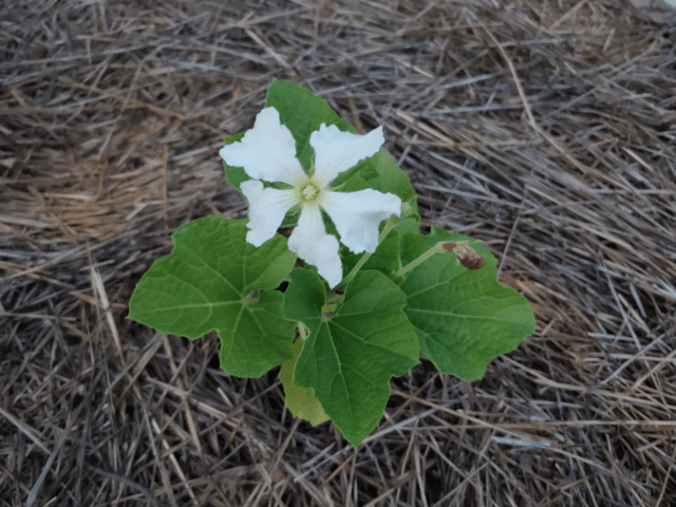
When checking the squash beds, I have been keeping an eye on the back row, trying to decide with of the surviving plants are gourds. I noticed 3 of them (with possibly a 4th) sending up tall flower stalks. Completely different from all the others!
Now, two of them have these dramatic white flowers!
Not knowing for sure what is what, after the starter trays were knocked over, sure makes checking the squash beds much more exciting than one would expect! :-D
With all the lovely rain we had yesterday, I could see the squash really appreciated it!
This is one of the recovering squashes that recovered after frost damage to our first transplants.
We’ve got baby yellow zucchini!
This is the first of the summer surprise squash mix that we can actually see what it is. :-)
I’m happy that some of the damaged ones have recovered so well. We won’t be getting anywhere near as many squash as I had originally expected, but that’s okay. We’ll still have lots!
Yesterday evening, I happened to glance out my window facing the garden and saw a deer making its way into the yard. Something startled it and it ran off, but I figured that would be a good time to do my evening rounds – and check the sunflowers!
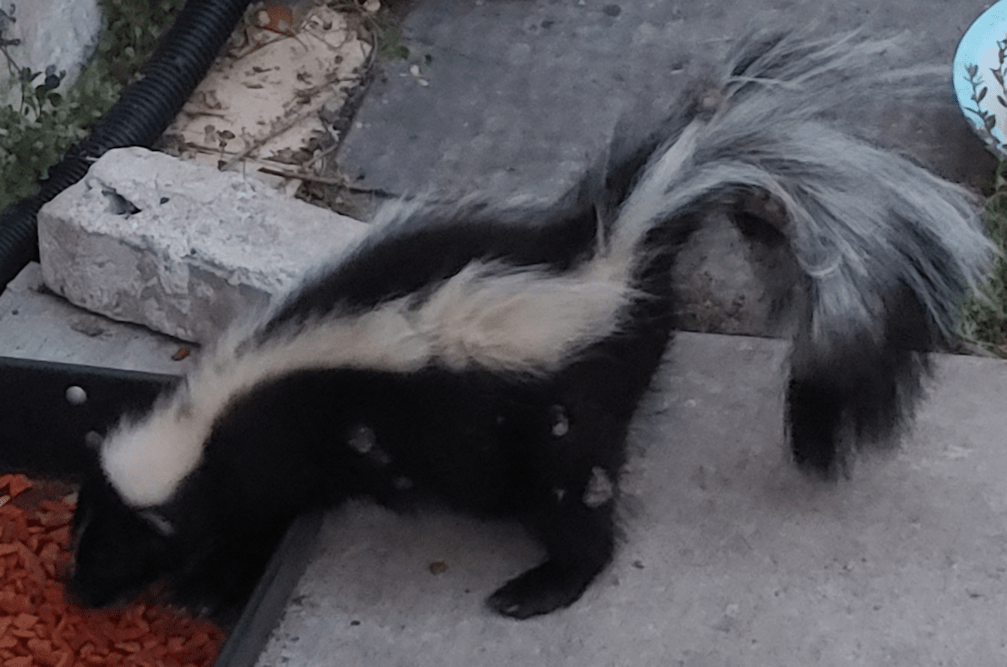
I headed out through the sun room and found another visitor.
The cheeky little bugger completely ignored me and the noise I was making as I came out the sun room doors.
He seems to have some odd matting in his fur. Or maybe something it caught in it?
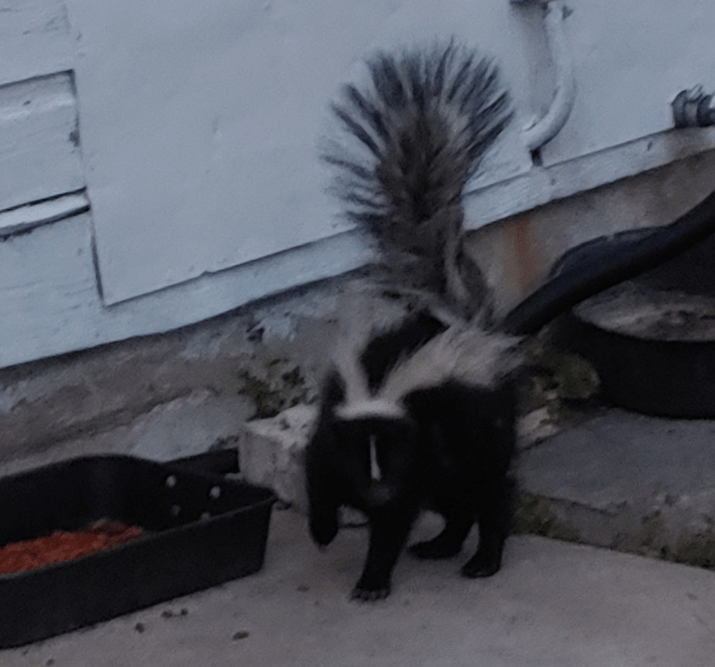
It wasn’t until I started moving further from the doorway that he started paying attention to me.
(Yes, I was zooming in to take photos, and then I cropped the photos. I was staying well away from Stinky!)
He was not a happy Stinky! I just kept moving away, and he eventually ran off through the old kitchen garden.
So I made sure to go around the other side of the house, to check the garden! :-D
After checking the sunflowers and making my way back to the house, I saw Stinky again – with a friend! – running through the back yard towards the old garden shed. Of course, that was the direction I needed to go! I was able to skirt around them, then use the garden hose to discourage them from coming closer.
Alas, we did lose one of the smaller sunflowers.
I took this picture this morning. This is one of the third variety of giant sunflowers that we planted much later, to replace the ones we lost in the original planting.
The survivors of our first planting are doing pretty good, I think!
Most of them are approaching 5 feet in height, now. Once they got higher than a couple of feet, the deer seemed to ignore them. One of the last ones that got its top chomped off is surviving quite well, and is growing a new “head” from the side of the main stalk. I have high hopes that the most recently decapitated sunflower will do fine and grow a new head, though being one of the variety planted the latest, chances are it won’t have long enough of a growing season to fully mature. We shall see.
I’m just really impressed with how big the pattypan squash plants are getting! They are also filled with buds and blossoms, and little baby squashes. None of the others are even close. There’s a good possibility these will be the only squash that actually produce this year. Which is okay. This year is our experimental year. Anything we get is bonus, and we’re learning a lot.
I keep forgetting to take pictures of the potatoes. They actually look rather sparse, as far as foliage goes, but some have started to bloom, so we can definitely look forward to having our own potatoes this year. Whether or not we use the same method to grow them will be decided when we harvest them.
I also found a rather dramatic surprise this morning, when checking on the carrot and beet beds.
This is a chokecherry tree growing among the sour cherries that are doing so poorly. When I went past it last night, the berries were all still green!
This one is mostly by the cherry trees and a lot of other stuff that we will be taking out (the cherry tree by the house has ripening berries on it, but none of the ones in this other location). I want to make sure to keep the chokecherry tree, since it seems to be doing so well, now. Our first two summers here, this tree didn’t even bloom, so we didn’t realize what it was!
There is another chokecherry tree, in behind where the sad little Saskatoon bushes are, that also decided to bloom and produce this year. It is in an area still filled with spirea that we need to clear out.
Another surprise this year is that we have more, stronger and healthier Saskatoon bushes, hiding behind the stack of boards and junk that have Junk Pile kitten her name. (No kittens in there, this year!) They are still producing big, juicy berries. There is another chokecherry tree growing with them. It’s berries are still very green. In this location, this tree is in shade most of the time, whereas the other two get a lot of sun.
Which had me curious about the other trees we’d gathered chokecherries from, over the past two summers.
It was pretty windy when I tried to take this photo, so it’s not very clear, but you can see there are no red berries on here, yet. A few of the berries are starting to show just a bit of a blush on them. This tree has more shade, being planted so close to the maple grove and rows of spruce trees my parents added on the North side over the years. The berries on this tree ripened later than the other two I checked next, but the berries it produced were larger and juicier.
This chokecherry tree is being choked – by lilacs! It is tipped way over and hanging down. My daughters and I have been talking about what to do with this one. I’ve been thinking of cutting away the lilacs surrounding it, then adding some sort of support I can use to train the tree to start growing upright.
My daughter suggested we leave the lilacs, and get rid of this chokecherry! The lilac hedge serves as both a privacy and dust screen from the main road that goes by on this side of the property. It has quite a lot of traffic, for a gravel road. The reason my mother spent so many years planting and extending this hedge was partly because of just how much dust drifts in, every time a vehicle drove by. Plus, every now and then, vehicles going by would slow down to peer into our yard and garden. And not just the year we grew “konopie” from seeds my mother got from Poland, after regaling us with stories from her childhood. It turned out that konopie is Polish for hemp, but someone thought it was marijuana and stole a row and a half of it.
Anyone who tried to smoke that would probably have gotten rather ill rather than high!
Anyhow. The lilacs serve a purpose, and in that location, privacy and dust screening is more important than having chokecherries. Especially since it turns out we have so many more, elsewhere.
This chokecherry tree is also among the lilacs.
Unlike the other one, this one is growing from the inside of the hedge, instead of out from the middle of it somewhere. So it is growing straight and tall, rather than falling over. In the last couple of summers, I found that of the two among the lilacs, this one also produced better berries, and ripened sooner, than the one that’s falling over.
There is also a small chokecherry tree growing in the middle of the area I move, near where the falling over chokecherry is. It likely sowed itself, but over the years, it has been allowed to grow, rather than getting mowed over. We will likely leave that one be. In the open as it it, it will have lots of light and space to grow straight and tall, and eventually produce lots of berries.
It’s a good thing we like chokecherries. I like to eat them straight off the tree, even though they are very … astringent, I believe the word used is. Given how many trees we’ll have producing berries this year, we can expect to have lots to make things with!
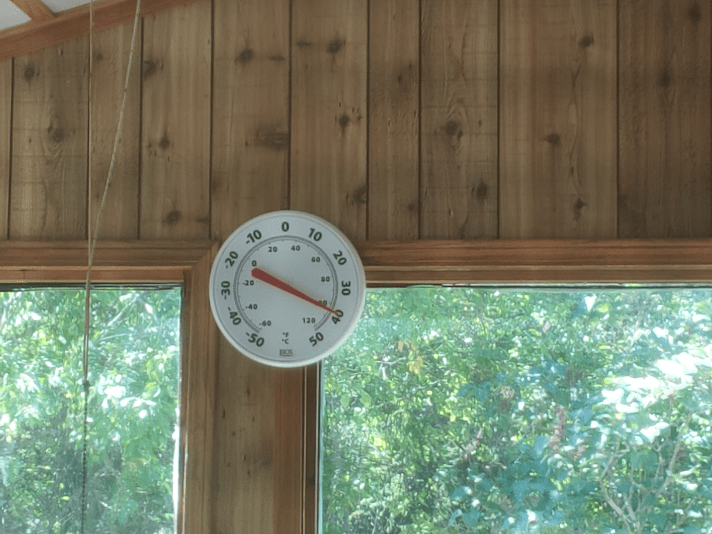
When I headed out to do my rounds this morning, it was already 26C/78F. When I grabbed the hose to use it briefly, before topping up the cats’ water bowls, the water was almost hot! So I decided to water a bunch of things, using up the warmer water so as not to shock the plants, until I could fill the cats’ bowls with cold water.
Since I have not found what I need to fix the front tap, we have all our hoses linked together at the back tap. That’s almost 300 feet of hose.
I got quite a bit of watering done before it started coming out cold! The nice thing about being on well, though, is that it does get cold. Ice cold, even. When we were on city water, on days like this, the best we could get was maybekindasorta cool.
I’m going to have to get in the habit of carrying a basket or something with me, when I do my rounds.
This are thinnings from the three different carrot beds. I would have picked more but 1) it was getting hard to hold them all in one hand – especially the ones where the greens broke off, 2) the mosquitoes were eating me alive and 3) I had a Creamsicle deciding to jump up on my back.
And roll around.
And repeatedly start to fall off before I finally got him off (with only minor scratches! LOL).
So he then decided to start rolling right over the carrots!!
*sigh*
We have lots of little sunburst squash showing up, but just the one bigger one. I didn’t want it to get too tough and seedy, so I picked it now. Later, I will choose one that I will leave to go to seed, for next year. We will probably still buy seeds, but I’d like to at least try saving seed as well.
This afternoon, I made a quick run into town. By the time I got home, we had reached our high of the day, which we are still now, now. At 32C/89F and a humidex putting us at 38C/100F, I was very glad to see my daughter meet me at the garage to help me hall the water jug refills back to the house! Yes, I did have the wagon, but getting anything through the door with kittens about is much easier with 2 people!
The sun room is definitely NOT a place to hang out right now.
If we were still keeping the doors open for the cats, I would have had the ceiling fan on to help at least a little. Right now, I just have the replacement door open – it has a screen window that actually opens and closes, unlike the one we replaced. :-D My mother used to have lacy curtains on all the windows because of how hot it would get in here. I can understand why, but it sort of defeats the purpose of having a sun room.
Who knows. We might use this at least part of this room as a greenhouse, some day.
The girls must be just dying upstairs. I wouldn’t be surprised if my daughter has to stop working because her computer and drawing tablet are overheating again!
We’re supposed to “cool down” after today, but the only means we’re supposed to remain below 30C, over the next two weeks.
One of the things I did while doing my evening rounds was bring the rain barrel we’d found behind the storage out, closer to the garden. My thought was to fill it with water, so that I can use ambient temperature water in the garden, rather than the hose. Unfortunately, since I’d last rolled it aside, it has developed cracks where it had been lying on the ground. I’m thinking I can patch them with some silicone sealant and still use it. I think I even have some, already. Before I do that, though, I have to figure out what I can use as a cover for it. I wouldn’t want some critter to fall in.
At some point, we will dig up the hose to the tap by the garden and replace it. The set up for the tap itself is getting very wobbly, so I want to redo that, as well. Thinking of how we do want to keep at least part of the area back there as a vegetable garden, I not only want to have a tap I can hook a hose onto, but I’d like to set up a surface area of some kind, so we can wash the veggies right away, or even just wash our own hands. Maybe with a small bench to sit on while scrubbing, for old and decrepit people like myself. ;-)
We can’t even start on that until we get the branch piles cleared away, first. The line runs almost under one of them – and that’s where water was spraying through the ground when I tested the tap. :-D
I’m really looking forward to when those are gone!
The plan was to hire the company that cleared trees from the roof and power lines to bring in their massive chipper this year, but after having to replace so many expensive items just this month, it doesn’t look like we’ll be able to do it after all. Ultimately, though, we should invest in our own chipper.



















 The Re-Farmer