Our root vegetables this year were a mix of successes and failures!
First up, the successes.
Potatoes
We had three varieties of potatoes this year. We chose the varieties based on things like their storability, and their resistance to disease, as well as their flavour profiles. One time, the Purple Peruvian Fingerlings, were a potato we’d grown a couple of years ago and quite enjoyed. The other two were new to us: Irish Cobbler, a white potato, and Red Thumb Fingerling, a potato with both red skin and red flesh.

The original plan had been to plant them all in grow bags this year. We’d tried the Ruth Stout method last year, and both beds got flooded out, and there was very little left to harvest. We were going to repurpose old bird seed and deer feed bags for this. We have stopped buying both – we just can’t afford it anymore, with how much cat kibble we’re buying now – so it turned out we didn’t have enough for all three varieties.
This required a change in plans and, that early in the season, there were only a few places we could plant potatoes directly into the soil. So, the red and white potatoes went into low raised beds in the Old Kitchen garden.


The red potatoes went into the long, thin bed next to the retaining wall block, which got redone this spring, and when I ran out of room, into the short end of the L shaped wattle weave bed.
You can see how the Old Kitchen Garden beds the potatoes were planted into progressed over the years in this video.
The Purple Peruvians went into the grow bags.
So, how did the potatoes do this year?
Pretty darn good.
We harvested baby potatoes from the Old Kitchen Garden only a couple of times, since we didn’t really have a lot of any variety. The Irish Cobbler were the first to be ready to harvest, then the Red Thumb.


The Purple Peruvians, on the other hand, took an incredibly long time to mature, and did not get harvested until mid October. I’ve been going through my files to find photos of them – they were our biggest harvest – but it turns seems that by the time I was done harvesting them, it was too dark for photos!
As I write this, we have finished off our Irish Cobbler potatoes, but still have Red Thumb and Purple Peruvian Fingerling potatoes in storage.
Final thoughts on potatoes
I would consider all three varieties a success, this year. Especially the Purple Peruvians.
The smallest harvest we got was the Irish Cobblers. They were also the earliest maturing variety. They did seem to have issues with scab, however. They tasted good, however, and were a good potato for a variety of preparation methods.
The Red Thumb did quite well, and were also tasty. When cooked, they practically mashed themselves, so not a good variety if we wanted to do a hash or in a soup or stew. Having pink mashed potatoes as a side for Thanksgiving dinner was rather fun!
The Purple Peruvians seemed to take a lot longer to mature compared to the first year we grew them, with robust plants right up until the frost hit them. They are nicely prolific. The only “down” side is one of aesthetics. They do bleed their colour quite a bit, leaving fingers purple can changing the colour of any soups or stews they are cooked in!
When it comes to growing potatoes for our general needs and use, we will need to grow a lot more, but we are still figuring out what varieties we want to grow. As much as we like the Purple Peruvians and Red Thumb potatoes, I think we might want to move away from fingerling potatoes in general, other than perhaps as a side crop. Their smaller sizes and, in the case of the Purple Peruvians, uneven shapes, make them harder to handle, clean and peel. In the future, I think we will try varieties that have more even shapes and larger sizes, as well as being good for long term storage.
One last surprise
As I mentioned, we grew potatoes last year using the Ruth Stout, deep mulch method. Not only did the potato patches get flooded out, but they also got hit with slugs quite badly.
It seems, however, that we missed a few potatoes when we harvested them, and they showed up this year!
One of them, from the All Blue patch, got quite large and began producing seeds!

I didn’t try digging up the potatoes in the fall, but I did collect the seed balls. I haven’t tried opening any yet. From what I’ve read, these can be opened and the seeds inside processed much like tomato seeds. Seeds from potatoes will not be clones, as they are when the tubers are planted. I believe there are some rare exceptions, but the seeds each typically produce a new variety, like apple seeds do. I think that if we planted them, we’d still get something similar to the All Blue potato they came from, but the only way to find that out is to plant them and find out! I’ve read that, in the first year, potatoes planted from seed will only produce a single potato that can then be planted like any other potato and produce clones of itself. I don’t know if we’ll be able to experiment with this next year. It will depend on how much space we have. Still, I’d like to try it!
Carrots
We has several varieties of carrot seeds this year, and I’d intended to plant more. In the end, we only had space to plant two.
One variety was new to us; the orange Naval carrot. With those ones, we tried something else new: making seed tape.
The other variety was the Uzbek Golden carrot. We’d grown them last year and, while they did not get a chance to reach their full potential, it being such a bad growing year overall, we did enjoy them. This year, they did even better!
With these ones, we harvested them throughout the summer, as needed, then harvested the last of them after we had our first frosts.

There was some slug damage, and a few of them split, but overall they did very well.
These carrots are lightly sweet, crispy and delicious. They were a great carrot to eat raw, and also held up to cooking very well. This is definitely a variety we would enjoy growing again. I would like to find a Canadian supplier of seeds, though. It’s getting too expensive to order seeds in from the US.
As for the Naval carrots, we planted devoted an entire bed to them.
I definitely liked how the seed tape worked out. We planted an entire package of seeds, didn’t need to thin any of them, and got a very high germination rate.
We didn’t harvest many of them through the summer, though. Instead, we left them in the ground to try out a different method of storing them for the winter: in ground and under a heavy mulch. The idea is to be able to harvest fresh carrots during the winter.
This is our first “winter” harvest.
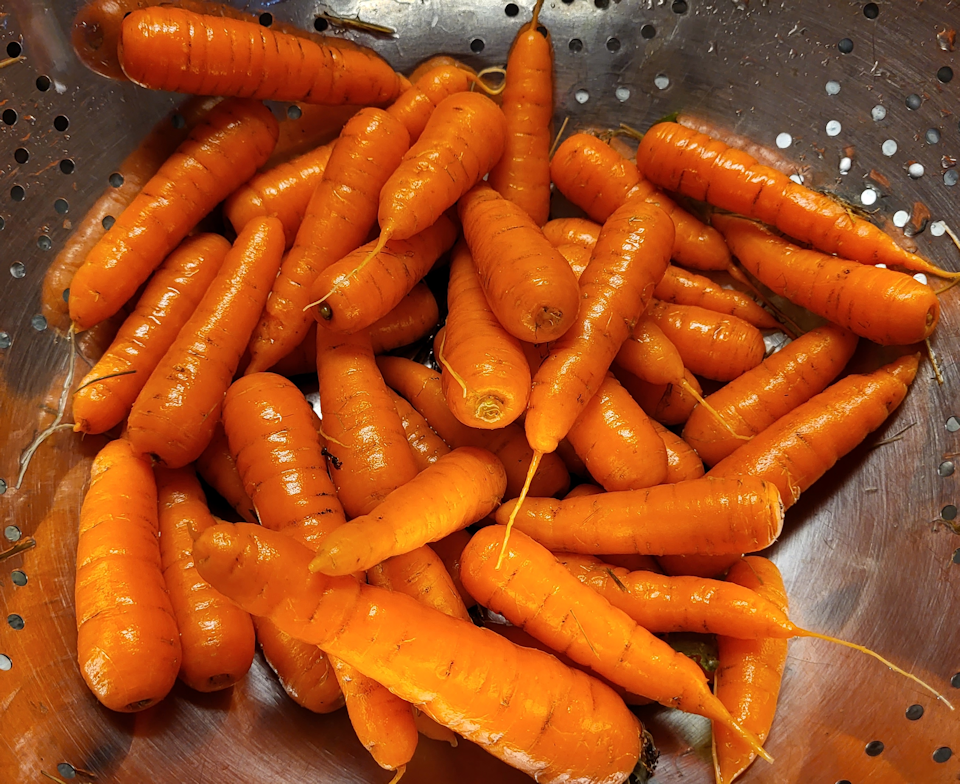
The carrots were noticeably smaller at one end of the bed, likely because that end gets less light, so that’s the end I harvested these from. Under the thick mulch, the ground was cold and did have ice shards in some places, but the ground was workable and the carrots could be dug out fairly easily. They were wonderfully crisp and fresh and very tasty! The ultimate test for this method of storage is yet to come, as winter isn’t even officially here yet, and things have still been pretty mild, compared to how our winters usually tend to be.
Final thoughts on carrots
I do wish we’d had the space to plant more varieties, but I’m happy with what we did plant. Both varieties are tasty. If I have anything to complain about, I’d say it’s that they are a bit harder to pull, as their greens come off easily. These need to be dug loose, first. I’d be doing that anyhow, so that’s not really an issue. These are definite winners.
Now for the losers. Mostly.
Turnips and Beets
This year, we planted varieties of turnips and beets we have tried before.
Last year, we got Gold Ball turnips as a freebie with a seed order. We tried growing them, but something ate the seed leaves as fast as they came up. So, we bought more seeds to try them again.
For the beets, we planted a variety called Merlin.
There were planted in the same bed, next to the Indigo Blue tomatoes, and bordered with yellow onions. I hoped that the onions would help deter any critters or insects that would want to eat the turnip and beet greens.
The turnips did seem to do rather well. They got quite leafy, enough though something was most definitely eating them. The leaves were filled with holes.
While we did harvest a few larger turnips, ultimately, they never reached their full potential. You can see in the photo with the Uzbek carrots above, how few there were, that were worth harvesting, by the end of the season. All bug eaten greens, almost no turnips. I think they tasted okay, but they probably didn’t taste the same as they would have, if they’d reached their full potential.

In the photo above, you can see where we planted the Uzbek Golden carrots, sharing a bed with the Black Beauty Tomato transplants in the foreground. The carrot seeds are covered by boards to protect them until they sprouted. In the bed on the left of the photo, the half on the lower left got the turnips, while the half on the upper left got the beets. You can see the labels marking where they are in there. (The white boards on either side of the tomatoes are there to protect the new transplants from high winds.)
The beets barely came up at all.
The first year we grew beets, they did rather well, but pretty much every time we’ve planted them since, they’ve been doing worse and worse. This year was, to be honest, pathetic.
In the case of this bed, however, I think there was something odd about the soil. Even the turnips grew stronger and healthier on the south end of the bed, but by the middle of the bed, they were smaller and sicklier. Then there were a few little beet seedlings that started to emerge, but by the north end of the bed, there was nothing. No germination at all. Even the tomato plants at that end seemed to be smaller and less healthy looking.
The entire bed got the same amount of sunlight and water. This was one of the beds that had a sprinkler hose wound throughout. The problem could be in the soil itself, but after harvesting the grow bags at the end of the season, I think the problem may actually be that row of self seeded trees my mother allowed to stay. She’d had a row of raspberries there and, after transplanting the raspberries, she left the saplings to grow to be a wind break. In trying to clean up around there, I can see that attempts have been made to remove these trees in the past, and they’ve just grown back. It’s a mix of maple and Chinese elm, which means they are not only taking up space that used to be productive garden space, but are spreading seeds. Those Chinese elm seeds are the worst, and have been causing all sorts of problems. However, when working on the soil in these beds, pulling up roots and amending it, we find a lot of roots at the north ends of them. The bottoms of many of the grow bags the peppers were in were absolutely crowded out by tree roots that had grown in from below. Because of how these trees growing, I suspect that it’s the Chinese elm roots that are depleting spreading the most and winning the competition for nutrients.
Final thoughts on turnips and beets
We’ve had such poor results growing turnips and beets, I don’t know that we will try to grow them again, until we can plant them in higher raised beds. The one area we’ve grown beets in semi successfully, was in the East yard, near the spruce grove. When we cleared out where the old wood pile used to be, we found the best and softest soil of all under there. While my daughters have enjoyed what beets we’ve managed to grow in the past, with the Merlin variety being a favourite of theirs, I honestly don’t know if we like any of the turnips. I’ve selected turnips to grow as a good storage crop for food security, but it’s not much good for that, if we don’t actually like eating them. With the small turnips we’ve managed to harvest so far, we’re not getting their full flavour.
Which means we will likely skip trying to grow turnips and beets again for at least a couple of years. Once we have more, and more established, raised beds, we can try again.
Extras: more beets, plus radishes
After we harvested the garlic, we had an empty bed suitable for a fall crop. In it, we decided to plant spinach, beet and radishes.
We planted the Cherry Belle radishes, Lakeside spinach and Bresko beets.
I’ll cover spinach in another post, but in this bed, they started to germinate, then promptly disappeared. A couple of seedlings did survive, but didn’t grow much at all. The beets barely germinated, and what did germinate, soon disappeared. Only the radishes grew, and while we got decent looking plants, and a couple that shot up and started to bloom, there were almost no radishes worth harvesting. While I think insects or slugs got the beets and spinach, I suspect it was the nearby trees that did in the radishes.
Only one of us in our household actually likes radishes, however I’ve been curious to try radish pods. So far, we’ve never had radishes get to the point of producing any! Even though these ones were planted so late (my daughter that likes them ended up house sitting for a month, so she wasn’t here to eat what few we got!), the ones that started blooming are the furthest along we’ve had them grow.
As with the beets and turnips, I think radishes are something that we won’t grow again for a while. They do produce very quickly, if eating the roots is what we’re after, so we might tuck them in between other things as a sort of ground cover, but that’s about it. I do still want to grow some for their pods to try. Perhaps we’ll have an empty corner in a higher raised bed to tuck a few seeds in, and just let them be until the end of the season. That will be a last minute decision, depending on what space we have to work with, next year.
Which means that, for root vegetables, we’re basically down to potatoes and carrots!
Well. I guess that’ll make things easier to plan out next year! 😄
The Re-Farmer

 The Re-Farmer
I’m definitely branching out with potatoes next year—might try those Purple Peruvians. Exactly the same thing happened to me with beets, I don’t get it. I thought maybe Hubby cursed the ground since it’s the only veggie he doesn’t like. 😆. I’m a huge radish lover, so I plant different varieties all year except for deep summer and it’s so nice to have at least one ‘no brainer’ in the garden b/c they are so easy. We also get lots of turnips in spring, perfect pig food when there’s so little forage for them. Nice to see your progress, thanks for sharing!
LikeLiked by 1 person
Thank you!
It’s an interesting thing to see how things are growing, because I have my entire childhood to remember my mother’s garden in the same areas. She never grew turnips, but she did grow beets every year, and had enough to do plenty of canning as well as for making borszcz. Potatoes made up the bulk of the garden, and we had enough to last 7 people all winter. The main difference, of course, is that my dad would actually plow and harrow the garden every fall, and we had a herd of cows to supply manure. The last time the areas was plowed, it was not long before we moved here, by our vandal. My sister thinks he must have been drunk while doing it. We’re still trying to repair the damage. As for manure, it’s probably been 20 or more years since manure was added to the soil, and since even the old manure pile got stolen, we’ll have to find alternatives. My mother always had the most amazing garden!
LikeLiked by 1 person
Have you found any old photos from that time? Would be so interesting to compare them. Our garden has totally been transformed since we added lots of poop! Of course the soil has been amended with lots of compost too, but I had definitely underestimated the requirements of heavy-feeders like potatoes, having had no experience or education in it. Isn’t it marvelous to watch it develop over the years!
LikeLiked by 1 person
Hhhmm… Probably? There are boxes and boxes of photo albums in the storage shed. I’d love my sister to take those. She’s the one that’s into all that, and has been scanning photos to keep digital records.
It’s so awesome to see the fruits of your labour? (Literally and figuratively! 😄) You’ve done such amazing things! You’re a few years ahead of where I and working to be, and I find you quite inspiring!
LikeLiked by 1 person
So kind of you to say—the feeling is mutual! You are so good with your social media presence, too, which is impressive. I’m not so motivated in that direction, but I keep trying. 😁
LikeLiked by 1 person
Thank you! I’ve never thought of myself having a “social media presence”. 😁😁
LikeLiked by 1 person
Would sound better to say—your presents to social media—🤗
LikeLiked by 1 person