I was out again this evening, when it cooled down a bit (as I write this, it’s past 10pm, and we’ve finally cooled down to 26C/79F, from a high of 31C/88F), to do more transplanting. I was able to fit 13 Black Beauty tomatoes into one row in a second bed, which leaves another 13 extras I can give away.
After putting the rest of the Black Beauties in the sun room, I started to get the rest of the transplants from the picnic table, when I spotted not-Junkpile sitting rather strangely beside the storage house.
Then parts of her moved and turned out to be…
… bitty bebbehs!!
It was getting dark and I zoomed in so as not to disturb them because, of course, they ran away as I skirted around them to get the trays of plants. My daughters came out to help, and we saw them dashing about, hiding in the lilacs.
Later, I saw the mama up on the cat house roof, looking for kibble and growling at me. I’d already given them their evening feeding – early, so avoid feeding the skunks and racoons – but she wasn’t the only hungry mama around. I set out about half what I usually do, putting most of it on the cat house roof, where the skunks can’t get it. The racoons can get up there, of course, but they’ll go for the trays in the kibble house, first.
There are more very round cats wandering around. Junk Pile, who lost her first litter that she had so incredibly early in the year, looks like she’s about to explode. Caramel and one of the grey tabbies that we can’t get near are looking round, too.
And I can now confirm that least one, maybe two, of the white and greys are female. One of them, simply because I’ve seen her getting some action with the males. The other – the one with the distinctive almost black spots – is starting to look round.
*sigh*
Hopefully, they will all have small litters like this one, instead of the usual four or five.
Tomorrow, we’re supposed to hit 28C/82F, but by the time that happens, I should be on the way back from my eye exam. My daughter is coming along as a back up driver, in case they do that eye dilation test. I haven’t had my eyes tested since several years before we moved out here, so… 8 years? Nine?
If all goes well, though, I’ll be able to get some work done outside during the cooler hours.
Assuming my body is up to it. I just had to get my daughter to clean the litter boxes in my room for me, when I could barely bend over to put my inside shoes on – and I was sitting down! 😄
It’s not even 11am as I start this, but I’ve already put in several hours in the garden, trying to beat the heat. Which wasn’t easy, since it was already feeling too hot when I was doing my rounds, first. The weather app was saying 18C/64F, but it felt hotter. It would be good to set up a thermometer in the garden area again.
My focus today is to get the Indigo Blue Chocolate done, and as many of the Black Beauty as I can fit, plus an edging of yellow onions. There are only 11 Indigo Blue and, at about a foot apart, they will easily fit in one row in the bed I chose for them. This bed is somewhat narrower, so it will be able to fit one more row, plus the onions around the edge.
The problem?
There are 26 Black Beauty transplants.
I also counted the Roma tomatoes as I set them out. There are 61, though the plant that broke in the wind yesterday is looking like it probably won’t make it.
Then there are the 30 Spoon tomatoes.
Right now, we have 2 more low raised beds, which are about 15ft long, for about 14ft of growing length. Then there is the high raised bed, which is 9′ x 4′ on the outside, so about 8′ x 3′ of growing space. Aside from a small section in the wattle weave bed in the old kitchen garden, and 4 blocks between the gourds at the chain link fence, that’s all we have left for prepared beds. The squash patch needs work and, of course, we need to get those trellis beds built.
Meanwhile, the lawn is getting out of control, we still need to cut down the dead spruce trees that will be used to make the trellis beds, as well as pre-cut and drag over the trees I cut down for the trellises.
As it is, I did as much as I could this morning, then had to head in to get out of the heat. We are at 24C/75F right now – yes, to me that’s way too hot already! – and we are supposed to reach 30C/86F this afternoon.
I got the Indigo Blue Chocolate tomatoes in, after setting up three of the salvaged T posts to hold their vertical supports, then transplanted some of the yellow onions along the outer edge. The tomatoes were starting to wilt already, so I added a grass clipping mulch around them and along the outer edge of the low raised bed on the one side, being careful not to cover the onions before giving them a final watering.
I was planning to plant the Black Beauty tomatoes on the other half, but I think I will put them in another bed, instead, and direct sow something else with them.
Unless I fill an entire bed with just Black Beauty tomatoes, I will have room for only about half of the transplants. And I don’t want to fill an entire bed with them. A dozen plants is more than enough for fresh eating. The Romas are the only variety that I’d be willing to dedicate an entire bed to, since those are being grown specifically for preserving.
Meanwhile, we’re still getting storm warnings for tomorrow evening. We’ll see if the system reaches us or not, but be ready to protect the garden beds, just in case.
For now, I will be staying out of the heat! Maybe get a nap in, since I will likely be working outside once it starts cooling down, and staying as long as daylight holds.
Yeah. That sounds like a good plan. I didn’t get much sleep last night!
I headed outside when things started to cool down and gave the garden beds another watering. I also snagged the trays of Spoon tomatoes and “potted them up”.
Which was just taking off the lower leaves and adding more soil to the cups. These were all so tiny when they were transplanted from the Jiffy pellets, the cups were barely half full of soil. Even now, a couple of them are so small, the cups still couldn’t be filled to the top. A few of the largest ones, however, actually seem to be showing the beginnings of blossoms!
We’ve got 30 of these, plus the Romas, and I still don’t know where they will be planted. It all depends on how much progress there is on the new trellis beds that still need to be built!
Next, I transplanted the lemongrass.
I treated the pot a bit like filling a raised bed; on the bottom, I put a layer of grass clippings, which got a good soak, then potting soil. The potting soil was really dry, so it took quite a bit more soaking to get it moist.
For the lemongrass, I decided to break them up and plant them individually, instead of in groups. That meant breaking up the biodegradable pots. These had been started in smaller, square, biodegradable cells of the same material, so when I potted them up, I just put the whole starter cell into the bigger pot.
For biodegradable pots, they sure don’t break up easy. They were still pretty rootbound in the original cells! So I pulled those pieces out, too. Considering how much handling the roots got, I really hope they survive!
Once transplanted and watered, I very carefully mulched with grass clippings. This pot is set up on the concrete landing of the stairs in front of the main doors. A good, warm microclimate for an herb that needs much warmer temperatures than what we usually grow here. It’s going to get pretty baked, though, so the clippings will help moderate the temperatures as well as protect the soil and transplants. Once the clippings were in place, I was going to give it one last watering.
The handle broke off the sprayer.
*sigh*
I bought is at part of a 2pc set, so I did have another nozzle I could use. I just don’t like it very much. It’s the kind where the spray is adjusted by turning the tip of the spray head. It doesn’t spray very well. Ah, well. Something else for the list of broken things to replace!
Then I finally!!! finished the cover over the shallots bed.
The ends are now closed off, so no cats can walk through and use the shallots as a bed!
As I was finishing this off, I could hear thunder that seemed to be coming closer, so my daughters and I quickly got the rest of the transplants inside. According to them, we did have smatterings of rain today, while I was in the city, and even had a very brief downpour last night! I never heard a thing. There sure wasn’t any sign of it when I watered the garden beds this morning.
Whatever system I was hearing this evening, it passed us by. A good rainfall really would have been nice! It got so very muggy out there!
Tomorrow is supposed to be another hot one, with no expectation of rain at all, so I plan to get an early start. The largest tomatoes need to be transplanted, but I want to put in the supports for the indeterminate Indigo Blue Chocolates first. The Black Beauties can be staked individually.
Which means an early bed time for me, and hopefully a good sleep!
It’s feeling a bit surreal today – I’ve gone to the city and back, and as I start this, it’s not even 1pm yet. I headed out early this morning to do the watering and switch out the trail cam memory cards, and was on the road not long past 7:30am. Usually, I don’t leave for the city until around 10:30 or 11.
I wasn’t sure if I’d be making the trip at all, today. My husband’s CPP Disability was due on Monday, but these days, both his CPP and private insurance payments show up in our account on Saturday instead of Monday.
I have no complaints there.
Because I left so early, I asked the girls to take the transplants out to the picnic table for me. We’re not supposed to get the high winds we got yesterday, but we were still supposed to get pretty hot, with a high of 25 or 27C/77 or 81F, depending on which app I looked at. The thunderstorm we were supposed to get last night is now pushed back to Monday. In the end, I figured it was just safer to have the transplants under the old market tent, even though it’s further from the house. Even there, with the high winds we had yesterday, one of our tomato plants snapped clean off, right at soil level. I replanted the stem. It might still survive. Not that we can’t afford to lose any. I just can’t help trying to save any that need it!
I was greeted by a pleasant site when I opened the gate to head out this morning.
Most of our lilacs were badly damaged by last year’s flooding, and not showing a lot of flower sprays. This one, however, has the most we’ve ever seen on it! Usually, it has none at all. This area is usually baked dry. For the first time in the past 5 years, at least, the water table is high enough for it thrive and bloom!
When I got to the Costco, their doors had just opened, and I found myself winding through two long lines of people that had been waiting to get in. The parking lot was already almost full! Things moved smoothly and quickly, though.
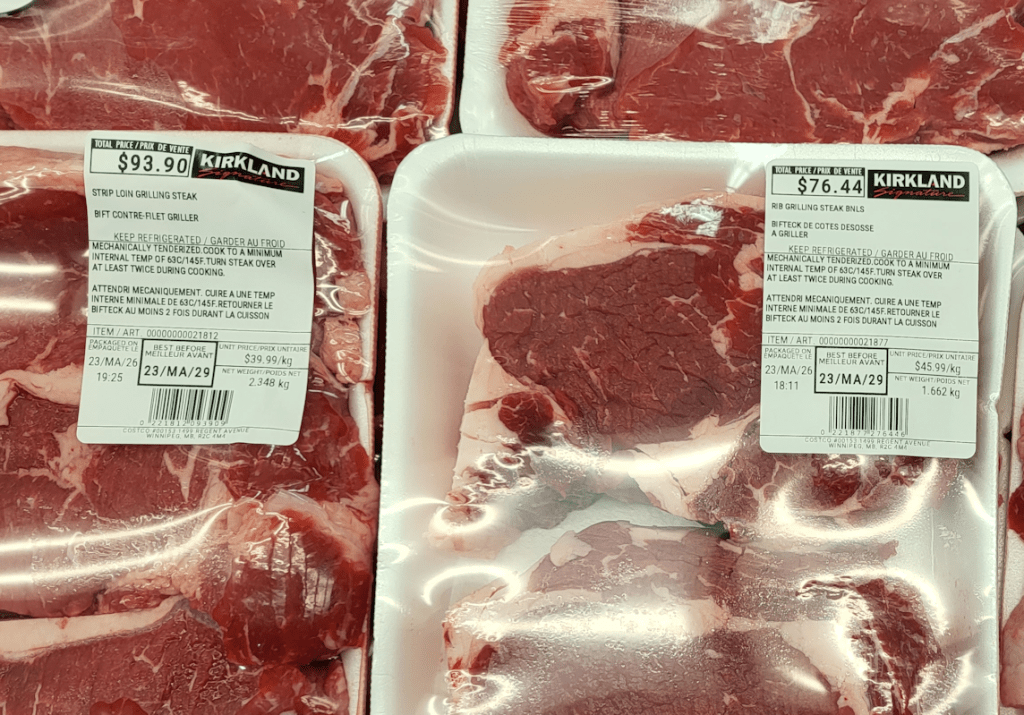
I did have quite the heart attack when going through the meat section. Especially the beef!
The strip loin grilling steaks were $39.99 (US$29.37)/kg. The ribeye grilling steaks were $45.99 (US$33.78)/kg. The whole beef tenderlions were $53.99 (US$39.66)/kg One kg equals 2.2 pounds.
No. I didn’t buy any.
Time for another order from our beef supplier!
I still ended up spending $800.06 after taxes.
That looks really meager for $800.
This is what I got:
Two large jars of mayo, at $10.99 each (yes, we can make it ourselves, but with the cost of ingredients, that’s no longer worth the effort, really) One jug of Kirkland EVOO – the smaller one – at $23.99 Iced tea mix, $9.99 That’s almost $5 cheaper than what I’m seeing for regular prices elsewhere right now. Triple berry jam, $7.99 Peanut butter in the 2kg size jar, $10.49 garlic granules, $8.99 Truffle, parmesan, black garlic mix, $9.99 This one was a splurge. I was looking for the garlic granules when I heard a couple other customers looking for ordinary table salt. She spotted this and read the label out loud, wondering what it was for. It sounded fantastic to me, so I grabbed some, and we ended up talking about different ways to use it. 😄 popcorn, $10.89 Bacon, 4pk, $19.99 Whipping cream, two 1L cartons, at $4.79 each – much cheaper than anywhere else Kirkland sour cream, $5.49 4pk Kirkland cream cheese, $9.49 Old cheddar, Marble and Mozza cheese at $14.99 each Double cream brie, $10.99 Butter, five at $5.49 each Two rotisserie chicken, $7.99 each Eggs, 60 pack, $17.89 lean ground beef, $46.29 – this is the huge plastic chub of meat that will be broken down into smaller packages ground pork, $19.99 – another chub that will be broken down into smaller packages pork loin, $29.47, minus $5 for a sale Tilapia filets, $32.89 – a treat for my fish loving daughters flour, $9.99 – a much better price than elsewhere. I’d have gotten two, if I wasn’t concerned about the space and weight in my mother’s car Vit. B12, $13.99 Mr. Freeze, $14.99 – this huge box of freezies cost about as much as boxes half the size in other stores AA batteries, $25.99 plus $1.60 eco fee AAA batteries, $25.99 plus 80 cents eco fee laundry detergent, $21.49, minus $4.50 for a sale Kirkland toilet paper, $22.99 Dry cat food, six 9kg bags, $28.99 each canned cat food, $38.99
The sub total came to $757.79, plus $42.27 in taxes.
Ouch.
It wasn’t that long ago when a load like this would have cost between $600 and $700, depending on how many things like batteries or household supplies were on the list. Back then, I would buy 10 pounds of butter at a time, too. As for today, I completely forgot to pick up any bread and wraps, which is okay, because I was running out of room.
Given the price of kibble, we might end up doing another Costco run. We did find a source for larger bags at an even better price, but none of the cats liked it. Not even the outside cats. There’s a reason the cheap stuff is cheap.
Along with the groceries, I got gas, which was at 151.9 cents per litre for regular gas.
So the first stock up shop for the month is done. It took a huge chunk out of the budget for the month. This month will have some extra expenses, too. One is to get the septic tank emptied. The other is to get the van checked and find out what’s causing that noise near the alternator. Hopefully, it will be a minor fix. As much as I appreciate being able to use my mother’s car – especially with working air conditions! – there are some things I would rather use the van for, like big shopping trips, or runs to the dump.
Well, the heat is really kicking in. Last night, in the wee hours of the morning, I checked the temperature, and we were at 20C/68F
That was somewhere around 3 – 3:30am
As I write this, it’s past1:30pm, and we’re already at 31C/88F. We are now above the 30 year record high for today, set back in 2015. I’ll still take that over the record low of -3C/27F! We’re getting heat warnings all over the place. Winds are high and we’re looking at possible thunderstorms this evening.
Pain levels were high for me this morning, so the girls took care of feeding the outside cats and setting the transplants out on the picnic table, under the old market tent and sheltered from most of the wind. Then my younger daughter did a fantastic job of cleaning up the branches from when I harvested trees for the permanent trellises we will be building. I just asked for the branches I tossed over the fence to the driveway side to be picked up, but she cleared away the big branch pile in the trees, too! Even sorted out longer pieces that we can potentially use, others suitable for the fire pit, and the rest went into the big branch pile we still have just outside the gate by the fire pit.
She was still working on it, when I finally made my way outside.
I started watering things, before it got too hot, and was able to mostly empty the rain barrel. If we do get some rain this evening, it won’t be enough to need to add the diverter to prevent it from overflowing.
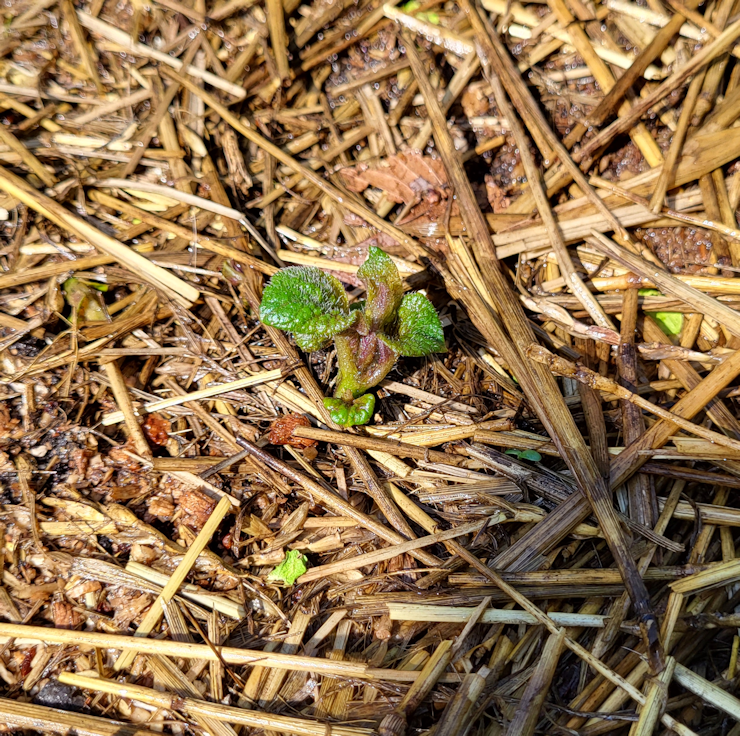
While watering in the old kitchen garden, look what I found!
Our very first potato has broken ground!
This is one of the Irish Cobbler potatoes, which were the first ones planted.
I am very happy!
While watering further afield, I found the Crespo squash was very wimpy and made sure they got a super deep watering. These plants grow very big and, if they survive long enough, are supposed to produce very larger pumpkins, so they are going to need a lot of water. The nearby leaking rain barrel that I filled with a hose still had some water in it, so I was able to use that, while refilling it with the hose, at the same time, to water the raspberries, cranberries and sea buckthorn, too. I filled the barrel to almost half way, and hope to be able to see where the leak is. It may be more than one spot.
Things are looking quite lovely out there! The crab apple trees near the house are in full bloom, and the ones along the north side of spruce grove are almost there. The common lilacs and the double lilacs have sprays of buds that are starting to open. Of course, we have a sea of dandelions blooming and starting to go to seed, but the mowing will have to wait.
There are a few outside jobs that I want to work on, but will have to work around the weather conditions. Thankfully, the days are getting long enough that, if I time it right, I can get some good productive hours in the early morning and the evening. I’m not good with mornings, though! So far, at least, the house is not over heating, but we’re going to have to set up the screen “door” at the top of the old basement stairs, so we can leave the real door open to help cool the house down.
Here’s hoping all this heat and, if the long term forecast for June is at all accurate, rain will mean a healthy garden and a good harvest!
We’ve got high winds today, with an expected high of 29C/84F. I wanted to get the transplants out, though.
With the wind direction, I was able to use the picnic table under the old market tent by the fire pit. They won’t get full sun, but with the expected heat, that’s quite all right. They will still get some wind, which is good for them, but not enough to send them flying across the yard.
The next while is expected to continue with high temperatures, with high winds and a possible thunderstorm tomorrow, though only one of my weather apps is predicting that. Overnight temperatures are also expected to be quite warm.
I decided today was a day to do some direct sowing, while also raking up some of the grass clippings to lay down some much needed mulch. If we’re going to be getting thunderstorms, I want the soil protected as much as possible. If we don’t get the thunderstorms, I want the soil well mulched to keep it moist, and from getting too hot!
I set up the extra phone to take time lapse video, so that will be put together for another post. With the peas, I planted the free Hedou Tiny bok choy from Bakers Creek and Jebousek lettuce I got for free from Heritage Harvest. As the peas grow up the chain link fence, they will shade and shelter the lettuce and bok choy. Then I prepped and planted the Tom Thumb popcorn.
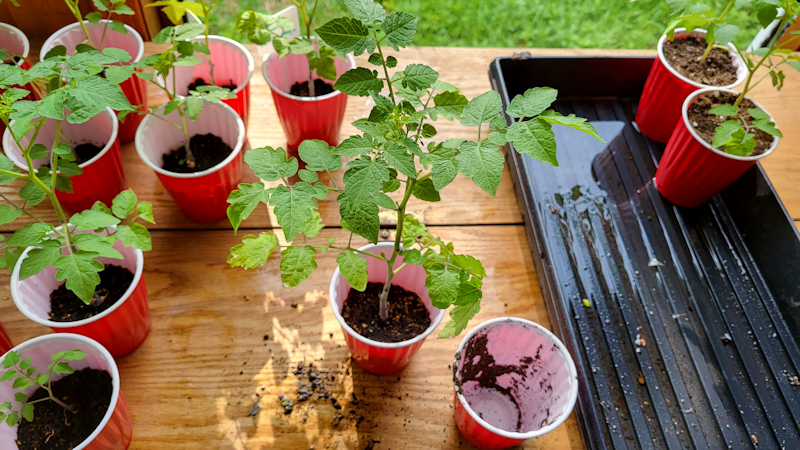
I don’t know if I’ll have the energy to get back out there again today, but I’d really like to transplant the Black Beauty and Indigo Blue Chocolate tomatoes. They are getting quite large, and I’d rather transplant them than pot them up again. That and it would mean a fewer trays to take in and out every day! As it is, there were some Spoon tomatoes that didn’t make it, and removing the pots meant I could combine 3 trays into 2, with some judicious rearranging. When I transplant the bigger tomatoes, I want to transplant some of the onions in with them, too. The Black Beauty tomatoes are determinate, but the Indigo Blue Chocolate are indeterminate, so I need to consider the different types of support they will need. I also need to resist transplanting all of them, if I start running out of space. We had very good germination rates and few losses, and it’s the paste tomatoes that I want to have a lot of. I can always give away the extras! It’s the same for the remaining peppers. We have a 100% germination rate on all but one variety, and of that one variety, there’s only one peat pellet didn’t germinate – and I only planted one seed per pellet!
With the way things are looking, we may have to start doing outside work in the morning and late evening. The hottest part of the day tends to be around 3pm, but stays hot until about 6 or 7.
In my youth, I wasn’t bothered by the heat the way I am now. Makes it harder to get things done!
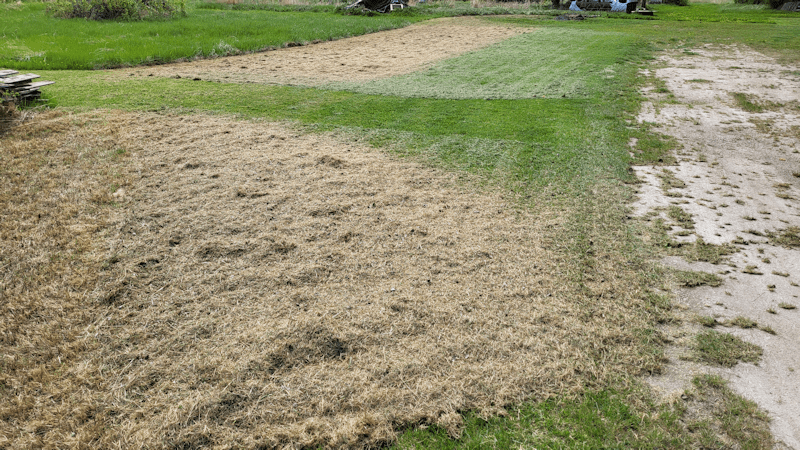
It was too windy to start taking down trees, though from a direction that allowed me to take the transplants out. So instead, I started mowing the driveway and outer yard. The inner yard really needs a mow, too, but not as urgently as the outer yard. That and I had the gate open for a prescription delivery, so that gave me a chance to mow all the way to the road, which is behind me in the picture above.
You can really see how far I had been able to scythe and mow the grass last year, and where I couldn’t. I was basically mowing old hay with fresh grass growing through it, which meant constant back and forthing in small sections to get it done.
This will need to be raked up so it doesn’t smother the grass below. I am quite happy to have it for mulch!
I mowed until I ran out of gas a second time and then just stopped. I was physically done for the day! Thankfully, today was a cooler day – as I write this, we’ve reached our forecasted high of 18C/64F – making it much more pleasant to work in. That’s about average for this time of year. The next couple of days are supposed to be in the 28-29C/82-84F range. The record high for today is 30C/86F, but the record low is -3C/27F, so I’m not about to complain!
Before I started on the mowing, I had to head into town to get more cat kibble. We ran out of outside cat kibble awfully fast for an 11kg bag. I had gone into town a couple days ago and looked for some, but a 9kg bag was almost $44, so I figured I could wait. This morning, however, I finished off the bin for the outside cats – and that was after adding the last of the kibble from a bag for the inside cats. They still have enough in a bin to last until I can do the big shop, plus wet cat food, but there was no more spare for the outside cats.
While I was in town a couple of days ago, which was Victoria Day and a statutory holiday I completely forgot about, my daughter gave me her wallet and asked me to pick up some hoagies for her.
I wasn’t able to do that.
The entire section was completely empty!
I was also finding other sections strangely empty – until I thought about it and realized that the empty shelves were basically all for BBQ/picnic type stuff, including certain condiments. I’m thinking some organization was having a big first BBQ of the year and cleaned out the supply!
So I went to a different store today, hoping to find kibble at a better price. The same brand name 9kg bag was even more expensive, but they did have a house brand that was a reasonable price.
While I was there, I went ahead and looked to see if they had any hoagies. They had lots, but…
… I just about had a heart attack over that price! Those bags aren’t any bigger than the ones the other store normally carries.
Yes, the labels on this brand say Smokies. We call them hoagies.
No, I didn’t buy any.
Yikes!
While I was there, I ran into someone that I know that works there, and he started asking me if I was moving.
Yup. My Facebook thief was at it again, with posts listing items for a moving sale. The same post they’ve sent out at least twice before, that I know of.
I’ve had friends send me screen captures of all the stuff I’m supposedly selling. I had sent a friend request to this person from my new account which, understandably, he ignored. Usually, it’s the friend request from someone already on your friends list that is the fake! So I told him what happened, and asked him to report my old account and any strange posts like this. He then told me that he started to suddenly get Messenger messages from someone on his friends list that were very odd. Asking for help, much like the message that fooled me. He’d been ignoring them, since this was someone who normally never communicates with him, but suddenly he was getting all these messages asking “why won’t you answer?”, etc.
I had also had a chance this morning to talk on the phone with a friend from where we lived before moving here. On seeing strange posts from “me” about giving away a PS5 because I caught my “boyfriend” cheating me, she actually DM’s “me” to ask if I was okay, and what happened with my husband. The thief tried to pretend to be me and said “I” got a divorce because “I” caught my husband (no longer a boyfriend? 😄) cheating on me. It became pretty clear this was not me, and she asked for my husband’s name and where did she live, only to have the person start playing a guilt try, saying things like “why are you asking me all these questions”. So I was able to clear that up with her, too.
When I was outside mowing, the pharmacy delivery driver arrived, and we talked for a while. He saw the “moving sale” I was supposedly having, too. I asked him to report my original page and any posts from it. By this time, because people were getting confused with my new account and old account (my new account’s name was almost identical to my old account) I had changed my display name a bit. Hopefully, people would still recognize that it’s me, but not get mixed up with the old account.
One of the things that I noticed about the screencaps of comments people are sending me, is that there are people showing interest in these items “I” am selling, but I have no idea who they are. They are not on my original friends list. Either they got added after my account was stolen, or the thief is using other stolen or fake account to leave comments and make the scam post look legitimate.
It might be working.
As I was writing this post, I got a message from another friend, with screen captures of someone commenting about the PS5 giveaway, saying he’d take it and offering to pay for shipping. This was an online friend I’d already reconnected with, but not someone I know in person, so I quickly sent him a message, explaining about the screencap of his comments. I thought there might be several possibilities: either he really did think this was me (even though I messaged him about my stolen account after sending a friend request), he knew it wasn’t me and was trying to play the thief, it was being posted by a cloned account, or his account was stolen, like mine was.
It turned out he’d been tricked!
I’m so glad I stopped working on this post to message him right away, because while we were chatting, the thief contacted him and asked for $61 for shipping.
And this is why these scammers steal accounts. Some people actually fall for their fake posts, and send them money, thinking they are sending money to someone they know.
He responded by telling them to F off. Then he sent me the response he got to that…
“You sound skeptic from your last message, that very wrong if you think am here to play you or just trying to take advantage of you. When I know how people work hard nowadays to get money, I will never think of taking someone advantages over you and playing you, please take that out off your mind that is really awful thing on the earth that I will never think about doing.”
As if that weren’t enough, while I was chatting with my friend that sent me the screencaps, and the guy who almost got scammed, I got a message from someone I don’t know, but we have a mutual friend (I have my settings so that “friends of friends” can contact me). They saw the moving sale list and were interested in the 55″ TV and wanted to know the make and model number. How they ended up DMing me to my new account, instead of my original account, I don’t know, but I’m glad it worked out that way. I told them about the stolen account and asked them to report it. When I found out about the other person getting the message about sending money for shipping, I let them know about that, too. Not long after, they let me know that they told my thief that they were reporting them, and the thief took the ad down.
So it looks like, when they make these posts and tag people on my original friends list, the posts show up on their profile pages, and their friends can see it, too. Which would explain the people I don’t know being able to comment on “my” posts – they’re commenting through someone else’s page. The farther removed the viewers are from the stolen account, the easier for them to be tricked, since they don’t know me and wouldn’t recognize that these are not things I would normally post. The friend I talked to on the phone this morning told me she had gone looking through my old profile page, trying to figure out what was going on. She noticed that a lot of things that she saw me sharing in the past (I hit the share button a lot!) were gone, leaving only innocuous posts about Advent or other holidays. Even the posts she saw before, like the one where “I” was giving away a PS5 because of a cheating boyfriend were gone. Those ones get reported so much, Facebook might actually be taking them down, too.
You’d think, with so many people reporting the account as hacked, me reporting it as stolen from me, and even my finally being able to send in proof of ID, Facebook would finally clue in that there’s a problem with this account. But nope. Even with the ID part, where it says the identify confirmation is done by both automated systems and a real human being, did not seem to work. They seemed to think I was trying to recover my new account, not my original account. You have to be logged out to go through this process, but you still start from the “recover your account” stage, where I would have found my original account (which I can do because I got a notification telling me what my primary email address had been changed to, but was never able to use the “if this wasn’t us, click here” option) and gone from there.
It is such a mess, and Facebook has been so incredibly useless. If it weren’t for the fact that someone is actively using my account, pretending to be me, while trying to scam people, this would be the thing to drive me off Facebook completely.
While going through all this, I am hearing from SO many people who have had their accounts hacked, stolen or cloned, or had strange messages from people similar to the one that fooled me.
With Facebook being so useless about recovering accounts, it’s no wonder. The scammers are having a field day.
Which all leaves me with another level of exhaustion. I am wasting so much time dealing with this.
Today has been a nice, cool day, but very windy, with smatterings of rain. So windy, we didn’t dare set the transplants outside. They’re hardened off by now, so they should be fine. I just don’t want to have tomatoes blown half way across the yard!
So we did what we could, and the wind actually helped by keeping us mosquito free. I even had both daughters able to come help me at the same time! My older daughter normally sleeps during the day, but she couldn’t sleep. A night working on the computer left her more than happy to do physical labour outside, no matter how tired she was!
Thanks to the extra help, we got all three beds done in short order!
That black plastic had been on the bed in the foreground for a week or two, but the weeds underneath were too established to be killed off in that length of time. I moved it to the first bed that was complete – only one end is uncovered, because we found a couple of onions while weeding it, and they got transplanted at the end near the grow bags.
I just realized something. I think I forgot my gloves on the high raised bed, after taking this picture. 😆
The bed in the foreground was easily the worst for weeds, but all of these beds are so much better than when we first started gardening in this area! Every year is a little bit better. Once we’ve got the high raised beds set up, we’ll be sure to set aside the soil we’ve been working so hard on, and using it to top up the high beds.
That won’t happen until the fall, though. Until then, we’ll be collecting the materials and getting them ready, so that once things are harvested, we’ll be able to get right at it.
The next priority is to build the new beds and trellis tunnel – though if we just build beds with trellises, and turn them into tunnels later, that will be a good start! These will be permanent trellises, so I don’t mind taking extra time to make sure they are solidly built, but also, we need something to plant in. We have so many transplants and seeds, but not enough prepared beds for them.
In other things, I got a response to my email to the vet about Judgement. They don’t do “walk ins”, but if we can catch him and call them, they will find a way to get an available vet to see him. So, of course, there’s no sign of Judgement, today! *sigh* With not being able to put any weight on that foot, he is very vulnerable right now.
It’s so bright out right now, I didn’t realize it’s past 9pm, and I haven’t done a blog post yet!
I’m tired.
A good tired!
I finally got the chainsaw out and cut down trees that will be used to build our trellis tunnel.
I started out doing some clean up, first. Several of the apple trees that were discovered when I first cleared this area were dead or partly dead. I cut away the dead parts, which left only a couple of spindly trees.
Then I dropped a poplar on one of them!
It wasn’t supposed to work out that way. The tree was actually falling exactly where I meant it to. Then some branches got hung up on another poplar, which just kept bending and bending until the tree I cut down rolled off, directly on top of the apple tree!
I can’t say it’s a loss, though. As far as I know, these trees have never produced fruit, because of where they are. My mother says she planted them, but they were whatever crab apple seedling she found, so it’s unlikely any fruit they produced would even be edible. My mother had no understanding of how apples need to be grafted, not grown from seed, until I explained it to her. To her, it was all about them being “free”. I know my dad grafted apple trees but most of those died, and only the suckers remain.
Anyhow.
Cleaning things up opened the space to get at the trees I was after. Some of them could only fall in one direction – onto the fence! The fence is already breaking apart, so I wasn’t too worried. It actually handled having trees drop on it several times, surprisingly well! The power line that runs from the garage to the outlet on a fence post I was using had a lot of slack, so there was no risk to it.
A couple of the trees that fell over the fence had to have their trunks cut into two shorter pieces so I could get them free of the fence. I made sure to cut them in such a way that the straightest parts of the trunk were still at a useable length for both. Altogether, I’ve now got about a dozen logs, most of which are long enough that I can get at least a couple of lengths for vertical supports out of them.
While cutting down select poplars, I was also able to finally cut up and removed a dead, rotten tree that had fallen three years ago. I needed to clear it to access the last tree I wanted to cut down. While it was too rotten to be useable for building something, it was still solid enough that the wood can be used as fire pit fuel. 🔥🌭 I was even able to remove some of the little stumps I’d left all over the place, waiting until I had the tools to cut them to ground level. I kept them high, so that they could be seen and avoided, though I still found myself almost tripping over some of the shorter ones!
It was 24C/75F when I finally had to stop – and we were still expected to get warmer! The next step for the logs will be to cut them to length for the vertical supports on the trellis tunnel, then drag them over to where the tunnel will be built. We also need to cut down some of the thinner dead spruce trees, which will be used to form mid-height raised beds at the bases of the trellis tunnel. Once we have the materials, hopefully the build will go quickly.
I gotta tell ya, by the time I was dragging that last tree over to the pile, then cleaning up, I was moving real slow! I was certainly glad I remembered to bring a water bottle out with me. Getting dehydrated in this heat would not have been good.
Tomorrow is supposed to be a cooler day, but we’re also supposed to get some rain, so we’ll see how much I’ll be able to get done while using an electric chain saw.
In other things, the transplanted squash and gourds seem to be handling their transition well. Even the Sweet Chocolate peppers are showing no signs of transplant shock at all! That’s quite encouraging. If the weather holds, I might start transplanting out the biggest, oldest tomatoes. The beds they’ll be going into still need preparation, though, so we’ll see. Ultimately, it all depends on the weather.
I think some pain killers and an early bed time are in order, now!
I really hope I didn’t screw up by transplanting these so early. They all need really long growing seasons, though. It was either transplant them, or pot them up, and I really didn’t think they’d benefit from being potted up.
So here it is: today’s transplanting of Zucca melon, African Drum gourd, Caveman’s Club gourd and Crespo squash.
I actually thought I had two Zucca melons to transplant, but when I looked at the label, I saw that the smaller one was a drum gourd. It’s a good thing I labeled them or I would have been in for one heck of a surprise at the end of the growing season.
Assuming these survive getting transplanted. Also, assuming they don’t get eaten by something along the way!
The Re-Farmer
June update: I discovered the file got corrupted somehow, and re-uploaded it. Let me know if you see problems with it! Thanks.