Ah, what a day! As I sit here, I am watching the garage cam’s live feed, as blowing snow covers my daughter’s footprints, from when she closed the gate just a little while go. At least it’s still getting warmer!
FedEx never did show up with our Starlink system.
*sigh*
Hopefully, we’ll get a call or email tomorrow to tell us what happened.
We did, however finish making the pierogi!
Gosh, it’s been so long since I’ve made these, they are the ugliest pierogi, ever! :-D
We also have a huge amount of potato filling left over, even though I made a double recipe of dough. I keep forgetting just how little stuffing fits inside a pierog. We did make extra deliberately, though, and as I write this, the girls are using some of it to make supper.
No, we’re not having pierogi for supper today. Those are cooling off in containers for the fridge. I had thought I’d have enough for the freezer, but it turns out I would have needed to quadruple the dough, and I won’t be doing that. I was in enough pain by the end of it, with just the double batch!
Anyhow, this is how we make our loaded filling.
The potatoes are basically our usual mashed potatoes, except on the dry side. They can be completely plain, too, or maybe seasoned with just salt, but we to include butter, milk and sour cream, and whatever else we have on hand and strikes our fancy. My daughter added a dash of hot sauce to it this time; just a tiny bit, because she knows I have no tolerance for spicy foods.
While she worked on the potatoes, I cut bacon into very small pieces, then cooked them over medium low heat in a frying pan until crispy and the fat was rendered out. The bacon pieces then got removed with a slotted spoon onto paper towel to drain and cool down.
I then added a bunch of mushrooms, cut into little pieces, to the bacon grease and cooked those on medium heat until almost crispy. That can take a while, as they release quite a bit of moisture as they cook. I used white button mushrooms this time, but usually use crimini. Any fresh mushroom would work, I’m sure.
Once done, the mushrooms were removed with a slotted spoon onto paper towel to drain and cool, just like the bacon.
After that, I poured off some of the bacon grease, until there was only about 1 or 2 tablespoons left in the pan. To that, I added about the same amount of butter, then added onions, chopped fine. The onions can be cooked until translucent, but I decided to caramelize them this time. Near the end of their cooking time, I added a bunch of garlic I’d put through a garlic press.
All of that got mixed in with the mashed potatoes, then the entire pot was put into the old kitchen, which is at freezing temperatures these days, to cool down.
The filling didn’t need to be completely cold before I added the cheese, but I did want it cooled enough that it wouldn’t melt the cheese. Here, I’ve got some old cheddar and goat cheese. I’ve made these using Montery Jack, which worked out very well. Any sharp cheese can be used. A mild cheese would just disappear among the other flavours.
The dough was made using a basic recipe I found online. I like a dough that uses sour cream, but we didn’t have enough for a single recipe, never mind a double, so I used one that was just flour, salt and butter melted into boiled water. The fun part is kneading it. Pierogi dough has such a wonderful texture!
When it was time to start making the pierogi, I just made a mess of things! LOL The first ones I made were massive. I was shooting for three inches square, but I was probably closer to four.
Yes, I do squares folded into triangles, instead of cutting rounds. It’s faster that way, and there’s less dough left over that has to be rolled out again.
The next batch I did went the opposite way, and were far too small. Some of the squares were more rectangles and ended up being folded into smaller rectangles instead of triangles. :-D
My daughter started boiling the first couple of batches while I finished up the last ones. At the very end, when there was just enough dough to make three pierogi, I made three balls and rolled them out individually, so we got a few half-circle ones, along with the triangles and rectangles! LOL
After they were cooked and drained, we tossed them in olive oil, salt and pepper, then I split them up into take-out containers to finish cooling down.
I suppose I should have tasted one, but I was so focused on getting them ready to put away in the fridge, I didn’t think of it!
Let me remedy that.
Oh, my goodness! They turned out great!
The main reason I chop everything that goes into the potatoes so small is so that each pierog will have a bit of everything in it, and you can really taste each ingredient in there. Of course, with the onions and mushrooms fried in the bacon grease, the bacon flavour runs through it all, but without being too dominant.
The dough is nice and toothsome. I like a good, thick dough. Not too thick, of course, but I remember that even as a kid, eating my mother’s pierogi, my favourite part was the outer edge of dough. I would have liked a sour cream dough better, but the plain dough is still excellent. When we eat these later, they will be pan fried in butter, and that will make them even better!
Who cares if they are all weird sizes and shapes? They taste great!
While today has warmed up, this morning was a bitterly cold -26C/-15F!
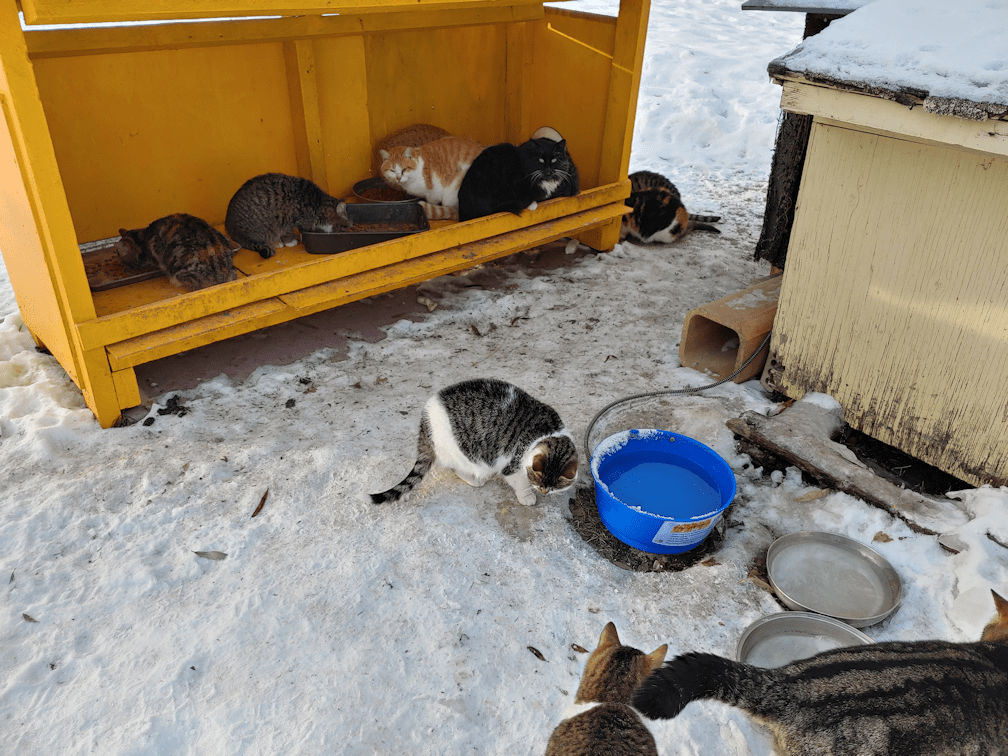
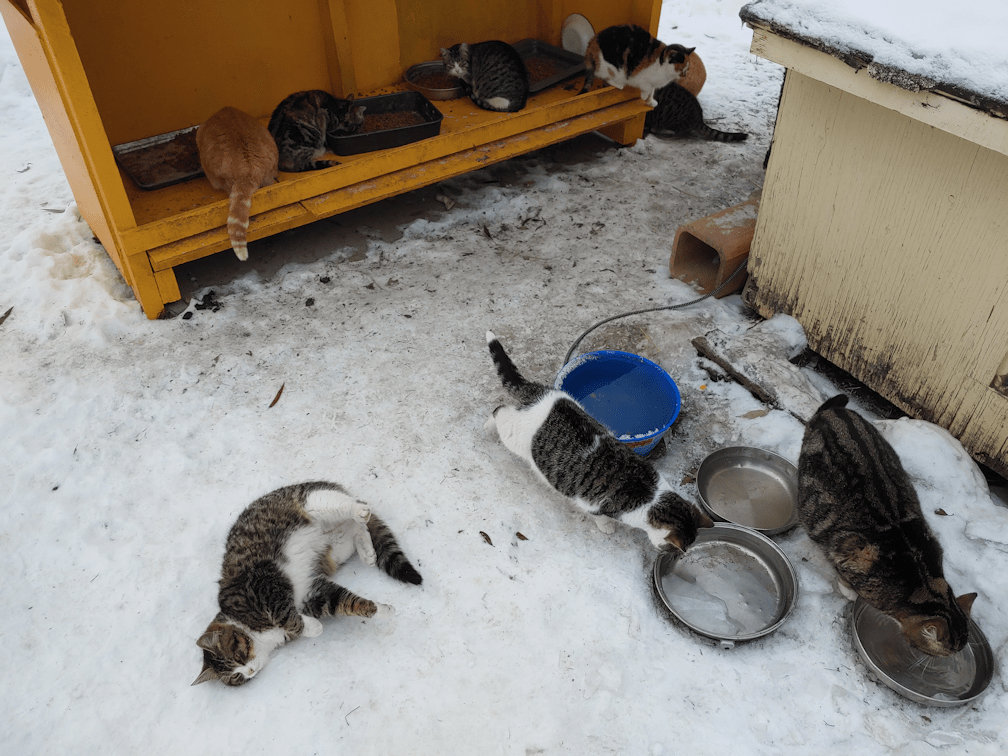
The outside cats still had food in the kibble house, but it was warm water that they were really wanting! Yes, heated bowl ensures they have water to drink, but it isn’t as warm as the water I top it up with.
Agnoos popped outside with me, but was more than happy to join Tuxedo Mask in the sun room again when I went back inside!
Since Tuxedo Mask’s other eye as started to get leaky, both of them got drops this morning.
One of the things I made sure to do this morning was to unlock and open the gate for the FedEx driver with our Starlink equipment. With the current conditions, we can be pretty sure our vandal won’t suddenly show up.
As we waited, I got our tree hung up on the dining room door. At this point, it’s only got the star at the top, because it’s the most awkward thing to put on. I have caught several cats under it, stretching as tall as they can to reach the bottom of the tree, which is wrapped like a gift, complete with bow. They can’t reach it and, so far, none have tried to jump at it. We’ll add the lights next, leave it for a day, then the garlands, leave it for a day, and if the cats seem to be behaving and getting used to it being there, finally finish decorating it.
Still no delivery.
In the afternoon, while it was still light out, our prescription refills got delivered.
I decided to make pierogi – something I haven’t done in many years – and my younger daughter has been helping me prepare the filling. I’ve got my own preferred mix, and it’s pretty loaded with stuff. :-D That has filled most of the afternoon and into the evening.
Still no delivery.
Leaving my daughter finished the filling, I started on the dough. It’s at the resting stage now, and I just helped my daughter move the filling to the old kitchen to cool down faster. I’m taking a break to write this, and then I’ll go shred some cheese.
Still no delivery.
In theory, we could still expect them to show up within the next couple of hours, still, but it’s full dark right now, snowing and blowing. I’m keeping an eye on the garage cam live feed but, at this point, I would be very surprised if the delivery actually happens today. So far, my husband has not received any notifications about it. We shall see. I do hate leaving the gate open like that. Especially after dark. :-(
Well, it’s time to get things ready to continue making the pierogi. I started really late for such a big job, but I’ll be heading to my mother’s tomorrow. Since there is no spice cake left to bring over for her to try, I think I’ll bring some pierogi. :-)
At least I thought it was, until I finally sat down and looked at the time. It’s pitch black out, and I was expecting to see something close to 9pm, but nope. It was barely past 6.
I am looking forward to when the days start getting longer again!
Of course, the day started with feeding the critters. Tuxedo Mask and Agnoos’ water bowl was frozen over, and they were very happy to have a warm water top-up! Agnoos, however, wanted to go outside. Tuxedo Mask wasn’t going for the door, so I let Agnoos out for a bit. He immediately ran onto a pile of snow from shoveling paths, hunkered down and stared at me. :-D
He did eventually come back to join the others. :-D
Including Chadicous, trying to trip me, as usual.
After the critters were fed, I made a quick run to the post office; I had to wait long enough to give them a chance to sort through the new mail, but I also wanted to get there before they closed for lunch, because I really didn’t feel like going out again when they reopened at 2! My husband is expecting the paperwork from his insurance company that he has to fill out every year, to let them know that yup, he’s still broken. At least he no longer has to get a doctor to sign off on it anymore, once it was obvious his disability had become permanent. He just has to let them know that yes, he is still under a doctor’s care. Which is getting harder to do, since it’s all phone appointments now, and he hasn’t even been able to get his bloodwork done. A few times we’ve tried, he had to turn around and leave before he ever reached the reception desk, due to pain, because of the long line up caused by restrictions. When he finally was able to get to the desk, he turned out to be missing his health card and, even though they knew who he was, they couldn’t do his bloodwork. Mostly, though, he’s just been in too much pain to make the trip to the lab.
The paperwork from the insurance company wasn’t in, but we did have a few packages. One of them was a couple of small ceramic heaters for the girls to use in their “apartment” upstairs, which gets so incredibly cold in the winter. The heater we got for them a couple of years ago had given up the ghost. This time, instead of one heater they had to move from their bedroom at night, to their studio during the day, they’ll be able to have one for each room.
I got a lovely surprise package in the mail.
It was my prize for scoring so high on my firearms safety exam! A lovely hoodie, with a pouch style pocket in the front, and our instructor’s logos on the front and back.
I had to giggle at the sleeve, though! Too funny!
After I got home from the post office, I did the rest of my morning rounds. Mostly. It was so cold, I didn’t bother trying to switch out the memory card on the sign cam. The LED screen inside doesn’t work when it’s cold like this, so I would have no idea if the micro-disc card was seated properly, or if it wanted me to format it again. I can sometimes get it to work if I warm it up with my hands, but I really didn’t want to stand in the wind for that long. I did the gate cam, which doesn’t freeze up like the newer one, but the card kept erroring out. I think moisture got into it at some point, and the contacts are damaged, because it works again when I take the card out and re-seat it, pressing it in hard. This time, it just did NOT want to read that card! I finally got it working, but by then, my finger tips were dangerously cold. This is not something that can be done with gloves on.
Meanwhile, my younger brother’s dog had come over for a visit. It’s been a while, and I was happy to see him. The cats, however, were not at all happy with the big, shaggy beast that kept wanting to play!
It did give me an opportunity to get a photo of Cabbages, sitting above dog height. Her eye has cleared up nicely though, as you can see, it’s still leaking quite a bit. There is no sign of redness anymore.
I’m seeing the forecast for Sunday is now up to 2C/36F! The cats will really appreciate the warmth. Today is supposed to be the last chilly day, and then it’s supposed to stay above -10C/14F, for a week, and even when the temperatures start dropping again, they’re still expected to be above -20C/-4F. Even the expected lows aren’t going to be much different. The cats will like that. And so will we, when our Starlink system comes in. Apparently, it’s going to be delivered by FedEx tomorrow! It was originally supposed to come by mail. It would be too dangerous to try and access the roof right now, even if it’s just the edge of the much lower sun room roof, so we might have to wait a few days. This is a bad time of year for it to come in! Which is okay; saving a couple hundred dollars a month will be worth it – if it works! Since it’s hard to tell which satellite dish is for the primary account, and which is for the secondary, we decided we will simply suspend both accounts (there’s just a $25/month fee per account that way) while we make sure the Starlink is working. If it does, we’ll close both of our current accounts and return their routers. If it doesn’t, we’ll put back whichever of the dishes we take down (we should be able to use either of the existing supports for the Starlink dish) and reactivate the accounts.
With the running around this morning, it was a while before I could snag a daughter and do Tuxedo Mask’s eye. The sun room is chilly enough that his other eye has started to leak a bit! I’d gone into the sun room ahead of my daughter to snag Tuxedo Mask and found him in his spot under the heat bulb, looking out the window.
Agnoos was outside the window, looking back at him, his front paws on the glass! He saw me and started bobbing his head around, looking into the sun room. So I went and opened the inner door. As soon as he heard it, he came running. When I opened the outer door, he slithered under it and into the sun room before I could open it all the way!
I think Tuxedo Mask was quite happy to see his brother, and they both wanted all kinds of cuddles!
The only problem is their new habit of sitting on the board the heat bulb fixture is attached to and hanging down from. It’s a good thing we can see into there from the bathroom window, because I discovered it knocked off its support. I set it back up and secured it with a small Bungee cord, but in having to keep it well away from the fixture, it would still slide around when they jumped off. When I had the chance, I put pieces of rigid insulation we have from a cat condo we made with cardboard boxes, a couple of winters ago, to make walls around the bottom of the mini-greenhouse frame I’m using the hold the heat bulb. They won’t be able to see out the window from there anymore, but it’ll be warmer. I cut a piece of insulation into two, to put on the shelf that’s supporting the board the heat bulb is on, one on each side of the board, in such a way that they will stabilize the board and also give the cats more space to sit on and look out the window, while acting as a roof to help keep them a little bit warmer under there. Between that and the box nest, they’ll be nice and toasty, even as the temperatures drop.
My husband, meanwhile, cut holes in the sides of the boxes the packages came in, to give to the cats to play in. Which I did not appreciate, since I was in the middle of cleaning at the time. He dropped them in the space I had just opened up in front of where the Christmas tree will be hung! LOL
They were, however, perfect for the sun room.
The brothers were quick to explore one of them! :-D
My big job for the day was to get things ready for decorations. Normally, we would at least have the tree up by now, and have started decorating, but this year, the only thing we’ve got set up in the Advent wreath! I decided to shift some furniture around, after vacuuming the living room carpet. While moving smaller things aside, I got distracted by the cat scratcher. It’s just a post on a base. The post originally was wrapped in carpet, but when that got torn off, my husband got some sisal rope to wrap it in. It has since been re-wrapped a few times, but the cord keeps sliding to the bottom when the cats use it. Today, I decided to save our furniture a bit and fix it, using adhesive all over the post. That took a while, but I think it was worth it. It should no longer slide down! However, the adhesive needs 24 hours to cure, so I had to hide it away until tomorrow.
That distraction meant it was a while before I could finally start vacuuming – only to discover the beater brush on our new vacuum cleaner isn’t working! Everything else was working fine, though. I figure the belt broke, but would have to take it apart to see. I decided to just use it as it was and leave dismantling the base for another time. It meant having to run it back and forth a lot more often. With our 1970’s shag carpet, it wasn’t going to be a good cleaning at all, but I’d at least be able to get some of the cat hair off the top. LOL
Not only did this end up taking a lot longer than normal, but as soon as I started, my rotator cuff in my right shoulder decided to let me know it was injured. Except I haven’t injured it. I have no idea why it was hurting! So on top of having to take extra long to vacuum the carpet with (I’m assuming) a broken belt, but I had to do most of it using only the one arm.
Oh, and move furniture, too. Not much, mind you, but enough to make things even more “fun”.
The most frustrating thing was pausing half way through the vacuuming and using this opportunity to take out a power bar with an extremely long cord my husband got a while back. There are not enough outlets in this house, and the one that’s being used to light the aquarium greenhouse is the only one on that side of the living room, and has only one working plug. So for my husband to have a light on his desk, where he does his leather work, he had to use the only other available outlet, which is on the opposite wall from the aquarium greenhouse. He picked up one of those big power bars that has three rows of plugs, facing different directions, plus USB ports. It had a cord long enough to run behind the piano and the large aquarium greenhouse to the corner of the room, then behind the small aquarium greenhouse, a plant table, the TV and DVD shelf, to the outlet in the opposite corner.
It was very handy, until it stopped working.
Then it started working again.
Then it stopped working for good.
So today, I pulled out the cord, starting at the plug end by the TV, only to get hung up at the corner where the aquarium greenhouses are, fought with it for a while, eventually having to pull the cord through the cabinet the large aquarium sits on, before freeing it from whatever it was caught on in the corner and finally being able to pull it from the other side of the piano.
Which is when I made a discovery.
It was two power bars.
Yeah. I know. You’re not supposed to plug a power bar into a power bar.
The big one that I thought all that cord was attached to did have a longer than usual cord but, somewhere behind the piano, it was plugged into a regular sized power bar with a super long cord.
Once I got them both out, I tested them.
They both worked just fine.
What I think happened is that the cats stepped on the switch on the bar behind the piano, turning it off. So when we tested the outlet and it was working fine, we figured something had gone wrong with the power bar. We were confused when it suddenly started working again, and now I figure a cat must have stepped on the switch again, turning the smaller power bar on again, only to have them turn it off again later. With it working sporadically, we tucked it to one side, figuring maybe a cat had peed on it or something.
Nope. It most likely had just been turned off in a place I didn’t even know existed until I fought with the darn thing for nearly an hour.
So frustrating.
Anyhow.
While working on the living room, furniture got shifted so I could fit the extra chairs from the dining room and store the bins for our Christmas decorations out of the way. Then, when I had the chance, I put large cup hooks in strategic places along the walls the power bar cords had run along before, well above the floor, attached the big power bar to the wall above the work desk, then set up the one with the super long cord, running it from hook to hook behind the piano, aquariums, TV, etc. and plugged it in.
My husband can now have a light at his work desk again.
And you know what?
That thing is juuuust long enough that there is no need to use the big power bar.
Oh, sure, we won’t be able to plug in USB cables to charge phones, but that just means we can set the big power bar up somewhere else, if we want to.
No more power bar plugged into a power bar.
With all that finally done, I was able to prep the space in front of the dining room door, where we will be hanging the Christmas tree, flat against the door and high enough off the floor that the cats won’t get at it. That worked very well, last year!
By the time that was all done, I was completely wiped out. So was my younger daughter, who baked three double batches of bread and buns while I was doing this. My older daughter was working on her quick commissions. A couple of times a year, she opens a limited number of slots for relatively simple commissions, for a quick turnaround time at discounted rates, skipping the usual back and forth for details. She has a lot of repeat customers that wait for these to get digital art as gifts, so the slots fill up fast. Which means she has a whole list of commissions to get done in a very short time. She worked all day, but when she came down to start another pot of tea, she told me she had just realized she’d a mistake on a commission. Instead of being done for the day, she was going to have to go back to work.
Well, at least she’s warm while working, thanks to the heaters that arrived today. In the summer, she had to work at night because it was too hot for electronics during the day, but now it’s so cold up there, they both have had to bundle up in blankets at their desks, and the cold was even affecting her drawing hand.
Tomorrow, we should be able to set up the tree and start decorating for Christmas!
The link should open in a new tab, so you won’t lose your place here. :-) Also, the photo at the link is completely different from what the recipe results in!
Of course, I had to do some modifications, so here, I will talk about what I changed.
In the ingredients:
It called for 1 cup of dark honey. I didn’t have dark honey. In fact, I didn’t even have a cup of liquid honey. What I had was some of my cousin’s creamed honey. I have no doubt using it will change a few things, from the colour to the moisture to the flavour, but I don’t expect them to be a big deal, and considering how my cousin makes his creamed honey, with a hint of maple syrup, I expect tasty results.
The next change was the 8oz, or 2 sticks, of unsalted butter.
I honestly don’t get the “sticks” of butter thing. I mean, yeah, I do see them in the stores, but my goodness, it costs more to buy butter in sticks than in pounds.
One stick equals a quarter pound of butter, or half a cup, so the recipe is calling for a cup of unsalted butter.
I don’t have unsalted butter. Just salted butter.
Usually, when I see a recipe that calls for unsalted butter, and I use salted butter, I would reduce the amount of salt elsewhere in the recipe.
This recipe doesn’t call for salt at all.
I’m not concerned. A touch of salt can wake up sweet things, and for the amount of salt in the batter, with no other salt in the recipe, we’re not going to have a salty cake or anything.
We were pretty much out of ground cloves, so for the 1 tsp in the recipe, about 3/4 of it was from whole cloves I ground in a coffee grinder.
The recipe also called for dark brown sugar. We have just plain brown sugar, or “golden” sugar.
The instructions mentioned beating mixtures at low speed, so it assumed an electric mixer would be used, but I didn’t want to fuss with it and did it by hand.
The instructions said to pour the batter into prepared loaf pans and bake at 350F for 45-55 minutes, or until a toothpick comes out pretty much clean. All ovens are different, so I set the timer to 50 minutes, then checked it with a steel chopstick. Because of course, I don’t have toothpicks.
It came out with batter stuck to it, so I added 10 minutes, then tested again.
Then I added another 10 minutes and tested again.
Then I added another 5 minutes and tested again!
Finally, the chopstick came out clean!
I don’t know why this took so much longer to bake than the recipe stated. Going from 45-50 minutes to 75 minutes can’t be completely put to differences in ovens. Whatever the reason, if you try this recipe, make sure to do the toothpick test (or chopstick, as the case may be) to ensure it’s done!
Doesn’t that look pretty? And the smell while baking was wonderful.
After letting it cool, I just had to taste test it for this post. :-D
As far as texture goes, it’s more “banana bread” than “cake”. It has a slightly crisp crust outside, with a lightly dense, spongey inside. The combination did make it a bit harder to cut! :-D
While sweet, is it nowhere near as sweet as I expected it to be! Not with so much sugar and honey in it. Using the salted butter was fine; there was no noticeable salty taste. I also don’t really notice a coffee taste, either, even though there was quite a bit of strong coffee in there. All the flavours blended together quite nicely, and no one flavour stands out more than the others. I found spreading a little bit of butter on my slice brought out the flavours, more.
It’s also drier than I would expect either a cake or most quick breads to be, though it is definitely moist.
From what I’ve read in other recipes, they can become moister with time.
I don’t expect these to last long enough for us to find out. :-D
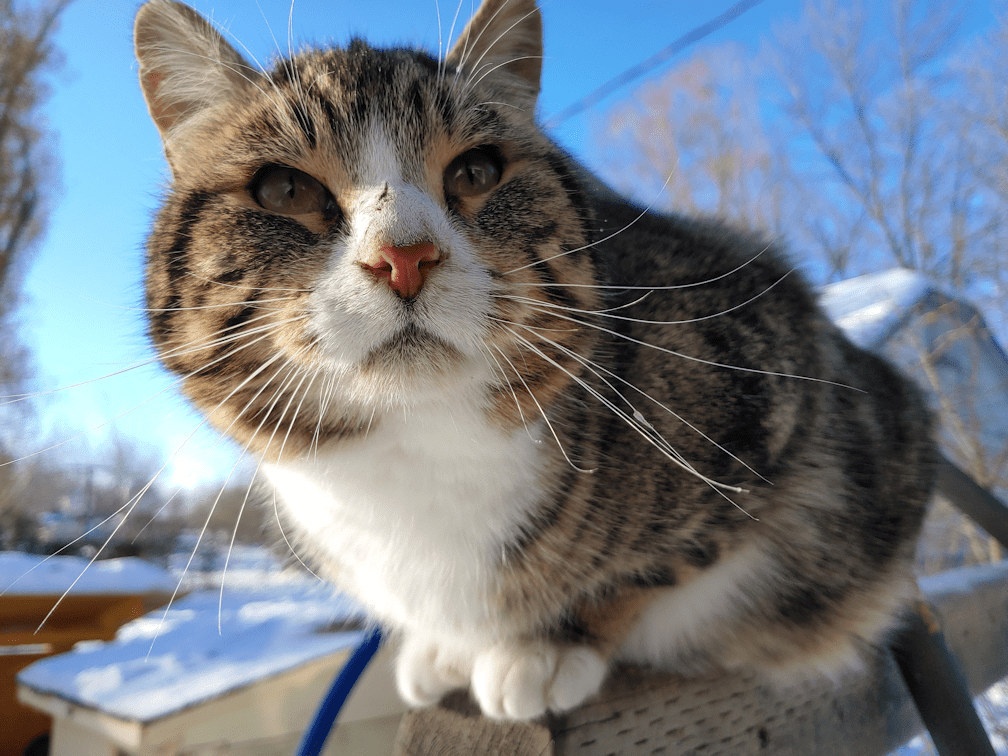
I had to dash outside to do a meter reading, and the boys dutifully and adorably posed for me!
Aren’t they sweet?
Doesn’t Tuxedo Mask’s eye look great? It’s his left eye that was affected.
That, however, is not my news.
I finally got a call back from our vandal’s lawyer. He was quite apologetic for not getting back to me earlier, due to conferences he ended up going to all week. I laughed and told him I was starting to think our vandal had fired him, and he assured me that did not happen. :-D
So it turns out that our vandal somehow did not understand some of the wording of the conditions. I know the lawyer spoke to him about them before, but I guess once things were written down in the form of a court order, it seemed different? I don’t know, but I’m not surprised he wasn’t able to understand them. He has always had such difficulties. Did very well in spite of them, so this is not a knock against him. The judge gave him time for the lawyer to go over it with him, and he’s back in court this Friday. I do not need to be there, but the lawyer said he would be there (I believe he attended by phone, previously). He assured me he would update me with an email after it was done, and was confident our vandal would accept the conditions to a Peace Bond.
I did ask about the psychiatric assessment, for which our vandal is on a waiting list, and the lawyer said that this was a separate matter and still ongoing. Accepting the conditions of a Peace Bond does not change that. That is encouraging. I really hope this puts him on the road to getting the mental health help he needs.
On a more pleasant note, today is St. Nicholas Day, and I decided to make some Polish spice cake today, instead of our usual spice cookies. The recipe was enough for two loaf pans, and is in the oven right now. I will have to set some aside to give to my mother, when I go over later in the week. It’s an interesting recipe that included strong coffee – which my daughter made for me in her French press, because I don’t do coffee – a cup of dark honey AND a cup of packed brown sugar. This is going to be sweeeeeetttt!!!! It also called for a teaspoon each of cinnamon, nutmeg and cloves. We had just dregs of ground cloves left, because I couldn’t find any in the stores, so I used our little coffee grinder (which is never used to grind coffee) on some whole cloves. Freshly ground cloves are very different from store bought! You can really tell the higher oil content. That should really come out in the flavour, I think. Apparently, it tastes even better after resting for a few days. I’ve never had this kind of cake before, so I’m looking forward to trying it out. :-)
It was pretty nippy this morning, with the temperatures dropped down to -26C/-15F. Thankfully, with no wind chill! That’s the coldest we’ve had this winter so far (and yes, I know; technically, we’re still fall), and the coldest we will be for the next few weeks, at least. As I write this, my desktop tells me we are at -22C/-8F with a wind chill of -30C/-22F, but my phone’s app tells me we are at -20C/-4F with a wind chill of -23C/-9F. My phone app seems to be the more accurate one.
With the cold, I did a short version of my rounds, mostly just making sure the critters had fresh food and warm water. My older daughter assisted with giving Tuxedo Mask his eye drops, then stayed with him to make sure he didn’t get out, as I had to go in and out of the sun room. It got cold enough that his water bowl actually froze! My daughter put some pieces of rigid insulation on the concrete floor in a few strategic places.
We also decided to allow Agnoos into the sun room to keep Tuxedo Mask company. They are brothers from the same litter and get along, and Agnoos already allows us to pick him up and cuddle him, so he was the least disruptive choice.
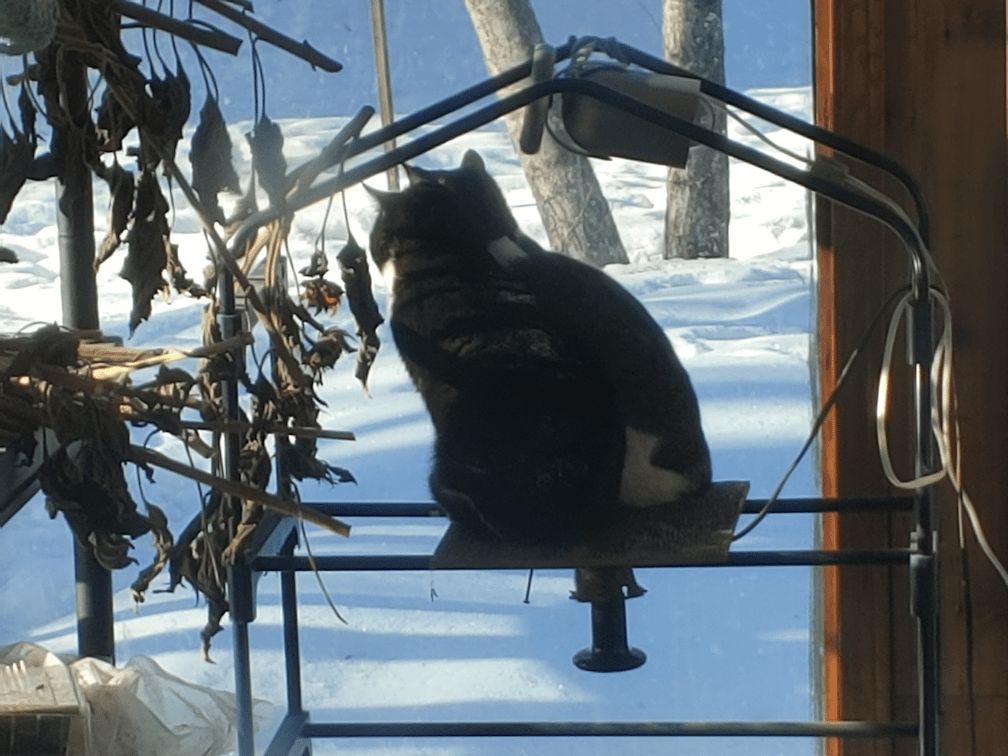
I just spotted this, outside our bathroom window.
They are just smooshed together, on top of the board the ceramic heater bulb is mounted to! Something out there sure has their attention!
Oh, I am extra glad we don’t need to go anywhere, tomorrow!
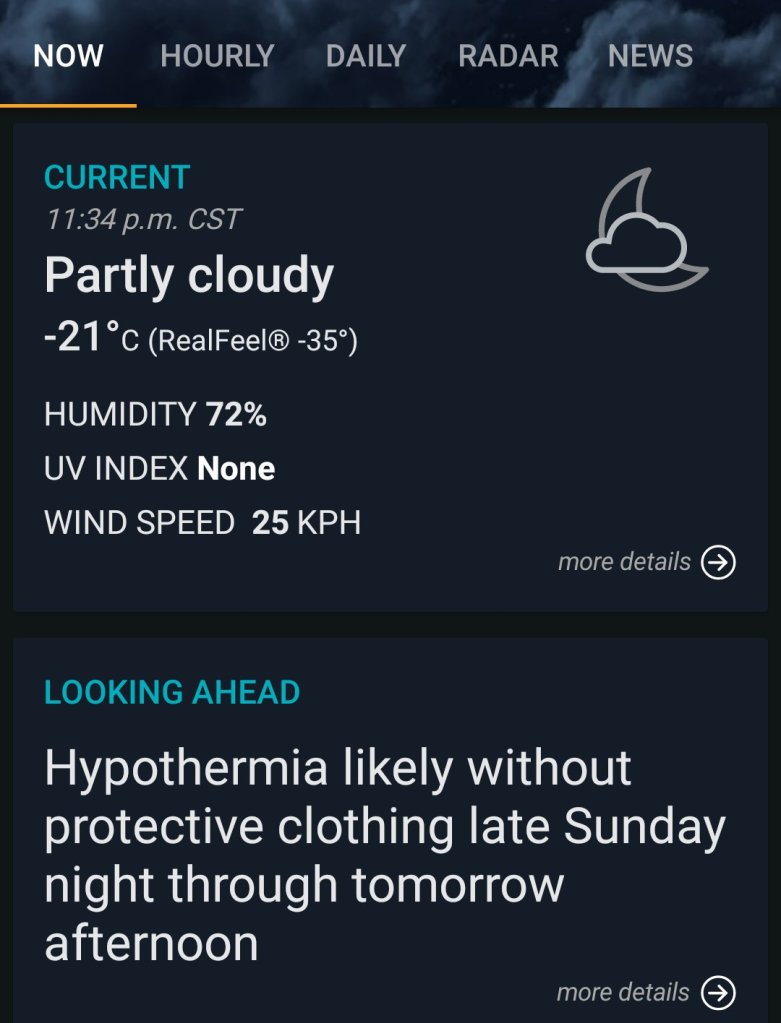
The -21C is not too big of a deal.
The wind chill at -35C is a whole different story!!
That’s -6F with a wind chill of -31F, for those of you in the US.
On the plus side, tomorrow’s predicted high is now -17C/1F tomorrow, which is a few degrees warmer than previously forecast. Looks like the cold swept in faster than expected.
By Thursday, we are supposed to warm up to -1C/30F.
Tuxedo Mask is doing just fine. His eye is looking good, and he’s been more active. The girls treat his eye in the evenings, then top up the kibble for the outside cats. He hasn’t been trying to dash outside, but he has tried to get into the old kitchen! He has also, I’m happy to say, started to use the litter box a bit. Hopefully, he’ll start using it all the time, so we’ll have less of a mess to clean up when things start to thaw!
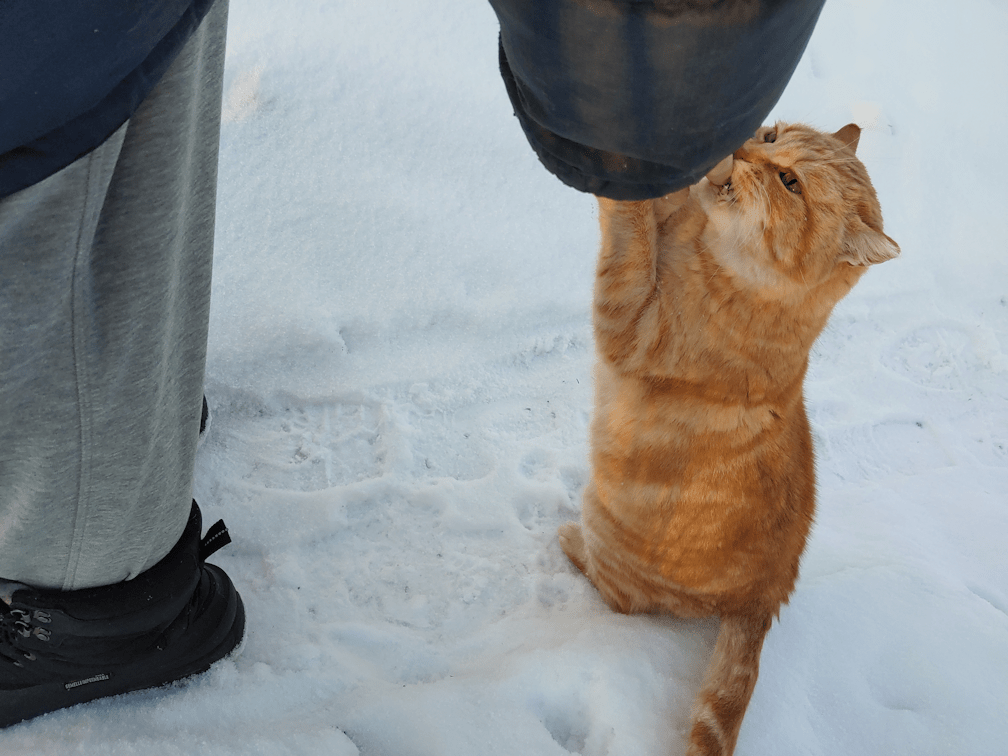
Chadicous, meanwhile, has taken on the job of trying to kill me, by flinging himself tragically in front of my feet while I am walking! :-D
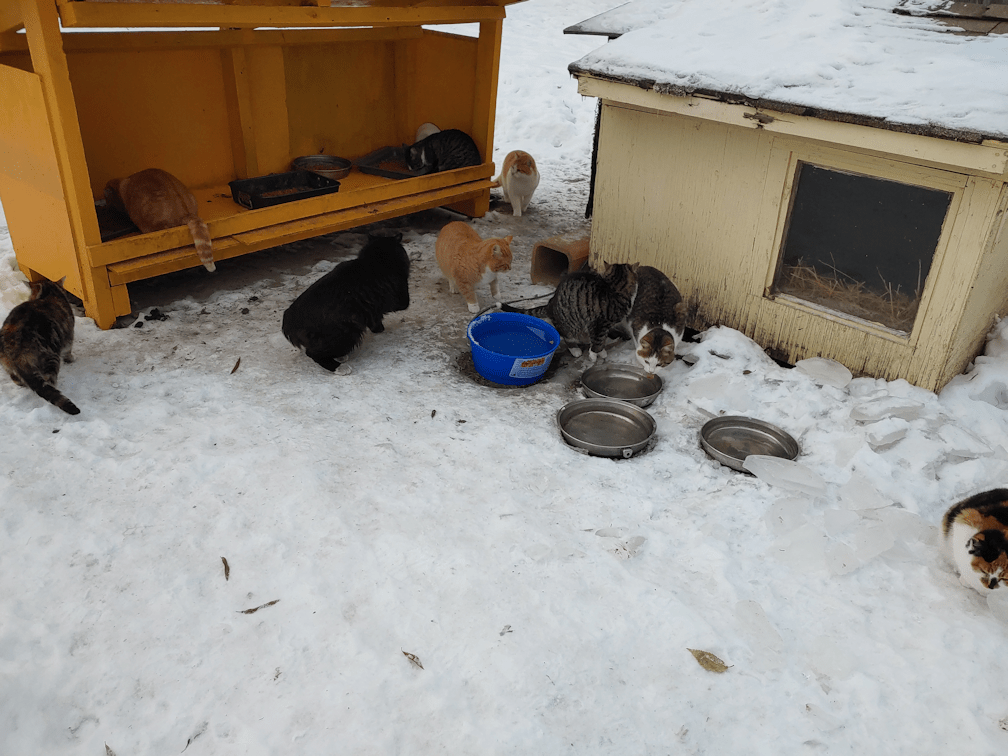
The other cats, meanwhile, mill about so much, I can’t get a head count! The most I got was 17, including Tuxedo Mask.
After I was finished my rounds, I was in a bit of a quandary. We haven’t done the rest of our big shopping yet, and while I would have preferred to go tomorrow, temperatures are supposed to drop dramatically. I really don’t like driving this time of year. I am just too paranoid about our older, fragile van with way too many miles on it. It’s actually done really well by us, but we’ve had too many unexpected vehicle problems too many times over the years, and it’s a whole lot different to have those problems in the city, compared to having them on the side of the highway in the middle of nowhere.
I procrastinated enough that I got the phone call from the ranch we’re getting our quarter beef from. The final hanging weight turned out to be 125 pounds, and she wanted to go over what cuts I wanted. The lower weight meant we over paid by about $50, too.
Apparently, I made things really easy for her. She’d emailed me a list of available cuts, and I just said “I’m good with a little of everything; feel free to surprise me.” LOL So that’s what we’ll be getting; a little of everything! We’ll have ground beef, stewing meat, several types of steak, several types of roasts, and even soup bones. I’ve never made bone broth before, and I’d like to try it. I also went with having the cuts wrapped in paper, rather than the Styrofoam and plastic; paper wrapped last longer in the freezer. It was a little bit extra per pound, which worked out to $10 for the whole order, but I had that credit, so that didn’t matter. At the end of the call, she asked me if I wanted her to etransfer the credit back today, and I was all, nope! I’d rather get more meat! They are low in inventory this time of year, and will be for a few more weeks, but when I asked about sausages, I had several types to choose from. The family really liked their breakfast sausages, so she said that, for the $50 credit, that would about 5 packages of sausages. I said, you mean for $40, right? She had forgotten about the extra charge for the butcher paper wrapping! Once she remembered, she said that’s okay. We’ll squeeze in 5 packages for you! :-D
So she will pass on the list of cuts to the butcher and, at this point, they are expecting to get the cuts around the 20th or 21st. She’ll contact me again to arrange how we will get the meat.
Meanwhile, I’ve also been talking to our neighbour about getting a half pig. They take orders in the spring, so they know how many extra animals they need to rear for fall butchering. A half pig would get us about 70-80 pounds of butchered meat.
In the future, we would like to buy in larger quantities, but for that, we’ll either need a second freezer or do a lot of meat canning!
Or both. I’m good with both. :-D
Once the call about the meat order was done, I headed out to do the shopping. It’s mostly the larger, heavier stuff we couldn’t set enough of, like the big dry cat food bags. It doesn’t take long to fill a shopping cart with those!
When I first headed out, things were looking fine, though the closer I got to the smaller, nearer city I chose to go to, the less visibility there was. By the time I was driving home, we had blowing snow. The roads, for the most part, were still good, but there were a couple of places where it was starting to accumulate. I was quite glad I’d left when I did!
I got a message from my brother while I was driving home, and it turned out to be some video. He had gone out to visit my mother and go to church with her (he does that often enough that he’s considered a member of the church, but with the way the restrictions still are, I probably wouldn’t be allowed in the door anymore). He convinced her to practice driving the motorized chair they got for her, and it was pretty cool to see video of her zipping around the lobby in her building.
Hopefully, the roads were still good for his drive home! We’re now seeing news stories about blizzard like conditions expected to the south of us, and my brother’s place is in the region.
I left just in time!
The temperatures are supposed to be quite bitter tomorrow, then whip right back up to just below freezing a couple of days later! My mother had asked me to pick up some honey from my cousin, which I was able to do yesterday (while picking up some creamed honey for ourselves). She said I could bring it over the next time I came to help her with shopping. My brother did take her to the grocery store today, so we decided to wait until Thursday, when it’s supposed to be much warmer, and I’ll come over. By then, she might be running short of a few things again. I brought up that she might want to stock up more than usual, since prices are expected to go up, and shortages are expected. When I explained about shipping and transportation problems, she dismissed the concerns. We have enough in our province and will be fine, she said. She just can’t understand that what we have in our stores are brought in almost completely from the port in Vancouver, which has been devastated by recent flooding, and the US, which has its own transportation and supply issues. This is all far away, so it can’t affect us, right?
*sigh*
Well, if necessary, between my siblings and I, we will be able to give her stuff if the local stores run out. We did find, when shortages happened last year, that the cities were harder hit than smaller communities, so hopefully, it won’t be an issue.
Meanwhile, I am more than happy to hunker down for a few days, and not go anywhere!
For now, I will enjoy warming up with a big mug of Rooiboos, and an arm full of cat making it difficult to type, and have a nice, quiet evening!
I’m happy to say that Tuxedo Mask is looking so much better!
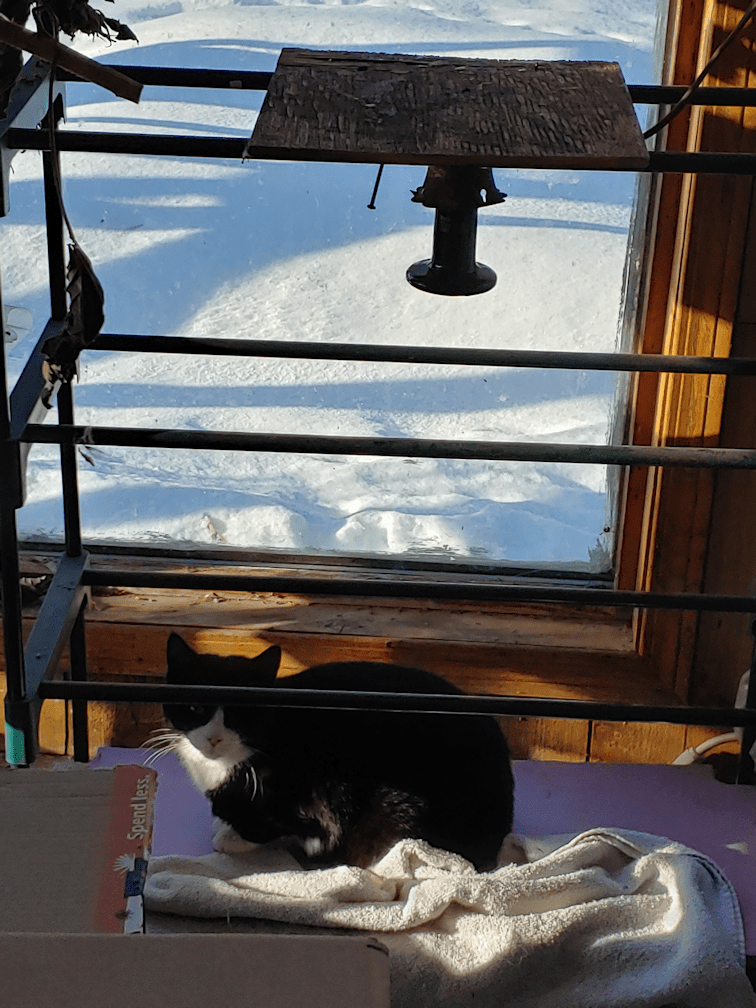
This has become his favourite spot, under the ceramic heat bulb.
Unfortunately, he’s still not using the litter. My daughter took a look this morning, and it seems he’s just going on the concrete beside the litter box.
*sigh*
At least the room is cold enough that it’ll be pretty much frozen, and will freeze completely once we are no longer using the heat bulb, until we can clean it up.
Somehow, I never thought I’d be using the mini-greenhouse frame like this. :-D Now we’ve used it to help convalescing critters a couple of times. It works great!
When putting in the eye drops this morning, his eye was looking really great. Just a bit of dry crustiness around his eyelid, and that’s it. If things keep up like this, we’ll be able to let him out in about five days.
Interestingly, he hasn’t been making a dash for the door when I go outside. He seems to quite like his warm spot! Until my daughter comes in, at which point he revels in cuddles.
Some of the outside cats are looking like they could use some eye drops, too, but none of them are cats we can catch. The ones that do let us pet them are all clear eyed.
Potato Beetle is looking pretty battle worn! At least, with the cold, he’s been less aggressive towards the other cats, but clearly he hasn’t stopped completely.
The temperatures outside are still relatively mild. We’ll have a couple of colder days coming up, but so far, we still don’t even need to plug in the block heater on the van.
When I do my morning rounds, I’m in and out of the sun room quite a bit. We didn’t want to take a chance of Tuxedo Mask dashing outside. Every time one of us used the bathroom, we could hear him through the window, crying to get outside! So my younger daughter took on Tuxedo Mask duty. I did have to stop my husband, though. He was about to do the outside cats’ food and water, forgetting that we have a patient in the sun room that would be eager to dash outside!
Tuxedo Mask was not a happy camper when we came in. He had settled at the bottom of the door to the old kitchen, then ran and hid when we opened it. It took a while for my daughter to get him out while I topped up the food and water bowls. Which did not need topping up. If he ate or drank during the night, it wasn’t enough that I could tell the different. The litter wasn’t used, either, which means we’ll likely find a mess to clean up in the spring.
Gotta love concrete floors.
My daughter then stayed with Tuxedo Mask, holding him in her arms while she sat on her dad’s walker, while I went in and out. As unhappy as he was about being stuck in the sun room, he had discovered the joys of being cuddled, and didn’t even try to get out of my daughter’s arms!
His eye is looking pretty much normal already! It wasn’t even very leaky. When giving him his eye drops, it was a bit more closed than the other, but the redness seems all gone. A huge improvement from when I first saw it, and it looked like blood.
Which means, unless something changes for the worse, he’ll be in the sun room for only a week.
Hopefully, he’ll have learned to use the litter box before then!
The other outside cats, meanwhile, were in fine form. Even Broccoli’s eye has no visible redness, and any signs of leaking doesn’t appear fresh. I couldn’t see Caramel’s eyes, though. Too much running around!
Rolando Moon joined me for a while.
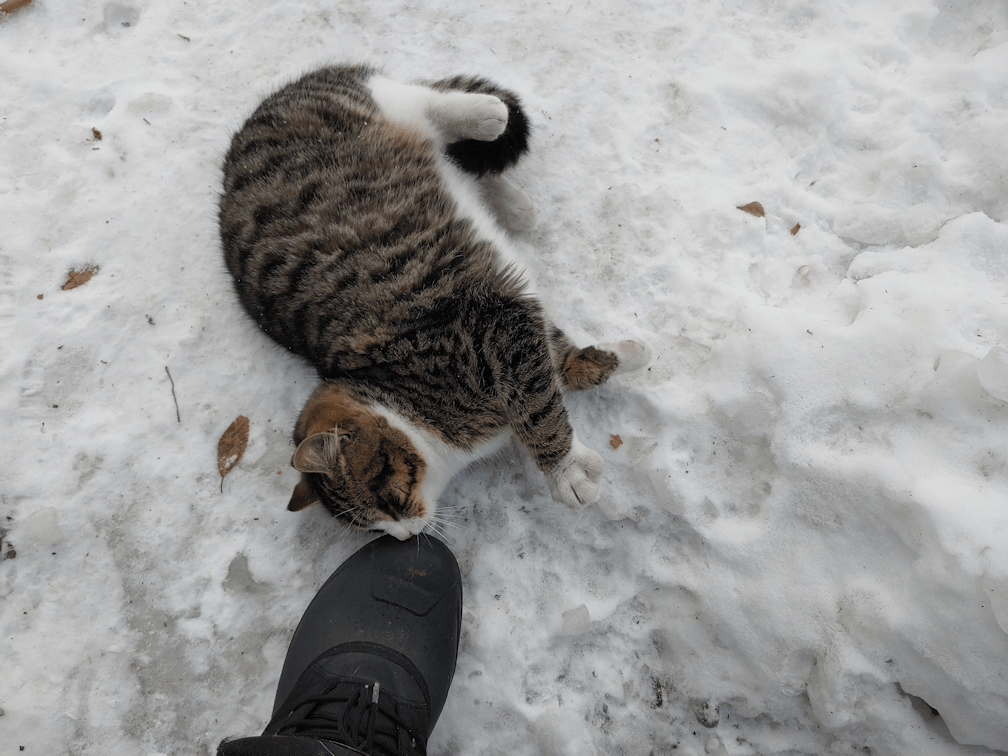
Ah, Rolando! One moment, it’s CHOMP!!!
The next moment, it’s KISS!!
She’s so mean and loving. :-D
Meanwhile, the fix on the door is holding out wonderfully. Tightening that hinge plate seems to be making the biggest difference. All this time we fought with the door, and never thought to look at the hinge! There was one spot on the floor where the door would jam. If I could push it past that one spot, it would swing free again. The floors in this house are uneven, and it’s been doing this for longer than we’ve lived here. It never even occurred to me that it was anything other than the uneven floor being the problem. Tightening the hinge plate adjusted the door a tiny bit, but it’s enough that we can now open the door all the way, without it jamming on that bump on the floor!
The door latches much better now, too, and we no longer have to fight to get it to stay closed. Which means where will be less wear and tear on the knob mechanism. It opens and closes so smoothly now, I didn’t even notice the bit of give on the handles, because of the too-long bar!
To think we put up with this for 4 years, and never thought to look at that hinge the entire time. Even my dad would have been putting up with it for who knows how many years; as his mobility declined, he went in and out through the sun room, too, because there are no stairs that way.
Funny how easy it is to miss these little things, yet they can make such a big difference!
















 The Re-Farmer