A huge jump ahead on the way!

I got a surprise this morning!

My SIL started sending messages, telling me they had an opportunity to get a whole bunch of haskaps, if there was somewhere to plant them.

Somewhere around 30 of them.

!!!!!

I told her we’d been preparing areas in the food forest for the past several years that had the full sun and space needed.

Long story short…

She would come over to get their pick up truck, so she could pick them up and bring them over. My brother would then come out after work to plant them.

While she was on the way out, I went to the future food forest area and started preparing it. The three rows where we once grew bush beans, with fresh garden soil added, were still there, slightly elevated from the new soil. What had been an annoyance while mowing now made it easy to find and clear them with the weed trimmer.

The old rows were marked out at 6 feet apart, while the rows themselves were about 2 feet wide and 18 feet long, leaving a 4 foot path between them.

With planting space needing to be 4 feet apart, I knew the three rows would not be enough. I weed trimmed the length of them, then extended them in a curve to match the curve of the silver buffalo berry. The plan was to leave a lane in between large enough to drive through with a truck, and the curve making it easier to change direction.

Once the weed trimming was done, I measured and marked out three rows at 20 feet, each with six poles that were 4 feet apart. I was just finishing up when my SIL arrived, so I went over to ask if she had time to see.

She was surprised. It turns out they intended to do it all themselves, expecting nothing from us to do in advance. I was feeling really good today, so I was happy to do it.

Once we got out there and I explained what I was doing, and why I was marking the way I did, I realized the curves I’d trimmed were completely off and did not match the curve of the silver buffalo berry as well as I’d though, while actually doing the trimming.

While showing there the different zones for planting I had in mind, she was quite surprised by how much we had planned out already. I told her that, with these new trees, they’re basically shaving probably 5 years off our plans!

While we were talking, my SIL noticed the gorgeously red crab apples, and we went over to check them out. The small red ones still have apples higher up and she was able to reach some. She also grabbed one from the tree with larger apples. We both enjoyed a snack of them and agreed that the smaller ones, with their sweet tart flavour, were more delicious than the larger, milder ones, though both are quite good.

As we walked back to their truck, she told me that she would drive right up to where I’d marked the rows, if I were okay with her driving through the yard. She was concerned the truck might damage the yard. We have a septic truck drive though there with no issues, so I assured her it was fine – and was exactly the sort of thing I was leaving a drivable lane open!

While she was getting the truck ready, I started heading back to continue marking rows but realized there was a bit of a problem. The huge maple by the old garden shed overhangs the entire space between the maple grove and the spruce grove, and one branch in particular was hanging low enough to be in the way while mowing the lawn. The truck would be hitting that branch.

So I headed to the garage and got the long handled pruning saw set up. The pole is designed to telescope but the wingnut that would have allowed the length to be adjusted was plastic and broken. I’d tightened it with a wrench. Ironically, that part of it held. The nut that was secured to the bottom length didn’t, coming loose while I was using it. I hadn’t put it back yet, not having needed the extra length until now. So, today, I finally worked on it and got the two lengths together again, making extra sure they were secure. Then I headed over and cut away the lowest hanging branch.

It was quite large, but I was able to drag it off to the branch pile outside the gate near the fire pit, where I left it on the ground. It was too big for me to maneuver onto the pile without over doing it. I messaged the girls and arranged for someone to come out and break it down enough to toss onto the pile, then went back to the tree.

Walking back, something dramatic caught my eye.

The dead maple near the fire pit had a pale frill around its base.

The maples get mushrooms growing on them regularly, but I’ve never seen a ring of them completely surrounding a trunk at the base like this!

Once back at the trimmed maple, I could see two other branches were hanging low enough that they would scrape the truck, so I took them down, too. Those branches were already dead and a bit smaller, so I was able to drag those over the branch pile inside the yard, for fire pit fuel. That left quite a few small broken off branches to clean up in the grass before I could continue. There was one more low hanging branch that should probably be trimmed, too, but even at its full extension, I couldn’t reach where the branch would need to be but to bring it down. There was room to drive around it, though, so it can stay for now.

Another thing I’d done was hook the garden hose back up. We have three hoses to be able to reach all of the main garden area, plus there is a fourth one added on when watering the food forest trees and bushes. While working on clearing the eavestroughs with the hose attachment, I needed only one hose length. I’d already hooked that back up again to the second length but, as I was cleaning up the broken branches, I realized I was hearing a hissing noise.

The female coupling on the second hose was leaking, under where it rotates to attach to the male coupling. I fiddled with it a bit and it got worse. I had to shut the tap off. Since we need the hose working to water the transplants, I messaged my brother and SIL, asking if they could pick up a Quick Connect repair kit, and was even able to send them a photo one I had an another hose, so they knew exactly what I was asking for. Hopefully, one of them will have a chance to swing past a hardware store along the way and get one, and I’ll etransfer them to pay them back for it. Otherwise, I’ll have to steal a hose from the front tap until I can pick one up myself.

Then it was back to marking planting spaced in a curve that match the sliver buffalo berry.

By the time I was done, lining the three rows up, I had marked 36 potential spots to plant in.

I was going to go back with the weed trimmer to clean up the corrected curves, but my alarm went off to take my afternoon pain meds, just as I was finishing the last couple of markers. I hadn’t had lunch yet, either, so I went in for both.

I still haven’t heard from cancer care, so I called my specialist’s clinic to see what I could find out. I’d called and left a message last week, but no one had called back.

The guy that answered the phone was able to look up my file and saw that cancer care had acknowledged they received my referral…

On the 24th.

I’d been expecting to get a call from them on the 17th or 18th.

Which means that, at this point, my file is most likely being assessed by the doctor(s) that will be taking my case, working out what needs to be done and finding a date for me to come in for the surgery. This is for a biopsy and to test my lymph nodes and determine what stage I’m at. Given my circumstances, it should happen quickly. Just not as quickly as my specialist expected. He then told me he would phone them right away to see what he could find out, as far as a time line.

With the longer wait, I brought up that the specialist, who was out of office today, had given me a 2 week prescription of Tramacet based on her expecting me to be in surgery around the time it ran out. I’ve got about 4 days of it left (only because I’ve taken T3s instead, while not at home). He told me that, once he had a chance to talk to cancer care, he’d be able to give the doctor enough information to know if I should get a 1 or 2 week extension on the prescription.

That done, it was past 2pm and the post office was open, so I headed out to pick up the mail and a parcel, then came back and made myself a late lunch.

Unfortunately, I seemed to have pushed myself a bit too far, as the abdominal pain started to come back, even with the painkiller. By the time my food was ready, it was still getting worse. I was going to lie down after having my lunch, but decided I was feeling well enough to write this post, instead.

As I was writing the above, I got a message from my SIL. She had messaged me earlier to tell me she had overestimated how many she could fit into the truck. She sent me some photos. She had already told me that these were from a friend who had a greenhouse and dreams of selling trees, only to become ill and recently passed away; they went to his funeral this past weekend. His family are dealing with a lot right now, of course, and she found out they were planning to throw them away. That’s why she was wanting to contact me about whether there was a place for them this morning. So these are all potted saplings. She sent me some photos of them, and the partially loaded truck. They are HUGE!! She did tell me they were starting to be neglected, so it’s possible they won’t all survive, but even if they don’t all make it, we’ll still end up with quite a lot.

She is still working out how to get them all into the truck, and it has started to rain where she is. My brother will be coming out here ahead of her and start preparing the ground for transplanting. They have a working tiller stored out there, and I now have what should be more than enough spots marked out for him to prepare. If things work out, it’s going to be quite late by the time it’s all done, but this is not something that can be set aside for later. They have “now” to do it, so it needs to be done.

Hopefully, the preparations I made will help it go faster. If nothing else, my brother won’t need to do any measuring.

With the mild fall we are having now, they should have enough time to develop a root system before the ground freezes, and they’ll survive the winter.

So that is where we are at now. Hopefully, tomorrow, I’ll be able to get some photos of a whole bunch of transplanted haskaps to share!

For now, though, I think I’ll go ahead and lie down for a bit, so that I am more likely to be feeling up to joining them outside when they get here – or at least when my brother gets here after work. For my SIL, it’ll be about a 2 hour drive from where she’s picking up the haskaps!

I love my brother and SIL. They are amazing.

This will be a HUGE boost to our food forest plans.

The Re-Farmer

Analyzing our 2023 garden: fall garlic, perennials and food forest items

Okay, let’s get into our longer term planting!

First, the garlic, which was planted in the fall of 2022.

We planted garlic in one low raised bed, starting with cloves we’d saved from the one successful bed of garlic planted the previous year.

First, we had to reclaim and prepare the bed from the summer’s crop. Of our saved garlic, we got only 24 big cloves out of the six bulbs we kept! We then bought more garlic locally, rather than ordering it in, this time trying a soft neck garlic for the first time.

So how did they turn out in the summer?

Apparently, not good enough to warrant getting pictures of the bed as it grew. At least not any I uploaded into my dwindling WordPress media storage.

We seemed to have lost quite a few to the winter cold. I’d say we had almost a 40% loss on our saved garlic, which was hit the hardest. Interestingly, it was the soft neck garlic that did the best, as far as survival. We harvested all the scapes from both the hard neck varieties well before soft neck variety produced scapes. All produced decent, if not particularly large, bulbs at harvest time. As I write this, we still have some left to use for cooking. We did not save any for replanting. We just didn’t have enough to make it worthwhile.

Final thoughts on garlic.

We seem to have a problem with losing our garlic to the cold over the winter. For this fall’s planting, we got just one variety. They were all planted in the Old Kitchen garden, closer to the house. We made efforts to plant them more in the middle of the beds, as the outer edges of raised beds will freeze faster. That resulted in the 3 pounds of garlic we ordered being spread out over 4 raised beds. They also got a deep mulch. This winter should be a mild one, though, so the risk of loss due to cold will be reduced, too.

Also, we need to plant a lot more garlic. That one bed, even if we hadn’t lost as many as we did, was not enough to meet our usage needs. We could easily plant two or three times as many garlic. This fall, we planted 3 pounds of seed garlic, and while it’s more than what we planted last year, more would never be a bad thing!

Raspberries

This spring, we planted three Royalty Raspberry plants.

We do have raspberries here that my mother has been growing for decades, descended from plants I used to pick from as a child. They are almost a wild variety. For our food forest, we want to include different varieties that mature at different times of the year. We’d purchased a red variety of raspberries a couple of years ago, but the deer kept eating them. They are protected now, but are not recovering well. So when these purple raspberries were planted, in an area we’d planted peas and beans in previous years, we made sure they were protected from deer.

They did rather well, too. These were supposed to be first year canes, so it was a surprise when we saw them starting to bloom. Yes, they actually produced fruit!

No new canes that would produce fruit next year emerged, though. Which means that when they died back after fruiting… well, it looks like they’ve just died.

I keep forgetting to contact Veseys about them.

[Edit: I have since remembered to contact them, and have been told this is normal, and they should start growing in the spring.]

Final thoughts of raspberries

We all love raspberries. This was actually a pretty good year for them, and the old raspberry bushes produced quite well. Especially since we cut away the crab apple tree that suddenly died of a fungal disease last year. It had been shading the patch quite a lot. This year, that end of the patch got a lot more sun, and they clearly thrived.

As for the purple Royalty raspberries, we did get enough to taste, and do like them. We will look to replacing the dead ones, while also planning to get a gold variety, plus another red variety. The long term goal is to have lots of raspberries from June through to August.

Our first apple tree

We have plenty of crab apple trees, most of which are dying of a fungal disease, so we have to be really careful about getting new apples. This spring, we got our first eating apple tree; a Liberty apple. It’s actually a zone 4 variety, so we needed to also give thought on where to plant it. It needed to get the full warmth of the sun, while also being sheltered from the cold winds. In winter, it will need extra protection to keep it from freezing.

For this, we chose an area in the west yard, closer to the house. There are ornamental crab apples nearby for cross pollination. We’ve got tulips planted here, which need protecting from the deer, with dead and dying trees that needed clearing away. So that all got taken care of, and the apple tree was planted closer to a hedge of lilacs for extra protection from the elements, while still getting that full sun.

We also got a pair of mulberry trees that are rated to zone 3. When we ordered one tree from Veseys, they did not have the size available for 2023, so we got two smaller ones, instead. They were so tiny, we ended up not transplanting them. Instead, they got potted up and kept indoors. As I write this, they are much, much larger, and their leaves have turned yellow and are dropping for the winter. If all goes well, they will come out of dormancy in the spring, we’ll harden them off and plant them in our food forest area when we are past our last frost date, in June, next year.

Final thoughts on apples (and mulberries)

Finding apples that are good for fresh eating, that are also hardy to our zone, is a challenge, but they are out there. So why did we get a variety that’s zone 4?

I’m a sucker for punishment?

The variety had qualities we were looking for, from flavour to storability. Hopefully, it will work out, and acclimate to our winters over time.

When it comes to apples, one tree should produce enough for a family, but they also often need another variety for cross pollination. So we might pick up one more variety of apple in the near future. What we really need to watch out for, though, is that fungal disease that’s killing off our crab apples. I’ve been researching about it, and there’s nothing we can do about it. Once it’s in the soil, it doesn’t go away. So if an area is badly infected, like where the row of crab apples are now, we would not be able to plant apples there again and expect healthy trees. Yes, there are ways to treat the tree, but it’s not really an option for us right now.

As for the mulberry trees, I’m pretty excited about those. I’ve never had mulberry before, but my mother remembers they had a huge mulberry tree behind their barn, when she was a child in Poland. As a food tree, they are known to be productive to the point of nuisance, so they will be planted well away from the house. There’s a gap in the lilac hedge on the north side of the property that needs to be filled in. That would be a good place to transplant these. Eventually, they should grow into towering shade trees, so we need to make sure they’re not going to cause problems for other things we want to plant around there.

Last minute addition: saffron crocus!

This year, I was really excited to find out Veseys got a Canadian supplier for saffron crocuses, acclimated to zone 4! So we took a chance and ordered some.

These were planted in a trench in the fenced off area about the tulips and the Liberty apple tree this fall. For the winter, they got a deep mulch to protect them. If they survive, they can be expected to produce flowers with harvestable stamens in the fall of 2024, and each year, they can potentially triple as they expand.

If they survive!

Of course, every year, they will acclimate more to our climate zone, too.

Final thoughts on saffron crocuses

We don’t really use a lot of saffron, so if even a few survive to produce next year, that will be enough for our needs. Long term, if they do well, who knows. We might eventually have enough saffron to be worth selling at the local markets or something. If not… well, it was worth a try!

Recovering Strawberries and Asparagus

Last year, our purple asparagus bed was flooded out. It didn’t really affect the strawberries that were interplanted with them, but the asparagus crowns were buried 2 ft deep. I wasn’t sure any survived. In the end, we did get some asparagus plants growing, but they have been set back, at least a year. This should have been the first year we could harvest any, but that just wasn’t going to happen.

As for the strawberries, they recovered quite nicely after the winter and were soon producing.

We even got a few small crops.

Then the deer got to them.

We ended up rigging up protection around the bed, and the strawberries did recover. In fact, they began producing again, quite late in the season, because of the deer damage, and were still trying to produce, right up until the first frost hit them!

Final thoughts on strawberries and asparagus

We planted a purple variety of asparagus, and the plan had been to plant a green variety the next year, and to keep adding more every year until we had enough for our family to enjoy regularly. Well, that didn’t happen. The challenge is, asparagus is a 20 year commitment. We have to find places to plant them that will not be used for anything else for 20 years, because I sure don’t want to be transplanting them in the future. Since we’re still struggling to clear up certain areas, we just don’t have the space that can be used that way.

After last year’s flooding, we now have an idea of where the more susceptible areas are that we either have to avoid, or where we’d have to make a bed raised high enough that flooding won’t be an issue.

So, yes, we do still intend to increase our asparagus beds, with both green and purple varieties. It’s just been delayed. As for the asparagus we have right now, I’m hoping they recovered enough that they will do better next year. I don’t expect we’ll have enough to harvest next year, though. Maybe in 2025.

Asparagus is definitely a long term planning sort of thing!

As for the strawberries, these were purchased transplants that were interplanted with the asparagus because I’d read they do well together. Over time, however, I am now thinking to get more strawberries to interplant around the food forest area, as a sort of ground cover, rather than having dedicated beds to just strawberries.

Strawberries from seed

Now we move on to an impulse purchase that did surprisingly well. I got a kit to grow strawberries from seed. It was marketed for kids, but strawberries are strawberries, and we just can’t get enough strawberries in this household!

What started out as this…

… became this.

Yes, we actually got a few mature strawberries!

These got transplanted in the wattle weave bed along with some herbs, peppers, eggplant and luffa. Eventually, the Old Kitchen garden will be mostly an herb garden. I honestly didn’t know if they’d make it, or if they’d produce this year at all, they were so tiny.

The kit did not say what variety the strawberries were and, from the looks of the berries, they seem to be a type of wild strawberry. We only got maybe 4 or 5 ripe berries to try, and they were tasty, but not as tasty as the variety that were bought as transplants.

Final thoughts on strawberries from seed

Since this was a spur of the moment experiment, my expectations were not high, so it doesn’t mean much to say they exceeded expectations! Once transplanted, they did really well. I don’t think I’ll grow strawberries from seed again, though. The ones purchased as transplants were more productive (even after the deer got to them) and much tastier. We’ll see if these survive the winter. They are mulched, but they were planted along the edge of the bed, so are still susceptible to freezing. For all I know, they will produce larger berries once firmly established. We shall see.

Sunchokes

I kept forgetting about the Sunchokes, aka: Jerusalem Artichokes, this year! They are in a permanent bed next to the asparagus, and this is their second year. Last year, we’d planted 10 tubers in two rows. In the fall, I harvested half the bed, replanted 5 of the largest tubers, leaving the other half of the bed untouched. The sunchokes came up quite well from both halves. They grew nice and tall and…

That’s it.

Like last year, they never boomed. I never even saw any buds forming.

This was all we harvested last year.

I was going to harvest some this fall but, in the end, I just left them. We should have more to harvest, next fall. Instead, we cut the stalks and lay them down on the bed and covered them with a grass clipping mulch. As Sunchokes are native to Canada, they probably don’t need a mulch at all, but it won’t hurt.

There are people on some of the local gardening groups on Facebook I’m part of that also grow sunchokes. I saw several people talking about how they’ve been growing them for years, and they have never bloomed, wondering what they were doing wrong. Some old time gardeners have said theirs have never boomed, either, but they still get a good harvest every year. At least I know it’s not just here!

Final thought on Sunchokes

So, obviously, I don’t have much to say about the for this year, since we skipped harvesting them. When we did try them, we liked them, so I do want to let them grow and multiply, so that we can have larger harvests. After learning that other people in our zone that have grown them for years and never had them bloom, I guess that means we don’t have to transplant them somewhere else or something. We can just leave them were they are. Hopefully, next fall, we’ll be able to get a good harvest out of them.

Everything else

This is a follow up on the things we planted the year before.

We planted a bundle of 5 sea buckthorn. Two survived. They are still surviving and growing bigger. Eventually, we will get more to add to the privacy hedge. If all goes well, we’ll have at least one male sea buckthorn, and will eventually get berries.

We planted two highbush cranberry. Last year, the deer ate one of them, it recovered, and they at it again. I put an old saw horse of that one to protect it as it recovered again. This year, it was growing well, as was the other one, which is still unprotected. Amazingly, towards the end of the season, the one with the saw horse over it to protect it got eaten again! Given how late in the season this happened, I don’t know if it will recover.

Deer chewed Highbush Cranberry.

We planted 30 silver buffalo berry in two curving rows, to eventually act as a privacy screen. It looks like we’ve lost 2 of them, possibly 3. One, I expected, as I’d accidentally pulled it up last year while weeding, but one or two may have died before fall, too. Some of them are getting pretty big, while others are still quite small. With last spring’s flooding, one end of the rows was completely underwater, and they handled it just fine. It will be a few years, yet, before they get large enough to start producing berries.

We had planted 6 Korean pine in the outer yard. We have 4 survivors. This year, they were still quite tiny, and are still covered in their chicken wire cages for protection.

From what I’ve read, they grow very slowly for the first 5 years, then start to really shoot up, and eventually become very large trees. We got 3 yr old seedlings, which means this was year 5 for them. We shall see if they get their first growth spurt next year!

Final thoughts on our food forest.

Our long term goal is to have as many perennial food plants as we can manage. Fruits, nuts, berries, tubers, whatever. We’ve got a good start on it, and hope to add more to it every year. For some things, like the sea buckthorn and silver buffalo berry, these are multipurpose plantings. They should be prolific enough – eventually – to provide winter food for the birds, while the bushes themselves will be privacy screens and living fences. The far flung areas we’d planted corn, beans, squash, etc. last year were done to help prepare and amend the soil for permanent planting, and this year, only one small area was used to grow squash in. Next year, we hope to plant a fruit tree or something in that spot.

We are trying to be very selective on what we plant and where. We need to leave lanes open, wide enough to drive through, to be able to get at fences, etc. There is also the lane we will keep open because there is a telephone line buried under it. That means we need to consider root systems, as well, when locations are decided on.

The one thing we planted out there this year – the Royalty raspberries – appears to ultimately be a failure, since they produced this year, instead of next year, and died back. So very little progress was made in that area this year. We do have some black currant bushes that I am thinking of transplanting out there. They are closer to the house, but under trees. They bloom in the spring, but have almost no berries. They simply don’t get enough sunlight.

Over time, we will keep adding more to the area, as the budget allows. Pears, plums and gooseberries are on the list, and I’m seriously considering transplanting our haskap bushes. The “male” haskap, which is supposed to be the right variety to cross pollinate the two “female” varieties, is done blooming before the two other even start. I think they’re just planted in a bad spot. Too many tree roots, and too many of those perennial flowers that my mother planted there. Even though I’ve cleared them away from around the haskaps, they get so big, they still cover the bushes – and the haskaps are supposed to get big enough that it shouldn’t be an issue! We shall see.

The experiments.

Last year, there were two things we planted that, while annuals, could be treated as perennials, because they self seed so easily. Wonderberry and Aunt Molly Ground Cherries. With those, I let them drop fruit to see if they would come back this year.

They did not.

We might still get some ground cherries in the future, but they were much more fragile a plant than I expected. They broke easily, as I reached under to find and pick ripe berries, and the patch itself got flattened by wind and had to be supported. If I do plant them in the future, I’d want to have some sort of supports for them, and I don’t know if they’re worth the extra effort!

That is where we are at now, with our fall plantings and perennials. Not a lot of progress there, this year, unfortunately. When it comes to perennials – especially trees – it can take years before they start producing, so delays in progress add years, rather than months, to having food production! At least things like berries produce faster and fill the time gap a bit.

Little by little, it’ll get done!

The Re-Farmer

Change in plans, morning in the garden

This morning was our date with the vet, to get Potato Beetle, Big Rig and Tissue spayed and neutered, as arranged by the Cat Lady.

I had a chance to text with her last night, as she reminded me to have them fasting. She herself was going back to the hospital today. The poor thing has been in and out of hospital all summer, and yet she still manages to help with cats. She just brought home a couple more because they were sick, and no one else was willing/able to take care of them. She is so awesome!

She did warn me that there is a shortage of vets, and there was a possibility of cancellation. So when my phone started ringing while I was driving with the three cats, I had a sinking feeling. Of course, I couldn’t answer while driving. It started ringing again, then I suddenly started getting notification noises, one after another. *sigh*

The calls were from one of the staff from the clinic – but she was calling from home! When she couldn’t get through to me, she called the Cat Lady, and both of them were trying to text me at the same time, letting me know that the vet wasn’t coming in today. All surgeries were being cancelled.

I got all these when I parked in front of the clinic.

After responding to both of them, the lady from the clinic said she would call me when she got into the office to reschedule, then I headed home.

The cats were not happy with all this. I was concerned about Potato Beetle. He’s already been stuck in the sun room for over a week. Yes, he has cool places to lie down, and we make sure there’s a frozen water bottle in his water bowl, the ceiling fan is going, and the small box fan I found the the garage is set up. Still, it gets quite warm in there and, as much as we try to go over and pay attention to him, he’s mostly all on his own.

Thankfully, the clinic was able to reschedule us for this Friday, so tomorrow night, we do the fasting again.

Since we no longer to dash to and from town to deal with the cats, I took advantage of the change in plans and decided to do our Costco trip today, instead of next week.

But first, I had to do my morning rounds, switch out the memory cards in the trail cams, and check the garden beds.

The Carminat pole beans finally have pods forming!

The one giant pumpkin is growing so fast!

I looked around and finally saw another pumpkin forming. Just to be on the safe side, I hand pollinated it. The vines of the two plants are overlapping each other, but as far as I can tell, this one, plus another female flower I found that is still just a bud, is on the same plant as the pumpkin that’s growing so big. The second plant has lots of male flowers, but I can’t see any female flowers on it.

I’ll keep checking and, as I find them, I’ll hand pollinated them, just to be on the same side.

Which I am also doing with the Red Kuri (Little Gem) squash, in the south yard. These are doing really, really well here. I have hand pollinated several female flowers already, and I can see more budding. I’m happy that these are doing so well, because these may be the only winter squash we get this year!

The cherry tree by the house is doing well, too. This is the most we’ve seen on this tree since moving here. The other trees at the edge of the spruce grove have nothing. Being close to the house seems to be providing the microclimate it needs. I don’t know the name of this variety; only that the original tree was from Poland, which has a longer growing season than we do.

The cherries at the very top look ripe, or close to it. We’ll have to bring over the step ladder and start picking them!

Speaking of picking things…

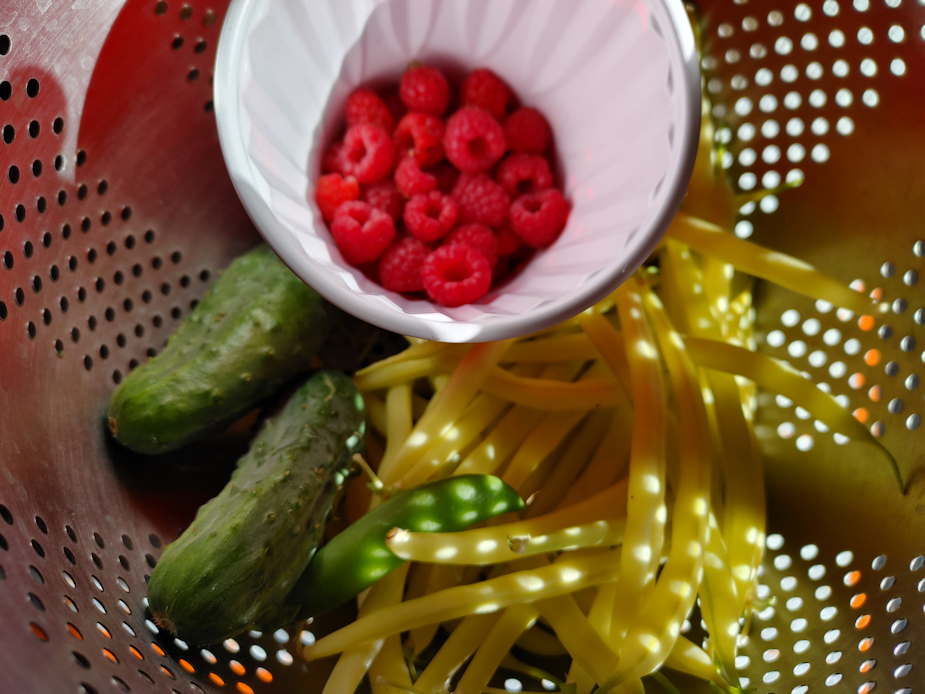
This is this morning’s harvest. Along with the bush beans, there was a single pea pod from the row that was planted first. That row is almost done, but the ones that were planted later have quite a few pods that should be ready to pick in a few more days.

I also picked our very first two cucumbers! I picked this variety as it is supposed to be good for both fresh eating and pickling. Whether or not we’ll have enough to make pickles, I’m not sure yet, but we at least have these ones to taste test now!

There was also a few raspberries to pick. Maybe 3/4’s of a cup in total.

It’s not much, but it’s enough to enjoy with a meal. Certainly better than nothing at all!

That done, I was off to the city to do the last of our monthly stocking up, but that will get it’s own post. 😊

The Re-Farmer

Our 2021 garden: unexpected things

Yesterday, one of my goals was to start on the lawn. We have yet to mow the lawn this year, but with how little rain we’ve had, it’s not really that overgrown. Other than some straw we still have left, we’re out of organic material to layer and mulch with, so it would be good to have grass clippings again. At the very least, I wanted to get out the weed trimmer and do the edges.

Then I got a phone call.

My mother was letting me know my sister was on her way to visit her, and they were planning to go to the cemetery, which is just a few miles away from us. They were planning to come here, after.

*sigh*

We had talked about this possibility just the day before, so I can’t say it was too unexpected, but I had advised against doing a cemetery trip when we were supposed to get so very hot again. She also knew that I like to have a lot more notice before visits, so we can be prepared. My mother actually sounded apologetic when she was telling me they were coming over, and added that she was good with not going into the house if we didn’t want her to. Which isn’t the problem, but whatever.

So the girls did a quick rush to try and prepare things, like making sure everything was clear from the sun room doors, though the old kitchen, to the bathroom (so my mother wouldn’t have to use the main doors, with all the little sets of stairs), while I quickly used the weed trimmer around the yard, between the main garden beds, and a few other places that I thought my mother might want to get at with her walker. I had thought to move the picnic table to a shady spot in the south yard, but my daughter reminded me that, when we moved it to where it is now, after it was painted, it was pretty rickety, so it probably couldn’t handle being moved so far, again. So she set up some camp chairs in the shade, and we used an overturned bin for a table. :-D My mother and sister had even brought some fried chicken, so we had ourselves a picnic lunch in the shade, before touring the yard and garden beds.

When they arrived, my sister passed me something my mother had for me. At her apartment building, they have garden plots available. My mother doesn’t do much gardening herself anymore, but she does tend the perennials that had been planted by some of her friends and neighbours who have passed on. The caretakers, unfortunately, have a habit of digging everything up at the end of the year, including a bush my mother described as having beautiful yellow flowers, followed by black fruit. She had no idea what it was; it was planted by someone who passed away some years ago. No one ate the berries, but it was lovely, and the caretakers dug it up and got rid of it. This spring, while tending some plants, she noticed that part of the bush had survived. Not wanting the caretakers to kill it off, she dug it up and put it in a pitcher with some soil. She wanted to give it to me to plant somewhere near the house. We have a grocery shopping trip arranged next week, and I was going to get it then, but with my sister coming over, they were able to bring it over early.

I’m pretty sure it’s a currant, though my mother says it’s different than what we have here. My sister, who is the one that gave my mother the currants that are here, thought it might be a gooseberry. Whatever it is, I made sure to transplant it as soon as things started cooling down a bit. I picked a spot right near where we’d had our picnic lunch. There is a flower bed with white lilacs taking up about half of it. After it was cleaned up, a couple of years ago, we were left with an empty spot that I decided to take advantage of.

I scraped away the wood chip mulch we’d put in, first – it was about 3 inches deep – and started digging. I had to shift the hole a few times, after hitting tree roots, but after clearing out a few bigger rocks, I finally had a space I could transplant into. It was bone dry. We don’t water this bed regularly, but I have been trying to water the lilacs and a low growing plant with variegated leaves I like. From how dry the soil was, you’d never know it had been watered recently! So I filled the hole with water, then got a wheelbarrow load of new garden soil.

After transplanting it into the hole with fresh garden soil, I put back some of the mulch and gave it another thorough watering.

So we now have a new, unplanned, fruit bearing bush in the yard. :-) Hopefully, it will survive.

Backtracking a bit; my mother and I had talked about her coming out to see the gardens later in the season, when things were more grown in, but she got a bit of a tour yesterday. I did appreciate her very visible efforts to not say anything negative, which is usually the only thing she’ll say. I think it’s a generational thing, or maybe a cultural thing, but my mother seems to believe in NOT saying positive things. Like it’s somehow bad to compliment people or something. I suspect it has to do with believing it would lead to pride or something along those lines, though I doubt that’s in any way on a conscious level. She did, however, manage a backhanded compliment on how healthy the garlic looked! So that’s progress. :-D

She was not up to taking the walker to the furthest beds, of course, but my sister did, with her ever-present camera, and she got lots of pictures. It was a long day for my mother, so they left almost immediately after touring the yard. Going to the cemetery, then coming here, was probably too much for her. :-(

After I’d taken care of the transplant my mother gave us, I started hearing thunder. We’ve been having thunderstorm warnings for a while, but they kept getting pushed back. We were hoping to at least get some rain! I could see the storm clouds, and the wind was picking up, so I brought our hardening off transplants back into the sun room early, and we even shut down our computers, just in case.

We got nothing. Not even a spit of rain.

By 9:30pm, I finally went back outside to water the garden beds. The rain did finally come, but not until about 5am this morning.

When I headed out to do my morning rounds, it was still raining! A lovely, steady rain. I got completely soaked. :-D So no pictures this morning. ;-)

While checking the garden beds, I had some more unexpected surprises. The sweet corn is coming up already!! New shoots, in all three corn blocks. I also found more Hopi Black Dye sunflower sprouts, but also some Mongolian Giant sunflowers have already sprouted! Clearly, they are loving our heat wave. The bush beans, meanwhile, are coming up like crazy. The purple ones are still a bit slower in coming up than the yellow and green beans, but once they do come up, the sprouts seem to be leafing out faster than the others.

I’m finding it awesome that so many things we direct sowed is sprouting already. We haven’t even finished putting out our transplants, yet! :-D

Of course, while checking the garden beds this morning, I was looking for deer damage. When I’d watered last night, I tied some plastic grocery bags onto a couple of the stakes supporting the Mongolian Giant transplants, as a noisy deterrent. Happily, there was no new damage.

Then I checked the trail cam.

There was one file triggered during the night. Off in the shadows, a single deer could be seen, walking through! It looked like it was going down the path between the corn/sunflower blocks, and the pea/bean beds. It didn’t stop or pause, but kept walking towards the spruce grove.

Today, I’m moving the camera again. I think I know where the deer came in, but there are a couple of places they like to jump the fence, and I want to cover both possibilities, if I can, and see if there are any other areas they might be coming through.

We shall see what the weather does today. Today’s expected high is “only” 25C/77F, with scattered showers. Which means we will probably not be able to use a power drill, with its 300 ft or so of extension cords, to finish assembling the squash tunnel. Hopefully, we’ll be able to get the summer squash in, though we might have to prioritize the Montana Morado corn. At least the place they will be planted is right next to what’s left of the pile of garden soil. We might end up having to use soil from the pile in the outer yard to finish transplanting. The good thing is, we actually have that second pile!

Little by little, it’ll get done!

The Re-Farmer

Clean up: to the chokecherry trees

Normally, I would not have done clean up on a Sunday, but the chokecherries needed to be picked, and we couldn’t get at the two trees with the ripest berries.

Which turned out to be 4 trees… :-D

Here are the ones behind the garden beds where the old wood pile used to be.

The arrows are pointing to the two chokecherry trees. They are close enough together that I had thought they were just one tree at first. All around them are dead cherry trees with live cherry saplings coming up the bottoms, along with other odds and sots that have come up since I cleared things away last year.

I started on this side because I figured taking out the dead cherry trees would be the more difficult job. Especially since we were getting spotty rain, so I wasn’t going to string out extension cords to use the electric reciprocating saw!

This is how it looked when I stopped.

The fallen spruce tree and poplars behind them kinda make it look like they’re not cleared, but there is plenty of space to walk around them now.

While the girls started picking berries, I moved on to the other side. This is how it looked before I started.

In the spring, I had cleared a path to the junk pile to access the wood stacked in it, and I’ve been trying to keep things clear around the Saskatoons. You can see those on either side of what’s left of the path, and the arrow is pointing to the chokecherry tree. Which is actually two trees next to each other.

Most of what’s here is spirea and thistles, with a bit of burdock, plus a few other things hidden by the spirea. I figured this side would be much easier to clear, since I could basically just yank them out of the ground.

I really should know better by now.

The spirea and thistles were, indeed, easy to pull up.

First, I’d forgotten about the fallen spruce tree in there, and how close it was to where I needed to go.

It’s been there for a long time, so I was pulling out bits and pieces that had broken off as it fell, as well as breaking off or pulling out rotten branches that were jutting out all over.

I’d uncovered the one stump that I already knew about, then found another, smaller one, beyond it.

As I worked my way closer, I found something else.

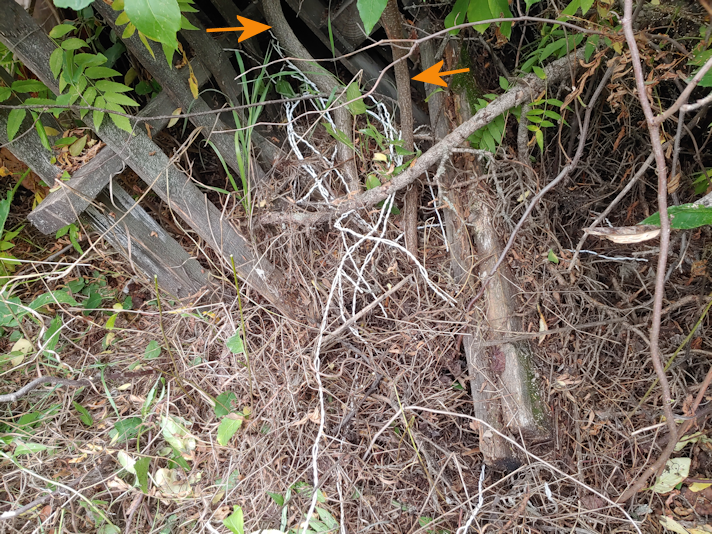
There’s a reason we call what started out as a pile of neatly stacked boards that used to be covered with a tarp, a “junk pile”.

So… that’s… wire? It looks like the wire from those little decorative fences you can get to put around garden beds.

Also, there’s an old pallet there.

Because, of course there is.

Don’t mind me. After clearing out the old wood pile and dragging away a couple dozen rotten pallets, I’m not much of a fan of those anymore! :-D I remember having to work my way around it, while searching for boards in the pile that weren’t too badly rotted.

As I worked my way closer, I found the chokecherry trees grew through the partially rolled up wire. Which gives an idea of how long it’s been hidden there!

That wire really does look like it’s from one of those little fences, undone. It even has cross pieces still wound into the twists.

At this point, I stopped!

It was clear enough to reach the trees, and most of the berries. So I started picking those, while the girls harvested carrots and little squashes. :-)

The piles of debris will wait until tomorrow to be hauled away!

This pile is almost all spirea and thistles, with a few smaller branches from the fallen spruce tree tossed in. I had to pull up some of the wildflowers, too. They’ve shown up all over the place this year, so there are plenty more around the yard.

This pile is mostly the cherry I cleared away from around the first chokecherry trees, plus the larger pieces of the dead spruce tree I was working around.

These are pieces I set aside to keep for future crafting or carving purposes.

As for the chokecherries, we picked about a gallon pail of them. The girls had picked from the tree by the squash beds, and the ones among the lilac hedge, too. Lots were left behind for the birds. We are finding more chokecherry trees deeper in the spruce grove, that are not ripe yet, so we will have more to pick, later on.

Now to decide on what to do with them. :-)

The Re-Farmer
Comparisons

As we work on clearing, cleaning and reclaiming the yard and planting our first garden beds, I’ve been keeping a close eye on details to keep in mind for the future. Things that will help us decide what needs to be done next, what to change or what to keep the same.

This morning, I found myself making a lot of comparisons.

The cutest one is the cucamelons.

This is the largest one that is developing, with my fingers giving an idea of just show small these are!

Isn’t that just the cutest thing? :-D This is the first one big enough to start seeing the patterns developing.

The trellis I made for these is just cotton yarn. It is working very well, except for on thing.

The cats.

When I am out there and the boys come over for some attention, they will plow their way through the trellis, pulling tendrils off in the process, then look at me all confused over why I’m flipping out at them. :-D They also try to lean and rub against the strands of yarn, only to flop over onto the plants. !!!

We already know that this location doesn’t have enough sun for cucamelons. If we grow them in the future, they will be planted somewhere with full sun. Our original intention was to plant them against the chain link fence for them to climb, and the cats are showing us exactly why that’s a very good idea! If not there, then we will have to make sure to have trellises that are sturdier, with strands much closer together. Not because the cucamelons themselves need it, but because of the cats!

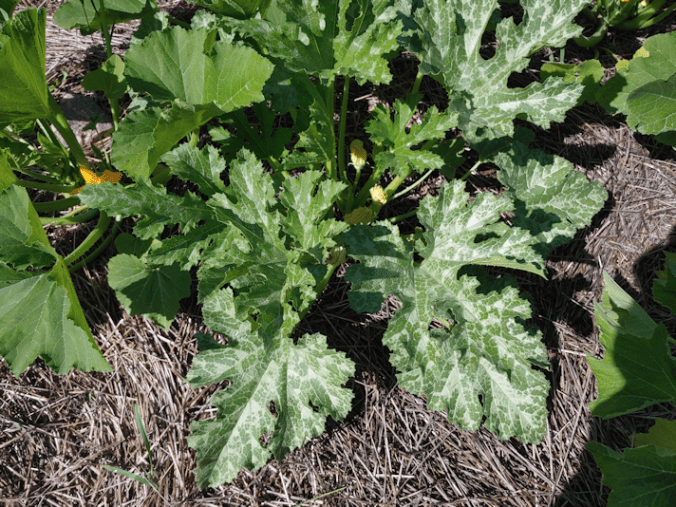
Here is another comparison. These two squash plants, with the mottled leaves.

They look pretty much like the same kind of plant, don’t they?

Now look at the developing squash.

They’re completely different!

I’m looking forward to being able to start harvesting these. My favourite way to eat them is raw, with dip. No need for anything else, when they’re at just the right stage. :-)

It was looking at the chokecherry trees that I am really seeing what a difference even minor changes in conditions makes.

This first one is at the south side of the garden where the squash beds are.

This one gets sun in the mornings, but for most of the day, it is shaded by spruce and maple trees to the South and West of it. It is not crowded by other trees. It has quite a lot of berries that are looking big and juicy (well… as much as chokecherries can be! ;-) ). Even last year, during the drought, it had larger berries. While I do not specifically water this tree, I do sometimes water the little patch of flowers and raspberries on one side of it, and the black current bush (my sister confirmed what it was for me) on the other side, so it does get extra water from that. While is has larger berries, it also ripens later. As you can see, the berries are still very much on the red side of things.

This next one is the chokecherry tree that is engulfed by lilacs.

This one gets full sun for most of the day, though it does get slightly shaded at the end of the day, by the trees my mother left to grow after she moved the raspberries they’d self-sown in between, years ago. This whole area gets quite dry, and we do not make any effort to try and water anything here.

The berries themselves are noticeably smaller than in the previous tree, and there are less of them, but they are also ripening faster.

Then there is this tree, right nearby.

This is the top of a young, small tree that was self-sown and allowed to grow (rather than get mowed over, like all the other saplings) in a grassy band between the old garden area (with the row of trees mentioned previously) and the lilac hedge. It might get some shade towards the end of the day, but otherwise gets full sun. Our first summer here, it did not produce fruit yet, and I wasn’t even completely sure what kind of tree it was. Our second summer, it had a few berries. This year, it has matured enough to produce quite a lot of berries. With full sun most of the day, not at all crowded, and little moisture, the berries are still not as big as the ones closer to the house, but the clusters are dense and ripening quickly.

You can see how this tree is situated in the background of the next photo, below. This next chokecherry is also among the lilacs, but on the edge of the hedge, not in the middle of them.

Here, it gets no shade at all. It has lots of berries that are already ripe. As you can see, though, some of the leaves are turning yellow. Only a few branches are like this, not all of them. It’s not stopping them from heavily fruiting! Like the other two along this side of the old garden, the berries are not as large as the trees nearer the house.

This next one was a surprise find, along with the Saskatoon berries. This area had been full of spirea that I had pulled up. It’s starting to grow back, so I’ll have to do it again, as pulling them up has been a good thing for other trees. The Saskatoons thrived this summer, and we discovered another chokecherry tree among them.

This area is under spruce trees, both living and dead, getting very little sun. In the above photo are the berries on the North side of the tree, where it gets even less sun. As you can see, they are just turning from green to red here.

This next photo is of the same tree, but on the South side.

That little bit more sunlight sure makes a noticeable difference in how fast they ripen!

Again, while I have not really been watering these trees, they are near the horseradish, and with the spirea taken out, wildflowers have come up and I’ve been watering those. So they will have benefited a bit from that, too. Mostly, though, being under the spruces as they are, they don’t get the full heat of the day, so the soil doesn’t dry out after a rainfall as quickly, either.

Then there is this one…

That’s a chokecherry in the middle of the photo. I had cleared a path to the junk pile you can see part of, to try and find useful pieces of wood in it, but that’s as far as I got so far. The tree itself is not crowded by other, large trees, and is shaded only in the morning hours. It’s surrounded by spirea and thistles, so we can’t get at it right now, but it appears to be just loaded with ripe chokecherries.

Finally, there is this one.

This is the top of a chokecherry tree among the cherries. I can get close to it, but not enough to be able to harvest it until I clear away the cherries around it; mostly cherries that had been killed off by last year’s horrible spring, and the bits that are now growing up from the bases. They create a formidable barrier!

This tree also gets shade in the morning hours only. Our last two summers, I don’t recall seeing any flowers or berries at all. Last summer, I’d cleared away the old wood pile, which turned out to be a much, much larger job than I expected. You can read about it in this series of posts (all links should open in new tabs, so you won’t lose your place!); parts one, two, three, four, five, six, seven, eight.

Did I mention it turned out to be a really huge job?

Yeah.

So while there is still lots to clean up to work our way into the spruce grove, what has been done so far made a big difference. I’m thinking that, had the cherries not been so damaged by the previous spring conditions, they would have improved, too. Mind you, the one cherry tree I kept because it managed to actually produce a few berries, and is not at all crowded, did not produce even a blossom this year.

It’s amazing how the same type of tree, while not really all that far apart from each other, are so different based on even minor changes in sun, shade, moisture, etc. When it comes time for us to plant more food trees, the differences among these chokecherry trees is providing us with a lot of information.

Comparisons can be very useful!

The Re-Farmer

Our first haskap berries

I was out doing my rounds a lot earlier than usual, though I skipped tending to the kittens for later. My husband needed to go into town to get his blood work done – something that has been postponed several time already – and we were planning to get there for when the lab opened.

Of course, since I had something scheduled in the morning, my brain decided that sleep was not going to happen.

Yeah. I was up all night.

It turned out to be a gorgeous morning. We were at 9C! (48F) It was absolutely wonderful!

Not wonderful enough to make me a morning person, but I did appreciate it. :-D

One of the things I made sure to check was our haskap bushes. The flowers in the bed around them have grown high enough to almost completely hide the bushes, even though I made a point of pulling up anything growing near the haskap. In time, the haskap will be taller than the flowers, but that might take a couple more years.

I was sure the female haskap had died last fall, but it has recovered remarkably well. I had noticed a couple of flowers, and then some berries forming, so I wanted to see how they are doing.

There are actually 2 berries here; one is still green, and is hidden by the ripe one. In another spot, I found a couple more berries, one ripe, one green.

It looks like that’s all we’ll get this year. Which I am happy with, since the alternative would have been trying to find a replacement female plant, and I just haven’t seen them at all in the garden centres this year. I had hoped to get 1 or 2 more female plants anyway (the ratio for pollination on these is 1 male for every 3 females), but there were none to be had.

That’s okay. Next time, I want to order them from Vesey’s instead. I think I’ll get better quality plants from them.

Until then, I am happy with our bitty baby berries!

The Re-Farmer

Growing things, wins and losses

Oy, what a day it’s been!

Our high of the day was reached at about 4:30 pm! 32C/89F, with the humidex putting us at 36C/97F. We’re not going to be cooling down much, even overnight, either.

At least there’s a wind, and on the weather radar, it looks like we’ll at least get some rain this evening, if not the thunderstorms. Those look like they’ll go right past us.

It was, at least, much more bearable when I did my rounds this morning. That, and the basement is nice and cool for the kittens.

Since they have gotten so good and escaping as soon as the door is opened and my hands are full, I’ve sacrificed one of my slightly taller laundry baskets for kitten jail.

I succeeded only in catching David! :-D He loves that thing!

I ended up just leaving the door open and let them be, until after I was done outside. By then, a daughter was available to help herd them back downstairs.

I am happy to say that some of the replacement sunflower seeds we planted are starting to sprout! They are just starting to break ground. The ones from the first planting have, for the most part, been growing quite well.

Something has been digging into the softer soil where we planted the seeds. Whatever it doing it, isn’t after the seeds themselves. This time, at least, the seedling didn’t get dug up in the process. My guess is, skunks are after grubs or worms.

We did, however, have a couple more losses of the original seedlings.

Something just up and ate a couple of them! Most likely deer. *sigh* The deer aren’t coming around much anymore; there is one that I’ve been seeing at the gate on the trail cams, but that’s it.

So far, at least, nothing has been eating the squash plants, and it doesn’t look like we’ve lost more beet greens.

The small mock orange by the side door of the house is going to be blooming very well this year! It got a major pruning, the summer before we moved out here, so that the walls could be painted, but it has recovered very well. The other one by the clothes line platform had a rough time last year, but it does have some flowers – all along the bottom! Most of it, however, has no buds at all.

These guys are finally starting to open. I expect to see many more, within the next few days!

This little shrub along the south side of the driveway has lots of berries on it. I have no idea what they are. There are quite a few of them around, but only this one has berries. I’m thinking location has much to do with it. It’s the only one that gets a lot of sun all day. The others are shaded by trees or sheds.

If anyone knows what this is, please feel free to let me know in the comments.

For now, I’ll just assume that whatever it is, is poisonous, and just appreciate it for its beauty. :-)

The Re-Farmer

Morning company

I had some company while doing my rounds this morning.

Beep Beep also joined me, emerging from somewhere beyond our driveway.

We have been having plenty of rain during the night, which is making things really beautiful.

Like the berries on this self-sown asparagus along the eastern fence line.

So beautiful!

The Re-Farmer

Chokecherries, ready to freeze

The chokecherries I picked this morning are all done for now.

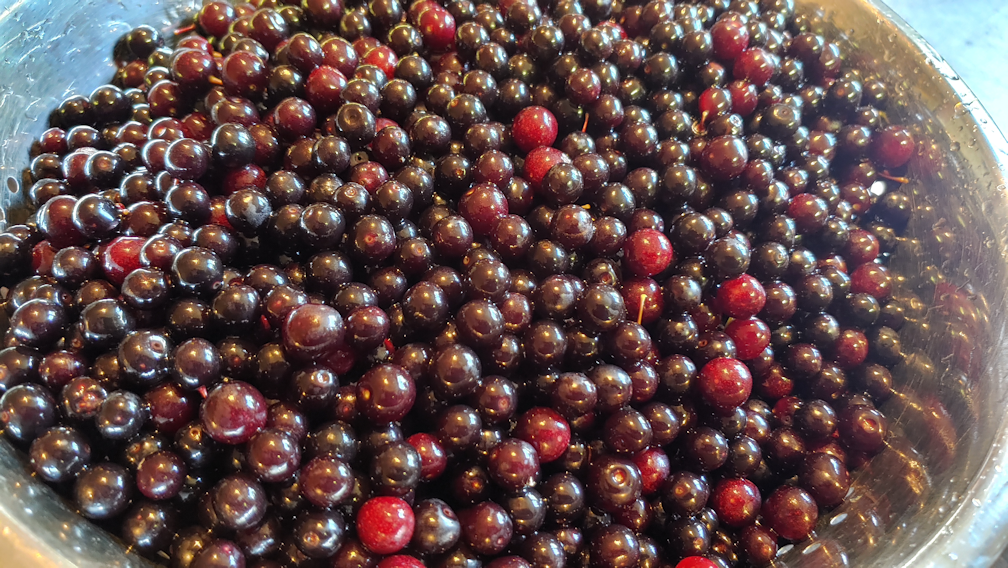
Nice to see my colander so full of berries! All clean and ready to pick over.

I got all the stems (of course, I found one I missed after I took this photo!) and the ones that were damages or whatever. I filled two 9×13 jelly roll pans with berries when I was done.

They are now in the deep freeze, to be transferred to freezer bags when they are frozen solid. After that, they can wait until we decide how we want to use them this year. :-) The freezing will help them release their juices later, too.

So… what shall we make? More chokecherry vinegar? Or try a jam or jelly this year?

The Re-Farmer