Babcia’s Bread Experiment, part 9: a few changes

Yesterday, I made another batch of bread using the old dough stored in flour as a starter. I did change things up a little bit, though.

One of the things about trying to recreate how my grandmother did this is, I’m relying on my mother’s childhood memories. There would definitely be things my mother never noticed, never saw, or simply doesn’t remember. In reality, my grandmother would have made do with what she had, so while their bread would certainly have been as basic as flour, salt and water, if she had had other ingredients, she would have used them. I know they would have made their own butter and rendered their own lard. They may even have pressed their own seed oil (my mother does remember processing hemp, so they likely had hemp oil, too). They likely had honey or some type of sugar, if only rarely. It’s hard to say, though, since my mother doesn’t remember very much of that, and none of my research so far has turned up more historical detail. There just isn’t a lot out there to describe how people in poor, backwater villages ate because, frankly, most of the people recording such things either didn’t know about them, or were indifferent to how ordinary people lived.

I do think that there is room to experiment a bit and still be pretty true to how Babcia would have done things, even if they were only on special occasions or when she happened to have access to ingredients.

With yesterday’s baking, one of the things I changed up was how long the old dough was left to soak in warm water. My mother says it was left overnight. My grandmother had a large lump of old dough, for her weekly baking of a dozen or so loaves, but I’m not working with such quantities. The amount I’d set aside from the last batch was the largest I’d done yet, and it was getting too big for my canister of flour. In fact, I didn’t get any pictures of it when I took it out, because there was just too much flour all over, it was bigger than the plate I’d brought to hold it, and I just broke it up into my crock right away.

When the old dough was left to sit in a warm oven overnight, it seemed to me that this was too long. It was no longer actively bubbling by morning. So this time, I decided to just let it sit for a few hours. I also added a small amount of sugar (about a tablespoon to 2 cups of water that had been boiled, then allowed to cool down to the right temperature) to feed the yeast. Last time, I supplemented with a bit of commercial yeast, but not this time.

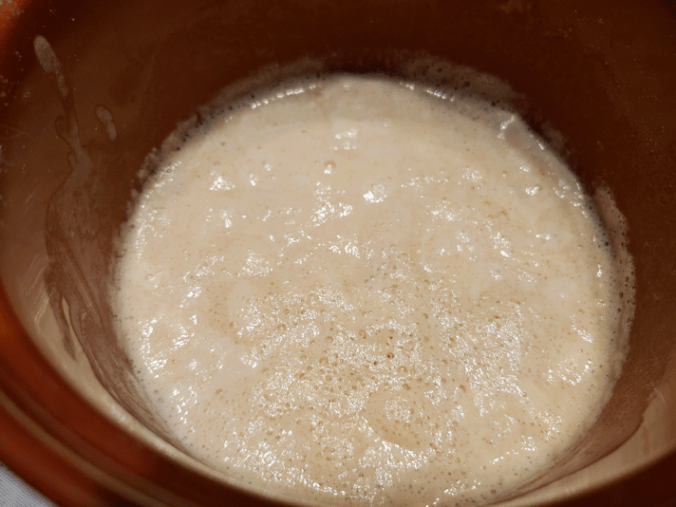
This is how it looked, after about three hours sitting in a warm oven.

Just look at how bubbly that is!

I did add a bit more sugar (another tablespoon or so) to the dough as I mixed it, too. No added yeast. This was a slightly larger batch than before, too. Previous batches used about 3 cups of water in total, to 4 or 5 cups of flour, but this time I used about 7 cups of flour to 4 cups of water. Then, after cutting away a piece of dough for next time, I tried something else.

I kneaded in a cup of thick cut rolled oats. This is something my grandmother would have had, at least sometimes, so I have little doubt that she would have included it, when it was available.

Normally, I would have added the oats at the very beginning, leaving it to soak in boiling water until it was cool enough that the yeast or sourdough started could be added. I wasn’t sure how that would affect the dough set aside for next time, though, so I left it until later.

I knew the flakes would still soften while the dough was rising, and it would add some texture, too. Kneading it in was a challenge, though! I deliberately left the dough stickier than I usually would have, just to make working in the rolled oats easier, and it was still trying to fly all over the place! LOL

Unfortunately, I completely forgot to take pictures after this!

The dough itself just did not want to rise! Yes, it was in a warm oven, but I’m using a plastic bowl (metal can react with sourdough, affecting the flavour, and this is pretty much a kind of sourdough), so I didn’t want to make the oven much warmer. It did rise some, and again as I formed the loaves, but even the smaller loaves didn’t rise as well. I really should be leaving it to rise for far longer, but it’s just to dang cold.

It does rise more while baking, of course, so that helps. The bread was still dense, but it did still have plenty of air bubbles in it. The rolled oats did soften up, as expected, while still adding a bit of nice texture and a subtle flavour.

Speaking of subtle flavours, there is most definitely a light sourdough taste developing.

I made a total of 8 small loaves out of this batch; 4 round loaves (basically just big buns!) baked in a cast iron pan, and 4 long loaves baked on a pizza stone. At 400F, the round loaves needed about 40-45 minutes to bake, while the long ones needed about 30-35 minutes. I have no idea how long my grandmother would have baked hers, since she had a masonry stove, and I don’t know what method she used to determine when the temperature was right.

As for the bread it self, it was quite tasty. I like the addition of the rolled oats. This morning, I cut one of the little long loaves into slices, pan toasted one side in butter, then topped each with a slice of mozzarella, for breakfast. It was very nice! It probably would have been nicer to broil the cheese, but I didn’t feel like fussing with the oven. :-D

Next time, I’ll have to remember to take pictures through the whole process. :-D

The Re-Farmer

Fall planting: the garlic is in!

I was so excited to finally get our bulbs this morning!

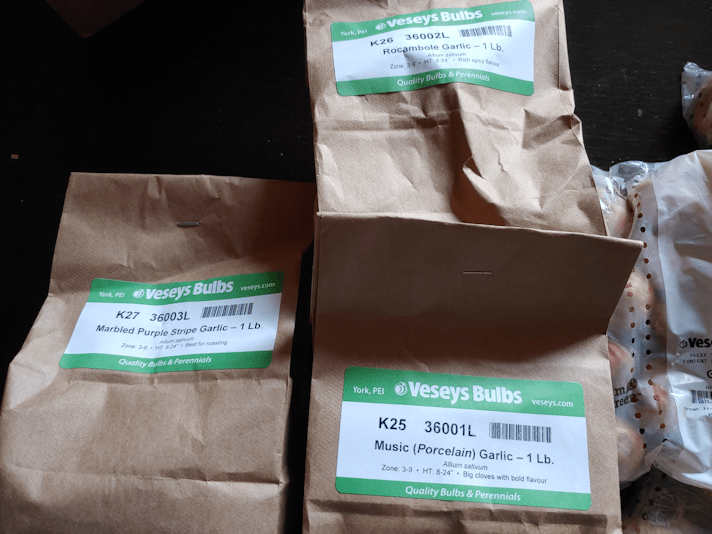
Here are the three varieties of garlic we ordered.

I appreciate how they add things to the label, like “best for roasting” , “rich, spicy flavour” and “big cloves with bold flavour”.

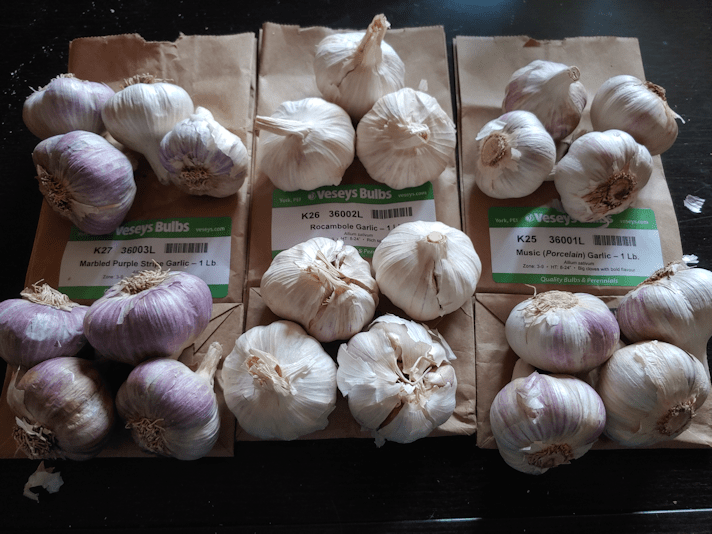
This is what 1 pound of each variety looks like. I wasn’t sure how many bulb heads or cloves that would translate into. That was the main reason I wasn’t sure if the two beds I’d prepared for them would be enough. At least I was reasonably sure it wasn’t going to be too much space! :-)

Today turned out to be a very windy day, so my daughter and I broke apart the cloves inside the house.

Those old take out containers were perfect for keeping the varieties organized!

Also, they made the house smell absolutely amazing!

I had been watering the prepared beds, to try and get moisture down to the layer of compost and straw buried inside. Unfortunately, I wasn’t able to do that as often as I’d wanted to, so I gave them another thorough soak.

The frame used as a guide to dig 4′ x 8′ beds fit in the next space, inches to spare between it and the ring around the new compost pile. It was ready, just in case I needed a third bed.

Thankfully, I didn’t!

Porcelain Music Garlic

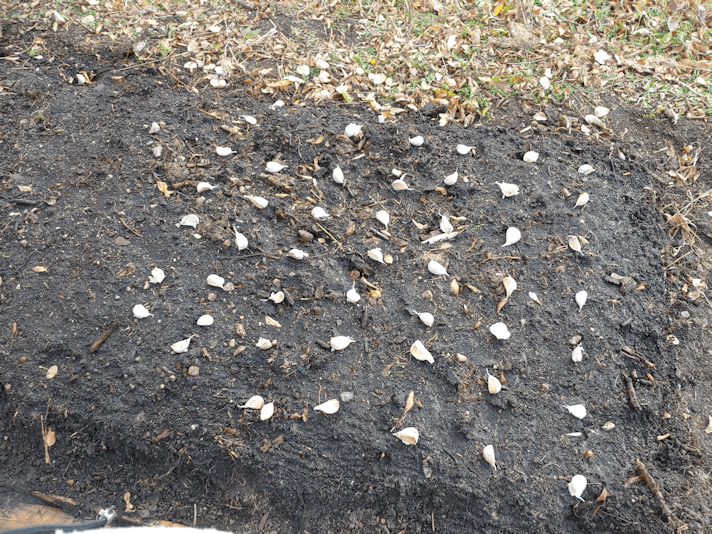
The first variety I planted was Music. Directions for planting hard neck garlic I have looked up, say to plant cloves 4 – 8 inches apart, in rows about 12 – 18 inches apart. Since we are doing beds rather than rows, I laid them out in a roughly 6 inch grid. The soil is so soft here, I was able to plant the by just pushing my gloved fingers in to the correct depth, without the need for any tools.

Purple Stripe Garlic

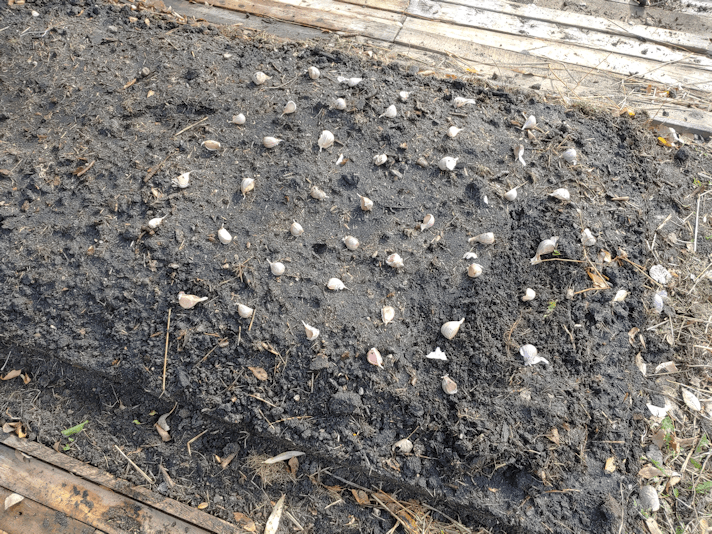
With the number of cloves we got from the Purple Stripe, my grid wasn’t quite as even at the end. :-D The corners on this bed seemed like they would collapse a bit, so I moved the cloves that would have been planted there to the other side.

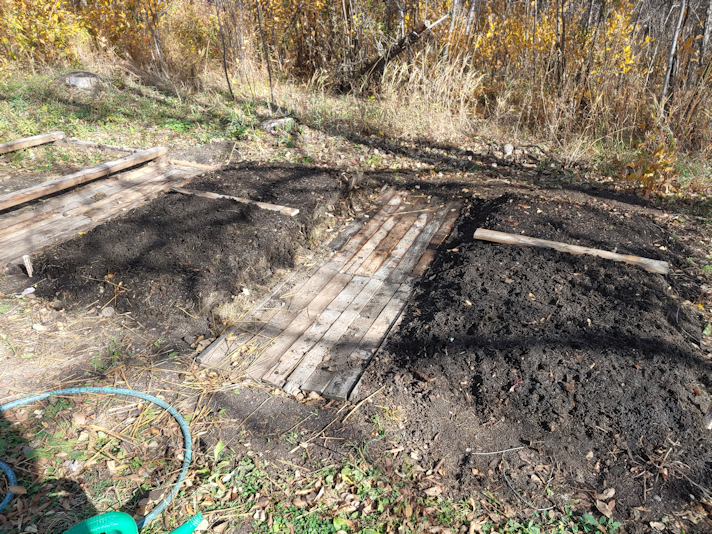
Once the two varieties were planted, I added boards to mark where the grid ended, and the third variety, which would be in both beds, started.

Racombole Garlic
Roggenrola (Pokémon) - Bulbapedia, the community-driven Pokémon encyclopedia

The last ones to plant were Racombole. Which sounds like a Pokemon.

Meet Roggenrola.

(image source)

The Racombole turned out to have a lot more cloves, including more smaller ones. It was almost like soft neck garlic that way. So these were planted slightly closer together. More like 4 inches apart, rather than 6. I probably shouldn’t have bothered to plant the smallest ones, but I didn’t want to waste a single clove!

Those boards across the beds also came in very handy to put a foot on to brace myself, making it easier for my short little arms to reach the middle. ;-)

Planting in these beds really demonstrated for me that building much higher raised beds for accessibility is a very good idea!

The next step was to add the mulch, and this is where the wind became a real potential problem.

Thankfully, I thought to put the chopped up straw on a tarp.

It was easy to slide the whole thing into the path between the beds. I could then grab handfuls, keeping them low and out of the wind as much as I could, to spread out.

I then had to rush to give the mulch a soak with the hose, more to weigh the mulch down than anything else! As you can see, the wind was already starting to blow the straw away!

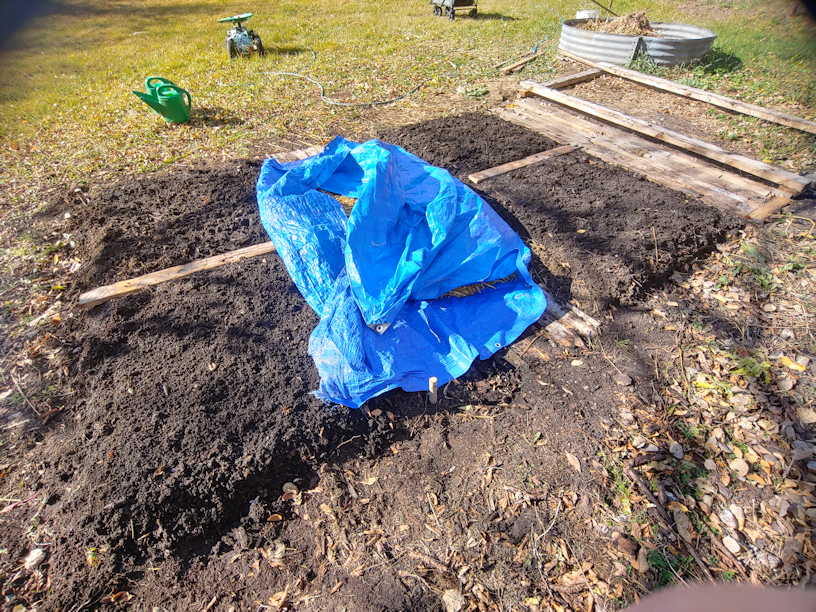
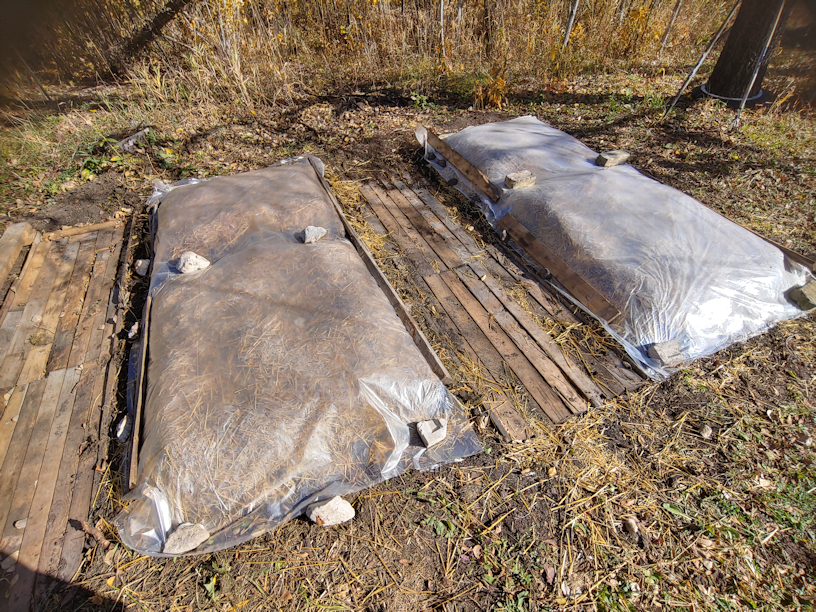
The last step was to cover the beds with plastic – which the wind certainly made challenging! Thankfully, we’ve found a couple of rolls of plastic while cleaning up the house and basements, so we have plenty, and I could unroll it directly on the mulch, adding weights as I did.. The plastic is actually folded in half on the roll, and I didn’t bother to unfold it, so this is a double layer of plastic on the beds.

As you can see, those board across the beds came in handy for the weights, too!

The plastic isn’t something I’ve seen suggested, in general, but we are in zone three, and most of the places I’ve looked up are in at least a zone 6. While October is the month for planting hard neck garlic for them, we probably should have planted these at the end of September – and would have, if they had not been back ordered.

The issue is overnight temperatures. We’re consistently hovering just below freezing. In the long range forecasts, our highs for the day will be just barely above freezing.

There are a few things going for these beds that should help with our planting this late in our zone. Burying the organic matter at the bottom of the beds means there should be some warmth generated as they break down, just as it would have if it were in a compost pile. The mulch will also help regulate the temperatures and, finally, the plastic should help keep things a bit on the warm side. I don’t want it warm enough for the garlic to start sprouting, but they do need to start their growth below ground before winter temperatures set in.

I might remove the plastic later on. Snow also acts as an insulator, plus these beds should not need any watering throughout the growing season. Between normal precipitation and the mulch, they should have enough moisture. Letting the snow cover the beds would give them that first burst of moisture in the spring, and the beds being slightly raised means they should thaw out faster than the ground surrounding them. However, the plastic will also keep the moisture they already have from drying out before the snow falls, and will help the soil warm up even faster in the spring, giving the garlic a chance to start growing a bit earlier. I would then remove the plastic once I saw that greens were making their way through the mulch.

My mother grew garlic in the old kitchen garden, but she never used mulch or plastic or any of the other techniques I am using that irritates her so much. :-D So I can’t go by how she did things, in past years.

So if there are any experienced garlic growers here, I would love to hear how you have done it! And would you leave the plastic, or take it off before the snow falls?

I’m really looking forward to seeing how these do. When it comes time to harvest them next year, we will be looking to save the largest bulbs for planting. Hopefully, we’ll have enough large ones to have more to plant than what we started with.

You just can’t have too much garlic, after all!

The Re-Farmer

Replacement door: hung

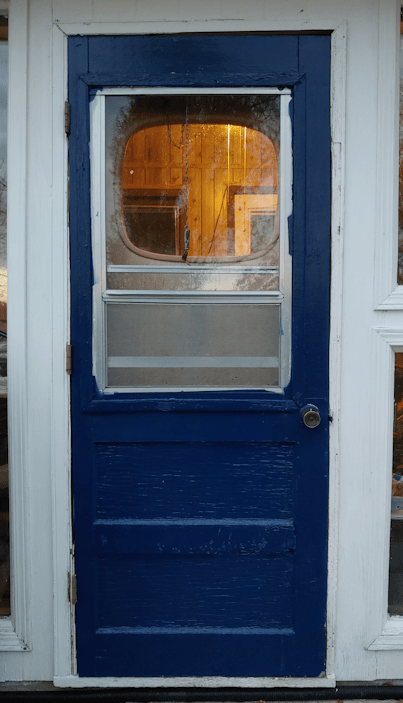
The replacement door to the sun room is back up again!

Of course, things went wonky in the process. At this point, I expect nothing else!

I don’t know if you can tell, but we ended up adding yet another piece of wood under the bottom hinge. The gap there was still massive. And yet, none was needed at the middle hinge!

Of course, the door didn’t quite fit, even after all this. We still needed to force the door over the threshold. We’d had to do that with the old door, to a certain extent. It wasn’t as noticeable, and I think that was partly because the door was already starting to fall apart before we moved here.

Using the blue paint scraped off the door as a guide, I used whatever tools I could dig up to smooth out the side piece. I tried one of the planes we found in the basement. It was a bit big for the space, but it would have worked, except the plate was loose, which is when I discovered the frame holding it was cracked.

We didn’t find it that way. The cats had knocked it off the shelf I’d put it on.

*sigh*

I carved out a recess for the latch plate and deepened the hole for the latch itself until it could finally catch and stay caught. I also began chiselling, carving and rasping away at the outer edge of the threshold until the door could close without being forced.

Well. It still kinda needs to be forced. There is still an issue with the hinges. Understandably, there is a lot of stress on them. I’m trying to think of what I can do to fix that, and not a whole lot comes to mind that is feasible.

I suspect this door won’t last very long, but it’s the best we can do right now, and at least there’s a working door!

I still need to work on smoothing out the frame some more before we paint it. I have been eyeballing some tiny little planers at the hardware store that would be perfect for the job. I might just have to spring for one.

I will be so happy when this job is finally done.

The Re-Farmer

So many cords…

Today I did some work on my mother’s car, to help prepare it for winter.

For those less familiar with some of the things many of us Canadians need to do to our vehicles so they better survive our winters, most vehicles here have, at the very least, a block heater. That’s all our van has. This prevents the oil from freezing and cracking the engine block.

We actually had that happen to us. We were living in Victoria, BC, which is temperate rainforest. Getting snow there is a rarity, and temperatures below -20C/-4F even rarer. An unexpected windfall meant we could afford to drive out to be with family for Christmas. We had no car of our own, so we rented one. My husband called several places and, at each one, told them that where we were planning to drive and asked for a car with a block heater. The typical response was “what’s a block heater?” So we took what we could and headed out, stopping for the night along the way. That night, temperatures plummeted and wind chills reached -61C/-77F. Amazingly, the car started the next morning, but we barely got back on the highway when it started making noises, so we stopped. This was in the days before cell phones, so my husband started to walk back to town, getting a ride from someone (thank God!) along the way, to get help. Long story short, the engine block had cracked (also, a 6 pack of pop on the floor of the back seat exploded. :-D ) and by the time all was said and done, it cost the company some $5000.

A few years later, when we went back to rent a car there again, we learned our story had become legend in the company. Also, the franchise owner replaced his entire fleet, and all their cars now had block heaters.

So… yeah. These are essential.

If you ever see a vehicle with Canadian plates, and the end of a cord hanging out the hood, now you know what it’s for. :-D

My mother’s car, however, also has a battery warmer and, because it was used so little, my brother added a trickle charger, too.

All of which need to be plugged in.

The plug and cord for the block heater in newer vehicles are different. They don’t need to be on constantly to do that job so, to save power, the cord itself is designed to shut itself off about about 20 minutes, then if the temperature of the lines drop below a certain point, it turns itself on again.

When my brother set things up, he used an extension cord they could all plug into, tucked neatly away.

I needed to replace the extension cord.

He also had a wire around the battery warmer to hold it in place. However, with my mom’s car having so much work done in recent years, things got moved around. After the battery died while sitting at the garage for so long, it was taken out to be charged, but I guess the wire that had been around the warmer was forgotten. I was going to use Zip Ties to hold it, but they kept breaking, so I used a Bungee cord; the red that you can see around the battery.

This is the plug for the trickle charger, after I pulled the rest of it loose. As you can see, there’s no way to plug in the block heater or the battery warmer. My mother didn’t drive the car in the winter and, until we took over taking care of it, my brother stored it here at the farm and took the battery into the house for the winter.

Remember how I mentioned the extension cord used to be neatly tucked in, until work was done on the car?

This is why the cord needs replacing.

I had noticed an odd sound a while back (this was before we had the serpentine belt and pulleys replaced) and found a loop of it hanging down, touching the belt. Thankfully, it didn’t get caught, but there was enough contact for the friction to wear right down to the wire. In another spot, it had been caught between something tight enough to cut through two layers of plastic.

We had the same type of extension cord set up in the garage for our own van, so I was going to just switch them out. I had gotten to the point of trying to figure out how to fit the end, with all three plugs in it, in place when I realized something.

Our cord was much longer than the one I’d just taken out! There was no way I could safely tuck away any excess.

Since I couldn’t leave everything half done like that, I made a quick run into town. Of the 2 hardware stores, one was already closed, and I had less than an hour to get into the second one!

Score!!

I have never seen an extension cord for block heaters before!

I could have done with shorter, but that was the shortest they had.

It took a fair amount of fiddling to find a way to lay the plugged in cords out.

More Zip Ties were used to keep things from slipping down, while the new extension cord was set up to exit at the other end.

At this point, I’m not bothering to hook up the trickle charger. It’s not needed right now.

The battery has nothing to indicate which side is positive and which is negative! Only by stretching to see the far side of the battery can I see which connector cable is red and which is black.

I’d used the slots for holding the battery cover in place for Zip Ties to hold the cord. Thankfully, that did not prevent me from being able to fasten the cover back into place.

I then dropped the hood a couple of times to make sure I could actually close it with the end of the extension cord sticking out.

For now, though, it’ll stay tucked away. When we get colder, I’ll hook up the trickle charger and leave the plug hanging out. A lot of public parking lots have outlets available, so an extension cord will be kept in the vehicle in case we want to plug it in while out and about, too.

Aside from that, my mother’s car is all set for winter. :-)

The Re-Farmer

Fall cover, and working out a problem

It’s been rather windy for the past few days.

We certainly won’t be needing to mulch the bulbs we planted! They’re getting an excellent cover right now. :-)

We’ve got a bit of a challenge in winterizing things outside. One of the things that needs to be done is to replace the rotting skid under the cat house.

After dismantling our goat catcher earlier in the year, we left the frames together. The two 4′ x 8′ ones were prefect to use as guides for our potato beds. When I noticed how rotten the skid under the cat house was, I grabbed one of the frames to check.

It’s actually a better size than what’s already under there! Right now, only one side rests completely on the length of the skid, while the other rests on the skid at only 2 points. That’s the side that also had the little addition, where the entrance is. There is nothing supporting the weight of the entry at all, other than the floor beams.

The problem is, this thing is incredibly heavy. My brother had managed to move it onto his trailer all by himself, but he did that by putting straps around the skid. We need to take it off the skid, then put a new one underneath. The whole thing will be on bricks to keep the wood from contacting the ground, and I plan to add more under the entry to support it, as well.

We discussed taking the roof right off, since that’s where a lot of the weight it, but we are already hearing crackling of wood every time we raise it. It’s already got a lot of years on it, and we’d like to be able to use it for quite a few more! Once we have it on a new skid, set up a bit closer to the house for the extension cord to reach, it will hopefully never need to be moved again until it’s no longer usable. Another part of the problem is the lack of tools. We don’t even have a bar we could use to lever it – there was one, but it was among the things that disappeared while the place was empty.

We will have to make do with whatever we can find!

The Re-Farmer

Morning surprises, and is the hard cider okay?

So I had a few pleasant surprises this morning.

And one not so pleasant.

When I headed out to do my morning routine, I had a rush of outside cats come running as soon as I opened the door! And who was in the lead?

Little Braveheart!

She ran right up to me. She still won’t let me pet her, but she’s coming the closest.

While in the sun room, filling a container of kibble at the storage bin, there was a crowd of cats going in and out, including Butterscotch, Potato Beetle, Junk Pile cat and her 2 kittens. When I felt a cat rubbing against my legs, I looked down, expecting to see Potato Beetle, who has been begging for attention these days.

Nope.

It was Little Braveheart! Weaving around my feet.

*melt*

The mystery kitten came out from under the cathouse again. That seems to be a favorite place now. I’m glad she’s willing to hang out so close.

Once he’d eaten his fill, Potato Beetle accompanied me for the rest of my rounds.

He did not want me to put him down, either! :-D

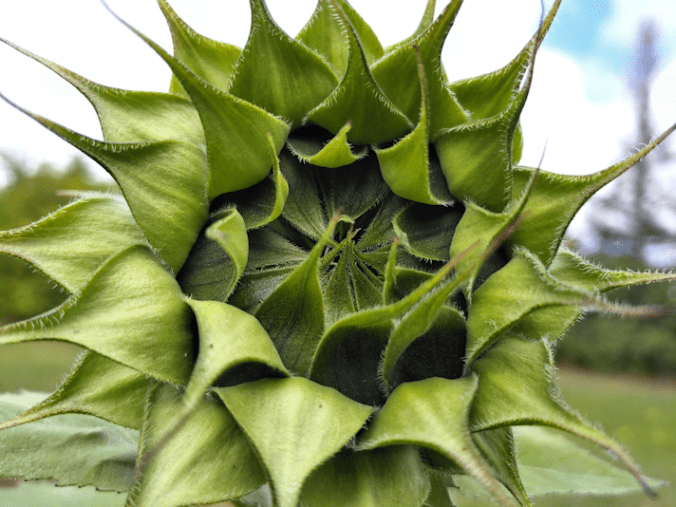
The biggest seed head on the mutant sunflower, with its 20 or so seed heads, is opening up quite nicely!

Once back inside and chatting with my daughters, I noticed a kitten on a side table. They are allowed on this table, but it’s also where the hard crab apple cider is sitting, and the kittens have been going after the airlocks. So I went to move her away and…

… noticed both airlocks were gone.

!!!!

I had checked the temperatures before heading outside, and didn’t notice they were gone. I guess it’s a good thing it’s been relatively chilly; they both read at 17C/62F this morning, while the ambient temperature is 16C/60F. They are both wrapped in a towel to keep the warmth of their own fermentation in, but at these temperatures, there’s not a lot of activity in the airlocks.

I found the airlocks, upside down, between the towel and the wall. The bungs were quickly covered with plastic wrap. The main concern is that we have a fruit fly problem right now, and we just can’t seem to get rid of them all. Another reason to be glad the cooler temperatures mean slow fermentation, I guess. They weren’t attracted to the open holes in the bungs! There were no fruit flies in the jugs. *phew*

They can’t have been without airlocks for long, but even so, could this be a problem? Will they be okay?

I have no idea.

We need to find a way to warm them up. For the mead, we used an electric heating pad, but there is no electrical outlet anywhere near where we have them now. We were thinking of wrapping something warm around them, like those microwavable neck warmers, but we don’t have any.

Hhmm… I could warm up a towel and wrap them in it.

*sigh*

Well, we will just have to keep a close eye on them and see how they turn out!

The Re-Farmer

Stages of sun

I recently harvested the two biggest heads of sunflower seeds that were done blooming. They are now hanging in the basement to dry, where the birds can’t get at them.

As for the rest of them, we’ve got seed heads at all stages! Not all will have time to mature before the growing season ends, but we should still have a decent number of them to harvest and dry for the winter.

Click on the images to see larger sizes, though they are all 25% of the original size.

That one mutant sunflower, with all the extra seed heads developing, is one to keep an eye on! We might actually get a couple of seed heads mature enough to harvest before the end of the growing season.

While going through some of the photos I took with one of my daughters, she was suggesting I make some available for sale, in various forms. We’re still trying to come up with ways to be able to raise funds for things like a new roof, when I cannot get a job (for the new folks following this blog; as we are living on my husband’s health insurance disability payments, anything I earn would be deducted from his payments. If I were to earn more than his payments, he would lose his plan, which means no more coverage for his prescriptions). I was considering offering things up as fundraisers: all proceeds go towards replacing the roof, or getting yard cats fixed, or building a wheelchair ramp, etc.

So I’m putting the idea out there. If I were to, say, make photos available on, say, Redbubble, as prints, mugs, t-shirts, etc., would this interest you? I’ve had it suggested to put a donation button up, but I don’t like to ask for something for nothing. Other people use sites like Patreon, where there are rewards for different tiers. Of course, there are always affiliate links, like with Amazon, where the site would earn a commission. All proceeds would go to specific things, such as a new roof (long term goal) or getting yard cats spayed and neutered (short term goal) or building a wheelchair ramp (mid term goal), etc. It would have to be fundraising for a specific project, not an income for us. We would have to be very careful about that.

What do you think? Is it worth giving it a go?

The Re-Farmer

Potato beds put to bed

Today, we took advantage of the warmer weather and dug up our two potato beds.

The first one got done fairly early in the morning, before we headed to the city. Having already dug up a few of them earlier, I had some idea of what to expect, but I have zero experience with growing potatoes the “Ruth Stout” way.

I first pulled up the potato plants, then carefully used my potato fork to lift off, then “rake” the mulch away. Here, you can see some of the potatoes I uncovered in the process.

I also uncovered several chilled little frogs! I carefully moved them to the mulch by the squash, where they could warm up in the sun.

I also uncovered slugs.

I did not rescue them. ;-)

Almost all the potatoes I found were just sitting on top of the soil! Some took a little more raking away of the mulch to find, but not much more.

What had been rock hard ground when we started, the mulched soil was so much easier to work – even with all the rocks.

I took advantage of the situation and dug up the entire plot, so I could pull out as many weed roots as I could. The crab grass came out pretty easily. Then I hit a solid mass of roots near the surface, with a tap root of some kind that continued deep into the ground. I could not get it out with the fork! If I’d had the spade handy, I might have been able to cut through it, but since it seemed to be dead, I left it. It will be buried.

I did find a couple more potatoes in the process!

The end result looked like a 4×8 foot grave! :-D

When I finished pulling up as many roots as I was able, the mulch all went back – along with the potato plants that had been pulled up.

These are all the potatoes I got out of the one bed.

Also, note the one slightly darker potato with the arrow pointing to it. I’ll explain that, below!

When we got back from the city, I continued working on the second bed.

Once again, I was finding most of the potatoes on the surface of the soil as I pulled away the mulch.

These are all the potatoes I found, before I did any digging at all. Unfortunately, quite a lot of them had holes eaten into them. :-( After digging, I found maybe 5 more.

Speaking of 5, do you see those 5 darker potatoes on the side?

Those are the original seed potatoes! The other bed had only one. While they had stems and roots that I broke off of them, they are just as hard as the day I planted them. I found the remains of some other seed potatoes, all mushy and used up like one would expect at the end of the growing season.

I got two 3 pound boxes of seed potatoes, which gave me 3 row of 6 potatoes in one bed, and 3 rows of 5 potatoes in the other, plus an extra. That’s 34 potatoes – and 6 in total never grew more potatoes!

As with the previous bed, I dug it all up, finding a few more potatoes, a whole lot more slugs, and pulling out weed roots.

Would slugs be the cause of those holes in the potatoes?

This bed had quite a few more rocks near the surface that I got rid of, too. My fork was hitting many more as I dug down, but I didn’t try to get them out, since we will continue to build these beds up. The mulch and old potato plants went back over the soil.

I then took all the harvested potatoes and laid them out on the dry straw mulch between squash beds, so they can cure (is that the right word for it?) in the sun. Except for the tiniest ones, which will be cooked and eaten right away. :-)

I then had the 6 original seed potatoes. What to do with those??

Yeah. I planted them, almost the same way they were planted in the original beds. The only difference is that I did loosen the soil a bit, first. Not to bury the potatoes – there are so many rocks along this end, I could barely do more than scrape away the mulch on top! No, it was so I could push in the bamboo poles to mark where they are. Even then, I don’t think the poles will be able to stay up for long. I could barely get them into the soil at all. No matter how I shifted and searched, I kept hitting rocks just inches below the surface.

What will most likely happen is that the potatoes will freeze over the winter, and nothing will come of them. Another possibility is that they will be protected by the mulch and, as soon as it gets warm enough next spring, they will start growing and we’ll have early potatoes started.

We’ll find out next year!

As for now, the potato beds are put to bed for the winter. I don’t know what we will plant in those spots next year. We do intend to do potatoes again, but in a different location. We don’t want to entice the Colorado potato beetle by planting in the same location again. We didn’t see a single one this year, but one of my neighbours a mile up the road mentioned that his potatoes had been decimated by them! My parents always planted lots and lots of potatoes, and I well remember going through the rows, picking off the beetles or their larvae, and hunting for the eggs to crush. Even with several of us doing that every day, some years my mother had to resort to using a poison powder of some kind, to get them under control.

I’d really rather not have to deal with them at all, if I can avoid it!

As for the squash, for now I have stopped harvesting any more of the sunburst squash, though there are a couple of zucchini that are almost large enough to pick. I prefer them when they are quite small, but with the sunburst squash, I want to give them as much of the remaining warm weather as I can for them to grow. As I write this, past 6pm, we are still at 21C/70F. We are supposed to stay fairly warm over the period covered by the long range forecast, with no more frosts expected overnight. That should give our produce a bit more time before we have to harvest what we can, then prep for the winter – and next year’s gardening! :-)

Our first year gardening since moving here has been quite interesting, and quite the learning experience. We will, for sure, continue using the Ruth Stout method until we are able to start making the accessible raised beds that are the ultimate goal. The extensive use of mulch is making a very noticeable, positive difference in the soil, even after just one year. My mother may be disappointing in our gardening, compared to what she had here, years ago, but I’m happy with our progress so far! :-)

The Re-Farmer

The new kitty pool

With bringing a yard cat into the house to have her kittens, instead of using the sun room as a maternity ward, has us facing some different challenges.

In the sun room, as the kittens got bigger, they had a fairly decent sized room to run around in, and still be safe from other critters. Now, we obviously don’t have to worry about skunks or weasels or foxes or even feral toms coming into the house, there are other safety issues we need to keep in mind. The house itself is not at all kitten proof, so we can’t just let them run amok. Even if we could, however, there is the issue of other cats. At one extreme, we’ve got Two Face, who has been trying to mother them herself. Most are mildly curious or content to just ignore them. A couple, however, are not happy with having new adult additions to the household, never mind kittens. The adult cats can protect themselves, but the kittens can’t even run off and hide at this point.

The other thing is, we need to find a way to give them access to kitten food, water and a litter box, as they begin the weaning process.

We had considered a number of options. Even buying a play pen. Which, it turns out, cannot be found locally. We’d have to drive to the city! A wire dog kennel? The mesh is too wide for kittens, Mom needs to be able to get in and out, so the door would have to be left open. Though, I suppose, it could be used upside down. However, the kittens would be able to climb the wire mesh pretty easily. We could probably figure something out, but that would assume such a thing would be available locally. Once again, nope. We’d have to go to the city.

My daughter and I headed into town today and went to a store where I knew we could find decent cat litter at an equally decent price (the second Costco trip to the city we were planning looks like it’s just not going to happen). As we walked in, we saw a potential solution.

We bought a kitty pool.

The sides, of course, are way too low, but it’s big enough we can put in a litter pan and food and water bowls, along with their bedding, and they’ll still have room to run around.

As I write this, my daughters are building cardboard walls for it, at a height Mom can jump over, but the kittens can’t climb.

We’ll see how this works over the next few days! :-)

The Re-Farmer

Gardening progress: transplanting

Today, it was time to transplant some of the squashes we started from seed indoors.

I am really hoping we’re not jumping the gun, here, but many were outgrowing their Jiffy Pellets and really needed to get in the ground. In the future, for things that need to be started so early indoors, I am thinking it would be better to go straight into 4 inch pots, instead. That would give a more flexible timeline for getting them in the ground.

In going through the seedlings to see which ones had their true leaves and were ready to transplant, I counted out 16 in total, so I decided to do two rows of 8. I think most of them – at least the largest ones – are from the zucchini surprise mix, but after the trays got knocked over yesterday, they are all going to be a surprise! :-D

I used flags I picked up at the hardware store to mark the first row at 2 feet apart.

Though we mulched the area last summer, and the soil has improved quite noticeably, we are still dealing with lots of rocks and a soil in need of amendments. Several times, when placing the flags, I hit rocks and had to poke around to find somewhere I could push the wire in. We needed to figure out a way to get around that, and this is what I’ve come up with.

The first step was to open a hole in the mulch to the surface of the soil (removing any rocks I found in the process.

I also prepared a soil mix.

The wheelbarrow still had some straw on the bottom that I didn’t bother taking out when I dumped in a bag of garden soil I also picked up at the hardware store (only because they were on sale! *L*) and a couple of spade fulls of peat. This got mixed together with plenty of water. The dry peat was actually being blown away by the wind while I mixed! It took a while to get it wet enough for the next step.

Into each opening I made in the mulch, I added a spade full of the soil mixture. Then a hole was made in the middle of each one for the transplants, with more water added as well.

Each squash was then transplanted and secured in their own little “hill” of soil mix.

Then I mixed some more soil and peat and repeated the process for the next row, which was made about 2 feet away from the first.

Which was when I discovered I had 2 extra seedlings! LOL So I added them to the ends of the rows, taking a little bit of the soil mixture from each of the other plants, to transplant the extras into. So we now have a total of 18 surprise squashes transplanted.

Once both rows were planted, they were mulched with more straw. When we add a trellis, it will go between the two rows.

After the straw was placed – with the wind trying to take much of it away! – I gave the bed a fairly thorough soaking, to dampen the straw. Not too much, as I didn’t want to shock the transplants with cold water in this heat! I will set up a sprinkler over it this evening. Unless the predicted showers make it to our area. It’s been quite a hot day, and the rain will be most welcome.

When I was done and inside the house, I checked the weather. My phone app said it was 18C, (“feels like 18C”) (46F).

They lie.

I checked the app on my desktop and it said we were at 26C, with a “feels like” of 28C (79 and 82F). That was certainly the more accurate one!

Our barometer agrees.

Since we cleaned this out and refilled it, I have never seen it this high!

We had thunderstorms predicted for the next couple of days, but now those have been pushed back to Sunday. Whether the storms reach us is always touch and go, but I’d like to find some way to cover the transplants, if we do. The straw will protect them, but only so much.

Meanwhile, we’ll be keeping watch on what’s left in the seed trays. We won’t be transplanting as much as we hoped, but right now the only thing I’d say is a total loss is the fennel. I still have hopes for the gourds to emerge! Not that I’d be able to tell which ones they are at this point. :-D

Still, I hope we’ll have a couple more rows of squash in this garden bed by the end of the month. Tomorrow, however, the plan is to get the sunflower seeds in. :-)

We shall see if planting them in their own little islands of soft, stone-less soil will work!

The Re-Farmer