Chokecherries

This morning, I grabbed a bucket and checked out the chokecherry trees.

After my last visit with them, I thought I might be too late for the one tree; either they would be over ripe, or the birds would have got them by now.

Happily, there were plenty of perfectly ripe (very dusty!) berries!

I was even able to pull branches down and get lots from the top.

This is how much I got, from just the one tree – minus the many that went flying or rolling out of my hands onto the ground! :-D

Which is quite noticeably better than last year.

20180802.bucket.of.chokecherries

That was all what I was able to pick from both trees near the road, last year.

This year, that second tree is not doing as well.

There were very few berries, they were really small, and not consistently ripening.

I left this tree alone.

Then I went for the tree closer to the house. The berries there were much plumper, but the berries were also mostly out of reach. The lower branches don’t get anywhere near as much light, so there were fewer berries and they were redder. My daughter was able to come out and help by pulling the upper branches down so I could reach to pick them.

Check them out!

While there were a fewer berries, they had almost as much volume as the berries from the other tree.

Yes, they are also a lot more red and not as ripe. This is okay, as the less ripe berries have more natural pectin.

As I write this, the chokecherries are sitting in cold water to get rid of any critters that might have come along for the ride, and get the bulk of the dust from the gravel road off. Later, I will give them a thorough wash in cold water, then pick them over to get rid of stems and any messed up berries.

Last year, we made chokecherry vinegar, to use mostly as a drink mix, with our berries. I have not yet decided if we will do the same thing this year. I’ll go through some ideas with my daughters later. I rather like the idea of making a jelly, but that vinegar was really good!

At the very least, we’ll set some aside to freeze and use to make chokecherry mead at some point. :-)

The Re-Farmer

Crispy rice patties

I had a birthday recently, and my awesome daughters treated me to Chinese food. We ordered a bunch of mostly protein dishes to pick up in town, while my older daughter cooked scallop noodles, coconut sticky rice and plain white rice at home to go with it.

On unpacking the order, we discovered they had thrown in a couple of free orders of white rice and chicken fried rice.

Which left us with a pot of plain white rice that ended up in the fridge, untouched.

Not a problem at all! I used it to make these crispy, pan fried patties. It’s a great way to use up leftover rice, though tasty enough to be worth making a bunch of rice, just for this!

Rice Patty Ingredients:

  • 4 cups cooked, cold white rice
  • 4 eggs
  • 1 – 2 cups shredded cheese (I used medium cheddar and a fine grater)
  • seasonings to taste (I used bacon salt, freshly ground pepper, paprika and garlic granules)
  • oil and butter for frying

Tip: when your cooked rice is ready to go into the fridge for the night, put it into a large slide-lock freezer bag. You can then more easily break any lumps of chilled rice apart in the bag, before putting it into the mixing bowl.

Note: I used a fine hand grater, normally used to grate Parmesan, for the cheese, as a regular sized grate could make the patties fall apart more. If using a regular size grate, reduce the amount of cheese used. The cheese can be skipped, too, if you wish.

Sauce ingredients:

  • mayonnaise
  • sour cream
  • white wine vinegar
  • dried herbs and seasonings to taste (I used a Mrs. Dash mix, plus a bit of rosemary lemon salt and fresh ground pepper, but feel free to combine whatever herbs you like or have on hand!)

To make the rice patties

  1. add your chilled rice into a medium bowl. Add seasonings to taste.
  2. add eggs and mix well with your hands, breaking up any remaining clumps of rice.
  3. add shredded cheese and mix in. Let rest for a minute or so (this is a good time to make the sauce). Note: if the rice mixture seems too loose to form patties, mix in a small amount of flour, then let rest again to allow the flour to absorb moisture.
  4. prepare a deep frying pan by adding about half an inch of oil (any oil with a higher smoke point, such as canola, sunflower or peanut oil, will work) along with about a tablespoon of butter, at high heat. The butter adds flavour, but it also lowers the smoke point of the oil. It can be skipped, if you wish. Note: it is important that the oil is very hot before adding the patties, so that they will crisp up rather than absorbing the oil.
  5. begin to form patties by taking about 1/4 cup of rice and pressing it into your hands to form a sticky ball. Flatten slightly, then set aside on a plate.
  6. when the oil is very hot, gently add several patties into the pan (I could fit only 3 in my pan). Use a spatula to gently flatten the patties.
  7. cook until the bottoms are crispy and golden. Gently turn the patties to cook the other side until also crisp and golden.
  8. remove patties and drain on a paper towel. Keep warm as you continue cooking patties in batches. If it become necessary to add more oil and butter to the pan, make sure to give it time to get very hot before continuing cooking.
  9. serve with sauce while hot. Garnish, if desired.

To make the sauce:

  1. place equal parts mayonnaise and sour cream into a small bowl or measuring cup. I used about 2 – 3 Tbsp each.
  2. add a splash of white wine vinegar and any dried herbs you wish.
  3. mix well and set aside to let the flavours meld.
  4. drizzle over crispy rice patties just before serving.

Making these is rather messy, and the rice mixture tends to want to fall apart until it starts to get crispy, but it is so worth it!

Enjoy. :-)

The Re-Farmer

Recipe: Roasted Chickpeas

Here is a really easy recipe for a healthy snack to satisfy those cravings for something crunchy!

Roasted chickpeas.

Roasted, Seasoned Chickpeas

Ingredients:

  • canned chick peas
  • olive oil
  • seasonings to taste

I have found that a 9×13 baking tray fits 2 cans of chickpeas in a single layer very well.

Instructions:

  1. Turn oven to 400F.
  2. Drain the chickpeas into a colander and rinse well. Spread the wet chickpeas onto a baking tray and let the water dry off for a while.
  3. Put the dried chickpeas into a bowl large enough to toss them. Add olive oil and seasonings. (In our last batch, we used Scarborough Fair Garlic Salt and freshly ground pepper. You can use ordinary course salt and pepper, if you wish. It would be great with Rosemary Lemon Salt as well, or if you want to stay away from salt, use your favourite Mrs. Dash mix. )
  4. Toss the chick peas until well coated with olive oil and seasonings.
  5. Return the chick peas to the baking tray and spread into a single layer. Place on centre rack in pre-heated oven.
  6. Roast for about 20 minutes. Take the pan out and give it a shake to turn the chick peas. Return to oven and continue roasting to desired crunchiness, giving the pan another shake every now and then. (We like them extra crisp. With our oven, that takes more than an hour of roasting time. Our oven also has some cold spots, so when we give the chick peas a shake, we also turn the pan, to ensure even roasting. )
  7. When done, remove the pan and allow the chick peas to cool.
  8. Once cool, store in an air tight container.

These make a really excellent and healthy snack, and are downright addictive!

Enjoy!

The Re-Farmer

Getting Ready

While we are ready and waiting for my husband to come home from the hospital, we are also getting ready for Easter.

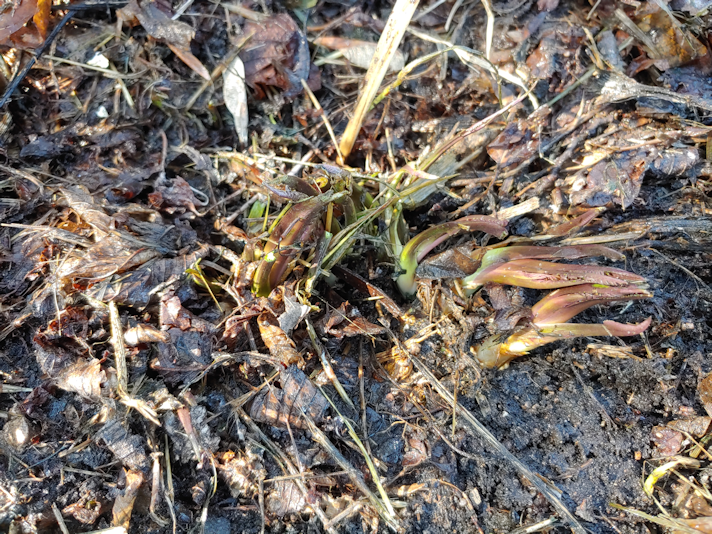
This evening, I went hunting for horseradish.

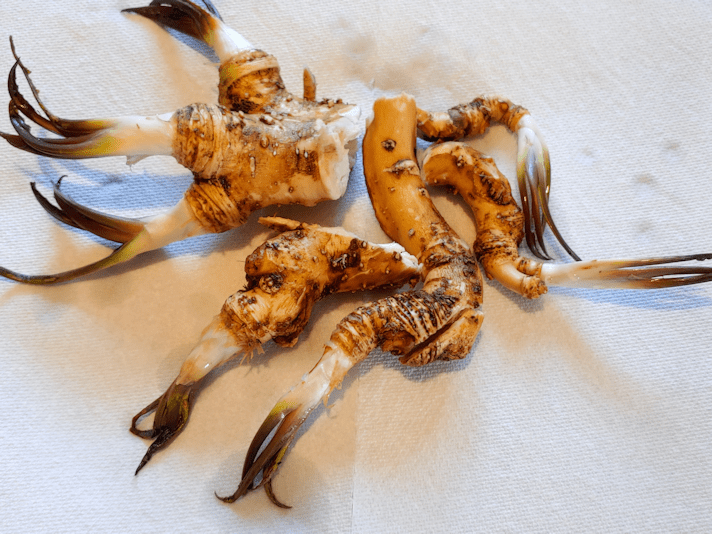
20190417.horseradish.found

After scraping away some fallen leaves, I found some new grow peaking through the ground. I used a potato fork (the only fork that didn’t grow legs and walk away over the years) to dig up a few pieces.

This bunch is growing under the power pole in the garden. I knew the area was very rocky, but wow. I had a really hard time getting that fork deep enough to get some roots out. No matter where I moved it, I was hitting rocks, just a couple of inches below the surface.

20190417.horseradish.roots

I didn’t take out much. A larger piece for our own basket, and a couple of small pieces for my mother. If she wants, she can use one and plant the other, since she has garden space where she lives.

20190417.horseradish.roots.cleaned

For now, I’ve scrubbed the dirt off, and they are wrapped in damp paper towels. For our basket, I will peel some of the outer skin off the lower part, and save the top. The tradition is to use horseradish paste, mixed with beetroot, in the basket; the bitter taste of the horseradish symbolizes the pain of crucifixion Christ endured for us, while the sweetness of the beetroot symbolizes the joy of the resurrection. Growing up, though, we always used fresh horseradish root. My mother would sometimes give away pieces with sprouting tops, after the baskets were blessed, to friends to plant if they wanted.

My mother planted the horseradish in strange places. One batch is under a spruce tree, which would be just as difficult to harvest as the ones growing among rocks. I found more growing among some of her flowers outside the living room window, which has better soil conditions, but harvesting it would mean damaging the bulbs of the flowers it’s growing with.

I’m thinking of maybe using some of the raised planters that are still in decent shape, so the horseradish itself will also be contained better, and not spread too much.

Something to figure out over the next few days!

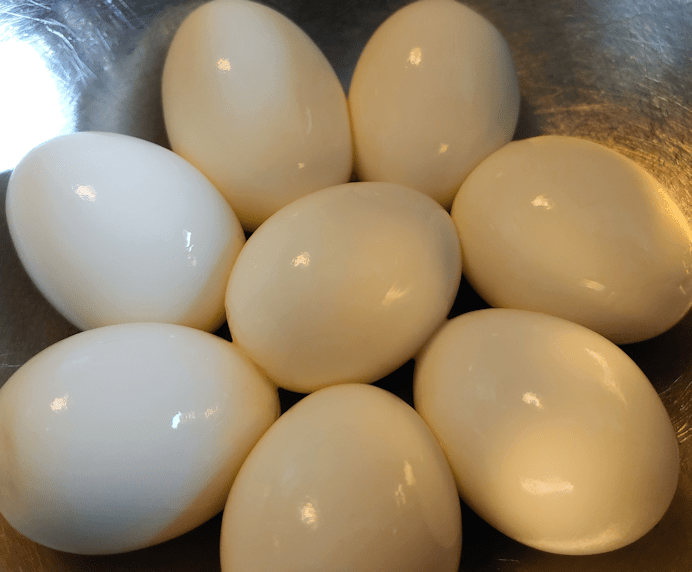
Meanwhile, I will now go and boil some eggs to make pink pickled eggs. :-)

The Re-Farmer

Marinated Goat Cheese

Though it is still weeks away, we are already planning our semi-traditional Polish Easter basket.

I say “semi” traditional, because we’ve modified some of the contents over the years.

If you’re unfamiliar with a Polish Easter basket, these are filled with symbolic foods to be blessed on Holy Saturday, and eaten on Easter Sunday. The foods include ham, sausage, bacon, bread, cheese, salt, butter, horseradish and eggs. We also include things like olives, vinegar, and olive oil. It may also contain a bottle of wine and a candle. Oh, and sometimes chocolate or candy. The baskets are decorated and covered with lace or embroidered clothes. As a child, Easter was my favourite holiday, and our traditional basket was a big reason for that!

Some of the contents require more advance preparation, and I was able to start on one of those, yesterday. This is a non-traditional way to include the traditional cheese in the basket.

This year, I found some absolutely delightful mini-jars, and decided to make several small jars of marinated goat cheese, but we’ve also done it by layering medallions of goat cheese in a larger jar. Both ways work fine.

It had been my intention to make two baskets this year, with a large family basket for ourselves, and a smaller one for my mother. She declined my offer, and will be making her own basket.

We’re going to have lots extra out of this batch!

To start with, I scalded the tiny jars I bought special for the basket, plus extra pint size jars. Then I prepared the ingredients. The mini-jars have smaller openings, though, so that changed things a bit.

marinated.goat.cheese.1

Here we have fresh rosemary leaves and fresh thyme leaves – they came in 28gram packages, and I stripped the leaves from the stems. There are peppercorns and about 8 cloves of garlic, sliced. Not pictured is Extra Virgin Olive Oil.

I completely forgot about the bay leaves. There should have been a bay leaf per jar.

As you can see, this is a forgiving recipe.

The goat cheese came in 300 gram logs; I had 2 of them and cut them each into 4 equal pieces. For the ones to go into the mini-jars, I cut pieces off to try and make them into smaller columns, then gently rolled them between my hands to make them smooth and round.

The first one I tried, promptly crumbed apart. Which is why I have rolled balls of cheese. I broke up each trimmed quarter piece into 4 and formed the smaller pieces into smooth balls.

For the pint sized jars, I didn’t have to be pretty, since they’re not intended for the basket

Each jar got some peppercorns, thyme leaves, garlic and rosemary leaves placed on the bottom. If I’d remembered the bay leaves, they would have gone into the bottom, too. Then the goat cheese gets put into the jars.

This is why I make extras…

marinated.goat.cheese.2

I didn’t make one of the small columns of cheese small enough. It got messy. :-D

No worries. It’ll still taste good!

Once the cheese is in, more peppercorns were added, as well as the rest of the thyme, rosemary and garlic slices. Then the olive oil was added.

marinated.goat.cheese.3

After the oil was added, the rims were cleaned, the jars sealed, and into the fridge they went.

Next is the hard part; waiting a week before using them!

From the looks of them, I think the balled cheese will be kept for the basket. I do have one non-messy mini-jar with a bigger piece, so I might use one of each. We shall see. The pint jars don’t have to wait for then, though, and I will post pictures, when they are ready. :-)

After marinating for a week, the oil can be drained through a sieve and reserved (the herbs are discarded). It makes for incredibly flavourful oil to use when cooking. The cheese can be served as a spread on bread or crackers, or used any other way you would use goat cheese.

Alternatively, little jars like this can be served as individual appetizers. The jars can be warmed by placing them in a flat bottomed pan with hot water, and placed in a hot oven until heated through. They can then be used as individual servings, eaten straight from the jar.

I intend to put these in our basket, just as they are, without straining them first since the jars are so small. When we made them before, with layers of cheese in a larger jar, we removed the cheese, then put a few pieces into a smaller container with a liquid tight seal. I then covered the cheese with strained oil and closed it up. It made for a nice presentation in the basket. :-)

The Re-Farmer

Foil packet fire pit cooking: preparations

I am really looking forward to our cookout this afternoon, and have been doing some preparations for things beyond hot dogs and corn dogs. :-)

I’ve got 4 foil packets now sitting, ready and waiting, allowing several hours for the seasonings to work their magic. Here is the first one I made up.

20190316.firepit.foilpacket.potatoe.mix

The base of this one is a packet of mixed baby potatoes. I stabbed them all over with a fork to allow the flavours in. The rest is mix and match of what I had available. A couple of carrots, a leek, and some asparagus (there was a good sale on those recently. ;-) ). They were tossed with Rosemary Lemon Salt, pepper, garlic powder and olive oil.

This amount ended up being split between two foil packets. I used a double thickness of heavy duty aluminum foil to wrap them in.

This is something I’ve done before, using whatever vegetables and seasonings I had, and cooking it in an oven. Today will be the first time I’m doing this over a fire. I can hardly wait!

I am also trying out two versions of cabbage.

20190316.firepit.foilpacket.cabbage.butter.mix

I’d found a recipe and instructions online, modified slightly for what I had on hand. This is one cabbage, outer leaves removed and cut into 8 wedges. The cut sides are spread with softened butter. In with is is half a medium onion, Scarborough Fair Garlic Salt, pepper, and extra garlic powder.

Because you can’t have enough garlic.

These were also wrapped with a double layer of heavy duty aluminum foil.

20190316.firepit.foilpacket.cabbage.oliveoil.mix

With this version, the only thing I changed was to toss everything in olive oil, instead of buttering the wedges.

As you can see, some of the leaves of cabbage came loose. Before wrapping it up, I took one out to give it a taste.

Wow.

I am totally still craving it right now. I think this is going to be a future salad; raw cabbage chunks tossed, with the same seasonings, tossed in olive oil. It was so, so good!

You know. When I was a kid, I hated cabbage. We used to grow lots of it, and my mother used it to make sauerkraut, or to wrap cabbage rolls. I don’t recall us ever eating it raw. My mother’s sauerkraut was incredibly strong – at least to me – and I didn’t like it. As for cabbage rolls, I loved the filling. Hated the cabbage. I still am not a fan of cabbage rolls (for a Polish person, that’s heresy! :-D ), and it’s because of the cabbage leaves. I’ve since eaten and enjoyed sauerkraut, cooked in bigos – something my mother never made – but that’s about the only time I’ll eat it.

Anyhow…

These cabbage wedges were also wrapped in double thickness, heavy duty aluminum foil.

Along with these, I have cut a pineapple into slices (with the core still in; otherwise it falls apart) to cook up on the grill for desert.

It should warm up to -4C by the time we’re going to start cooking over the fire. It’s going to be a beautiful day! I am so looking forward to it!

The Re-Farmer
Getting Steamed

We got to try out the new bamboo steamers last night, and these are the results!

First up; pork and mushroom bao.

20190226,steamed.bao

I was sure I’d bought some frozen bao, but I looked at so many things, I think I actually bought the in-house made bao at the same counter I got the dumplings. Either that or the buns were completely thawed out by the time we got home. Since the other frozen food wasn’t, that seems unlikely.

They were the first things my daughter prepared in the steamer. The instructions I found suggested putting something as a liner in the steamer, such as cabbage leaves or parchment paper, so food wouldn’t stick. These already had their own little parchment papers under them, so no extra liner was needed.

The dough was satiny soft and tender, and they were delicious. They did tend to stick a tiny bit to their papers, which is much better that than sticking to the steamer tray! :-)

The variety tray of dumplings I got had so many that, even with 3 steamer trays holding 5 dumplings each, they had to be cooked in batches. These also did not need anything to line the trays, since they are each wrapped in their own little cabbage leaf.
20190226.dumpling.pork

The first batch was pork dumplings.

Definitely my favourites. I realize these are just “grocery story” dumplings, and I’m sure purists would be quite unimpressed, but boy did they ever hit the spot. Meaty and juicy and full of flavour!

The tray also included seafood dumplings; about half as many as the pork ones.

20190226.dumpling.seafood

Personally, I found them too strongly fishy in taste; something my daughters did not find at all. There isn’t a lot of seafood I like, so the girls happily ate the rest of my share! :-D They preferred these to the pork ones. The dumplings were big, heavy and dense with seafood. No skimping, here!

The store we got these at have other varieties that were not included in the mixed tray I got, and we look forward to trying others the next time we shop there!

Now that we’ve broken the steamers in and have an idea of how to use them, it’s time to break out some of my cook books. I have dim sum recipes that I would love to try out!

The Re-Farmer