More and more of the sunflowers are opening up, and today I spotted one that’s different.
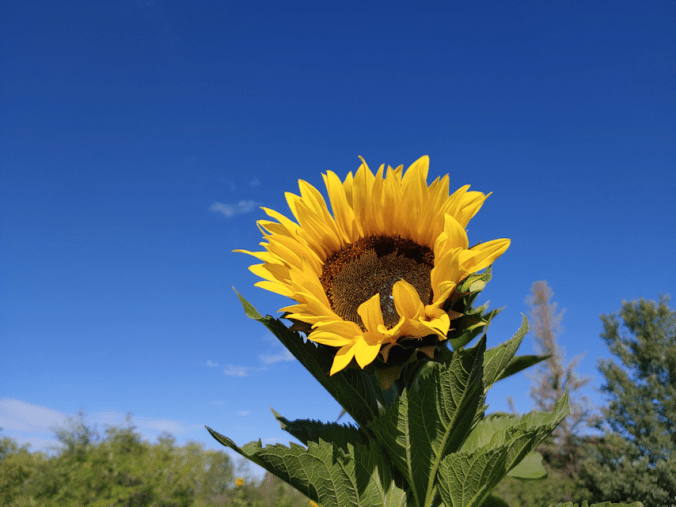
Most look like this.
Bright, sunny, mostly yellow with light oranges and greens around the developing seeds.
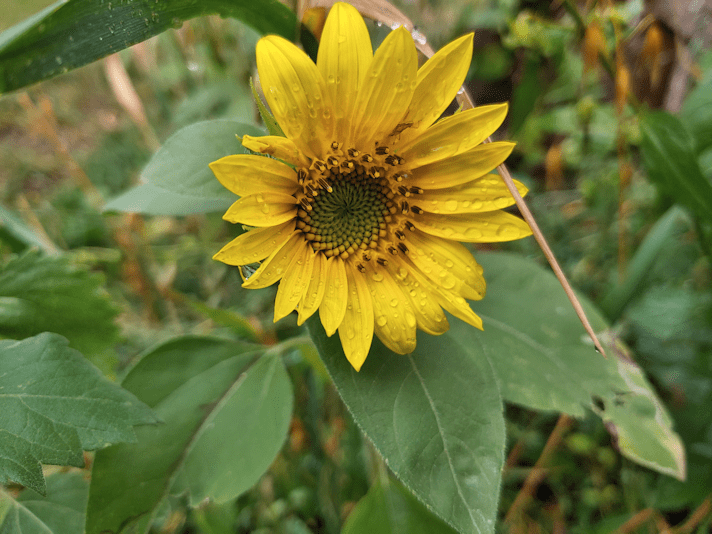
Then there was this one.
The camera actually lightened it up a bit. Compared to the others, this one looks almost black in the middle! Very dramatic.
This may be the first of the slightly shorter variety of giant sunflowers we first planted, so start opening its seed head. If so, I expect to see more. :-)
Last night, a massive storm system passed over us. In parts of the province, there were tornado warnings.
Here, we had rain.
Finally.
It started to rain somewhere around 2am, and didn’t stop until about 7am, and we might still get more, later.
For all the watering of the gardens we’ve been trying to keep up on, it couldn’t match last night’s deep soak, and it really showed!
We now have several of the self-sown, tiny sunflowers under the platform bird feeder with seed heads opening up.
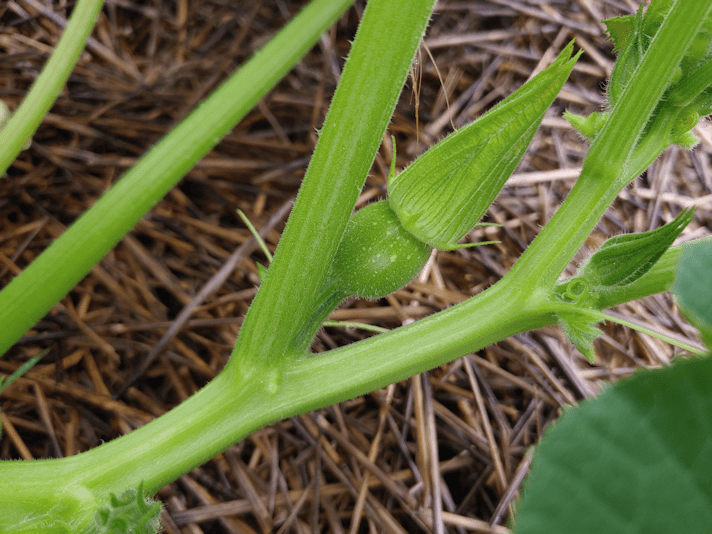
The pumpkins had been starting to bloom for a while, but I was only seeing the odd male blossom here and there. This morning, there was an explosion of flowers and new buds, and…
Our very first baby pumpkin.
This is on one of the first pumpkin plants that sprouted. I found a second one, on the mound that took so long to sprout one of the 5 seeds planted in it, that I had begun to think none would come up there.
We’ll keep an eye on them to see how many more begin to develop, then select one or two on each plant to keep growing. It’s still highly unlikely they will have a chance to fully ripen, but who knows; we might have a long and mild fall this year.
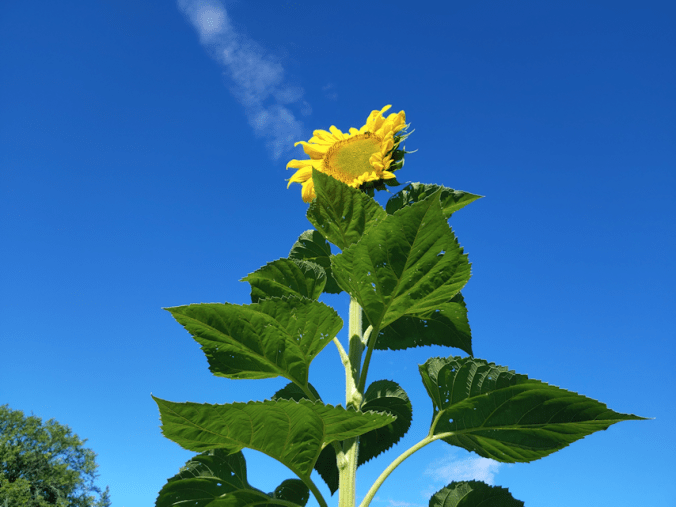
The big sunflowers have been pretty remarkable.
More and more seed heads are developing, which I would expect with these ones that are well above my head.
There are others that are quite a surprise.
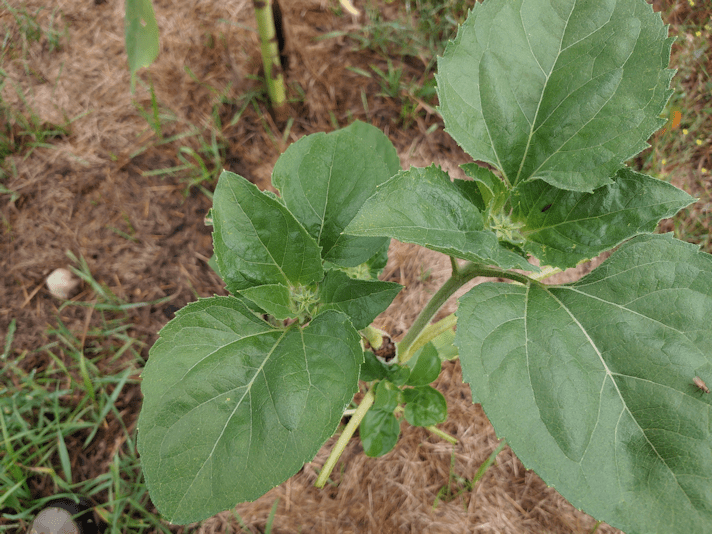
This is one of the deer damaged sunflowers. You can see the dark spot in the middle, where the original top of the plant had been eaten off. Two branches have now developed into stems, and have their own tiny seed heads starting to develop among the new leaves.
Which is impressive, but this next one shows resilience at a whole new level!
You can see, lower down, where the original top had been eaten off. Of the two new stems that developed has also lost it’s top, and basically all the leaves have been eaten off – and yet there it is! A seed head, developing among the tiny cluster of new leaves.
No, none of our giant sunflowers are blooming, yet. In fact, we didn’t even plant these ones.
Bird seed and deer feed we’ve been leaving at one end of a flower garden have been sprouting. Much of it is in the grass and gets mowed, but right under the platform feeder, we’re letting them grow.
I was surprised to see a sunflower blooming this morning. They are all really quite small plants! From the seeds I’ve seen in the mixes, I expected them to grow much larger.
Another sunflower will be blooming soon! The oats beside it are from the deer feed.
Then there’s whatever this is. Millet, maybe? I don’t know.
There are some other plants that I find myself looking at and wondering; is that from the bird seed? Or is it a weed? :-D
For now, I’m leaving them. We’ll find out soon enough!
I was out doing my rounds a lot earlier than usual, though I skipped tending to the kittens for later. My husband needed to go into town to get his blood work done – something that has been postponed several time already – and we were planning to get there for when the lab opened.
Of course, since I had something scheduled in the morning, my brain decided that sleep was not going to happen.
Yeah. I was up all night.
It turned out to be a gorgeous morning. We were at 9C! (48F) It was absolutely wonderful!
Not wonderful enough to make me a morning person, but I did appreciate it. :-D
One of the things I made sure to check was our haskap bushes. The flowers in the bed around them have grown high enough to almost completely hide the bushes, even though I made a point of pulling up anything growing near the haskap. In time, the haskap will be taller than the flowers, but that might take a couple more years.
I was sure the female haskap had died last fall, but it has recovered remarkably well. I had noticed a couple of flowers, and then some berries forming, so I wanted to see how they are doing.
There are actually 2 berries here; one is still green, and is hidden by the ripe one. In another spot, I found a couple more berries, one ripe, one green.
It looks like that’s all we’ll get this year. Which I am happy with, since the alternative would have been trying to find a replacement female plant, and I just haven’t seen them at all in the garden centres this year. I had hoped to get 1 or 2 more female plants anyway (the ratio for pollination on these is 1 male for every 3 females), but there were none to be had.
That’s okay. Next time, I want to order them from Vesey’s instead. I think I’ll get better quality plants from them.
Until then, I am happy with our bitty baby berries!
So the series of severe storms that looked like they were going to head right over us… didn’t. They passed to the East of us, instead, though we did get some nice rain.
I’m good with that.
I headed out to check on things this evening, and was greeted by a Rolando Moon!
She seemed quite happy to see me and let me pet her in the tree. Right up until she decided to grab my hand with her paws and try to bite me.
Ah, Rolando. She doesn’t change. :-D
I took the opportunity to take the grass clippings I’d left beside the carrots and beets and use it to mulch in between the plots. Creamsicle joined me and did his rolling around thing to get me to pet him. Unfortunately, he decided to roll around on the baby beets! What a bad boy. :-D
I completely forgot to take any pictures, though, as I started to hear growling from Rolando Moon in the tree. It took me a while to see which cat was after her and, much to my surprise, it was Butterscotch! A quick spritz with the hose got her away, but then Creamsicle went after her!
Creamsicle got a thorough soaking before he took off!
Other things have gotten a good soaking, and are thriving for it. Like my mother’s lilies.
The flowers are so big, they’re starting fall over!
The maple grove is looking absolutely lush.
When we first moved here, this area was full of tall crab grass, like you can see in the background, broken branches and dead trees. Once the big stuff was cleared away, all I had at the time to cut the grass was the weed trimmer. Under the grass, it was pretty sparse, and mostly covered with dead leaves.
Last summer I was finally able to mow in here and, again, it was pretty sparse with lots of dead leaves. Some new growth was starting to show in patches, but not much. I had to be careful mowing in there, as so much debris was being thrown out and blown around – usually right back at me! :-D
Now… well, you can see it’s changed quite a bit!
I don’t know about the shorter plants; I think they’re a flower, but I’m not sure. Sprinkled throughout are taller ones that I know a flowers. You can’t really tell them apart in the picture, though!
While there, I noticed some other new growth.
Willow is just amazing. This tree is full of rot and dying. This section of it broke in a blizzard last October (you can read about it here). Yet now, this almost completely rotted out section is throwing out new growth! There are small bunches of branches like this in several places. (Read most about the storm damage here, and here, and how it was before, here.)
It is not the only storm damaged tree that is showing new growth.
The elm tree in front of the kitchen had lost a couple of large branches, including one that had broken, but still needed to be cut. (Click here to see the clean up process.) When I cut loose the broken part, the remains of the branch, free of the weight, sprung up much higher than it was before.
It’s hard to see, but that arrow is pointing to the cut end of the branch.
It had no smaller branches around there at all when it was cut. Now, it’s absolutely bushy!
Welcome to my “Recommended” series of posts. These will be weekly – for now – posts about resources and sites I have found over the past while that I found so excellent, I want to share them with you, my dear readers. 🙂 Whether or not I continue to post these, and how often they are posted, will depend on feedback. Please feel free to comment below, and if you have a favorite resource of your own, do share, and I will review them for possible future posts.
I hope you find these recommendations as useful and enjoyable as I have!
When I was a kid, I refused to eat mushrooms.
Especially morel mushrooms, which we found in various places here on the farm. I thought they looked like brains.
My parents, being Polish, loved mushrooms, but couldn’t make me eat them.
To this day, I have yet to taste a morel mushroom.
I have, however, developed a taste for other mushrooms, and even an interest in the idea of growing them at home. I had discovered a website that sold different types of mushroom spores, which I didn’t even know was a thing until then. We were still living in the city, however, so the closest we ever got to growing mushrooms was to buy an oyster mushroom kit we saw at a grocery store. Once.
It didn’t grow very well, but we did get a couple of mushrooms out of it.
Since moving back to the farm, we have talked about buying spores and inoculating areas around the farm. I have been interested in trying morel mushrooms, but have only ever seen very expensive dried ones in stores. Since I already know they can grow here in the wild, it seemed logical to inoculate an area somewhere closer to the house.
Unfortunately, the website I’d found years ago has disappeared. I found a few other sites, but they were all US based.
For starters, they are Canadian. They might be in BC, but it still makes being able to find varieties that will grow here in our province much greater.
What is awesome is that this company doesn’t just grow and sell fresh mushrooms, mushroom spores and the things you need to grow them. They provide a lot of information and support to teach people how to start a viable mushroom growing business for themselves.
With the current Wuhan virus shut downs, they are now producing videos that focus on how to continue to run a business and make an income when almost all avenues for sales are no longer available.
While most of their growing videos involve greenhouses or indoor mushroom farms, they also have videos on growing mushrooms on logs, outdoors. Which is more in line with what we were originally thinking of doing here at the farm.
Their video channel is a wealth of information, from how to grow different types of mushrooms, to equipment used, to financial concerns.
On their website, you can buy mushroom kits and supplies and, if you are in their area of BC, order fresh mushrooms. They even have a mentorship program for those interested in commercial mushroom growing.
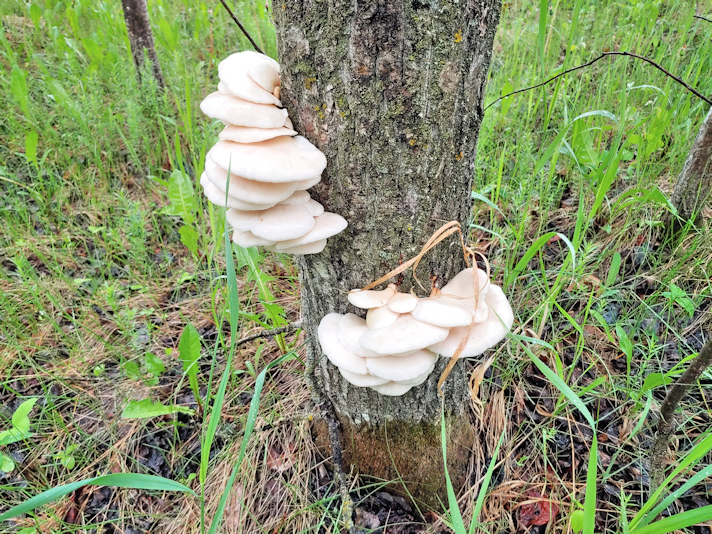
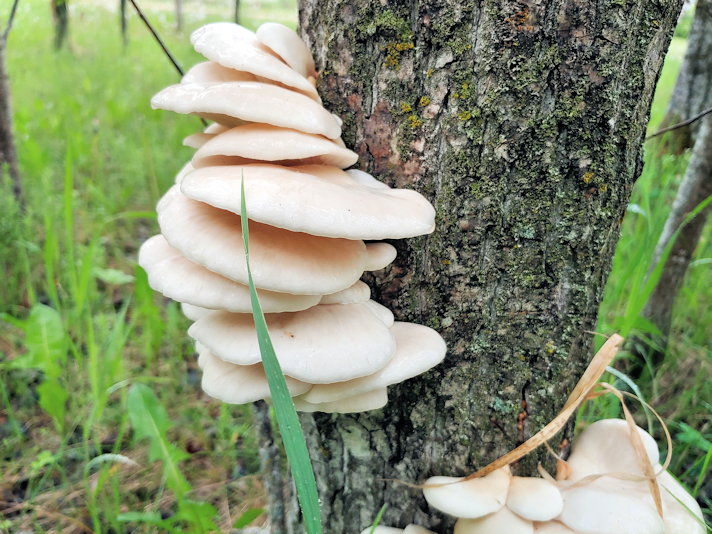
Now, we’re just interested in growing mushrooms for our own use. We have lots of mushrooms growing wild here at the farm, but I have no idea which ones are safe to eat (except morels, which I have yet to look for since we’ve moved here, because where I remember finding them is actually on the other quarter section that’s rented out), so this would be a way to have mushrooms we can be sure are edible. We would also be able to grow varieties that are either not available locally in stores, or are way out of our budget.
After discovering What the Fungus, however, I am starting to feel that growing commercially is something we could do at some point. Right now, this farm makes no money. We don’t own it, so we’re not the ones paying the taxes or the property insurance (and the income from the renter barely covers the taxes, if I remember correctly), but the maintenance of this place is almost all out of our own rather limited pockets. As it stands now, at some point, when my husband and I are no longer able, it’s already planned for the girls to take over as caretakers, and it would be good to have things set up so they can run a profitable farm, even on just the few acres that aren’t rented out. So this is one of the avenues we can consider in the longer term.
With the wealth of information and resources available in the videos and on the website, this actually seems quite feasible!
Welcome to my “Recommended” series of posts. These will be weekly – for now – posts about resources I have found over the past while that I found so excellent, I want to share them with you, my dear readers. 🙂 Whether or not I continue to post these, and how often they are posted, will depend on feedback. Please feel free to comment below, and if you have a favorite resource of your own, do share, and I will review them for possible future posts.
I hope you find these recommendations as useful and enjoyable as I have!
You’d think that, having grown up on this farm and with my family being subsistence farmers, I would already know how to garden here. And I guess I do, really. The thing is, I want to do things differently than my parents did. Some simple things, like trellising, which my parents never did. One of my jobs as a kid was to flip the rows of pea plants, so the sun could get at the other side. We also want to grow new things I have no experience in, use no-till methods my parents never used, and eventually have raised beds.
So basically, I’m learning how to garden, all over again.
Part of this learning curve is figuring out how to grow what we want in our climate zone, which is a zone 3. It takes extra measures to produce food in our short growing season. We can’t even take advantage of any urban heat island effects.
With that in mind, I have been looking up resources for cold climate gardening. In my searches, I have found many sites and YouTube channels dedicated to cold climate gardening. How wonderful, I would think, as I eagerly began to explore them.
Right up until I discovered that these “cold climate” gardeners were in…
Zone 5.
Really?
Just about everything I look at that I’m interested in growing is rated to zone 5. How is zone 5 considered a cold climate?
Okay, okay. I realize that these sites are almost all based in the US, and northern states are rightfully considered cold climates compared to the southern states. But I’m in frikkin’ central Canada. To us, zone 5 is almost tropical. :-D
All joking aside, it did make my searches frustrating. It turns out there just aren’t a lot of active Canadian gardening resources out there.
Maritime Gardening is run by Greg Auton, in Nova Scotia. It’s basically one person and 2,500 square feet of back yard garden! He’s been making these videos since 2016.
The only down side?
It’s still a zone 5 climate region… but it’s far closer to our situation than anything else I’ve found! There are lots of videos on how to lengthen the outdoor growing season, like getting the soil to thaw out faster, or dealing with high winds.
There are also a lot of videos on specific crops, such as garlic, onions, potatoes, and strawberries, and techniques, such as no-till gardening, using cold frames, different types of mulches, and so on.
There are videos on planning out your garden spaces, dealing with weeds and insect problems, saving seeds, harvesting and preserving.
There are even cooking videos, fermentation videos, videos on how to make tool handles, and so much more.
There is just SO much to learn from here! I highly recommend this channel as a resource.
Welcome to my “Recommended” series of posts. These will be weekly – for now – posts about resources I have found over the past while that I found so excellent, I want to share them with you, my dear readers. 🙂 Whether or not I continue to post these, and how often they are posted, will depend on feedback. Please feel free to comment below, and if you have a favorite resource of your own, do share, and I will review them for possible future posts.
I hope you find these recommendations as useful and enjoyable as I have!
Last week, I recommended a resource that would be very useful for anyone interested in homesteading, geared towards rural living.
This one is for you city folk who are also interested in growing things, either for your own use, or as a way to make an income; BC based Urban Farmer Curtis Stone.
Curtis Stone is the owner of Green City Acres, a commercial urban farm, so this is someone who actually is making a living as a city farmer. Being in Kelowna, BC, this is also someone who manages to do it in our Canadian climate, with all its extremes of heat and cold. They also offer online courses, workshops and have a newsletter available.
There are also podcasts and lives shows. I’ll be honest, though, I haven’t been able to watch these longer videos – some going to 2 hours – simply because of limited data available on our internet.
There is a lot of practical information from growing food, to growing a business.
There are videos about farm software, using hedgerows, using solar, building greenhouses, growing mushrooms, and even videos about the issues farmers and land owners in Canada have to deal with, in regards to our laws and regulations (we’ve got some pretty insane ones here in Canada).
With the sudden shortages and rations that have happened because of the Wuhan virus lockdowns, a lot of people are looking at ways to grow their own food. With that in mind, Curtis Stone has made videos to address these concerns directly, and has also started up a new farm project, to see how much food people can grow themselves quickly, on a small parcel of land, that will be very interesting to follow along.
So if you’re someone living in an urban environment, and would still like to find ways to grow food, Urban Farmer is the resource I would recommend.
My daughter spotted a surprise in our largest aloe vera, Sarlac 2.
It’s starting to send up a flower spike!
This aloe traveled with us during the move. Before the move, we were able to sell quite a few things, including several of Sarlac 1’s transplanted babies. We had intended to bring the Sarlac along with us, but realized it was simply too big to fit in our van, even without all the other stuff we had to jam into there. So when someone came to buy this plant, I asked if they’d be willing to upgrade to the mama plant and we’d keep this one.
Not only did they agree to take the mother aloe, they ended up buying almost all the remaining potted aloes as well!
So that saved us a whole lot of space.
The Sarlac was a massive, toothy aloe we’d had for quite a few years, but it wasn’t until we moved to a larger townhouse in the co-op that it apparently got the amount of sun it was longing for. Shortly after, it threw out a flower spike with three buds on it – then a second spike, soon after! I’d never seen an aloe bloom before. Unfortunately, the spikes tipped the balance of the aloe – literally. The pot fell under the weight. Everything survived just fine, including the pot, but we transplanted to a pot with straight sides, instead of the more decorative pot with a narrower base.
Our umbrella tree is in that pot right now, and this experience is why I’m really wanting to find a larger, straight sided pot for it.
The girls and I will be re-arranging the living room over the next week. My husband has moved his computer set up into his bedroom, closer to his hospital bed, so now there’s this strange empty space. As we move things around, we’ll hopefully find a better arrangement for the plants in the process, including a better spot for the mini-greenhouse until it can go outside.
I did end up stopping at the post office today, where I could also pick up some more deer feed (the post office is in an old style general store, so it’s got a little bit of all kinds of things!) and found my back ordered birdhouse gourd seeds in the mail box. We will be starting these indoors, too. I was more than ready to start the cucamelon and fennel, but even if we were to transplant earlier than the last frost date, it would still be way too early to start them indoors. They can be started closer to the middle of the month, then the rest of the things we want to start indoors, like these gourds, can be started about a week later.
It’s nice to think about budding things when there’s still snow on the ground!







 The Re-Farmer