Over the past while, I’ve been adding another coat of Plasi Dip to the ends of the picnic table legs. I stopped adding more coats yesterday, but have continued to spray the cracks in the rain barrel. Basically, I plan to empty that can on those. :-D
This is about 5 or 6 coats. I lost track of how many, exactly. When I took the picture, it had at least 24 hours to cure since the final coat. It looks like it will do the job just fine, and help extend the life of the picnic table.
Earlier today, a daughter and I flipped the picnic table right side up, then checked the surface. Sure enough, there was a bit of damage. Some paint had come off when the bird feeder had been put on top of it – both surfaces hadn’t quite cured yet, and the feeder stuck to the table.
While upside down, the table was on the chimney inserts I’d used to raise it off the ground while painting. There were a few scratches from those, as well as dirt. My daughter hosed it off and scrubbed where needed.
Tomorrow, the bits of damage will get touched up before we move it to somewhere near the fire pit.
For something that is too far gone to repair, this should last quite a bit longer now. As long and nothing actually breaks. :-D
I realized I’ve neglected to take progress photos of some of our garden beds, so I got a few this morning.
Here are our two potato beds.
I was shooting blind, because my phone’s screen went completely black in the sunlight. Still, you can see the potatoes among the mulch, separated by a path of grass. Some have bloomed and the plants are starting to die back. We could probably harvest baby potatoes now, if we felt like digging under the layer of straw. I’ve never grown potatoes this way, so it should be interesting to see how they did.
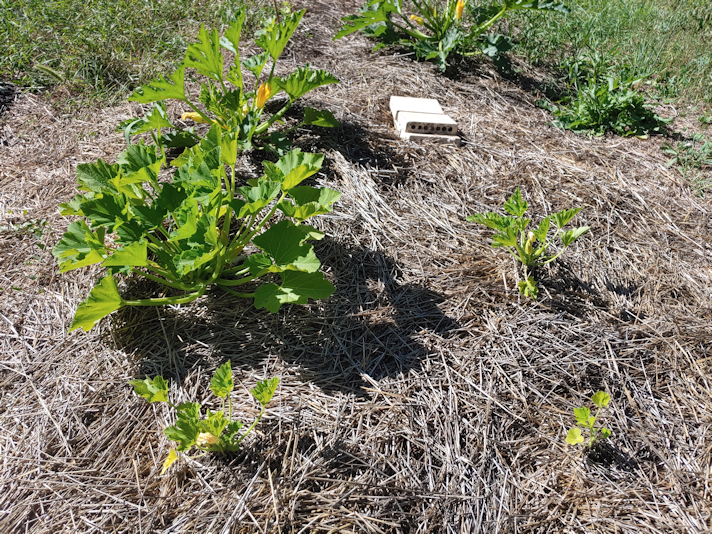
This next photo is the second squash bed.
I just happened to catch a locust flying by in the picture!
We are currently inundated with grasshoppers and locusts right now. Hopefully, they won’t eat up too many of our vegetable plants.
This second bed is the one we planted the day after we were hit with one last frost. The sunburst squash are huge, with many flowers and many little squashes. The mixed summer squash has a couple of plants that are doing well. Interestingly, it seems that plants on the south end of the bed are struggling more than the ones at the north end, rather than any particular type of squash having a more difficult time.
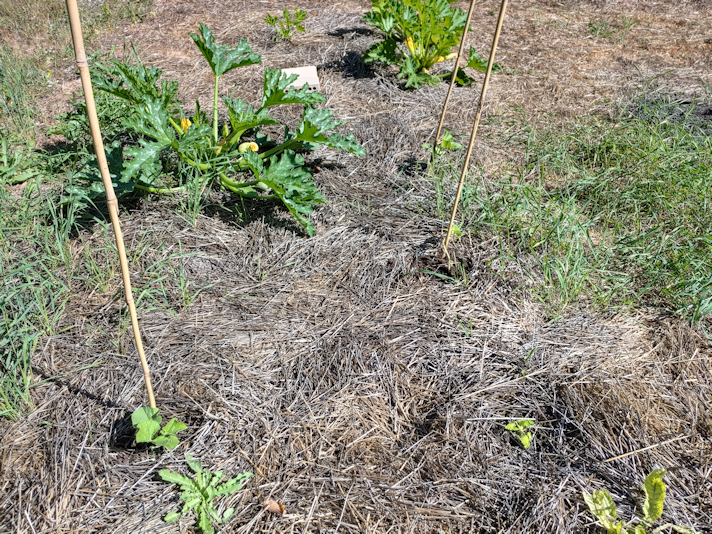
Here is the first bed that got planted.
These are the ones that got frost damaged, even though we had covered them for the night. Some died completely, but a surprising number have managed to survive – with some downright thriving!
This picture is the same bed, from the other end.
The transplants had died at this end, so when some gourds in the seed tray actually germinated, I transplanted them here. Three of them are marked with bamboo poles. Much to my surprise, the one that got dug up by a skunk digging for grubs is surviving. Given how late they germinated and got transplanted, I’m not actually expecting much from them at all, but it will be interesting to see how much the manage to grow.
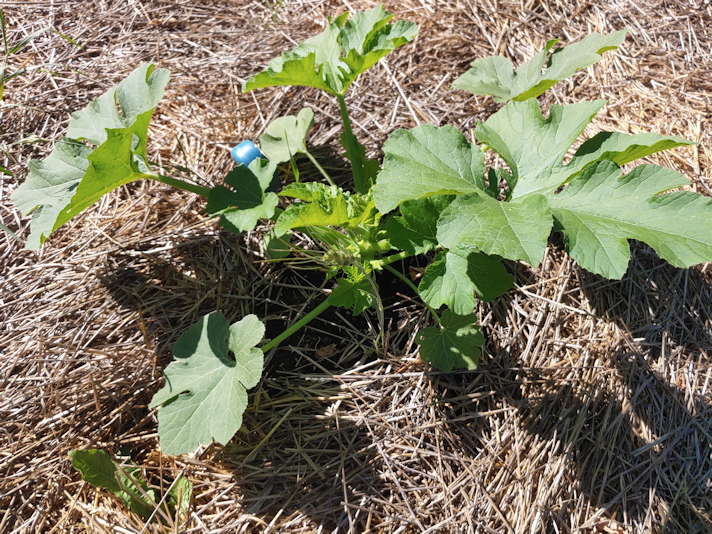
Then there are the pumpkins.
These were from seeds that were being given away for free at the grocery store near my mother. I had taken one (it even had a sign asking people to take only one), and then my mother gave me two more. Clearly, she didn’t read the sign, because she still had a pack she kept for herself and planted in her own little garden plot that she has this year!
The pumpkin in the above photo is the one from a pack that had 5 seeds in it (the others had 3 seeds). This is the only one of the 5 that germinated, and it came up much later than the ones that germinated in the other two mounds. One mound had 2 seeds germinate.
In spite of such late germination, this one is probably the biggest of the bunch.
It is also the Northernmost mound.
When we started planting here, I’d made a point of planting in the Northern 2/3rds of the area we had mulched. The south side of the area has a lot more shade from the spruces my parents had added to the north side of the maple grove. I didn’t even try planting at that end for that reason. The middle third of the area still gets a lot of sun, but the north third gets basically no shade at all, at any time of the day.
I think that might actually be why I’m seeing differences within the same beds of squash, and the pumpkin mounds.
Something to keep in mind for any future planting in here!
Then there are the beds we made where the old wood pile used to be.
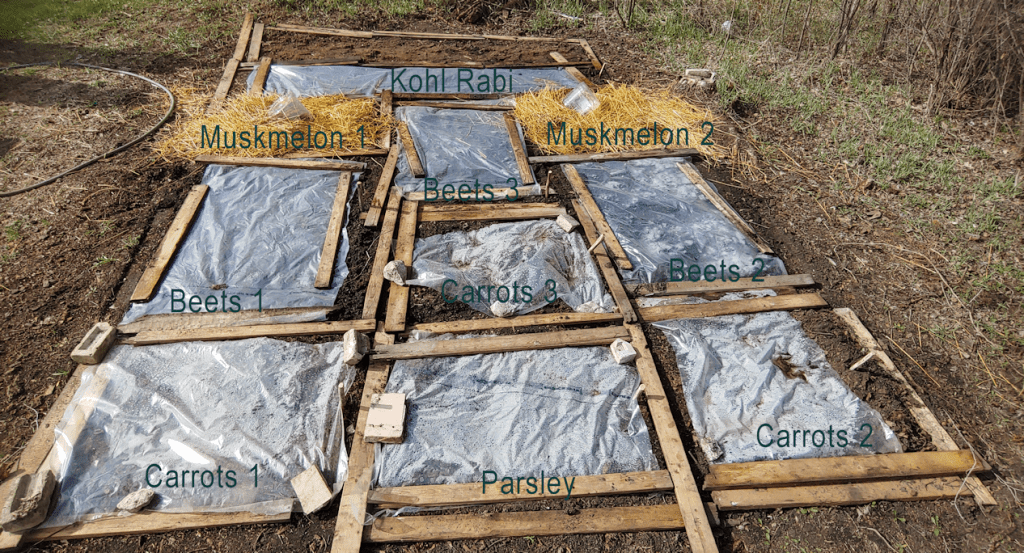
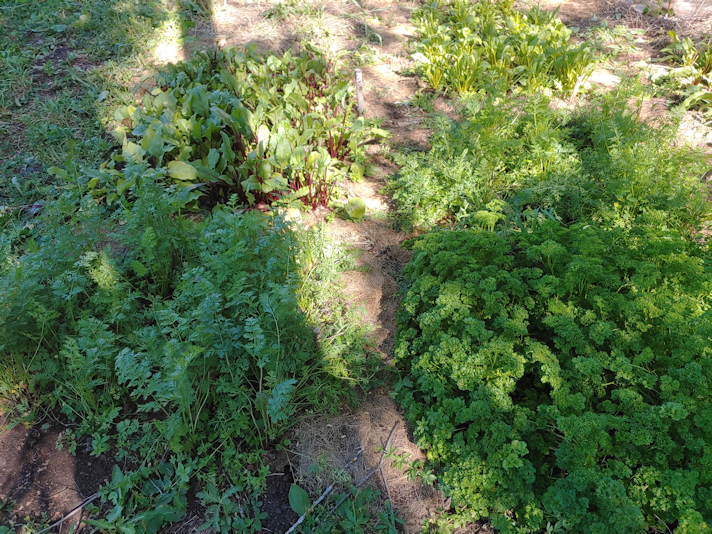
The beets we got were a collection with Merlin (a dark red), Boldor (golden yellow), and Chioggia (alternating rings of purple and white)
In the foreground, you can see the parsley bed in both photos. It is doing very well. To the left of the parsley bed are the deep purple carrots, with white satin carrots on the right. The carrots could be doing better, but overall, they’re okay.
In the midground of the photos, there is a bed of rainbow carrots above the parsley bed, and beets on either side . Another bed of beets is in the background, beyond the rainbow carrots.
I don’t know how well you can tell in the photos, but there are not a lot of beet greens. The deer have really done a number on them. :-( We should still have some to harvest, though.
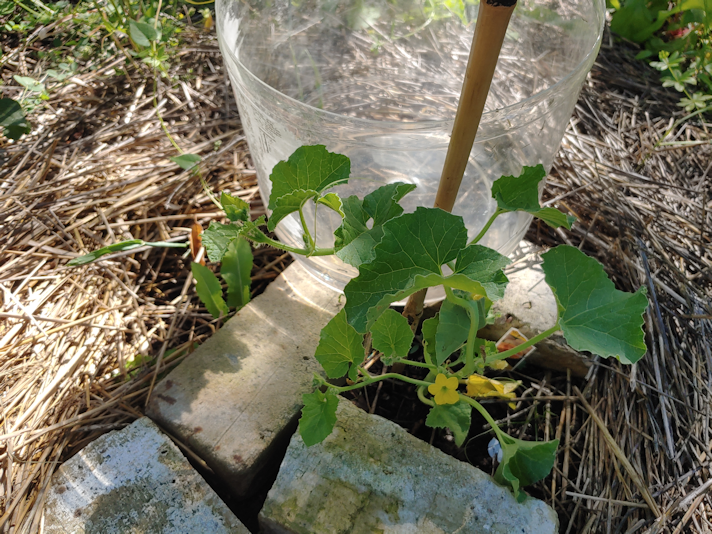
Of the two muskmelon we bought to transplant, one died. This is the survivor.
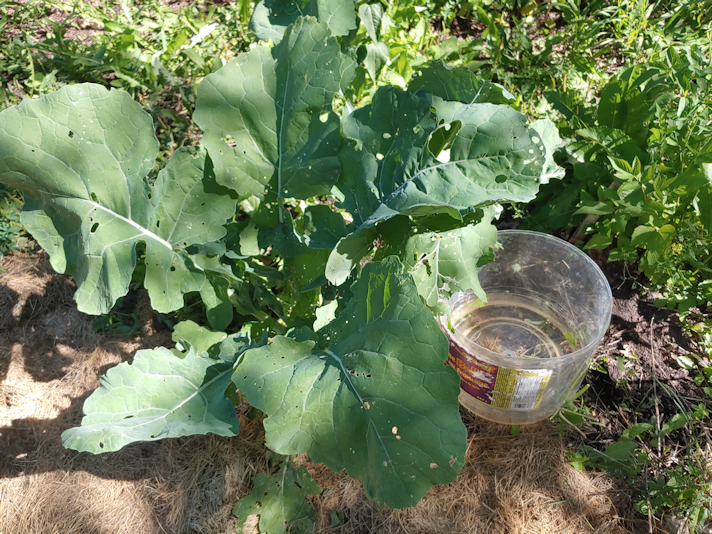
We planted a lot of kohl rabi, but this is all we have that came up and survived.
The large leaves that you are seeing are from 2 plants.
Yup. Out of all that we planted, only 2 survived.
Actually, there had been four.
It turns out that deer like kohl rabi, too. You can’t even see the second one that was nearby; it, too, was reduced to a spindly stem!
In case you are wondering about the plastic containers…
Those are what I used as cloches to cover the muskmelon overnight, to protect them from colder temperatures after transplanting. The containers used to hold Cheese Balls that we got at Costco. I just cut the tops off, then drilled holes around near the bases for air circulation.
I now have them set up near the surviving muskmelon and the kohl rabi. When watering the garden beds, I fill those with water. The water slowly drains out the holes I’d made for air circulation, giving a very thorough watering to the plants. The first time I’d tried this was with the muskmelon, which was pretty small and spindly. The next morning, it had grown noticeably bigger and stronger! So I put the second one by the struggling kohl rabi, and the difference the next day was just as dramatic.
Until the deer ate the two littlest ones.
This worked so well, I’m trying to think of ways to use other cloches we have, most made from 5 gallon water jugs I’d bought for the fish tank, to set up near some of the more struggling squashes.
This morning is the first time I’ve harvested some of the parsley, along with a few carrots. What I don’t use right away will be set up to dry. Which is what will happen with most of the parsley we planted, as we tend not to use fresh parsley all that much.
And now I’m going to stop struggling with our nasty internet connection, which really doesn’t like inserting photos right now, and start on the scalloped potatoes I have planned for supper. I think I’ll find a way to layer some carrots in with the potatoes, too! :-)
This morning, I applied the first coat of spray-on rubber to the legs of the picnic table, and the cracks on the rain barrel.
This is the product I am using.
I have never used this stuff, or this brand, before. It was the only one on the shelf, so it’s not like I had a choice of brands or product versions. I think it will work just fine.
The first time we used a product like this, it was a can of liquid rubber deep enough to dip things directly onto. Like the handles of tools. Which is what we did at the time. Or it could be brushed onto a surface. The first time we tried a spray, it was basically the same product as an aerosol. My husband used it to coat the handle of one of his canes (made with aircraft grade aluminum, that could also be used for self defense), and to a cord wrapping he added to parts of his walker for extra support to hold the weight of the backpack he has hung on it. For the can, a dip version would have done a better job, but as a spray, it worked very well on the uneven surface created by the rope work. It’s still holding out, and it’s been about 5 years.
So that was basically what I was expecting. Black, spray on rubber.
Nope.
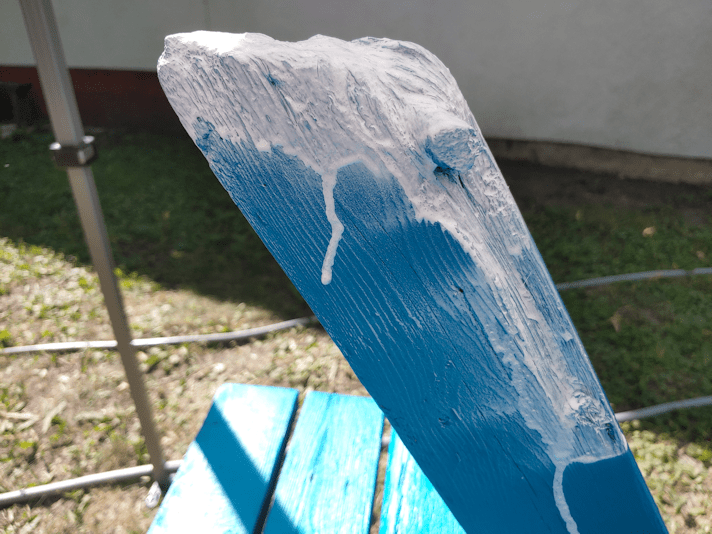
It’s white.
At least it looks white against the blue paint.
It’s also a lot lighter and thinner than I expected. Which I suppose is exactly what I need to fill in all those crevices. I added extra along the part where the most rotted wood had come off on the one leg.
I probably could have applied it more carefully to avoid drips, but there is no aesthetic requirement on this.
On the rain barrel, it looks a bit different. The barrel got sprayed both inside and out.
Here, you can see it has an almost blue tint to it. Depending on the angle, it looked a bit more purple than blue.
It should be interesting to see how it looks when it’s done.
How many layers we put on will depend on how well it coats. It requires at least 2 hours between coats. Depending on how often someone can get outside to add another coat, this may take a day or two! It then needs at least 4 hours of curing time after the final coat for the coated object can be used. Thankfully, these are not things we need to use, quickly.
When I got back from the city with our new washing machine, I just had to go around back to see how the painting went for the girls.
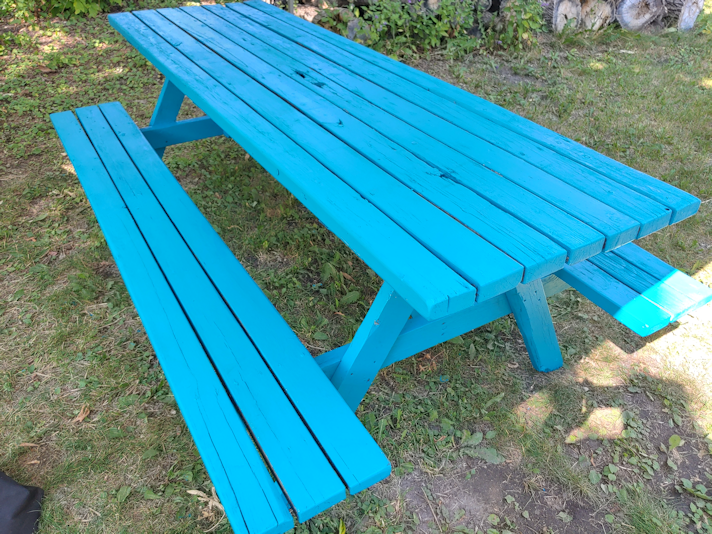
The first coat of paint is done!
You know, when I first picked up this shade, I was afraid that once it was on large surfaces like this, it would be too much. I’m happy to say that, now that I see it, I’m loving it even more!
The bird feeder had also been started.
Since these photos were taken, the girls were able to go back and do another coat on the picnic table, then flip the bird feeder to finish the rest of the top side and give the roof a second coat.
I might have to get another can of this paint! The window frame for the basement screened window didn’t get done, but that’s okay. There is no rush on that. We’re also going to wait for the paint to fully cure before we add the spray on rubber stuff for the bottoms of the picnic table legs. Since they’ve already been painted, there’s no rush on that, either.
These are going to look great, once they’re done and set up in the yard!
While the tech was here to try and figure out why our secondary internet account wasn’t working (more about that on another post), my daughter and I got started on the scrubbed and fully dry picnic table.
First, we set up her tent!
Once we moved it over the table, she got the paint ready while I pegged down the legs.
Well.
Tried do.
I was able to get only 1 leg properly pegged down. With the others, it didn’t matter what angles I tried, I kept hitting rocks!
Hopefully, it’ll be enough to keep it down if we get any winds.
Even if we don’t end up getting rain, it provided much appreciated shade!
Since it’s the underside, we weren’t too worried about complete coverage, except for the ends of the legs. Those might even get a second coat before we flip it.
I’m really glad we had those chimney liners to use to raise it off the ground. They really made the job easier! Amazing what a difference just those few inches makes, on preventing back strain.
The colour darkens a bit as it dries, but it’s still really, really bright!
Of all the things we need to work on, this small project is something that will be done fairly quickly. It’s a psychological thing. Once it’s done and set up, we’ll be able to see this one bright object in the yard that is a thing that we actually finished. So many other things have been delayed, or are things that will be worked on over years, not days, or even months.
I really look forward to using it when it’s done! :-)
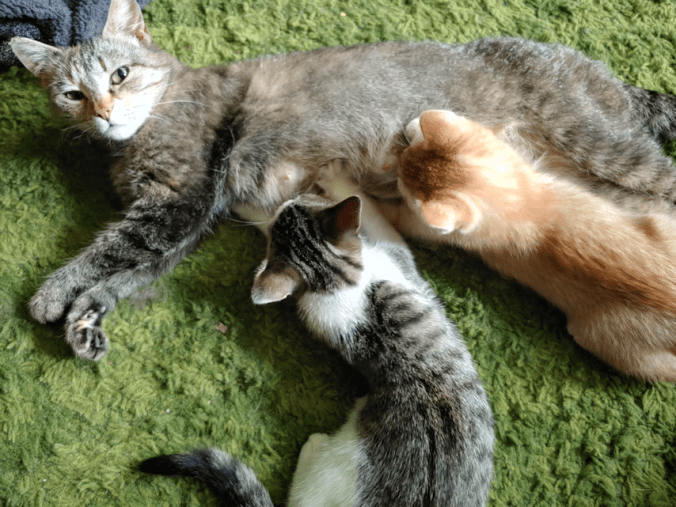
The kittens have taken to napping under the couch regularly. Beep Beep can just barely squeeze under there, herself. A little while ago, my daughter saw her squeeze part way there, then start wiggling oddly. Moments later, some sleepy kitties came out. She then flopped on the floor for them to nurse. She actually woke them up for lunch! :-D They’re more than old enough to be weaned, but it’s still great bonding time. :-)
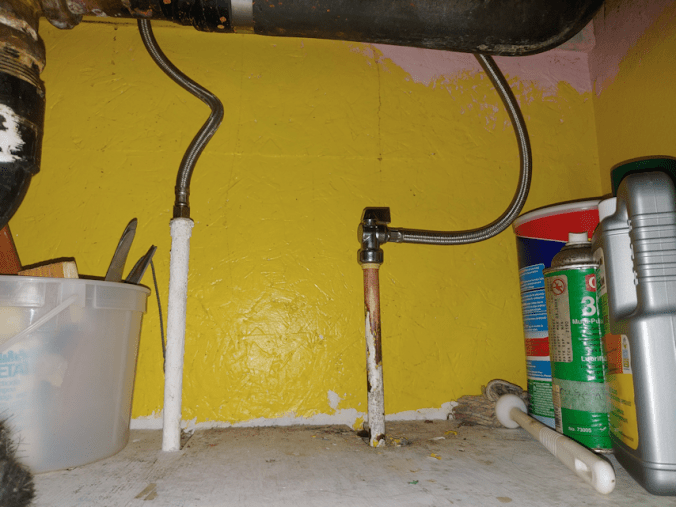
My daughter got the broken flexible pipe replaced. She did just the one for now.
The other has been left for now, partly to make sure the cold water is working fine and there are no leaks. With the hot water, there is at least a shut off valve at the hot water tank. When we replaced the tank shortly after moving here, the plumber added one on for us. When it’s time to replace the other piece, only the hot water to the house will need to be shut off, and not all the water.
For some reason, the copper pipes are painted, including the end of the flexible hose. My daughter tells me the pipes to the old sink in the entry way, which now supply water to the washing machine, were also painted.
Why paint copper??
As for me, I headed outside for a last bit of mowing.
That’s 4 days of mowing, now, and I’m skipping some places!
I did do an extra bit, though.
I mowed a path to and around the old Farm Hand tractor. Next, we’ll be going in there with the weed trimmer. Once we can access the tractor, we need to cut away the trees that are growing through it. We aren’t able to maintain the tractor itself, but we can at least prevent some types of damage to it!
For the last couple of summers, I’d been able to keep an area to the back gate mowed, large enough to drive through. This year, between the rain and the heat, I just never made it that far.
Today, after mowing the area in front of the storage shed, I decided to mow a path to the back gate. It’s our “emergency exit”, so I don’t want to leave it entirely.
A path, however, is all I was up to!
I cranked the mower up as high as it can go – which is higher than the riding mower can go – and only managed a path twice the width of the mower itself. I actually took 8 passes, just to get it as good as this! The first pass, I had the front wheels up almost the whole way, just to get the height down enough to not choke out the mower.
My daughter suggested it would probably be easier to use the old scythe in the garden shed, instead of a mower, for this stuff! She’s probably right. This is hay that’s being cut! Heck, if we had the equipment (well… working equipment), we could probably get a couple of large round bales just in this section! :-D
I’m hoping to at least keep up a path to the back gate. I don’t expect to make the wide “driveway” I’d kept clear last year. I’d hoped to do more, since the area becomes quite the fire hazard, but we just can’t keep up with it all. More time is being spent on the lawn than anything else right now. As much as I love mowing the lawn, there are other things that need to get done! Ultimately, the goal is to have less lawn, with trees in some areas, and raised garden beds in others. Maybe even a greenhouse or two. Other areas, I hope to replace the grass with moss.
Until then, though, there’s an awful lot of grass to cut!
One of the things that is quite visible when the grass is tall, is a path through the grass, worn down by cats, leading from the yard to under the storage shed. While I was working on the path to the back gate, and was turning to make another pass, I noticed Junk Pile cat, sitting in the newly mowed grass in the shade of the shed, watching me. I think her kittens might be under there. When I told my daughter about it, she said she saw them this morning! Junk Pile cat had brought them to the house for food. :-)
I look forward to seeing them more often and, hopefully, being able to socialize them at least a bit. And their mom, too!
I am happy to say that I have finally finished my first attempt at carving!
Yay!
My trip into town was successful, in that I found a teeny tiny tip for my Dremel.
Saffron made sure to check it out, too!
I discovered something when I went to put it on my Dremel, though.
It didn’t fit.
The shaft is too small. By maybe a millimeter!
Well, it’s an engraving tip, and I have an engraving tool, so I got that out.
That one was even worse!
What to do? I wasn’t going to take it back. Not only did I have to destroy the packaging just to open it, it was the ONLY tip they had that was small enough for what I needed.
Painters tape to the rescue!
I got it on, and it was secure. Perfect!
After making a few practice passes on the piece of lilac I’d practiced the carving knives on, I started using it on the morel.
This is how it looked, immediately after I finished (and you can see the tape that allowed the tip to fit). I was really happy with this tip. It was exactly what I needed for the job. If anything, I would have gone even smaller, if I could!
While certainly better than the carving knives, it was still rather messy. Sanding it did take care of some of that.
I have sandpaper only up to 220 grit, which is adequate for the job. No way to get into the holes, though, which is okay. I wasn’t done with it.
The next step was to break out the wood burning kit. The kit has a very fine pointed tip that I used to burn inside each hole in the morel. This allowed me to also burn away any ragged bits.
Once the insides of the holes were done, I could use the side of the tool to burn the flat surfaces.
Here is how it looked, once done.
The only thing to do after this is to oil it!
Two Face decided to “help”. :-D
Here is the completed spoon.
For the mushroom, I basically poured the mineral oil over it, to get into all the crevices, then used a paper towel to apply oil to the rest. At this point, I will let it sit for a day or two, then see if it needs more oil. I’ve seen sites that recommend putting small things like spoons into a slide-lock bag with oil, making sure the air is all squeezed out, and the item is in contact with oil all over, then leaving it for several days. I might try that with future projects, but I think just a light coating of oil is adequate for this one.
I am really happy with how this turned out!
I feel much more encouraged about tackling some of the wood I’ve salvaged lately. :-) I think my next projects, though, will be spreaders.
Basically, I’d managed to clear around an old tree stump, and not much else, before being driven indoors by the heat.
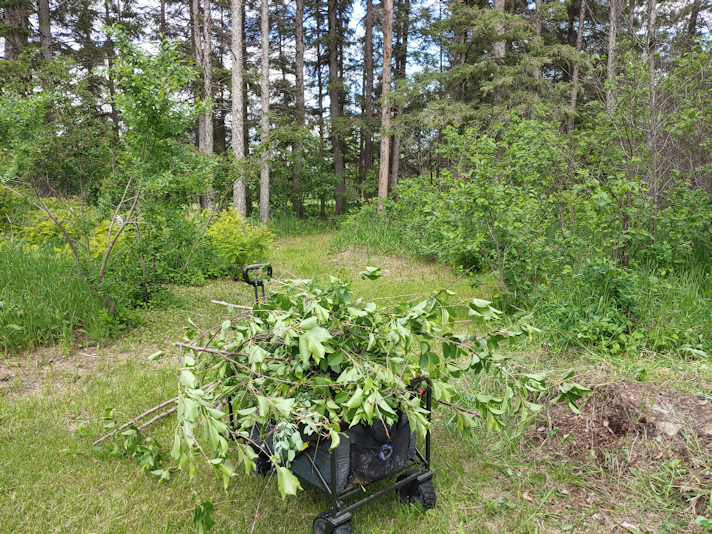
This time, I brought out the reciprocating saw to take down some of the larger things, including cutting the stumps of what I’d cleared before, to ground level.
One of the issues we have with using the outside plug is, even the weight of the cord itself tends to pulled it out enough to kill the power.
Today, I tried a solution that worked out just fine.
This pole used to have a bird feeder on it. I took the feeder off to repair it, but with the lilac growing over it, I don’t see use putting it back in this location again. At some point, we’ll pull it out, but for now, it’s coming in handy! :-D
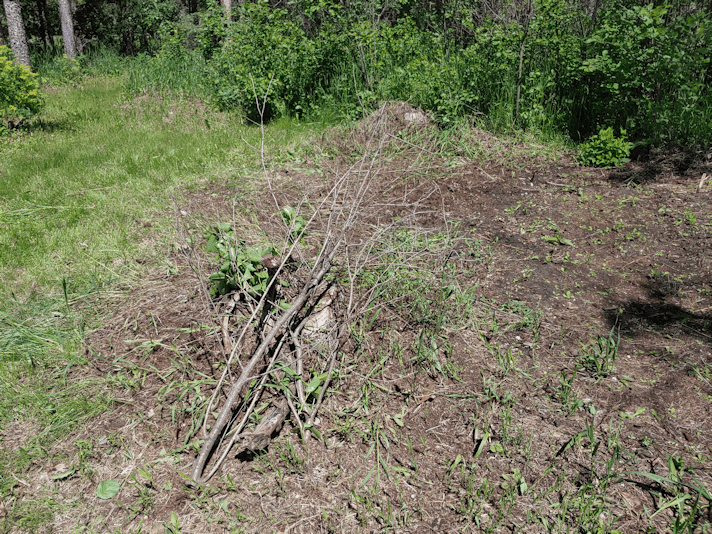
Here is how the area I worked on looks now.
The branches in front, on top of a stump, are for the chipping/burn pile. I cleared as far back as the next stump.
This turned out to be a very finicky job. I kept having to pull things out by hand, like crab grass and small saplings growing out the roots of things I’d cut away last year, then raking out debris, just to get at the larger things I needed to cut down.
In the process, I uncovered a bunch of flowers. I don’t know what they’re called, but I’m finding them kind of all over the place.
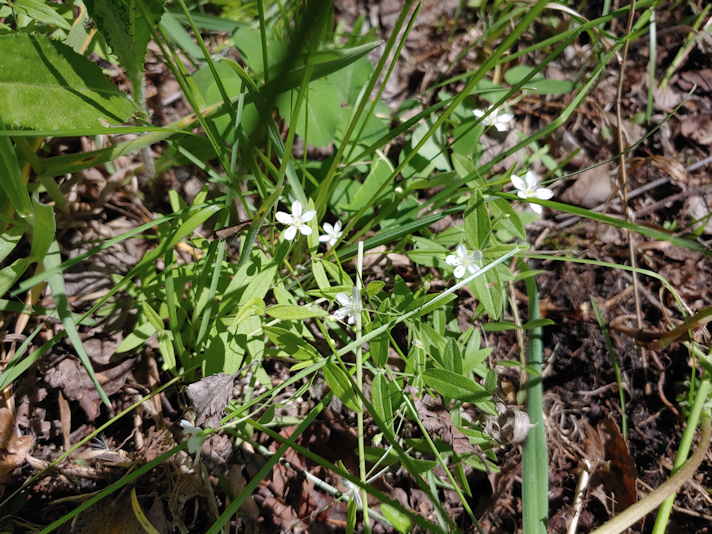
I also uncovered these.
There are quite a lot of these very delicate little wildflowers! I tried not to pull any up as I cleared debris from around them.
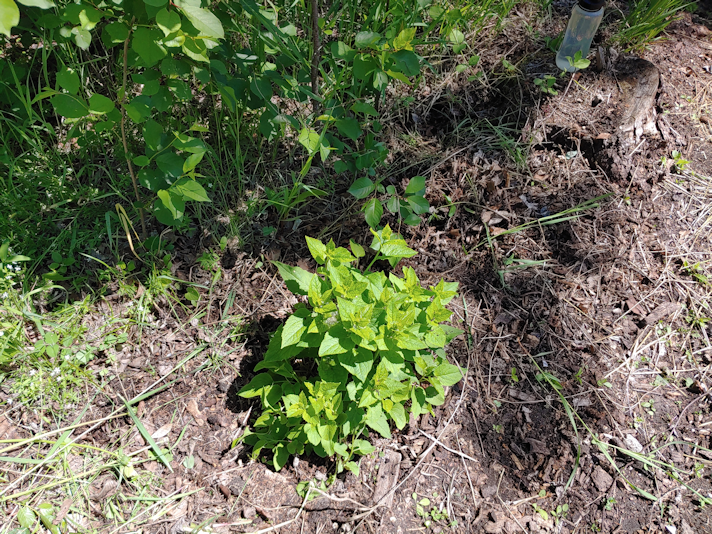
Further in is where more cherry trees are. None of which have bloomed, that I ever saw. You can see on the right of this photo, the cherry trees that were killed off last spring, when we had a sudden drop in temperatures after they started blooming. They got fresh growth from their bases. I think I have identified one or two in this area that look like they are strong and healthy enough to keep. The rest will be taken out.
Meanwhile, covering the left half of the photo, berries are starting to form on what I believe are chokecherries!
These are pieces of cherry wood that I will be keeping for future projects.
This is the pile of debris I cleared away from that small area!
We’ve started a pile behind the old outhouse, of what is turning out to be a tree debris compost pile. Stuff that we don’t want to add to the chipping/burning piles, but that don’t belong in the compost pile, either.
When we get to the point where we will be building accessible raised bed gardens, debris like this will be used on the bottoms of the beds to help fill them.
It’s remarkable how much stuff came out of such a small area!
When next I work on this area, I want to start on the other side of where we want to put the cordwood outhouse, clearing more towards the junk/wood pile. There’s at least one old tree stump in there, plus fallen trees that need to be cleared out.
Those might end up being part of the walls of the outhouse! :-)
I’d like to be able to access the junk pile better, so we can go through it and see what wood in there can be salvaged, what needs to be added to the debris pile, and what needs to go into the junk pile that will be hauled to the dump.
There are two Saskatoons and an elm growing on that side. We’ll have to decide which, if any or all, of these will be kept.
There’s also a mound of… soil? beside it. I’d like to get rid of it, but it’s got a layer of grasses growing on it right now, so I can’t tell what it’s actually made up of. The other mystery pile out by the barn turned out to be a pile of insulation. I’m kind hoping this one is something like gravel, or even just dirt.
The goal at this point, though, it just to clear access to the junk pile, then get back to clearing the space the outhouse will be built on, and start clearing out the sod.
I’m happy to have gotten at least a little bit or progress in there today!
My plans to continue mowing and, hopefully, reclaiming more overgrown areas nice and early got delayed a bit. We had an unusually heavy dew this morning, and cooler temperatures kept it from evaporating until well into the afternoon.
However, progress was made!
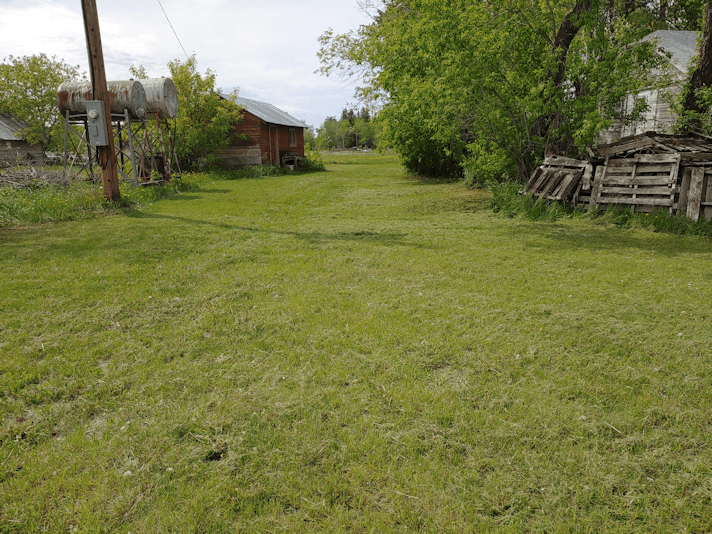
Remember this area?
I hiked up the lawnmower, and was able to clear the area all the way to the storage building around behind the pump shack that’s in the photo.
Eventually, I will continue on beyond this, making access to the back gate, but for today, I focused on the area around the maples.
The last time any of this area was NOT overgrown was when the renter’s cows discovered his electric fence wasn’t working, and broke through.
Two years ago.
By the time they finished grazing, the entire outer yard looked awesome! :-D
When I was a kid, the fence to the inner yard at this location was on the other side of the maple trees. There was a small gate near the pump shack, for when we went to get water for the house, or took baths with water heated on a wood burning cookstove that used to be in there. When the chain link fence was installed, it was done in a straight line, rather than turning a corner to include the trees.
I miss having a gate there!
I had to be really careful working through here. I’ve tried to keep up on removing any fallen branches over the past couple of years, but knew there had to be more, hidden in the tall grass. Plus, who knows what else would show up.
Like the lone brick I found, half buried in the dirt.
Thankfully, raising the lawnmower meant I didn’t hit many of the larger buried branches, like the one in the photo above, that I pulled out of the thatch.
It’s only a start. We’ll have to go through the area to clear out any other branches and whatnot that is still buried in there, prune back the trees (there is now lilac growing in the space we used to walk through to get to the pump shack), and get in there with a weed trimmer. Some of the trees have fence wire around them, though one of them is just a stump that has some suckers growing out of it. Since we don’t have to protect the trees from cows, I want to clear away the wire, and salvage it for something else.
I’ve been wanting to get into this area for the last two summers! It feels so good to finally start cleaning it up. :-)
The winds finally died down today, and we were able to prep for the giant sunflowers we will be planting.
To recap, these are being planted for several reasons. One is to have seeds for the birds over the winter (and for ourselves, if we want). Another is to create a wind break and privacy screen at the far end of the old garden area. A potential bonus is that sunflowers are supposed to be good for improving soil, and the area can use all the improvement it can get!
Normally, like anything else grown from seed, the sunflowers would be planted closer together, then thinned out after they germinate. For these giant varieties, they would be thinned out to 2 feet apart.
We’re not going to do that.
I counted the seeds in the packets, and they each have exactly 25 seeds in them.
We will be planting one seed every two feet. If they don’t all germinate and we end up with gaps… well… we’ll just end up with gaps.
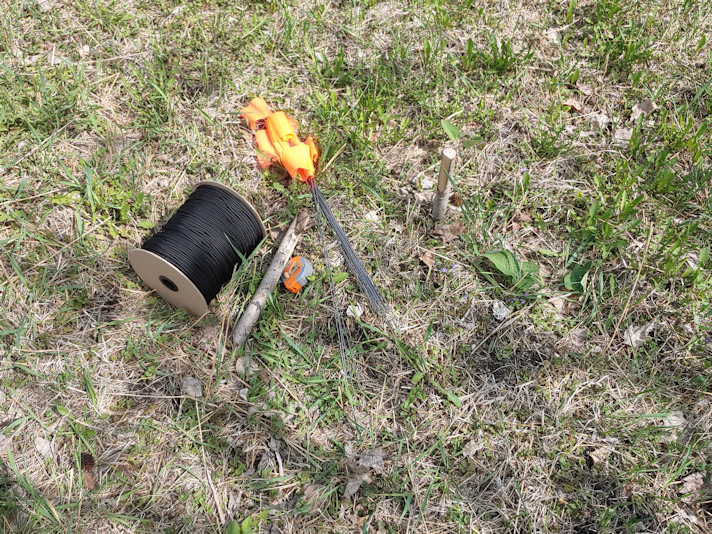
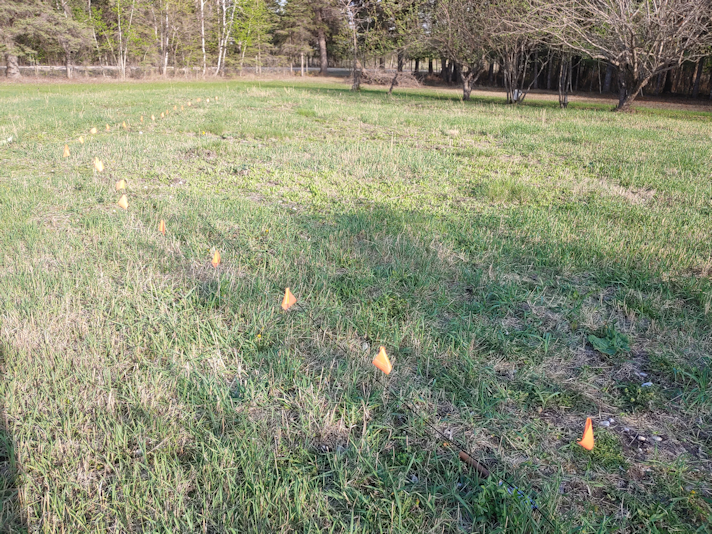
I also decided to plant them in a gradual curve rather than in straight lines. To do that, I used these.
The bundle of flags I picked up had 25 in it, so that worked out perfectly. I decided on where I wanted to have the ends and pounded a stake into the ground, with another stake to help guide the paracord, (which my husband had ordered a spool of that just happened to come in the mail today) and a tape measure to place a flag every two feet.
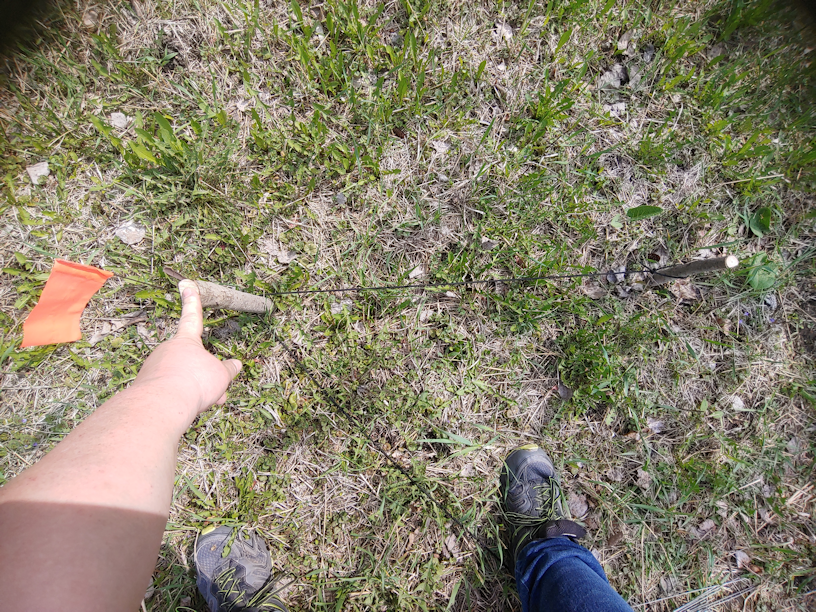
I attached the paracord to the two stakes in the ground, with about 3 feet of slack.
For the first flag, I eye-balled where I wanted it to be in relation to the first stake. The extra stake was used to hold the paracord taut.
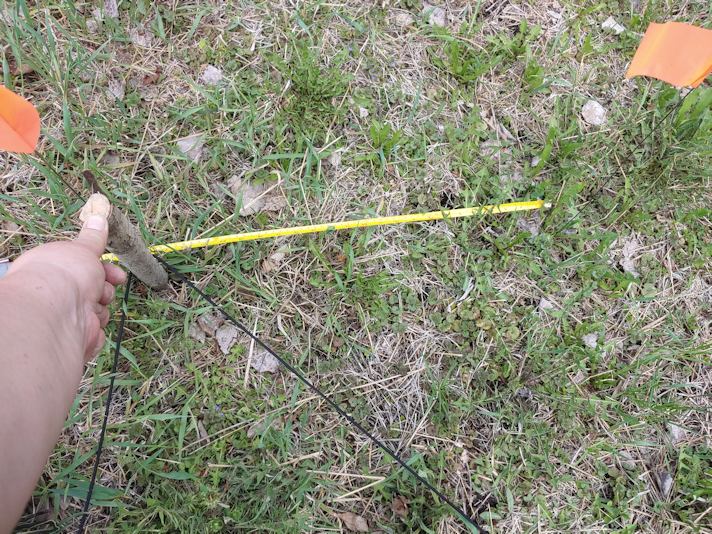
I then slid the stake along the cord and used the tape measure to determine where to put the next flag. I continued to do this for each flag.
The hard part was making sure the cord wasn’t getting hung up on grass and weeds, which would mess up the arc! :-D
The end result was a long, gentle curve.
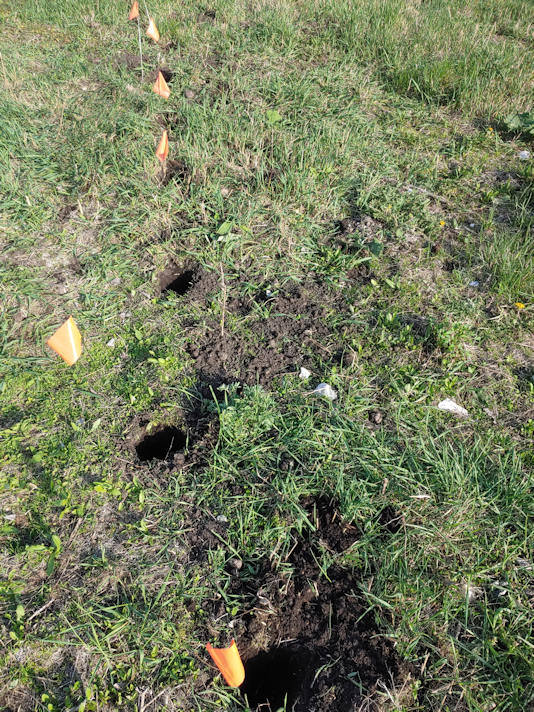
One of the things I realized as I was placing the flags was, there was no way I was going to be able to use my new soil auger. I kept hitting rocks, and even bent the wire of one of the flags!
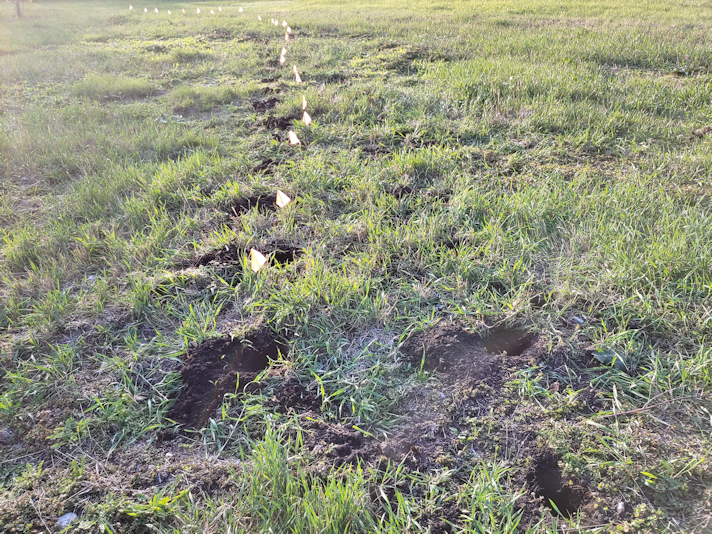
My daughters were sweet enough to take over and dig the holes while I had to do something else. Then after supper, I got back at it. The first thing was to move the stakes in the ground over about 2 feet. For the second row, I started at the opposite end.
This will give us two overlapping rows that will stretch across the entire end of the old garden area.
Digging the wholes was certainly a challenge. Not using the soil auger was definitely the right decision.
This is an example of how many little rocks we had to deal with, at each flag, just on the surface. The holes ended up being somewhat varying in widths and depths, from having to dig out more rocks, as well as pulling out rhizomes. The riding seat we found in the basement and brought out last summer came in very handy, though the terrain was rather rough to roll around on, thanks to whomever botched the plow job however many years before we moved out here. Still better than bending and stretching!
Digging out the holes was made extra interesting by another battle.
Squadrons of mosquitoes were dive bombing me the whole time. Mosquitoes that seemed to treat bug repellent as nothing more than a condiment that was tasty and delicious!
The two rows overlapped for 10 holes, at about 2 feet apart.
Tomorrow, weather willing, we will add a very damp soil mix into each hole, and get those sunflowers planted. :-)
Since the kitty pool didn’t work out, I’m thinking of taking it outside and using it to mix the bags of soil, compost and peat together. It’s big enough to fit all the bags we’ve got, and it will be much easier to mix it all together at once, than doing it in batches in a wheelbarrow. We should have enough left over to use elsewhere, too.
I’m really hoping planting the sunflowers like this works. We’re basically breaking all the “rules” doing it like this. :-D But then, pretty much everything we’re doing for gardening this year is an experiment.
As for the kitties, they are now settled with Mom in the basement. Lots of places were set up for them to cozy up into, and the girls were diligent in making sure everything set up for them was either elevated a bit, or at least not directly touching the concrete.
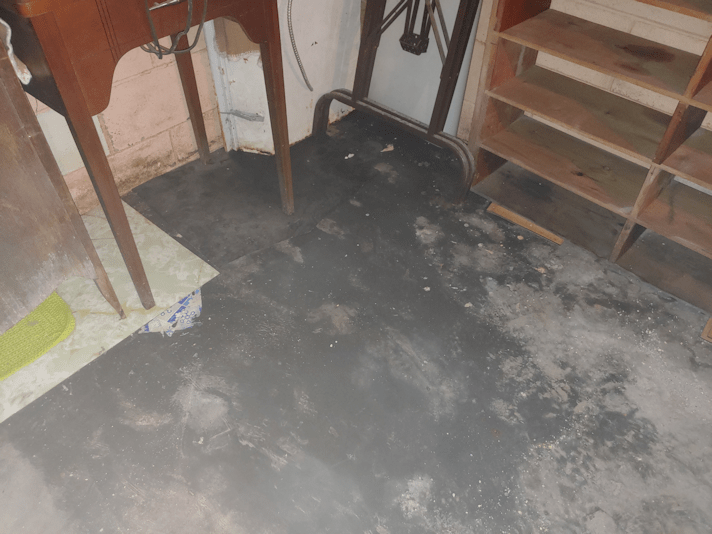
This would be why.
This was the corner my older brother found full of water and starting to mold, the summer before we moved here. A rain barrel outside this corner had been allowed to overflow right against the basement wall, through most of a very wet summer. He cleaned it up and bleached it (then we bleached it again a couple of months ago), and for our past two summers here, it was so dry, we never had an issue. Now, for the first time, water is starting to seep through the concrete – and we’ve had very little rain! Which means it is as we feared; the weeping tile is probably filled with soil and no longer doing their job, thanks to the overflowing rain barrel.
*sigh*
Another thing that will be a big, expensive, fix.
As for the corner, we already made sure the things we put there were raised off the floor. The only exceptions were the pieces of light figures, and the legs for a folding table. The plastic light cover is not a problem, but the metal piece is now raised off the floor, and the metal table legs were move out completely.
This would explain why, when we did a temperature and humidity check in the root cellar yesterday, the humidity was almost up to 80%! The temperature had gone up to about 13C. With a potential cheese cave in mind, the humidity would be good, but the temperature is now a bit too warm. It should be interesting to see if it gets any higher over the summer.
Meanwhile, we’ve now got a fan on the corner to help try it out. The old part basement already has had the blower for a while, to try and keep things drier there, too. We still need to rebuild the mesh cover for the window on that side, so we can open it up for the summer and not have to worry about critters getting in.
Little by little, it’ll get done. :-)
At least we were finally able to get prepping for the sunflowers checked off the to-do list!






















 The Re-Farmer