I just had to share this really interesting video from Huw Richards.
Richards is based in the UK, and he’s in a wildly different growing climate than we are, but some things are pretty universal.
Richards set himself the goal of growing enough food to feed a household of four in a small space, and kept track of everything, including the costs, then comparing to what it would cost to buy that food (he does include what the costs are in US$ and Euros). Of course, his costs and availability would be different than were we are, but the same methodology can be used anywhere.
For our situation, we have the luxury of space, which is good because we also need to take into account accessibility in our planning. His narrow paths between beds, for example, are not something we can get away with. We also need to have higher raised beds, again for accessibility and mobility reasons. To a certain extent, we are also able to scavenge materials around the farm, whether it’s felling dead trees and using the logs to build the raised beds, or scrounging for lumber and tools in the barn and various sheds, we should be able to get away with spending less. Our plans will – eventually – incorporate animals to help improve and amend our soil. We were supposed to at least have a few chickens, a couple of years ago, and that just didn’t happen. It’s a goal that has been shifted to this year but, the way things tend to derail our plans, I’m just hoping we can at least get started on building a chicken coop, so we can get chicks next year!
This next video on self sufficiency is also really useful.
Sometimes, I tease myself, watching gardening or homesteading videos by people who live in wildly different climates than I do. The things they can grow, when we’re still months away from being able to plant even cold hardy crops leave me pining!
Of course, there is always something to learn, even if much of the other stuff doesn’t apply to us.
Homestead Heart is one of these video channels that I find inspiring and informative. Some things apply, no matter where you live or what your growing season is like! This is one of them.
She makes some awesome points. When things were shutting down and grocery stores were empty, it really shook people up. So many people started talking about growing their own food, or stocking up seeds for the next time something goes wrong, and the stores are empty again. As much as I absolutely support people doing this, it was rather dismaying to see so many people excitedly sharing “how to” videos produced by content mills that were absolutely fake. At best, the information was useless. At worse, it was dangerous.
So if you’re among those looking into growing your own food, now or in the future, this is someone who tells it like it is, flat out, with no holds barred. She’s awesome!
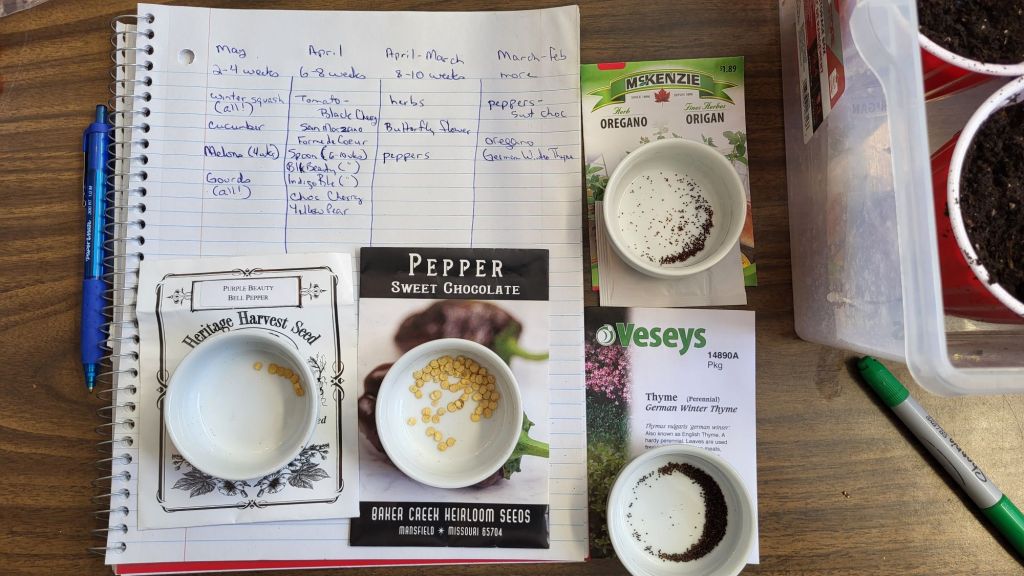
After marking out the weeks backwards from our June 2nd last frost date on our calendar, I then went through my bin of seeds and organized them by when they need to be started indoors. Then I picked out the ones I could get started now.
We won’t be starting everything that we have seeds for.
Starting from the 3-4 weeks list:
I still haven’t decided if we’re going to plant any gourds at all this year. There are several I really want to grow, but we just don’t have the space. With the winter squash, we have the new packet of mixed winter squash seeds to try, plus one type for pies my daughter asked for. With the mixed seeds pack, we will of course want to plant the entire package, and see what we’ve got! I would still like to try the Honeyboat Delicata squash again; the few we got didn’t get a chance to fully mature, but they were great in the pie my daughter made! We also really liked the Pink Banana and Georgia Candy Roaster. There are other varieties that didn’t do well that I want to try again, just so we can decide if we like them or not, but that will depend on how much space we have. The problem is, there are a LOT of things that need to be started in that 3-4 week time span. I’m still not sure if we’ll do cucumbers this year. I’d rather use the space for the melons and winter squash. We’ll be skipping the hulless seed pumpkins this year, but I really want to try the Crespo squash again. Last I saw, Baker Creek didn’t carry the seeds anymore, so I want to successfully grow at least one to collect seeds from!
As for the tomatoes in the 6-8 week list, we’ll not be planting all that we have seeds for. We’ll do the San Marzano paste tomatoes for preserving and the Black Cherry for fresh eating. The free seeds we got are tempting me greatly, and I always want to grow more Spoon tomatoes! They’re just fun. I want to start quite a lot of the San Marzano, but not as many of the cherry tomatoes. I don’t want a situation like last year, where we ran out of space and had to give away so many transplants!
From the 8-10 week list: the Butterfly Flower is a type of milkweed, so I definitely want to get those going. We have three varieties of “early” peppers that I waited to start last year. They have such a short growing season, technically we could direct sow them. It didn’t work out. They didn’t get to produce, though with most of them I now know that the grow bags they were planted in were invaded from below by roots from the nearby Chinese elm. So we’ll definitely need to keep that in mind, when deciding where to transplant them this year. I will be starting fewer seeds, shooting for at least 2 plants per variety in the garden, but between the 6 varieties I’ll be starting this year, we’ll still have plenty for our needs. Hopefully, my family will have peppers of each kind to try, so we can decide which varieties we like enough to keep growing, year after year.
You’ll notice there are no summer squash on my list. Those got moved to the direct sowing bin. I’m not going to have the space to start them indoors. As long as I can keep the slugs away from them, they should be okay to start outdoors.
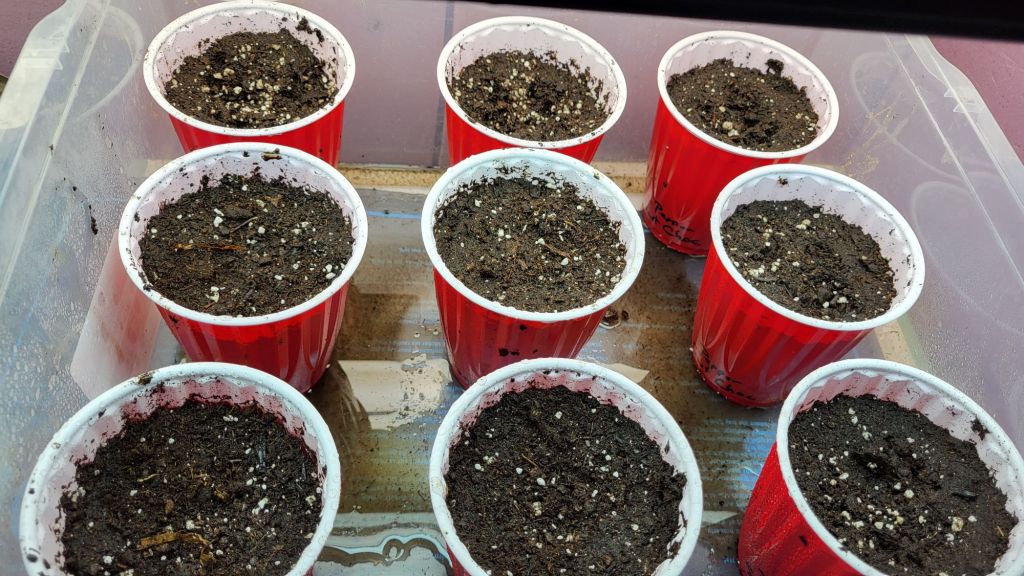
There were four things I could start today. Since I was after fewer plants per variety, I decided to go with the Red Solo cups to start them in, rather than the larger trays with smaller grow cells.
With the herbs, I’m just doing the oregano and German Winter Thyme again. The chamomile we planted last year should have self seeded, and we’ll see if the spearmint survived the winter in their pot. We ended up not using the lemongrass at all, so I’m not trying them again this year. We’ll plan out our herbs more, as time goes by. The herb seeds are so incredibly fine – especially the oregano! They got surface seeded over the pre-moistened seed starter mix, then covered with a light dusting of dry starter mix to just barely cover them, followed by a spritz to moisten the tops. Vermiculite would have been better, but I don’t have any. The herbs went into two cups each. With such tiny seeds, there’s no way to know how many I managed to sprinkle onto them. I still had seed left over, too, so if they don’t take, I can try again. The oregano really struggled last year, and I ended up with only one surviving seedling to transplant. That one plant did well, at least! They were started in the little Jiffy pellets last year, so I hope they do better in the larger cups and a different growing medium.
I decided to go ahead and plant the last of our Purple Beauty seeds, which are two year old seeds. The first time we planted them was a year of drought and heat waves, and they did very poorly. Last year, what was planted in that bed also struggled, so I think it’s more a problem with the soil in that bed. I split the last 7 seeds of Purple Beauty between two cups.
The Sweet Chocolate peppers were the one pepper that we were actually able to harvest mature peppers from last year, and they were also the only ones I started quite early. We saved seed from them, too, but there was still plenty in the packet, so I used those. There was enough to plant three seeds into each of three cups, with plenty of seed left over. I had intended to do just two cups, like the others, but the bin they’re in for bottom watering holds 9, and I just had to fill in that last space! Yeah, it’s a bit OCD, but I have an excuse. If there are gaps in the bins, the cups tend to fall over more easily when the bins get moved around.
So these are now in the big aquarium, on the warming mat.
The next seeds don’t need to be started until the second half of March, at the earliest.
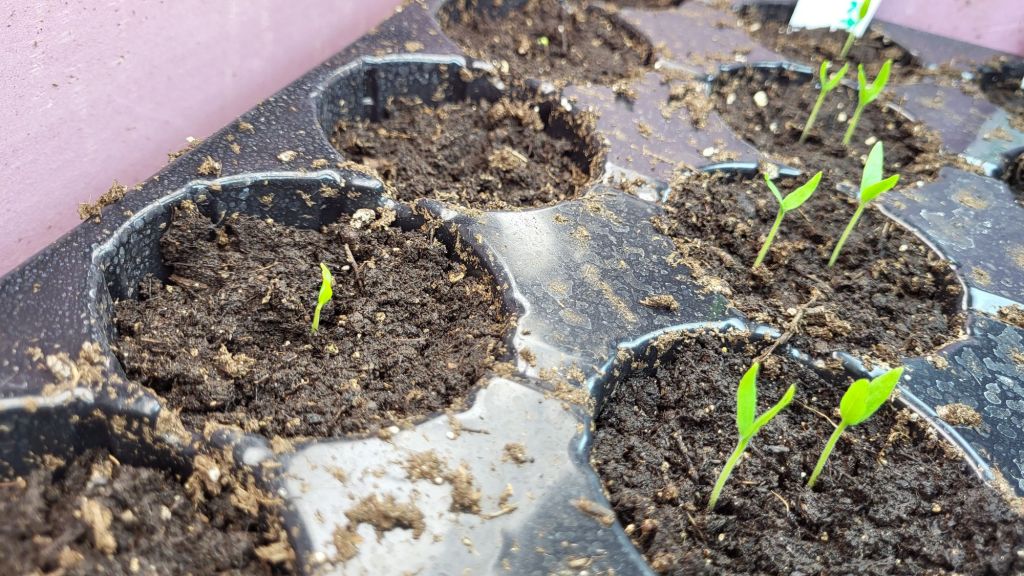
I went to bottom water the seed trays and turn the lights over them for the night, when I made a happy discovery. Our first Cheyenne hot peppers have sprouted!
The peppers are in the row of cells on the left. It’s hard to see, but there is a second one barely visible in the cell at the top of the photo, just breaking ground!
Now that those are starting to sprout, I’ve unplugged the heat mat. Tomorrow, I want to set up the mini-greenhouse frame near the window and above the heat vent – we’ve got some shelves to move out of the way, but we now have a portable AC unit stored in the living room that we might have to move, too. Once these trays are out, the next batch of seeds will be started and set up in the aquarium greenhouses.
One nice thing about using those fruit and vegetable trays for starting seeds. They have a smaller, round space in the middle that had either a container of dip in it, or some strawberries, that’s not deep enough to plant anything in. I’ve got their lids under the trays, which is handy, as they have recesses that fit each section of the trays, but there’s not a lot of space to reach for bottom watering. Instead, I’ve made drainage holes in the empty spaces in the middle, and pour the water in there. They then drain slowly into the lids below. Bottom watering from above! 😁
The red onions are still very sparsely emerging, and not very many of them, so I want to put them into the big aquarium for at least a few days.
Once everything is ready, I’ll have to make some decisions on what long season seeds to start next. Some herbs, for sure, but they don’t need to be in the remaining new tray with the larger cells. I want to save that for larger seeds. I should have room enough to start some tomatoes, I think. I don’t think they all need to be started this early, though. I’ll probably start more peppers, too. Yes, they are supposed to be short season varieties, but the only ones we had a really good harvest with last year were the ones we started much earlier. I don’t want to start as many pepper or fresh eating tomato seeds this time; we had such a high germination rate last year, we ended up giving away lots. Space for the trays will be an issue this year, as we were gifted a nice big armchair that is now the most comfortable chair in the house – but now we don’t have room for how I set up an extra “table” for seed trays like we did last year!
Setting up the living room as the cat free zone has become way too handy. The room is getting way too full of things we need to protect from the cats, because our house plants and seed trays!
This morning, I headed out to drive my mother to her doctor’s appointment. It really sucks to not be able to use her car right now, because it’s a real struggle for her to get into the truck, even with the foot stool. She finds it easier to get out, and refuses the foot stool completely, preferring to use her walker for support.
I’m certainly glad my shoulder is all healed up, because I had to help boost her up into the truck! Something I could not have managed, just a few days ago.
Once in the truck, though, she was happy as a clam! She commented on how nice it looks inside, and how smooth the ride is, compared to her car. I think she finds the seat more comfortable too.
At the doctor, she got the referral she was there for. The doctor was supposed to give her a physical exam, but my mother couldn’t even get up the step to go onto the examination table, so that was skipped. My mother will get either a call or letter about an appointment in the city to see a specialist, and the wait should not be long.
After that, she was up to stopping for lunch before heading home. I didn’t stay long after dropping her off; mass on TV was about to start, and she watches every day. Plus, I wanted to stop at the grocery to pick up an ingredient we were missing for my daughter, who wants to use the last of our winter squash to make a pie, and my husband sent me a message saying we had parcels to pick up at the post office.
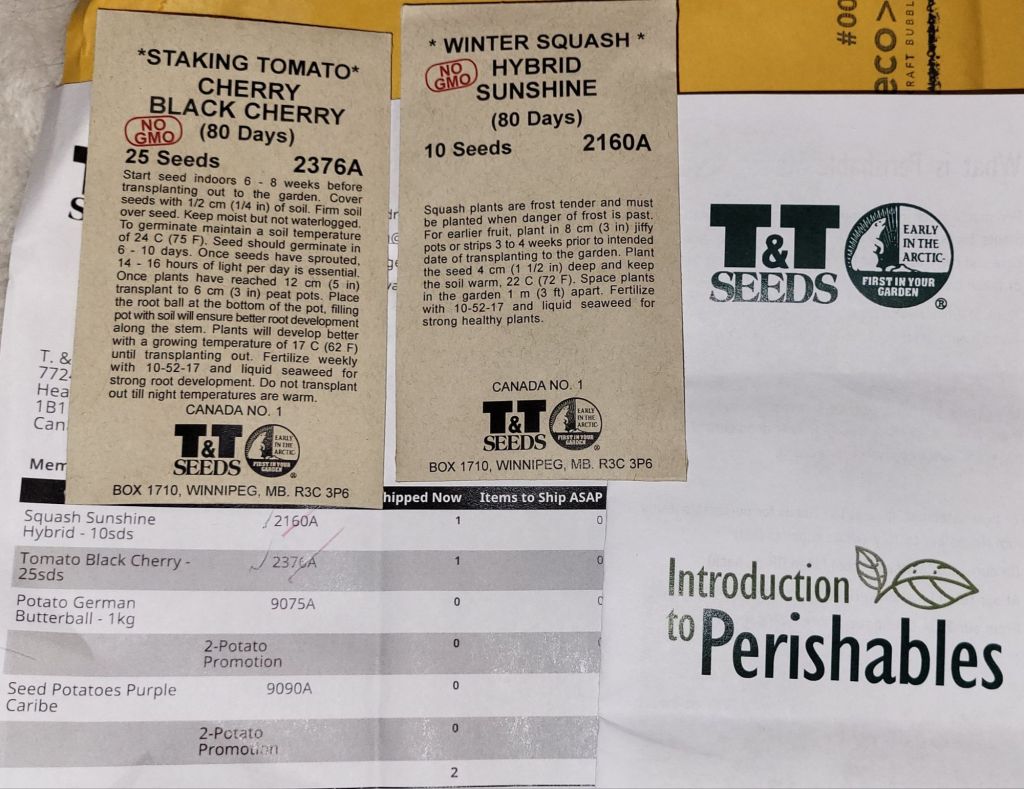
Along with the parcels, my seed order from T&T Seeds was in.
It took several tries to get a photo without a cat photo bombing me!! 😄
The potatoes will be shipped in the spring, but they included a pamphlet on how to handle their various types of perishables with the seeds.
Based on what the package says, with our June 2 average last frost date, the tomatoes can be started indoors in the first half of April, and the winter squash can be started indoors at the beginning of May. Both say 80 days, though, and our growing season from last frost in the spring, to first frost in September, is 100 days. Technically, we could direct sow both of them! I don’t think I’d want to take that chance, though.
I must say, it’s very hard not to buy more seeds right now! The McKenzie Seed displays are out, and they are everywhere. Even some gas stations have them! As soon as I walk in somewhere – like the grocery store, today – and see the displays, I just zoom right in and start looking. We have so many different seeds, and for many we also have several varieties, so there’s really not been anything in the displays that I would get, that we don’t already have. About the only thing I really find myself looking for is sugar snap peas. We have lots of seeds for shelling peas. The first year we grew peas, we grew both types, but that was the drought/heat wave year, and the snap peas barely survived.
With everything melting outside right now, and the rest of the winter expected to be mild in our area, who knows. We might be able to get things started earlier than usual! At the very least, we should be able to get to work on the building more trellis tunnel beds and reworking others. early. There are seeds that can be planted as soon as the ground can be worked, even if there are frosts later on, so I’d quite like to have some of those started, nice and early! Things like the peas, which I want to plant in the bed the popcorn was planted in, last year, to get some nitrogen back into that soil, spinach and onions.
I so looking forward to getting outside and back to work again!
Today, we placed our second seed order for next year’s garden. This time, from Heritage Harvest Seed. (All images belong to Heritage Harvest) They specialize in rare and endangered seeds and, more importantly for us, grow their own seeds and are in a zone 3 location that’s even further North than we are, so we can be quite confident that anything we get from them can grow in our short season.
Unless something else causes problems!
Which is why we are re-ordering two items that failed last year.
We grew these a couple of years ago and they were among the few things in that terrible growing year that did rather well, though they never had a chance to reach their full potential. Last year, we tried growing them in the block planters by the chain line fence, and the transplants just didn’t grow. Next year, we will have to be more selective on where we transplant them. We also had issues with starting them indoors that we did not have the year before, so we need to take that into consideration as well.
We tried these last year and, while the seeds germinated very well and we had plenty to transplant around our Roma VF tomatoes, they just… disappeared. The tomatoes also got blight, so I believe it was a soil problem in that bed. I really like the shape of these onions, and that they are supposed to be a good storage onion, so I want to try them again. As with the eggplant, we will need to give more consideration as to where to transplant them.
We are still looking for a preferred paste tomato. I keep reading how the San Marzano is supposed to be the best for sauces and canning. Honestly, all the excessive praise I have been seeing about them is one of the biggest reasons I hesitated to get them. However, I am willing to give them a try, and see if they live up to the hype.
When it comes to summer squash, we seem to have the best results with patty pans (aka: scallop squash). This is “An ancient summer squash that was a traditional food crop of the northeastern tribes for centuries.” I’ve actually been eyeballing this variety for a few years, and have decided to pick up some seeds for this coming year.
Not a large order at all, but we don’t need a lot of seeds this time around.
Must… resist… getting… more! 😂
There is one more Canadian company we will be ordering seeds from – and seed potatoes. I was just talking with one of my daughters, and there were several winter squash varieties in their catalog that caught her attention.
I have my suspicions as to why so few of the different winter squash, pumpkin and melon seeds we started indoors for 2023 germinated. I hope to be able to fix that this time around. Which means that for 2024, we’ll be once again shooting for a few plants of many varieties (I’ll be skipping the pumpkins this time, though) to see what works and which ones we like the best.
The main thing, though, was to get the last of our onion seeds ordered, since they need to be started indoors so much earlier than anything else! That goal is now accomplished.
Okay, now that we’ve gone though and analysed how our garden did in 2023, it’s time to use that information to review and reset our plans for our 2024 garden.
For the past few years, we’ve done a lot of experimenting. We will continue to experiment, but some things will be set aside for now, to try again later.
So let’s go through the different categories again.
Fall garlic, perennials and food forest items
Our fall garlic is already planted. This year, we’re just doing one variety, so we got 3 pounds of garlic and they’re planted in locations, in the old kitchen garden. Hopefully, they will survive the winter in their raised beds, and we’ll have a good harvest out of them. Garlic will be a staple crop. We might still try other varieties to find which one we like best but, at this point, it’s more about figuring out how much to plant to meet our needs.
We’ve also got the unexpected purchase of saffron crocuses planted already. I’m quite excited to see how they do. They’re zone 4 and got extra protection for the winter, but our winter has been so mild so far, they should do just fine.
Berries, fruit trees and expanding the food forest
What we do next here will depend on our budget. With fruit and nut trees, they really should be planted as early as we can get them, since they can take so long before producing. We still need to get more sea buckthorn, since we lost 3 out of a bundle of 5. We got two tiny Trader mulberry along with our Liberty apple tree. They didn’t have stock of the usual sizes they ship, so instead of one 2 yr seedling, we got two 1 yr seedlings. Those were so small, we ended up keeping them indoors. They’ve grown quite a bit and, as I write this, they have gone dormant for the winter. Hopefully, they will start budding in the spring, as we harden them off before transplanting outdoors.
We might get another, hardier variety of apple tree, but we also need to keep in mind that almost all the crab apples we have now are dying of a fungal disease, and once that gets in the soil, there’s no getting rid of it. We’re looking at hardy plum and pear trees, but I’m also keen on getting things like hazelnuts, butternuts or black walnut trees. The hazelnuts bushes, at least, will start producing in 3-5 years, unlike the much longer time needed for the bigger trees.
We have black currants that need to be transplanted out of the shady area they are in now, and the haskap probably need to be transplanted, too. They have yet to produce.
Saskatoons are on our list, as are gooseberries.
More raspberries are definitely on the list. The goal is to have different varieties that mature at different times, so extended harvesting.
I would like to get more strawberry transplants and use them as a ground cover under food forest transplants. Those are something that should to be replanted elsewhere every few years, so that would work out.
We intended to get green asparagus and more purple asparagus, in alternating years, but we are having trouble figuring out where to plant something that we can expect to produce for 20 years, so that will wait.
No change on the sunchokes. They’ll take care of themselves at this point.
We also need to figure out where to plant annuals that we can treat as perennials that we didn’t plant in 2023, like strawberry spinach, dill and other varieties of bread seed poppies.
We also need to get native wildflowers to attract pollinators growing. Those will be scattered about, and bordering other areas.
Root vegetables
Potatoes will, of course, be grown again. I just don’t know where, yet! While I like the fingerling varieties, I don’t like fussing with smaller potatoes as much, so I think this year I will focus on just two basic varieties, one a white or yellow potato, and one a red potato. Scab resistance and storability will be the main factors to consider when choosing varieties.
I think we’ll need to skip beets and turnips for a few years. I’d still like to grow a couple of radishes for their pods but, so far, none have had a long enough growing season to reach that stage, so it might be skipped. We might still grow a few radishes for their roots, for those family members that enjoy them.
Carrots, however, have done well, so we’ll keep growing those for sure. I can’t remember if I still have Uzbek Golden carrot seed left, but do want to grow those again. The only down side is that I haven’t seen a Canadian supplier, and the cost of ordering from the US is getting too high. I’ve got lots of seed for other varieties, though.
Onions and Shallots
These will continue to be staples, even as we try different varieties to see what works. I’ve just got seeds for yellow globe onions and pink shallots in, plus I need to get seeds for a red variety. It’s yellow onions we use the most, so finding something that grows well here, and stores well, is the priority over other types.
Tomatoes
We had so many tomato starts in 2023, and not enough space to transplant them!
While we liked the black varieties we experimented with, my daughters have suggested that for 2024, we stick with just one fresh eating variety, and requested it be a grape or cherry tomato type. Besides that, we will try a different paste tomato variety. Something more resistant to blight!
When cleaning up the old kitchen garden, the Spoon tomatoes still had some ripe tomatoes on them, so I just stuck those into the ground after pulling up the plants. Who knows. We might have some self seeded Spoon tomatoes next year!
Corn, peas and beans
I want to grow peas again, but would like to try them somewhere else. We have yet to have really healthy pea plants, even though we’ve managed to have some to harvest. Deer eating them is only part of the problem!
With beans, I still want to try the varieties we didn’t manage to plant in 2023, with both bush and pole bean varieties, plus dry bean varieties. If we have the space, I’d like to try the seeds I’d harvested from the self seeded varieties that grew in our compost pile. I still haven’t been able to figure out what they are, or where they came from!
As for corn, I think we’ll save experimenting with popcorn again for another year. Likewise with the purple corn. I want to focus on growing sweet corn. We have a couple of short season varieties that didn’t get planted in 2023, so I want to grow at least one of those, and a decent amount of them!
Peppers, herbs and greens
For the sweet bell peppers, my daughters have suggested we just do one variety, and they don’t particularly care what kind. They find they all seemed to taste the same. I do have a request to grow hot peppers, too. We still have plenty of seeds to choose from.
For herbs, it should be interesting to see what makes it through the winter. Did the chamomile self seed? Will the thyme make it? I normally would expect the spearmint to survive, but they’re in a pot, not in the ground, so they will likely not survive the winter. We will likely find other varieties of herbs to grow, as we convert our old kitchen garden into mostly herbs, but we haven’t decided what to try next, yet.
As for greens, we probably will skip the lettuces again, but I won’t be unhappy if the Jabousek lettuce managed to self seed. I also want to try growing the Hedou Tiny Bok Choy seeds I harvested our of the tiny little plants that survived being choked out by Chinese elm seeds.
At some point, I want to grow cabbage, but I don’t think it’ll be this coming summer.
Melons
We love melons, so we will definitely be growing them again. I just got a summer melon mix of seeds to try, plus we still have seeds left from the varieties we tried in 2023. I would love to get the Cream of Saskatchewan Watermelon growing. It’s a short season variety that I might actually try direct sowing, since starting them indoors was a complete failure!
Summer squash
These are a staple crop, and we still have plenty of seed for the green and gold zucchini, the yellow pattypan squash, and the Magda squash. I might need to get more G-Star seeds, as those seem to do so well here, but I’d also like to try a new variety of patty pans, too. If we can get control of our slug problem, these can be direct sown instead of started indoors.
Winter Squash
I want to try all the varieties we tried in 2023 again! We won’t have the space, though. We have the new Wild Bunch winter squash mix of seeds that just arrived, and those will probably take up most of the space we have available. If we have the room, I’d like to do the pink banana and candy roaster again, as they did so well. There are also others that didn’t do well that I want to try again, with better growing conditions. The main reason I am willing to dedicate so much garden space to these is for their winter storage that will provide food for us for many months.
Gourds
Gourds are something I’ve been wanting to grow mostly for crafting purposes. Especially the larger varieties, such as the canteen gourd and the African drum gourd. Luffa, of course, I want to grow for their sponges. Unfortunately, we’ve had issues with getting most of them to survive at all, never mind bloom and produce early enough to fully mature on the vine, even for varieties that I know should be able to do so, in our short growing season. I need to rethink where to grow these, and focus on improving the soil. I think that’s the source of most of our problems. These are heavy feeders, and our depleted soil needs more work. Whether or not we grow gourds again in 2024 will depend on having that sort of prepared space. They are not as high on the priority list for the upcoming year.
Eggplant
I definitely want to grow both the Little Finger and Classic eggplant again! We had the one Classic eggplant do surprisingly well. I now know not to plant any in those chimney block planters, but the wattle weave bed seems to be a much better space for them.
Salsify
My daughters had requested these, as the roots supposedly taste like seafood, and that appeals to them. With their deep roots that, from what we’ve read, are fragile, they were going to be grown in repurposed garbage cans turned into planters. It just didn’t happen. I’d like to give it a go in 2024 and see if we can successfully grow these at least once!
Sunflowers
We still have the seeds for Mongolian Giant and Hopi Black Dye sunflowers. They need to be grown while they are still viable. When we grew them before, we tried starting them both indoors and outdoors. The main problem was, the deer!
So I do want to grow these again, if we can figure out where, and how to protect them. With the Mongolian Giant, I want them to double as a privacy screen, too. Ideally, I would interplant them in the food forest area, but that’s where the deer traffic is heaviest!
Cucumbers
We still have Lemon Cucumber seeds that I wouldn’t mind trying again. We’ll see if we have the space. I don’t think we’ll bother with pickling cucumbers. The year we grew those, my sister dumped loads of cucumbers from her garden on us. We pickled as many as we could before we ended up having to toss the rest on the compost, because they went moldy before we could finish them.
We haven’t been eating the pickles.
My husband normally loves pickles. We only opened one jar, and that’s it. No one’s wanted to eat any of them, since.
I have no idea if our own pickling cucumbers would have done better, as we never had enough of a crop to pickle, though we did have some for fresh eating (they were a dual purpose variety).
Perhaps some day, we’ll try pickling cucumbers again. For now, though, if we try any, it’ll be for fresh eating, and I think the Lemon cucumber is an interesting variety I’d like to try – if we can get them to germinate and survive long enough to transplant!
So that’s my thoughts on what we want to plant. These are the other related projects we need to work on.
Raised beds
A priority needs to be put onto getting the trellis beds built. Then add the trellises and, if we have the time, join pairs of them to make the trellis tunnels we have in mind. We will also need to have portable trellises for climbers that will be planted in other beds that will not have permanent trellises built in.
The current low raised beds in the main garden area need to be rebuilt into more permanent fixtures, but the priority is to build more beds in general, first. Especially since we won’t be growing squash in the old squash patch again, and still plan to grow a lot of squash. That space will also eventually have raised beds in them.
The soil in the low raised beds, however, needs further amending, particularly to prevent soil compaction. I suspect soil compaction is the cause of a lot of our problems, even though we use mulches to help prevent that.
Rebuilding the garden tap
When I was a kid, helping my mother with her garden here, that tap came in so very handy. I hope to put a priority on getting that set up again, in a way that will last at least another 50 years! Along with the tap, which will be set up strong enough to support a garden hose attached to it, there will be a vegetable washing station and work station.
Garden shed
I want to at least get started on the base of this. We need to replace the old and rotting garden shed. I also want to do a small cordwood construction practise building. The original plan of building a 10’x10′ outdoor bathroom with composting toilet, to replace the outhouse, will be postponed. We’ve chosen a location for it, but when it comes time to fell the rest of the dead spruces, we need to be able to fell some of the trees in that direction, then drag logs through there.
So what I want to build first as a practise building is a smaller garden shed. Because cordwood walls are so much heavier, we need to prepare a base that will support that weight and not sink. That will mean bringing in gravel (now that we have the truck, we can actually drive to the gravel pit to collect some!) to cover the ground and raise the area a bit higher and level it. We plan to visit a ReStore in the city, or a salvage yard, to find concrete blocks or pavers to use as a floor, and a base for the cordwood walls.
The shed itself is planned out to be 6’x8′ on the inside, not counting the thickness of the walls. The cordwood walls will probably be 8 inches thick (for a larger building, like a house, they might be 12 or 16 inches thick, or even more), and have a shed roof, which will probably be a metal roof. The south facing wall will have a window – we have many salvaged windows, complete with frames, in the barn to choose from – and bottle bricks in the wall around it for light inside. We have doors in the barn and sheds, too, and should be able to find something we can salvage.
I want to take advantage of the cordwood construction to include longer logs in the walls, extending outside the northern wall closer to that garden tap, that can be used to build a bench and maybe a counter. Other longer pieces can be extended into the interior, closer to the roof, to build shelves on.
There are other things that are a priority that will take a lot of time and resources, but I do hope to at least get a start on the base. We really do need a good garden shed, and I’d like to build one that will last many, many years.
Well, that’s all I can think of right now. I’m sure I’m forgetting something!
With the previous garden analysis posts, I wasn’t able to include a lot of photos that I would like to have. Due to media storage running out in my WordPress account (I’m at 98% now, so I have to go find some more photo/critter of the day posts to delete!), I did a lot more videos, instead.
Turns out, I did quite a lot of them.
So this post is going to have all those videos, starting with the longer garden tour videos.
But first, I want to mull over my final thoughts on this past year’s garden, before I do a final review and reset post for next year’s garden.
Honestly, I’m not sure what to think about how the garden went this year.
I’m unhappy with the fact that the garden was so much smaller, and that we didn’t get the trellis beds built, that we wanted to. Even if we didn’t get the trellises added until later, we should have at least been able to build the raised beds. It seems that every time we had a day where we should have been able to get in to fell the dead spruces to use for it, something would come up that needed to be done right away, like helping my mother with errands, or doing our own errands in the city, etc. Then there were all the days when it simply wasn’t safe to try and fell trees due to weather. Mostly high winds. Felling 60′ + tall trees against the wind is just not a thing to to! It got me very frustrated. Still, I’m glad we managed to fell the trees we did, and the more that are taken down, the more space there will be to fell the bigger ones that we need to make sure fall away from the house.
The price of lumber is still quite high, which is why we’re scavenging our dead trees. Though prices have been slowly dropping again, they’re still high enough that I’ve even had people offer to cut down the dead trees for me, in exchange for the lumber. In another world, I would have happily taken them up on this exchange, but we need the lumber for ourselves!
The other frustration is not knowing why some things, like the beets, did not do well at all.
Oh! I completely forgot to include the radishes in the root vegetables post! They were planted as a fall crop, and while a couple grew fast enough to start blooming, and they certainly did better than the beets did, by a long shot, their roots still did not do well. Plus, my one daughter that actually likes radishes happened to be away and house sitting at the time when they would have been best for harvesting, so even what little we had never really got used.
Discovering that the roots from those trees my mother allowed to grow where she’d had a row of raspberry bushes, many years ago, were actually getting into the grow bags and crowding out the things I actually wanted to grow was another frustration. When she asked us to move here, and I mentioned wanting to clear those trees away, she demanded they stay. They’re a wind break, she says. Well, sort of, but even as a wind break, they’re not located in a good place. When I was starting to clean up around them, I discovered a number of stumps that showed these trees had been cut down in the past, most likely by my late brother. Much of what we’ve got now are actually suckers that grew out of the stumps.
Those trees have got to go, and go permanently, if we want to be able to use that space to grow food.
Still, they do provide a small amount of shelter, so that will likely wait until we’ve been able to plant more shelter belt tress in better locations. We just have to be very careful about where, since we need to avoid a buried telephone line.
We might just cut down the Chinese elms, though, as their seeds were also a contributing problem. The maples that are in there are not so bad. They have different root systems, too.
All in good time, but where they are used to be part of the main garden, and that’s space I’d like to reclaim at some point. I just didn’t realize, until this year, the extent of the problems those trees are causing.
Then there was the stuff planted in the new chimney block beds against the chain link fence. The bed we had there previously didn’t have anything to hold the soil in place, and we were losing it under the fence, so we had to do something. These are the last of the chimney blocks that were intended to replace the chimney for the old wood furnace – back when my parents bought the property in 1964! A chimney that was taken down when we got the new roof last fall, as only the electric furnace is being used.
We’ve used those chimney blocks as planters in the old kitchen garden retaining wall, so I expected them to work find. Yet nothing planted in them thrived at all. I can make some guesses, but I can’t say for sure why they failed.
There was some frustration with deer damage to the peas, bush beans, strawberries and asparagus, but nowhere near as bad as the year we had so many groundhogs move into the yard, so that’s a relative thing.
We did have some good harvests, especially with the pink banana and candy roast squash, the carrots and – eventually – the tomatoes. Even the tomatoes that had to be harvested early because they got blight, which is a first. We’ve never had tomato blight before and, as far as I can remember, my mother never did, either.
Though I have to say, it’s been great to grow potatoes and not have any Colorado Potato Beetles! We had massive problems with those in my mother’s garden when I was a kid! We also grew massive amounts of potatoes to last 7 people all winter, but there until we started growing them again, I don’t think anyone has grown potatoes here for many years.
So I am happy with quite a few things, but disappointed or frustrated with quite a few other things. A real mixed bag!
You will be able to see how that progressed over our year in these garden tour videos. This first one is the spring tour I included in another post.
I was able to do monthly garden tour videos, starting in June.
In this July tour, you can see the self seeded red poppies that showed up in the shallot bed, that turned out to be this variety – and I have no idea where they came from originally!
In this August tour, you can see just how poorly the plants did in the chimney block planters – and how well the compost pile squash did!
This September tour was done on what was our average first frost date.
We even got one last tour in October! We’d had our first frosts by then.
Also, I completely forgot that the cat we now call Syndol had been named Rudy!
Amazingly, we still had crops in the ground to harvest in October. The frosts we got came quite a bit later than usual, and the temperatures remained mild, so we could get away with quite a bit being left out longer!
These next videos are more topical, starting with one I included in an earlier post, about preparing beds and making carrot seed tape.
This next one was done in early April, when we got a snow storm. I was able to pot up tomatoes that day!
You can also see some of the early sprouts, many of which did not survive to be transplanted.
This next one is a time lapse video of planting the carrots, and preparing the spinach bed.
Gooby, the yard cat you see often in the video, has since disappeared. 😥
In this next video, we planted the Alternative Lawn Mix, spinach in the bed prepared above, and the bed preparation and planting of the Hungarian Blue poppies.
Sadly, Marlee, the cat in the thumbnail, did get outside and disappeared. She was unhappy that we’d brought the tiny kittens and their mother in, and when a window screen got knocked open, out she went and we never saw her again.
I miss her!
This next video took 5 years to make, and shows the progression of the old kitchen garden from completely overgrown in 2018, to our 2023 garden.
This progress video includes time lapse video of building the last two raised beds.
The next video is another time lapse video, and one I posted previously, showing where we reworked the tulip bed and planted our new apple tree – and protected the area from deer!
That was another area that had been very overgrown when we first moved here.
This next short video is of planting our Purple Peruvian potatoes in grow bags, with comparisons to the first year we’d grown them.
This next one was done in late May, when we transplanted our gourds and some squash, before our average last frost date.
It’s a shame that such healthy looking transplants did so poorly!
Here is another time lapse video, also done in late May, planting the Tom Thumb popcorn, plus the free Hedou Tiny Bok Choy and Jabousek lettuce seeds we tried.
This next one is very different. It shows what was discovered as I tried to repair a hose from the house to a tap in the garden, including more time lapse video.
The damage turned out to be far more extensive – no surprise, given the pipes were likely older than me!
Since this video was taken, I’ve dug up half the pipe, from where I’d first tried to repair it, to the tap. I asked my brother about the mystery sections of pipe the narrower pipe was running through. He said those were put there to help protect the narrower pipe. Which seems and odd way to do it, to me!
Now that we know the whole thing needs to be replaced, the plan is to dig a trench and remove the remains of the old pipe, then lay down some PVC pipe, with drainage holes, to protect a contractor’s grade garden hose that has been gifted to us already. At the garden end, we’ll have the tap and a sink set up – I’ve found what I want to use in one of the sheds – as a vegetable washing station. We will also be building a garden shed nearby, to replace the current one that’s rotting and starting to fall apart.
Lots of work to be done!
Finally, one last short video, showing our first major harvest!
For all the struggles we had this year, I think I can say we had a pretty decent gardening year overall. Especially compared to our Terrible Now Good Growing Year, last year. 😂
When we moved here, we had set out a five year plan with goals for various areas. It was in year five that we expected to finally be ready to plant a garden, which would have been last year (counting our summers, since we moved in so late in the year). My daughters, however, were keen on getting things started. Prep was done in the old garden area starting in 2019, with our first garden planted in 2020, which you can read about here.
With our goal to eventually be able to grow and produce as much of our own food as possible, the gardens have been expending every year since.
Until this year.
This year, it was probably half the size of last year’s garden.
There are several reasons contributing to this.
The first were the far flung beds that were done as part of our food forest plan. With the exception of one newer bed where the Crespo squash were transplanted, this meant the squash/bean tunnel, the pea and bean trellises, and the corn and sunflower patches were not used for growing vegetables. In that area, we’ve progressed in our food forest plans, and will continue to plant more trees and bushes in that area as the budget allows.
Last year, we got three new large areas prepared, where we planted potatoes, melons, squash and corn.
All of which got flooded out.
We did have things to harvest in the old garden area, thanks to the raised beds we had. We already wanted to go to all raised beds because of how rocky and nutritionally poor our soil it. My mother was able to garden here because my dad had a tractor to plow the area with and spread manure from our herd of cows over it, plus she had 5 kids to help her pick rocks! That and my mother has two green thumbs. 😄 The soil condition was much better back then, but that was many years ago. Yes, there were still gardens grown here over the years, but they grew ever smaller, and eventually my parents stopped gardening and it was the younger of my brothers that grew a few things. It did also get plowed at times. I only know that because the last time it was plowed, some time before we moved in, it was done by the person that would become our vandal, and my sister thinks he had to have been drunk when he did it. We’re still dealing with the mess, and just trying to mow the area has been damaging our lawnmowers, no matter how careful we try to be.
After seeing where water collected the most during the flooding, the new areas we’d claimed last year were going to be converted to a series of raised beds joined by trellis tunnels. We were supposed to build the first ones in the fall of last year.
That didn’t happen.
Which I didn’t mind too much, since it gave me time to rethink how we wanted to build them.
So they were going to be built in the spring.
That didn’t happen, either.
These are going to be built mostly out of dead spruces we need to harvest out of the spruce grove, but felling these trees is not as simple as it sounds. With the help of my brother, we did eventually get some down (though one of them got stuck on other trees, and I still haven’t gotten it completely out yet), but it still took forever to finally process the trees. In the end, we only managed to get one low raised bed framed out. The high raised bed is four logs tall and 9 ft long. The new bed is two logs tall and 18 ft long. This series of beds – hopefully there will be six in total – will all be 18ft long, joined in pairs with trellis tunnels. The way we’re building them now, if we want to make them higher, that can be easily done.
In the end, the areas we’d reclaimed the year before, did not get used this year. They were just too overgrown and we won’t be able to do anything in those areas until the new raised beds are built.
Which meant we were using about as much garden space as we had maybe two or three years ago, instead of expanding as planned.
It was very frustrating for me. I’d bought so many seeds, in preparation for having a larger garden! Plus, we still had seeds from previous years to use.
I go through all of those in this video.
So here are some of the things we didn’t grow, mostly because we just didn’t have the space, but also the things that failed.
These are seeds we’d ordered from Veseys.
We planted pretty much everything in the paper envelopes in the above photo. The beets failed completely, but the rest did pretty well. In the beans, we had yellow and green bush beans that got planted in the high raised bed that did well, even after they got eaten by deer, but we had planned to grow varieties of poles beans, drying beans, and even some beans my mother gave me that go trace back to her own days of gardening here. The Red Swan beans were only planted late in the season, with the purple corn, for their nitrogen fixing properties, though we did get beans to harvest out of them.
We did plant the Dalvay peas, but not the Espresso corn. We have several varieties of short season sweet corn, but didn’t plant any of them at all. There was simply no space for them.
We did get more of these wildflower mixes. The areas we’d tried to grow them previously got flooded, so we wanted to try again in another area.
The bare earth in these photos is where we’d had branch piles that finally got chipped, making an already blank slate for us. My daughters prepared and planted the alternative lawn mix here.
If anything sprouted, they didn’t survive long enough to be identifiable.
The biggest problem turned out to be the cats. They love to roll around in bare earth, and even used the loosened soil as litter boxes.
We still have the Western Mix. I’m still wanting to plant those in the strip of flat, open land between our fence line and the ditch. Perhaps in the coming spring, I’ll be able to broadcast them. This is not an area we can prepare the soil. We just plan to keep broadcasting native wildflowers to attract pollinators, and whatever takes, takes, what doesn’t, doesn’t.
Then there were these seeds from Baker Creek.
Out of all these, we planted the corn and the tomatoes. That’s it.
With the sunflowers, we just didn’t have any prepared space for them. With the poppies, we’ve grown this variety before, so this year we tried the other variety I found. We hadn’t planned to grow lettuce this year at all, so those free seeds were set aside. The salsify was meant to be planted in deep containers. I did find a couple of old garbage cans we could have tried, but we never got around to cleaning them up, drilling drainage holes, and filling them with soil.
This next batch of seeds were from Heritage Harvest. I like this seed source in particular, because they grow their own seed, and their zone 3 location is even further North than we are! So when it comes to growing season, we can be sure anything we get from them should be able to grow here, too.
*sigh*
We had massive germination problems, and I don’t think the problem was the seed quality. I think there was something wrong with our seed starting set up.
The Red Wethersfield onions started out fine, but basically disappeared after they were transplanted. That same bed had the Roma tomatoes, which got blight, so that might be a soil health issue.
The salsify, like the seed from Baker Creek, never got the containers they needed ready in time.
With the Lemon Cucumber – a free gift – one did germinated. I transplanted it where we’d grown ground cherries last year, and it seemed to do okay for a while, until something killed it.
As mentioned previously, the Little Finger eggplants that did finally germinate did not do well, which I think was a location/sunlight problem. The chamomile did well, as did the Tom Thumb popcorn, though the kernels won’t pop for some reason I can’t quite be sure of. As for the rest…
These are just some of the winter squash and gourds we tried.
Nothing on the Red Warty Thing, Styrian and Kakai pumpkins, nor the Apple, Canteen and Yakteen gourds. Either no germination, or they germinated, then died. We had a couple of Lady Godiva’s and Boston Marrows that made it into the squash patch. Eventually, a couple of Ozark Nest Egg gourds germinated, and got transplanted near where the Lemon Cucumber went, but by then, it was so late in the season, we didn’t expect much out of them.
There was also the Cream of Saskatchewan watermelons from Heritage Harvest that had zero germination.
There were other things we intended to plant, but just never got done, because these area annuals that easily self seed, so we want to find a permanent location for them, and treat them as perennials. Along with the poppy seeds, we have strawberry spinach, plus a couple of varieties of dill. One variety is better for their leaves, and the other for their seed heads.
I’m sure I’m forgetting other things. There was so much!
Final thoughts on what didn’t happen
A lot of our issues came down to not having prepared garden space, and that’s a huge frustration for me. It’s one thing to not be able to add more, but to not be able to use spaces we used last year, too?
Building raised beds is becoming a greater necessity. The current low raised beds in the main garden area are not doing well, as time goes by, even though we’ve been amending the soil every year. Soil compaction is a major problem, I think. Those beds are all sort of temporary, anyhow, so the logs along their sides tend to roll away, and the crab grass grows under them easily. Little by little, we will be rebuilding them as mid-height and high raised bed. We need to keep some beds lower, for tall plants like climbing beans and peas, corn or tomatoes, but for the sake of our backs, we need high raised beds for things like bush beans, lettuces, and other plants that don’t get very tall.
Over time, our garden expansion will extend into the outer yard, too. The idea is to have the things that get harvested throughout the summer, closer to the house, while the things that get harvested at the end of the season can be further from the house. That will take a few more years, though. We need to get the stuff close to the house addressed, first!
We also need to rethink how we start our seeds. I’ve been using compostable pots that are designed to be planted right into the ground, but they aren’t breaking down as advertised. That was particularly noticeable in things that were potted up in them. We also used Jiffy Pellets for many of the melons, squash and gourds, and I think they were just too small for the bigger seeds.
The Red Solo cups have been working well, though. They’re just so much bigger, it becomes a space problem to have them all set up under the lights in our living room. Ideally, we’d have shelves set up in the new basement with grow lights, as there’s lots of room down there, but the cats would destroy everything. The old basement has the benefit of access to water, but it doesn’t have the space.
Just a few more reasons why a greenhouse is on our list of things we want to set up! We can get one of the inexpensive portable greenhouses but, in the long term, we will most likely go with a polytunnel, or maybe even a Polycrub. Those seem to be a UK only thing, but would be ideal for our high winds and climate. My older daughter is looking to save up for a small, permanent greenhouse but, unfortunately, she’s been paying for a lot of vet bills and stuff, instead. 😥
For now, we need to get more of those dead trees cut down to use as building material. With our winter being as mild as it has been so far, we might actually be able to get progress on that before spring. We still have some garden soil that we purchased two dump truck loads of left, though the thistles and other weeds have been taking it over, so the soil needed to be sifted every time we collect some. We’ll probably need to get another dump truck load in a year or so, with the expansion plans we have.
There is lots of work ahead of us, just to be able to maintain the garden space we have now!
Okay, I’m going to start with the eggplants, because I keep forgetting about them!
Last year, we grew the Little Finger variety of eggplants. Last year being our Terrible, No Good Growing Year, they never got to the size they would normally have been harvested at, but we did have little baby eggplants to try, and really enjoyed them. So they were worth growing again. I also picked up some Classic eggplant seeds to try.
This was not a good year for our eggplants.
I started the Little Finger seeds in the middle of March. The Classic eggplant seed packet, however, was mistakenly sorted in with the direct sowing seeds, and I didn’t find it and start them until the end of March.
We had trouble with both types, right from the start. With all the Little Finger seeds that were planted, only 3 germinated, so more were planted. It was even worse with the Classic eggplant, which also got replanted.
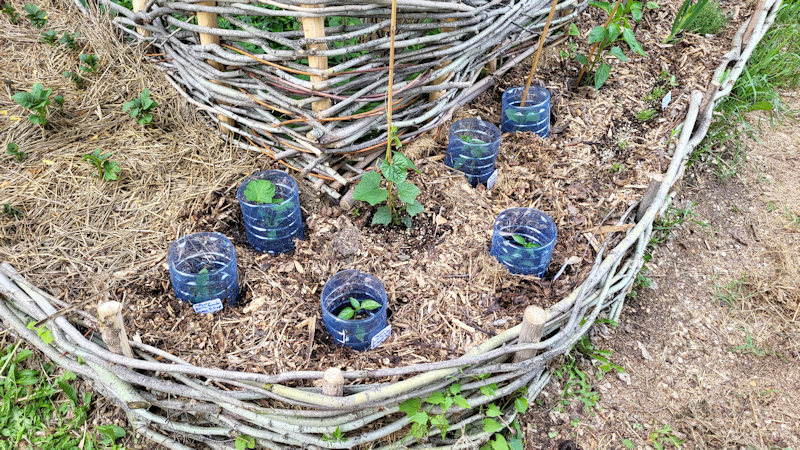
They were transplanted in between the gourds by the chain link fence, with the tiniest two, which were really too small to be transplanted, but I did, anyhow, going into one planter block.
With the Classic eggplant, we had only one transplant, and it went into the wattle weave bed.
In the above photo, it’s just to the right of the luffa that doesn’t have a plastic ring around it anymore.
I really thought the Little Fingers would do well, where they were. They had plenty of space and lots of sunlight. Instead, they didn’t thrive at all. The one at the very end of the row, next to the people gate, did sort of grow, but mostly they just stagnated. They never even got large enough to start producing flower buds. In fact, nothing did well in those blocks at all.
The Classic eggplant, however, did surprisingly well. The plant grew quite large and robust and started to bloom and produce!
Everything this year seemed to be behind, though, so while these were a variety that should have been able to mature within our growing season, they never quite got there. We did have a long, mild fall, which helped, and when we did get an unexpected frost, that one plant handled it quite well, though we did cover it, along with the peppers, during other nights we thought might get frost.
This is how big they got before we finally harvested them, knowing they wouldn’t get a chance to grow any bigger before a killing frost was expected. Which means we did get a chance to taste test them, and were quite happy with them.
Final thoughts on eggplant
While the Little Finger were a completely failure this year, and we got only one Classic eggplant, we like them enough to grow both again.
Just not in the planter blocks by the chain link fence!
Eggplant is not something we buy often, mostly for budget or space reasons, but we do like them. Growing them ourselves will allow us to do more with them, too. In the future, we will probably try other varieties, but for next year, I think we’ll just stick to the two we still have seeds for.
Next up – the gourds.
We had a real problem starting gourd seeds this year. Many didn’t germinate at all, and I don’t know why. These included varieties we grew last year that had no problems germinating.
Then they started dying off, and I replanted, but the new seeds didn’t germinate. In the end, I had just one survive. The growing medium in the other pots got reused when potting up other things, but I could find no sign of seeds in them.
So that one surviving luffa got planted in the corner of wattle weave bed, where it could get good sunlight, and have the taller portion of wall, then the lilac bush, to climb.
Later on, however, some seedlings sprouted that looked an awful lot like luffa! So I planted them in the same bed.
How they did
This was the best year for growing luffa, yet!
Ideally, we’d be growing them in a polytunnel or greenhouse, because they need twice the growing season we’ve got, to reach full maturity. If we were just growing them as a summer squash for fresh eating, that would be fine, but I’m after the luffa sponges.
The two mystery plants did turn out to be luffa, but they were planted way too late to do well. That first transplant, though, grew so very well and was soon climbing high into the lilac bush where, hidden from view, we actually had several gourds start to develop!
Not all of them made it. In fact, only one did, really. We left it on the vine as long as we possibly could before harvesting it. As I write this, it’s currently curing over a heat vent in the living room. I keep forgetting it exists, so I haven’t tried to peel it and see if we got an actual mature luffa with usable sponge – and possibly seeds – inside.
Final thoughts on luffa
Luffa is one of my “just for fun” experimental plants, so I keep trying! We will eventually get some sort of polytunnel or greenhouse set up, which should make them easier to grow in our short season. I will keep trying to grow them for the challenge of it, but I think I will try seeds from other sources in the future.
Drum gourds, Caveman’s Club gourds, Zucca melon and Crespo Squash
We tried growing Zucca melon last year, but that bed was one of the ones that got flooded, so I wanted to try again. The African Drum gourds and Caveman’s club gourds were new ones to try. I want to grow gourds to use them for crafting. The first time we tried to grow Crespo squash, they did really well, even when recovering from being eaten repeatedly by groundhogs and deer. Both the Zucca melon and Crespo squash are experiments we are growing so we can at least try them and see if we enjoy eating them.
The Crespo squash and Caveman’s club were started in the middle of March.
Though I made sure to scarify the seeds, when they germinated, there were problems with the seed leaves not being able to free themselves from the shells. We also had losses and germination issues, and had to replant the pretty much all of them.
The ones that did take, did well, though, and soon got quite huge!
Here you can see where I used a straw as a splint to protect a breaking stem. It started to break, just from moving the pots around to get good light, when they were still smaller and in the living room. Once we were taking them outside to harden them off, there was a much greater risk of damage. So some of them got transplanted earlier than I normally would have, given our last frost date.
One Zucca melon and one African Drum gourd went into the block planters, along with the two surviving Caveman’s Club. The Crespo squash got their own bed, well away from the other squash, in case we were able to save seeds, as they don’t seem to be available anymore.
The last of the Zucca melon and African Drum gourds went into a reworked bed near the squash patch.
At least, that’s what I thought.
As things started blooming and developing, it because clear that there were only Zucca melon. With restarting seeds and putting up, I must have mislabeled things, because the pots that were labelled African Drum gourd began producing fruit that could only be Zucca melon.
Which means the only African Drum gourd transplant we had, was the one planted along the chain link fence.
How they did
As you can see from the photos above, the drum gourd, Crespo squash and Zucca melon did start blooming.
What was grown in the blocks by the chain link fence did not do well at all.
The Crespo squash also did not like their location. I was expecting the huge, lush plants we got the first year we tried them. Instead, they were spindly vines, with many male flowers but almost no female flowers. What few did appear, I hand pollinated. We did get a few that started to grow, but by fall, there was just one to harvest, and it was much, much smaller than these are supposed to get.
With the Zucca melon, they also produced mostly male flowers, but they did start to eventually produce a good amount of female flowers. I hand pollinated those, too! While the plants themselves didn’t thrive, either, they did do better than the Crespo squash, or the ones at the chain link fence. They started to produce fuzzy fruit, which is how we could finally say that what we thought were Drum gourds were actually Zucca. Some of them even started to get pretty big, but in the end, they all ended up with blossom end rot and dying off!
Update:
I knew I was forgetting something!
The Caveman’s Club gourds did slightly better, though far from healthy plants. They bloomed and pollinated, and at the end of the season, we had two – sort of – little gourds. After picking them, one got all wizened and was tossed. The larger one is currently curing in our sun room. The cats keep trying to play with it!
Final thoughts
These were all really disappointing. Those transplants were looking so good when they went in, but none of them thrived!
With the Crespo squash, a bit of research leaves me to conclude that they actually got too much sunlight. Where they were planted gets full sun, all day – no shade at all in the summer. This will be the last year we use that patch for vegetables, though, and next year we will be planting something for the food forest there.
I still have seeds and do what to try them again, but in a different location, where they will be less likely to get sun burnt.
As for what was planted in the blocks, this was the first year those blocks were used as planted, and something is definitely going wrong. It shouldn’t be the soil. One possibility is that the regrown branches above are cutting out too much sunlight. Another is that the blocks themselves are creating a hydration problem. We will grow completely different plants in there, next year.
The Zucca melons near the squash patch, though… that’s where we grew Crespo for the first time, two years ago, and giant pumpkins last year. The soil had been reworked and had manure added to it. They should have done well, and yet they didn’t. I’m not sure why. Next year, we will use that spot to grow something different.
I do still want to try growing all of these again, plus other gourds that we have seeds for. We are working on building trellis beds, but these are all supposed to produce really massive fruit, so I will likely try them in low raised beds, instead. Whether or not we try them again next year, or pause them for a year, will depend on just how many of the various raised beds we need to build, progress.
Summer and Winter Squash
I’m putting these together, but there isn’t much to say about the summer squash!
We had seeds for the same varieties we grew last year; green zucchini, yellow zucchini, yellow patty pans and Magda squash are all seeds we got from a variety pack we accidentally bought 3 of, so we’ll have seeds for these for a long time! We like all of them, too. Then there was the G-star patty pan that we grew last year, and was one of the few things that produced, in spite of the flooding. We got those seeds sent to us by mistake. A happy mistake, as we quite like them, too.
As these are shorter season varieties that we only plan to eat when they are smaller, I was going to experiment with starting a few seeds indoors, and direct sowing others. In the end, we didn’t have the space to start more seeds indoors, so they got direct sown.
Every red dot you see in the above photo marks a slug.
I’ve never seen so many slugs in my life – and we’ve lived in Victoria, BC, where the Banana slugs come out in herds, after a rainfall!
They absolutely devastated our sprouting summer squash. They did damage to the winter squash as well, but they seemed to leave the larger transplants alone more.
Ultimately, we did have a green zucchini, yellow zucchini and a yellow pattypan squash survive and actually produce some fruit. No Magda squash survived. The G-star, however, did surprisingly well; they didn’t seem to get hit by the slugs as badly, recovered very well, and had decent production.
There was the problem of only male flowers being produced, and when a female flower did finally show up, there were often no male flowers to pollinate them. So I ended up hand pollinating them with any male flowers I found on other summer squash plants.
We didn’t have a lot of summer squash to harvest, but there was at least some!
I think the biggest surprise was when they got hit by frost, but when we got more mild temperatures again, they started to recover and continue to produce!
Then there was the winter squash.
As with so many other things we started indoors, we had a really hard time with germination. Some squash and melons simply did not germinate at all, or when they finally did, the seedlings quickly died. In the above photo, you can see what was left to transplant. Just two Lady Godiva hulless seed pumpkins (we started 3 varieties of hulless seed pumpkins), two Winter Sweet (they were among those we tried last year that got flooded out), and two Boston Marrow (another from last year that got flooded). The Little Gem/Red Kuri are something we’ve grown for a couple of years now, and quite like, but this is the first time we’ve tried growing them without a trellis of some time.
More of the Honeyboat Delicata survived. This is a new variety for us, and is a variety of Delicata that is supposed to be good for storage. We’d tried Candy Roaster last year, too, but they, too, got flooded. The Pink Banana was a new one for this year.
The empty mounds got summer squash planted in them, plus another row was prepared for the rest of the summer squash, on the left of the photo.
The thing with winter squash, of course, is that there’s nothing to harvest until the end of the season!
What a difference between the plants, though.
How they did
The Pink Banana and the North Georgia Candy Roasters did excellent! I didn’t think they would, because their two rows were planted in an area that gets a lot more shade. The other winter squash were planted in rows that got much more sun, yet they were the ones that failed to thrive! Going back to what I learned in trying to figure out what happened to the Crespo squash, it looks like they actually got too much sun, while the rows that got shade for much of the day got just enough! Lesson learned!
We still managed to get small harvests out of some of the sun burnt squash. We did get to try both the Banana and Candy Roaster squash and found them delicious.
Final thoughts on summer and winter squash
When it comes to summer squash, these will remain a staple in our garden. We just have to find a way to deal with all the slugs!! We will try other varieties as we’re able – there are a few patty pan varieties I want to try, but what we have now are basic and we will keep growing them. Especially the G-Star. They seem to really thrive here, even under really horrible conditions!
With winter squash, we are still very much in the experimental stage in learning what what grows well here, and what we like. The Red Kuri/Little Gem squash are a winner – though they definitely need better growing conditions than what they got this year! The Pink Banana and Candy Roasters are both ones well worth growing again. I don’t know that we’ll bother with the hulless seed pumpkins again, though. I seem to be the only one that likes pumpkin seeds in the family! As for the other varieties of winter squash, we will try them again in different growing conditions. With the tiny fruit we got this year, we can’t really say if we like them or not, as they would not have developed their full flavour.
Next year, we will not be growing squash again in this location. They need to be rotated out. The trellis tunnel that will be built into the new mid-height raised beds we are working on will be strong enough to hold the weight of these climbing varieties, so hopefully, that’s where we’ll be planting them next year.
The Surprise Squash
We got some unexpected squash, too!
In our compost ring!
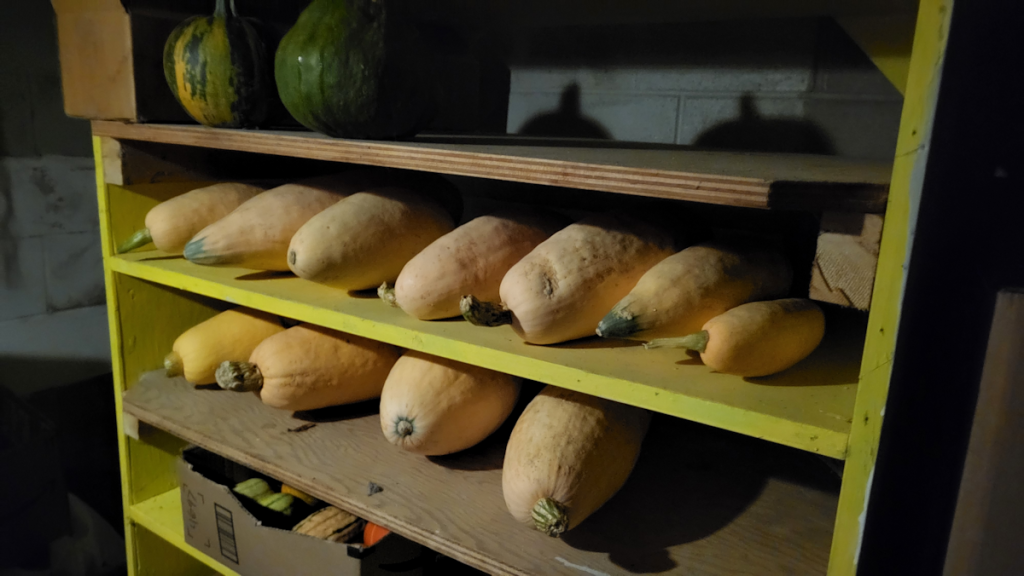
They were the biggest, healthiest squash of all! 😄 Unfortunately, we don’t really know what they are. Some looked like hulless seed pumpkins. Some looked like they might have been from some hybrid zucchini we were gifted with. We harvested them, but have yet to actually try any of them. If you look at the photo of squash in our root cellar, the two big green ones at the top are from the compost heap! Whatever they are, they are likely hybrids, or even hybrids of hybrids! 😄
We also got surprise beans in here. I left them to go to seed, and have no idea where they came from. We’ve never grown beans like those before!
It should be interesting to see what volunteers we get in our compost, next year. 😁
Melons
We were so eager to do melons again!
Two years ago, in spite of a drought, we successfully grew two types of melons, Halona and Pixie, and were looking forward to growing even more, last year.
Yeah. They were in beds that got flooded.
Total and complete loss.
This year, we hoped to be able to grow quite a bit more. We started the seeds indoors in early May.
This year, we tried the Halona and Pixie melons again, plus Sarah’s Choice, a new variety. We also tried Cream of Saskatchewan watermelon. The watermelon we tried the previous year – a short season variety, too – was among the losses.
The water melon was a loss this year, too! Zero germination. Bizarre!
The others struggled to start, too. In the end, we had only two Sarah’s Choice, and a couple of Pixia and Halona, each, none of which looked particularly strong.
These were intended to go into the new trellis bed, but that didn’t get built, so we got creative.
We have a kiddie pool we’ve been using for all sorts of things, from washing cat blankets outdoors, to harvesting potatoes out of bags into, to sifting soil into, to use elsewhere.
I made holes in the bottom and turned it into a raised bed, because the few melons we had really needed to get transplanted!
How they did
They did remarkably well! So well, we had to add more supports to the top of the makeshift trellis.
As with the winter squash, these just needed tending until the end of the season. They developed many flowers and we saw lots of little melons forming.
Unfortunately, like so many other things, they started blooming late. We did get a couple of larger melons that were fully mature, but most of them never had a chance to get to that point, even with our exceptionally long and mild fall.
This was our final harvest of all the melons, and you can see we did get some decently large ones!
The smaller ones, however, very quickly started to rot, so we didn’t get very many to eat.
Final thoughts on melons
We will continue to try and grow melons, because we really like them, but they tend to be too expensive to buy regularly. As we build more raised beds, and the trellis tunnels we are planning, we should have better growing environments for them over time.
The Halona and Pixie melons are varieties we know can grow here, so we will probably stick to those two.
We will try the watermelon again. I don’t know why they didn’t germinate; I don’t think the problem was with the seeds. It’s a short season variety developed in Saskatchewan, so it should grow here fine. I might even try direct sowing them instead of starting them indoors, to see if that makes a difference.
We will also try other varieties over time until we eventually settle on something we all really like, and can save seeds from. There are many short season varieties we can choose from!
Poppies
I almost completely forgot about these!
I really want to grow non-ornamental poppies. My mother used to grow them on the old kitchen garden, when I was a kid, and we had enough that my late brother and I would eat the seeds straight out of the dry pods, and my mother could still make filling for makowiec.
We had two varieties of bread seed poppies; one we’ve grown before, and one that is new to us. Previously, we’d grown Giant Rattle poppies, but where we grew them ended up getting highly compacted, was full of weeds, and they did not thrive, though we did get fully mature pods out of them. The other variety we got was Hungarian Blue.
As poppies reseed themselves easily, I wanted to make sure they were planted somewhere where they could be treated as a perennial, plus I also wanted to make sure the two varieties were planted well away from each other, so as not to cross pollinate.
We only got one in.
We had an area by the chain link fence where we’d first grown potatoes in bags. After the potatoes were harvested, the soil was returned to where the bags had been sitting to create a new bed. Last year, we unsuccessfully tried to grow white strawberries there. For this year, it got a thorough weeding, and then Hungarian Blue poppies were planted in it.
How they did.
At first, I thought for sure we wouldn’t get any at all. For all my efforts to remove weed roots, that’s what we got the most of. Eventually, however, poppies started to show up! Yes, some even got to fully mature, with dried pods developing.
We also had some self seeded poppies show up with the shallots. These were transplanted in a new raised bed built over where we’d grown Giant Rattle poppies before, so I thought they’d reseeded themselves and let them be. They turned out to be a variety that predates our living here! Still a bread seed poppy, so I collected seeds from those in the fall.
Final thoughts on poppies
With edible poppies available as seeds again (for a while, they were not available, because they are the source of opium), I want these to be a staple again. I don’t know what happened to the variety my mother used to grow – the ones that have come up on their own are different from the ones I remember. I’ve even found poppy seeds while cleaning up the place, but it seems my mother switched to ornamental poppies at some point. There’s no what to know what kind the seeds I’ve found are without planting them, and with how old they probably are, it’s unlikely they will germinate.
The bed where the Hungarian Blue were planted will need to be completely reworked, with the soil sifted to get out more weed roots. Then, they will be replanted there. Once the poppies themselves are established, they will choke out any weeds, themselves. Until then, we’ll have to battle the weeds for them. The soil also got quite compacted, which affected their growth as well., so we will have to amends it more.
As for the other varieties, we still need to find locations where we can plant them, and then just leave them to self seed. There are a few areas I can think of, but it will take time to take out grass and weeds and amend the soil before we can plant them.
Well, this one turned out much longer than intended! This is the last of what we grew, though.
Next time, I’ll be looking at what we intended to grow, but it just didn’t happen!













 The Re-Farmer