Thoughts on being prepared

With all the crazy stuff going on these days, the price of food skyrocketing, and so many people losing their sources of income, all those “crazy preppers” out there are looking pretty vindicated!

There was a time, not all that long ago, when everyone was encouraged to be prepared for emergencies – usually around the time when whichever city we were living in at the time was faced with flooding or wildfires or some other natural disaster. I don’t know when reasonable prudence started being viewed as “crazy prepper” (and no, I’m not talking about the super paranoid doomsday types that have always been around). You know things have really gone bizarre when people on canning groups on Facebook start getting pop ups advising to report people who looked like they are becoming too prepared. !!

Going into our fifth year living here on my childhood farm, a lot of things now being recommended as preparedness was basically how I grew up, and not much different from how we live now. I mean, we’re already doing bulk shopping once or twice a month, with modest local shopping in between, so stocking up for at least a month is our normal. Stocking up for 2 or 3 months over the winter is also a necessary part of living here. We are nowhere near where we want to be, yet, but that’s where all the gardening and other plans are fitting in!

While the needs of living here hasn’t changed much since I was a kid, the resources and technology available sure has! I’m just loving the various groups I’m on for leading me to some excellent sites. Recently, someone shared a link to this Food Storage Calculator. It’s a really awesome tool for figuring out how much shelf stable foods you would need, for various lengths of time. This is for the absolute, minimum essentials recommended. I found this bit at the beginning interesting;

The below calculator is based on estimates from organizations like the CDC and recommendations from the Church of Jesus Christ of Latter-Day Saints Home Production and Storage manual. 

Years ago, in an early email support group for homeschoolers, the topic of emergency preparedness had come up. One of the members had been a Mormon, and said that they were encouraged to have at least a year’s worth of food stored up. Though she had left the church, that was a habit she kept up. It came in very handy when her husband suddenly lost his job and was unable to find a new one for months. The one thing they did not have to worry about was how to feed themselves and their kids, and she talked about what a boost to morale it was to be able to whip up a pan of brownies, while in the middle of such hard times. Her story really stuck with me. Seeing that the Latter-Day Saints manual was used for this was a huge plus, to me.

In the end, though, it’s still just a guide. Something to use as a starting off point, when planning one’s own supplies. (Also, it’s a fantastic site, and I encourage checking out the many useful and informative posts in there!)

So I figured it would be a good idea to go through the calculator results for ourselves, and talk about how I would modify it to our own particular circumstances and why. Hopefully, this will give you an idea on how you might modify your own results to your own situation.

Let’s start with the demographics. We are a household with 4 adults, and no very young children. I chose 3 months as the time frame, as we could potentially be stuck here for that long, if we had a particularly bad winter. Here is what the calculator came up with, and how I might modify the results.
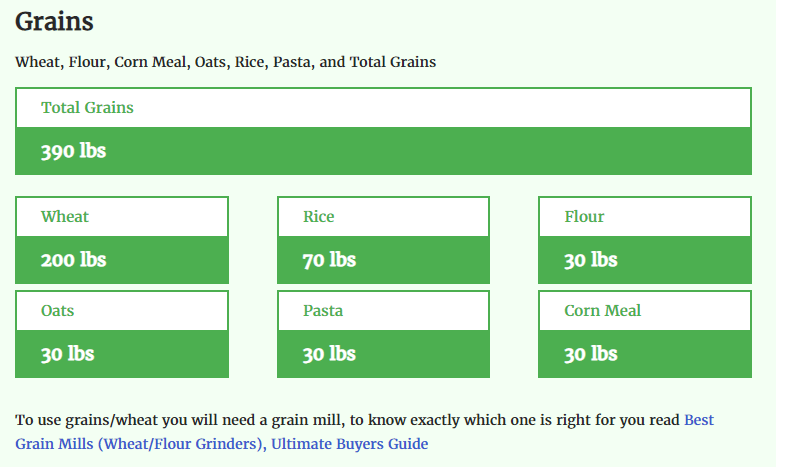
The first section is for grains: a total of 390 pounds.

For us, 200 pounds of wheat just isn’t going to happen! While it might be worthwhile to have some wheat berries to cook as a cereal, this is an amount intended for grinding into flour. We don’t have a flour mill. We do intend to get one, but for now, it would be a waste for us to have that much wheat. It’s the same with 30 pounds of oats. At the same time, 30 pounds of flour is laughably low, since we do quite a bit of baking. A lot of that wheat weight would get transferred to flour. I might get 15 pounds of rolled oats, then otherwise transfer the weights to rice and pasta. Both of which come in quite a few varieties, so there’s no need to be bored with just white rice and spaghetti. For our uses, I’d probably either stay the same with corn meal, or even reduce it.

That, of course, would change once we do get a mill. As losing power is something that is likely to happen, I would go with a hand crank mill, and since we are working towards growing flour corn, it has to be something strong enough to handle such a hard grain. Also, manual mills would be quieter than electric ones.
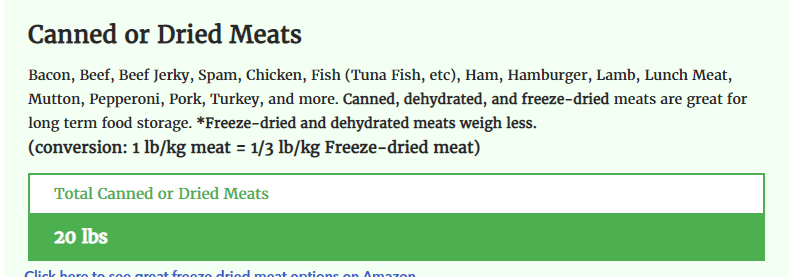
The next section is canned or dried meats.

Twenty pounds for three months? That seems so very low! Especially for 4 adults.

As we do have a chest freezer and I’m finding local sources for meat, we’re moving towards buying in bulk until we are able to start raising meat animals ourselves, so this is a flexible area for us. For now, we actually should be buying more canned meats for those “just in case” times, and we do need to take into account that if the electricity goes out for too long, we risk losing whatever is in our freezer. Hence the need for shelf stable supplies. Canning meat ourselves is something we are working towards.

So for our needs, I would increase this amount substantially, but not until we are at a point where we are canning our own meat.

Twenty five pound of fats and oils. Hmmm. Interesting that it lists more fats and oils than canned or dried meats!

The two gallons of vegetable oil would, for us, become a gallon of vegetable oil, another of olive oil, and probably a mix of other oils in smaller quantities. For a 3 month period, I would probably add in another gallon of vegetable oil. We don’t buy salad dressing. It’s an easy thing to make an oil and vinegar dressing. We do buy mayonnaise, but it is also easy to make, and can be a base for dressings, too. That’s where the “extra” oil would be used. Oil and fat can also be used for emergency fuel and lighting, so more would never go to waste.

We don’t buy shortening. Or margarine, for that matter. Just butter. We buy 8-10 pounds of butter for 1 month. More if we plan to do a lot of extra baking, like before certain holidays. For our usage, a 3 month supply would mean 24-30 pounds of butter. Not realistic! Butter is not shelf stable, so it would probably be a good idea to have a few pounds of shortening. If we were unable to get out, we could probably get away with using oil in place of where we might normally use butter, so we could play with the quantities and ratios a bit. The quantity of peanut butter could stay the same.
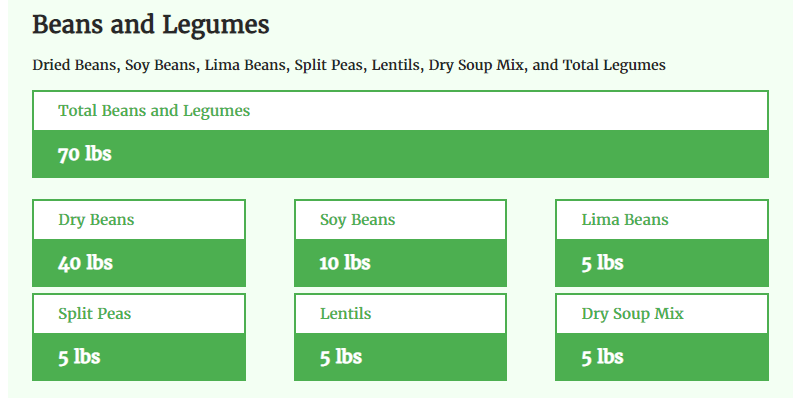
Beans and legumes: 70 pounds total.

That’s probably more than we would need, for how much we eat them. Soy beans and lima beans would be dropped completely. We don’t eat them. Also, I’d probably make my own dried soup mixes. It’s something I’ve done before, in quart jars, including things like dehydrated vegetables, mushrooms and bouillon cubes. They worked our very well, though I would do them in smaller jars in the future. Also, no black beans. They turn the end result a very unappetizing grey! :-D

One of the things I have been picking up at Costco is cases of baked beans. The prices of those has pretty much doubled recently. It would be cheaper to buy dry beans and cook them ourselves. Among our gardening plans is to grow beans for drying as well as fresh eating. Along with just keeping dry beans, I hope to can plain beans, as well as making baked beans for canning, too. I would add chickpeas to this list, canned or dried. There are chickpea varieties that grow in our zone, so that’s something else we could someday, potentially, supply ourselves.
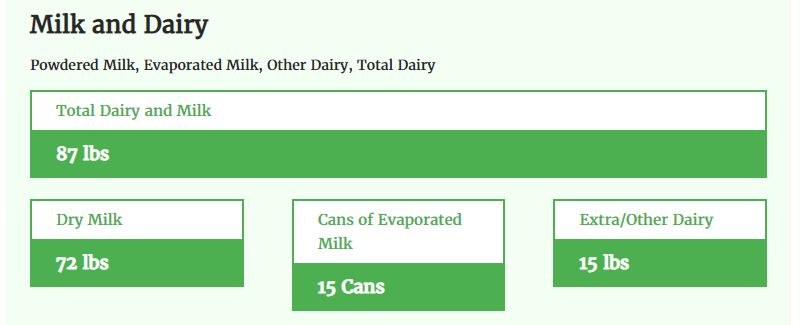
Milk and Dairy: 87 pounds

Shelf stable dairy products are a huge gap in our pantry. We should at least have some powdered milk. I don’t even know what to do with evaporated milk. And what does “other dairy” mean, in the context of shelf stable products? We don’t drink a lot of milk; it’s mostly used in cooking. What we do use a lot of is dairy products, such as cheese, sour cream, yogurt, more cheese, whipping cream… and more cheese. None of which is shelf stable. Well. I guess the cheese is, if stored properly. And we do love our cheese!

Sugars: 60 pounds.

I did not expect to see jams, powdered juice mixes or Jello in the sugars list.

White sugar and brown sugar are things we use quite a lot, since we do so much of our own baking. For honey, the 1kg (2.2 pounds) container we last bought from my bee-keeping cousin disappeared fast, so if we were to stock up on honey, we’d be getting more than what’s listed. Probably a 5kg (11 pounds) bucket, which is the largest my cousin sells. We’d probably get more molasses, too, though we don’t really use it all that much. Corn syrup would be off the list. We don’t use it. That amount of jam is probably more than we would need. I don’t know that we would include the Jello at all.

I wouldn’t not have thought of powdered juice mixes. Now that I think about it, though, it would be a good idea to have a supply of drink mixes, as their own category; juices, iced tea, lemonade, hot chocolate, coffee and tea would all be good things to have in the pantry. Plain water gets tiresome, fast!
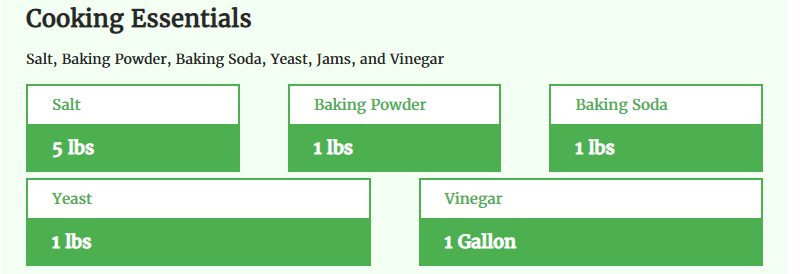
Cooking essentials! Gotta have these.

For the amount of baking we already do, I’d probably increase all of these. The vinegar would be used along with the fats and oils for those salad dressings we would be making ourselves. For salt, I’d want to have a variety, but if I had to choose just one type of salt, it would be course salt. We have salt grinders for seasoning meals, but I like to use course salt for a lot of things. If space allowed, I’d include a variety of vinegars, too. Salt, vinegar and baking soda can all double as cleaners, too, so extra of those would never go wrong.
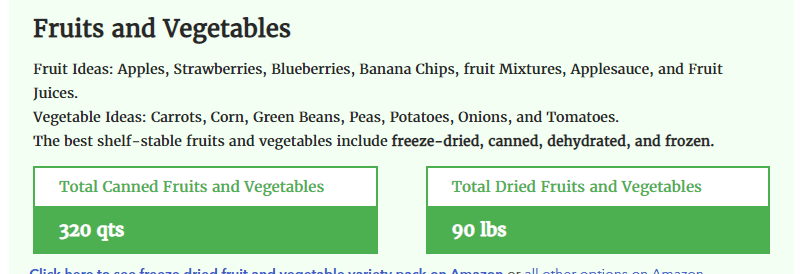
Canned fruits and vegetables: 320 quarts, plus 90 pounds of dried.

This is another area where we tend to be too dependent on our freezer, and why we want to move towards canning our produce. We do have a root cellar, so that helps. Almost all the fruits and vegetables we eat are fresh, with a small amount of frozen. We pretty much never buy canned, but once we’re growing enough to make it worthwhile to can them ourselves, it would make a big difference in the winter months. Before we moved out here, I had a dehydrator and used it to dehydrate purchased frozen vegetables. It works really well; the vegetables are already blanched and most are cut to size, so they can be laid out on the trays while still frozen, with no extra work needed. They were great in our jar meals.

While I’ve bought dehydrated vegetable mixes once in a while (they always include peppers in them, which is irritating for me), we’ve never really bought dried fruit. Sometimes I’d get dates, with their pits still in them, for snacking, but they’re quite expensive. We hardly even bought fruit leathers for the girls when they were little. We don’t buy raisins. Dried fruit in particular is something I would forget about when it comes to emergency supplies, but they would be good to have on hand. Ninety pounds, however, would be way more than our family would use.
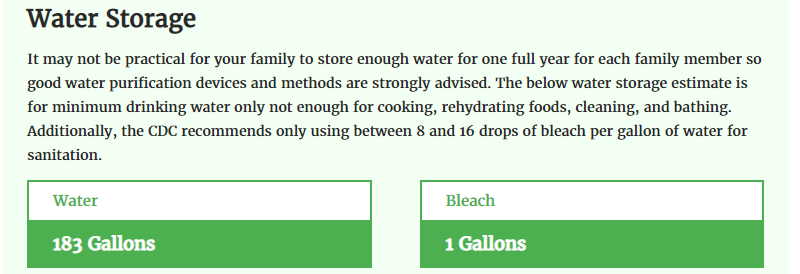
Water storage. This is our weak spot! We are already buying drinking water, so at least we do have the big water jugs. Storing 183 gallons, just for drinking, simply is not an option. This is a big part of why we want to get that old well repaired, so that we have access to water even if the power goes out. The bleach is something we don’t buy. We found a half empty bottle of bleach among the laundry supplies while cleaning up the old basement, and for the amount we use bleach, we’re still using that bottle we found! Still, it would be good to have bleach on hand. It’s something I would have forgotten about, so I appreciate it’s in the calculator.

That 183 gallons is the minimum water required for drinking. Much more would be needed for everything else. A safe supply of water is, typically, the biggest and most common hurdle in emergency situations for most people, I’m sure. At least for us, we have the possibility of getting the original well working again. Even here in the boonies, most people have wells that rely entirely on an electric pump.

Of course, in our situation, we would also have to add in wet and dry cat food. Since switching to the wood pellets for litter, we’ve been going through that a lot more slowly – and it’s a product that is actually a fuel, so it can do double duty. A single 40 pound bag goes a long way.

This calculator makes for a very interesting tool. I like that it’s just the shelf-stable essentials. There are so many lists out there that include everything but the kitchen sink – and then tell you what to use for a kitchen sink. Even just this list, for a 3 month period, can look overwhelming. However, it’s a place to start, to modify for our own circumstances, and the sort of thing that can be achieved, little by little, without taxing the budget too much.

It’s good to be prepared.

Even if Facebook thinks your a scary extremist for putting up a bit of extra food!

The Re-Farmer

We’re getting warmer. Honest!

I delayed heading outside to do my morning rounds, to warm up a bit before having the outside cats come out of their shelters for kibble.

I finally gave up and just headed out, because I knew they would be hungry. I was inside for a while before I took the above screencap. Yup. Almost noon, and we were still at -28C/-18F with a wind chill of -38C/-36F The wind was from the south west, though, not the south east, so the yard was protected.

I didn’t see as many of them this morning, and there was even kibble still in the tray under the shrine, from being topped up yesterday evening, so they were not too hungry. :-)

The Distinguished Guest is looking rather disheveled! She could use a good brushing. Not that we’d be able to. She lets me pet her while at the kibble house, but that’s as far as it goes. Mind you, that’s still more than we get with most of the outside cats that were born here!

Chadicous was quite happy to get some loving!

Such a handsome boy!

Once inside and putting a kettle on, I saw a flash of movement through the dining room window.

These two had come bounding through the yard to the feeding station! They looked so very excited. :-D It’s funny that they come running, and these same two deer come back several times a day, for that little bit of feed I put out. Especially since we’ve got chickadees, Blue Jays, Pine Grossbeaks and probably squirrels, going at it, too.

The good news is, we will keep warming up through to tomorrow.

They’re again telling us we’ll hit -4C/25F – the forecast changes frequently, of course – and we’re supposed to stay warmer than -20C/-4F for about a week. Even after that, we’re supposed to be just a degree or two colder, for the rest of the month.

I’m sure the critters will be enjoying that!

The Re-Farmer
Our 2022 garden: Eagle Creek Seed Potatoes order placed!

I wasn’t going to be able to place another order for our garden until next month’s budget, but thanks to my daughter, we now have our potatoes ordered!

While I was very happy with the potatoes we ordered from Vesey’s, we went with a new company this time – one that I have added to our Cold Climate Seed Sources list.

Eagle Creek Seed Potatoes is in Red Deer County, Alberta, so we can be pretty sure that anything we order from there will grow in our Zone 3 area. It was a company recommended in one of the cold climate gardening groups I’m on, and I really wish I’d discovered them earlier! Not only to they provide a lot of information on each variety of potato they carry, they even have a container and tower pack. That would have been very handy, for when we grew potatoes in feed bags, before we knew that potatoes came in determinate and indeterminate varieties!

This year, however, we are going to use our potato plantings to reclaim more garden space, and will be using the Ruth Stout method again.

These are the potatoes we ordered, to be delivered in May (they let you choose your delivery date range), since our last frost date is early June. They can be ordered as 4 packs, 1 kg or 5 kg sizes (1 kg = 2.2 pounds), and some are available in 14 kg bags.

All images belong to Eagle Creek. All links will open in new tabs.

Caribe.

This is an early maturing variety, though it’s said that they can get quite large if left until late in the season. We ordered these in a smaller, 1kg (2.2 pound) package, to stay under budget. They are listed as having excellent winter storage, and described as making the fluffiest mashed potatoes ever! :-D

Bridget.

This is a medium maturing variety (though the description also lists it as early maturing) with good yields in most soil types, good winter storage and good disease resistance. They are noted as being particularly good for making French fries, though that’s not something we normally do. They are also a good baking or mashing potato. We ordered this in the 5kg size.

All Blue.

Well, we just had to include a purple potato!!! This is a late maturing variety with great winter storage, and is good with pretty much any cooking method. We ordered this in the 5kg size.

Last year, we ordered 4 varieties in 6 pound packs, for 24 pounds of seed potatoes. We got a pretty good return on them, though nowhere near enough to store any for winter. This time, we’re getting about the same weight in 3 varieties.

As we are planning to use the Ruth Stout method again, we’ll have to be pro-active in combating snails. Our first year growing potatoes left us with soil that was much more workable when we converted the space into beds for onions and carrots. We pretty much doubled the length of the beds, and when we were harvesting and preparing the beds for the fall, we could really tell the difference in the soil between the two halves! Where the potatoes were grown previously, the garden fork easily sunk deep into the soil, but in the extended portion, once the fork got through the new soil we added on top of the beds, it was like hitting a hard floor beneath.

When we grew potatoes that first year, the only thing we had available for mulch was straw. It’s what we can get, so that’s what we will be using again this year. This time we can run the straw through the shredder chute on our wood chipper, first, so it will cover better and break down faster.

As far as quantities go, unless these all turn out to have amazingly high yields, this is not going to be enough to last us into the winter. Which is okay, because these are new varieties we are trying out. Over time, once we’ve worked out what grows best here, and which ones we like the most, we will get larger quantities of seed potatoes and, hopefully, be able to have enough to plant our own potatoes every year, instead of having to buy seed potatoes. At least, that’s the long term goal for the bulk of our potato growing. I suspect we will continue to try new and different varieties regularly, simply because we like trying new things!

One more item for our 2022 garden to check off our list!

The Re-Farmer

On the right path

While one daughter stayed indoors to do baking, another daughter and I went out to dig paths, before the temperature dropped too far.

The main path, from the house to the front of the garage, gets dug wide enough for my husband to get through with his walker, or we can haul things from the van with the wagon. In the outer yard, we also maintain paths to the meter and the burn barrel. We decided against going to the dump today, but I was at least able to do a burn while shoveling, so we don’t have those bags taking up space any more.

The area around the cat shelter and the kibble house got cleared earlier this morning, as I dug the non-heated water bowls out of the snow. This afternoon, we dug out the paths to the kibble tray under the shrine, and I even dug out the path from their kibble house to the corner of the storage house, where they get in and out of the space under it.

Paths to the feeding station and compost ring are cleared, as well as this path from the compost ring to the back door of the garage. You can sort of see the path to the outhouse, too.

I also made sure to shovel the front of the garage, so we can swing open the doors to where my mom’s car is parked on one side, and where the lawn mowers and little Spewie are stored on the other.

It would probably be faster if I took Spewie out to clear the paths, but I really don’t want to fight with so much extension cord. For the main paths, the snow has been so light and fluffy, it’s almost easier to just shovel, and I don’t mind the exercise! I really ought to bring the little snow blower out, though. We have yet to make a path to the fire pit, and it would be good to have a path around the entire house. Especially to where the septic tank is, just in case.

It’s one thing to clear paths we’ve already been keeping up on, but when the snow is knee high, it’s a bit much to be breaking entirely new paths! LOL Mind you, the snow is deeper than the snow blower is high, so maybe it’ll be easier to shovel it, after all.

I do wish we’d been able to take the big snow blower in to be fixed over the summer. It would be quite handy right now!

The Re-Farmer

Dry Dancers

While watering plants today, I thought it would be a good time to post some pictures of how our Tennessee Dancing Gourds are drying out.

We have been using the big aquarium tank to protect some of our plants from the cats, and the gourds have been drying in there, too. Also to protect them from the cats, who love to play with them!

It’s awkward to water in there, and I didn’t want to accidentally spill water on the gourds, so I took them out and put them in the stack of egg trays I’ve got stored next to the tank. I don’t know why I’m keeping these, as we will NOT be using them to start seeds again. That did not work out at all. However…

… an egg tray turned out to be perfect for holding the gourds!

Here are all the Dancing gourds we were able to harvest for drying. There were many, many more on the vines that were too under developed to harvest.

Like this one was. This immature gourd withered as it dried.

This fully mature gourd shows how they change colour as they dry. It’s almost as dry as my finger tips!

Eventually, all of them are supposed to dry to this tan colour. It’s a bit of a shame, because their green stripes look so pretty!

This one looks like a bit of mold had started as it was drying. From everything I’ve read about drying gourds, this is normal and not a problem. When fully dry, they can be scrubbed and sanded.

Which is going to be a bit more difficult with gourds this tiny!

I moved things around inside the tank to fit the tray. Before, they had been just lying on the bottom, so they took up less space. We’ve got a tiny fan we found in the basement to maintain air circulation in the tank.

You can see one of my daughter’s orchids is going to be blooming again, soon! The one flower that is visible is actually completely dried out from the last time it bloomed.

I need to figure out what to do with all these plants, so we can use the tank to start seeds. Since there is no way to lower the lights, we put boxes under that sheet of insulation on the bottom, to bring the seed starting trays close to the lights. This tank has two light fixtures; the one that originally came with it, which lies flat on the top, and one that has stands on the ends to keep it several inches above the top. That one gets warm, and is one of Saffron’s favourite places to sit (along with the heat vents). :-D She’s so tiny, it’s not an issue, but we’ve caught her brother, Layendecker, on there, too, and he’s about double her size and triple her weight. It’s weird how Saffron has stayed so tiny – even Turmeric is finally starting to fill out a bit – while Big Rig quickly became larger than their mother, and Layendecker, who was probably the smallest of the litter, is now as big as Cheddar!

But I digress…

One of the reasons my daughter’s orchids are in here is because it’s warmer. In the spring, it’ll be warm enough to hang them in front of a window again, but we’ll be needing the tank to start seeds long before then. One of them is small enough that we could probably keep it in the tank after raising the floor higher, but I am not so sure about the bigger one.

The aloe vera, however, will need to come out. We have all sorts of places we can put them, but Cabbages in particular is absolutely dedicated to digging into the plant pots. We’ve been able to create barriers to protect other plants. With one pot, we had to build a cage around it out of hardware cloth, and sometimes I can hear a cat trying to tear through. Which cat it is, I have never been able to find out, since they run off when I come out to check, but the girls and I have caught Cabbages sitting on top of the cage! I’ve seen Tissue trying to climb the cage, too. That Jade tree would have been destroyed long ago, if we hadn’t put that cage around it! Another Jade tree is so big, it covers its pot and protects itself, but we’ve not been able to create a barrier around these pots that the cat’s haven’t been able to get past, and they’re too big and heavy to hang.

Frustrating.

Anyhow.

When I put the gourds back in the tank to dry, I kept the wizened one to see what’s inside.

The answer is, nothing! It was so immature, I don’t see any sign of developing seeds.

Cutting it open felt a bit like trying to cut a dry, crispy sponge on the inside. Even the outer shell around the widest part felt like cutting through a brittle, rigid foam. It was practically weightless, too.

I haven’t decided what to do with the dried gourds, but I am thinking of cutting open at least the largest one to harvest the seeds. We do still have seeds from last year, so it would be interesting to compare germination rates.

They are so adorable! I look forward to growing more of them. :-)

The Re-Farmer

Winter wonderland. Yeah. That’s it!

Oh, my goodness, am I even more thankful our neighbour happened by and cleared our driveway for us a couple of days ago!

Because having this, on top of what was there before, would have been much harder to clear away with little Spewie! LOL

Yes, that’s our plowed driveway. Not even the deer have been going around.

We had blowing snow all night, and from how high it was on my boots, I’d say we got about 4 or 5 inches of new snow. Light and fluffy stuff, though, so easy to shovel. My husband had gone out to give food and water to the outside cats earlier. It had warmed up to -12C/10F, but by the time I went out, it had cooled down to -15C/5F, and as I write this, it has dropped to -16C/3F with a wind chill of -26C/-15F. The wind is now from the north west, though, so we’re pretty sheltered from it.

With the high winds we had blowing snow all night, I am seriously considering skipping our dump run today. It doesn’t look the like roads have been plowed yet. I had to get to the door at the back of the garage and found myself trudging through snow that was knee deep. I shoveled some of the paths, and either the girls or I will head out later to do the rest.

We’re supposed to get cold again for the next couple of days, then scream up to -5C/23F (or -8C/18F, depending on which app I’m looking at) on Tuesday. Even the gravel roads should be cleared by then, and that’s when the dump is open next. Maybe we will wait, since we also have to pick up packages at the post office.

Frankly, I’d much rather shovel snow then go out anywhere, anyhow!

The Re-Farmer

We timed that right!

Helping my mother with her errands turned out to be timed just right. Chilly as it was, there was almost no wind, making it pretty easy to handle.

Not today!

I took this screen cap shortly after noon, and we were still at -31C/-24F. I somehow doubt we’ll reach the high that is in the forecast! The wind chill, at least, had improved from -41C/-42F to -38C/-36F. The problem is, the wind is coming from the southeast, where we have almost no protection from the wind at all.

Today was our day to do the meter reading. The meter is mounted fairly high on the pole, and I’m short, so what I do is take several photos and hopefully have something I can read once I’m at my computer and can submit the reading. Since I was taking pictures, I wore my fingerless gloves. I couldn’t believe how fast my fingertips started hurting from the cold wind! It’s always a surprise, no matter how many times I’ve had it happen. I’ve done this on colder days, but with no wind, it doesn’t happen anywhere near as fast as on a day like today.

Right now, we have two weather alerts; the snowfall warning, and an extreme cold warning.

And yet…

… in less than a week, we are expected to reach -4C/25F!! At that temperature, some things can actually start melting.

The outside cats will, I’m sure, enjoy it! Today, as I first opened the door to put out the kibble, Agnoos slipped into the sun room and did NOT want to come out again! As I was finishing up, Nosencrantz dashed in, too.

Gotta love Chadicous rolling in the snow, there. He is constantly doing that!

Usually right in front of my feet. :-D

If the forecast is accurate, tomorrow we should reach a much more pleasant -15C/4F. It’s Saturday, so the dump is open and we’ll finally be able to do that. We’ve had garbage and recycling bags already in the van for a few days. At least they’re frozen, so there won’t be a smell.

As for today, we finally have a day where we can just stay home!

The Re-Farmer

This is a huge step

Well, we’ve gone and done it.

After much discussion with my daughters, we have made our “seed budget” purchase for this month, and it is trees.

We’ve been going through a number of websites for nurseries that supply cold hardy trees. Among the ones we want to get is a nut orchard collection, and the nursery that sells the one we’re looking at has scaled down the package deal, making it much more affordable. The collection, if planted spaced out as recommended, would cover 1 acre. However, some of the trees in the collection have the potential to reach 100 ft tall. That’s almost 40 feet taller than the tallest trees in our spruce grove! Which means we have to plant them in the outer yard, or even beyond, where the renter’s cows pasture, and we are just not going to be ready for that this year.

Beyond that, some of the sources we have been looking at just don’t have new stock listed yet. Among the things we are eyeballing are fruit trees, such as apple trees to replace the diseased crab apple trees we will have to cut down, pears, plums, Saskatoons, highbush cranberry, as well as different types of raspberries, etc. There’s only so much we can do in a year, though, and only so much space we are ready to plant into.

For this year, then, we settled on buying from Tree Time. They do a lot of shelterbelt trees, but also have fruit, nuts, berries, etc. They also come highly recommended. They are a reforestation nursery, which you can read about in their “how to order” page. Right from the start, they say:

We are a reforestation nursery that makes it easy for Canadians to purchase large quantities of tree, shrub, and berry seedlings at low prices.

Shop with us if you want convenience, selection, low prices, outstanding service, a guaranteed ship date, and high quality stock. Our customers tend to enjoy doing things themselves and watching their trees grow.

We grow our trees for maximum survival, not height or aesthetics. We mostly grow 1-2 year old trees because they have the best survival rates and are easier to ship in the mail.

We guarantee every tree we sell.

We decided to focus on two areas. First, creating our privacy barrier/living fence, and second, our first nut trees. Because of how they bundle their trees, the numbers we are getting are quite different than they would have been, elsewhere.

This is what we are getting (all images belong to Tree Time nursery).

Sea Buckthorn.

When talking about what to get as barrier trees, we were thinking of setting these aside for another year, but the way various things have changed since then, we’re going for it.

This is a zone 2b tree, so well suited to our zone 3. They are good in poor soil, are nitrogen fixers, and their berries are edible and healthy. They can grow up to 15 ft in height, with a 12 foot spread, and should be planted at 3-4 ft spacing, so they will do very well as a living fence/privacy screen, as well as a deer barrier, once they grow big enough. Plus, they will provide food for birds.

These will come as year old, bare root trees. We will be getting their smallest bundle, which is five trees. Sea buckthorn requires 1 male tree to 4 females to produce berries, but at only 1 year old, there is no way to know what sex the trees are. It may be a few years before we can tell! The males do not produce berries, but hopefully, there will be at least one male in the bundle.

Where we plant these will be partially dependent on how far we go with this next batch.

Silver Buffalo Berry.

This is one that disappeared from other sites we were looking at, so we were very happy to find them at Tree Time.

These are a super hardy, Zone 2a tree. Like the Sea Buckthorn, they can also handle poor soil and are excellent for attracting birds. They can grow to 18 ft in height, with a 10 ft spread, and should be planted 3-4 ft apart, so they should also make a good barrier and privacy screen. These will come as 1 yr old bare root stock.

We also got them in the smallest bundle of 30.

Which is triple what we expected to buy, when we first found these.

The area we planted the corn and sunflower blocks is where we intend to plant these. Right at the corner, along the north fence, the lilac hedge my mother slowly extended over many years, peters out. There is a gap there that the deer jump through. I am thinking that section would be a good place to plant the 5 Sea Buckthorn. Then, the Silver Buffalo Berry can be planted all along the east line, leaving a “lane” behind them to access the trees along the fence line itself, and also leaving a gap where the telephone line is buried.

With 30 of them, planted 3-4 feet apart, however, we will have WAY more than will fit in a row in that area. Since we will be slowly planting more food trees further west, we will be planting just the one row of them. Which means we’ll need to find another location to plant the remaining trees! I am thinking of the area we had originally considered planting the Sea Buckthorn later on, which is in along the north fence line in the outer yard. Or even filling in gaps west of the lilac hedge. This would go a long way to help reduce the road dust that drifts into our yard in those areas, every time a vehicle drives past on the gravel road.

Before the trees arrive, we will have to measure and mark out where we want to plant in that north east corner. Once we know how many we can fit into there, we’ll know how many we have to plant somewhere else. That is a lot of trees for how we want to use the spaces.

Now that I think of it, we could also gift some to my older brother, for the forest he’s been working on for the past couple of decades. :-)

Then there are our first nut trees. Pine nuts, to be more specific!

Korean Pine.

In other sources, we have seen these as being a Zone 2 tree, and some listing them as reaching up to 100 feet in height. !!! Considering where we intended to plant them, that was just not good.

These, however, are listed as Zone 3a, and reach “only” 60 ft in height – about as high as the spruces in the spruce grove. Which is about where we intend to plant these.

These also have a spread of up to 30 feet, but the website doesn’t list how far apart to plant them. We’ll get that information later.

We ordered two bundles of three, 2 yr old seedlings as plugs, not bare root. They have special requirements. For the first five years, they grow very slowly and need to be kept shaded, because their bark can be easily burned by the sun. This is why we want to plant them along the north side of the spruce grove, between the grove and the row of crab apple trees, where it is shaded for most of the day. At 5 years, they suddenly shoot up in height, and no longer need to be protected with shade. Since we’ll be getting 2 yr old seedlings, that should happen in three years.

I have some concerns.

The nursery we first found these at sells them with their roots in a plastic wrapped ball of soil – the only tree they don’t sell as bare roots – because they require a particular fungi at their roots for optimum growth. We may be able to buy the fungi to inoculate the soil, though. At least that’s what I learned from this other nursery. According to the Tree Time website, however, there is no mention of the fungi needs, plus it says they should be planted in full sun, not shade.

We’ll have to do more research on them, because this might be due to differences in varieties. We might end up having to plant these somewhere else. They would make a good shelter belt tree, and at 60 feet high, that would mean either along the north property line, or further out in the south, where we get hit with winds because there is a gap in the sheltering trees. Since we intend to plant permanent garden beds in the outer yard, anything we plant there has to be carefully placed so as not to create the very shade we are trying to get away from!

It’ll take about 7 years before these start producing pine nut containing cones. I don’t think I’ve ever bought pine nuts before, as much as I’d like to be able to use them for making pesto, etc. I enjoy them, but they are just too expensive. These trees have the potential to be a cash crop.

When placing our order, I chose a shipping date of May 30. Since our last frost date is June 2, I thought that would make the most sense. It also means that, in the week or so before they are shipped, we can get out and measure where they will be planted, and even pre-dig the holes (the ground should be thawed out enough), as well as making sure we have everything we need for planting, then protecting, the 41 seedlings we will be getting!

There we have it. After 4 years of living here, we are finally at the stage where we are starting to plant trees and shrubs in bulk. The first stage of a multi-year plan in planting food trees and reach our self-sufficiency goals. Given how long it takes for trees to start producing fruits or nuts, it would have been better if we’d started this years ago, but when we first moved here, we didn’t even know what we wanted, or how to get them. There is a big difference between planning for things that will live for decades, and can potentially become very large, and planning vegetable beds!

Placing this order really feels like a milestone for us!

The Re-Farmer

Awesome!

Happy Christmas to those who follow the orthodox calendar. :-) Happy Three Kings day. Today is our last day of of the Christmas season, and what a lovely day it turned out to be.

It was another cold one, but there was almost no wind chill, so it was quite bearable.

This morning, we had one deer at the feeding station, while this one just hung out at the gate for a while. I was able to get this picture through the kitchen window.

The deer and the cats are quite used to each other.

I even caught a flash of deer tail going past while I was setting out kibble and warm water for the cats. The deer didn’t run off until I came around with more feed.

Potato Beetle was quite content to enjoy the sunshine in his insulated corner, while the other cats ate. :-D

I found this interesting! One of the selling features of the Starlink system for more northern areas like ours, is that the dish keeps itself warm. You can see the icicles that show it’s working!

I hope the dish won’t need to adjust itself, because it’s quite attached to the roof at the moment. :-D

The roads were plowed yesterday evening, so before taking my mom’s little car out to help her with errands, I opened the gate and began to shovel away the plow ridge at the end of the driveway. While I was shovelling, a familiar looking front end loader came around the corner and headed my way. The driver stopped on the road and motioned to me, but my glasses were frosted over and I couldn’t see more than an arm waving around, so I came over as he opened the door – and offered to clear the driveway for me!

Of course, I said yes!!

This shot was taken after he was done and was backing out to the road again.

Now, I’m pretty sure that’s the renter’s front end loader. I don’t know of any others like it around. However, I did not recognize the driver. It could be they have a new hired hand? I don’t know. Whoever he was, I made sure to thank him enthusiastically, and I was soon off to my mother’s.

My mother had a few errands to run this morning, including a stop at the credit union. With all the restrictions still going on, and so many places that don’t recognize medical mask exemptions, even when I wear the Mingle Mask, I would just open the door for her and wait outside. Today, I used the wait to pop over to the mail box – I finally was able to print out the photo I needed, and have sent off my forms to get my PAL (Possession and Acquisition License), after passing my Firearms Safety course at the end of November. My mother was faster than I expected, and came out while I was about to top up her washer fluid. One of the staff came out with her, to help with the doors. As I helped her back into her car, she told me that the lady helping her saw me outside, and asked my mother to tell me that I was welcome to come in with her. I used to come in with her all the time, but as the restrictions got more draconian, and more warning signs popped up on doorways, I stopped. It’s good to know that they are reasonable.

Unlike our next stop at the pharmacy, which doesn’t recognise medical exemptions, so I can’t go to help my mother at all. You’d think, of all places, a pharmacy would get that some people just can’t wear masks; especially since the (illegal) mandates specifically mention exemptions, but some places really seem to enjoy our medical apartheid. At least they don’t harass my mother about covering her nose. She shouldn’t be wearing a mask at all, and can’t breathe if both her nose and mouth are covered.

The grocery store was our last stop and they are always good, there. My mother was able to stock up quite a bit, and will be set for a while. Between the beef I gave her, and the venison my sister gave her, she didn’t need to buy any meat at all. Which is good, because food prices are getting insane.

Aside from that, I was able to visit with my mother, and we had lunch before heading out for errands. Which is when I was able to show her pictures of her new great-grandson, who was born this morning! My SIL also sent birth pictures of his big brother from a couple years ago, and my goodness, they look so much alike! So far, their mother seems to be doing okay. She has some medical issues that they are keeping an eye on, but she should be home after 48 hours. Meanwhile, my brother and his wife are still there, helping out.

A new baby in the family was definitely the highlight of a very good day!

The Re-Farmer