For the past while, we have been pretty much constantly checking the weather radar. Yesterday evening, it was getting discouraging, and the predicted overnight rain kept getting pushed back and the weather system passed us by to the south. This morning, however, I was thrilled to see a system pushing rain right over is. Granted, based on the radar images, we should have been raining right at that moment, but at least we weren’t going to be missed entirely.
We did get at least some rain last night, as the ground was still damp when I came out to do my morning rounds. It even started raining while I was out there! A very light rain; the sort of rain that, had I not been outside being rained on, I wouldn’t have been able to tell it was happening, but still, it was rain!
While checking the furthest garden beds, I was accompanied by Creamsicle Baby, who has finally started to allow us to pet him again. Frustratingly, when the cats follow us around those beds, they have a terrible habit of going into the pea trellises. This morning, I had to chase Creamsicle off the pea plants he was rolling on, only to have him come right back and start playing with the trellis twice, pulling their pegs out of the ground and getting tangled in them!
Even as I checked the garden cam this morning, I saw Butterscotch going through the pea beds, all four kittens following along, and every one of them went through the pea trellises, running, bouncing and rolling around.
Those poor peas just can’t seem to catch a break!
Other things, however, are doing quite well.
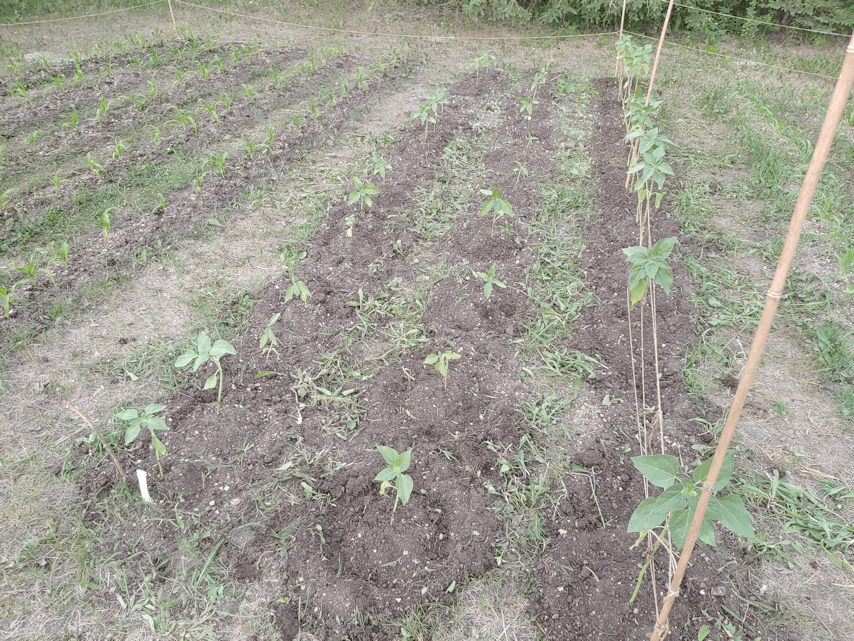
I’m really impressed by how well these Hope Black Dye sunflower transplants are doing. These are from the ones we tried starting indoors, but never germinated until well after we’d direct sown the other half of the seeds outdoors. The seedlings have pretty much quadrupled in size since they got transplanted. I don’t expect them to have a chance to reach maturity, given how late in the season they got transplanted, but part of the reason we grow sunflowers is as a privacy screen and wind break, and these might still accomplish that. Assuming they don’t get eaten. This morning, I saw deer tracks in the soil at the very ends of two bean beds, but no signs of anything new critter damage, so here’s hoping!
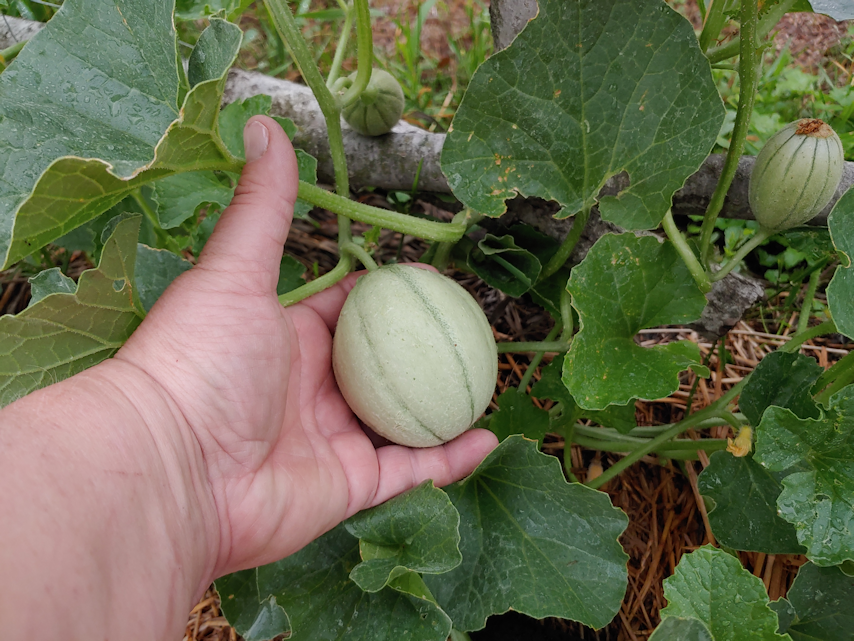
Every time we go out to these garden beds, we can’t help but check on the melons. They are getting so big!! This variety isn’t supposed to get as large as, say, the cantaloupes we see in the grocery store, but they are still supposed to produce lots of 4-5 pound fruit. The Pixies are supposed to reach about 1 1/2 pounds in size. I’m really, really excited about these. Melons are among my favourite foods, but we rarely buy them, as they are a treat, rather than an essential.
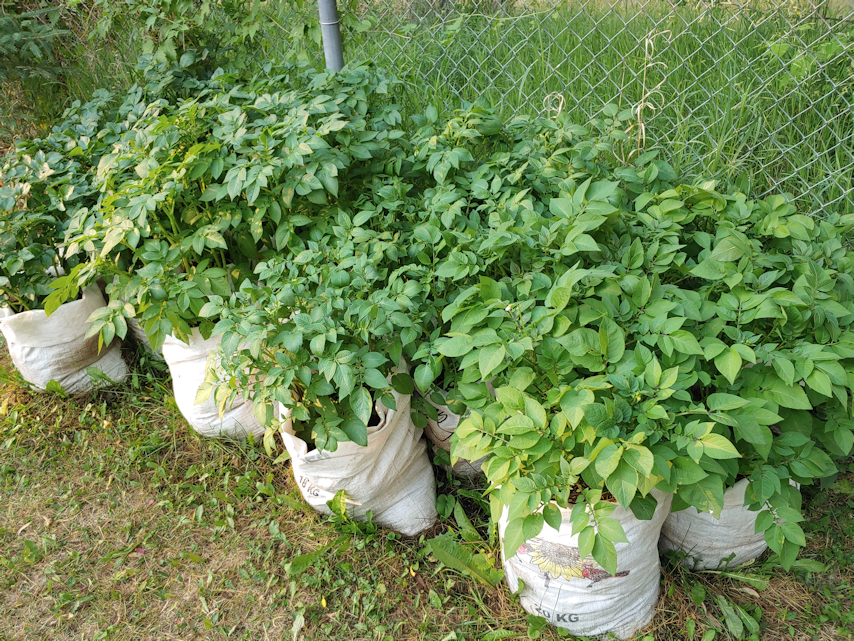
One of the challenges we’ve been having as been with the potatoes. Since discovering some critter damage, we unrolled the feed bags we’re growing them in to full height. If these had been indeterminate potatoes, we would eventually have done that by continually adding more soil, but these turned out to all be determinate potatoes, so there is no advantage to doing that.
Unfortunately, that meant there was nothing to support the bags, and the plants kept flopping over. Especially while being watered. If we had mulch, we could have added that to help fill the space and keep them from flopping over, but we don’t have anything right now. At least it’s been working to keep critters out, but some of the bags were flopping over to the point that I was concerned the stems would all break, and they’re still in their blooming stage.
Last night, I think I found a solution.
This is how they looked this morning, so it seems to have worked!
What I’d done is cut small holes near the tops of the bags, then tied them together with twine. The double row was tied together in groups of four, while the bags in the front were tied in groups of three. Then, just in case, extra twine was run around the front, tying them to the chain link fence. So now, the bags are holding each other up, while also protecting the plants from critters. It’s just insects we’ll still need to keep an eye on.
Hmm. One down side of finally getting some rain. There are some storms passing to the south of us, which means we’ve lost internet. The WordPress editor’s autosave has been spinning for a while, and once that starts, it doesn’t recover even once the connection is back. Which means that I can’t save my draft, and once our connection is up again, I’ll have to open whatever draft was last autosaved, then copy and paste whatever got missed into it, before I can publish it, and close this window.
Oh, the internet seems to be back again! Let’s see if I can publish this!
While going through the old kitchen garden this morning, I was seeing more of our beets, slowly being nibbled away. We’d added stinky soap, cat fur, hot chili flakes, and a motion sensor light. The only thing they seem to be doing is spreading out the damage, as the various things get avoided.
So today, we tried something else.
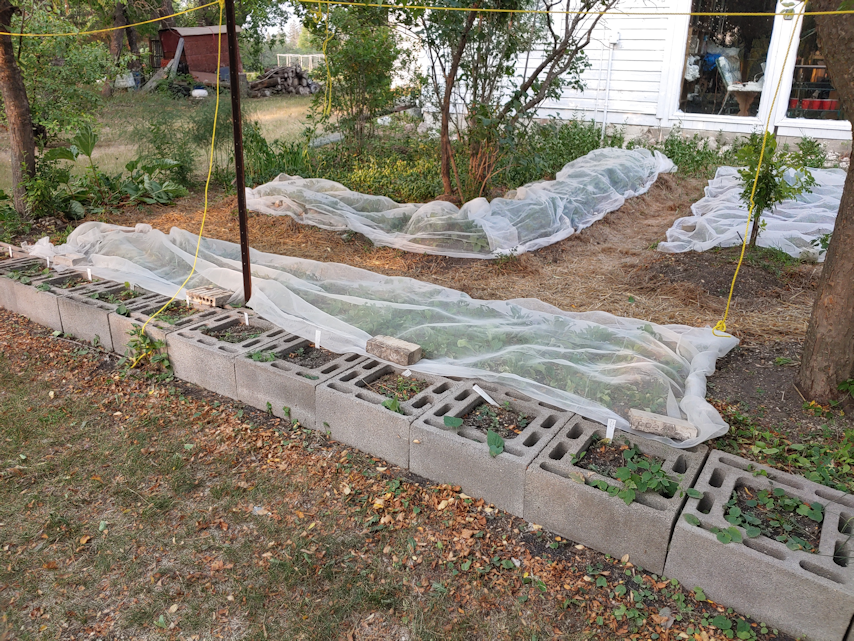
Since there’s no point keeping the mosquito netting wall up to keep the deer away from the lettuces that the groundhog decimated, it was taken down. The sheet was then torn in half, lengthwise, to be used as floating row covers.
One half was used to cover the L shaped beet bed. The other half was cut into two pieces, with one covering the beets by the retaining wall, and the other covering the carrot bed. The edges are weighted down with bricks and whatever rocks we could find that had some weight to them.
It won’t stop a determined critter, but it might be enough to convince it to not bother, and move on to easier pickings.
My only concern about that is, “easy pickings” would be the poppies and the couple of sunflowers growing next to them. They’re too tall to cover with anything, without damaging them, but not too tall for a critter to reach.
That done, we moved on to the cucamelons and gourds.
For this, we rigged a chicken wire “cage. The top is laced to the chain link fence with twine, above the cucamelons. Over the gourds, it’s just tacked in place at the end, so that a gap can be make for the plants to grow through. The ends were cut and folded in to close them off, and the bottoms are tacked down with tent pegs.
Again, this is not going to stop a determined critters. But it is better than nothing.
As I write this, it was past 9pm, and we are still at 30C/86F, with the humidex at 33C/91F. Tomorrow’s forecasted high is 34C/93F, with the humidex at 38C/100F. Hot, though not quite as hot as the previous heat wave. The girls have been diligent about the evening watering, though I think we’re going to have to keep it to just one watering a day, after something concerning happened last night.
The sweet corn and sunflower beds have been the most difficult to properly water, so we have started to use a sprinkler, turned on for about an hour before the rest of the watering is done. It reaches almost all of the corn and sunflower beds, leaving only a row and a bit at each end that need to be watered manually. Yesterday, as one daughter headed out to switch the hose from the sprinkler to the spray nozzle, my other daughter started to use the front hose to water the old kitchen garden.
This is something we have done before without issue, but this time, all pressure was lost. My younger daughter went into the basement to check the pump, and found it making that grinding noise we have managed to avoid for quite a while now, and the presser was down to zero. By the time she called me over to look, the pressure was back up to 30psi, which is where it should be, but the taps to outside were shut off, anyhow. After the pump shut itself off again, we turned the taps back on, and the girls continued watering, but with just using the back tap.
Now, when we first noticed the pump making that noise and we would lose all water pressure, it was quite a concern. There was a possibility that the foot valve was leaking. We had two plumbers look at the pump, and one even crawled into the well shaft, and my brother even bought a new pump to replace this one, which is about 20 years old. The problem is, the system is so old, neither plumber was willing to chance doing the work, because the risk of something breaking in the well and losing our water completely was too high. At the very least, we’d have to hire someone to find parts for a system that’s almost 50 years old and are in different sizes than modern wells, break the well cap to access the well and replace the parts, or dig a new well.
Digging a new well was the recommended course of action.
None of this is an option for us, so basically, we’re being really careful. The main thing is that problems would start when water was being used faster than the pump could refill the pressure tank. As long as we don’t do things like run the bath as full pressure, or use multiple sinks at once, etc., we can keep it from happening. We know we’re on borrowed time, though.
The hoses do not use a lot of water at once, and even with both taps being used, we never had issues with the pressure before. So why did it happen last night?
I can think of only one thing.
The water table is dropping.
I don’t remember this even happening before, but I can’t think of anything else. It’s not like someone decided to take a shower or something at the same time – and we’ve even the shower get used by someone not knowing the hose was in use, with no loss of pressure.
So for now, we’re going to stick to watering just once a day.
Hopefully, it will be enough.
This is when we could really use more mulch! In the future, when we build our permanent garden beds, a drip irrigation system is also very much in the plans.
We have been very excited by how well the Montana Morado corn has been doing. However, as some of the stalks have gotten taller, they have started to fall over. The soil around the plants seems to be washing away as we water them. So, this evening, I added more garden soil to the bases of each one.
While watering these, my daughter has been focusing on giving a deep watering into the paths in between them, then using a finer spray to water the entire bed, so as to prevent more erosion. A couple of the stalks are also supported by stakes.
We are very curious about what the cobs will look like. Some of the stalks, silks and tassels are very purple, while others are varying shades of green. These are all supposed to give us corn so dark a purple, it looks black. But is that what we will get? We shall find out! It does look like several cobs are filling out nicely. :-) I’ve taken to hand pollinating every now and then, just to be on the safe side.
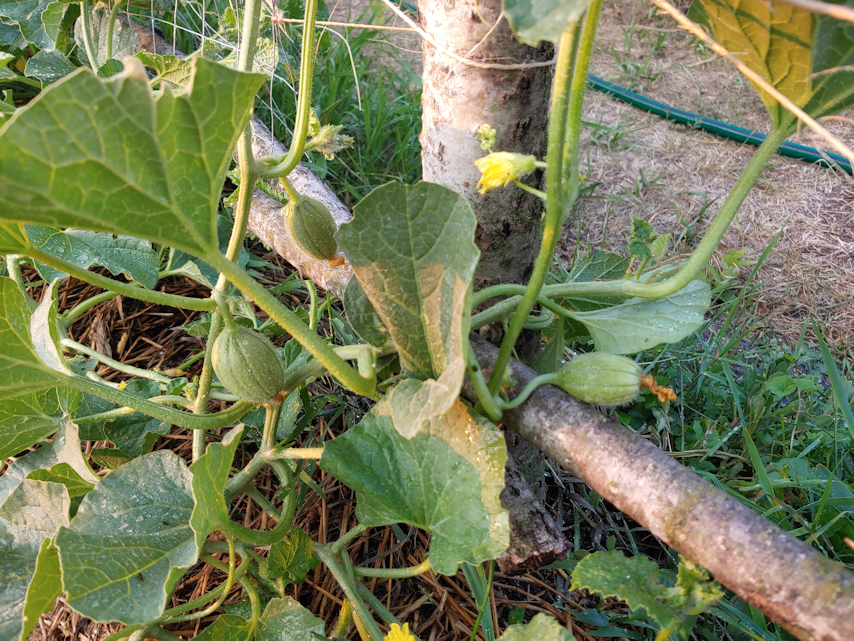
Meanwhile, while watering the squash tunnel, my daughter found another little melon!
At first, she thought one of the ones she’d found before had fallen to the ground, but then she saw they were both still there, so she lifted the third melon onto the structure. This had me looking around for more, and I was very excited to see two of these.
Tiny little melons, juuuust starting to form!
This is awesome!
I checked the other melons, squash and gourds. The summer squash is getting nice and big, and I might even have a couple of squash to pick tomorrow. The other melons and the winter squash have flowers and/or buds, but no fruit forming. Same with the Crespo squash. The luffa isn’t even showing flower buds, but it is climbing the trellis.
Then we went looking at the tomatoes (so many fruits are forming!), and they are doing great. The tiny little onions we planted under them are still tiny and little. :-D I noticed this morning, however, that a couple of self seeded (likely from the bird feeder) sunflowers seemed to be gone. This evening, I looked again and found their stems, leaves all eaten away. *sigh* More of the flowers in the bed nearby have not only had their heads eaten away, but in one area, even the stems are being eaten. We will not be getting many blooms out of that bed this year!
That reminds me: it looks like a lot of our French Breakfast radishes have been eaten, too. Possibly grasshoppers.
When checking the cucamelons, it looked like some of them had lost a few leaves and vine ends, too! They’re such small, fine plants, though, it’s almost hard to tell.
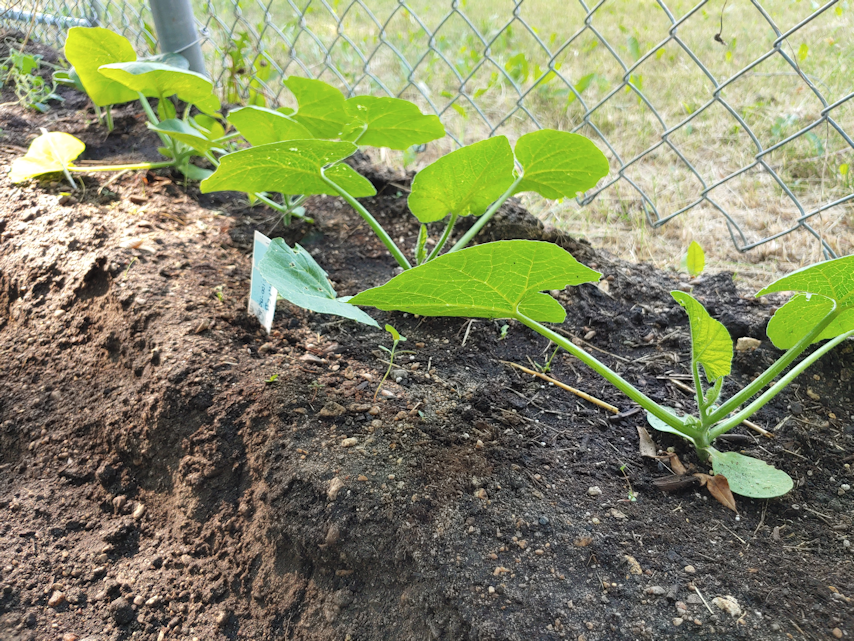
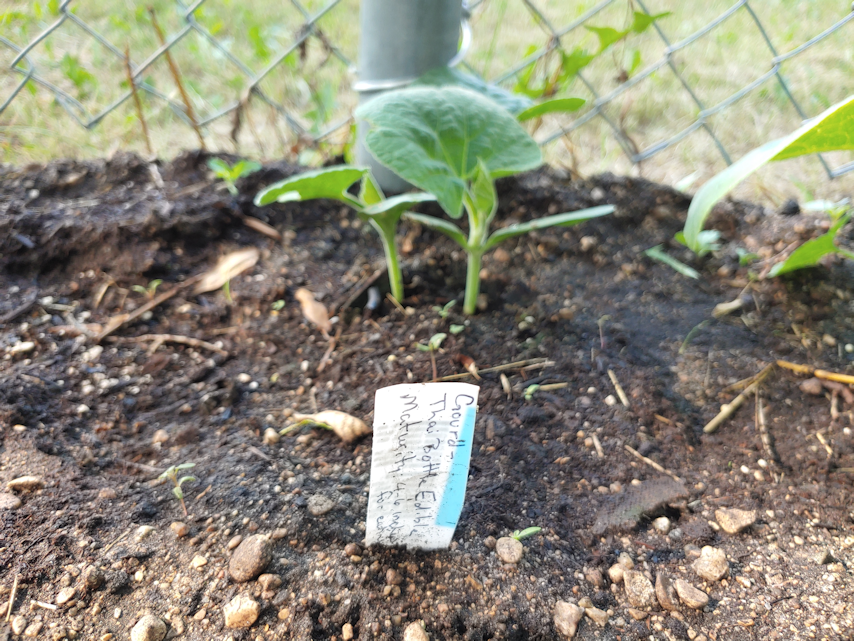
Then I saw this. :-(
This is the Thai Bottle Gourd. We had the one transplant, and a second seed germinated next to it. Now, the little one has lost most of its leaves, and the big one has lost a couple, plus a couple more leaves are partially eaten.
No damage to the Ozark Nest Egg gourds. Which is good, but we have more of those!
Very frustrating.
This year’s garden has been such a mixed bag of stuff going well, and stuff going badly, due to critter damage!
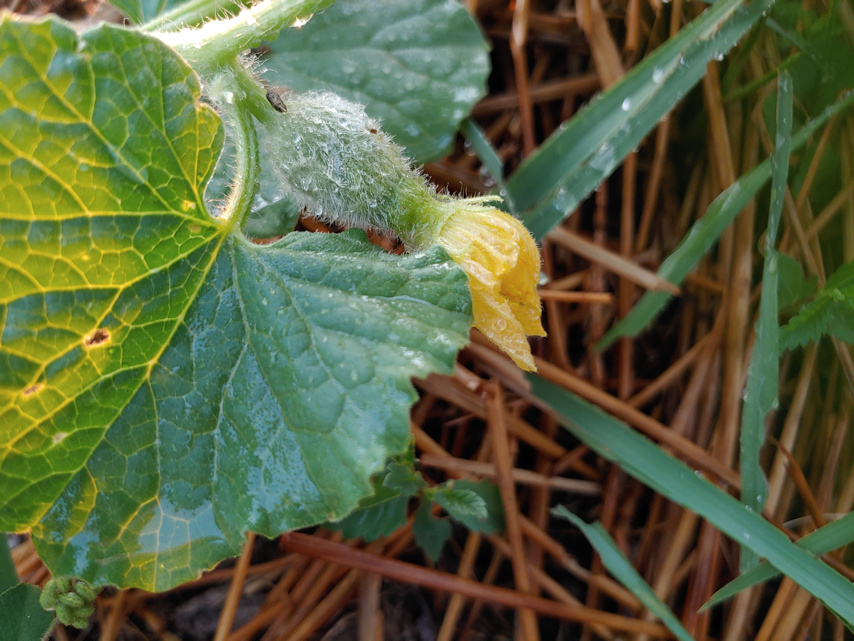
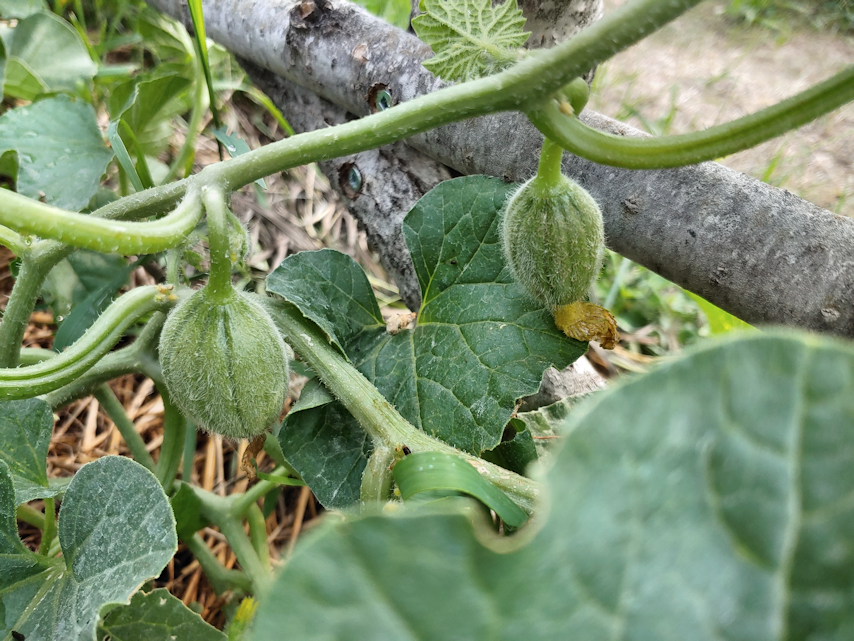
While doing the evening watering, the girls spotted a couple of little melons last night! I just had to go looking for them this morning.
Aren’t they adorable?
The bigger one is about 2 inches long. I wasn’t expecting them to be fuzzy. :-D
These are the Halona melons. Still nothing among the Pixies – at least not that we can see. Lots of flowers, though.
In thinking of how to protect our Crespo squash from being nibbled on, and our new sprouts from the upcoming heat, I scrounged in the old garden shed and dug up some old, bent up, decorative wire border fences.
Most of the sections went around the Crespo squash. Whatever has been eating them has not tried to go past the hoops, so I’m hoping the new border will further dissuade it.
The ground here is so rocky, I wasn’t able to push all the wire “legs” into the soil! Enough are in to keep it from falling over, though, so it should be fine.
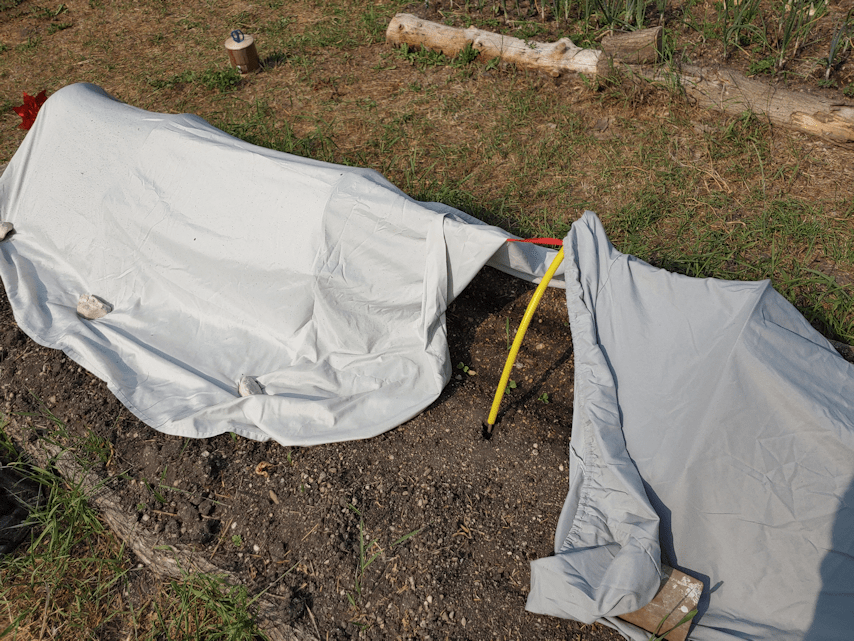
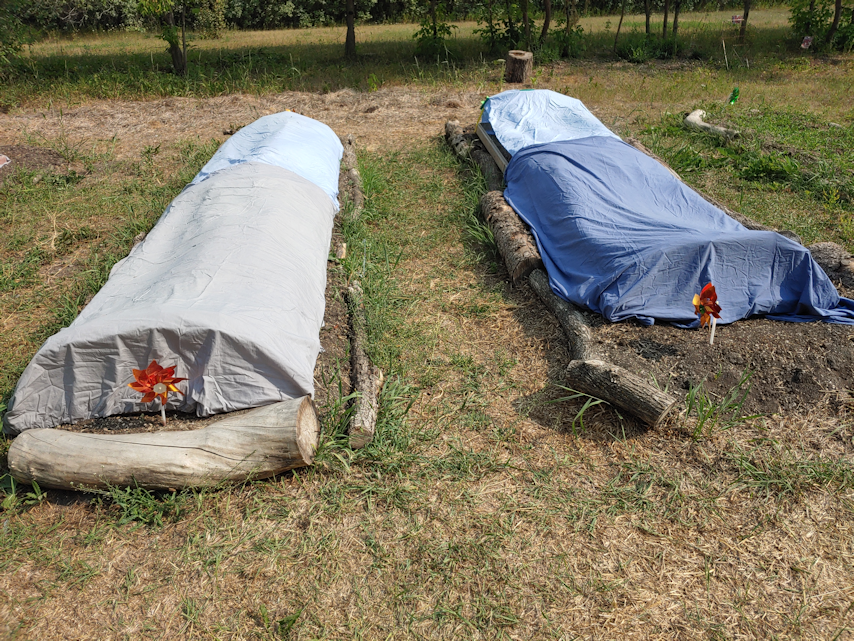
There were a few sections left, and they got used in the garden bed that doesn’t have a row cover on it. Then I used some bed sheets as shade covers. I neglected to take progress photos, though. :-/
There were 6 individual sections that got evenly spaced over the seedlings. The bundle of fencing had been tied with a fairly long ribbon, so I used that to join the tops of as many of the middle ones as I could. As I was laying the sheets down, though, there was nothing in the centre to support the ends. I had a short piece cut from a hula hoop left, so that’s now in the middle, on a couple of sticks in the ground to hold it up. It was too short to bend well, so there’s a kink in the hula hoop piece, but at long as it holds the sheet up, I don’t care! :-D
After that, rocks and bricks were used to pull the fabric taught and weigh it down.
For this bed, I could use some old Twin sheets. For the other two, I had some queen and kind sized sheets to use.
The one top sheet was easy enough, but the fitted sheets needed to have their elastics cut off, and one of them was cut in half and used to cover the ends of the rows. With these, the fabric could be secured by tucking it under the wooden frame. The sheet that was cut in half is barely wide enough on one frame, and a few inches too narrow on the other, but the ends are tucked, and in the middle of the row, the other sheets were laid on top to hold it in place.
So now our shade-loving seedlings have their shade, and protection from the heat of the day. We can uncover them when we start the evening watering, so they get some less direct light during a cooler time of the day. Then I can cover them again when I do my morning rounds.
We’re supposed to start hitting 30C/86F and higher, tomorrow, though the hourly forecast on one of my apps says we’re supposed to hit 32C/90F this afternoon. The record high for today is 33C/91F, set back in 2002. I think we were actually living in this province again in 2002, though I believe we moved back in the fall. The record low for today is 9C/48F, set in 1993.
Anyhow, we’re supposed to stay about 30C/86F for almost a week, and these sheets should help keep the seedlings a bit cooler. I’m considering whether it would be a good idea to moisten the sheets, too, but the extra weight of water might be too much for the frames to hold.
It should be interesting to see how these work out!
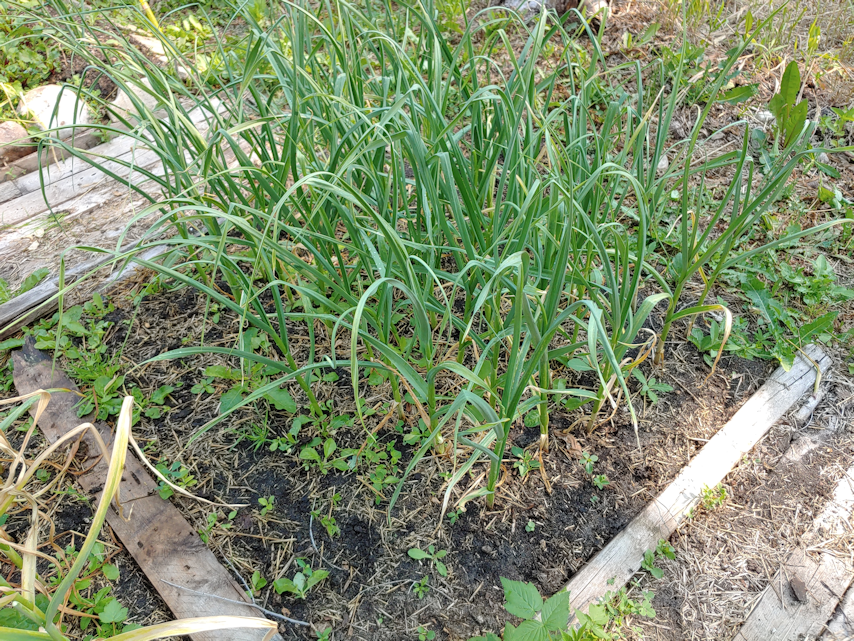
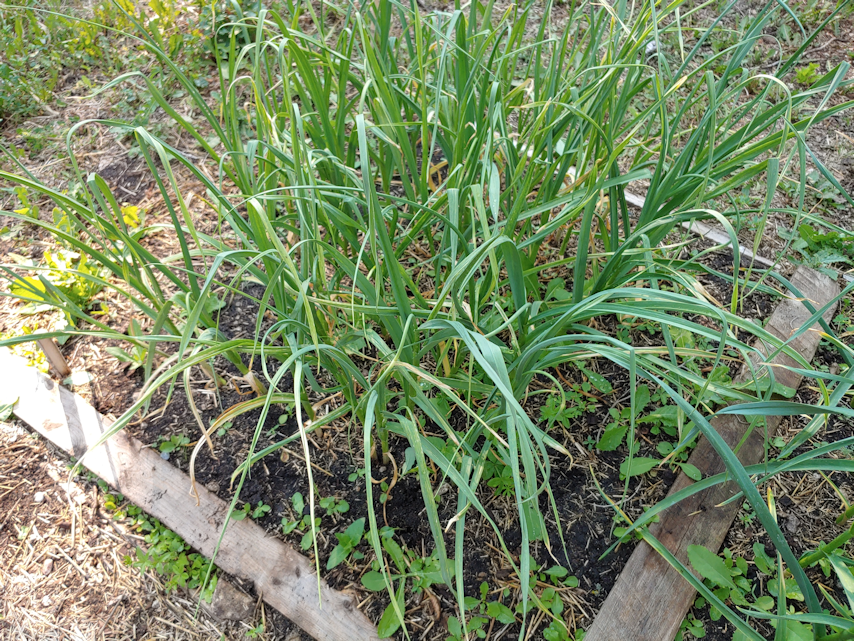
I’ve been eying one of our garlic beds closely for some time now.
This bed has the Purple Stripe garlic. Most of them started dying back a while ago, which was very strange. It seemed very early for them to be doing that. Especially since some of them were still growing scapes. I’ve been reading as much as I can, and everything tells me that once, with so many of their leaves died back, the bulbs are done growing. When even the scapes seemed to have stopped growing, I decided it was time to dig them up.
But just the ones that had died back.
I left behind the ones that were still green. Hopefully, their bulbs will continue to grow bigger.
It’s normally recommended to leave them on the ground to cure, but we have too many critters of various kinds that could get into them, even if they aren’t likely to eat them, so I laid them out next to the kibble house under the tent.
As you can see, most of them are very small. There’s only one or two larger ones. I wish I knew why they stopped growing so early. They had the same soil, sun and water as the other two varieties. No matter. While we won’t have anything to keep for planting in the fall, I’m sure they will still taste good!
Also, when I came over to set these out, Rosencrantz’s grey and white kitten was at the kibble house. It wasn’t until I started setting out the garlic that he took off. Last night, I topped up their kibble dish near their junk pile home. When I came back to top up their water, Rozencrantz and both of her kittens were eating. She and the orange tabby left, but the grey and white stayed and kept eating, even as it watched me closely while I refilled their water bowl next to him. Progress! Junk Pile’s four kittens have also been spotted in the kibble house, eating, too. We’ve decided not to give it another coat of paint, but might do some decorative painting on the outside, so the floor boards have been put back in place, and their food bowls are now in the shade of the kibble house, instead of on the baked lawn. Junk Pile’s kittens dash off as soon as they see us, but the fact that they are coming to the kibble house to eat at all is more progress.
I’m glad I picked up this tent. It’s coming in handy for painting, for critter shelter, and now garlic curing, already! :-D
It was a rough night for me, last night. Very little sleep, and the pain levels are just high enough to make any position uncomfortable after only a short time. Thankfully, my husband was well enough this morning to head out do all the food bowls for the cats, and refill the bird feeder, allowing me to postpone the rest of my morning rounds until later in the day.
Once I did get out, the first thing I noticed was the haze. I know we don’t have fires nearby, but we’re getting smoke. I’ll have to check the fire maps later, and see what the current status is.
The other thing I noticed was Junk Pile cat. Who looked at me and growled.
Now, why would she do that?
Because she had brought her kittens over, and they were around the cat shelter! I saw some furry little butts disappearing behind it, so I carefully went around, giving them lots of space, to check on the potatoes and grapes. I saw a little grey and white kitten run across to the storage out, while a little tuxedo squeezed under the cat shelter.
A tuxedo?
Yup. She had more kittens with her this time! There were at least three, possibly four. I was just catching glimpses of them, though later on I saw the tuxedo under a tree by the storage house, watching me from a safe distance.
I am so glad she’s bringing her babies over to the food bowls!! Hopefully, they will be moving into the inner yard now.
Before finishing my morning rounds, I got the hose going to refill the water barrel at the far beds. Unfortunately, it is still leaking. I’ll have to pinpoint exactly where, then empty it enough that it can dry and I can try sealing them again.
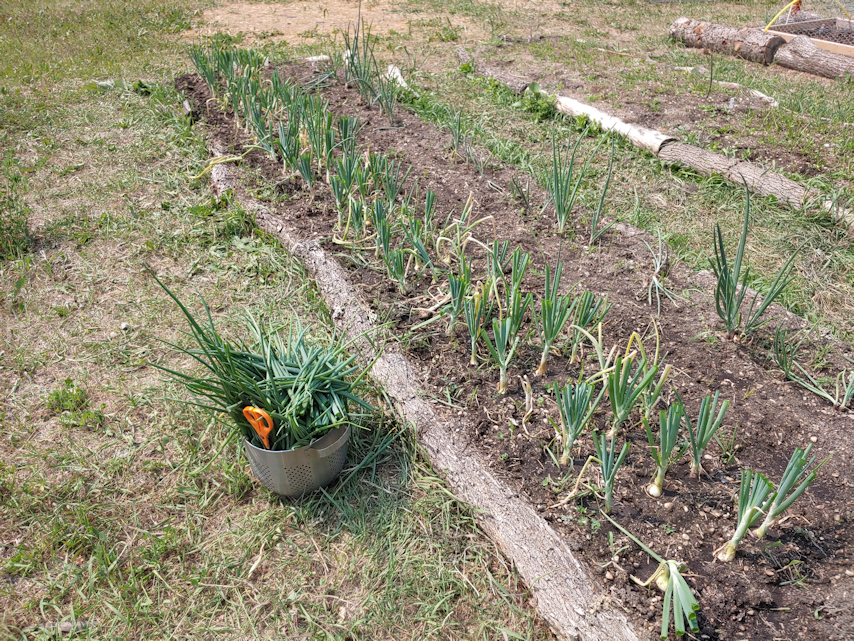
Once everything else was done, I came back outside to give the onions a hair cut. :-D
It was on one of the gardening groups I’m on that I saw someone post pictures of the green onions they had just harvested and bagged up for the freezer. I know it’s recommended to trim onions grown from seed, down to about 3 inches, before transplanting. I hadn’t thought about trimming them, other than to gather greens for the day’s cooking, before harvest. The gardener that posted the pictures said that trimming them meant more energy going towards growing the bulbs. If the greens start falling over, the onions stop growing for the season. I knew that last part, but it never occurred to me that the growing season could be extended by trimming. I’ve never grown onions before, and the onions my mother grew were left in the ground to come back, year after year, so I never saw her doing that, either.
The yellow onions sets that I bought locally got really large greens. I quickly ran out of space in my colander, and had to come back to do the bigger shallots, then the other onion bed. The red onions (from sets) and the other yellow onions (from seed) did not have as many large greens, but the colander still got pretty full again! All the greens completely filled our giant metal bowl. Thankfully, it has a lid, because the cats were VERY curious! It’s full enough that the lid is sitting on top of greens, but at least that cats can’t get at them. Onions are toxic to cats, but that doesn’t stop them from being very curious about them!
We’ll have a lot of washing of greens to do, and then they’ll be coarsely chopped. We will probably dehydrate a couple of pans of them in the oven, and the rest will get frozen.
We’re going to have enough to last us quite a long time! :-)
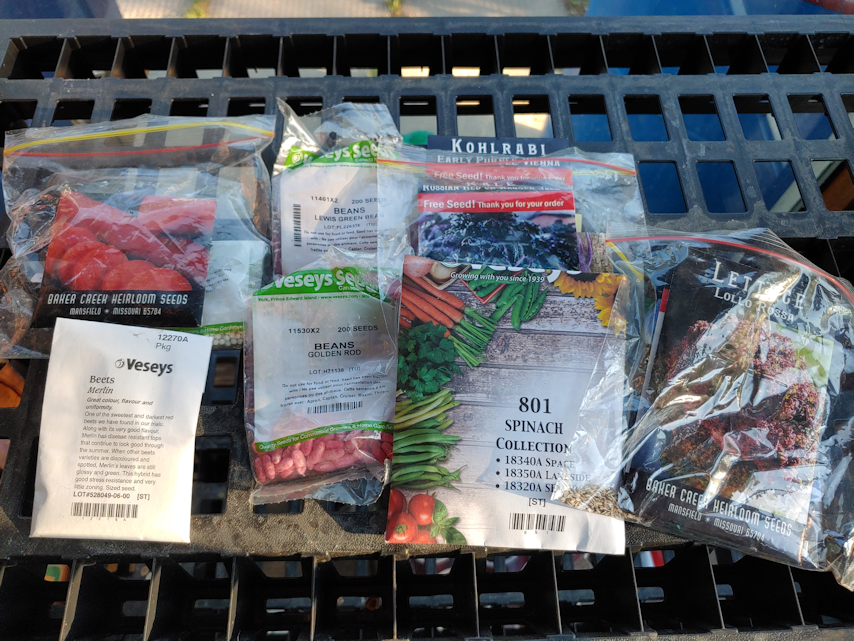
Before heading out to do the watering, I went through our remaining seed packets to do a bit of planning.
First, there’s what’s left of things we planted in the spring.
To the right, we have the two types of carrots in pelleted seeds. I keep reading that we can still plant carrots this late in the season, and I had debated with myself about replanting the carrots decimated by the woodchuck, but really… what’s the point? It seems to have a special love for carrot greens, and until we get rid of the woodchuck, there will be no new plantings of carrots!
To figure out what we can plant for a fall harvest, I looked up our first frost date, which is Sept. 10, and worked out how much of a growing season we have left. Then I checked out the germination and days to maturity to see what we can plant now, and what will wait until later. We could plant the remaining Merlin beets, but we have so many beets planted, there is no need. The two types of beans could also be planted, but again, there is no need. Not in the photo are the remaining green peas, which apparently can also be planted this late in the season, but we won’t. If we wanted to, we could plant any of the summer squash, too, if we wanted to. All the seeds we will not be using this year got set aside for next year.
We had received the purple kale and purple kohlrabi as free seeds with each of our orders from Baker Creek. We ended up with two packs of kohlrabi seeds, but still have seeds in the one we did open. There are still kale seeds, too. These are both cool weather crops, and the kale can hand frost. While I plan to try kohlrabi again next year by starting them indoors, I’d forgotten we still had seeds. I’ve decided I will go ahead and plant the rest of the open packets of seeds, in hopefully better conditions, and actually get some growing!
The 3 types of spinach adn 4 types of lettuces will be planted, but not until the end of July.
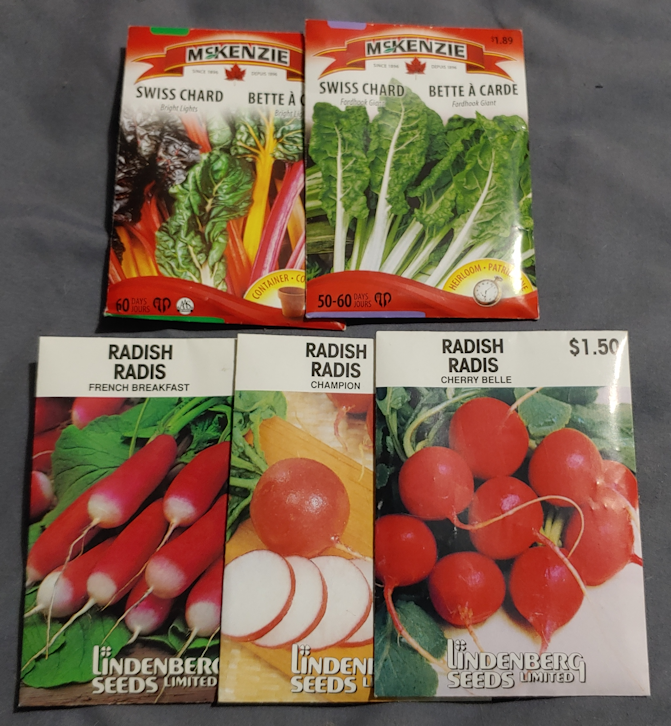
Then there are these.
I’d picked up the radish seeds when I was last helping my mother with her grocery shopping. I intend to plant those as soon as possible; just a few of each. From what I’ve read, I should not expect to get bulbs developing in the heat of summer, and will be growing them for their pods.
The chard was something I picked up a few days ago. While waiting in line at the grocery store, I found myself next to a couple of boxes of seed packets, all jumbled together, instead of in their display cases. I rifled through them and found the two types of chard, which will be planted right away, too. I’ve read that they are tolerant of summer heat.
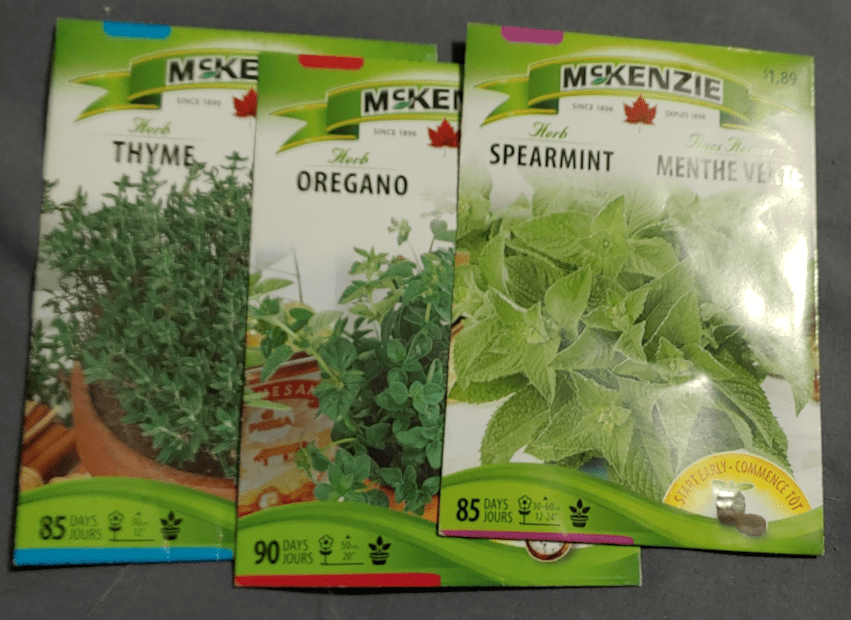
While going through the seed packets, I also picked these up.
Little by little, we intend to have an herb garden, likely in the old kitchen garden, so these are seeds for next year. Unless we want to try growing them in pots indoors, but I don’t imagine they’d survive the cats.
So we now have our first herb seeds, and more seeds to join the Yellow Pear tomatoes I picked up earlier.
The 5 day forecast has us back to around average temperatures for July, which means we should be able to catch up on things we’ve set aside because of the heat. But then, the forecasts have been so off for the past couple of weeks, I wouldn’t be surprised if the forecasts were completely off! Still, those empty beds need to have something planted in them, and it needs to be done soon!
Apparently, we got rain while I would outside, watering the garden, too.
That would have been nice, but all we had was hot, muggy, thick air.
*sigh*
One of the awesome things about gardening is how fast things can grow. We’ve got a whole bunch more summer squash blossoms, more squash growing (still no yellow zucchini, though), and the squash that started earlier could probably be picked right now. I’m going to wait until they’re a bit bigger, though.
I was very excited to see our very first WINTER squash blossom! Those are starting to get quite big. As we are able, we’re moving them to train them up the trellis, and some are sending out tendrils and looking almost ready to be climbing on their own, as are more of the melons. We’re going to have to go back with some twine to string between the sections of mesh and fill in the gaps a bit for the few plants that are under them. I had remembered to look for twine when I was last in the city, and found a huge roll of it. It should last us until next year! :-D
I am absolutely thrilled by the Montana Morado corn. This is the stalk that we are seeing silk on already. Pretty soon, it will have pollen, too! A few of the others are starting to show the little red bits, but they do not yet show corn silk.
We’re going to have to go in between these and “hill” the corn. With having to water so often, and not having a mulch, the water is eroding the soil at the base of the corn a bit. A couple were starting to fall over, so last night I worked the soil around their bases and secured them upright with it, but I want to do that with all of them. The ground here is so soft, though, we don’t walk in here at all unless we absolutely have to. I’d hoped to be able to add grass clippings for mulch, but with the heat and lack of rain, the grass hasn’t been growing.
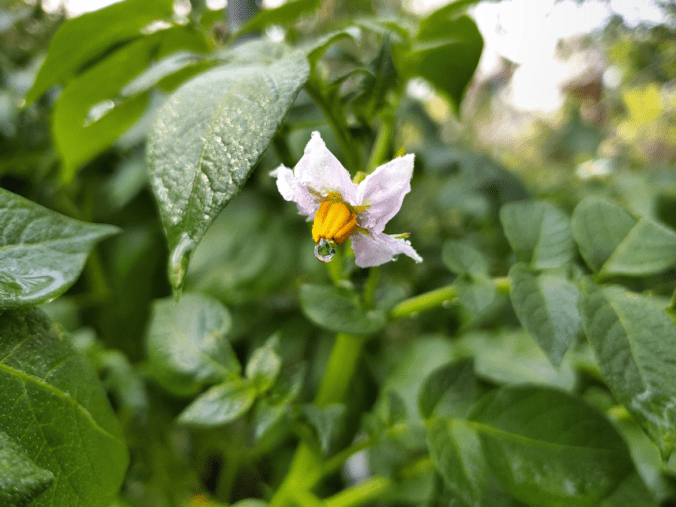
There are just a few potato blossoms that are fully open right now, but I am seeing many, many buds!
Of course, I’m always second guessing myself about deciding not to “hill” the potatoes more. As determinate type potatoes, it won’t result in more potatoes, but the plants have gotten so tall, it feels like they should be hilled! :-D
When I got to the old kitchen garden, I found the end of the L shaped beet bed was nibbled on.
I did see the woodchuck run under the garden shed this morning, but I’m not sure it is responsible for this. I think the carrots in this garden were nibbled on more, but I’m not sure. The motion sensor light would cover that carrot bed and the section of this beet bed next to it, and should be startling off any critters, but the section in the photo has a lilac bush between it and the light, so it wouldn’t be triggered by anything nibbling on the beets here.
I did see a deer going by the garden cam when I checked the files this morning. They seem to be just walking through, and not even going very close to the garden, now that I’ve put up the stakes and twine around the corn, and rope along the back of the Dorinny corn and the pea beds. I find myself wondering if a deer might have nibbled on the beets, since the woodchuck doesn’t seem to like beet greens, but that would mean the deer coming right up to the house, and pushing its way through the asparagus ferns and rhubarb, and I just don’t see that.
The beet beds in the old kitchen garden did get the Critter Ridder granules, but I was finishing off the container in the area in the photo, so there wasn’t as much there. It obviously doesn’t work to stop cats, since yesterday evening, we saw Junkpile and her kittens in the beets by the retaining wall. :-D
I still have to use the new spray we got, but it’s supposed to be applied on dry surfaces, so I’ll have to wait until later in the day.
Or until tomorrow, if we actually get the predicted storm!
With today’s expected heat, I was out in the garden by 6am, and ended up staying out there for almost 3 hours, watering and weeding. The watering was started after replacing the connectors on three hoses.
I’m a goof, but it did work.
When I bought the connector repair sets, I got what was left on the display, and didn’t even think to look at the sizes. They are for 1/2 inch hoses.
We have 3/4 in hoses.
No matter. The clamps they came with could tighten enough to properly seal them. They will do while I am on the lookout for the right size connectors.
The little flexible piece I got for the tap, to prevent kinking, leaks. In several places! I guess I got a cheap one, though there wasn’t much choice. It still leaks less than it did before. One of the leaks is at the tap itself. Every single hose we’ve ever hooked up to that tap, leaks there. I plan to replace the tap itself, eventually. Meanwhile, there is some very luscious growth happening around the blocks we have under the tap. :-D
When I headed out again this evening, I got to break in the new action hoe.
What a fantastic tool!
I first tried it in one of the onion beds. It did well, but the onions are planted in a three row grid, and it just didn’t fit in between them, so there wasn’t a lot I could do with it, there. Mostly, I used it in the space in the middle, where the purple kohlrabi failed to grow.
It was at the Mongolian Giant sunflowers that it really did the job!
The soil here has always been rock hard, and baked bone dry. Right now, the only soft soil is the layer we put down for each row, and that was just a few inches deep. That anything we’ve planted here is growing at all is pretty remarkable. This thing worked like a dream!
Now, don’t get me wrong: it was still really hard to work around the sunflowers.The soil in between the rows is even harder now, as we walk between the rows to water things. It wasn’t just the hard soil, but also the very fibrous roots from the plants that were already growing here, and now enjoying regular watering for a change. This hoe was able to cut through those roots, and the rock hard soil at the edges of the paths. I was then able to pull out the cut weeds and their roots, before hilling the loose soil around the sunflowers a bit.
I am very impressed with this thing! The tool I was using around the corn before worked well; better than a regular hoe, but not as good as the action hoe. It was one of the unusual tools we’ve found around the place. The head of it is shaped almost like a mattock, except… not. LOL The “hoe” part of it is longer and narrower than a regular hoe, and it has a two pronged spike on the other side that I believe is a weeding tool. I’ve never tried to use that end, yet. It works really well at cutting into the hard soil. Better than a regular hoe, as least. Unfortunately, it’s quite old, and the head sometimes pops off the shaft.
I was doing one last row with the action hoe in the next corn bed, when my daughters came out to do the evening watering. My older daughter had finished watering the beds closer to the house with the hose, and when she came to continue watering where I was working, she told me about something awesome she found in the Montana Morado corn.
Silk!
Our very first corn to start showing silk!
If these are going to be maturing so unevenly, we may need to hand pollinate the silk, just to make sure they do get thoroughly pollinated. It would be pretty hit and miss to rely on the wind to pollinate the corn, when there might be only one or two corn plants ready to be pollinated at a time.
I am so happy that this corn seems to be working out so well!!
Today is supposed to be the last day of our heat wave. After this, we are dropping to more average temperatures. The expected high had been 38C/100C for a while, then it went down a few times. By morning, we were forecasted to hit 34C/93F, which we did hit. I don’t know what the humidex was. The forecasts for thundershowers tomorrow have shown up, disappeared, then showed up again, several times today! As I write this, it’s past 11pm, and we’re still at 28C/82F. The overnight low is expected to be not much cooler, but we are also supposed to get some rain, too.
I’ll believe that when I see it. From the looks of the weather radar, any rain or storms sweeping through are going to go right past us, and hit the city. But if we get even a little bit of rain, I will be happy. Even with all the watering we’ve been doing, twice a day, things are still really dry. I could really see that while weeding. Even at the start of the day, which the ground still looked damp from the previous evening’s watering. While hand weeding among the beets in the old kitchen garden, I had the hose set to mist, so the water would make it easier to pull the weeds out by the roots. I’d already watered the bed before I started weeding, yet when I pulled up the weeds, I could see how dry the soil still was.
When we build our permanent beds, having some sort of watering system would be very useful. We do have sprinklers we can use, but I’d rather have something less wasteful, like a drip system.
But that is something to figure out later. For now, we make do with what we have, and right now, that means watering twice a day with roughly 300 feet of garden hose and watering cans! :-D
It occurred to me that, while I’ve been posting lots of pictures of our garden, some areas get focused on more than others. As we are now in July, I figured it would be a good time to do a “tour” of all the garden, and review how things are doing so far.
This is going to be a very photo heavy post! :-D Which is probably silly of me, as our internet connection is horrible right now, so it will probably take me at least a couple of hours to get it done! :-D
Let’s get started!
Asparagus bed with onions
Our first photo shows both success and failure.
In the foreground is the asparagus bed. We planted 6 crowns of Purple Passion Asparagus. The crowns came in at the same time as our Mulberry sapling. I didn’t get a photo of that. It did not survive that one unusually cold night in late may. :-( But the asparagus did emerge, and we are very happy with them!
Along two sides of the asparagus bed are some tiny onions. These were some last minute Norstar onions we started indoors after having so many of the other onions seeds we started get destroyed, one way or another. They are incredibly tiny, and yet they are forming bulbs!
In the other bed is where we planted the Strawberry Spinach. That is a total loss. We have no idea what happened to them after they sprouted. I do want to try them again, next year, though. These are both intended to be permanent beds.
Royal Burgundy
Lewis Green
Golden Rod
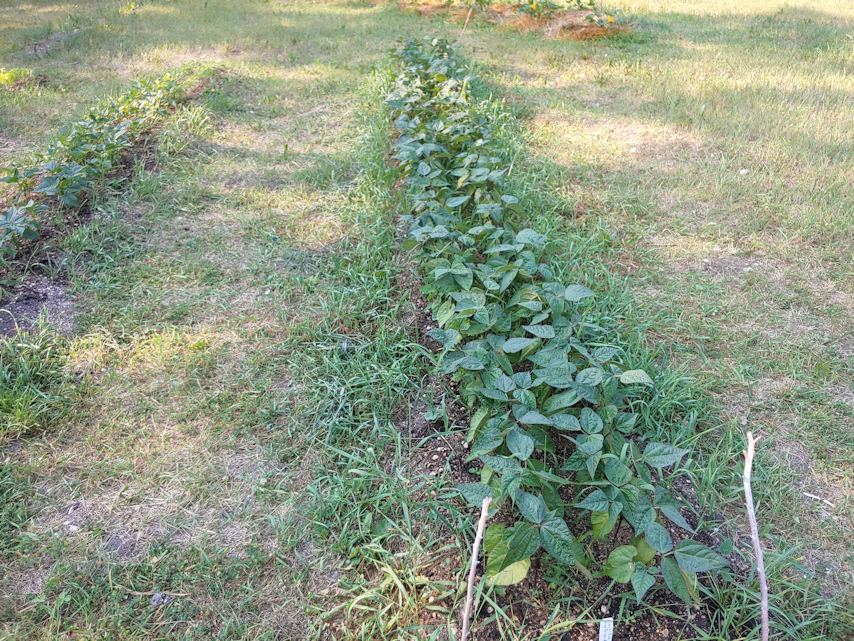
Here we have our three bush bean beds, planted in a temporary garden location. The photo on the left has the Royal Burgundy beans. We are totally amazed by how vigorously they are growing! The middle photo shows the Lewis Green beans, and the final photo shows the yellow Golden Rod beans. It’s interesting to see how the colours of the leaves show differently with the different coloured beans!
I would call all of these a success, so far. Aside from the odd deer walking through them, or a cat rolling around in them, they have not had any external issues, and they seem to be growing very well. I’m really looking forward to eating fresh beans! We pretty much never buy them at the grocery store, as they never look good, so these will be a real treat. :-)
Robin beets with onions
This is the new bed in the old wood pile area, built this spring. It was seeded with Robin beets, a new variety we got along with some Merlin beets, which we tried last year. Later, when we planted onion sets, some were planted around the beets to act as a deer deterrent.
It didn’t work.
Need more onions.
The beets do seem to be recovering, though. A while back, shredded Irish Spring soap was scattered in the bed, and this morning I added the Critter Ridder granules, so hopefully, it will not be a deer buffet again!
This bed, and the two others near it, are intended to be permanent beds, and we will eventually build boxes around them, and figure something better out for the paths in between.
Beets and lettuce beds
Mixed beets bed
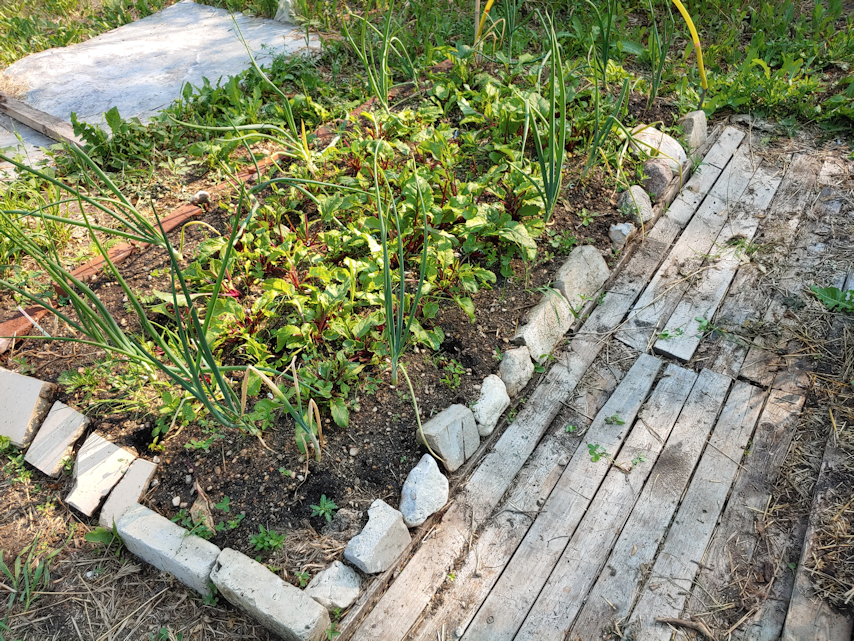
These are the rest of the beets, in the old kitchen garden. They have not been nibbled on by critters, thankfully.
The beets planted along the retaining wall blocks are of the Merlin seeds we got this year, plus seeds from last year, which was a collection of Merlin, Boldor and Chioggia. The girls planted them in blocks. There were still seeds left, and when we finished planting in the other beds, I went ahead and mixed all the remaining beet seeds together and planted them in the L shaped bed, so that is a beet surprise!
All of the beets here are looking to be quite a success. Mostly because the deer haven’t gone into the garden, and apparently our woodchuck doesn’t like beet greens.
We planted 4 types of lettuce in the retaining wall blocks, alternating with Lunix, Merlot, Lollo Rossa and Buttercrunch. We added the mosquito netting wall later, as a deer deterrent. The Lollo Rossa seemed to struggle, but the others were doing okay.
Right up until the woodchuck ate them all.
We will be planting more lettuce later this month, well after the current heat wave is over. The seed packets were together in a slide lock bag that got knocked about, and there was spillage, so they’re all mixed up now, so we’ll have lettuce surprise! :-D
Napoli and Kyoto Red carrots
Deep Purple and Longe Rouge Sang carrots
Here we have our carrot beds. The large bed has two types of carrots; Kyoto Red, at the far end, and Napoli. These were pelleted seeds, which made it much easier to plant them without having to thin them later. We also had plenty of seeds left over for next year.
They had been doing so well, until the woodchuck ate all the greens! The wire cover isn’t going to stop a woodchuck, but will hopefully at least slow it down or discourage it. I’m still holding out hope that they will recover, and will be spraying around them with repellent soon.
In the old kitchen garden, we have two other varieties of carrots. Deep Purple and Longe Rouge Sang. There were far fewer seeds in these packets. I’d made a cornstarch gel to make planting them easier, which we did last year successfully, even though the gel was way too thin. This year, however, I made the gel too thick. When my daughters planted them, it came out unevenly, but it still worked out. These have, unfortunately, also been nibbled on, but not decimated like the others were. At the moment, we have a motion sensor light set up that will hopefully startle critters away, and this morning, I sprinkled Critter Ridder granules around this bed, and the beet beds nearby.
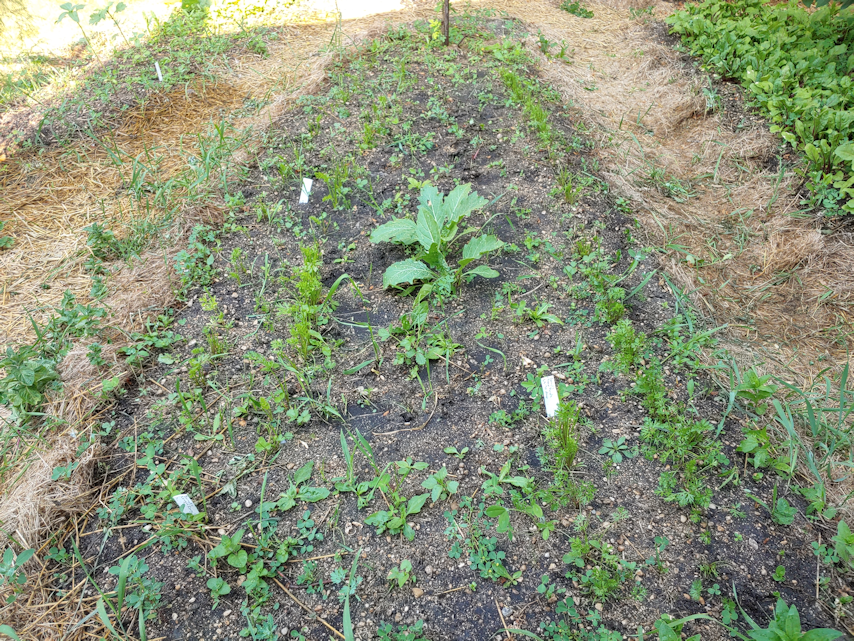
The two leafy things in the triangular bed are, I hope, white kohlrabi. These were seeds left over from last year, which had failed so spectacularly. Thankfully, we have seen no flea beetles this year. Still, I’m not even sure these plants are kohlrabi at all! I would call them a definite fail, unfortunately.
Next year, I want to try kohlrabi again, but will start them indoors. They are supposed to be good to sow directly before last frost, but they just don’t seem to do well that way.
Cucamelon
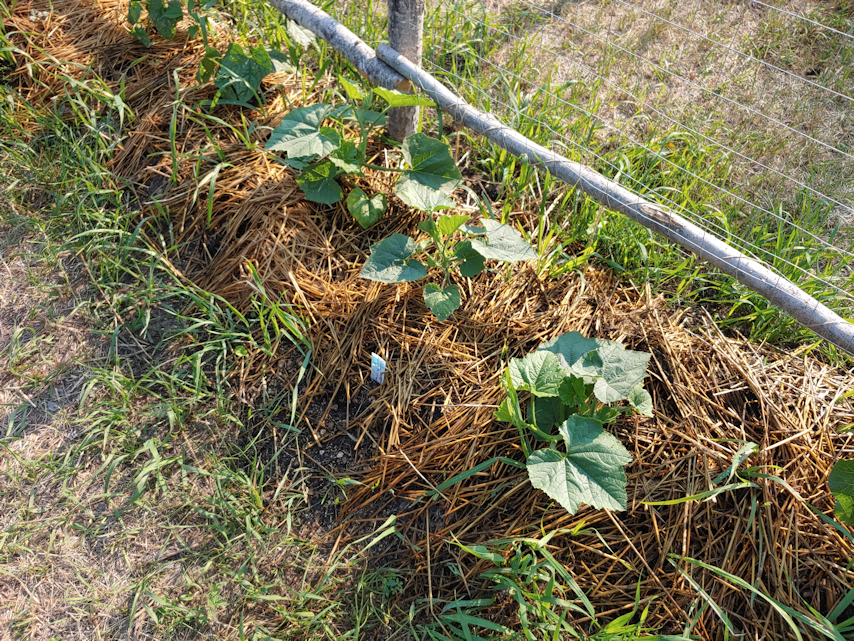
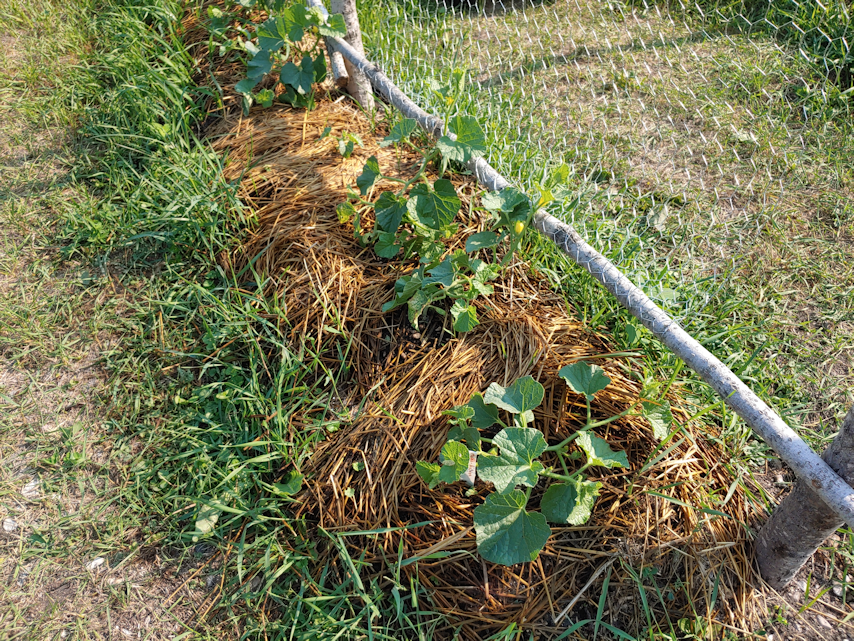
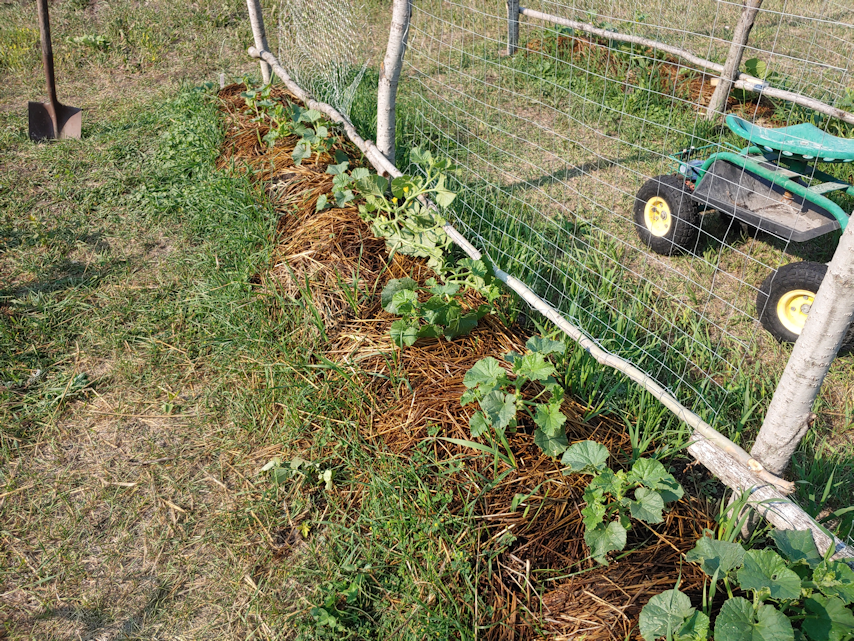
Here we have our cucamelon transplants. We did these last year and, in spite of a poor location, they did really well. This is where we had intended to plant them last year, in the rest of the chimney blocks we have left over after using some for the retaining wall. I am hoping the increased sunlight in this location, plus the chain link fence to climb, will lead to an even better crop than last year. :-)
Montana Morado corn
Dorinny corn
Here we have our two experimental corn blocks!
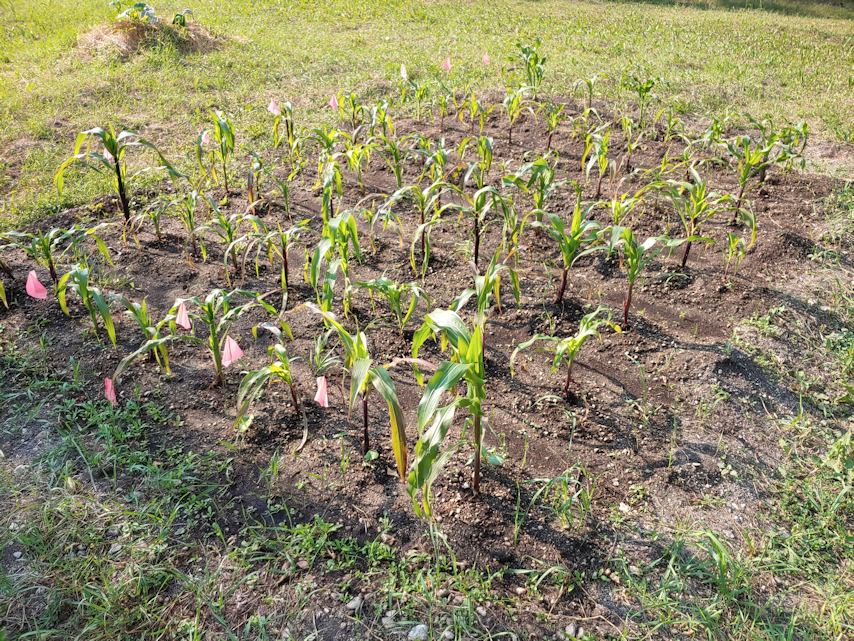
The purple Montana Morado corn (the photo on the left) were started indoors and transplanted, and so far they seem to be a success. A few of them don’t seem to be thriving at all, but most of them look like they are doing just great.
The Dorinny corn were planted before last frost, and you can see the remnants in the photo on the right. Though they are a cold hardy hybrid that would have been able to handle a normal frost, it turned out they couldn’t handle the -8C/18F night we had in late May. The seeds that had germinated before then did look like they survived, but after a few days, they were gone. Thankfully, more germinated later, and of those, they are doing quite well. As long as more don’t get eaten by the deer! The ones that did get nibbled on seem to be recovering, but I doubt we’ll get any corn on those ones.
Just yesterday, I used one of the empty rows in the Dorinny corn block to transplant some Hopi Black Dye seedlings. I’ll talk about those more, later. I also transplanted the few, spindly pink celery seedlings. I don’t expect those to survive. They should have been started indoors much, much earlier. I want to try them again, next year.
Where the Dorinny corn is planted is temporary. Where the Montana Morado corn is planted will probably become a permanent part of our garden. I was really surprised by how much better the soil was in this location, compared to other parts of the old garden area.
Porcelain Music
Purple Stripe
Racombole
Racombole
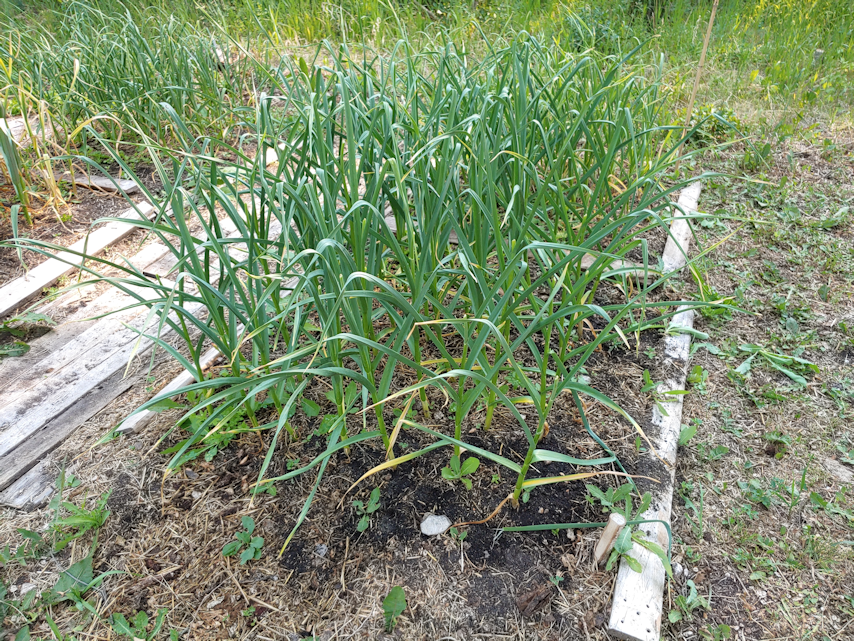
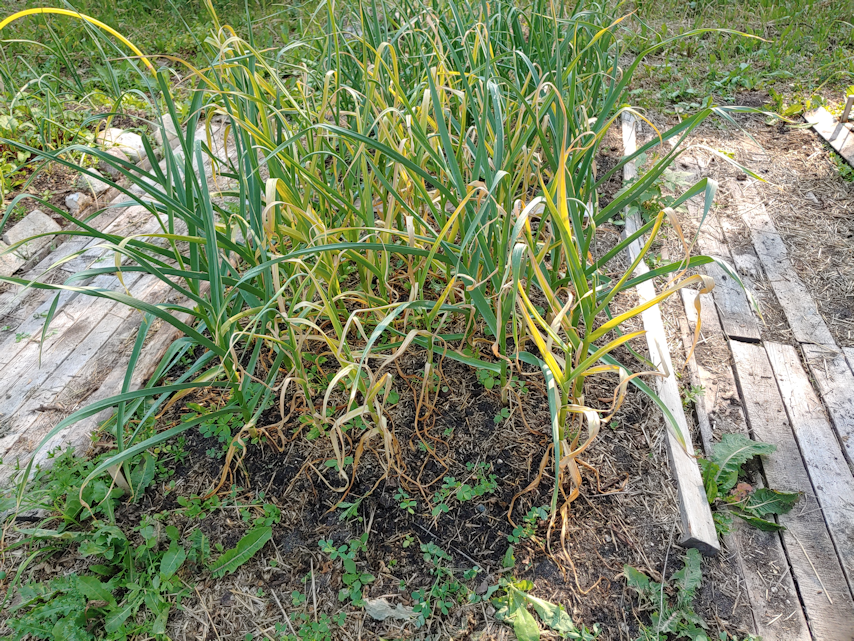
Here we have our hard neck garlic beds, which were planted last fall.
The Porcelain Music is looking amazing! Big, strong plants. They started showing scapes first. As I write this, we’ve gathered scapes from all these plants.
The Purple Stripe is looking like they will be ready to harvest soon – but they are still producing scapes! I’m not sure if this is a problem, or if this is normal for the variety!
The Racombole got split between the two beds. They came up later than the others, and the plants are smaller and slighter. They were also the last to start producing scapes. I don’t know if that’s normal or not for this variety. It’s possible, being on the East ends of the beds, they had slightly less sunlight than the others.
So far, these are looking like a fabulous success.
Now, we move on to the gourds. :-)
I honestly didn’t expect to have gourds this year. We started them indoors early, yet they didn’t germinate until much later.
These first ones are next to the cucamelons, in an area that will be a permanent bed.
Ozark Nest Egg gourd
Ozark Nest Egg gourd
These ones are the Ozark Nest Egg gourds. These had one plant germinated per pot, even though several seeds were in each. This morning, I noticed one of those seeds had germinated!
Thai Bottle Edible Gourd
Last time I posted about these, I mistakenly referred to them as the Tennessee Dancing gourd. Silly me. These are the Thai Bottle Gourds. There’s just the two of them.
Tennessee Dancing Gourd
Luffa Gourd
The Tennessee Dancing Gourd were among the first to germinate, and we got quite a few of them! If they are as prolific as I’ve read in reviews, we’ll be up to our eyeballs with them. :-D
It’s the luffa I am most eager to see how they turn out. They also germinated faster, though that’s not saying much, considering how long it took for the other gourds to germinate!
This area is temporary, even though we built a squash tunnel for them to climb. We intend to plant trees in this far-flung area, but this area, and the squash tunnel, might see another year of use. I’m pretty sure there is a telephone line buried under here, so we will probably not be planting trees exactly here.
As late as they all started, they all seem to be doing surprisingly well! They are really loving this heat wave. I’m looking forward to seeing how they climb the structure!
Here we have our grapes. There are two vines. We did not plant these. My mother did, but she does not remember what variety they are. I was talking to my mother today, and she worked out how long ago she planted them here, and figures it was about 12 years ago. !!! They had been completely engulfed by spirea when we first moved here, and we’ve been slowly working at getting them strong and healthy again. They are producing tiny clusters of grapes right now, and I look forward to seeing if they grow bigger this year, than last year. :-)
Halona Melons
Pixie Melons
I am really excited at how the melons are doing! We stared them indoors at the same time as we started with summer squash, but everything took a long time to germinate. That we ended up with so many is totally bonus. I love melons and really look forward to how these do! They are currently blooming, and starting to get big enough to train up the mesh, so I hope that means they’ll have a good summer’s growth.
Norstar and Red Karmen onions
Shallots and Stuttgarter onions
Here we have more successes and failures.
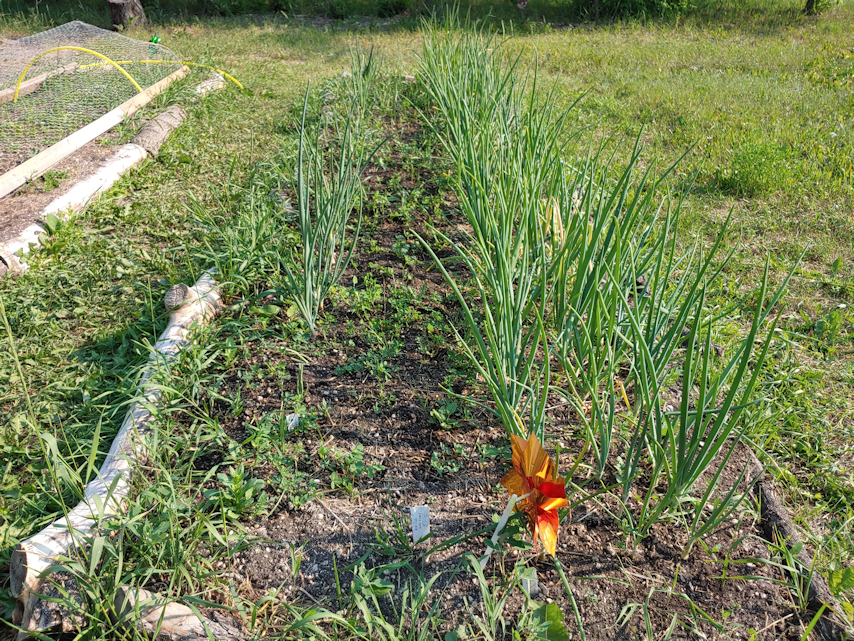
The Norstar onions were started from seed, and they are growing nice big bulbs right now! They may have been small when they were transplanted, but they easily match the Red Karmen sets they share a bed with.
What you don’t see is what should be growing in that gap in the middle. The very first seeds we planted outdoors was purple kale; seeds we got for free with one of our Baker Creek orders. If they ever germinated, we never saw them.
Because the bunching onions and shallots we tried to start from seed died a glorious, cat induced death, we ended up buying sets. Unsure if the Norstar seedlings would survive, I picked up some onions sets when they came out in the stores. When I found shallots as sets, too, I grabbed a couple of bags. They both seem to be doing well.
However, they too should have a neighbor.
In the middle, our purple kohlrabi was planted. Like the kale, if anything sprouted, we never saw them.
I do want to try the purple kohlrabi again, but will start them indoors next time.
Dalvay green peas
King Tut purple peas
Here we have our peas. We planted all of the purple peas in the one row, while there were so many of the green peas, we were able to replant in spaces where peas did not germinate, and still have some left over!
They are currently blooming and growing pods, but I am not sure if they are actually doing well. They aren’t very big! It could be because of the poor soil in this temporary location. Quite a lot of whatever was trying to grow here before is now making its way through the straw and garden soil we added, quite enjoying the watering and feeding the peas are getting!
We shall see how they do over the next few weeks.
Here we have before and after pictures of our potatoes.
The first picture was taken four days after they were “hilled”. The other was taken 10 days later.
I can’t believe how huge they are! All four varieties are just thriving in these home made grow bags.
And now for something a bit different.
Heritage raspberries
Unknown raspberry variety
Raspberry bushes.
We bought raspberries for the first time this year, as a birthday gift for my daughter. She chose the Heritage variety. They were doing great after transplanting – until they got nibbled on by deer, and then hit by that late May frost.
They won’t do very well this year, but they will survive, and should be fine, next year.
The others are a combination of raspberries my mother transplanted many years ago, and other self-seeded plants we transplanted when we mulched the area that now has our main garden beds in it. They, too, were hit hard, not just by that one bitter night, but also the Polar Vortex we got hit with in February. Yet, they survived, and we will probably get raspberries from them this summer!
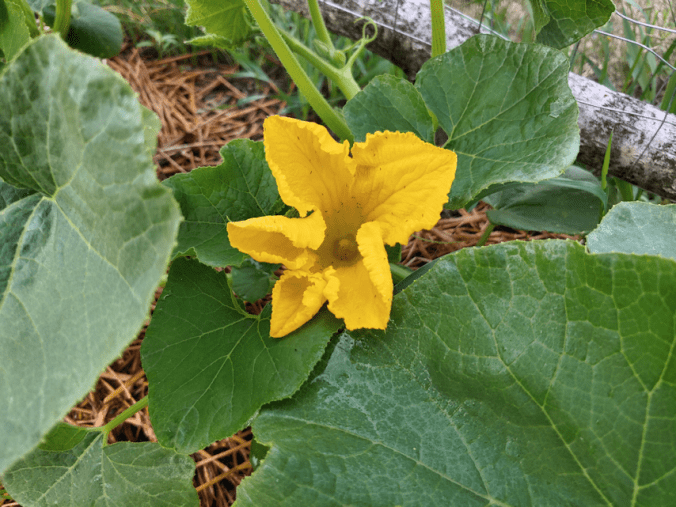
Crespo Squash
Crespo Squash blossom
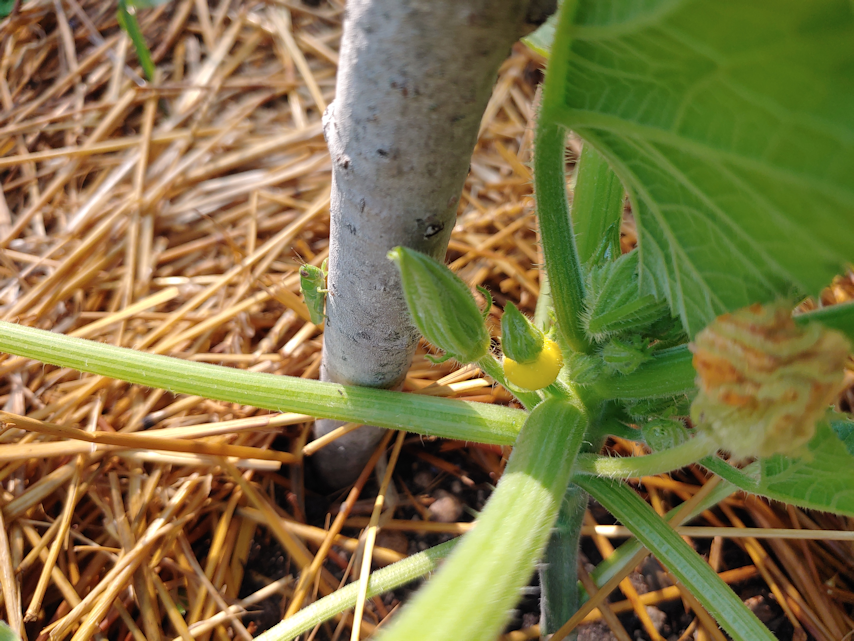
Here we have our Crespo squash. This is another one we weren’t sure would work – and I’m still not sure we have a long enough growing season for them, even with starting them indoors. They seem to be doing very well, though, and one of them is starting to bloom quite nicely!
and now, the summer squash!
Summer Squash
Magda
Endeavor Zucchini
Sunburst pattypan squash
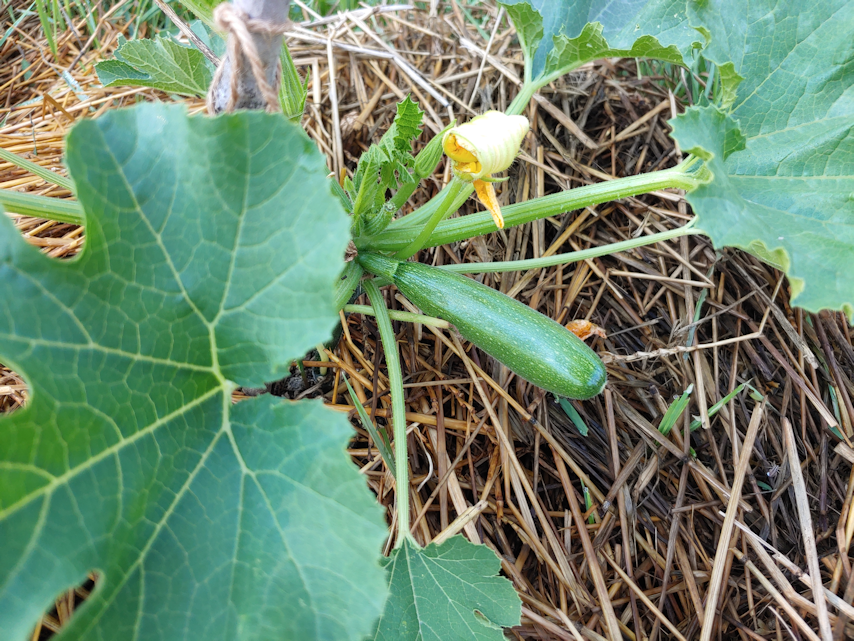
This morning, I finally saw some little Sunburst squash! They were our favourite, last year. We are also seeing the green Endeavor zucchini, and the lighter green Magda squash. Still no sign of the yellow Goldy zucchini.
This year, we are trying to grow them vertically, but not all of them are big enough to tie to the stakes yet. But we’ve already got squash forming on those little plants! I am so excited by these! :-D
Winter Squash
Here we have our two varieties of winter squash, Little Gem and Teddy, both chosen for their shorter growing season and smaller size. They look like they are doing very well in this heat wave, too! They’re not big enough to train up the mesh, yet, but I do see some tendrils forming on some of them.
Mystery squash
Then there are these mystery squash, growing out of the old compost pile. We think they might be from the pumpkins we tried to grow last year. Hopefully, they’ll grow well enough that we’ll find out!
Mongolian Giant sunflowers
Hopi Black Dye and Mongolian Giant sunflowers
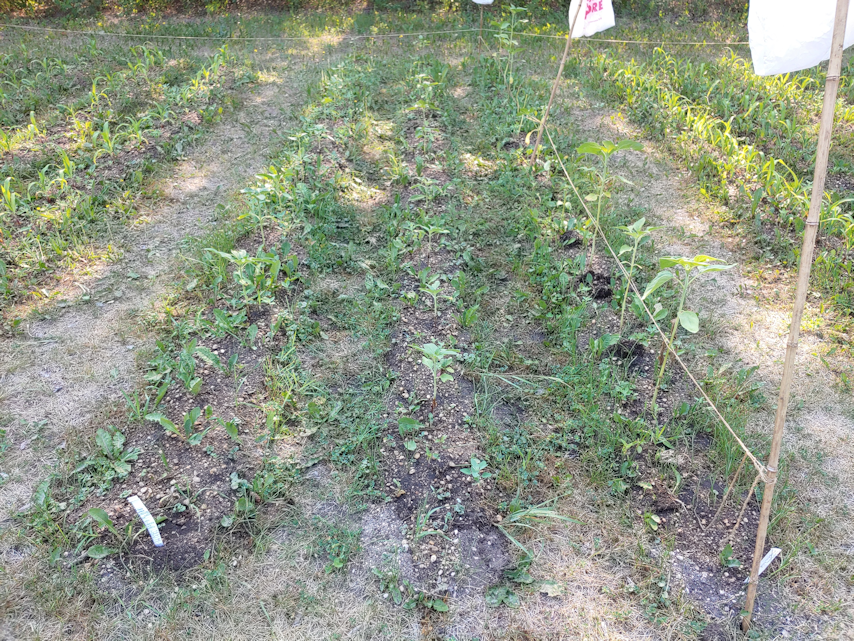
Here we have our sunflowers, in between blocks of corn. The corn are from a collection that included, Early Eh, Montauk and Sweetness. I didn’t bother taking separate photos of them. They are doing remarkably well, considering the poor conditions in this temporary location.
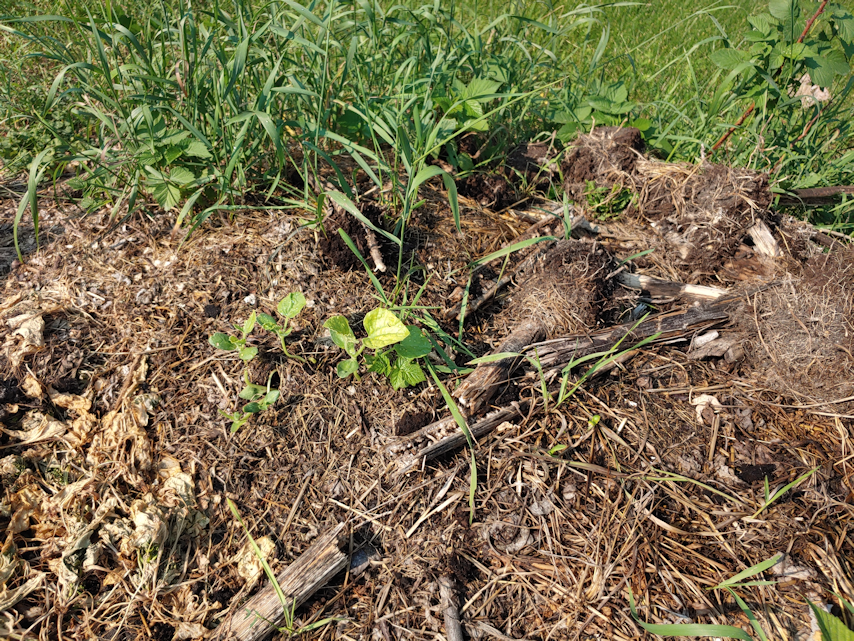
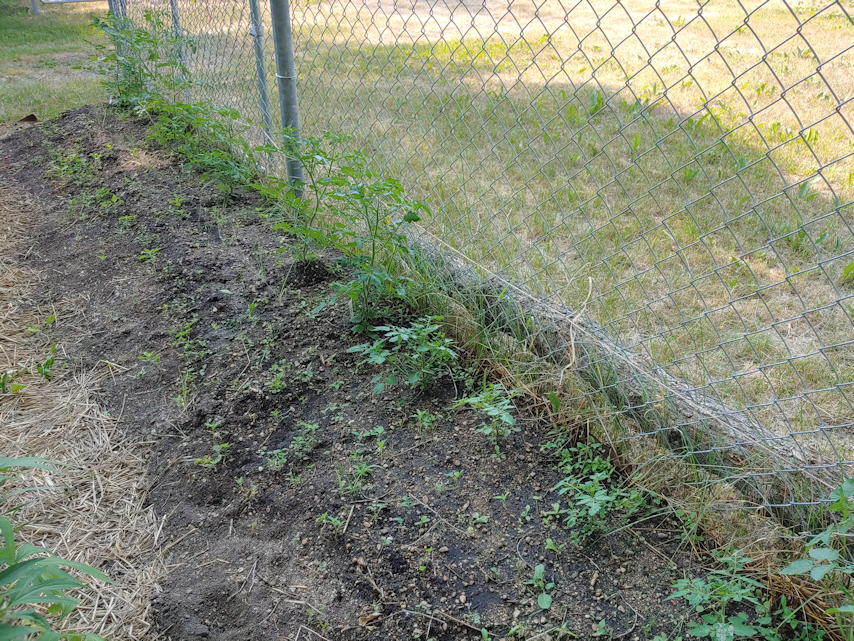
The sunflowers that are supported by twine are the Mongolian Giant sunflowers we started indoors, then transplanted. None of the Hopi Black Dye we started indoors had germinated… until they finally did! Long after these were done, which is why they are now planted near the Dorinny corn. Aside from losing a few to deer, I think they are doing well. At least as well as can be, in these conditions, and surrounded by weeds! Last year, none of our giant sunflowers reached full maturity before the first frost hit. I’m hoping at least the transplanted ones will have the time they need. If not… well, they make a good privacy screen.
If all goes well, we will be planting our first nut trees in the area next year.
Mosaic Mix cherry and grape tomatoes
Spoon tomatoes
Here are our wee little tomatoes! The teeny Spoon tomatoes have fruit developing already, while the Mosaic Mix is still just blooming.
In front of the Spoon tomatoes, you can see tiny wisps of onions. Those are the Red Baron bunching onions, from a very late start with the last of the seeds, indoors. In front of the Mosaic Mix, we have little Norstar bunching onions, again a late planting of the last seeds indoors. Starting these were a bit of a Hail Mary, and I doubt much will come of them, but hwo knows? :-D
Here we have a bit of a mish mash.
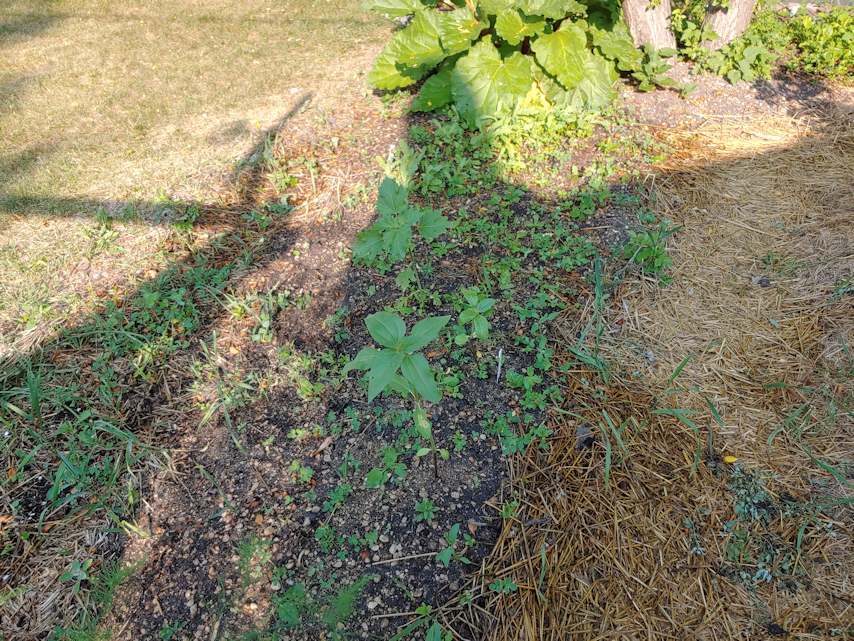
The photo on the left is where we seeded the Giant Rattle poppies. They came up in patches, mostly beside the rhubarb in the background (which predates us living here!). At the tip of this triangular bed, my daughter planted an iris that was shipped for spring planting – only to get hit by that late May frost, which killed it off. Other irises were planted in a trench along the south side of the old kitchen garden. One type has come up. They are hard to see, but several are by the laundry platform in the middle photo, with a few along the edge in the left photo. The ones planted in the trench towards the rhubarb never came up at all.
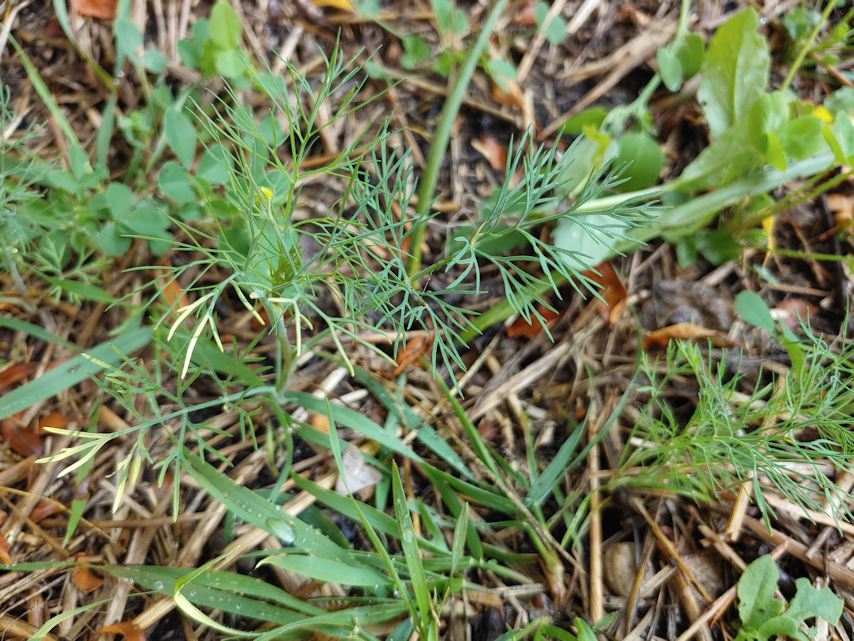
However, while trying to weed the area, I noticed something. You can barely see one in the photo on the right.
Dill!
All in a row, along the edge of where the trench to plant the irises last fall was dug!
We did not plant any dill. In fact, we have not seen any dill coming up since we moved here!
My guess is that, in digging the trench to plant the bulbs last fall, any dill seeds in the ground were brought closer to the surface, and this year, they could germinate.
I’m letting them be. We were intending to plant dill eventually, anyhow! :-D
Not pictured: our spinach beds. Because they’re all harvested and the beds are empty right now. The three varieties of spinach were a huge success, even with loosing some to deer. We will be sowing more in late July, for a fall crop. :-)
Also not pictured are our little pumpkins, Baby Pam. None germinated. We have seeds left over, though, so we can try again next year.
Also, also not pictures. The radishes we interplanted with the Peaches ‘n Cream corn blocks. They germinated, then disappeared, and we have no idea what happened!
That is finally it!
And now I hope I can actually publish this. I’ve lost internet over and over while trying to write this, almost lost the entire post while the editor was stuck on “autosaving” – and now it’s stuck there again!
I might have to do some browser magic to save this post and finally get it published… more than 4 hours after I started!
If you’re reading this now, I succeeded, and didn’t give up in a fit of rage. LOL






































 The Re-Farmer