After sitting overnight, tucked away in the oven, it was time to take out the cheese and do the final steps.
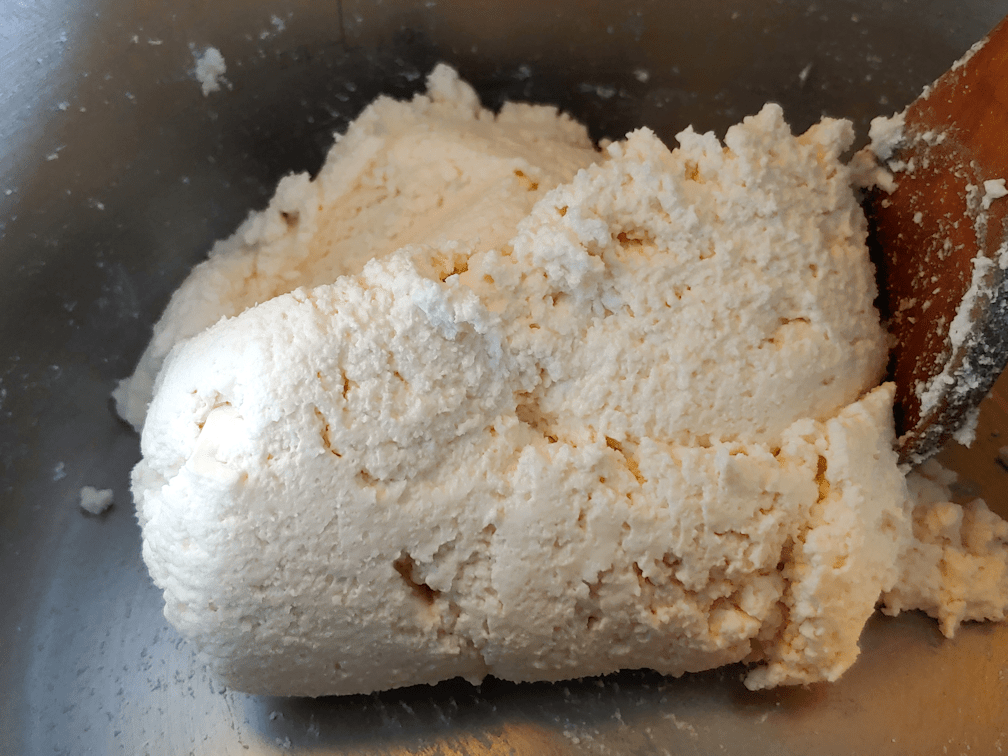
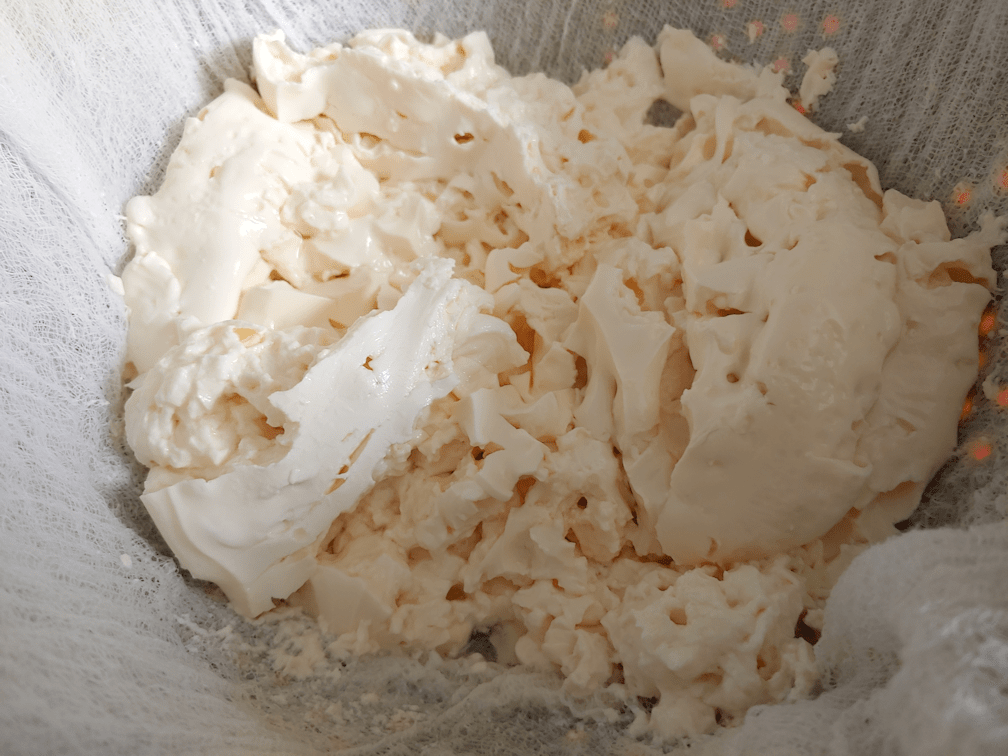
This is what it looks like this morning, after stirring.
It… looks like dry cottage cheese.
The next instructions were:
Add salt to taste, if desired. Add colour if desired. Add herbs/spices, if desired.
For this first attempt, I am only adding salt.
If you look closely, you can see the salt on the curds in front of the spoon. My mother would have just plain table salt, since that’s what she would have had. I stole some of the powdered salt my daughters use in the popcorn pot. It’s just coarse salt that has been run through a coffee grinder, so it can be added to the oil that popcorn is popped in, and actually stick to the popcorn as it pops. That got very thoroughly mixed in while I started the next step.
Put to frying pan on low heat, in batches, and heat. Mix while heating.
The more the curd got mixed, the more dough-like it got in consistency.
Then, it actually started to melt!
I know that’s what my mother said, but I still felt surprised by it!
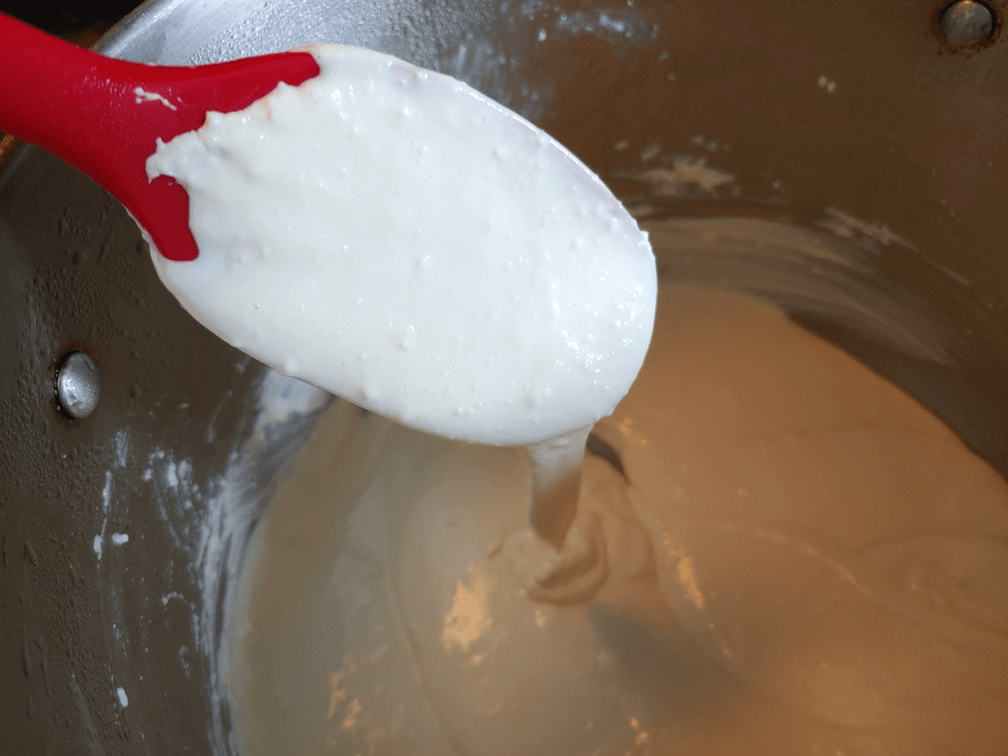
I even had to change spoons. By this stage, the texture was a bit like cake batter.
When melted completely, pour into form.
I didn’t know how long it needed to be stirred, but my mom said to pour it, so I just kept going.
Just look at this! It really did get to a pour-able consistency, unlike any other cheese I’ve ever worked with! At this stage, it was like well stirred sour cream in consistency.
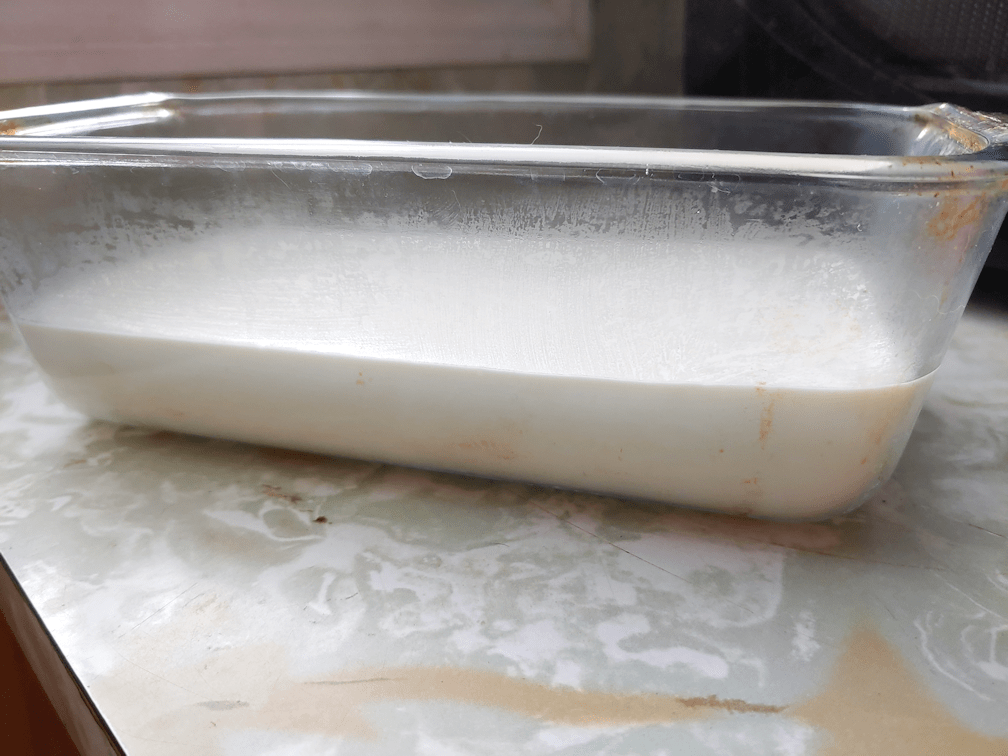
I then poured it into a loaf pan I’d scalded and had ready. This level if what 1 gallon of milk was reduced to.
Leave to rest until cool. When cool, ready to slice.
This is the stage we are at now. I covered the loaf pan with a narrow wooden cutting board I have. I considered covering it with plastic wrap, but I wasn’t sure I wanted the condensation build up, and the board would keep the dust off while also allowing a bit of air.
I’m hoping that, as it cools, it shrinks a bit, so it’ll be easier to remove from the loaf pan.
I did taste it after pouring it into the mold (I admit it. I licked the spoon!). The salt definitely improves the otherwise bland flavour. There is another flavour in there that I just can’t identify or describe. I’m hoping after we do a taste test, later, someone in the household will be able to describe it!
Okay, so the curds have been hanging for about 5 1/2 hours, and I’ve moved on to the next steps in trying to recreate my mom’s cheese.
Now, my Mom had said to just set it aside for a few hours, or overnight, so hanging it may have changed things a bit. I don’t know. But this is what it looks like after hanging for most of the day.
Also, it’s a good thing I covered the whole set up with another cheesecloth, because the cats REALLY wanted to get at this!
The next instructions are:
Put solids into large pot. Add about 1 tsp baking soda and mix thoroughly. Leave overnight. Will rise like bread.
Hmmm.
Looking at how little there is in here, I’m starting to think that my original notes, saying about 5 gallons of milk, was accurate. There is not a lot in here, and when I saw my mother’s cheese, it filled an ice cream bucket, so there’s no way it was only 1 gallon.
Which means I’ve been using the quantities for vinegar and baking soda for 5 gallons, not 1 gallon. Yet, 1 tsp of vinegar to sour 5 gallons seems like way too little. Mind you, she would have been making this in the summer, and the milk probably would have soured quickly, with no vinegar at all. Knowing she was pretty loosey-goosey on the quantities to begin with, it’s really hard to know. Considering how long it took to sour using 1 tsp of vinegar to 1 gallon of milk, I suspect it’s actually the correct amount, and that I would have needed more, if I were using more milk.
This is after very thoroughly mixing in the baking soda. Yes, I used 1 tsp for this amount.
The curds feel like a cross between cream cheese and cottage cheese. I spent quite a bit of time mixing it, because I wanted that baking soda to be worked in as much as possible.
My mom said to leave it overnight, which means she would have just left it on a counter, but I have put the covered pot into a warm oven, because of how chilly that part of the house gets.
She commented that it will “rise like bread.” That makes sense, since we should be seeing a chemical reaction between the acidic milk soured with vinegar, and the alkaline baking soda. It’s something I’m used to when working with sourdough, but with cheese? I did get the sense that the curds were starting to feel “fluffier” by the time I finished stirring in the soda, but that could be just my imagination because I am expecting something like that.
I did taste the curds before and after adding the soda. As I mentioned before, it has very little flavour right now, but I did feel that the baking soda … softened… the flavour, if that makes sense.
After it has sat for the night, salt, colours and herbs and spices can be added. For this first attempt, I will be adding some salt, but that’s it. If we make it again, we’ll experiment with adding herbs and spices or whatever.
I am incredibly curious to see what it looks like by morning!
Growing up here, as a subsistence farm, we had cows for milking and for beef. Even with 7 of us, we were milking enough cows to have excess milk. I remember my mother making cottage cheese (which I did NOT like), but that was the only type of cheese I saw her make until some years after I’d moved off the farm. I’d come out to visit, and saw some semi-hard cheese in an old ice cream bucket for a form. It was slightly harder than a cheddar, sort of tannish yellow in colour, with caraway seeds in it. It was quite tasty. I asked my mother about it, and she said she had made it.
A few years ago, I asked my mother about how she made this cheese I remembered. Unfortunately, she thought I was talking about cottage cheese, and the more I described it, the more perplexed she was.
After moving here, I was having a conversation with my mother about making and preserving food, when she mentioned a cheese she’d made. It was the one I remembered! I quickly took advantage of the moment, and got her to describe to me how she made it. I knew it had to be different, because my mother did not have access to rennet or any of the bacterial starters. She didn’t have a food thermometer, either.
Getting any sort of information like this from my mother has always been difficult. I remember the first time I tried to get a recipe for a soup she made. I remembered some of the ingredients, and asked her if she remembered how she made it. Instead of answering me, she started mocking me for not knowing how to cook and not knowing how to make soup. Never mind that I was already married and a child, by then, and had been feeding the family just fine.
I never did find out how she made that soup.
This time, I did manage to get the information down then, after I got off the phone with her, re-wrote it into more cohesive instructions, since the conversation bounced all over the place. When I was finally ready to try it, I was perplexed by some of the quantities, so I called her to clarify. Did she really start with 5 gallons of milk, or did I make a mistake writing it down?
Finding out was like pulling teeth! She kept avoiding answering the question, and kept saying, “you mean you’ve never made cheese before?” in total shock. Then giving me instructions on how to do different parts. I kept going back to the quantity, and asked her if she had used 5 gallons, only to be told how I should just use one gallon, because 5 gallons is such a lot… *facepalm* Then she talked about how she’d never made it using milk from a store, and how I could use lemon juice instead of vinegar, and on and on. It took a while, but I managed to explain that I have made cheese before, I did only want to use 1 gallon, and if the instructions I had was for 5 gallons, I’d have to know that, so I could adjust the other quantities.
What it came down to is, my mother never measured. She used whatever amount of milk she had, and went from there. I did know that. What I needed was some sort of approximation, because there is a heck of a big difference in quantities involved.
Finally, she told me she used about 1 gallon.
*sigh*
Once I had that clarified, I finally got a batch started. Here are the instructions I got from her, highlighted in blue, with my own commentary.
Milk – about a gallon Add 1 tsp vinegar to make sour. May take all night.
This part actually ended up taking almost two days. The milk was supposed to rest at room temperature, but with how cold our house is – especially the kitchen – I put it in a warm oven.
When sour, put in pot/roaster into oven to warm (lowest heat) until forms curds and whey.
We finally reached that stage this morning.
This is how it looked.
I have no idea if this is how it’s supposed to look.
Drain through cheesecloth.
There is nothing about cutting the curds or anything like that, first. Just to drain it.
I did give it a taste at this point. It doesn’t have much flavour to speak of. The texture was a lot denser than I expected it to be, considering how it broke apart.
Set aside for a few hours or, preferable, overnight.
This is the stage we’re at now, though I’m cheating a bit. I dug out the stand I made to hang jelly bags or drain yogurt cheese, tied off the cheesecloth and hung it.
After taking this photo, I covered the whole stand and bowl with another cheesecloth, to keep out the dust and cat fur – and cats!
Since I got to this point so early in the day, I will likely continue after a few hours, rather than leaving it overnight, because…
Put solids into large pot. Add about 1 tsp baking soda and mix thoroughly. Leave overnight. Will rise like bread.
… it will sit overnight again, after this stage.
As for the whey, I think it’s time to do some more bread baking! I love using whey as the liquid. It adds so much flavour!
The next instructions have me wondering.
Add salt to taste, if desired. Add colour if desired. Add herbs/spices, if desired.
This is all stuff that’s supposed to be added after the baking soda gets added, and after it rests overnight. Which seems odd to me, but that’s how she did it, so that’s how I’ll try it!
Put to frying pan on low heat, in batches, and heat. Mix while heating. When melted completely, pour into form.
… melted?
It can melt at this stage?
I am really perplexed by this.
I’m not sure what I’ll use as a form just yet. It will depend on what I see when the time comes
Leave to rest until cool. When cool, ready to slice.
If I hadn’t see my mother’s cheese, I would never guess that these instructions would get that result. As it is, I am still unsure of what I’ll actually get!
So this should be an interesting experiment. I hope it works, because it’s really easy to make, even if it does get spread out over several days.
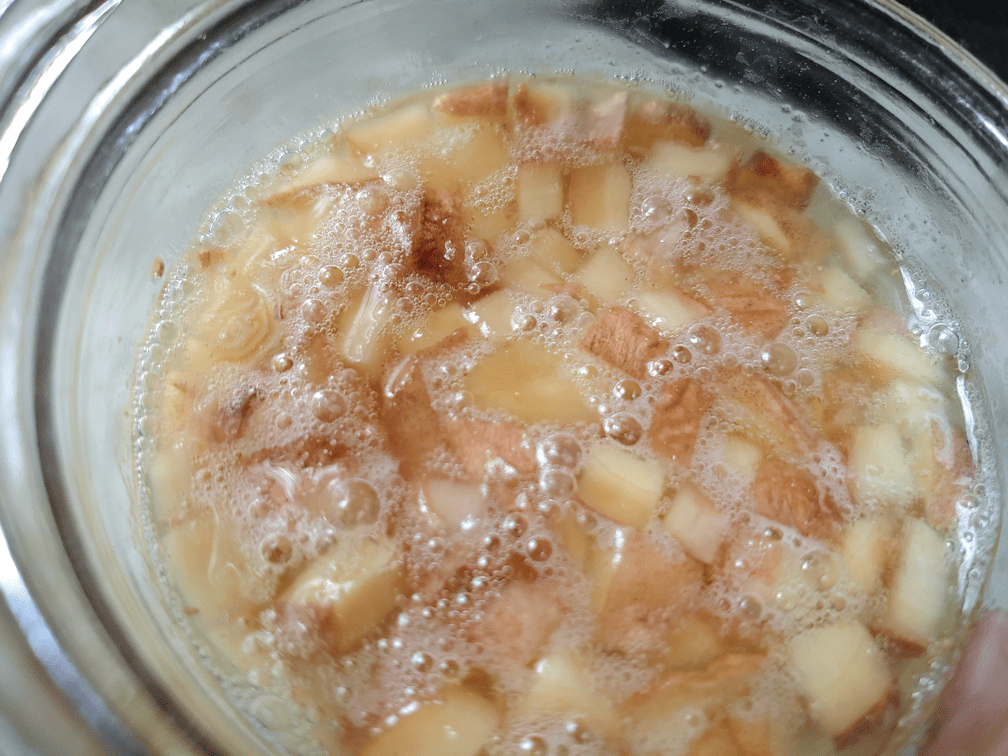
Well, we are into our third day of starting our ginger bug. It got its third feeding last night, and third morning stir today.
Look at those bubbles!
While researching how to make this, I saw sites that said it could be used after three days. Others said to wait four to ten days. All seemed to agree that it could be used once it starts bubbling.
Which means we should be able to start fermenting some pop, any time now!
I picked up some cranberry-raspberry juice to try first. There should be enough for at least two or three 8 cup batches. The recipes I’ve been reading said to use 7 1/2 cups juice to 1/2 cup ginger bug. Eight cups is not a lot, though.
Time to go back over the various instructions I’ve found and confirm the next steps we need to take. Then I have to decide on what container to use. Depending on what we go with, we might do a double recipe. We shall see!
Thanks to my wonderful daughter taking over for me, yesterday, we had a couple of fresh loaves of bread to try this morning.
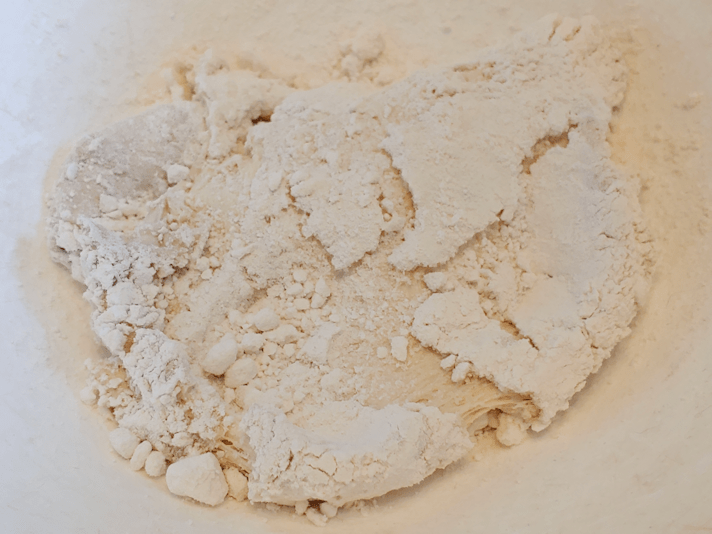
I’d started by having the dough baby soak overnight, then added flour to make a sponge. After several hours, this is what the sponge looked like.
My daughter set aside half of this, then used the remaining sponge to make our basic bread. Instead of using loaf pans, she made two big, flat loaves on a baking tray. Here is what I used for breakfast, this morning! :-)
The bread had a very mild sourdough flavour. For all the months the dough baby sat in the flour, it did not get any stronger in flavour. It was mild enough that I could put them with slices of brie under the broiler, and the flavour of the bread did not overpower the flavour of the cheese. The bread had a very nice texture to it, too.
As for the sponge that had been set aside; my daughter had used the flour from the dough baby’s canister in the bread, but there was still some left. I kneaded some into the sponge to make a stiffer dough, then refilled the canister half way with fresh flour, added the bough baby, then topped it with more flour. The canister is semi-transparent, so when I checked on it an hour or so later, I could see the dough baby had risen enough to work its way through the flour, so I gave the canister enough of a shake to cover it up again. With our temperatures slowly cooling (though I saw a 30C day in the forecast!!), we’ll be using this more often, which should further develop the flavour.
As someone who has never managed to keep a sourdough going for more than a couple of years, I really appreciate how low maintenance the old dough method is. If we can’t going to bake as often, it’ll just stay in its flour bed and dry up. It doesn’t need to be constantly used, fed, stirred, or kept warm. I think this will work out really well for us!
We meant to bottle these months ago, but time and space and other priorities kept delaying things.
Today, I finally broke down and did it.
Well. Half of it.
We didn’t want to use corked wine bottles for this, so we’ve been saving up our screw top bottles for a while now. Only recently did we get enough to bottle the hard cider, anyhow. We just don’t buy wine-bottle sized things very often. I suppose that’s a downside of our buying habits. Not a lot of materials left over to reuse.
I only did one of the two carboys we had fermenting. They are 3L each, so I needed at least four 750ml sized bottles. After sterilizing them, I didn’t siphon the cider into them. I have problems with using the siphon. We don’t have an auto siphon, and have not been able to find one that will fit in anything smaller than the large carboy that came with our wine making kit, so it’s gotta be done old school. I always end up disturbing the sediment, and splashing all over when moving from bottle to bottle, so today I just gently poured it from the carboy through a sterilized funnel.
For the last bottle, I added a coffee filter to the funnel, just in case.
It actually worked out MUCH better than fighting with a siphon. Not only did I barely disturb the sediment at all, but there was no mess. I’m sure I committed some major faux pax by not using a siphon to fill from the bottom up, and getting all that air in there, but… it is what it is. I still wiped the bottles with vinegar water, but there really wasn’t anything to clean up.
Of course, I then had to do a taste test!
This was poured from the partially filled bottle, so if there was any sediment that got through, this would be the bottle that has it.
As you can see, it is very clear.
There is a very strong smell of alcohol from this, but you can also really smell “crab apple” as well.
I just love that colour! Sadly, it doesn’t look like we’ll have many crab apples at all this year, never mind from this particular tree with it’s very red little apples, so we won’t be making more hard cider, nor cider vinegar, with our crab apples this year.
We still have the second carboy to bottle, though, and that will leave us with hard cider to last us a while.
Ah, but how does it taste?
The first thing that hits is SOUR! This is a remarkably sour cider! Not a bitter kind of sour, though. It really wakes up the taste buds. I think this would be good with game. Or with a really strong flavored dessert.
For all that it smells of strong alcohol, there isn’t a strong alcohol flavour. I don’t actually enjoy the taste of alcohol, but I can drink this. And yes, there is a light, fruity apple taste, too.
I find myself thinking this would be nice with a spot of sugar or honey added to it. Perhaps I’ll try some with a bit of our vanilla sugar added. Or to include it in a fruit punch.
I did not take a hydrometer reading. I wasn’t up to digging it out this time. Based on previous readings, it was just under 11% alcohol. After tasting it, I would not be surprised for that to have remained unchanged. This is strong stuff, even if it does take a while to feel it!
This is definitely a “sip it slowly” kind of drink.
It should be interesting to see if the flavour changes after they’ve had a few days to rest after being bottled without a siphon.
Well, we had at least one good thing happen today.
I was able to finish the chive blossom vinegar.
The bottle has had two weeks in the cupboard to infuse. Any time we went into the cupboard for something, we’d turn the bottle upside down a few times, to get the blossoms out of the bottle neck and mix with the vinegar.
I was curious how the colour would turn out. The site I’d found instructions on had a final product that was bright pink. I used white wine vinegar, though, which is pale yellow.
The final colour is quite dramatic, isn’t it?
After straining the vinegar, the bottle got cleaned and scaled, the vinegar added back, and we replaced the little plastic thing in the top, that controls the flow of vinegar when pouring.
We haven’t tried it in anything yet, but the smell of it is absolutely fabulous!! I can’t wait to try it!
A while back, we tried a recipe for overnight bread, which you can read about here, and find a link to the original recipe we used.
I then tried an “over day” version, using the dough baby from my Babcia’s bread experiment. It was fantastically successful!
We’ve made it again, as a pretty basic no-knead bread and, once again, it turned out awesome!
If you are new to this blog and don’t know the background to this, you can read the story behind my experiment to try and recreate the bread my grandmother made in pre-WWII Poland, as my mother remembers it. Or you can check out all the posts about it at this link. All links will open in new tabs, so you don’t lose your place here!
Here is how we made No-knead bread, using the old dough method.
The first step is to dig the dough baby out of the flour it sleeps in.
My Babcia did bread baking once a week, and when the old dough sits that long, it tends to be dry enough to break apart into pieces before reconstituting it. This time, the dough baby had not been sleeping in its bed of flour for that long, and it was still quite… doughy! :-D
So I just pulled it apart a bit and placed it in the bottom of a very large bowl.
I don’t know how much that is. Maybe about 2 cups, including the flour stuck to it? The dough baby rises and collapses while stored in the flour, and I made no effort to measure the quantity.
I also pre-measured 2 Tbsp each of course salt and sugar, and 1 Tbsp of yeast.
The yeast would be optional. The dough would need more time to rise without it, which would give more of a sourdough flavour.
Four cups of very warm water was added to the dough baby. Since it wasn’t dry enough to break into pieces, I spent some time stirring it and breaking it up in the water.
Then, the sugar and yeast was added and mixed in, the bowl loosely covered, and it was left for about 10 minutes.
I like to use traditional active dry yeast, rather than quick or instant dry yeast, but that’s just me. The traditional yeast needs more time to proof in the liquid compared to the quick yeast, and the instant yeast wouldn’t need to be added at all at this point, but would be mixed in with the flour.
If I were not using yeast, I would leave the water, dough baby and sugar mixture in a warm place for much longer, checking regularly to see how active it was.
Here is how it looked after 10 minutes. I stirred it again to break up the dough baby a bit more.
Then it was time to add some flour.
I started by adding 3 cups of flour. It’s easier to mix in that amount compared to starting with just one cup.
I decided to use Durum wheat flour at this point, just because I have it. Use whatever flour, or mix of flours, you like best!
After the first 3 cups was thoroughly beaten in, I added another cup of flour and the salt.
More flour was beaten in, about a cup at a time at first, then a half up at a time.
How much flour to use is something I’ve never been precise about. I know there are bread bakers that weigh and measure precise amounts, but in my experience, that just doesn’t work. The amount of flour needed can depend on things like how fresh the flour itself is, to how much humidity there is in the air.
With 4 cups of water, I would have expected to work in at least 8 cups of flour for this recipe (with my usual kneaded bread, I typically used 5 or 6 cups of flour to 2 1/2 cups liquid).
We are very, very dry right now.
Today, I worked in 7 1/2 cups of flour, and probably could have done with a bit less.
By this point, I was working the flour in with my hand rather than trying to stir it with a spoon. If you have an electric mixer with a dough hook, go ahead and use it!
Before setting it aside to rise, right in the same bowl, I sprinkled some flour over the top and sides, in case it rose high enough to touch the bottom of the bowl’s lid.
Lightly cover the bowl, then set it in a warm place for about an hour. With our chilly our kitchen is in the winter, I heated our oven to its lowest setting (145F on “warm”), then shut it off before I started mixing the flour into the dough. The covered bowl is left in the warm oven, with the light on, to rise. Anywhere that is warm and draft free will do.
Here it is, after an hour. It just barely touched the bottom of the lid! :-D
The dough it then pushed down and worked a bit to incorporate the flour that had been dredged on top.
Next is a very, very important step.
A piece of the dough needs to be removed and set aside for the next batch of bread!
I dumped some flour on a container and plopped about a cup of dough onto it.
Once the new dough baby was set aside, the rest of the dough was dumped onto a 9×13 inch baking sheet that was lined with parchment paper. The last time I made this, I used a parchment paper lined lasagna pan, but I could also have split it into two parchment paper lined loaf pans.
If I didn’t have parchment paper, I would have well oiled the pan, first.
Speaking of oil…
After spreading the dough out to fill the bottom of the pan, I stabbed at the dough with my fingers to create “dimples”, then topped it with oil, course salt and dried parsley flakes.
I happened to still have some fake truffle oil that I used, but an olive or avocado oil would work just was well.
The pan was then set aside for the dough to rise again. Since this batch is so flat and thin, I started preheating the oven for 450F right away. Had I used loaf pans or the lasagna pan again, I would have let it rise longer before preheating the oven. If I had used no yeast at all, it would be left in a warm place until doubled in size.
While the shaped loaf was waiting to go in the oven, there is this to deal with…
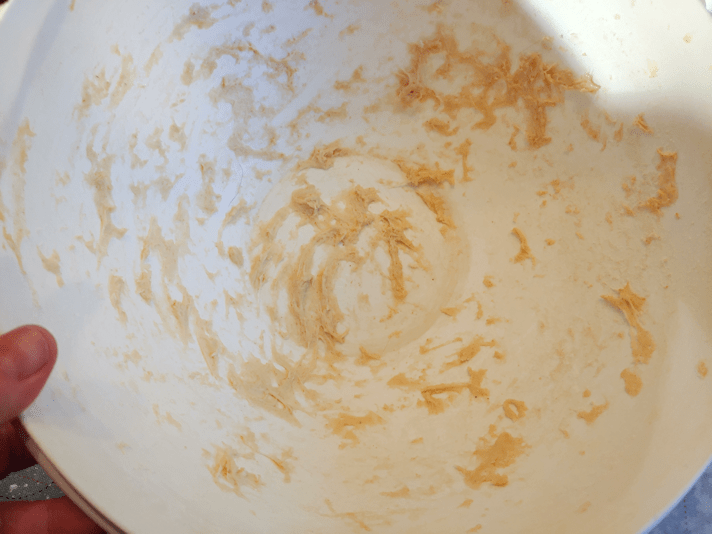
The bottom of the bowl still has quite a bit of dough stuck to it!
We can’t let that go to waste!
Into the bowl went the new dough baby, and the flour it had been resting on.
While working the flour dregs into the dough baby, scrape as much of the dough stuck to the sides and incorporate it into the dough baby.
You probably won’t get all of it off the sides, which is okay.
The dough baby is now ready for a nap. I have a canister of flour that I bury it in, but it can also be buried right in a bag of flour, as long as you’re not planning to use the flour for anything else in between bread baking!
After the dough baby has been buried, it will rise quite a bit before collapsing in on itself, breaking through the surface of the flour. Remember to check on the dough baby later on, to make sure it is still covered in flour.
Once the oven is ready, place the pan of bread into oven and bake. If you wish, place a container with about a cup of water on the rack under the bread pan, to add some steam to the oven as it bakes.
For a very flat loaf like what I made today, it took about 25 minutes. A deeper loaf, or a pair of loaf pans will likely need 30-40 minutes. Bake it until it looks like this.
With the oil added to the surface, it will have a deep, golden colour when it’s ready.
When baked, remove from the oven and left to cool for a few minutes. Once it is safe to do so, remove the bread from the pan and onto a cooling rack (parchment paper makes that job a LOT easier!).
I really like the big, flat slab of bread, but it is a bit hard to cut a slice off! :-D
Here is how it looks on the inside.
The crumb is light and fluffy, yet still wonderfully chewy. The star of the show, however, is that golden, flavorful top crust! It’s just a lovely and delicious combination of textures and flavours.
The only problem with this bread is how difficult it is, not to just scarf it all down right away! :-D
Here is the recipe.
Old Dough No Knead Bread
Ingredients:
old dough set aside from previous bread baking
4 cups warm water
2 Tbsp sugar
1 Tbsp traditional active dry yeast (optional, or use 2 Tbsp if you don’t have old dough)
2 Tbsp course salt
about 7 or 8 cups of flour
small amount of good quality oil (olive oil, avocado oil, etc.)
small amount of dried parsley and course salt
Break up the old dough into a large bowl. Pour water over the old dough and stir. Add the sugar and yeast and leave to proof for about 10 minutes. If you do not have old dough, use the larger amount of yeast and proof it in the sugar water. If using only the old dough and no added yeast, leave the bowl in a warm place until the mixture is bubbly.
After the yeast and old dough has proofed, add 3 cups of flour and mix thoroughly until it forms a very smooth batter. (An electric mixer can be used at this stage.)
Add the salt and 1 cup of flour, mixing thoroughly.
Add more flour a little at a time, mixing thoroughly after each addition, until it reaches a thick but sticky consistency. Use your hands to mix in the last of the flour. (If you have an electric mixer with dough hook attachments, switch to the dough hooks at this point.)
Leaving the dough in the bowl, dust the top of the dough with flour and cover loosely. Place in a warm spot to rise until doubled in size.
Prepare baking pans by lining with parchment paper or oiling thoroughly.
When the dough has risen, punch it down again, folding it into itself to incorporate the flour dusted on top.
Dust some flour on a small plate or bowl. Remove about a cup of dough for the next batch of bread, setting it aside on the floured container until later.
Pour the remaining dough into the prepared baking pan(s). Using your hands, press the dough to fill the pan to the edges and corners, then stab into the surface with your fingers to create dimples in the dough.
Carefully sprinkle oil across the surface of the dough, then use your hand to spread it evenly across the surface.
Sprinkle the oiled surface with course salt and dried parsley.
Set aside in a warm place to rise.
While the bread is rising, return the dough set aside earlier to the mixing bowl, along with any flour in the plate or bowl. Use the flour and the dough ball to scrape off any remaining dough stuck to the surface of the bowl, working the dough ball until smooth. Shape the dough into a ball, then bury it in a container of flour, for use in the next batch of bread.
When the pan of rising bread is almost doubled in size, preheat the oven to 450F.
Place the bread in the centre rack of the preheated oven; if desired, place about a cup of water in an oven proof container on the lower rack to create steam.
Bake until the bread is a deep, golden colour – about 25 minutes when using a 9″x13″ baking sheet, about 30-35 minutes if using loaf pans, or a cake or lasagna pan. The finished loaf should sound hollow when the bottom is tapped.
Set aside to cool in the pan for a few minutes, then transfer the bread to a rack to finish cooling.
Yesterday, I made another batch of bread using the old dough stored in flour as a starter. I did change things up a little bit, though.
One of the things about trying to recreate how my grandmother did this is, I’m relying on my mother’s childhood memories. There would definitely be things my mother never noticed, never saw, or simply doesn’t remember. In reality, my grandmother would have made do with what she had, so while their bread would certainly have been as basic as flour, salt and water, if she had had other ingredients, she would have used them. I know they would have made their own butter and rendered their own lard. They may even have pressed their own seed oil (my mother does remember processing hemp, so they likely had hemp oil, too). They likely had honey or some type of sugar, if only rarely. It’s hard to say, though, since my mother doesn’t remember very much of that, and none of my research so far has turned up more historical detail. There just isn’t a lot out there to describe how people in poor, backwater villages ate because, frankly, most of the people recording such things either didn’t know about them, or were indifferent to how ordinary people lived.
I do think that there is room to experiment a bit and still be pretty true to how Babcia would have done things, even if they were only on special occasions or when she happened to have access to ingredients.
With yesterday’s baking, one of the things I changed up was how long the old dough was left to soak in warm water. My mother says it was left overnight. My grandmother had a large lump of old dough, for her weekly baking of a dozen or so loaves, but I’m not working with such quantities. The amount I’d set aside from the last batch was the largest I’d done yet, and it was getting too big for my canister of flour. In fact, I didn’t get any pictures of it when I took it out, because there was just too much flour all over, it was bigger than the plate I’d brought to hold it, and I just broke it up into my crock right away.
When the old dough was left to sit in a warm oven overnight, it seemed to me that this was too long. It was no longer actively bubbling by morning. So this time, I decided to just let it sit for a few hours. I also added a small amount of sugar (about a tablespoon to 2 cups of water that had been boiled, then allowed to cool down to the right temperature) to feed the yeast. Last time, I supplemented with a bit of commercial yeast, but not this time.
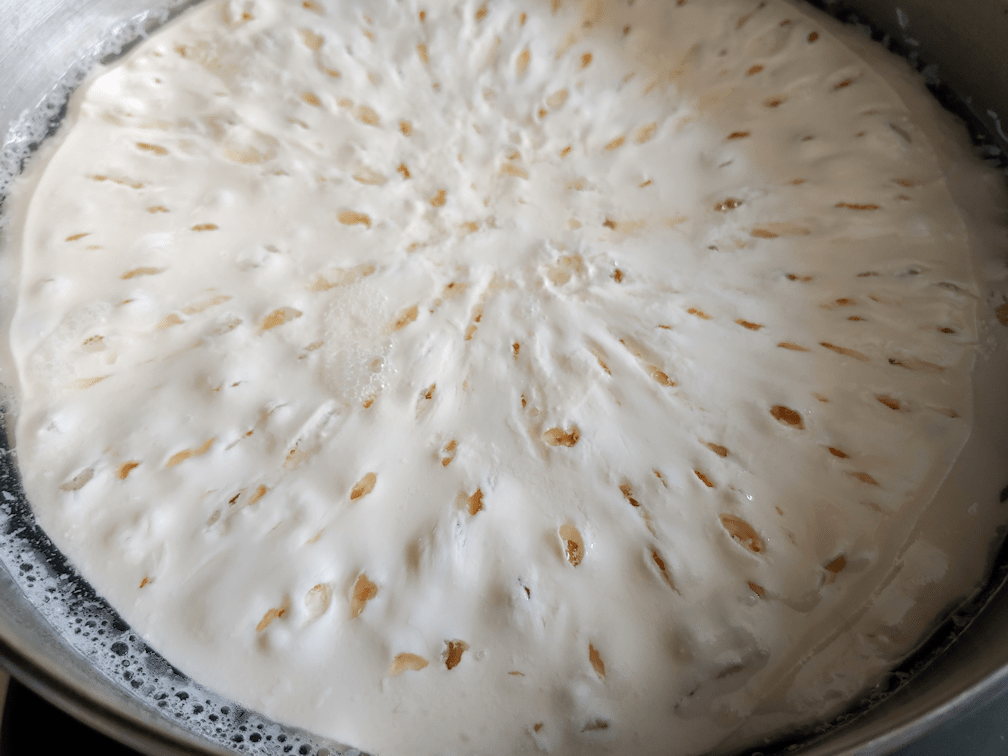
This is how it looked, after about three hours sitting in a warm oven.
Just look at how bubbly that is!
I did add a bit more sugar (another tablespoon or so) to the dough as I mixed it, too. No added yeast. This was a slightly larger batch than before, too. Previous batches used about 3 cups of water in total, to 4 or 5 cups of flour, but this time I used about 7 cups of flour to 4 cups of water. Then, after cutting away a piece of dough for next time, I tried something else.
I kneaded in a cup of thick cut rolled oats. This is something my grandmother would have had, at least sometimes, so I have little doubt that she would have included it, when it was available.
Normally, I would have added the oats at the very beginning, leaving it to soak in boiling water until it was cool enough that the yeast or sourdough started could be added. I wasn’t sure how that would affect the dough set aside for next time, though, so I left it until later.
I knew the flakes would still soften while the dough was rising, and it would add some texture, too. Kneading it in was a challenge, though! I deliberately left the dough stickier than I usually would have, just to make working in the rolled oats easier, and it was still trying to fly all over the place! LOL
Unfortunately, I completely forgot to take pictures after this!
The dough itself just did not want to rise! Yes, it was in a warm oven, but I’m using a plastic bowl (metal can react with sourdough, affecting the flavour, and this is pretty much a kind of sourdough), so I didn’t want to make the oven much warmer. It did rise some, and again as I formed the loaves, but even the smaller loaves didn’t rise as well. I really should be leaving it to rise for far longer, but it’s just to dang cold.
It does rise more while baking, of course, so that helps. The bread was still dense, but it did still have plenty of air bubbles in it. The rolled oats did soften up, as expected, while still adding a bit of nice texture and a subtle flavour.
Speaking of subtle flavours, there is most definitely a light sourdough taste developing.
I made a total of 8 small loaves out of this batch; 4 round loaves (basically just big buns!) baked in a cast iron pan, and 4 long loaves baked on a pizza stone. At 400F, the round loaves needed about 40-45 minutes to bake, while the long ones needed about 30-35 minutes. I have no idea how long my grandmother would have baked hers, since she had a masonry stove, and I don’t know what method she used to determine when the temperature was right.
As for the bread it self, it was quite tasty. I like the addition of the rolled oats. This morning, I cut one of the little long loaves into slices, pan toasted one side in butter, then topped each with a slice of mozzarella, for breakfast. It was very nice! It probably would have been nicer to broil the cheese, but I didn’t feel like fussing with the oven. :-D
Next time, I’ll have to remember to take pictures through the whole process. :-D
I was feeling lazy today, and wanted to make something quick and easy for supper, to go with the meatloaf I had in the oven.
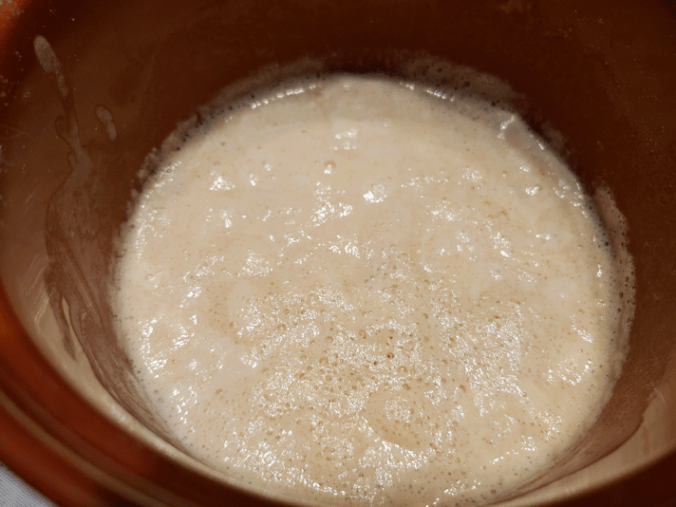
I decided to make kluski. Well. I suppose the proper name for them is kluski kladzione, since kluski is a generic Polish word for all kinds of dumpling type things.
These work up really quick, so start a large pot of salted water going, have a slotted spoon handy, and place a colander over a bowl nearby.
I finished mixing the dough well before the water reached a rolling boil.
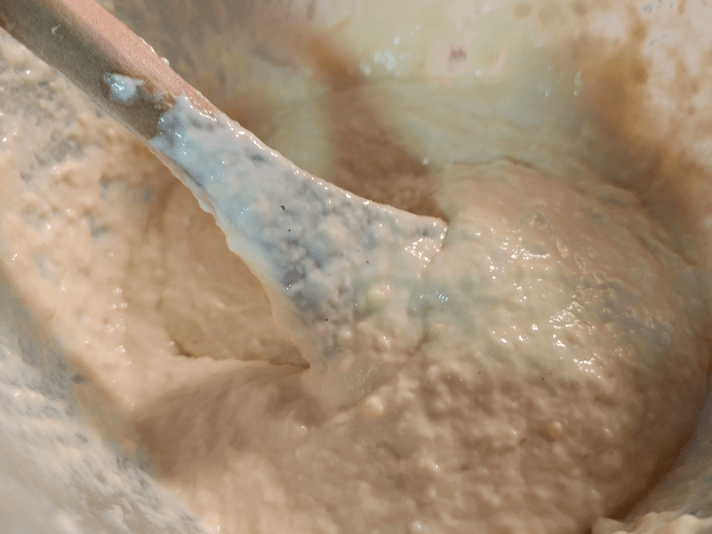
The recipe is simple. Three cups flour, three eggs, a bit of salt… (the recipe in the link above uses only two eggs, but I followed the quantities I got from a video I found, so things can be flexible)
… and enough water to make it a batter-like dough.
I use a little over a cup of water to get it to this consistency. It just needs to reach a consistency that’s almost something you can pour.
I mixed by hand, but an electric mixer can be used. I just didn’t feel liking something else to wash. I just kept beating it by hand until the water was ready.
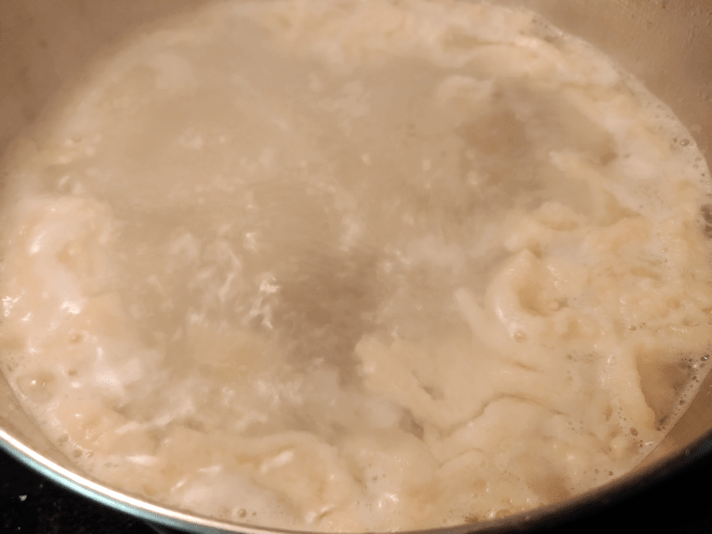
Traditionally, the drop noodles are made by putting some of the dough onto a plate, then scraping pieces off into the water when it reaches a roiling boil. Or, they can be dropped directly into a soup.
I didn’t want to wash a plate, either. I’d used an 8 cup measuring cup to mix the dough, so I just scraped small spoonfuls over the edge of the bowl, instead of the edge of a plate.
They cook up very quickly, too. The pieces I scooped out were pretty small, so they were done very soon after they all started floating on the top. I just gently stirred after dropping them in, to make sure none were stuck to the bottom.
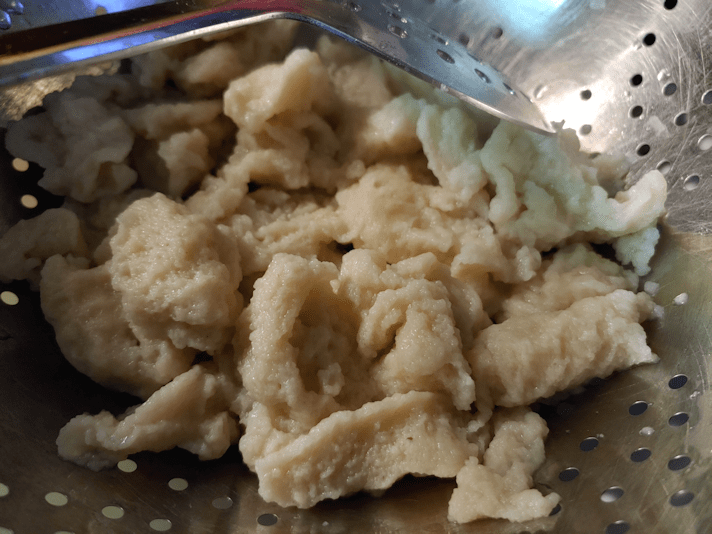
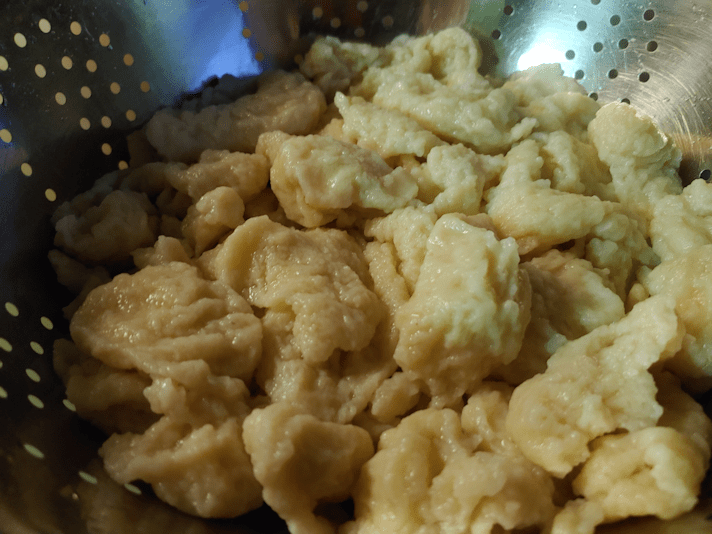
Once a batch was done (I did it in three batches), I used the slotted spoon to scoop them into the colander to drain.
They can be eaten right away at this point, just tossed with a bit of butter and seasonings. I decided to keep following the video I found, though. This next part isn’t necessary, but the video I watched did it, so I gave it a try this time, too.
I took the colander over to the sink and rinsed them with cold water.
They were then dumped into a hot pan with generous amounts of melted butter.
After frying for a minute or so, they were done and ready to serve!
Except my meatloaf wasn’t even done yet.
The resulting little dumplings have a soft, toothsome texture to them, and taste wonderful. I found I didn’t even need to add more seasons. Just the butter it was fried in was enough! Unfortunately, my meatloaf did not turn out all that well, but at least I had delicious kluski!
This is the video I found, when confirming my quantities to make these. I think Grandma Lipinski is adorable!


















 The Re-Farmer