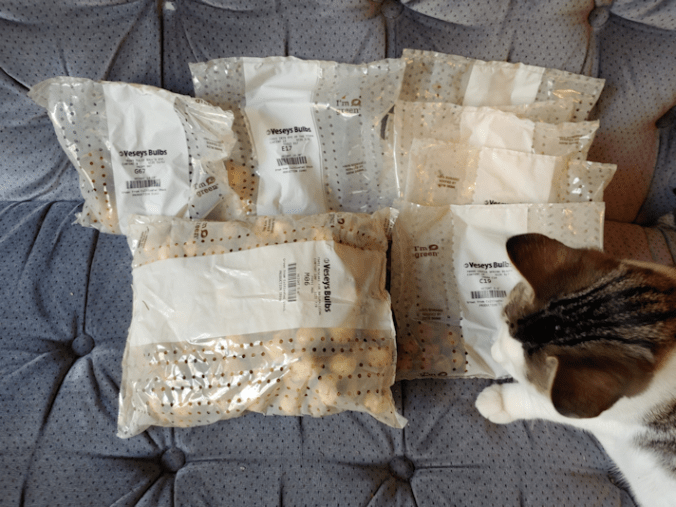
A package I was expecting next week, came in today! Our first shipments of bulbs for fall planting.
Which the cats found very, very interesting…
That’s better!
Mostly. :-D
We’ve got 2 packages of Muscari (grape hyacinth) of 100 bulbs each. There are 5 bags of crocuses. I believe we were planning to mix these all together and plant them randomly. There are also an iris and tulips. We still have some on back order, including a fall garlic mix. The long term weather forecasts show no temperatures dipping low enough for frost over the next too weeks. Hopefully, the rest of the order will come in before things start to cool down that much again.
Yesterday was a day of running into town a couple of things, but I did manage to get one important – if rather late – job done in the evening.
I burned a fungus.
I really should have done it earlier in the year, but just didn’t have the chance until last night. Mostly because of winds. Yesterday evening was finally calmer. The fungus seemed to be growing anew on the remains of a stump, so I really wanted to get that burned away. Because this was under tree branches, I used the sheet of metal to prevent the flames from getting to high, even though I kept the fire small. It ended up being handy. I found that, by moving it around, I could basically direct the fire to around the stump area more easily, making sure to get all the fungal bits.
I had found the fungus almost a year ago, while taking photos of various mushrooms around the yard. The ones growing on the old apple tree stumps were so pretty and unusual, I looked them up – only to find out they are a deadly disease called Silver Leaf, and likely what is killing our crab apple trees. To get rid of it, at its worst, it is actually recommended to take out the tree, roots and all. I have no way to take out the roots – and this stump is in between two other trees, which are so close together, I wouldn’t be able to do so without damaging the other trees, anyhow.
The larger stump I’d burned earlier shows no signs of growth on it. I still need to burn it the rest of the way down to ground level, just because it’s sticking up so high. I could cut it flush to the ground, but this way, I can also burn the stack of diseased branches we’d pruned away, too.
Reading up on this disease again, I find myself thinking of the fruit and nut trees we intend to plant in the area, in the relatively near future. We might have to get brutal to eliminate the disease, and simply cut down any tree that shows signs of the disease. This includes inedible crab apple trees closer to the house, where several have already died. Even the plums (also an inedible variety, but one that my dad used to make wine out of) show signs of it.
*sigh*
That would be a job for next year. For now, we will just burn away what we can, including the pruned branches.
This morning, I headed over to do a meter reading on our power pole. I’ve stayed away, since it’s got a wasp nest under it, so I haven’t actually looked at the nest for a month.
Hhhmmm.
It… looked pretty quiet in there.
Was that spider webs I was seeing in the opening???
Yup.
There was a dead wasp in the opening, too.
I am guessing this nest, being as exposed as it is, did not survive that frost we got not long ago. The tree by the house is still buzzing, so the wasps inside it are still active, but I can probably remove this nest safely, now.
I don’t want to destroy it, though, so I’ll think about how to take it down with as little damage to the nest as possible. I should be able to peel it away from the box and the post easily enough. That power cable it is built around will require greater care.
There was also a snoozing moth next to it! :-)
In other things…
The reason we had to go into town a couple of times yesterday was because the girls had arranged for a vet visit for Leyendecker. The boy is now snipped!
It still blows me away how expensive it is to get that done – and it costs twice as much for females! Thankfully, the girls are taking care of that, as they are able.
I took advantage of being in town to pick up some scrub brushes, including for just outside stuff. This morning, I finally was able to give the outside cat water bowls a thorough scrubbing. I was even able to scrub the bird bath. I’m amazed we got another year out of that thing! It developed such big cracks in it over the winter, and yet it still holds water!
Oddly, this year I have found a couple of drowned frogs in it. We’ve been seeing a lot of little frogs in the garden plots this year, which is great, but why would we have drowned frogs in the bird bath? I keep a brick in it, so the smaller birds can more easily reach the water. Plus, with all those cracks and not expecting it to hold water very well, I haven’t been keeping it as full as I used to. Any frog should have been able to get out of the water, easily.
I’ll have to keep a closer eye on it, now that I’ve cleaned it and refilled it. So strange!
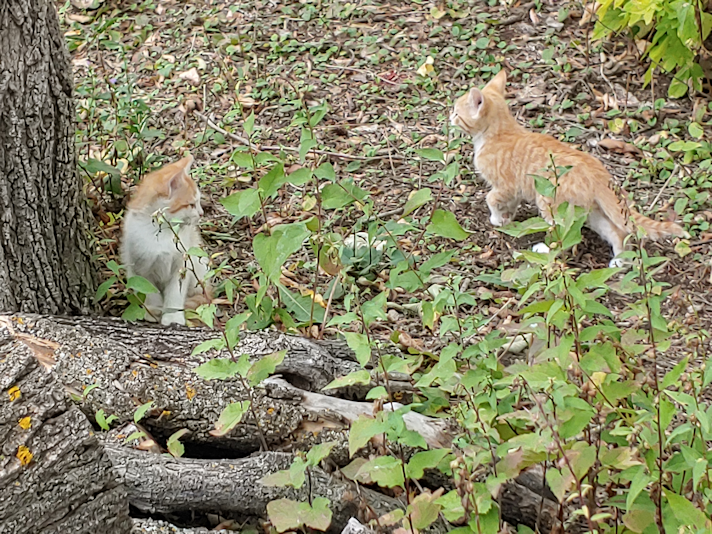
Yesterday evening, while doing my rounds and walking around the back of the house, I startled some babies!
Butterscotch seems to have moved her kittens from the junk pile to under the garden shed.
Her kittens are getting so much bigger and more adventurous, wandering further afield in the yard.
I suspect this has something to do with why Butterscotch as moved them. Wherever they are inside the junk pile, it must be getting a bit tight for her and the 4 of them to fit!
Which means that, with the wasp nest gone and the kittens elsewhere (though they do go back to the junk pile to play), I can continue cleaning up in that area.
Now, if only Butterscotch had been willing to move them to the other side of the house, where the food bowls and the old dog house are!
When topping up the kibble, I put one of the containers in the entrance to the doghouse. Recently, I was noticing a definite skunk smell in there, so yesterday, I lifted the roof, fluffed up the straw and left it open to air out for a while. I am trying to think of other ways to encourage the cats to go in there for shelter, but I think it’s going to take winter temperatures to finally convince them!
As for bigger things, look what I found this morning.
It’s the only one that got big like this!
It seems we had a light frost last night (there were no frost warnings), and some of the little squashes actually look a bit frozen. At this point, I don’t think they’re going to get much bigger. I will check them later today, and might just pick what’s left, then start cleaning up the beds in preparation for winter.
This morning, I got a shipping confirmation for part of the fall plantings we ordered. Unfortunately, the garlic was among the things that are back ordered, so they will be shipped later. Still, we will be able to get started on the varieties of flowers we will be naturalizing in the maple grove. I can also leave the beets and carrots in the ground a bit longer, while we wait for the garlic that will be planted there once they are harvested.
It looks like I’ll be able to accomplish more in a few weeks in the fall, than I’d been able to over the past few months, with this summer’s heat! :-)
It still might not survive the winter, but for now, it’s doing just fine.
Unlike this one.
This is the crab apple tree by the old compost pile. Last year, it had good eating apples. This year… well, the ones that aren’t infected taste good. :-( About half of the tree has yellowing leaves with brown spots, and even the apples on those branches are more yellow have have spotting on them. I’d hoped to have cut away the infected branches in pruning it, but the fungus had clearly already spread further.
I’ve been looking at some of the other crab apple trees and thinking of what to do with them. Like many trees here, they were planted too close to each other. Some had already died and were cut away, others show signs of fungal infection, and most… well, they’re just not good apples. When I do my rounds and check on them this time of year, I do taste the occasional apple. One tree had me spitting it out right away. Another has the most bizarre combination of being really sweet and really sour at the same time – so sour, I end up spitting that one out, too. Others are so tiny, they’re just ornamental. The grosbeaks and deer eat them, so even though we can’t use them, they are still feeding critters. In that respect, I’m okay with them.
However…
Partly because they are so close together, partly because of the spreading fungal infection, I am increasingly thinking of cutting most of them down to save the two trees that have good eating apples, and are still healthy. I hate the thought of cutting them down at all. There is even the sentimental side of things. My late father planted these, though it looks like the parts he grafted have died and only the suckers from the bases are still growing.
If they do get cut down, they won’t go to waste. One tree with particularly disgusting tasting apples is quite large. If that one were cut down, I’d find all sorts of ways to use the wood. It’s base is large enough, I can see carving some decent sized bowls out of the wood.
In the long term, we are intending to plant a nut orchard in the area, having found a place that specializes in trees that grow in colder climates such as ours. We will also be planting hardy varieties of different fruit trees. Hopefully, we will have apples, pears, and plums in this area, too. Taking out any sick trees, poorly placed trees, or any fruit trees with inedible fruit, would free up space needed for food trees.
*sigh*
I know we’ll need to take them down. I just don’t like having to do it.
All in good time. Aside from the diseased ones, there is no urgency to it right now.
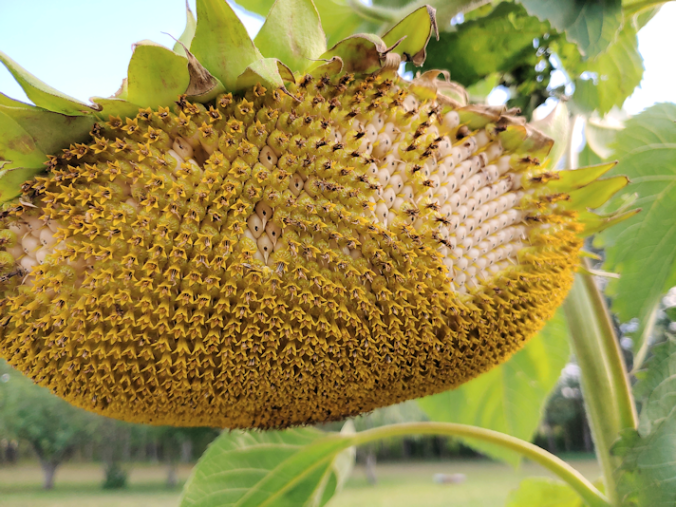
I recently harvested the two biggest heads of sunflower seeds that were done blooming. They are now hanging in the basement to dry, where the birds can’t get at them.
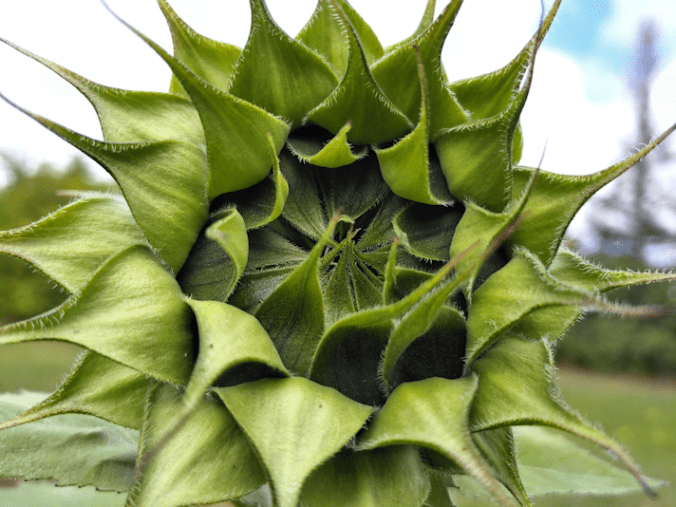
As for the rest of them, we’ve got seed heads at all stages! Not all will have time to mature before the growing season ends, but we should still have a decent number of them to harvest and dry for the winter.
Click on the images to see larger sizes, though they are all 25% of the original size.
That one mutant sunflower, with all the extra seed heads developing, is one to keep an eye on! We might actually get a couple of seed heads mature enough to harvest before the end of the growing season.
While going through some of the photos I took with one of my daughters, she was suggesting I make some available for sale, in various forms. We’re still trying to come up with ways to be able to raise funds for things like a new roof, when I cannot get a job (for the new folks following this blog; as we are living on my husband’s health insurance disability payments, anything I earn would be deducted from his payments. If I were to earn more than his payments, he would lose his plan, which means no more coverage for his prescriptions). I was considering offering things up as fundraisers: all proceeds go towards replacing the roof, or getting yard cats fixed, or building a wheelchair ramp, etc.
So I’m putting the idea out there. If I were to, say, make photos available on, say, Redbubble, as prints, mugs, t-shirts, etc., would this interest you? I’ve had it suggested to put a donation button up, but I don’t like to ask for something for nothing. Other people use sites like Patreon, where there are rewards for different tiers. Of course, there are always affiliate links, like with Amazon, where the site would earn a commission. All proceeds would go to specific things, such as a new roof (long term goal) or getting yard cats spayed and neutered (short term goal) or building a wheelchair ramp (mid term goal), etc. It would have to be fundraising for a specific project, not an income for us. We would have to be very careful about that.
Today, we took advantage of the warmer weather and dug up our two potato beds.
The first one got done fairly early in the morning, before we headed to the city. Having already dug up a few of them earlier, I had some idea of what to expect, but I have zero experience with growing potatoes the “Ruth Stout” way.
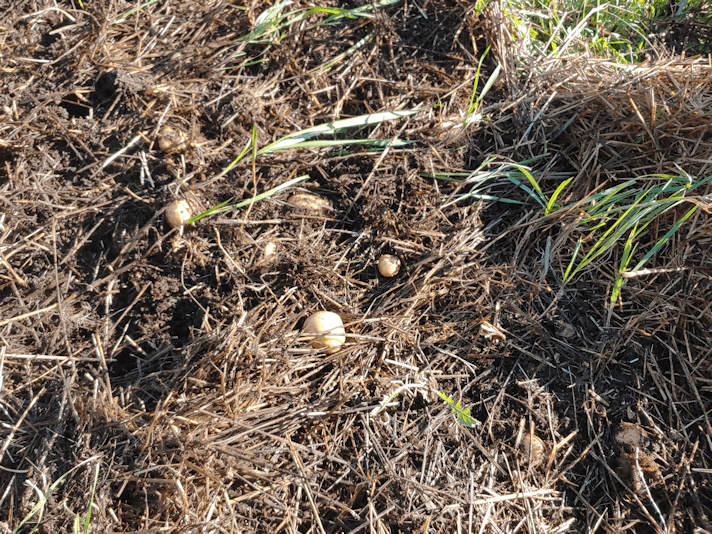
I first pulled up the potato plants, then carefully used my potato fork to lift off, then “rake” the mulch away. Here, you can see some of the potatoes I uncovered in the process.
I also uncovered several chilled little frogs! I carefully moved them to the mulch by the squash, where they could warm up in the sun.
I also uncovered slugs.
I did not rescue them. ;-)
Almost all the potatoes I found were just sitting on top of the soil! Some took a little more raking away of the mulch to find, but not much more.
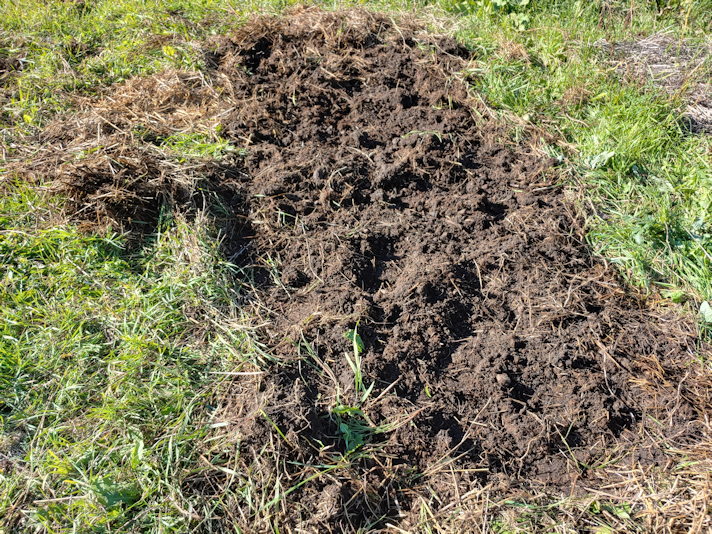
What had been rock hard ground when we started, the mulched soil was so much easier to work – even with all the rocks.
I took advantage of the situation and dug up the entire plot, so I could pull out as many weed roots as I could. The crab grass came out pretty easily. Then I hit a solid mass of roots near the surface, with a tap root of some kind that continued deep into the ground. I could not get it out with the fork! If I’d had the spade handy, I might have been able to cut through it, but since it seemed to be dead, I left it. It will be buried.
I did find a couple more potatoes in the process!
The end result looked like a 4×8 foot grave! :-D
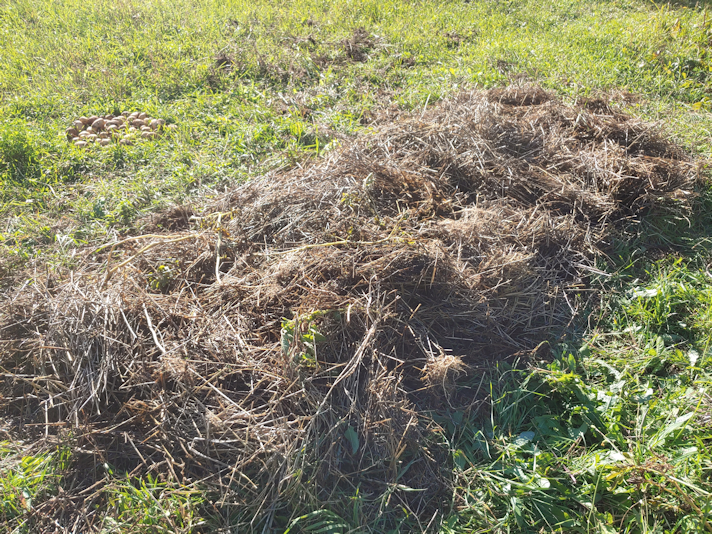
When I finished pulling up as many roots as I was able, the mulch all went back – along with the potato plants that had been pulled up.
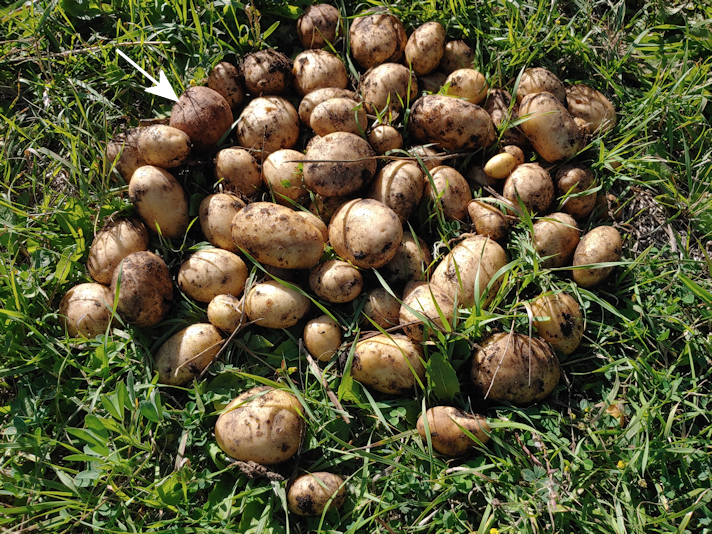
These are all the potatoes I got out of the one bed.
Also, note the one slightly darker potato with the arrow pointing to it. I’ll explain that, below!
When we got back from the city, I continued working on the second bed.
Once again, I was finding most of the potatoes on the surface of the soil as I pulled away the mulch.
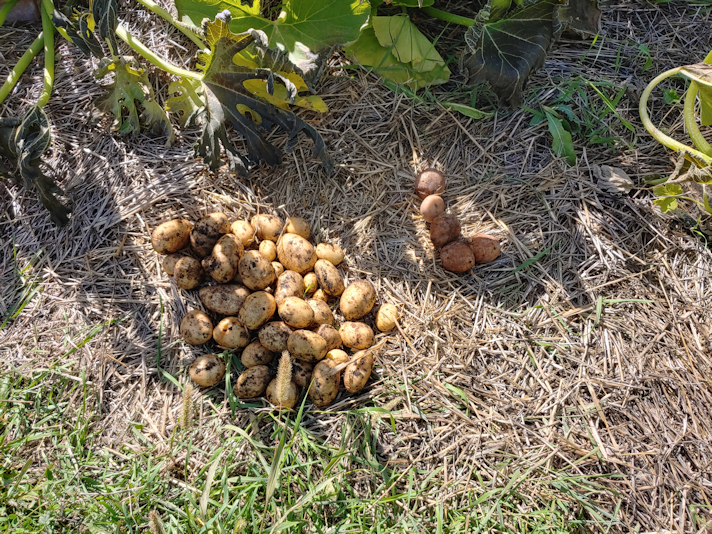
These are all the potatoes I found, before I did any digging at all. Unfortunately, quite a lot of them had holes eaten into them. :-( After digging, I found maybe 5 more.
Speaking of 5, do you see those 5 darker potatoes on the side?
Those are the original seed potatoes! The other bed had only one. While they had stems and roots that I broke off of them, they are just as hard as the day I planted them. I found the remains of some other seed potatoes, all mushy and used up like one would expect at the end of the growing season.
I got two 3 pound boxes of seed potatoes, which gave me 3 row of 6 potatoes in one bed, and 3 rows of 5 potatoes in the other, plus an extra. That’s 34 potatoes – and 6 in total never grew more potatoes!
As with the previous bed, I dug it all up, finding a few more potatoes, a whole lot more slugs, and pulling out weed roots.
Would slugs be the cause of those holes in the potatoes?
This bed had quite a few more rocks near the surface that I got rid of, too. My fork was hitting many more as I dug down, but I didn’t try to get them out, since we will continue to build these beds up. The mulch and old potato plants went back over the soil.
I then took all the harvested potatoes and laid them out on the dry straw mulch between squash beds, so they can cure (is that the right word for it?) in the sun. Except for the tiniest ones, which will be cooked and eaten right away. :-)
I then had the 6 original seed potatoes. What to do with those??
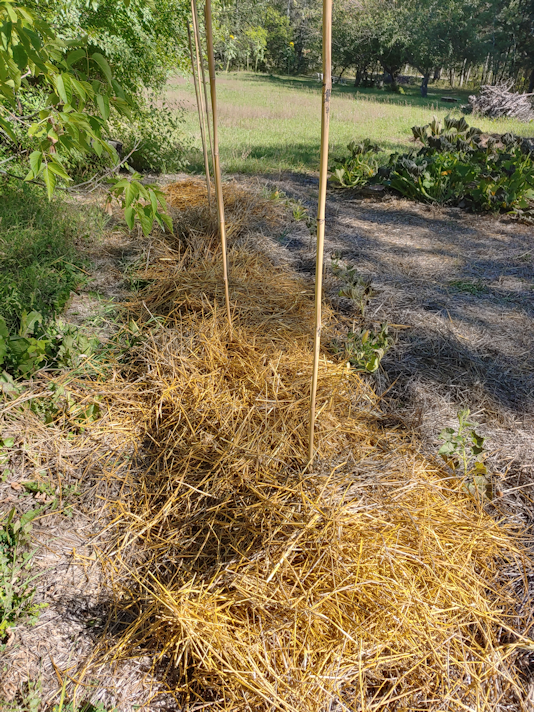
Yeah. I planted them, almost the same way they were planted in the original beds. The only difference is that I did loosen the soil a bit, first. Not to bury the potatoes – there are so many rocks along this end, I could barely do more than scrape away the mulch on top! No, it was so I could push in the bamboo poles to mark where they are. Even then, I don’t think the poles will be able to stay up for long. I could barely get them into the soil at all. No matter how I shifted and searched, I kept hitting rocks just inches below the surface.
What will most likely happen is that the potatoes will freeze over the winter, and nothing will come of them. Another possibility is that they will be protected by the mulch and, as soon as it gets warm enough next spring, they will start growing and we’ll have early potatoes started.
We’ll find out next year!
As for now, the potato beds are put to bed for the winter. I don’t know what we will plant in those spots next year. We do intend to do potatoes again, but in a different location. We don’t want to entice the Colorado potato beetle by planting in the same location again. We didn’t see a single one this year, but one of my neighbours a mile up the road mentioned that his potatoes had been decimated by them! My parents always planted lots and lots of potatoes, and I well remember going through the rows, picking off the beetles or their larvae, and hunting for the eggs to crush. Even with several of us doing that every day, some years my mother had to resort to using a poison powder of some kind, to get them under control.
I’d really rather not have to deal with them at all, if I can avoid it!
As for the squash, for now I have stopped harvesting any more of the sunburst squash, though there are a couple of zucchini that are almost large enough to pick. I prefer them when they are quite small, but with the sunburst squash, I want to give them as much of the remaining warm weather as I can for them to grow. As I write this, past 6pm, we are still at 21C/70F. We are supposed to stay fairly warm over the period covered by the long range forecast, with no more frosts expected overnight. That should give our produce a bit more time before we have to harvest what we can, then prep for the winter – and next year’s gardening! :-)
Our first year gardening since moving here has been quite interesting, and quite the learning experience. We will, for sure, continue using the Ruth Stout method until we are able to start making the accessible raised beds that are the ultimate goal. The extensive use of mulch is making a very noticeable, positive difference in the soil, even after just one year. My mother may be disappointing in our gardening, compared to what she had here, years ago, but I’m happy with our progress so far! :-)
The girls and I made our trip into the city. While I didn’t need anything myself, I did take advantage of the trip – and summer clearance prices.
While we had cleaned and painted the old wooden bird feeder and replaced it on its metal post, not a lot of birds are using it. I believe it’s just too crowded by the novelty lilac, next to it. I’ve seen some of the smaller birds around it, but the larger birds, such as the mourning doves, are still trying to find seed on the ground by the old platform feeder (where we stopped adding bird seed, since our supply filled the newly painted one).
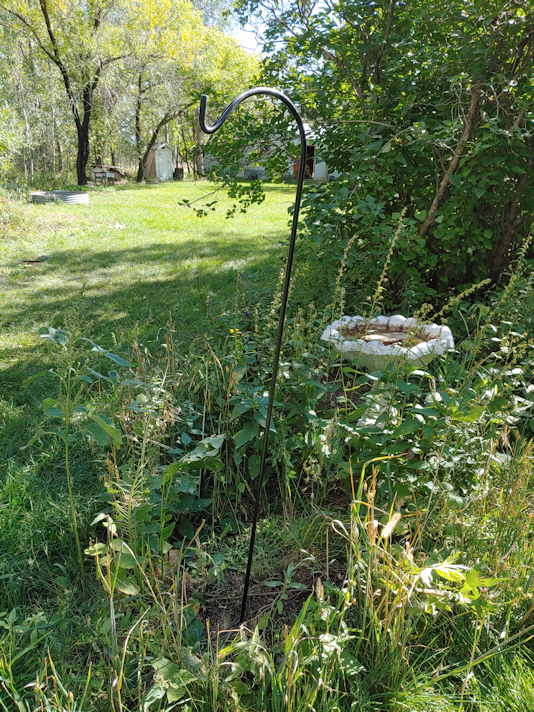
If I could get that metal post out of the ground without having to dig, I’d transfer it to the other end, where the platform feeder and bird bath are. It seems the better location for it, plus we can see them from the living room. We can’t see the metal post set up from inside the house.
The platform on the platform feeder, however, is in really bad shape. So today, when I spotted supports for bird feeders or hanging baskets on clearance, I grabbed one.
I’ll… go back and straighten that out, later. :-D
It’s a lot shorter than the platform feeder. Perfect for short little me to reach!
The old one was constantly being blown over in the wind, until we stopped actually hanging a bird feeder on its hook. One of the hanging feeders hit the ground so often, it no longer holds together very well. The base wasn’t very stable and, as you can see, where it was touching the ground is rotting.
The platform is also a complete loss, but the hook itself, and the pressure treated 2×4, are just fine.
I am thinking of removing the rotted platform, the pieces on the bottom, and cutting off the rotten end. If I can figure out a way to make it more stable, it might be worth making a new platform and setting it up again. Having hanging feeders is good, but some types of birds prefer the platform to feed from. Plus, with two hangers, we can have the suet feeder out again, too.
We shall see.
Meanwhile I wanted to share a really terrible, zoomed in photo I took this morning, before we headed to the city… :-D
The kittens were playing on the steps at the other door! I had started to move their food bowl further from the junk pile, to encourage them to come closer to the house, but Butterscotch beat me to it. :-D
Ultimately, I’d like the kittens to start coming around to the south side of the house. I’ve started to place food bowls near the entrance to the old doghouse my brother brought for them to use in the winter. It would be great if the whole little family would just move into there. As this litter is so much younger than the other kittens, they are more at risk when the cold weather hits. There is enough room in there that all of the yard cats can fit in there and be nice and warm, just like they used to all pile up together on the swing bench in the sun room. Petty differences between the cats seemed to disappear when it came to staying warm!
It was very encouraging to see the kittens playing by the house. What an adventurous bunch they are! They were just loving those stairs. :-D
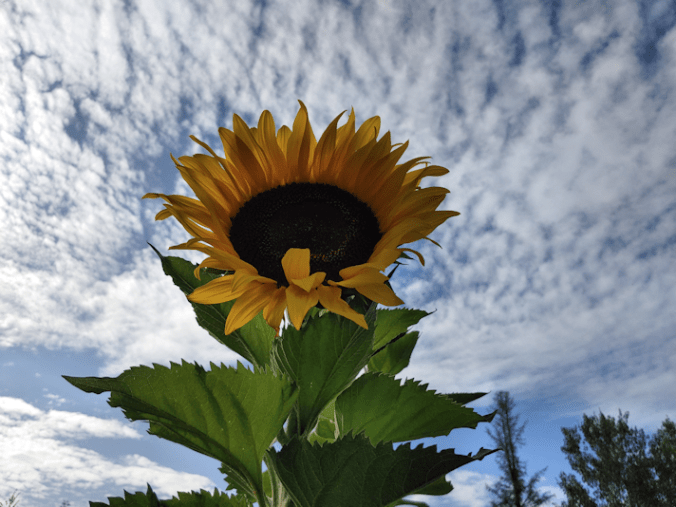
I’m happy to say that last night’s frost seems to have had no effect on the sunflowers at all.
The only leaves with frost damage that I saw were leaves that had first been broken by the high winds we had a few days ago.
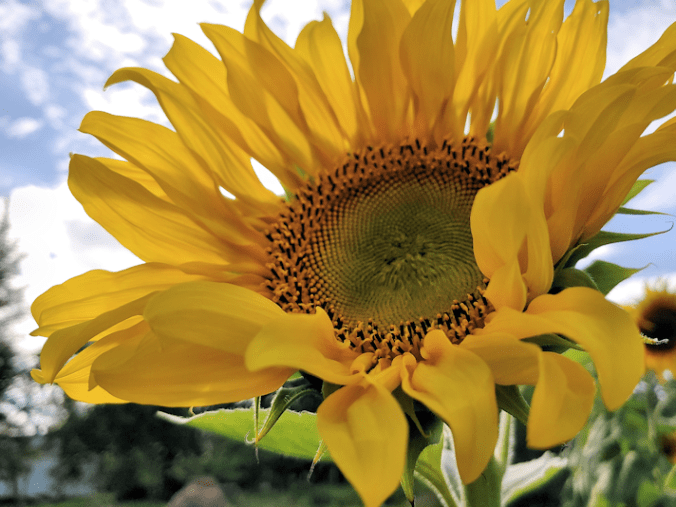
Right now, we’ve got seed heads at pretty much all stages of opening and ripening!
The birds seem to have finally discovered this one. Based on what I researched, I should be able to cut this seed head off and set it up to dry, but in the video I saw that demonstrated this, the guy was able to easily brush off the flower heads from the seeds. That isn’t happening on this seed head at all! The ones that haven’t already fallen off on their own are still attached quite well.
The girls and I will be heading into the city tomorrow, but I might harvest this seed head after we come back. If not then, then the day after. I’m planning to dig up the potato beds as well. We’ll see how the timing of things goes.
Hopefully, tomorrow’s trip to the city will be more productive than today’s – but that will get it’s own post later!
My husband has an appointment at the heart clinic in the city today, so I was out a bit earlier to do my rounds this morning.
As I write this, it’s still only 1C (33F), with a “real feel” that has warmed up to -2C (28F) since I last checked. Our high today is supposed to reach 15C (59F), which is warmer than the last few days. We’re then supposed to go above 20C (68F) for a couple of days, before dropping back to the mid-teens, which is more typical for this time of year.
We don’t have what we need to be able to cover plants as large as our squash right now, so this morning was more about surveying the damage.
I will check them again, after we get back from the city. Some look like they’re completely killed off, but others might still make it through the rest of the season.
I’m pretty sure the pumpkins are a total loss, though.
This is the largest of them, and you can see where the frost was on the pumpkin itself.
This pumpkin hill is the one that’s the furthest South – which means that it gets more shade from the trees than the others. It isn’t much, but as you can see by the plant, it doesn’t take much, either. This plant still had visible frost on it.
The other two hills were pretty much clear of frost. The developing pumpkins don’t show signs of direct frost on them – but from the state of the plants, I think they’re likely complete losses, too. We shall see.
Remember this little birdhouse gourd, bravely blooming just yesterday?
This is how it looked this morning.
*sigh*
Well, this year was our year to figure things out, and we’ve learned a lot.
We will have to work on finding different ways to cover and protect our plants from late and early frosts. Especially since we do want to keep growing squash, which are more easily damaged by the cold. The beets, carrots and parsley are just fine. Even the cucamelons showed less frost damage than the squash, which surprised me.
Altogether, though, we did far better with our gardening this year than I expected. It really has been a successful year, for the circumstances!
You’d think, having grown up here and helped my mother with the gardening for my entire childhood, I would already know what is needed, but everything is really quite different than the garden of my childhood. Especially with my parents planting or allowing so many trees to encroach into the garden.
While we will continue to have garden plots in this area, my mind is already starting to look at the outer yard, towards the barn, for possible raised beds, polytunnels or greenhouses for vegetable gardening.
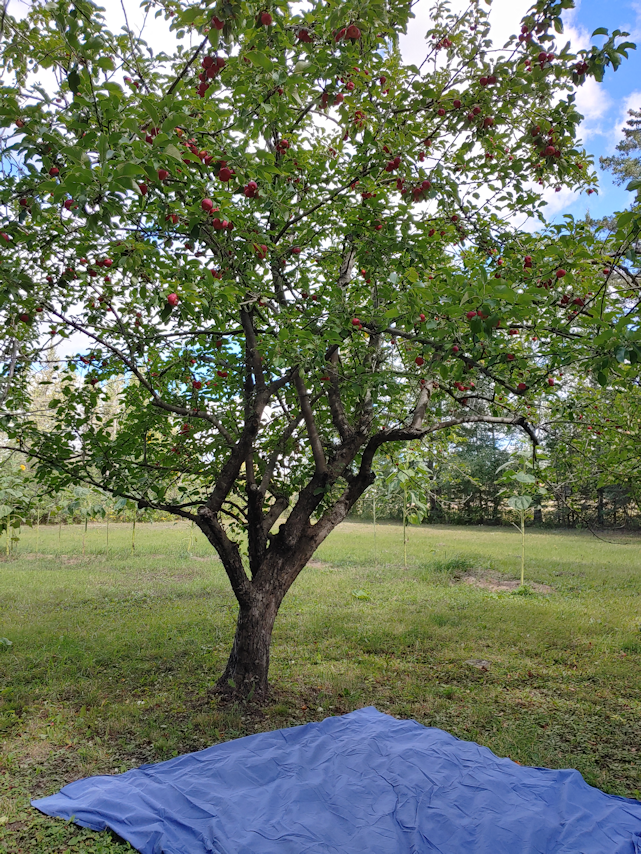
Today, I headed out to pick the apples off of one of our crabapple trees.
This is the one that has such bright red, sweet apples. It also ripens earlier than the other trees.
Last year, most of the apples disappeared before I had a chance to harvest them, so I wanted to get them before the … deer? … get them first.
When we were cleaning things out, I was flummoxed by finding a grabber with spoons attached to it. My mother eventually remembered that my dad used it to pick apples.
I’m happy to say that it works absolutely beautifully!
Since there were so many apples to pick this year, I laid out a sheet on the ground for them to fall on. It also made it much easier to move the apples into a bucket.
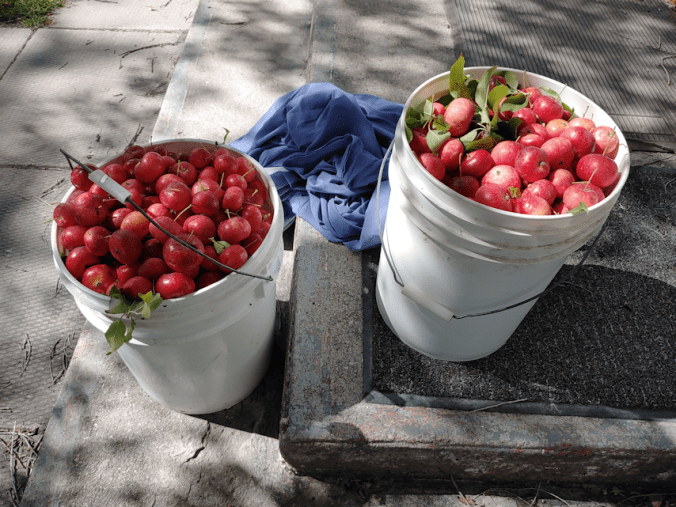
I was able to fill a 5 gallon bucket just with the apples I could reach with my hands, or the grabber. I did try shaking the trees, too, but the branches are a bit too thick to be able to shake much at that height, so I didn’t get a lot that way.
Using the step ladder, I was able to fill another 5 gallon bucket. I could have gotten more, but by then, it was getting too dangerous to try and get the apples, even with the grabber. The remaining apples will be for the birds. :-)
Ten gallons of apples is so awesome! Last year, I used the apples from this tree to make apple cider vinegar. After trimming and chopping, I filled a quart jar 3/4s full.
That’s it. That’s all we had.
This year, I plan to make more apple cider vinegar, then juice at least a gallon, to make hard apple cider. There should still be plenty to give to my family, when they come out this weekend, if they want some.
For the hard apple cider, we have gallon jugs, bungs and airlocks to use. When we made apple cider vinegar in a quart jar last year, it was a success, but there was a problem with fruit flies being attracted to the coffee filter covered jar in the cupboard. So this year, I plan to use an air lock (they’re so cheap, I’ve been buying extras).
I’ll be using a repurposed gallon sized pickle jar for this, which means I need to find a way to get an airlock into the lid.
Which I’ve already gotten started, and will show how in my next post. :-)




















 The Re-Farmer