Okay, I’m going to start with the eggplants, because I keep forgetting about them!
Last year, we grew the Little Finger variety of eggplants. Last year being our Terrible, No Good Growing Year, they never got to the size they would normally have been harvested at, but we did have little baby eggplants to try, and really enjoyed them. So they were worth growing again. I also picked up some Classic eggplant seeds to try.
This was not a good year for our eggplants.
I started the Little Finger seeds in the middle of March. The Classic eggplant seed packet, however, was mistakenly sorted in with the direct sowing seeds, and I didn’t find it and start them until the end of March.

We had trouble with both types, right from the start. With all the Little Finger seeds that were planted, only 3 germinated, so more were planted. It was even worse with the Classic eggplant, which also got replanted.
By the time they got transplanted, there were only 5 Little Finger eggplant.

They were transplanted in between the gourds by the chain link fence, with the tiniest two, which were really too small to be transplanted, but I did, anyhow, going into one planter block.
With the Classic eggplant, we had only one transplant, and it went into the wattle weave bed.
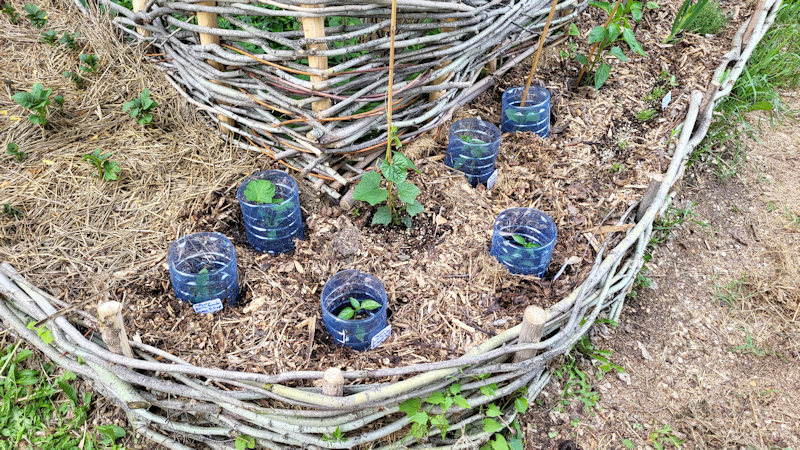
In the above photo, it’s just to the right of the luffa that doesn’t have a plastic ring around it anymore.
I really thought the Little Fingers would do well, where they were. They had plenty of space and lots of sunlight. Instead, they didn’t thrive at all. The one at the very end of the row, next to the people gate, did sort of grow, but mostly they just stagnated. They never even got large enough to start producing flower buds. In fact, nothing did well in those blocks at all.
The Classic eggplant, however, did surprisingly well. The plant grew quite large and robust and started to bloom and produce!

Everything this year seemed to be behind, though, so while these were a variety that should have been able to mature within our growing season, they never quite got there. We did have a long, mild fall, which helped, and when we did get an unexpected frost, that one plant handled it quite well, though we did cover it, along with the peppers, during other nights we thought might get frost.

This is how big they got before we finally harvested them, knowing they wouldn’t get a chance to grow any bigger before a killing frost was expected. Which means we did get a chance to taste test them, and were quite happy with them.
Final thoughts on eggplant
While the Little Finger were a completely failure this year, and we got only one Classic eggplant, we like them enough to grow both again.
Just not in the planter blocks by the chain link fence!
Eggplant is not something we buy often, mostly for budget or space reasons, but we do like them. Growing them ourselves will allow us to do more with them, too. In the future, we will probably try other varieties, but for next year, I think we’ll just stick to the two we still have seeds for.
Next up – the gourds.
We had a real problem starting gourd seeds this year. Many didn’t germinate at all, and I don’t know why. These included varieties we grew last year that had no problems germinating.
Luffa
This is the third year we tried growing luffa.
I started them much earlier this year, and at first, they seemed to do all right.

Then they started dying off, and I replanted, but the new seeds didn’t germinate. In the end, I had just one survive. The growing medium in the other pots got reused when potting up other things, but I could find no sign of seeds in them.
So that one surviving luffa got planted in the corner of wattle weave bed, where it could get good sunlight, and have the taller portion of wall, then the lilac bush, to climb.
Later on, however, some seedlings sprouted that looked an awful lot like luffa! So I planted them in the same bed.
How they did
This was the best year for growing luffa, yet!
Ideally, we’d be growing them in a polytunnel or greenhouse, because they need twice the growing season we’ve got, to reach full maturity. If we were just growing them as a summer squash for fresh eating, that would be fine, but I’m after the luffa sponges.
The two mystery plants did turn out to be luffa, but they were planted way too late to do well. That first transplant, though, grew so very well and was soon climbing high into the lilac bush where, hidden from view, we actually had several gourds start to develop!

Not all of them made it. In fact, only one did, really. We left it on the vine as long as we possibly could before harvesting it. As I write this, it’s currently curing over a heat vent in the living room. I keep forgetting it exists, so I haven’t tried to peel it and see if we got an actual mature luffa with usable sponge – and possibly seeds – inside.
Final thoughts on luffa
Luffa is one of my “just for fun” experimental plants, so I keep trying! We will eventually get some sort of polytunnel or greenhouse set up, which should make them easier to grow in our short season. I will keep trying to grow them for the challenge of it, but I think I will try seeds from other sources in the future.
Drum gourds, Caveman’s Club gourds, Zucca melon and Crespo Squash
We tried growing Zucca melon last year, but that bed was one of the ones that got flooded, so I wanted to try again. The African Drum gourds and Caveman’s club gourds were new ones to try. I want to grow gourds to use them for crafting. The first time we tried to grow Crespo squash, they did really well, even when recovering from being eaten repeatedly by groundhogs and deer. Both the Zucca melon and Crespo squash are experiments we are growing so we can at least try them and see if we enjoy eating them.

The drum gourds and Zucca melons were started indoors in early February.

The Crespo squash and Caveman’s club were started in the middle of March.
Though I made sure to scarify the seeds, when they germinated, there were problems with the seed leaves not being able to free themselves from the shells. We also had losses and germination issues, and had to replant the pretty much all of them.
The ones that did take, did well, though, and soon got quite huge!

Here you can see where I used a straw as a splint to protect a breaking stem. It started to break, just from moving the pots around to get good light, when they were still smaller and in the living room. Once we were taking them outside to harden them off, there was a much greater risk of damage. So some of them got transplanted earlier than I normally would have, given our last frost date.


One Zucca melon and one African Drum gourd went into the block planters, along with the two surviving Caveman’s Club. The Crespo squash got their own bed, well away from the other squash, in case we were able to save seeds, as they don’t seem to be available anymore.
The last of the Zucca melon and African Drum gourds went into a reworked bed near the squash patch.
At least, that’s what I thought.
As things started blooming and developing, it because clear that there were only Zucca melon. With restarting seeds and putting up, I must have mislabeled things, because the pots that were labelled African Drum gourd began producing fruit that could only be Zucca melon.
Which means the only African Drum gourd transplant we had, was the one planted along the chain link fence.


How they did
As you can see from the photos above, the drum gourd, Crespo squash and Zucca melon did start blooming.
What was grown in the blocks by the chain link fence did not do well at all.
The Crespo squash also did not like their location. I was expecting the huge, lush plants we got the first year we tried them. Instead, they were spindly vines, with many male flowers but almost no female flowers. What few did appear, I hand pollinated. We did get a few that started to grow, but by fall, there was just one to harvest, and it was much, much smaller than these are supposed to get.
With the Zucca melon, they also produced mostly male flowers, but they did start to eventually produce a good amount of female flowers. I hand pollinated those, too! While the plants themselves didn’t thrive, either, they did do better than the Crespo squash, or the ones at the chain link fence. They started to produce fuzzy fruit, which is how we could finally say that what we thought were Drum gourds were actually Zucca. Some of them even started to get pretty big, but in the end, they all ended up with blossom end rot and dying off!
Update:
I knew I was forgetting something!
The Caveman’s Club gourds did slightly better, though far from healthy plants. They bloomed and pollinated, and at the end of the season, we had two – sort of – little gourds. After picking them, one got all wizened and was tossed. The larger one is currently curing in our sun room. The cats keep trying to play with it!
Final thoughts
These were all really disappointing. Those transplants were looking so good when they went in, but none of them thrived!
With the Crespo squash, a bit of research leaves me to conclude that they actually got too much sunlight. Where they were planted gets full sun, all day – no shade at all in the summer. This will be the last year we use that patch for vegetables, though, and next year we will be planting something for the food forest there.
I still have seeds and do what to try them again, but in a different location, where they will be less likely to get sun burnt.
As for what was planted in the blocks, this was the first year those blocks were used as planted, and something is definitely going wrong. It shouldn’t be the soil. One possibility is that the regrown branches above are cutting out too much sunlight. Another is that the blocks themselves are creating a hydration problem. We will grow completely different plants in there, next year.
The Zucca melons near the squash patch, though… that’s where we grew Crespo for the first time, two years ago, and giant pumpkins last year. The soil had been reworked and had manure added to it. They should have done well, and yet they didn’t. I’m not sure why. Next year, we will use that spot to grow something different.
I do still want to try growing all of these again, plus other gourds that we have seeds for. We are working on building trellis beds, but these are all supposed to produce really massive fruit, so I will likely try them in low raised beds, instead. Whether or not we try them again next year, or pause them for a year, will depend on just how many of the various raised beds we need to build, progress.
Summer and Winter Squash
I’m putting these together, but there isn’t much to say about the summer squash!
We had seeds for the same varieties we grew last year; green zucchini, yellow zucchini, yellow patty pans and Magda squash are all seeds we got from a variety pack we accidentally bought 3 of, so we’ll have seeds for these for a long time! We like all of them, too. Then there was the G-star patty pan that we grew last year, and was one of the few things that produced, in spite of the flooding. We got those seeds sent to us by mistake. A happy mistake, as we quite like them, too.
As these are shorter season varieties that we only plan to eat when they are smaller, I was going to experiment with starting a few seeds indoors, and direct sowing others. In the end, we didn’t have the space to start more seeds indoors, so they got direct sown.
*sigh*

Every red dot you see in the above photo marks a slug.
I’ve never seen so many slugs in my life – and we’ve lived in Victoria, BC, where the Banana slugs come out in herds, after a rainfall!
They absolutely devastated our sprouting summer squash. They did damage to the winter squash as well, but they seemed to leave the larger transplants alone more.
Ultimately, we did have a green zucchini, yellow zucchini and a yellow pattypan squash survive and actually produce some fruit. No Magda squash survived. The G-star, however, did surprisingly well; they didn’t seem to get hit by the slugs as badly, recovered very well, and had decent production.
There was the problem of only male flowers being produced, and when a female flower did finally show up, there were often no male flowers to pollinate them. So I ended up hand pollinating them with any male flowers I found on other summer squash plants.


We didn’t have a lot of summer squash to harvest, but there was at least some!
I think the biggest surprise was when they got hit by frost, but when we got more mild temperatures again, they started to recover and continue to produce!
Then there was the winter squash.

As with so many other things we started indoors, we had a really hard time with germination. Some squash and melons simply did not germinate at all, or when they finally did, the seedlings quickly died. In the above photo, you can see what was left to transplant. Just two Lady Godiva hulless seed pumpkins (we started 3 varieties of hulless seed pumpkins), two Winter Sweet (they were among those we tried last year that got flooded out), and two Boston Marrow (another from last year that got flooded). The Little Gem/Red Kuri are something we’ve grown for a couple of years now, and quite like, but this is the first time we’ve tried growing them without a trellis of some time.
More of the Honeyboat Delicata survived. This is a new variety for us, and is a variety of Delicata that is supposed to be good for storage. We’d tried Candy Roaster last year, too, but they, too, got flooded. The Pink Banana was a new one for this year.
The empty mounds got summer squash planted in them, plus another row was prepared for the rest of the summer squash, on the left of the photo.
The thing with winter squash, of course, is that there’s nothing to harvest until the end of the season!

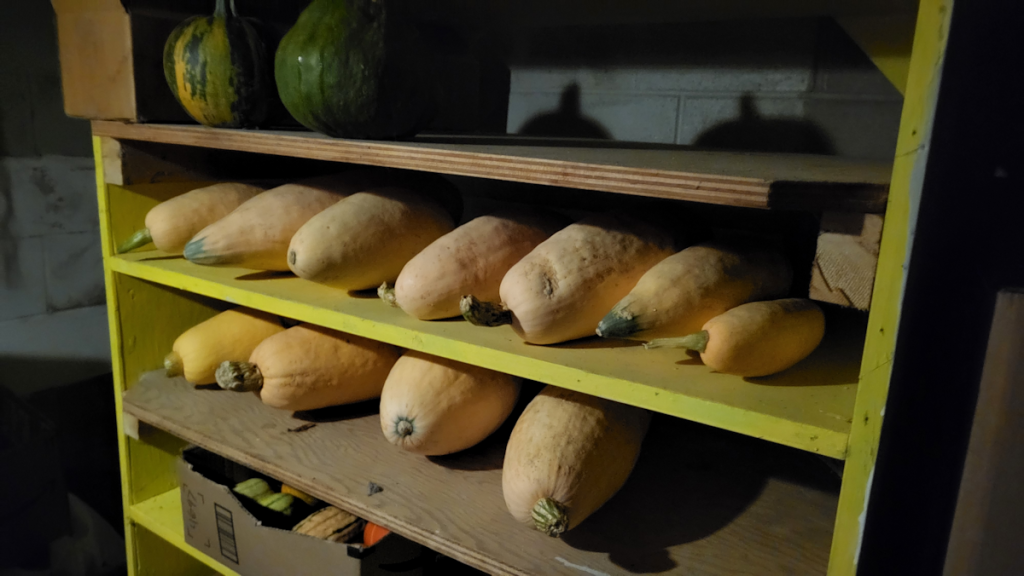
What a difference between the plants, though.
How they did
The Pink Banana and the North Georgia Candy Roasters did excellent! I didn’t think they would, because their two rows were planted in an area that gets a lot more shade. The other winter squash were planted in rows that got much more sun, yet they were the ones that failed to thrive! Going back to what I learned in trying to figure out what happened to the Crespo squash, it looks like they actually got too much sun, while the rows that got shade for much of the day got just enough! Lesson learned!
We still managed to get small harvests out of some of the sun burnt squash. We did get to try both the Banana and Candy Roaster squash and found them delicious.
Final thoughts on summer and winter squash
When it comes to summer squash, these will remain a staple in our garden. We just have to find a way to deal with all the slugs!! We will try other varieties as we’re able – there are a few patty pan varieties I want to try, but what we have now are basic and we will keep growing them. Especially the G-Star. They seem to really thrive here, even under really horrible conditions!
With winter squash, we are still very much in the experimental stage in learning what what grows well here, and what we like. The Red Kuri/Little Gem squash are a winner – though they definitely need better growing conditions than what they got this year! The Pink Banana and Candy Roasters are both ones well worth growing again. I don’t know that we’ll bother with the hulless seed pumpkins again, though. I seem to be the only one that likes pumpkin seeds in the family! As for the other varieties of winter squash, we will try them again in different growing conditions. With the tiny fruit we got this year, we can’t really say if we like them or not, as they would not have developed their full flavour.
Next year, we will not be growing squash again in this location. They need to be rotated out. The trellis tunnel that will be built into the new mid-height raised beds we are working on will be strong enough to hold the weight of these climbing varieties, so hopefully, that’s where we’ll be planting them next year.
The Surprise Squash
We got some unexpected squash, too!
In our compost ring!

They were the biggest, healthiest squash of all! 😄 Unfortunately, we don’t really know what they are. Some looked like hulless seed pumpkins. Some looked like they might have been from some hybrid zucchini we were gifted with. We harvested them, but have yet to actually try any of them. If you look at the photo of squash in our root cellar, the two big green ones at the top are from the compost heap! Whatever they are, they are likely hybrids, or even hybrids of hybrids! 😄
We also got surprise beans in here. I left them to go to seed, and have no idea where they came from. We’ve never grown beans like those before!
It should be interesting to see what volunteers we get in our compost, next year. 😁
Melons
We were so eager to do melons again!
Two years ago, in spite of a drought, we successfully grew two types of melons, Halona and Pixie, and were looking forward to growing even more, last year.
Yeah. They were in beds that got flooded.
Total and complete loss.
This year, we hoped to be able to grow quite a bit more. We started the seeds indoors in early May.

This year, we tried the Halona and Pixie melons again, plus Sarah’s Choice, a new variety. We also tried Cream of Saskatchewan watermelon. The watermelon we tried the previous year – a short season variety, too – was among the losses.
The water melon was a loss this year, too! Zero germination. Bizarre!
The others struggled to start, too. In the end, we had only two Sarah’s Choice, and a couple of Pixia and Halona, each, none of which looked particularly strong.
These were intended to go into the new trellis bed, but that didn’t get built, so we got creative.
We have a kiddie pool we’ve been using for all sorts of things, from washing cat blankets outdoors, to harvesting potatoes out of bags into, to sifting soil into, to use elsewhere.
I made holes in the bottom and turned it into a raised bed, because the few melons we had really needed to get transplanted!

How they did
They did remarkably well! So well, we had to add more supports to the top of the makeshift trellis.
As with the winter squash, these just needed tending until the end of the season. They developed many flowers and we saw lots of little melons forming.
Unfortunately, like so many other things, they started blooming late. We did get a couple of larger melons that were fully mature, but most of them never had a chance to get to that point, even with our exceptionally long and mild fall.

This was our final harvest of all the melons, and you can see we did get some decently large ones!
The smaller ones, however, very quickly started to rot, so we didn’t get very many to eat.
Final thoughts on melons
We will continue to try and grow melons, because we really like them, but they tend to be too expensive to buy regularly. As we build more raised beds, and the trellis tunnels we are planning, we should have better growing environments for them over time.
The Halona and Pixie melons are varieties we know can grow here, so we will probably stick to those two.
We will try the watermelon again. I don’t know why they didn’t germinate; I don’t think the problem was with the seeds. It’s a short season variety developed in Saskatchewan, so it should grow here fine. I might even try direct sowing them instead of starting them indoors, to see if that makes a difference.
We will also try other varieties over time until we eventually settle on something we all really like, and can save seeds from. There are many short season varieties we can choose from!
Poppies
I almost completely forgot about these!
I really want to grow non-ornamental poppies. My mother used to grow them on the old kitchen garden, when I was a kid, and we had enough that my late brother and I would eat the seeds straight out of the dry pods, and my mother could still make filling for makowiec.

We had two varieties of bread seed poppies; one we’ve grown before, and one that is new to us. Previously, we’d grown Giant Rattle poppies, but where we grew them ended up getting highly compacted, was full of weeds, and they did not thrive, though we did get fully mature pods out of them. The other variety we got was Hungarian Blue.
As poppies reseed themselves easily, I wanted to make sure they were planted somewhere where they could be treated as a perennial, plus I also wanted to make sure the two varieties were planted well away from each other, so as not to cross pollinate.
We only got one in.
We had an area by the chain link fence where we’d first grown potatoes in bags. After the potatoes were harvested, the soil was returned to where the bags had been sitting to create a new bed. Last year, we unsuccessfully tried to grow white strawberries there. For this year, it got a thorough weeding, and then Hungarian Blue poppies were planted in it.
How they did.

At first, I thought for sure we wouldn’t get any at all. For all my efforts to remove weed roots, that’s what we got the most of. Eventually, however, poppies started to show up! Yes, some even got to fully mature, with dried pods developing.
We also had some self seeded poppies show up with the shallots. These were transplanted in a new raised bed built over where we’d grown Giant Rattle poppies before, so I thought they’d reseeded themselves and let them be. They turned out to be a variety that predates our living here! Still a bread seed poppy, so I collected seeds from those in the fall.
Final thoughts on poppies
With edible poppies available as seeds again (for a while, they were not available, because they are the source of opium), I want these to be a staple again. I don’t know what happened to the variety my mother used to grow – the ones that have come up on their own are different from the ones I remember. I’ve even found poppy seeds while cleaning up the place, but it seems my mother switched to ornamental poppies at some point. There’s no what to know what kind the seeds I’ve found are without planting them, and with how old they probably are, it’s unlikely they will germinate.
The bed where the Hungarian Blue were planted will need to be completely reworked, with the soil sifted to get out more weed roots. Then, they will be replanted there. Once the poppies themselves are established, they will choke out any weeds, themselves. Until then, we’ll have to battle the weeds for them. The soil also got quite compacted, which affected their growth as well., so we will have to amends it more.
As for the other varieties, we still need to find locations where we can plant them, and then just leave them to self seed. There are a few areas I can think of, but it will take time to take out grass and weeds and amend the soil before we can plant them.
Well, this one turned out much longer than intended! This is the last of what we grew, though.
Next time, I’ll be looking at what we intended to grow, but it just didn’t happen!
The Re-Farmer

 The Re-Farmer
Pingback: Our 2024 Garden: transplanting tomatoes, luffa, onions, thyme and mulberry, plus some updates | The Re-Farmer