We got quite a bit of rain overnight! Enough to completely fill the rain barrel I’d returned to the corner of the sun room. When I came out this morning, I had to put the diverter back on!
It was still raining ever so slightly while I was out (I counted 31, maybe 32 cats this morning). The only garden related stuff I did was to take the mulch off the sunchokes and asparagus beds – the last beds that needed to be uncovered – so they can thaw out faster.
The rain looks like it has stopped, but it’s too muddy and chilly to do the work I had intended to do outside today. I did end up setting out the Purple Caribe potatoes to chit in the old kitchen.
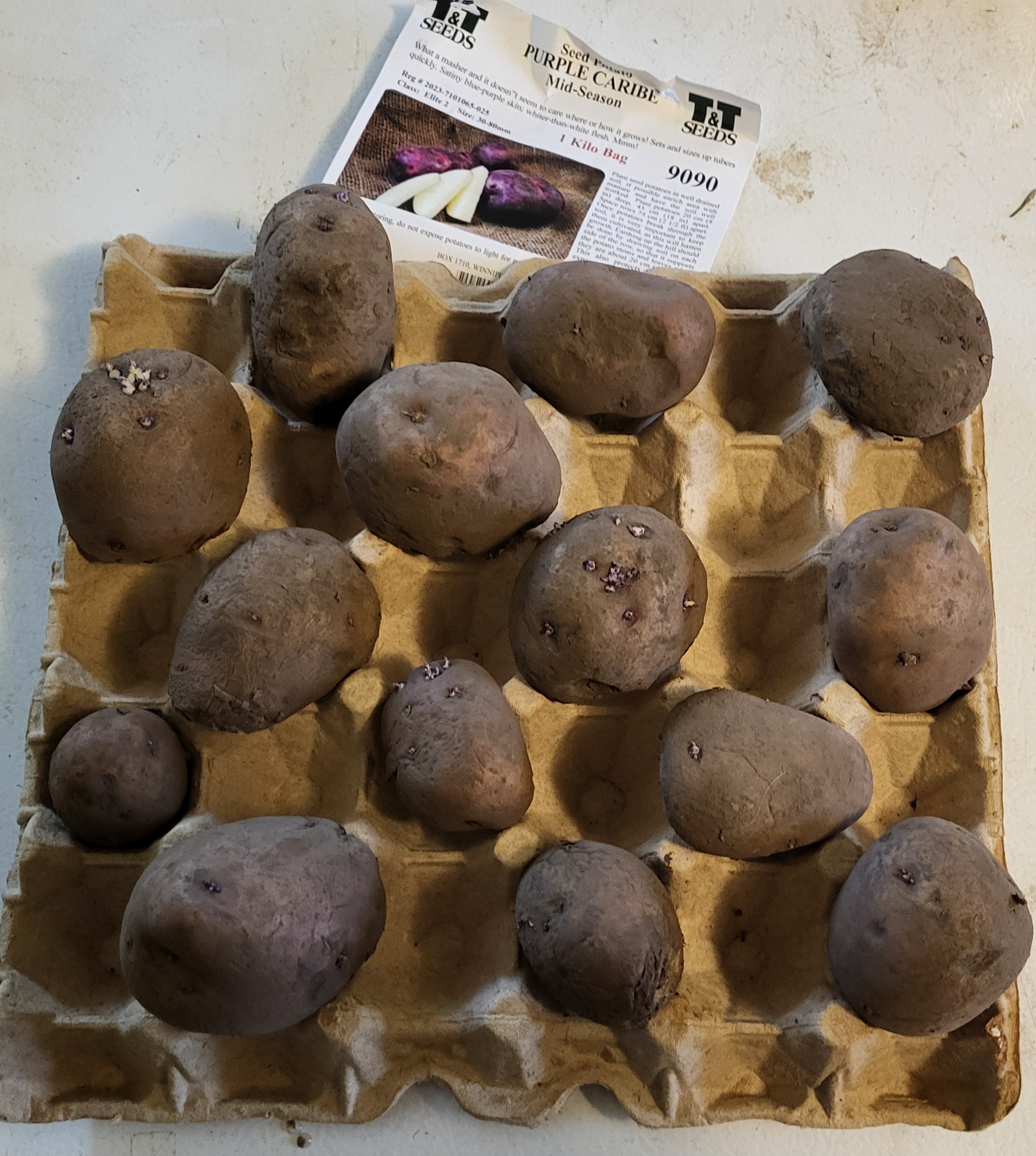
A couple of them were large enough that I cut them in half, and those ones are perched on the carton in such a way that they will have air flow under them, so the cut areas will dry out.
Looking at how many 1kg give us, I’m rethinking where we will put the 2kg of German Butterball potatoes. My thought had been to put them where the squash were planted last year, but that’s a huge space. I’d basically just have one row of potatoes. So now I’m thinking we might use one of the low raised beds, instead, where the soil should be softer.
We really need to think about increasing the acidity of our soil. It is very alkaline, and pretty much everything we are growing needs soil that is at least a little acidic. We should pick up a bale or two of peat, but that has a very minor and slow effect on acidification. A lot of the usual soil amendments, like adding compost, actually increases the alkalinity, which is the last thing we need. I ended up running errands in the small city yesterday and was looking for Sulphur, but saw nothing. We do have a box of fertilizer we found when cleaning out the old kitchen years ago that is for acidifying the soil; it’s meant for azaleas, but should work for other things, too. If it’s still good. Does water soluble Miracle Gro have an expiry date? I have no idea how old this stuff is. The box was opened but, based on how full it looks, it may only have been used once!
Since today was an indoor kind of day, I started pre-germinated some winter squash.
We’re at just under 7 weeks before last frost, which I hope is enough time for these. Not knowing what varieties are in this mix means we will have different days to maturity among them. I’m still hoping to be able to start some other varieties of winter squash as well – ones we actually know what they are! I’m just not planning to grow entire rows of each. With pre-germinating the seeds, I can start just a few of each and not have to be as concerned about germination rates like when they’re sown into pots or pellets.
I’ll need more pots, though.
Among the last seeds I want to start indoors, by about 3 weeks before last frost, are several types of melons.
Last year, we started so many squash and melon seeds, then had entire trays where nothing germinated. A real waste. I think we’re going to have a much better success rate using the pre-germination method. It should be interesting to see how much of a difference it makes, as time goes by.
The next few days are supposed to continue to be colder and wet, with possible snow, with Friday having a high at, or just below, freezing (it’s Tuesday as I write this). By Sunday, we’re supposed to be back up to the double digits (Celsius), but our overnight lows will be staying close to freezing through most of May. We don’t expect to be direct seeding anything until June, but there are quite a few cold tolerant things we’ll be able to direct sow once the current cold snap is done.
May will be our month for building more raised beds, and harvesting more dead trees to build with.
There is so much that needs to be done!
Weather willing, we’ll have more prepared garden spaces than we had last year, but I’m not sure we’ll reclaim enough to match what we were growing in – well, trying to! – the year before.
Little by little, it’ll get done.
The Re-Farmer

 The Re-Farmer
I am reasonably certain that ammonium sulfate fertilizer will lower ph (acidify) soil…as well as nitrogen.
LikeLiked by 2 people
change to “as well as add nitrogen”.
LikeLiked by 1 person
Yeah, we’re pretty low on NPK in general. Now that I know it’s due to leaching, the battle will also be more focused on keeping the nutrients from being washed away! The raised beds, with their layers of organic material at the bottoms, will help with that.
LikeLike
I’ve been reading up on various additives, and there is controversy as to the safety of ammonium sulfate.
Considering I can even find vermiculite or sulfur, I suspect finding ammonium sulfate would be even harder.
LikeLike
The sulfate is likely easier to find than ammonium nitrate (see ANFO).
LikeLiked by 1 person
Pingback: Various things | The Re-Farmer
Pingback: Our 2024 Garden: potting seeds already! (video) | The Re-Farmer