Wow. It’s amazing how much can get done in a day, when I can actually stay home for the entire day. Thanks to my daughter doing the mowing yesterday, I could actually focus on the garden! I got enough done that I will actually break it up into several posts.
For now, though, the cuteness!
I had a surprise, yet not surprise, when I went into the sun room to start feeding the yard cats.
After all our attempts to get Poirot and her babies into the cat cage, giving up and upgrading her carrier nest to a larger carrier she seemed happy with, she moved her babies.
Which I was really, really happy to see. They will be much safer there, as they become more active.
In a way, I wasn’t surprised that she moved them, though. When I set up the larger carrier for her, I made a nice bed inside with puppy pads. The past couple of mornings, though, I’ve noticed they were really messed up. I tried straightening them out in the front, over the frozen water bottle I’d tucked into the entry to help cool things down, but realized it was completely bunched up. The kittens were lying on the hard bottom. The puppy pad looked like it had been dug at and pulled from the outside. Which suggested that other cats, or even a skunk or a racoon, had gotten up there and was trying to find a stray piece of kibble or something. At least, that’s my theory.
Whatever her reason, though, Poirot put her babies into the nice, soft cat bed in the cat cage. I was even finding her enjoying her space on the blanket in the other cube, where she could still keep a close eye on her little grublings.
Today was a great day to be outside. Our expected high was 19C/66F, we did actually pass that by a degree or two, depending on which app I look at. We reached our high in the early afternoon, and are only just now, at barely past 7pm, starting to cool down ever so slightly. This morning, however, we had a low of only 3C/37F, and tonight we’re expected to drop to 5C/41F. The highs for the next few days are supposed to keep getting hotter each day, so I was glad to be able to get as much done outside today as I did!
While it was still cool this morning, I refilled the leaking rain barrel and, while that was filling, watered the new transplants, as well as the mulberry, sea buckthorn and highbush cranberry. I don’t water the silver buffaloberry, mostly because there are so many of them, and they look like they are doing just fine as they are.
I did some other watering in the main garden area, before pausing to have breakfast, then getting to work on planting and bed preparation. That area gets full sun, so it didn’t take long to start feeling way too hot!
My brother and his wife came by later in the afternoon, so I used that as an excuse to take a hydration break and say high. My brother had a lot of stuff he wanted to get done, though, and I had to get back to the garden, so I left them to it.
One thing about my brother bringing all his equipment out here is that there are some big jobs that can now get done. My SIL took one of those on and has been using their big riding mower to do the outer yard, including the completely overgrown area where the Korean Pine and walnut trees are (though we still have to plant the rest of the seeds). I headed out to see after I finished in the garden, and am just blown away. This is one of the areas I gave up on trying to keep mowed because it was so rough, and I got tired of breaking lawnmowers.
What a difference having the right equipment makes!
We’ve been using their smaller riding mower, and have permission to use the big one, too. We’ll just have to learn how! It’s a zero turn mower, so it doesn’t have a steering wheel.
My brother and his wife selling their acreage is going to change a lot for us. We are going to be seeing them a lot more often, which is always awesome, but with my brother’s help, we’ll be able to start getting things done here that we simply haven’t been able to, mostly because the tools and equipment that should have been here when we moved in had disappeared. That’s one of the reasons my mother originally asked us to move out here, when she still owned the property. They’ve got plans for things completely outside our scope, too. For the past few years, I’ve been feeling like we have been falling behind so much, simply because things are breaking down and wearing out faster than we can do anything about them, even if we did have all the tools and equipment. Add in various health issues of our own, taking care of things for my mother, vehicle issues, etc., and it felt like a losing battle, and I was feeling like I was letting my brother down. Now, I actually feel hopeful again!
Best of all, though, is just being able to see them more often. They’re just really awesome people, and I thank God for them both!
I also thank God for today being such a productive day. It’s been a long time since I’ve been able to get so much done in a day! It won’t be much longer before we can safely start transplanting and direct sowing things that have to wait until after or last frost date, and there is still much to prepare!
Corn and beans, in particular, were things we had so many seeds for, in so many varieties. Especially the Red Swan beans, though that was a mistake. I’d ordered a different, purple variety, because purple everything seemed to do quite well here. When I got Red Swan, instead, I contacted Veseys and they sent me another package.
Of Red Swan.
That happened a couple of times before I finally read on the website somewhere that they were out of the purple variety, and Red Swan as what they were sending out instead!
Oops.
When it came to beans, I’d hope to plant both bush and pole beans, in a variety of colours. I also wanted to try the beans my mother gave me, that trace back to what she used to grow here, when I was a child.
That didn’t happen. We simply didn’t have the space to plant many beans at all this year.
It was much the same with corn. We had many varieties to choose from. Mostly, I just wanted to have three types. The purple Montana Morado, the Tom Thumb popcorn, and one of the short season sweet varieties for fresh eating.
Well… two out of three is pretty good.
The purple corn.
As much as I’d like to grow the kulli corn, the seed source I’d found was out of stock. We’d grown the Montana Morado before a couple of years back (though we though we were getting an acclimated variety of kulli at the time), and they did well until something destroyed them.
This was all that survived from our 2021 garden.
The kulli corn we’d grown last year did absolutely amazing, growing into massive tall stalked that looked so strong an healthy – though high winds did try to take them down!
We had to add a lot of supports to the kulli corn and yellow pear tomatoes, after strong winds.
What they didn’t develop, however, was corn! Not a single tassel or cob!
So we went with the Montana Morado instead.
The Montana Morado got their own bed in the main garden area. I ordered a couple of packets of seeds, because there weren’t many per packet. It still wasn’t a lot, as far as corn goes, but this is an experiment for us. While the plants certainly didn’t thrive like the kulli stalks did last year, they at least produced cobs that we could harvest!
I waffled back and forth about interplanting beans with the corn as a nitrogen fixer, and did end up planting some Red Swan with them, late in the season, but more on that later.
Bonus for wanting the corn to use for flour is, no harvesting until the very end of the season.
There are a couple of things I wanted to do with purple corn. One was to make and try chicha morado, as the very concept of a drink made out of corn fascinated me. The other is to try making corn flour. For this year, the goal was just to have corn to try making flower, though we did try a few cobs for fresh eating.
We got almost exactly 1 cup of kernels. Just enough to try to make into flour, though we don’t have a mill. We were debating where to try the spice grinder in small batches, or the Bullet processor we’d been given, but were concerned the hard kernels would break them.
Then, one night, I heard a terrible crashing noise and went to investigate.
I found the container of kernels on the floor. A cat had somehow knocked it down.
We lost them all.
Every. Single. One.
*sigh*
Final thoughts on Montana Morado/purple corn:
Yes, we plan to try again but, gosh, that was disappointing to lose them all like that! We might wait another year or two before trying again. My source for the kulli seeds has them again, but they are insanely expensive – and in US prices, so quite a bit more, plus shipping, in Canadian dollars.
So that will wait.
The popcorn.
We got the Tom Thumb variety, which only gets a couple of feet tall. This is actually the second year we tried to grow them, but the location we grew them in last year, flooded. This year we planted them in a completely different area, both from the flooding and the purple corn. The two types of corn pollinate at different times, but the extra space reduced the chances of cross pollination, should we want to keep seeds.
When it came time to build frames to cover the raised beds, a priority was put on one that could go over the Tom Thumb corn, to protect it from deer or racoons. I’m rather happy with how it turned out, though I do want to stabilize the corners better.
As with the Montana Morado, these were grown to be harvested after they’d dried on the cob. These didn’t even get taste tested for fresh eating, so it was a very low maintenance crop! One we got a surprising number of cobs out of.
After they had their chance to dry on the cob indoors some more, we got a surprising amount of kernels.
We got almost exactly 6 cups out of them!
Final thoughts on Tom Thumb popcorn
We did a test pop, of course.
They didn’t pop. They just burned.
So we left them to dry longer, and stored them with a desiccant, before doing another test pop.
They still wouldn’t pop.
They’ve had more time to dry out and I’ll try again, but they should be dry enough. I’ve looked up about how to harvest and process kernels for popcorn, and we’ve done all that. The only thing I can see that might be the problem is that they still have too much moisture in them. Yet, they do need to have a bit of moisture in them, as that’s basically what makes popcorn pop.
I don’t know what to make of it!
I think we still have seeds left, but I don’t think we’ll try them again. In a way, it was a waste of space to grow these two varieties of corn, instead of a sweet corn that we could eat, freeze or can. We just didn’t have the space available to grow a third variety.
In the future, I think we’ll try a flour corn again when we have more prepared spaces. If we do find that we like having flour corn and actually use it, we would need to have a much larger space available to grow in, to make enough flour to be useful. That is still years in the future. Until then, we will continue to try small amounts as testers.
Next year, I want to focus more on growing a good, short season variety of corn, and we have seeds for at least two different varieties that fit that bill, ready and waiting to be planted.
Bush beans
In previous years, we have had great success with beans. The first year, we grew three types – yellow, green and purple – in rows about 25 feet long. The purple beans did especially well!
This year, I wanted to grow some bush beans, for their earlier harvest, pole beans for their later harvest, and shelling beans for dry storage.
Once again, we just didn’t have the prepared space for them.
In the end, we planted yellow and green beans in the high raised bed, which is only 9 feet long.
The yellow beans did okay, though a lot of the green beans in particular did not germinate. Most seeds were planted to fill the gabs, they they grew all right this time.
Then… this happened.
Turns out this bed is the perfect height for a hungry deer’s buffet!
We rigged a cover for the bed with poles and netting. Amazingly, the beans recovered, and we actually got some harvests!
Not a lot, but enough to include in our meals. Nowhere near enough for freezing.
Eventually, we were able to cover the bed with one of the garden bed covers we build this summer.
This worked out really well, as the netting could be lifted, and the openings of the fence wire used in the cover were wide enough to fit our arms through, so we didn’t have to remove the cover to harvest the beans. The only down side is that this netting is insane for catching on things!
One thing I found was that the slugs managed to get up into that bed!
This was a very bag year for slugs, but that will be covered more when we talk about the squash.
Still the beans did remarkably well under the circumstances!
Final thoughts on bush beans
While we will probably continue to experiment with varieties until we find ones we really like and can save seeds for, bush beans will probably be a staple crop for us. Especially purple ones, which seem to do best for some reason. Bush beans don’t need much done for them, and they are ready to harvest earlier than pole beans. Since we planted so few of them this year, we may not buy more for next year at all, and just go with what we already have.
The Red Swan beans.
There was some confusion when we got these, as I’d forgotten what I’d ordered, then realized what I ordered didn’t come in, and then… well…
I think we ended up with three bags of them, in total, by the time it was figured out!
These are a variety of bean that can be used for both fresh eating, and as a dried bean. They are also climbers. Since we had so many, when I decided to go ahead and interplant beans with the purple corn as nitrogen fixers, this was the variety I planted. I honestly did not expect them to have enough season left to produce edible beans, so it was a real surprise when they did!
They even got big enough to harvest!
They do turn green when cooked, rather than keep their red colour.
While they managed to grow pods, there was no chance they’d reach full maturity for harvesting dried seed pods. Which is okay. Having any pods at all from these was unexpected! They never even got big enough to climb the corn stalks.
Final thoughts on Red Swan beans, pole beans and dry beans
We will definitely be planting these again, with some left to mature for dry bean collection, and some for fresh eating, so we can figure out if we like them enough to keep growing. After all, there’s no point in letting all those extra seeds go to waste!
As for pole beans in general, we still want to try other varieties to see what we like, though for next year, we’ll probably go with the ones we got for this year, that never made it into the ground! Pole beans start to reach fresh eating maturity about the time bush beans are done, so having both will keep the harvests coming.
I also want to plant dry bean seeds we saved from last year that we didn’t have the space to plant this year, as well as experimenting with other varieties. We won’t go in that direction too far, though, as none of us enjoy dry beans quite enough to warrant having a lot of them. Mostly, having them will be part of our food storage and self sufficiency goals.
Peas.
Finally, we get to the peas!
This year, we planted a variety of pod peas we’ve grown somewhat successfully before, Dalvay. Previously, we’d grown them on trellises near the pole beans, way off in what will be our food forest area, as part of our efforts to amend the soil. Peas have yet to do very well for us, though they were growing in far from ideal conditions in that location. We didn’t plant in that area this year. Unfortunately, we didn’t have an alternate location ready for this year, either.
For the peas, though, I decided to plant them along the chain link fence this year, so they already had something to climb.
This area had had tomatoes growing in it for two years previously, and I felt it was time to switch up to a nitrogen fixer.
They did… okay. They certainly didn’t thrive in this location, which I found a bit strange. In fact, nothing did really well in this bed this year.
The peas did start climbing the fence, and we even got a few pods to harvest. Mostly, though, there were just a few pods I could snack on while outside.
Then one morning, I came out to do my rounds and discovered all parts of the pea plants that grew through to the other side of the fence, were gone. They all got eaten down to the same height, for the entire length of the fence!
Yup. It was the deer, again.
They did somewhat recover, only to get nibbled on again later on. We aren’t feeding the deer anymore – it’s just too expensive – so we don’t get the number we used to, but there are still a few that regularly come by. Usually, they just raid the compost pile, but every now and then, they help themselves to our garden.
*sigh*
So not only did they struggle in the new location, but with being eaten by wildlife, too!
Final thoughts on peas.
I like this variety of peas – the few times we were able to harvest them. At some point, I’d like to have enough pod peas to be able to can or freeze them!
As for why they didn’t do well in this location, when things had done well there before, I think the answer is above them.
We’ve been trying to cut back the branches on the Chinese Elm inside the fence, but in some places, that just resulted in new branches growing back even bushier. They are also too high to reach with our extended pole pruning saw.
Basically, that bed no longer gets as much light as it did over the past couple of years and, for the peas, that was a problem.
Since these trees also drop damaging amounts of seeds every spring, they are on the hit list. At some point, they are going to be taken down completely. They do, however, shade the yard and are among the few trees that are a partial wind break for winds from the south. I would rather not take them down until we have something to compensate for what we would lose when they’re gone.
However, given how much damage they are doing, we might just get rid of them and deal with the other issues later.
As for peas, I hope to plant them in different beds next year, and I’d like to try edible pod peas again. Eventually, I’d like to have both as staples in the garden.
In the end, when it comes to peas, beans and corn, the main hurdle we have is prepared beds to plant them in. We need to build a lot more raised beds of varying heights. We do have plans to build pairs of raised beds joined by trellis tunnels that has been started, and will continue to add more as we are able.
It’s the “as we are able” part that’s the problem.
Well, we do what we can with what we have available.
Last year, we grew tomatoes that were processed into tomato paste, rather than sauce. Cooking them down to a paste took many hours, and we filled a case of 125ml jars that got used up nice and fast! So this was something we were quite interested in doing again.
The variety of paste tomatoes we grew – Sophie’s Choice – was chosen partly because it was a rare variety. Yes, we saved seeds. The flavour was a bit on the bland side, so we wanted to try something different this year. So for paste tomatoes, we chose Roma VF.
We also wanted to have tomatoes that were good for fresh eating. I’m the only one in the family that can’t do fresh tomatoes. For these, we went a completely different direction and chose black tomatoes. Indigo Blue Chocolates for an indeterminate variety, and Black Beauty for a determinate variety.
Then, because they did so well a couple of years ago, I went ahead and got more Spoon tomato seeds. We did have a few seeds left, but when I saw the price per packet, and the number of seeds in them, drop to reasonable levels again, I ordered some.
Since then, I’ve started to see people and seed companies talking about Spoon tomatoes, so these miniscule tomatoes seemed to have found a following! These are also the only tomatoes that I can eat fresh, without gagging.
With wanting to have plenty of tomatoes to process into pastes and sauces, the original plan was to grow quite a lot of them. The first seeds we started indoors were the Indigo Blue Chocolate and Black Beauty, in March.
By this time, we had built the cat barrier, which allowed us to set trays on shelves, at least temporarily, and not have to worry about them getting destroyed.
We had a very high germination rate, which meant that when it was time to pot them up, we needed a lot of space!
With the red solo cups, they were first potted up with the soil only half way up. Once they grew big enough to need “potting up” again, we simply added more toil to the top of the cups, burying the stems so they could form more roots.
With our new indoor set up, we were able to start quite a lot of things indoors, but none thrived as well as the tomatoes! Not only did we have a very high germination rate, but we had almost no losses as they were potted up!
Eventually, when things were warm enough, the seedlings were transferred to the sun room, and then hardened off outside, before transplanting into the garden.
We soon found ourselves with a problem.
We were not able to get enough garden beds ready, before all those seedlings needed to be transplanted! The tomatoes got much bigger, faster, than we were ready for.
In the end, we got them into three of our long, low raised beds in the main garden area. One bed was filled with the Roma VF, with only a border of onions around them. We wanted to make sure to have the most of those, for processing later.
With the other two, they were each planted in a single row in the beds they were in, filling the beds half way, length wise, so that the other half could be used for the root vegetables we would plant later and, of course, room for the onions planted as a border around them.
That left the Spoon tomatoes, and at that point, I really didn’t know where to put them. In the end, I stuck a few of them into the retaining wall blocks in the Old Kitchen garden.
There wasn’t a lot of free space for them, but we got a half dozen in. Later on, a last Jiffy Pellet that had Spoon tomatoes in it finally germinated, so I stuck it at the end of the retaining wall, with a tomato plant that had broken in the wind.
That still left us with large numbers of tomato seedlings of all varieties – and nowhere to plant them!
I did find someone we could give a bunch of them to, but there were far more than they needed. In the end, I got permission to leave them outside the general store and post office for our little hamlet, with signs saying what they were, and recommending that seeds be saved. We had lots of peppers to give away, too!
I’m happy to say, they were all taken. I hope they grew well for people!
With the tomato beds, we were able to wind a soaker hose and sprinkler hoses throughout the beds so that they could be watered from below, which did free up quite a bit of time! I could just hook up the hose and go do something else, for most of the beds.
As for how ours did, I’ll talk about each variety.
The first that we were able to start harvesting from were the Roma VF. While they did start out rather well, they did get hit with tomato blight, and we ended up harvesting all the tomatoes, then pulling the plants for burning, rather than composting.
If you go through the Instagram slideshow of photos, you’ll see we were also able to harvest some Indigo Blue and Black Beauty tomatoes, too.
Both varieties of black tomatoes took a long time to ripen. Because of their colour, it was really hard to tell when they were ready to pick! Both were supposed to get a red blush on their bottoms, but ultimately, we had to go by the squeeze test to see if they were ready.
Indigo Blue Chocolate tomatoes
The Indigo Blue started to ripen first. These are a smaller tomato which, unfortunately, did have a tendency to split rather quickly, once they ripened. They have a nice, smooth shape to them, and their colours are lovely.
The Black Beauties, on the other hand, took a lot longer to ripen. They got so huge, so fast, and then… nothing. We kept checking them and they were rock hard for the longest time. They also had a tendency to split, more than the Indigo Blues did. Then, when we could finally pick some, their uneven shapes made them harder to work with. As for the flavour, my family was unimpressed. They did not live up to their descriptions on the website.
Then there were the Spoon tomatoes!
Where they were planted was not an ideal spot at all. It’s shaded by one of the ornamental apple trees, on the south corner. While they did grow quite tall on their bamboo stake supports, they did not get as lush and healthy as they did the first time we grew them, against the chain link fence. They were transplanted a bit late, too, so they took longer to ripen than before. As a result, we didn’t get a lot of them, relatively speaking, but there were certainly enough to snack on while we were out and about in the yard.
At the end of the season, when we got hit by our first frost, we harvested all the tomatoes left (except the Spoon tomatoes; we left them alone), bringing in the ripest ones, then spreading the greenest ones out on screens under the market tent to ripen.
Here, you can see the last of the Black Beauty and Indigo Blue Chocolate tomatoes set out in the sun, before they got transferred to screens.
We were able to process a sink full of Roma VF tomatoes into sauce for the freezer.
We had too many other things going on, though, and ended up freezing a lot of the tomatoes whole, to either cook as they are, process into more sauce, or into tomato paste. These can wait until slower, winter days.
The frustrating thing was all the left over, slowly ripening tomatoes. We just didn’t have the space to store them and keep them handy. Last year, we had a bin full in the dining room that the family snacked out of regularly, We weren’t able to do that this year. The end result was that many tomatoes started going bad before they could be eaten. Ultimately, way too many of them ended up in the compost heap, simply because they were forgotten.
Surprise tomatoes!
The last two years, we grew tomatoes in a bed along the chain link fence. This year, we grew other tings in there, but several self seeded tomatoes showed up, too!
It was September 8 when I transplanted them, and our average first frost date is September 10, so there was no way they’d have time to mature, but I figured I’d give them a chance! They did actually start to bloom. Even when the first mild frosts did, they were protected by the plastic rings I’d put around them and survived.
Final Thoughts on Tomatoes
As far as starting the seeds goes, they did amazingly well! I’m still blown away by the almost 100% germination rate. The transplants did really well, and I’m glad we were able to give the last ones away. Once they were in the ground, they all did mostly good, but I think our growing conditions and soil issues prevented them from doing as well as they should have.
Roma VF
As these ended up being harvested early due to tomato blight, I don’t know that they reached their full flavour potential. The family enjoyed them, but didn’t find the flavour exceptional. The tomato sauce we made was good but, again, the tomato flavour was nothing to write home about. We will try a different variety of paste tomato, next year.
Black Beauty
These are a pretty tomato, for sure, but they took so much longer to ripen, and had a real problem with splitting easily. My family was unimpressed with the flavour, and didn’t like working with the lumpy, bumpy shapes. I’m glad we tried them, but we will not be growing them again.
Indigo Blue Chocolate
These went over much better. They’re a smaller tomato, but still adequate for slicing and using in sandwiches. My husband likes to just eat the tomatoes with some salt, and quite enjoyed these that way. They were nicely productive, too. We will be growing these again.
Spoon
For all the set backs these had, they did surprisingly well. They’re also just a really fun tomato. I look forward to growing them again, just for the fun of them. Plus, they are the only ones I can actually eat, and it’s fun to have these tiny little tomatoes to snack on while working in the garden. Plus, being a rarer variety, I like the idea of keeping them going.
The challenge is going to be having enough space to grow the amount of tomatoes we would need for our long term goals. At some point, we want to be able to can and freeze sauces and pastes sufficient to last a year – basically, from harvest to harvest. For that, we’ll need to grow more tomatoes, which means we need to have more space to grow them in.
Which means we need to get our butts in gear to have enough raised beds for everything we want to grow. Even the low raised beds we have now, which have been amended for several years, will need to be made at least a little higher, with more amending.
All in good time. Little by little, it’ll get done!
First, the garlic, which was planted in the fall of 2022.
We planted garlic in one low raised bed, starting with cloves we’d saved from the one successful bed of garlic planted the previous year.
First, we had to reclaim and prepare the bed from the summer’s crop. Of our saved garlic, we got only 24 big cloves out of the six bulbs we kept! We then bought more garlic locally, rather than ordering it in, this time trying a soft neck garlic for the first time.
So how did they turn out in the summer?
Apparently, not good enough to warrant getting pictures of the bed as it grew. At least not any I uploaded into my dwindling WordPress media storage.
We seemed to have lost quite a few to the winter cold. I’d say we had almost a 40% loss on our saved garlic, which was hit the hardest. Interestingly, it was the soft neck garlic that did the best, as far as survival. We harvested all the scapes from both the hard neck varieties well before soft neck variety produced scapes. All produced decent, if not particularly large, bulbs at harvest time. As I write this, we still have some left to use for cooking. We did not save any for replanting. We just didn’t have enough to make it worthwhile.
Final thoughts on garlic.
We seem to have a problem with losing our garlic to the cold over the winter. For this fall’s planting, we got just one variety. They were all planted in the Old Kitchen garden, closer to the house. We made efforts to plant them more in the middle of the beds, as the outer edges of raised beds will freeze faster. That resulted in the 3 pounds of garlic we ordered being spread out over 4 raised beds. They also got a deep mulch. This winter should be a mild one, though, so the risk of loss due to cold will be reduced, too.
Also, we need to plant a lot more garlic. That one bed, even if we hadn’t lost as many as we did, was not enough to meet our usage needs. We could easily plant two or three times as many garlic. This fall, we planted 3 pounds of seed garlic, and while it’s more than what we planted last year, more would never be a bad thing!
We do have raspberries here that my mother has been growing for decades, descended from plants I used to pick from as a child. They are almost a wild variety. For our food forest, we want to include different varieties that mature at different times of the year. We’d purchased a red variety of raspberries a couple of years ago, but the deer kept eating them. They are protected now, but are not recovering well. So when these purple raspberries were planted, in an area we’d planted peas and beans in previous years, we made sure they were protected from deer.
They did rather well, too. These were supposed to be first year canes, so it was a surprise when we saw them starting to bloom. Yes, they actually produced fruit!
No new canes that would produce fruit next year emerged, though. Which means that when they died back after fruiting… well, it looks like they’ve just died.
I keep forgetting to contact Veseys about them.
[Edit: I have since remembered to contact them, and have been told this is normal, and they should start growing in the spring.]
Final thoughts of raspberries
We all love raspberries. This was actually a pretty good year for them, and the old raspberry bushes produced quite well. Especially since we cut away the crab apple tree that suddenly died of a fungal disease last year. It had been shading the patch quite a lot. This year, that end of the patch got a lot more sun, and they clearly thrived.
As for the purple Royalty raspberries, we did get enough to taste, and do like them. We will look to replacing the dead ones, while also planning to get a gold variety, plus another red variety. The long term goal is to have lots of raspberries from June through to August.
Our first apple tree
We have plenty of crab apple trees, most of which are dying of a fungal disease, so we have to be really careful about getting new apples. This spring, we got our first eating apple tree; a Liberty apple. It’s actually a zone 4 variety, so we needed to also give thought on where to plant it. It needed to get the full warmth of the sun, while also being sheltered from the cold winds. In winter, it will need extra protection to keep it from freezing.
For this, we chose an area in the west yard, closer to the house. There are ornamental crab apples nearby for cross pollination. We’ve got tulips planted here, which need protecting from the deer, with dead and dying trees that needed clearing away. So that all got taken care of, and the apple tree was planted closer to a hedge of lilacs for extra protection from the elements, while still getting that full sun.
We also got a pair of mulberry trees that are rated to zone 3. When we ordered one tree from Veseys, they did not have the size available for 2023, so we got two smaller ones, instead. They were so tiny, we ended up not transplanting them. Instead, they got potted up and kept indoors. As I write this, they are much, much larger, and their leaves have turned yellow and are dropping for the winter. If all goes well, they will come out of dormancy in the spring, we’ll harden them off and plant them in our food forest area when we are past our last frost date, in June, next year.
Final thoughts on apples (and mulberries)
Finding apples that are good for fresh eating, that are also hardy to our zone, is a challenge, but they are out there. So why did we get a variety that’s zone 4?
I’m a sucker for punishment?
The variety had qualities we were looking for, from flavour to storability. Hopefully, it will work out, and acclimate to our winters over time.
When it comes to apples, one tree should produce enough for a family, but they also often need another variety for cross pollination. So we might pick up one more variety of apple in the near future. What we really need to watch out for, though, is that fungal disease that’s killing off our crab apples. I’ve been researching about it, and there’s nothing we can do about it. Once it’s in the soil, it doesn’t go away. So if an area is badly infected, like where the row of crab apples are now, we would not be able to plant apples there again and expect healthy trees. Yes, there are ways to treat the tree, but it’s not really an option for us right now.
As for the mulberry trees, I’m pretty excited about those. I’ve never had mulberry before, but my mother remembers they had a huge mulberry tree behind their barn, when she was a child in Poland. As a food tree, they are known to be productive to the point of nuisance, so they will be planted well away from the house. There’s a gap in the lilac hedge on the north side of the property that needs to be filled in. That would be a good place to transplant these. Eventually, they should grow into towering shade trees, so we need to make sure they’re not going to cause problems for other things we want to plant around there.
Last minute addition: saffron crocus!
This year, I was really excited to find out Veseys got a Canadian supplier for saffron crocuses, acclimated to zone 4! So we took a chance and ordered some.
These were planted in a trench in the fenced off area about the tulips and the Liberty apple tree this fall. For the winter, they got a deep mulch to protect them. If they survive, they can be expected to produce flowers with harvestable stamens in the fall of 2024, and each year, they can potentially triple as they expand.
Of course, every year, they will acclimate more to our climate zone, too.
Final thoughts on saffron crocuses
We don’t really use a lot of saffron, so if even a few survive to produce next year, that will be enough for our needs. Long term, if they do well, who knows. We might eventually have enough saffron to be worth selling at the local markets or something. If not… well, it was worth a try!
Recovering Strawberries and Asparagus
Last year, our purple asparagus bed was flooded out. It didn’t really affect the strawberries that were interplanted with them, but the asparagus crowns were buried 2 ft deep. I wasn’t sure any survived. In the end, we did get some asparagus plants growing, but they have been set back, at least a year. This should have been the first year we could harvest any, but that just wasn’t going to happen.
As for the strawberries, they recovered quite nicely after the winter and were soon producing.
We ended up rigging up protection around the bed, and the strawberries did recover. In fact, they began producing again, quite late in the season, because of the deer damage, and were still trying to produce, right up until the first frost hit them!
Final thoughts on strawberries and asparagus
We planted a purple variety of asparagus, and the plan had been to plant a green variety the next year, and to keep adding more every year until we had enough for our family to enjoy regularly. Well, that didn’t happen. The challenge is, asparagus is a 20 year commitment. We have to find places to plant them that will not be used for anything else for 20 years, because I sure don’t want to be transplanting them in the future. Since we’re still struggling to clear up certain areas, we just don’t have the space that can be used that way.
After last year’s flooding, we now have an idea of where the more susceptible areas are that we either have to avoid, or where we’d have to make a bed raised high enough that flooding won’t be an issue.
So, yes, we do still intend to increase our asparagus beds, with both green and purple varieties. It’s just been delayed. As for the asparagus we have right now, I’m hoping they recovered enough that they will do better next year. I don’t expect we’ll have enough to harvest next year, though. Maybe in 2025.
Asparagus is definitely a long term planning sort of thing!
As for the strawberries, these were purchased transplants that were interplanted with the asparagus because I’d read they do well together. Over time, however, I am now thinking to get more strawberries to interplant around the food forest area, as a sort of ground cover, rather than having dedicated beds to just strawberries.
Strawberries from seed
Now we move on to an impulse purchase that did surprisingly well. I got a kit to grow strawberries from seed. It was marketed for kids, but strawberries are strawberries, and we just can’t get enough strawberries in this household!
What started out as this…
… became this.
Yes, we actually got a few mature strawberries!
These got transplanted in the wattle weave bed along with some herbs, peppers, eggplant and luffa. Eventually, the Old Kitchen garden will be mostly an herb garden. I honestly didn’t know if they’d make it, or if they’d produce this year at all, they were so tiny.
The kit did not say what variety the strawberries were and, from the looks of the berries, they seem to be a type of wild strawberry. We only got maybe 4 or 5 ripe berries to try, and they were tasty, but not as tasty as the variety that were bought as transplants.
Final thoughts on strawberries from seed
Since this was a spur of the moment experiment, my expectations were not high, so it doesn’t mean much to say they exceeded expectations! Once transplanted, they did really well. I don’t think I’ll grow strawberries from seed again, though. The ones purchased as transplants were more productive (even after the deer got to them) and much tastier. We’ll see if these survive the winter. They are mulched, but they were planted along the edge of the bed, so are still susceptible to freezing. For all I know, they will produce larger berries once firmly established. We shall see.
Sunchokes
I kept forgetting about the Sunchokes, aka: Jerusalem Artichokes, this year! They are in a permanent bed next to the asparagus, and this is their second year. Last year, we’d planted 10 tubers in two rows. In the fall, I harvested half the bed, replanted 5 of the largest tubers, leaving the other half of the bed untouched. The sunchokes came up quite well from both halves. They grew nice and tall and…
That’s it.
Like last year, they never boomed. I never even saw any buds forming.
This was all we harvested last year.
I was going to harvest some this fall but, in the end, I just left them. We should have more to harvest, next fall. Instead, we cut the stalks and lay them down on the bed and covered them with a grass clipping mulch. As Sunchokes are native to Canada, they probably don’t need a mulch at all, but it won’t hurt.
There are people on some of the local gardening groups on Facebook I’m part of that also grow sunchokes. I saw several people talking about how they’ve been growing them for years, and they have never bloomed, wondering what they were doing wrong. Some old time gardeners have said theirs have never boomed, either, but they still get a good harvest every year. At least I know it’s not just here!
Final thought on Sunchokes
So, obviously, I don’t have much to say about the for this year, since we skipped harvesting them. When we did try them, we liked them, so I do want to let them grow and multiply, so that we can have larger harvests. After learning that other people in our zone that have grown them for years and never had them bloom, I guess that means we don’t have to transplant them somewhere else or something. We can just leave them were they are. Hopefully, next fall, we’ll be able to get a good harvest out of them.
Everything else
This is a follow up on the things we planted the year before.
We planted a bundle of 5 sea buckthorn. Two survived. They are still surviving and growing bigger. Eventually, we will get more to add to the privacy hedge. If all goes well, we’ll have at least one male sea buckthorn, and will eventually get berries.
We planted two highbush cranberry. Last year, the deer ate one of them, it recovered, and they at it again. I put an old saw horse of that one to protect it as it recovered again. This year, it was growing well, as was the other one, which is still unprotected. Amazingly, towards the end of the season, the one with the saw horse over it to protect it got eaten again! Given how late in the season this happened, I don’t know if it will recover.
Deer chewed Highbush Cranberry.
We planted 30 silver buffalo berry in two curving rows, to eventually act as a privacy screen. It looks like we’ve lost 2 of them, possibly 3. One, I expected, as I’d accidentally pulled it up last year while weeding, but one or two may have died before fall, too. Some of them are getting pretty big, while others are still quite small. With last spring’s flooding, one end of the rows was completely underwater, and they handled it just fine. It will be a few years, yet, before they get large enough to start producing berries.
We had planted 6 Korean pine in the outer yard. We have 4 survivors. This year, they were still quite tiny, and are still covered in their chicken wire cages for protection.
From what I’ve read, they grow very slowly for the first 5 years, then start to really shoot up, and eventually become very large trees. We got 3 yr old seedlings, which means this was year 5 for them. We shall see if they get their first growth spurt next year!
Final thoughts on our food forest.
Our long term goal is to have as many perennial food plants as we can manage. Fruits, nuts, berries, tubers, whatever. We’ve got a good start on it, and hope to add more to it every year. For some things, like the sea buckthorn and silver buffalo berry, these are multipurpose plantings. They should be prolific enough – eventually – to provide winter food for the birds, while the bushes themselves will be privacy screens and living fences. The far flung areas we’d planted corn, beans, squash, etc. last year were done to help prepare and amend the soil for permanent planting, and this year, only one small area was used to grow squash in. Next year, we hope to plant a fruit tree or something in that spot.
We are trying to be very selective on what we plant and where. We need to leave lanes open, wide enough to drive through, to be able to get at fences, etc. There is also the lane we will keep open because there is a telephone line buried under it. That means we need to consider root systems, as well, when locations are decided on.
The one thing we planted out there this year – the Royalty raspberries – appears to ultimately be a failure, since they produced this year, instead of next year, and died back. So very little progress was made in that area this year. We do have some black currant bushes that I am thinking of transplanting out there. They are closer to the house, but under trees. They bloom in the spring, but have almost no berries. They simply don’t get enough sunlight.
Over time, we will keep adding more to the area, as the budget allows. Pears, plums and gooseberries are on the list, and I’m seriously considering transplanting our haskap bushes. The “male” haskap, which is supposed to be the right variety to cross pollinate the two “female” varieties, is done blooming before the two other even start. I think they’re just planted in a bad spot. Too many tree roots, and too many of those perennial flowers that my mother planted there. Even though I’ve cleared them away from around the haskaps, they get so big, they still cover the bushes – and the haskaps are supposed to get big enough that it shouldn’t be an issue! We shall see.
The experiments.
Last year, there were two things we planted that, while annuals, could be treated as perennials, because they self seed so easily. Wonderberry and Aunt Molly Ground Cherries. With those, I let them drop fruit to see if they would come back this year.
They did not.
We might still get some ground cherries in the future, but they were much more fragile a plant than I expected. They broke easily, as I reached under to find and pick ripe berries, and the patch itself got flattened by wind and had to be supported. If I do plant them in the future, I’d want to have some sort of supports for them, and I don’t know if they’re worth the extra effort!
That is where we are at now, with our fall plantings and perennials. Not a lot of progress there, this year, unfortunately. When it comes to perennials – especially trees – it can take years before they start producing, so delays in progress add years, rather than months, to having food production! At least things like berries produce faster and fill the time gap a bit.
Since moving out here, our gardening plans have changed a few times. Our original 5 year plan had us starting to garden around year 5, after focusing on cleaning and clearing first the inner yard in the first two years, then the outer yard over the next 2 or 3 years, before eventually moving beyond the outer yard, which is rented out.
It’s now been 6 years. The inner yard – specifically the spruce grove – is still not cleared and cleaned up. We had to start on parts of the outer yard earlier. Some things had to be dropped completely.
Gardening, however, started early, and I’m glad it did. We started off with a couple of reclaimed patches of ground. Each year, the garden beds were expanded and we grew more things.
Until this year.
All the best laid plans, indeed! We ended up with a garden perhaps half the size of the previous year.
Early in 2023, though, we still thought we’d be able to do a larger garden. Many seeds were purchased, and orders were placed for things that would be delivered in time for spring planting. Here is a video I did, going through our seeds – old and new – and starting our onions and luffa.
Even in April, I still thought we’d be able to meet most of our goals, and was able to get started preparing a couple of low raised beds.
I also did a spring garden tour in April, where I talked about our plans.
Among the things that changed was the shed we were supposed to get, that would have been fixed up to be a chicken coop. The person that had the shed to get rid of ended up throwing it away. It did not survive the winter.
Getting the dead trees to build more raised beds didn’t work out as planned. Slowly over the summer, we did get wood harvested, but felling dead spruces resulted in trees getting hung up and stuck on other trees.
That was just the beginning of plans that fell through.
All was not a loss, though. For what we did manage to get, there were some successes and failures, as there are every year, and that’s what I’ll be going through in this series of blog posts analyzing our 2023 garden. With what we’ve learned in the past few years, we should be able to make adjustments and do better next year.
Yep. We’ve been plugging away on here for 6 years now!
At this time six years ago, my husband, with our younger daughter as his mobility assistant, had flown out earlier than planned, as my FIL was suddenly hospitalized and we weren’t sure he would make it. They stayed here at the farm, with a car loaned to them so they could travel to the hospital in the city. The house had been empty for two years and it showed. Thankfully, my FIL recovered and is still with us.
Meanwhile, my older daughter and I were doing everything we could to sell, give away, donate or throw away as much as we could, while packing other things in preparation for the movers, and for our own drive out in the middle of November.
In the middle of all this, we decided to start this blog to document our adventures getting here, and living here. We had such plans!
A lot sure has changed in six years!
We still have plans, but things had to shift quite a bit. Some have pretty much fallen off the priority list entirely, while others that were intended for later had to be dealt with earlier.
For all the unexpected challenges we’ve faced, I’m still glad we were able to make the move. From what I hear, things were we used to live have only gotten much, much worse (don’t ever live in a housing co-op, unless, perhaps, if it’s managed by a separate, professional property management company!!). I’m also incredibly thankful we weren’t living in the city when the world went insane in 2020, and still hasn’t recovered from.
While cleaning up my parents’ stuff in the first couple of years, I found an old journal of mine, written “to” my husband. In it, I’d found long forgotten dreams and plans of being able to buy this farm from my parents (unrealistic dreams, since my parents intended the land to go to my brothers; girls didn’t get land!) and build as self sufficient a life as possible – what today would be considered homesteading and off grid living, but no one really used those terms that way, back then.
It’s taken over 30 years, and some very unexpected twists and turns in our lives, yet here we are. Getting old and rather broken, but with the help of our daughters and the excellent stewardship of my brother as our “landlord”, we’re actually starting to live that dream.
Almost 2 years ago, I found this video from the 2014 National Heirloom Expo, showing 300 varieties of squash on display. At the time, while watching it, my thoughts were along the lines of, “wow! Look at all those cool squash!”
While trying to find information about specific squash varieties, I stumbled on the video again and found myself watching it with new eyes. Last summer, we tried growing so many different types of squash, and I had been researching so many others, I found myself surprised by how many I now recognized.
Right near the beginning, there was a display of pumpkins I recognised and, sure enough, they were Lady Godiva hulless pumpkins. I was rather happy to see that our own Lady Godivas that we harvested were pretty close in size to what is in the video. For all the set backs, they actually did reach, or come very close to, their full potential.
There were several displays of Boston Marrow, and ours didn’t come anywhere near their full potential! I knew they didn’t, but it was by a lot more than I thought.
The nest egg gourds in the display were just like ours, though! I’m going to have to break one open to collect seeds to start indoors.
I recognised others from varieties we tried to grow but failed completely, and got to see what they would have looked like, had 2022 been a good growing year. Still others I remember looking at in catalogs and websites, trying to decide whether or not to get their seeds. Of course, I found myself keeping an eye out for others we’d grown or tried to grow, but not all of them were there. It’s pretty amazing, how many varieties of squash there are!
I started watching the video while searching for information of growing Crespo squash and kulli corn. There is very little information about kulli corn out there. I’m still trying to figure out why ours never even started to develop cobs. From what I did find, it has a 100 day growing season. That’s cutting it close for us, but not by much, and I’d started them indoors to make up for it. I do want to try them again, but probably not this year.
As for the Crespo squash, all I’m finding is a few – very few! – seed sources, before the hits are just generic squash links. If I look at images, I find my own pictures from the first year we tried to grow them! Other pictures come up that are labelled Crespo squash, but they look completely different.
Well, hopefully as we try growing them again and write about them in this blog, it will be helpful to others, trying to find information!
The freezing rain we got yesterday didn’t last long – at least not here. I was expecting the heaviest part of the system to be pushed to the south of us, but instead it was to the north of us, and they got quite a bit more rain and ice pellets.
We were clear for a while, then it started snowing during the night. All night, apparently. It was a lot deeper than I expected, when I came out this morning!
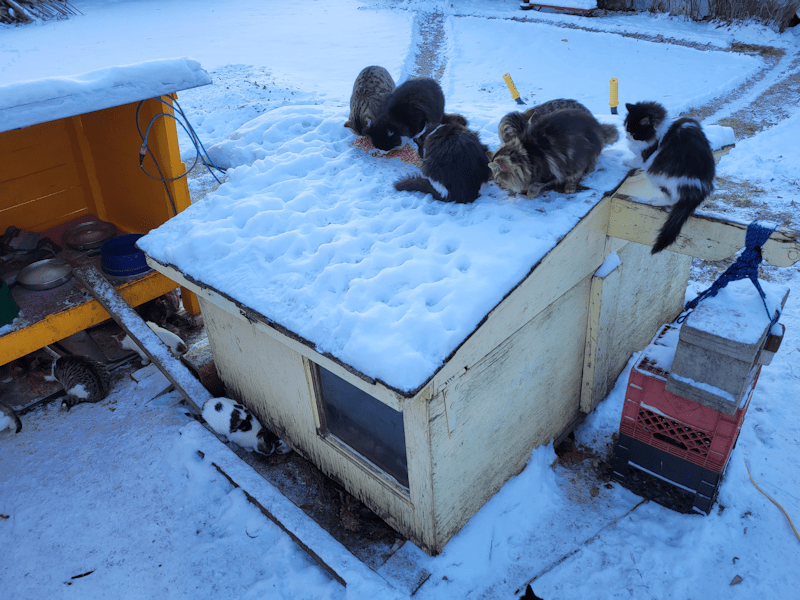
This handsome fella gives it a bit of perspective. I had mostly cleared the cat house roof of snow previously. You can see the warm spot over the ceramic heat bulb! There’s kibble buried under there, and it looks like cats were digging for it. Considering that there was still kibble in most of the food trays, I think maybe they wanted not-frozen kibble? When I shoveled most of the snow off again, I uncovered some of the kibble, and one of the cats was immediately up there, eating kibble out of the snow/slush by the warm spot.
Another perspective shot. This is accumulated snow on the kibble house roof, not just one night. It’s deeper than the height of my kibble container.
Those popcorn containers are the handiest things. The plastic is food safe and super strong.
I had to dig out around the cat shelters before I could finish putting out the kibble and topping up the heated water bowls. The snow seemed to drift right in space in the middle, and even in front of the entry to the cat house, which is probably the most sheltered space, with two overhanging roofs to protect it.
After that, I had to dig my way out of the yard, and a path to the garage. I am so thankful for our neighbour clearing our driveway yesterday! It’s still quite passable, even with the new snow. Of course, snow blown off the garage roof drifted right in front of all the doors, so I cleared a path in front of those. We can now access the side where little Spewie is stored.
We were supposed to reach a high of -6C/21F today, but apparently we’ve already passed it. We’re supposed to cool down slowly through the night, then get a high of -14C/7F tomorrow. After that, we’ll be warming up again. Very mild and pleasant for this time of year. Previous predictions of snow over several days have changed, and now there is no new snow expected for some time. Looks like we got what was expected to fall over several days, all in one night, instead.
We never heard back about the financing for the replacement vehicle yesterday. I will wait until about noon before I try calling the garage to see of they got the answer. I suspect not getting a call means we got turned down for financing. That would be disappointing, but not surprising. The shift to long term disability and losing 40% of my husband’s income ended up messing with his credit score quite a bit – and since neither of us have credit cards, nor any debt other than dipping into my overdraft now and then, we’re not building our credit scores back up again, either.
Well, we shall see.
It sure would be nice to have a reliable vehicle again!
We did eventually warm up to our predicted high of -12C/10F, though it came with wind chills colder than -20C/-4F at times.
When I fed the yard cats in the morning, I counted “only” 24 or 25, including the bitty baby – who never came outside!
You can just make him out through the frost, near the bottom of the window.
Thankfully, the south yard is pretty sheltered from the winds coming mostly from the north. Though we had blowing snow all night, there wasn’t anywhere near as much on the ground as it had looked like there should be. I started shovelling the more sheltered walkways, then got a bit carried away.
I used the tire tracks from when I lasted back up to the house as a guide for where to clear away the snow. You can even see the packed down snow under the tire tracks. I didn’t feel like bringing out the ice chipper to break those up, and the shovel I was using already has a crack in it, so I wasn’t going to bash around with it any more than I had to.
As we warm up over the next week, things should actually start melting a bit, and I want these high traffic areas to clear away completely. I think tomorrow, I’ll keep working to clear the space we use to drive into the yard and turn the vehicle around. I’ll leave the paths around the house, and the fire pit, for the girls to do. They’re planning on getting the fire pit going, just because they can, in the near future.
Meanwhile…
Not too long ago, I was outside again and did the evening feeding.
I counted 30 this time, including the bitty baby. He was in the larger window by himself, and even tried to play with me through it, before going to the entry where the food tray is. He never came out, but he’ll have to if he wants the water. If he had come out, I probably would have snagged him and brought him inside. To be honest, though, the next youngest litter of kittens, being all short haired, are probably colder than he is! It isn’t stopping them from playing in the snow, so their undercoats must be well developed for the winter already.
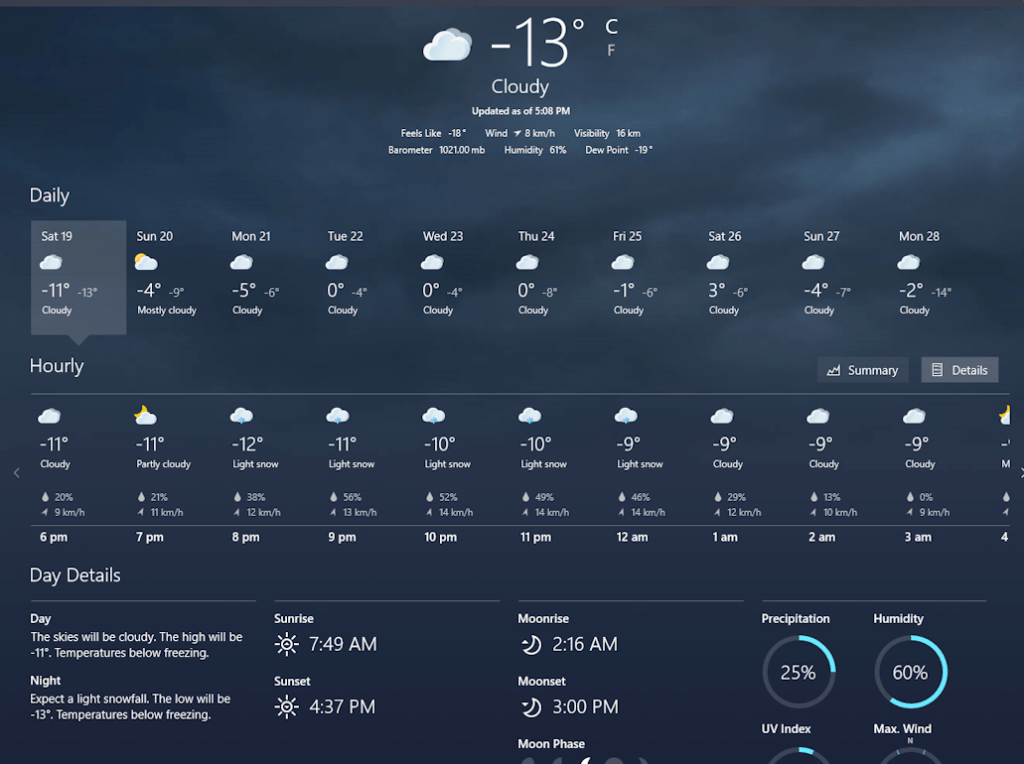
As I write this, it’s -13C/9F, and that’s as cold as we’re supposed to get, including overnight lows, for at least the next 10 days. In fact, the forecast has changed to predict even milder temperatures than before!
Not only are they now predicting three days with highs of 0C/32F, but we’re looking at 3C/37F a week from now! The last time I saw temperatures that high was in the long range forecast, in December.
Of course, it depends on which app I look at. Another app I have shows the first two of those 0C days as reaching 1C/34F, while another shows two days at 0C, then lower temperatures than in the image, though the Saturday is still supposed to be above freezing. All of them are predicting conditions well within average, though.
There is a saying, that a man with two watches, never knows the time. It’s much the same having multiple weather apps! Each company is linked to different data sources, so while one of them might be linked to data from the weather station at the nearest town to the west of us (one that is much closer to the lake, where conditions can be very different from where we are) another might be linked with a station to the north of us (which would probably be the one with conditions closest to what we get here, even though that station would be further away than the others), and yet another might be linked to a station to the south of us.
Well, at least between them all, it gives us a general idea of what to expect. I had been hoping that we might have the roofers coming out during that warm spell we’re supposed to get, but now I’m not so sure. My brother wanted to be here while they are here, and he’s the one that has Power of Attorney for our mother, to make sure they get paid – something my mother would have difficulty understanding how to do anymore. However, he and his wife are currently out of province due to a medical emergency. I got a call from them while they were still on the road, but they should have arrived by now. Hopefully, all will go well, and they will be coming home soon, but I know that they will want to stay there as long as possible, to be able to help. There is going to be a long road to recovery involved. My SIL might be able to stay longer, at least, as she is now officially retired, but not my brother. We are definitely keeping them all in our prayers right now! At least the roads should be good and they should have safe driving.
With my husband’s health, we are well aware of how suddenly everything can be turned upside down. All it takes is a moment. A car accident. A trip and fall. A heart attack or stroke. A bad reaction to medication. One moment, you’re able bodied and doing fine. The next… you’re not. A friend of mine in the disabled community has a term she uses for those who aren’t disabled: TABs. Temporarily Able Bodied. She says it tongue in cheek, but really, she’s right. At some point, we’re all going to start having issues, even if is just from getting old and the body wearing out. Not something we tend to think about while in our prime. For us, after all we’ve been through, we now work on the assumption at, at some point, we’re going to be dealing with stuff like this even more than we are now. So when we plan things like garden beds, or chicken coops, or repairing/replacing sidewalks and doorways, accessibility and mobility needs are part of the plan. I mean, yeah, I can slap together a perfectly functional chicken coop rather quickly, but what good is that, if we don’t have the mobility to get in and clean it? It takes longer to get things done, but at least when they do get done, it’ll be with “age in place” and future mobility needs in mind.
This house will never be fully accessible, though, which is why our long term plans include the possibility of building a smaller, fully accessible, house for my husband and I, while also acknowledging that at some point, we might simply not be able to live here anymore. We may have to move into a place like where my mother lives – but even her building is not fully accessible! They dropped the ball when designing that place, that’s for sure.
I’m digressing, to be sure, and yet this is all very much a part of things we have to think about. What we do with this place now is setting up for the future, for when our daughters will take over and, eventually, my nephew’s sons inherit the property. But even that isn’t written in stone.
Today is the 5th anniversary of all four of us finally being here at the farm today.
I can’t say “moved in”, since we had to put our stuff in storage for almost a month, but aside from that, it was done. We were here!
One of the things we did after spending some time assessing what we’d gotten into, as best we could at the time, was come up with a 5 year plan for what we wanted to accomplish, where we wanted to focus on, and a time line to shoot for.
Boy, did that ever get changed along the way!
Originally, the first two years were going to focus on clearing and cleaning the inner yard. Year one was going to be particularly focused on the maple grove to the west of the house, then year two would see us finish fixing up the inner yard with a focus on the spruce grove. Year three, we would continue working on the spruce grove, but also start moving more focus into the outer yard. By year five, we expected to be able to finish the outer yard. Through all this time, we were also going to work on where we wanted to put in gardens, and year five was going to be our first actual gardening year.
After year five, the inner and outer yards would be done, we could start planting gardens, and also start moving beyond the outer yard to start dealing with things like the car graveyard, junk piles, and so on.
Along the way, as things were cleared and cleaned up, we also kept our minds on where we wanted to plant fruit and nut trees, and other such permanent things.
Well… year one went pretty much to plan.
We got the old kitchen garden cleaned up and started to amend the soil with layers of cardboard, straw, leaves and whatever other organic material we could get.
We got a lot done around the fire pit area and the west yard in general. It took months, and so much progress was made! We even were able to work on the perimeter of the spruce grove, and open things up.
In year two, the clean up continued, and I think it was around then that it became clear we would not be finishing the inner yard – more specifically, the spruce grove – as planned. In fact, we still haven’t finished the spruce grove, and won’t for some time. It’s a much bigger job than expected, and there are a large number of dead spruce trees that need to be cut down.
We did, however, start preparing our first garden area. We also got the retaining wall built at the end of the old kitchen garden. The clean up continued, inside and out, with quite a bit of storm damage to deal with when a blizzard hit us in October. I think the biggest accomplishment was getting that old wood pile area cleaned up – an area that uncovered some of the best soil in the yard.
A lot of work got done in our second year, but for our third year, our focus had to shift. There was no way we were going to be done with the inner yard, though we would have to do more in the outer yard at the same time. Things were getting pretty loosey goosey with our plans.
We still got a lot done. It just didn’t feel like we made much progress.
But, we got a garden in, with squash planted in the bed we’d prepared the year before, new beds made for potatoes, and the old wood pile area became a new garden, too. Our first year gardening was ahead of schedule – and right about the time when suddenly everyone else was starting to garden, too, thanks to the lockdowns and restrictions. We did repairs, patch jobs and replacements. General clean up in the yards continued, and we even got some bulbs planted. Hundreds of them!
Among the more difficult things we had to deal with was my husband’s health. In 2019, he ended up in the emergency room. Things got worse, and he later ended up in the hospital for about three weeks. It wasn’t until 2020 that he finally got into the pain clinic – after 2 years on the waiting list. That was difficult enough, since we were still under lockdowns and restrictions, but the whole thing was really a waste of time. Much like his visits with the cardiac clinic. After all that, right now, he barely even sees our GP, and the last time he had a phone appointment with the cardiac clinic, they never called. I think they’re pissed off at him for refusing to drive all the way to the city so they can make him sit in the waiting room, in pain, until he finally walks out without ever being seen. That’s one down side about moving back to our home province. The health care here is a lot worse than our previous province – though from what I’ve heard, things have gone seriously down hill over there, since we left.
For a lot of people, 2020 was the year from hell. My younger daughter ended up leaving her job at the pharmacy, but at least we had my husband’s disability income unchanged, unlike so many others. Being here on the farm meant very little actually changed for us. Our regular stock up trips and most other outings eventually became just me. I can’t wear a mask and had to deal with a lot of issues, since most places ignored the medical exemptions, never mind the fact that the mandates were illegal in the first place. We basically put our heads down and did the best we could, and counted our blessings.
One thing that did become clear is that we needed to step up on our long term goal of being as self sufficient as possible. Gardening became a higher priority. Our first winters here showed that we also needed to focus on having a stockpile of necessities in case we’re snowed in, etc. Getting chickens and, eventually, other food animals also had to be bumped up the priority list, though plans to build a chicken coop and brooder keep getting foiled.
We did have some fun things happen, though – like having a herd of goats show up at our place! One of which stayed for quite some time. In the end, I just walked over to the owner’s place with a bucket of feed, and the goat followed me.
I think most of us would like to forget 2020 happened, and had high hopes for 2021.
Except 2021 didn’t turn out any better. The illegal restrictions and mandates continued, people continued to have their health and lives destroyed, and we continued to try to keep our heads down and stick to our hermitage as much as possible.
Focus was once again on the garden, which required some creativity, and it was a difficult growing year. It started out well enough, with an early spring that had all sorts of trees blooming. It was very tempting to plant early, and some things, like a mulberry tree sapling we bought, did get planted as appropriate for our climate zone. Then one exceptionally cold night in May killed off so much. That year we had no crab apples, no saskatoons, no chokecherries, and the poor mulberry got killed off.
We expanded the garden by a lot, and it was a constant battle. Drought and heat waves meant watering the garden plots pretty much every day, twice a day. It also meant struggling to protect our garden from hungry and thirsty animals, with deer and groundhogs doing the most damage. We had to watch for racoons, too, though they were more interested in the bird seed and cat food than the garden. And yet, we managed to get a decent amount out of it.
We had plenty of other things to deal with, from van and door fixes, and even tire blow outs, to cat fixes! (Ginger is doing just fine now, and the missing leg isn’t slowing him down at all!) We got more clean up and improvements done around the yards, such as this path we added in the old kitchen garden. We even added to our longer term goals, and I hope to start working on these ones, next year or maybe the year after.
Again, we got a lot done, with all sorts of projects, but it didn’t feel like we made forward progress, other than in the garden.
Then there’s 2022.
Our fifth year here.
I’ll be doing future posts about how the year went, including a gardening review and goal setting, like I did for 2021, so I won’t get into that too much, now.
It did turn out to be another rough year, though after 2021, I don’t think a lot of people expected 2022 to be better. Despite the fact that data around the world has shown that the illegal restrictions and mandates not only didn’t work, but made things worse, our own dictatorial government is talking about bringing them back for this winter. Supply chain problems and increased inflation has been devastating to so many and, being on a fixed income, we’re certainly feeling it, too.
Through we did not have to deal with drought and heat waves this year, we did get a long, drawn out winter, followed by flooding that washed out roads around us in all directions, and more water in our yard than I’ve ever seen before, even when I was a kid growing up here. We did get long term progress done, with finally planting berry bushes and trees.
We expanded the garden so much this year and planted so many different things, we did not have to fight critter damage like last year, and yet we had a much worse growing year than the year before. Over all, I feel like we didn’t really make much forward progress at all, in any area. In fact, in some areas, we’re falling behind. We’ve got aging outbuildings collapsing or falling apart, and no way to replace them. We need to replace our van, as it’s really not worth fixing up anymore, but that’s out of reach now, too. About the only really good thing is that our vandal’s vexatious litigation against us, in response to our getting a restraining order against him approved, finally got thrown out and he didn’t appeal, so we don’t have that hanging over us anymore.
So what can we expect for the next five years? How do we even plan for such an uncertain future?
Well… honestly… the original goals haven’t really changed. They’ve just shifted. We’ve always wanted to live a more self sufficient life, and that’s simply become a greater priority over things like cleaning up the spruce grove or the outer yard.
In the short term, the gardens will continue to expand. We’ve learned a lot in three years of gardening here. We now know that we need to put a priority on things like raised beds and trellises, and that we need to work out how to deal with both drought and flooding, as well as getting around our rocky and nutritionally depleted soil.
We know that we need to work to grow a lot more food, with a lot more varieties, on the assumption that much of what we plant will simply not make it.
We know we need to step up on planting a food forest and other perennials that will feed us – along with things to attract and protect pollinators.
We know we will have to battle critters over the food we grow.
We know that we have to put a priority on getting food animals, even if it’s just a few chickens or meat rabbits – and that we need to be prepared to grow their feed, because we might not be able to buy feed for them.
We know that we can expect to be unable to get out of here for potentially months at a time, whether it’s due to vehicles breaking down or freezing, or roads impassable because of snow or flooding, so we have to be prepared for that. We know we need to keep at least a couple months worth of food, household necessities, and cat supplies, on hand, just in case.
We have been incredibly fortunate in that we have not had any major power failures, but I remember many times when I was a kid, losing power and having to fire up the old wood burning cook stove. That is no longer an option. We can at least cook on the BBQ or the fire pit if necessary, which means that the priority list now includes finding some way to pay for the original well with the hand pump to be repaired, so we will at least have water if the power goes out. Water is our biggest weakness.
We always liked the idea of cooking over the fire pit, but with the first years here having total fire bans, this past summer was the first time we could safely use it for any length of time. We now know we need to come up with an off-grid, outdoor kitchen that we can use at any time of year, whether it’s in the middle of a snow storm in the winter, or if we’re under a fire ban in the summer. This would also be part of bringing back the old idea of having a summer kitchen, to use for canning and preserving, without overheating the house or taking up the kitchen from daily needs.
These past five years have shown us our original goals don’t actually need to be changed. Just the priority list. Yes, it’ll be great to finally have the spruce grove cleaned up, but that is less important than building garden beds and shelters and getting food animals. The goals are not mutually exclusive, though. Since we can’t afford much when it comes to lumber and supplies, we’ll just have to make use of the dead trees we need to cut down in the spruce grove, and we have to clean up around them to do that safely, anyhow.
We just have to keep reassessing and adapting the how and when, but the what has not really changed at all.




 The Re-Farmer